
How to Read a Book: Complete Chapter-by-Chapter Summary
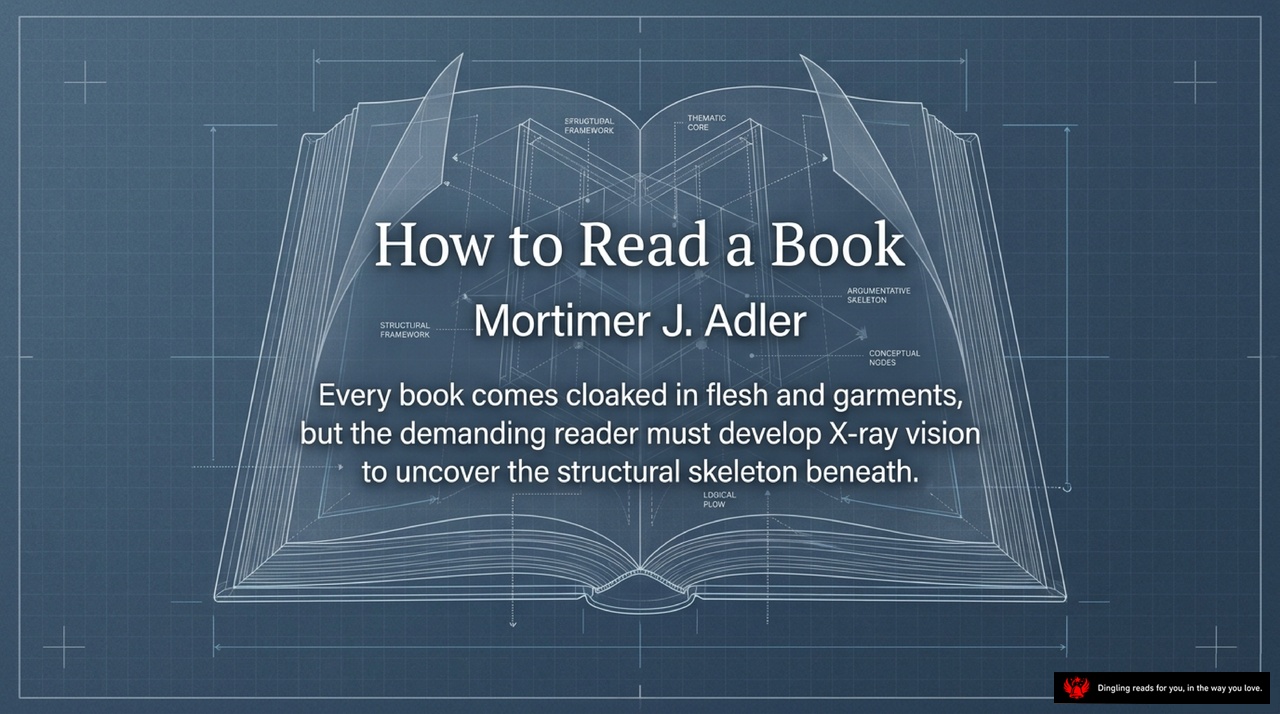
Welcome to the world of active reading. Imagine every book you pick up is wrapped in layers of flesh and garments—beautiful covers, engaging stories, and polished prose. But here's the secret: the true value of a book lies hidden beneath, in its structural skeleton. To get it, you need X-ray vision.
This is the core message from Mortimer Adler's classic, *How to Read a Book*. As Adler reminds us, a demanding reader must look past the surface to uncover the underlying framework. It's not enough to just read words; you must see the logic, the argument, and the core ideas that hold the book together.
Think of reading not as a passive act of consuming information, but as an active collaboration between you and the author. You are the detective, and the book is the crime scene. Your job is to strip away the distractions and find the truth. This mindset shift is the first step toward mastering the art of reading and transforming how you think.
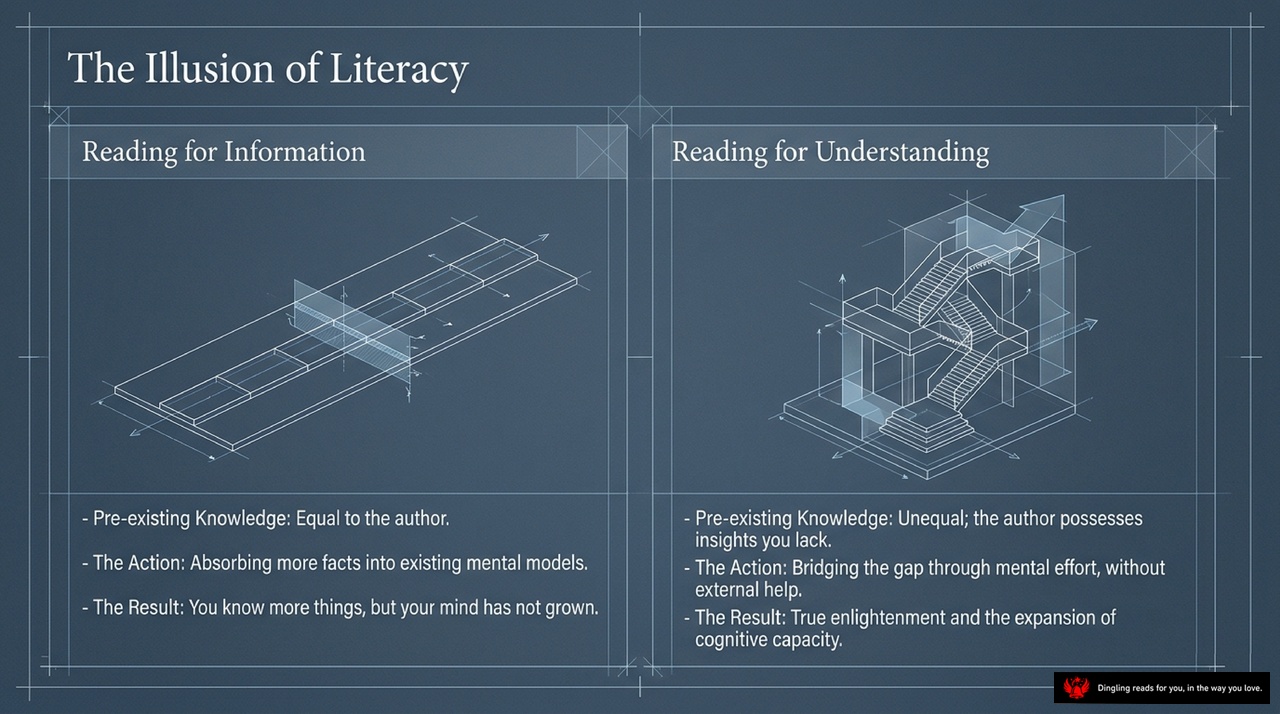
Look at this blueprint-style slide titled "The Illusion of Literacy." It visually contrasts two very different ways we approach books. On the left, we have "Reading for Information," depicted as a flat, linear track. On the right, we see "Reading for Understanding," shown as a complex, multi-level structure with stairs.
The slide highlights a critical distinction in our pre-existing knowledge. When we read just for information, we assume our knowledge is equal to the author's. We simply absorb more facts into what we already know. The result? You know more things, but your mind hasn't actually grown. It's like filling a bucket that's already full.
However, true enlightenment happens on the right side. Here, we admit that the author possesses insights we currently lack. Our knowledge is unequal. The action shifts from passive absorption to bridging that gap through mental effort, without external help. We actively work to understand concepts that are initially fuzzy. The result is the expansion of our cognitive capacity.
This visual perfectly captures the core argument from the book: the difference between being a passive container for facts and an active participant in a dialogue. Real reading isn't about accumulating data; it's about using your own mind to climb those stairs, transforming external information into internal wisdom. It's the shift from just knowing more to actually becoming smarter.

The Mechanics of Active Catching. Think of reading not as passively watching a ball fly by, but as actively catching it. This diagram illustrates the core dynamic between the Pitcher, the Author, and the Catcher, which is you, the Reader.
On the left, we have The Pitcher. The author encodes meaning into words, striving for what the slide calls "perfect control" to articulate a message flawlessly. But here lies the critical gap: the Gap of Understanding. This is where the real work happens. The message itself, labeled as The Ball, is a dense geometric sphere of information flying across that gap. It's not just text; it's a complex object of thought.
Now, look at the right side: The Catcher. The slide makes a powerful point here. The catcher must exert equal energy to stop the ball. The art of catching dictates the success of the pitch. This means if the author throws a difficult, nuanced idea, you cannot simply stand still. You must engage. Passive reading is a myth. If you just let the ball bounce off you, you miss the complete message.
The text at the bottom reinforces this: the reader who demands more from themselves and the text is the one who catches the full meaning. So, don't just watch the author throw; step up, exert that energy, and catch the idea. That is the true mechanics of reading.

The Active Reader's Checklist isn't just a graphic; it's a blueprint for how we actually engage with text. Think of this slide as your navigation system for any book you pick up.
First, look at **The Whole**. That map icon represents your first responsibility: asking, "What is this book about as a whole?" You need to step back and discover the core theme and see how the author systematically develops it. Without this big-picture view, you're just wandering in the dark.
Next, zoom in on **The Detail**. The microscope symbol reminds us to look closer. What exactly is being said, and how? You need to isolate the main ideas, assertions, and arguments. It's about understanding the mechanics of the author's thought, not just skimming the surface.
Now, consider **The Truth**. The scales of justice here are crucial. This isn't about blind acceptance; it's about asking, "Is the book true, in whole or part?" But here is the key: suspend your judgment. Don't decide if the author is right or wrong until you have fully answered the first two questions about the whole and the details. Premature judgment kills understanding.
Finally, ask **The Significance**. That compass icon asks, "What of it?" If a book offers information, you must ask why it matters. If it enlightens you, dig deeper into the broader implications. How does this connect to your life? Why should you care?
These four steps—The Whole, The Detail, The Truth, and The Significance—form a complete cycle. They transform you from a passive receiver of information into an active partner in a dialogue with the author. Mastering this checklist is the difference between just reading words and truly gaining wisdom.

Imagine reading not as a passive act of consuming words, but as a four-tiered pyramid of active engagement. At the very base, we have Elementary Reading. This is the foundation where we answer the simple question: "What does this sentence say?" It's about mastering vocabulary and basic literacy, the essential skill every child develops to move from not reading to actually reading.
Moving up the pyramid, we hit Inspectional Reading. This is the layer of efficiency. Here, we ask, "What is this book about?" It's a systematic skimming technique designed for time constraints. Instead of getting lost in details, you learn to quickly judge a book's value and structure by looking at the title, table of contents, and index. It's your first real step into understanding how to navigate a text without getting overwhelmed.
The third level is Analytical Reading, the heart of deep understanding. This is where we ask the critical questions: "What does it mean, and is it true?" Here, you chew and digest the text, analyzing the author's logic and arguments to truly grasp their ideas. It's a complete, slow, and thorough conversation with the author.
Finally, at the very peak, sits Syntopical Reading. This is the most complex and active level. We ask, "How do multiple books relate to this subject?" Instead of serving a single author, you become the master of your own research. You read many books on a specific topic, compare their viewpoints, and construct your own analysis of the subject. This is where you stop being a servant to the text and start building your own knowledge system.
These four levels aren't separate; they build on each other. You can't do analytical reading without the basics of elementary reading, and you can't do syntopical reading without the skills of inspectional reading. Mastering this pyramid transforms you from a consumer of information into an architect of your own mind.

Welcome to Chapter 5, where we shift gears from mastering a single book to navigating a whole library. This is the realm of specialized reading: literature, history, science, and philosophy.
Think of interpreting fiction as stepping inside a new world. You aren't there to judge the plot against your own life; you are there to live it. Read the story as fast as you can, immerse yourself in the characters' thoughts and actions, and only then can you offer a fair critique. For classics like Homer's epics, you must give your full attention. With plays, imagine the stage yourself—be the director, hearing the tone and seeing the action in your mind.
Now, look at non-fiction. Reading science or philosophy isn't about memorizing facts; it's about understanding the problem the author is trying to solve. In science, distinguish between the author's assumptions and their final conclusions. Don't fear the math; view it as a precise language that removes emotional bias. If the formulas get too dense, skip the heavy calculations and focus on the logic and the results.
Philosophy and social science require a different mindset. You need to catch the author's central question, which might be hidden in the text. Watch out for specialized vocabulary that differs from everyday usage. In social sciences, always be alert to the author's potential biases.
The golden rule for all these genres? Don't let your own prejudices cloud your judgment. Whether you are analyzing a novel, a scientific theory, or a philosophical argument, your goal is to truly understand the author's perspective before you decide whether to agree or disagree. Read to learn their world, not just to confirm your own.

Welcome to the final stage of our analytical journey: Subject Reading. This is the most complex, yet the most powerful, level of reading we've discussed. While previous levels focused on understanding a single book—whether by skimming for the main idea or analyzing its structure—subject reading flips the script. Here, you are no longer the servant of a single author. Instead, you become the master of your own theme.
Think of it this way: you stop asking, "What does this book say?" and start asking, "What can this book say about my specific topic?" In subject reading, you gather multiple books around a central theme, like "love" or "progress," and treat them all as raw materials for your own research. You aren't just collecting facts; you are building a new, integrated understanding that might not exist in any single book.
But how do you do this without getting lost in a sea of conflicting opinions? The process follows five clear steps. First, locate the relevant chapters across all your books. You don't need to read every word; just find the parts that speak directly to your theme. Second, establish a common vocabulary. Different authors use different words for the same concept, or the same word for different things. You must translate their unique language into a shared framework so you can compare them fairly.
Next, clarify the key questions. What specific questions does your theme raise? Ensure every author you've gathered answers these same questions, even if they haven't addressed them directly. Then, define the issues. Where do the authors agree? Where do they clash? Group their views to see the full landscape of the debate. Finally, analyze and synthesize. Don't just list their arguments; explain the differences, the reasons behind them, and the context of their views.
Crucially, you must remain objective. This isn't about proving your own point right. It's about presenting a balanced, dialectical view of the entire conversation. You are the editor of this intellectual symposium, ensuring every voice is heard fairly. By mastering subject reading, you transform from a passive consumer of information into an active creator of knowledge, capable of navigating complex ideas and forming your own wisdom.

Calibration by Genre isn't just a fancy term; it's the secret to unlocking the true potential of any book you pick up. Think of reading not as a one-size-fits-all activity, but as a tailored experience where your strategy changes based on what's in front of you.
First, look at the three columns here: Practical Books, Theoretical Books, and Imaginative Literature. Each demands a completely different approach. If you're holding a Practical Book, the author's goal is to prescribe action, rules, or behavior. Your core question becomes simple: "What is the author's ultimate objective?" And if you agree with that goal, your obligation is clear—you must act. Reading these books is about changing your behavior in the real world.
On the other hand, if you're diving into a Theoretical Book, the author is trying to prove that something is true. Here, you aren't looking for instructions on how to do something, but rather evidence for a claim. Your core question shifts to: "What are the primary propositions?" Your job isn't just to understand the argument, but to adjust your mental models. You must update how you see the world based on the new truths the author presents.
Finally, consider Imaginative Literature. The goal here isn't to teach you a skill or prove a fact, but to recreate a specific experience. The author wants you to feel what they felt. So, your core question becomes: "What is the plot or narrative arc?" Your obligation is the most challenging yet: you must inhabit the author's created world without judgment. You can't critique the magic or the setting as if they were real; you have to suspend your disbelief and fully immerse yourself in the story.
By calibrating your reading method to the genre, you stop fighting the text and start collaborating with the author. Whether you are acting on advice, updating your worldview, or living a new life through a story, matching your reading strategy to the book's purpose is the key to deeper understanding and real growth.
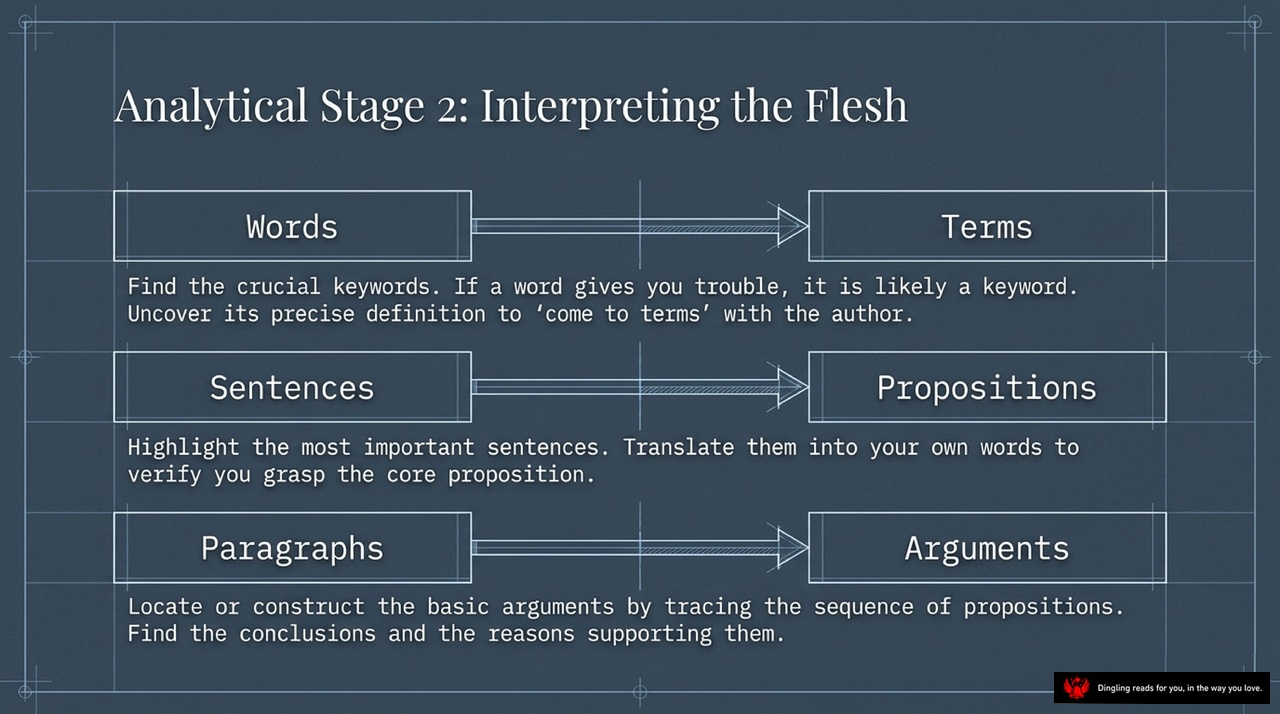
Welcome back. Today, we're diving into the second stage of our analytical reading process: Interpreting the Flesh. Think of this as moving from looking at the raw materials to actually understanding the structure of the book in front of you.
This slide breaks down exactly how we transform the text on the page into meaningful knowledge. It starts at the smallest unit: Words. The text reminds us to find those crucial keywords. If a word gives you trouble, it's likely a keyword. Your job is to uncover its precise definition to truly "come to terms" with the author. You can't just accept words at face value; you need to agree on what they mean before moving forward.
Next, we move up to Sentences. Here, we highlight the most important sentences and translate them into our own words. Why? To verify that we actually grasp the core proposition the author is making. It's about checking your understanding in real-time.
Finally, we look at Paragraphs. This is where we locate or construct the basic arguments. By tracing the sequence of propositions, we find the conclusions and the reasons supporting them. Essentially, you are building the logical skeleton of the book, turning a collection of paragraphs into a coherent argument.
So, to recap: we start by defining terms, then we verify our grasp of the main ideas, and finally, we map out the logical arguments. This systematic approach ensures you aren't just skimming; you are truly interpreting the flesh of the text.

Welcome back to our deep dive into analytical reading. Today, we are focusing on a critical checkpoint often missed by casual readers: the "Gatekeeper."
As the slide illustrates, before you can ever judge an author, you must first pass through this gate by confidently stating, "I understand." This is the non-negotiable rule of intellectual integrity. You cannot criticize, agree, or disagree with a text until you have truly grasped its argument. Jumping to judgment before comprehension is the fastest way to waste your time and the author's effort.
Once you've cleared that gate, the slide presents a rigorous framework for disagreement. If you do find yourself disagreeing with the author, you are not free to simply say so. You must prove that the author falls into one of four specific categories. First, they might be **Uninformed**, lacking the relevant knowledge or facts necessary to support their claim. Second, they could be **Misinformed**, asserting facts that are simply untrue. Third, they may be **Illogical**, committing fallacies in their reasoning or contradicting themselves within the text. And fourth, they might be **Incomplete**, failing to solve the very problem they set out to address.
The slide emphasizes a crucial note at the bottom: if you cannot prove any one of these four flaws, you must agree with the author. This isn't about forcing agreement; it's about ensuring your critique is constructive and grounded in evidence rather than personal preference. By adhering to this structure, you transform reading from a passive act of consumption into an active, disciplined dialogue where truth is the only goal.
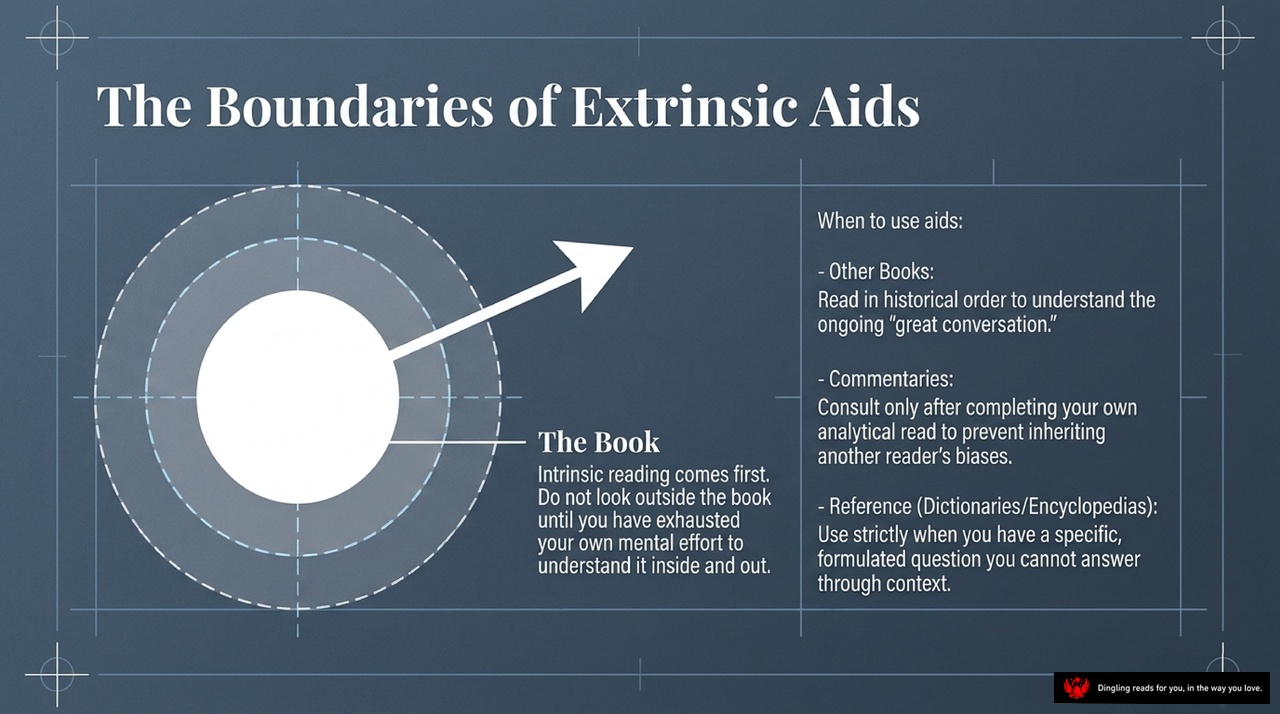
Let's talk about when—and when not—to reach for external help while reading. This slide, "The Boundaries of Extrinsic Aids," gives us a clear rule: start with the book itself. Before you look outside, you must exhaust your own mental effort to understand the text inside and out. Think of the book as the core; everything else is just a layer around it.
So, when is it okay to use aids? First, consult other books, but only in historical order. You need to read the earlier works first to understand the ongoing "great conversation" that shaped the author's ideas. Second, use commentaries or guides, but strictly after you've completed your own analytical read. If you jump to them too early, you risk inheriting another reader's biases instead of forming your own. Finally, turn to reference materials like dictionaries or encyclopedias only when you have a specific, formulated question you genuinely cannot answer through context. Don't use them just to skip over difficult words.
The goal isn't to avoid help entirely, but to ensure you've done the hard work first. Only after you've wrestled with the text yourself should you look outward for clarification. This approach ensures that the knowledge you gain is truly yours, not just borrowed.
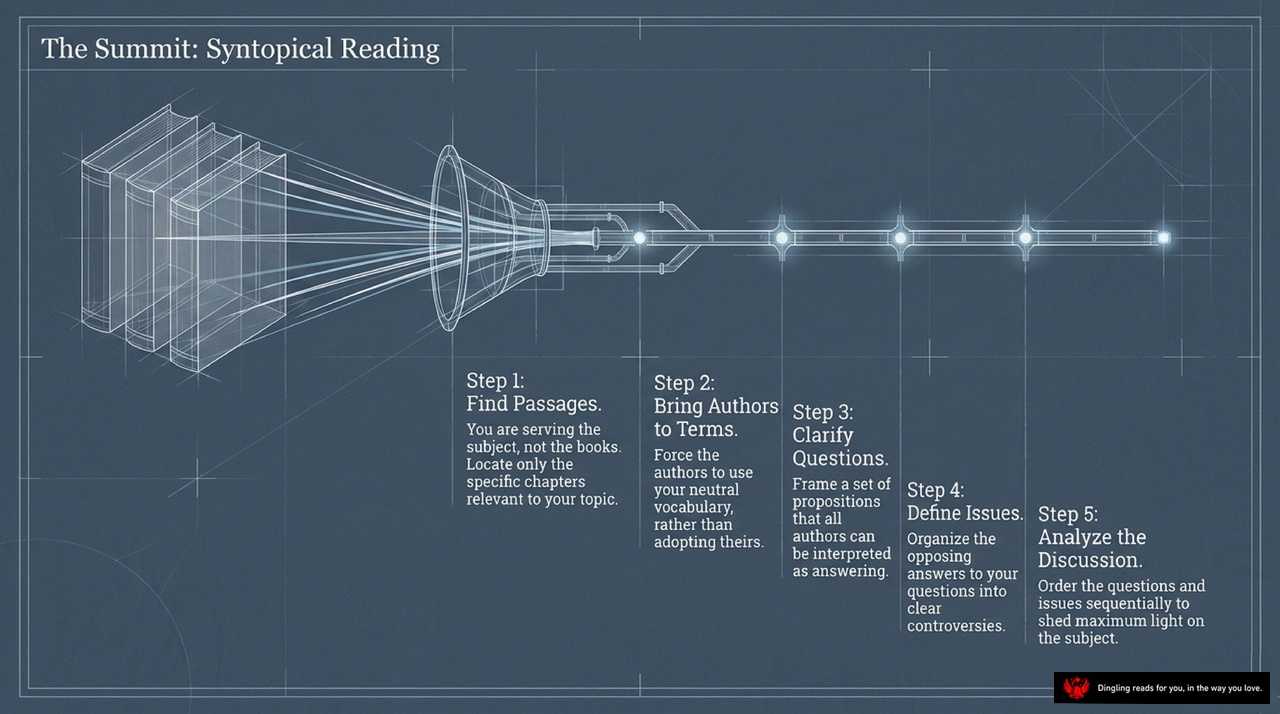
Welcome back. Today, we're moving from understanding individual books to mastering the art of comparing them. This is what we call **Syntopical Reading**, or thematic reading. Imagine you are no longer a servant to a single author, but the master of your own research topic. You are bringing multiple authors together to answer the questions *you* have created.
The process is visualized here as a funnel. On the left, you have multiple books. You aren't reading them cover-to-cover; instead, you are extracting specific passages relevant to your topic. These passages flow into a funnel where you force the authors to speak the same language. This is **Step 2: Bring Authors to Terms**. You strip away their unique vocabulary and find a neutral, common vocabulary so you can compare them fairly.
Once the language is unified, you move to **Step 3: Clarify Questions**. You frame a set of propositions that all these authors can interpret as answering. You are organizing the opposing answers into clear controversies. For example, if you are researching "progress," you don't just read about it; you ask, "Is progress inevitable?" and let every author you've read answer that specific question.
Next, **Step 4: Define Issues**. Here, you organize those opposing answers into clear controversies. You identify where they agree and where they disagree. You are not trying to find the "right" answer yet; you are simply mapping the landscape of the debate.
Finally, **Step 5: Analyze the Discussion**. You order these questions and issues sequentially to shed maximum light on your subject. This is where the real work happens. You are no longer consuming information; you are synthesizing a new understanding that likely doesn't exist in any single book you've read.
Remember, in this stage, you serve the subject, not the books. You are building a system of knowledge from the ground up, creating insights that are greater than the sum of their parts.
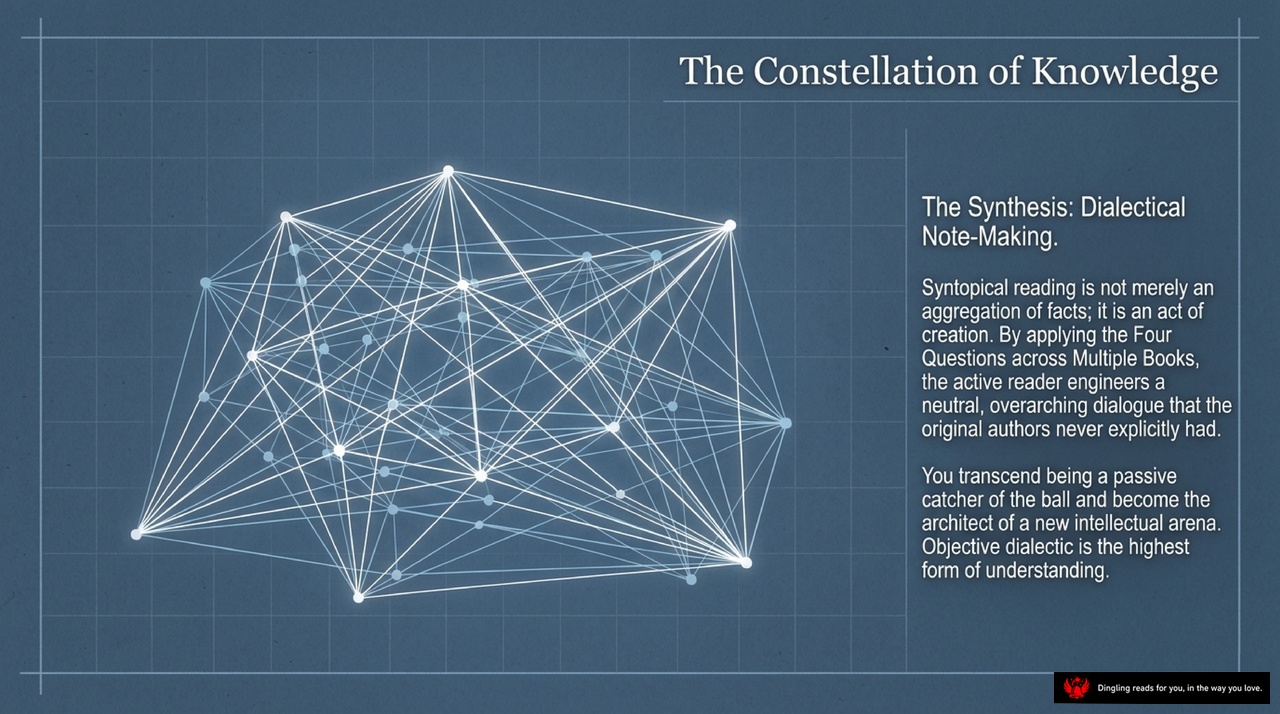
The Constellation of Knowledge isn't just a metaphor; it's the ultimate goal of how we should read. As the slide illustrates, true understanding comes from Synthesis: Dialectical Note-Making. This means moving beyond simply collecting facts or passively receiving information. Instead, you become the active architect of your own mind.
By applying the Four Questions across multiple books, you engineer a neutral, overarching dialogue that the original authors never explicitly had. You stop being a passive catcher of the ball and start building a new intellectual arena where ideas from different sources connect and spark something entirely new. This is what objective dialectic looks like in practice.
The text reminds us that syntopical reading is an act of creation, not just aggregation. When you synthesize different perspectives, you transcend the limitations of any single book. You aren't just summarizing what others said; you are integrating their arguments to form a comprehensive truth that stands on its own. This is the highest form of understanding. So, don't just read to memorize. Read to connect, to question, and to build a knowledge network that is uniquely yours.

To read well is to stop treating books like passive databases and start treating them as active partners in your intellectual growth. As the slide suggests, true reading isn't about accumulating facts; it's about forcing your mind to stretch, adapt, and elevate to the level of the author. If you only read what you already easily understand, your brain never gets the workout it needs to grow.
Think of a great book as something that remains just out of your reach initially. It challenges you to bridge the gap between your current understanding and the author's deeper insights. This struggle is where the real learning happens. You aren't just absorbing information; you are actively engaging in a dialogue across time and space. You must question the text, analyze the logic, and ultimately integrate those ideas into your own worldview.
So, the next time you pick up a book, ask yourself: Am I just scanning for easy answers, or am I actively pursuing a deeper understanding? Don't settle for comfort. Embrace the challenge of difficult texts, because that is exactly where your mind will expand.