
How To Think Straight about Psychology: Complete Chapter-by-Chapter Summary
Welcome to today's book share. We're diving into "How to Think Straight About Psychology" by Keith E. Stanovich.
Let's be honest, most of us have a pretty fuzzy idea of what psychology actually is. We've been fed a lot of pop-psychology myths—think Freud's old theories or those "magic" self-help tips that sound good but don't hold up under scrutiny.
But here's the thing: real psychology is a science. It's not about guessing or following intuition. It's about evidence, rigorous testing, and separating fact from fiction.
This book is a definitive guide to doing exactly that. Stanovich shows us how to distinguish genuine psychological science from the illusions of pop psychology and pseudoscience. It's about learning the tools to think critically about the world around you.
So, if you want to stop being a victim of bad advice and start understanding how the human mind really works, you're in the right place. Let's get into it.

Welcome back. Today, we're diving into a critical distinction: what psychology looks like in the popular imagination versus what it actually is in the real world. Look at this slide. It's split right down the middle. On the left, we have "The Grand Illusion." On the right, "The Data-Driven Reality."
Let's start with the illusion. The left side shows a classic psychoanalysis couch, surrounded by zodiac signs, a crystal ball, and self-help books like "Mind Power" or "The Secret Key." This is the image most of us have. We think psychology is all about Freud, intuition, and pop-psychology gurus. But the text tells us this is a "Grand Illusion." Public perception is hijacked by the "Freud Problem." Even though Freud's work relies on unverified case studies rather than empirical observation, it still defines the public's understanding. However, here's the hard truth: his work represents less than 5% of modern psychological research. It's a tiny sliver of what we actually know.
Now, look at the right side. This is the "Data-Driven Reality." Modern psychology is actually a rigorous, diverse scientific enterprise. It's not just one theory; it encompasses 54 distinct divisions, from behavioral neuroscience to cognitive psychology. The badge on the slide highlights these "54 APA Divisions." This diversity is united by a single trait: the relentless use of the scientific method to understand human behavior.
Notice the imagery on the right. Instead of a couch, we see a centrifuge, brain scans, and statistical graphs. This represents the tools of modern science. It's about data, not just stories. It's about rigorous testing and evidence. While the "Grand Illusion" makes us think psychology is a collection of unverified guesses, the "Data-Driven Reality" shows it's actually a massive, evidence-based field.
So, why does this matter? Because understanding this shift is key to appreciating how we truly understand the human mind today. We need to move past the pop-culture version and embrace the actual science. It's about distinguishing between the "Grand Illusion" and the "Data-Driven Reality" to get the facts straight. When we realize that the 5% of Freudian theory isn't the whole story, we can appreciate the vast, 54-division landscape of actual psychological science. It's about moving from the "Grand Illusion" of intuition to the "Data-Driven Reality" of evidence. This shift is what separates true science from the myths we often believe.
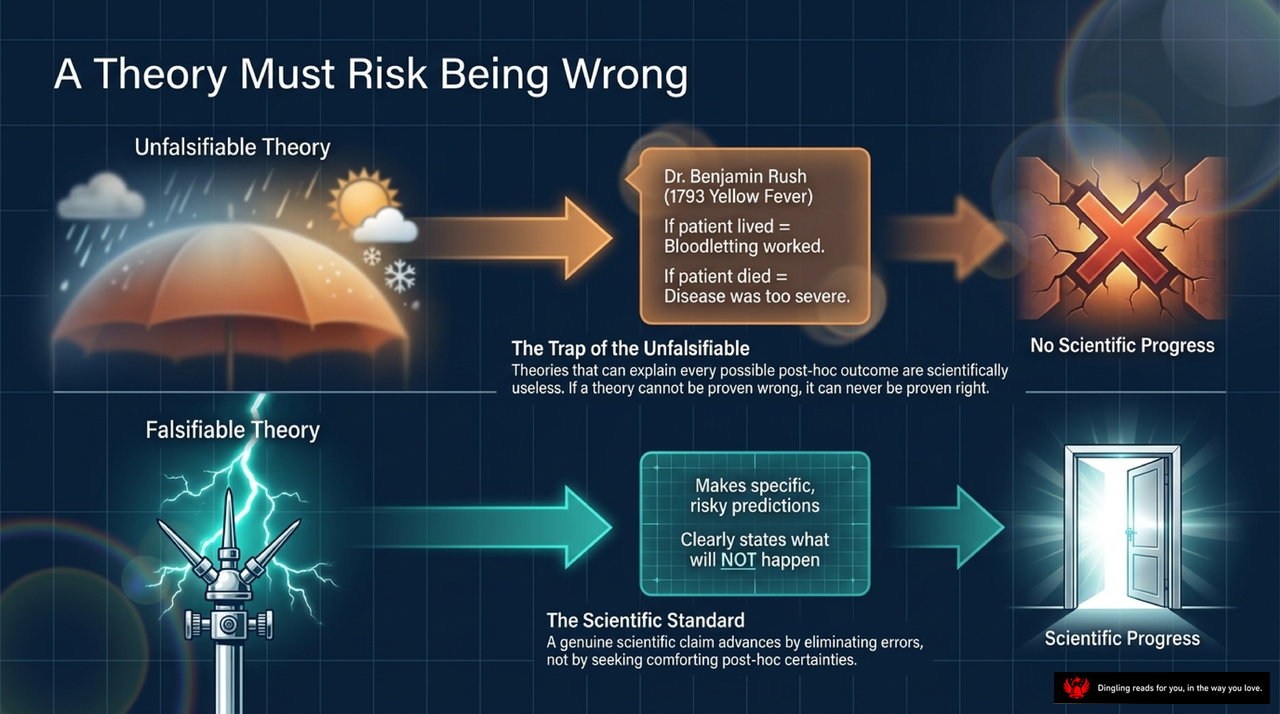
So, what makes a theory actually scientific? The slide says it clearly: A Theory Must Risk Being Wrong.
Let's look at the top path first. We have an Unfalsifiable Theory. Imagine an umbrella that protects you from rain, sun, and snow all at once. It sounds perfect, but because it explains every possible outcome, it actually proves nothing.
Let's look at a real historical example from the text. Dr. Benjamin Rush in 1793 believed bloodletting cured yellow fever. He had a logic trap: If the patient lived, the bloodletting worked. If the patient died, the disease was just too severe.
See the problem? He could explain any result. If the patient survived, he claimed the cure worked. If they died, he blamed the severity of the illness. Because he could explain every outcome, the theory was scientifically useless. This is The Trap of the Unfalsifiable. Theories that can explain every possible post-hoc outcome are scientifically useless. If a theory cannot be proven wrong, it can never be proven right. It leads to No Scientific Progress, shown by that cracked wall with the big X.
Now, let's look at the bottom path. This is the Falsifiable Theory. It's represented by this lightning bolt. Real science requires The Scientific Standard. A genuine scientific claim advances by eliminating errors, not by seeking comforting post-hoc certainties.
This means a theory must make specific, risky predictions. It must clearly state what will not happen. Look at the box: Makes specific, risky predictions. Clearly states what will NOT happen.
Think about Einstein. He didn't just say gravity exists. He predicted light would bend around the sun. If observations showed light did not bend, his theory would be destroyed. That risk is what drives progress.
When we make these risky predictions and they hold up, we advance. When they fail, we eliminate the wrong path. That's how we move from uncertainty to the open door on the right, labeled Scientific Progress.
So, remember this core lesson: A theory that tries to explain everything explains nothing. True science isn't about being right all the time; it's about being willing to be wrong so we can learn. That's the only way to actually move forward. This is why we need to embrace the possibility of being wrong. It's the engine of discovery.
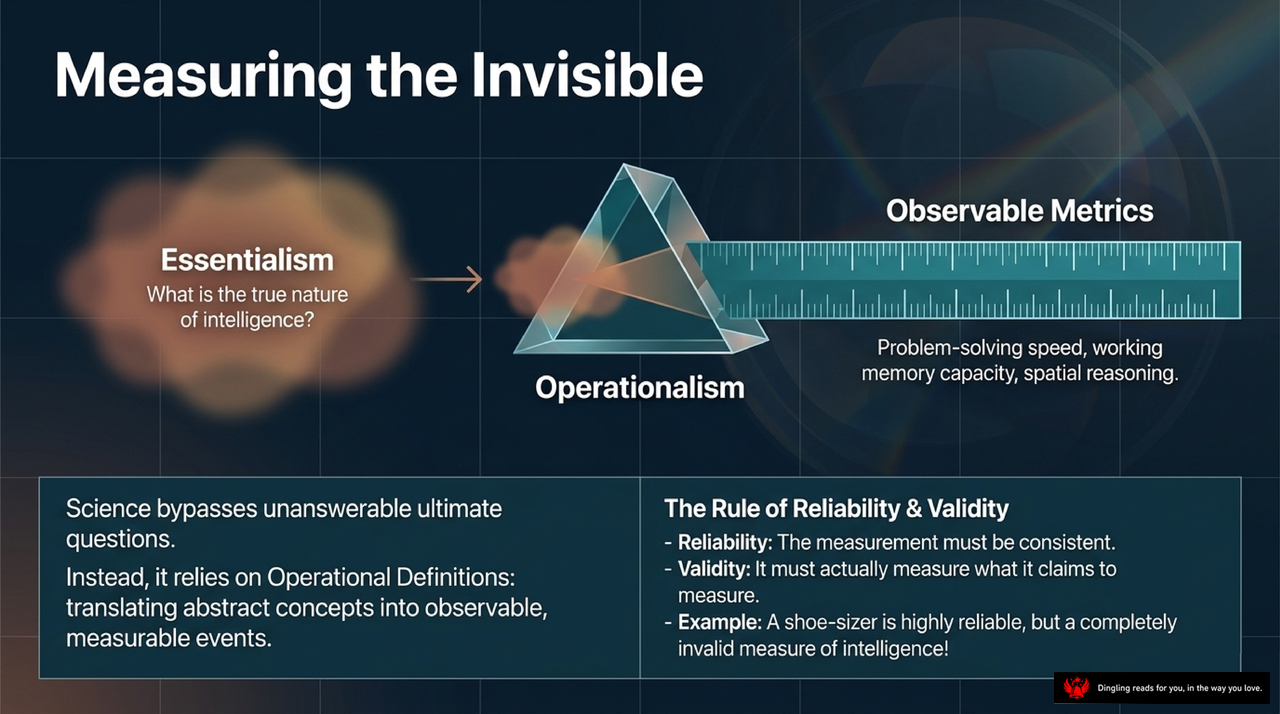
Let's talk about how we actually measure things in science. Have you ever stopped to think about how we quantify something as abstract as intelligence? We can't hold it in our hands, but we rate it constantly in schools and workplaces. This slide, 'Measuring the Invisible,' breaks down exactly how science tackles this problem.
On the left, you see the concept of Essentialism. This is the philosophical desire to know the 'true nature' of intelligence. It asks, 'What is it really?' But in science, chasing these ultimate, unanswerable questions often leads nowhere. It's like trying to define the color of a sound.
So, how do scientists move forward? They switch to Operationalism. This is the core logic of scientific progress. Instead of asking 'what is it?', we ask 'how do we measure it?' We translate abstract concepts into observable, measurable events.
Look at the 'Observable Metrics' on the right. We don't measure intelligence directly. We measure proxies. We measure problem-solving speed, working memory capacity, or spatial reasoning. These are concrete, countable things. This is the power of Operational Definitions. Science bypasses unanswerable ultimate questions. Instead of arguing about definitions, we define things by what we do to measure them. This is a huge shift. It means we stop trying to define the soul of intelligence and start measuring its behavior.
But here's the critical part. Just because we can measure something, does it mean we're measuring the right thing? This brings us to the bottom right section: The Rule of Reliability and Validity.
Reliability is about consistency. If you measure someone's intelligence today and tomorrow, do you get the same result? Think of it like a bus arriving on time every day. A reliable tool gives consistent data. If the numbers jump around randomly, the tool isn't reliable.
But consistency isn't enough. You also need Validity. Does the tool actually measure what it claims to measure?
The slide gives a perfect, funny example: A shoe-size. A shoe-size is highly reliable. If you measure your foot twice, you get the same size. It's consistent. But is it a valid measure of intelligence? Absolutely not. Just because it's consistent doesn't mean it's accurate for what we care about. It's like using a ruler to measure how hungry you are.
So, in science, we need both. We need our tools to be consistent, and we need them to actually capture the phenomenon we're studying.
This shift from asking 'what is it?' to 'how do we measure it?' is what allows psychology to be a science. It moves us from philosophy to evidence. It allows us to test ideas, refine our tools, and eventually, understand the invisible by making it visible through data. Without this, we'd just be guessing. This is the foundation of all scientific inquiry.
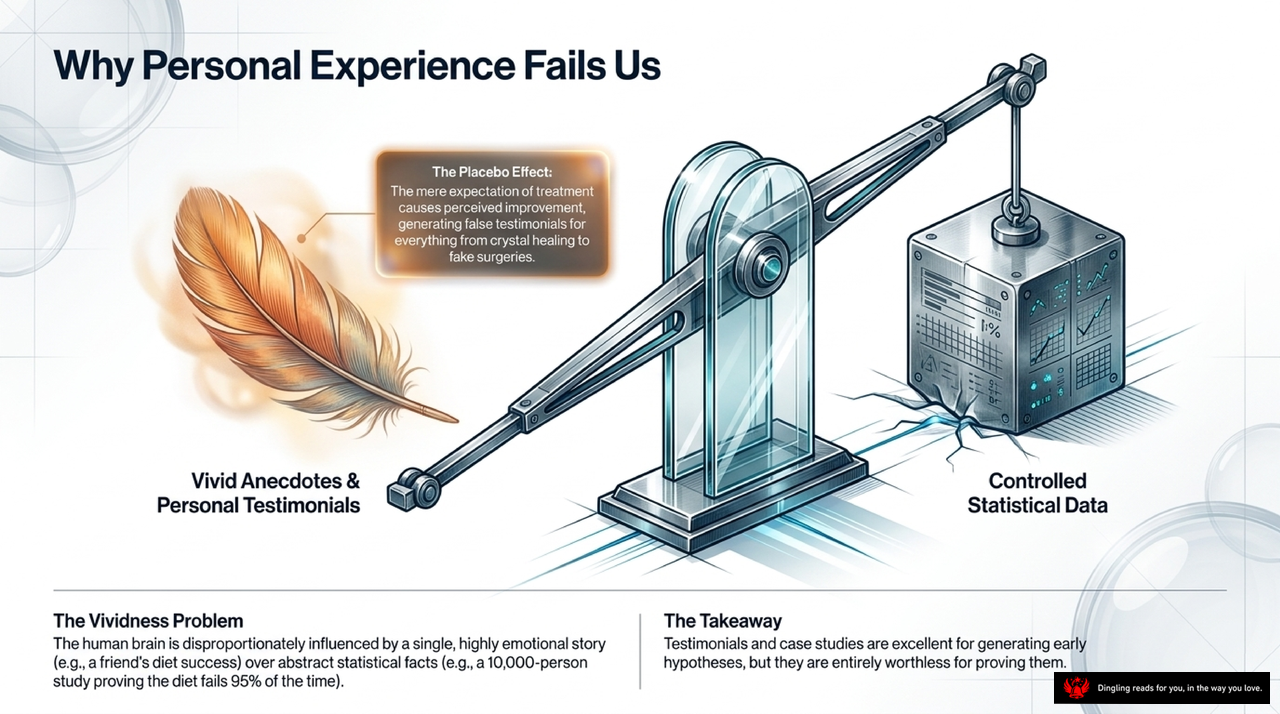
Welcome back. Today we're tackling a critical question: Why does personal experience often lead us astray? Look at this balance scale. On one side, we have vivid anecdotes and personal testimonials. On the other, we have controlled statistical data. The visual tells us something powerful: the side with the stories feels lighter, yet it often tips the scale of our beliefs.
Think about the placebo effect. We often believe something works simply because we expect it to. That's why false testimonials pop up everywhere, from crystal healing to fake surgeries. Just because a friend says a diet worked doesn't mean it's true. Our brains are wired to prioritize emotional stories over abstract facts. We remember the one friend who lost weight, ignoring the study showing that diet fails 95% of the time. This is the vividness problem.
Consider how we make decisions. We panic over airplane crashes because they are vivid, even though we die more often in car accidents. The data is there, but it lacks emotional punch. This bias makes us vulnerable to pseudoscience. A single success story can sell a miracle cure, even if the controlled data shows it's useless.
So, what's the takeaway? Testimonials are great for generating early ideas or hypotheses. They help us ask the right questions. But they are entirely worthless for proving the truth. To know what actually works, we need controlled statistical data. We need to move beyond the feather and trust the weight of the evidence. Don't let a single story convince you of a universal truth.
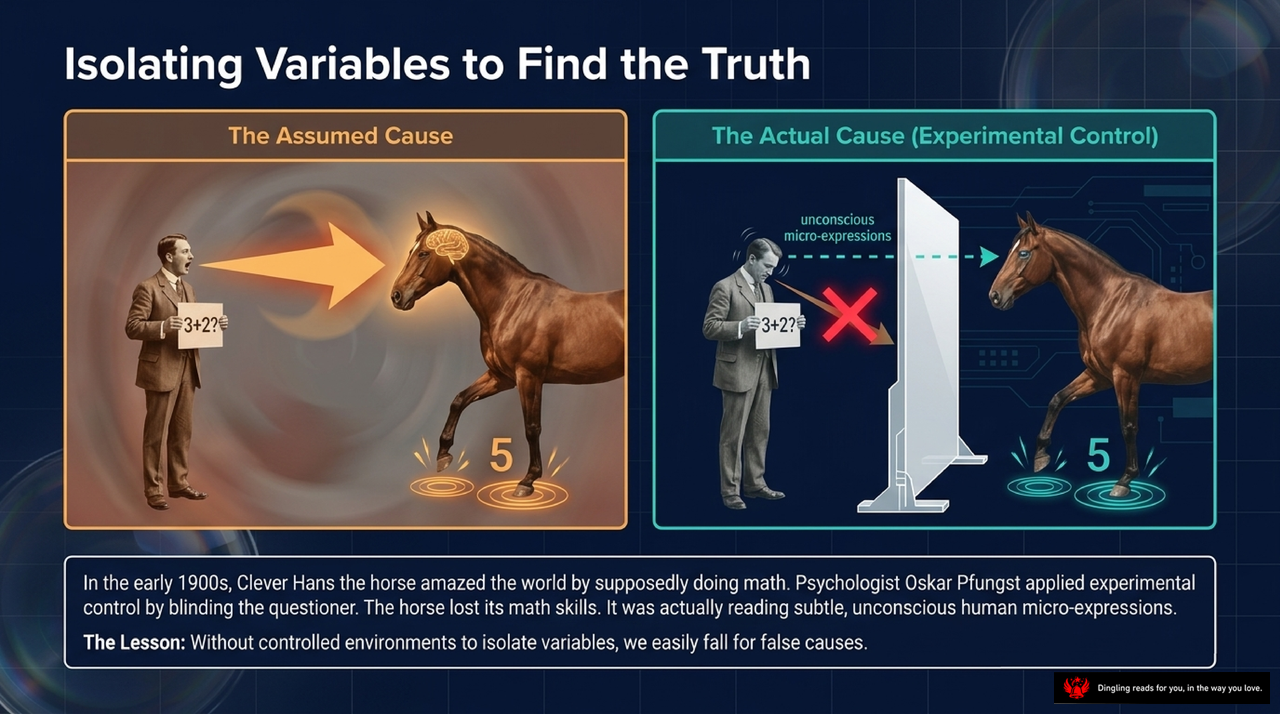
Imagine a horse that can solve math problems. In the early 1900s, Clever Hans was the global sensation. He'd tap out answers like three plus two equals five. Everyone assumed the horse was actually calculating. That's what this left side shows: the assumed cause. It looked like magic, a direct link between the question and the horse's brain.
But the truth was much more subtle. Psychologist Oskar Pfungst applied experimental control to find out. He put a screen between the horse and the trainer. When the trainer didn't know the answer, Hans failed. But when the trainer knew, Hans succeeded.
The actual cause wasn't math. It was the trainer's unconscious micro-expressions. The horse was reading the trainer's subtle head movements or relaxation when the answer was right. It wasn't intelligence; it was a trick of perception.
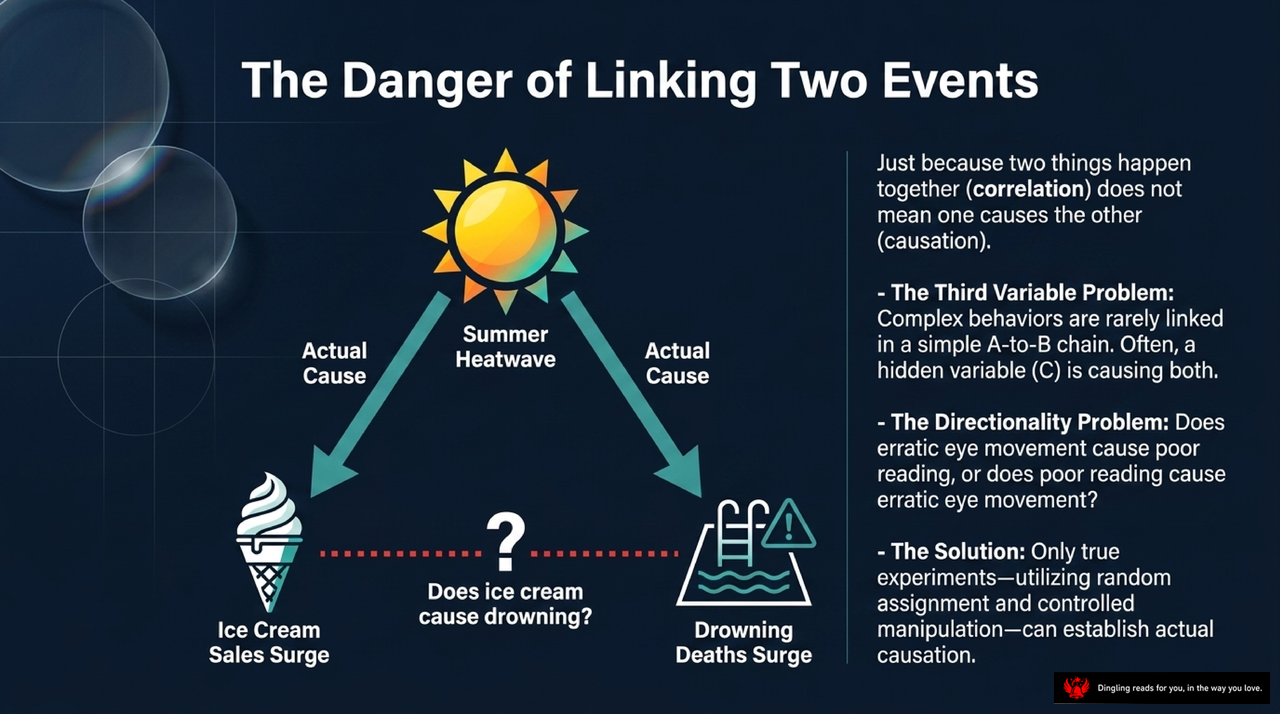
This story teaches us a critical lesson about science. Without controlled environments to isolate variables, we easily fall for false causes. We see a correlation and assume causation. But in reality, there are hidden factors at play.
Think about your own life. You might think your morning coffee makes you productive. But maybe it's just the time of day. Or maybe you're just feeling good because you slept well. Without isolating variables, we mistake coincidence for cause.
True scientific thinking requires us to strip away the noise. It's about separating the variables so we can see what actually drives the result. Whether it's a horse or human behavior, the only way to find the truth is to control the experiment and look past the obvious assumptions.
Remember, the lesson is clear: without controlled environments to isolate variables, we easily fall for false causes. So next time you see something that seems too good to be true, ask yourself: what variables am I missing? And how can I control the environment to find the actual cause?
This is the power of isolating variables. It turns intuition into evidence. It turns guesswork into science. It's the difference between believing a myth and understanding reality.
In psychology, just like in this experiment, we must be willing to challenge our own assumptions. We need to separate the signal from the noise. Only then can we truly understand how the world works, rather than just how we think it works.
Think about the news you read or the advice you take. Often, it's based on stories, not data. This slide reminds us that the truth is often hidden behind the obvious. By controlling what we see and isolating the variables, we stop being fooled by illusions.
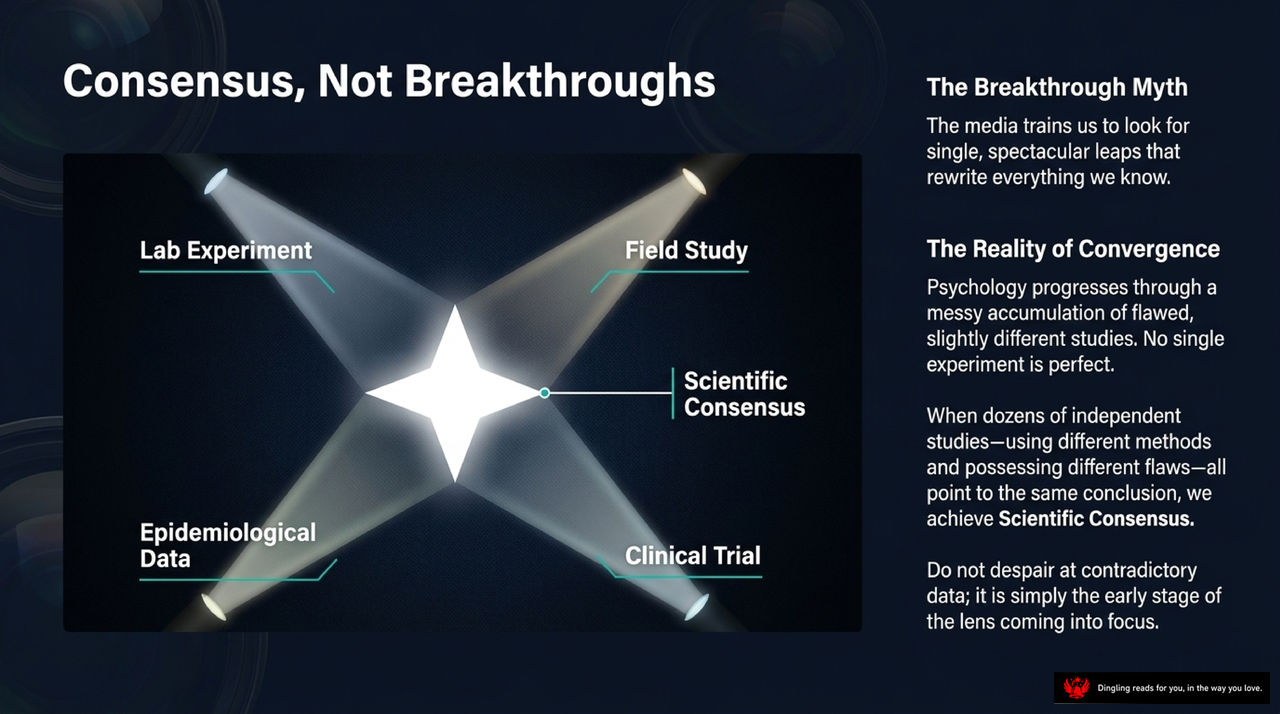
Welcome to this section. Look at the title right here: Consensus, Not Breakthroughs. We often get it wrong. The media trains us to look for single, spectacular leaps that rewrite everything we know. That's the Breakthrough Myth. It makes us think science is about magic moments. But the reality of psychology is totally different. It doesn't progress through one perfect experiment. Instead, it moves through a messy accumulation of flawed, slightly different studies.
Look at the diagram. You have four distinct sources of evidence shining in from different angles: Lab Experiment, Field Study, Epidemiological Data, and Clinical Trial. They aren't competing with each other. They are converging. They all point to the same center, which we call Scientific Consensus. This is the core of how we know what we know.
Here's the key takeaway: No single experiment is perfect. Every study has flaws. But when dozens of independent studies—using different methods and possessing different flaws—all point to the same conclusion, we achieve Scientific Consensus. This is much more reliable than any single breakthrough.
Now, what about that contradictory data you might see? Don't despair. The text reminds us, Do not despair at contradictory data; it is simply the early stage of the lens coming into focus. Sometimes studies disagree because we haven't gathered enough evidence yet, or because there are competing explanations still being tested.
Think of it like a camera lens. If you have one blurry photo, you can't be sure. But if you take hundreds of photos from different angles, eventually the image becomes sharp and clear. That is how science works. It's about the aggregate. It's about the pattern emerging from the noise. So when you hear about conflicting studies, remember that science isn't about finding the one right answer immediately. It's about slowly, patiently, converging on the truth through many, many attempts. That is the true engine of scientific progress.
This is why we value the process over the headline. We value the accumulation of evidence over the hype of a single discovery. So keep your eyes on the consensus, not just the breakthroughs. This approach helps us stay grounded when the news gets loud. It reminds us that truth is built, not found. It takes time, and it takes many people working together to get there. Understanding this shift in perspective is crucial for anyone trying to navigate the complex world of scientific information.
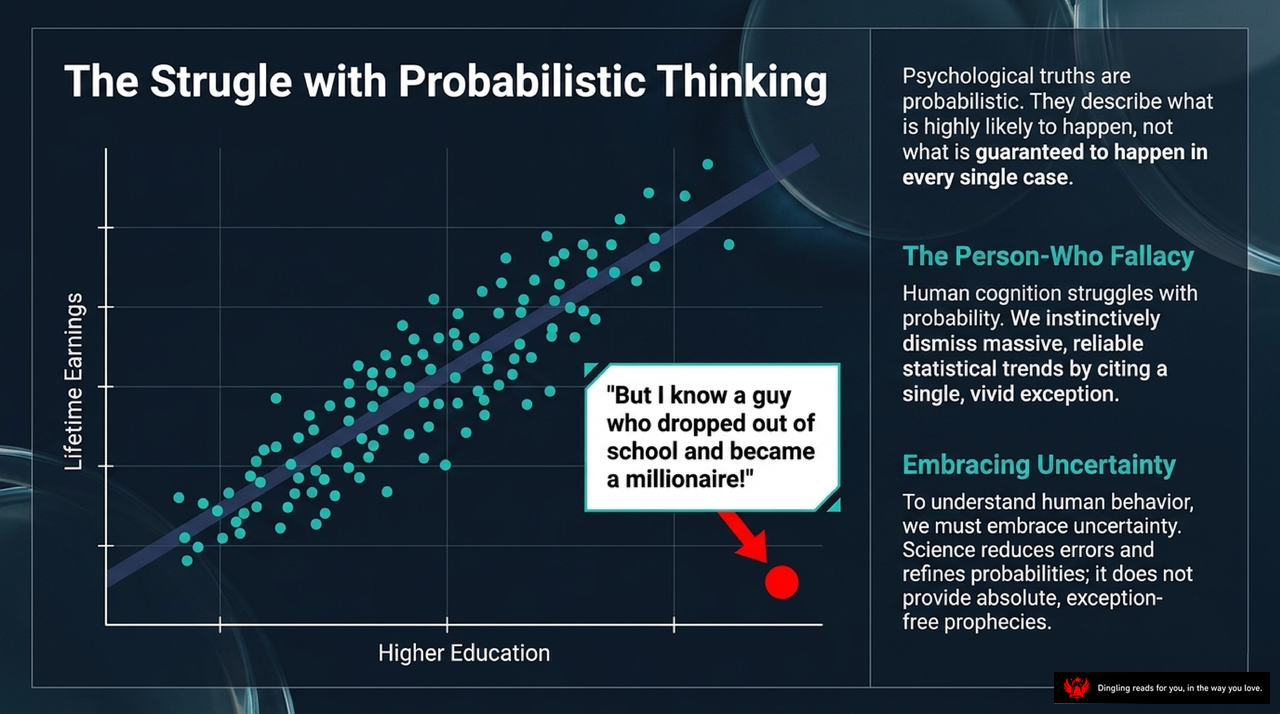
Look at this graph. It maps lifetime earnings against higher education. You can see a clear trend: generally, more education correlates with higher earnings. But here's the catch. The text on the right says it clearly: "Psychological truths are probabilistic. They describe what is highly likely to happen, not what is guaranteed to happen in every single case."
Human beings have a hard time with this. We have what's called "The Person-Who Fallacy." Our cognition struggles with probability. We instinctively dismiss massive, reliable statistical trends by citing a single, vivid exception.
Look at that red dot and the speech bubble: "But I know a guy who dropped out of school and became a millionaire!"
This guy is real. He's vivid. He feels like a fact to us. But he is just one data point in a massive cloud of data. He is the outlier. We use his story to reject the trend, but that's a cognitive trap. We are prioritizing a single story over the statistical reality. This happens because our brains are wired to notice patterns, but we often mistake noise for signal. We treat an anecdote as a universal truth.
So, what do we do? We need to embrace uncertainty. The text says: "To understand human behavior, we must embrace uncertainty. Science reduces errors and refines probabilities; it does not provide absolute, exception-free prophecies."
Science isn't about finding magic rules that work for everyone. It's about refining the odds. It acknowledges that while the trend is strong, exceptions exist. That's okay. That's how we know the truth. If we demand absolute certainty, we stop learning. We get stuck in denial.
Understanding this helps us make better decisions. When someone tells you about their "one guy" friend who defied the odds, remember the trend. Trust the data, not just the story. Accepting that life is probabilistic, not certain, is the first step to thinking like a scientist. It helps us avoid the "Person-Who" trap and see the bigger picture.
Ultimately, the goal isn't to be perfect. It's to be accurate enough to make good choices. By accepting the uncertainty, we stop being fooled by our own intuition. We learn to navigate the probabilities instead of fighting them. This mindset shift is crucial for navigating the modern world where data is everywhere, but our instincts are often wrong.
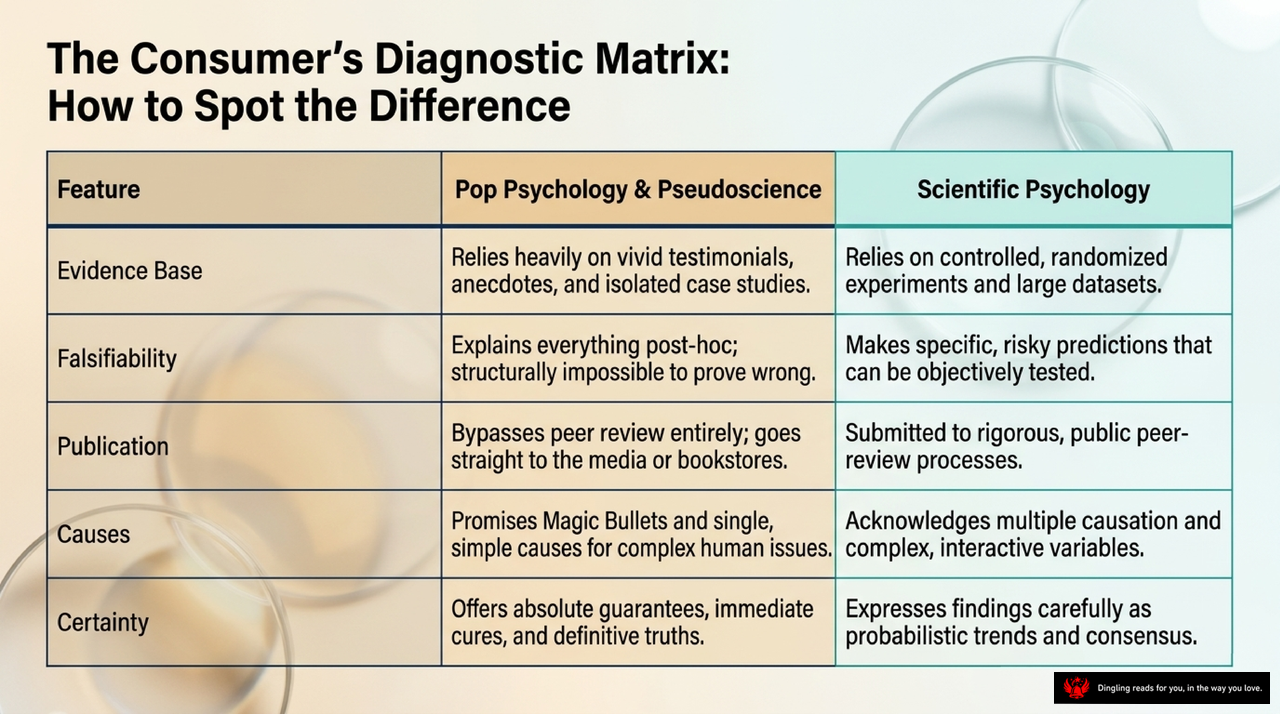
Let's talk about how to actually spot the difference between real psychology and the fake stuff out there. This matrix gives you a clear checklist for consumers to protect themselves.
First, look at the Evidence Base. Pop psychology relies heavily on vivid testimonials, anecdotes, and isolated case studies. It feels convincing because it's personal and relatable. But scientific psychology relies on controlled, randomized experiments and large datasets. Hard data beats a good story every time.
Next, consider Falsifiability. This is the real deal-breaker. Pseudoscience explains everything post-hoc. It can explain any outcome, making it structurally impossible to prove wrong. Scientific psychology, on the other hand, makes specific, risky predictions that can be objectively tested. If the prediction fails, the theory gets challenged. That's how knowledge actually grows.
Then, check the Publication process. Pop psychology bypasses peer review entirely; it goes straight to the media or bookstores to sell ideas. Scientific psychology is submitted to rigorous, public peer-review processes. Experts have to vet the work before it's shared. It's a quality control system you can't skip.
On Causes, pop psychology promises Magic Bullets and single, simple causes for complex human issues. It wants you to believe life has a simple fix. Scientific psychology acknowledges multiple causation and complex, interactive variables. It knows that human behavior is rarely that simple.
Finally, look at Certainty. Pop psychology offers absolute guarantees, immediate cures, and definitive truths. It sells you certainty. Scientific psychology expresses findings carefully as probabilistic trends and consensus. It admits that we don't have all the answers yet.
So, use this matrix as your filter. If a claim relies on stories, avoids testing, skips peer review, promises a simple fix, and guarantees results, it's likely pseudoscience. Real science is humble, complex, and based on evidence. Don't let the marketing fool you; trust the process. Remember, when something sounds too good to be true, it usually is. Stick to the methods that work, not the ones that just sound good. This distinction is vital because relying on pseudoscience can waste your money and even harm your health.
So, let's take a deep breath and pause for a moment to reflect on everything we've covered in these last few chapters. We've been on a journey to understand the true nature of the human mind, and now, it's time to pull it all together.
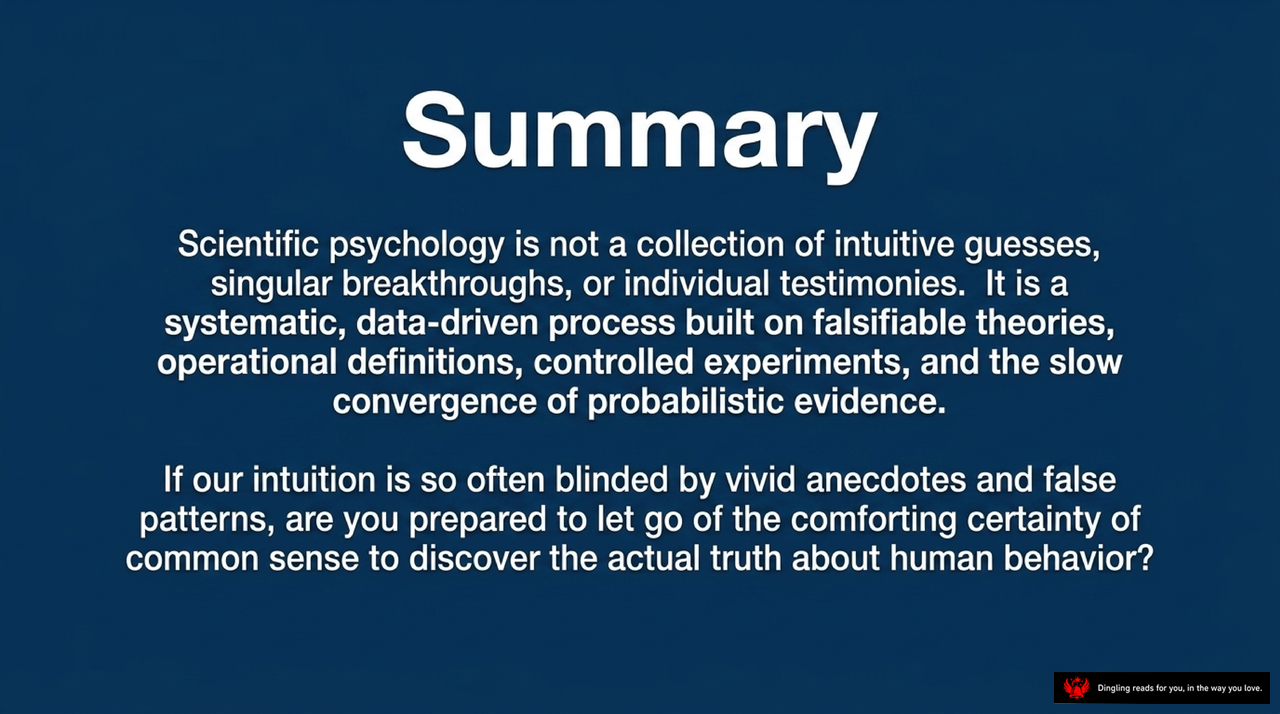
Scientific psychology is not what you might expect. It is absolutely not a collection of intuitive guesses, singular breakthroughs, or individual testimonies. It's not about trusting your gut or relying on one amazing story.
Instead, it is a systematic, data-driven process. It is built on specific pillars: falsifiable theories, where we must be willing to prove ourselves wrong; operational definitions, ensuring we can actually measure what we are studying; controlled experiments, which strip away the noise to reveal the signal; and the slow convergence of probabilistic evidence, because science deals in trends, not absolute certainties.
Why does this distinction matter so much? Because our intuition is often blinded by vivid anecdotes and false patterns. We are wired to see patterns where there are none, and to trust stories over statistics. We love the comforting certainty of common sense. We want to believe that the world is logical and predictable based on our own experiences.
But here is the hard truth. That comfort is often a trap. Common sense is often just a collection of biases. We think we know the answer, but we often don't. Think about the examples we discussed. The 'Smart Hans' horse, the 'Barnum Effect', the 'Vividness Effect'. These were all moments where our intuition failed us. We saw a pattern that wasn't there.
So, the real question is this: If our intuition is so often blinded by vivid anecdotes and false patterns, are you prepared to let go of the comforting certainty of common sense? Are you willing to discover the actual truth about human behavior, even if it means admitting that your gut feeling might be wrong?
This is the essence of the scientific approach. It's not about being smarter, it's about being more honest with the data. It's about embracing uncertainty and evidence over comfort. If you're ready to make that shift, you're ready to truly understand the human mind.