
Humility and Greatness: Complete Chapter-by-Chapter Summary
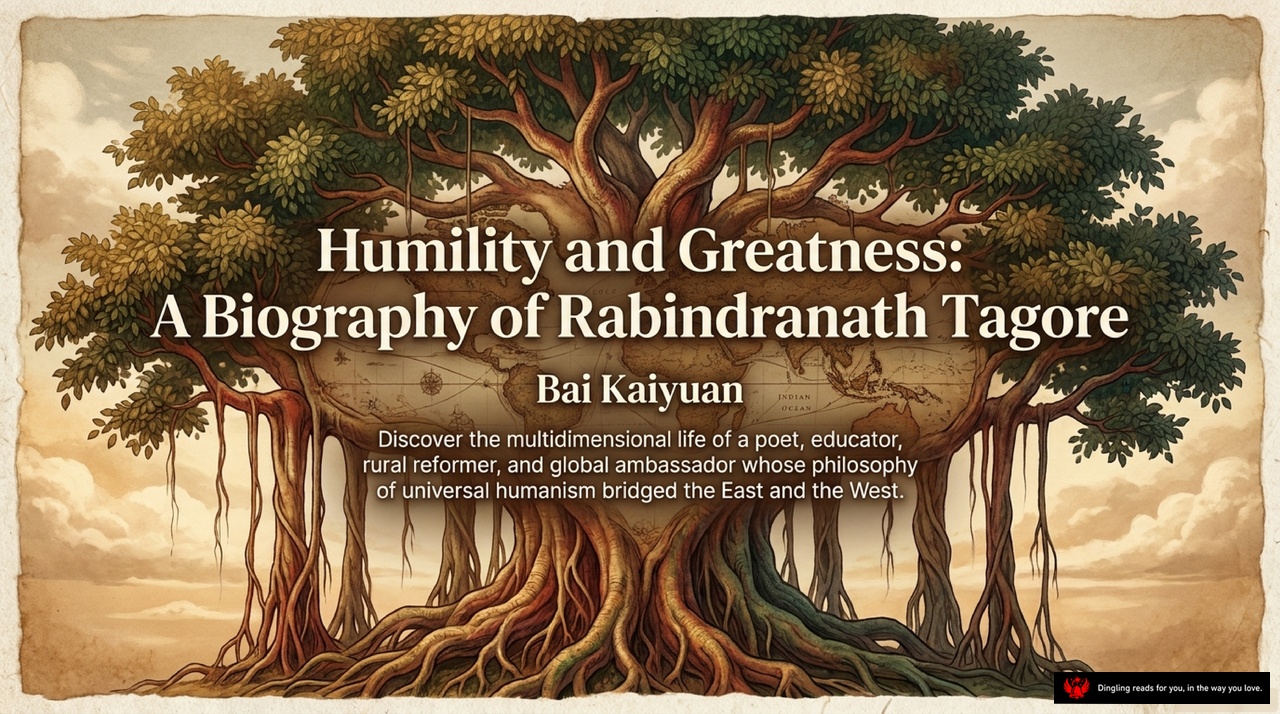
Welcome to our journey into the life of Rabindranath Tagore—a poet, thinker, and visionary whose words and wisdom continue to inspire across generations and continents. Today, we’re diving into “Humility and Greatness: A Biography of Rabindranath Tagore” by Bai Kaiyuan.
This book invites you to explore the multidimensional life of a man who was not just a Nobel laureate in Literature, but also an educator, rural reformer, and global ambassador. Through his poetry, essays, and actions, Tagore bridged the East and the West with a philosophy rooted in universal humanism.
In the pages ahead, you’ll discover how humility shaped his greatness—not as a weakness, but as a foundation for compassion, creativity, and connection. Whether you’re drawn to his literary masterpieces or his social vision, this biography offers a deep and heartfelt look at one of the most influential minds of the modern era.
Let’s begin.

Imagine a tree—not just any tree, but the life story of Rabindranath Tagore. Its roots? Deeply planted in Indian heritage, born in 1861 into the Tagore family of Calcutta, shaped by the Upanishads, the Bengal Renaissance, and the Brahmo Samaj reform movement. These aren’t just historical footnotes—they’re the soil that fed his genius.
From those roots, his trunk rises: Universal Humanism. Not a rigid doctrine, but a living philosophy—rejecting dogma and division, championing borderless spiritual unity and human dignity. That’s the core of his worldview, the steady force behind every poem, play, and idea.
Now, watch how that trunk branches outward. Into Literature—where he wrote poetry, songs, and novels that spoke to the human soul across cultures. Into Educational Reform—challenging old systems, imagining schools as homes for creativity and freedom. Into Rural Economics—putting dignity back into farming and village life. And finally, into Global Diplomacy—using art and dialogue to bridge nations, even during times of tension.
This isn’t just a biography. It’s a map of how one man’s deep roots could grow into global impact. And that’s the power of Tagore’s legacy.

Slide 2: The Alchemy of Grief
Imagine a man who lost everything—his wife, his daughter, his sons—over the course of just a few decades. That was Rabindranath Tagore’s life. And yet, from that crushing pain, he didn’t just survive. He transformed it.
On the left, you see what we call “The Crucible of Loss.” In 1902, his wife Mrinalini died at just 29. Then in 1903, his daughter Renuka. In 1907, his youngest son Sami. And finally, in 1918, his eldest daughter Bela. Each loss was a blow, but Tagore didn’t retreat into silence. Instead, he channeled that grief into something powerful—something creative.
That’s what happens on the right: “The Creative Transmutation.” First, he wrote *Smaraan*, a collection of 27 haunting poems that turned his private sorrow into universal art. Then, he adopted a philosophy of spiritual surrender—believing that if given more pain, he would never break. And finally, he poured his love into his experimental school, turning his personal void into a gift for society.
This slide isn’t just about tragedy. It’s about transformation. About how even the deepest wounds can become the source of meaning, beauty, and legacy.

Look at this powerful contrast. On the left, we see the "Prison of Walls"—the colonial education system. High walls, closed classrooms, no room to breathe. It was a "teaching factory" designed to produce compliant subjects for the colonial machine. Students were forced into rote memorization, disciplined with fear, and even punished physically with the cane. Their natural curiosity was crushed.
But on the right? That’s the freedom of nature. This is the Visva-Bharati model. No walls here—just open skies, trees, wind, and seasons. Learning happens in harmony with nature, not against it. Students explore freely, integrating music, painting, and dance into their daily lives. It’s not about obedience; it’s about nurturing the "hundred-petaled lotus" of a child’s mind—curiosity, independence, and creativity. One system builds walls; the other opens doors.

Let’s dive into the heart of what made Visva-Bharati so revolutionary. At its core, it wasn’t just a university—it was a living ecosystem, designed to heal the land and connect the world.
Look at this diagram. Right in the center is the tree of knowledge, symbolizing wisdom growing from learning. Surrounding it are two powerful wings: the Economic Wing and the Global Wing.
On the left, you see the Economic Wing—Sriniketan, known as “The Abode of Peace.” This wasn’t about ivory towers. It was about real people, real farms. Here, modern agriculture, cooperative economics, and self-reliance were taught to local farmers, turning rural India into a place of dignity and sustainability.
On the right, the Global Wing brings in Cheena Bhavana and Hindi Bhavana—dedicated centers for Chinese, Hindi, and Islamic studies. These weren’t just classrooms. They were bridges. They actively pursued a global cultural synthesis, bringing different traditions into dialogue, not just for curiosity, but for mutual understanding.
What makes this blueprint truly powerful is how these two wings work together. One grounds the institution in the soil of India, the other opens it to the world. It’s not about choosing between local and global—it’s about weaving them together into something greater.
This is what a holistic ecosystem looks like: rooted in place, open to the world, and built on the belief that education should serve life, not just theory.
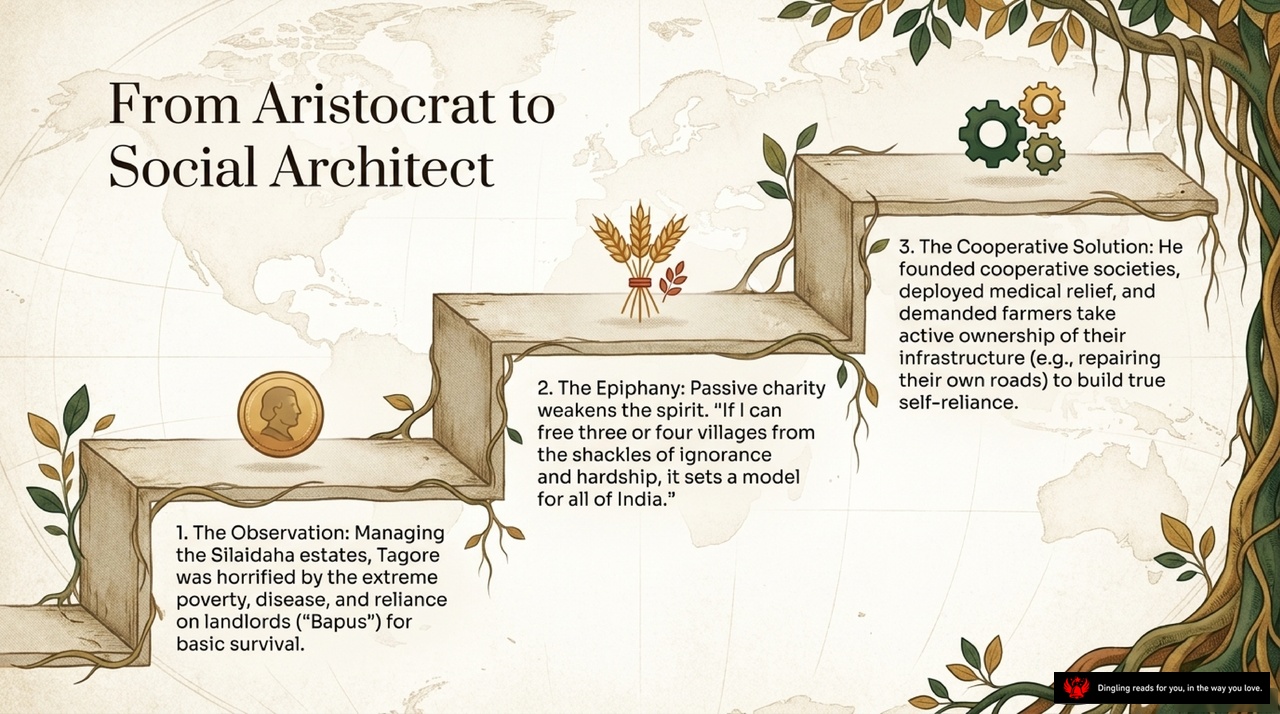
Slide 5: From Aristocrat to Social Architect
So, here’s where Tagore’s real transformation begins—not in grand speeches, but in the dusty fields of Silaidaha. He wasn’t just managing land; he was witnessing a broken system. Peasants were trapped, dependent on landlords called “Bapus” for their very survival. No dignity. No agency. Just survival. That’s Step One: The Observation.
Then came the Epiphany. Tagore realized something profound: passive charity doesn’t free people—it keeps them dependent. He didn’t want to just give rice or medicine. He wanted to ignite change. His words? “If I can free three or four villages from the shackles of ignorance and hardship, it sets a model for all of India.” That’s not just hope—that’s a blueprint.
And that’s how we get to Step Three: The Cooperative Solution. Tagore didn’t just hand out aid. He built systems. He founded cooperatives, launched medical relief, and most importantly, he demanded farmers take ownership—literally. Repairing roads, managing infrastructure, deciding their own future. This wasn’t about saving them. It was about empowering them.
This slide isn’t just about Tagore’s journey. It’s about a shift in mindset—from being a giver to becoming an architect of society. From aristocrat to social engineer. And that’s a lesson that still resonates today.
You know, when you think of diplomacy, you probably picture a man in a suit walking into a marble room, shaking hands, signing treaties. But what if I told you there was a different kind of ambassador? One who didn't carry a briefcase, but a bamboo staff. One who didn't cross borders to sign documents, but to plant trees.
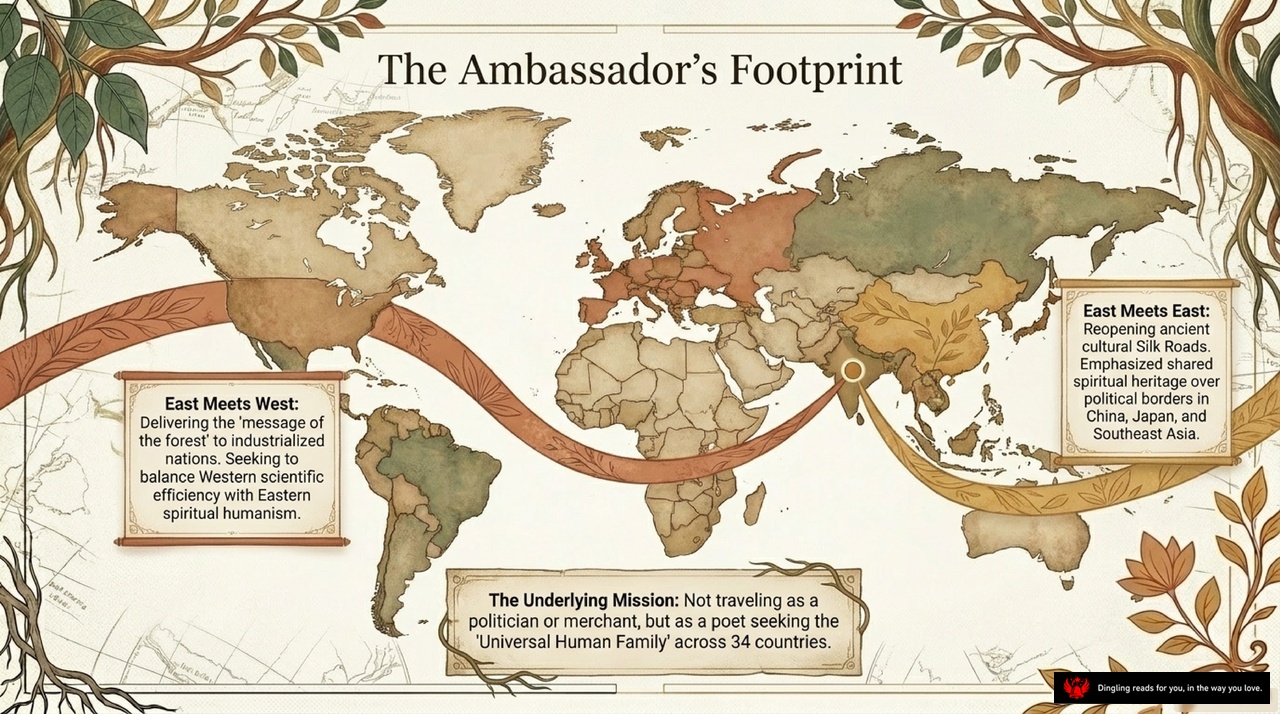
This slide is titled "The Ambassador's Footprint," and it's all about the legacy of Liang Qichao. Look at that winding path stretching across the map. It's not just a route; it's a journey of connection.
On the left, we have "East Meets West." This was his mission to the industrialized West. He wasn't just going to show them what China looked like; he was delivering a "message of the forest." He wanted to balance their obsession with scientific efficiency with the wisdom of Eastern spiritual humanism. He was essentially saying, "Your machines are great, but don't forget your soul."
On the right, we see "East Meets East." Here, the focus shifts. He was re-opening ancient cultural Silk Roads. He emphasized shared spiritual heritage over political borders, connecting China, Japan, and Southeast Asia. He was reminding people that they were all part of the same cultural family, long before it was a political slogan.
But what ties all of this together? The text at the bottom tells us the "Underlying Mission." This is crucial. He wasn't traveling as a politician or a merchant trying to make money or gain power. He was traveling as a poet. His goal was to seek the "Universal Human Family" across 34 countries. He was looking for the common humanity that exists beneath all the noise of nationalism and politics. That is the true footprint of an ambassador.

Slide 7: The Burden of Nationalism vs. The Freedom of Humanism
Imagine this scale. On one side, you’ve got “Militant Nationalism”—heavy, dark, and dragging down the balance. On the other? “Universal Humanism”—glowing, radiant, lifting us up. This isn’t just a metaphor. It’s the core tension that shaped one of history’s most profound moral voices.
In 1916, in Japan, he saw the danger clearly. He warned against blind imitation of Western imperialism and aggressive nationalism—not because he hated the West, but because he knew it was built on the exploitation of others. That’s why he later renounced his British knighthood in 1919. Not out of rebellion, but out of principle. When the British army massacred hundreds at Jallianwala Bagh, he stood with the oppressed, not the empire.
His words cut deep: “I will never allow patriotism to triumph over humanity as long as I live.” He didn’t reject his country—he rejected the idea that a nation must be built on the suffering of others. True freedom, he believed, comes not from loyalty to a flag, but from compassion for every human being.
This slide reminds us: the weight of nationalism can crush us—but the light of humanism can lift us all.

Today, we’re diving into a pivotal chapter in the story of cross-cultural exchange—Reviving the Ancient Silk Road of Culture. This isn’t just about history; it’s about how ideas travel, connect, and shape the future.
In 1924, during his China Tour, Rabindranath Tagore didn’t just visit—he engaged. He sat down with China’s brightest minds: Liang Qichao, Hu Shi, and Xu Beihong. These weren’t casual chats. They were deep, meaningful conversations that challenged the growing tide of pure materialism. Tagore urged them to look beyond money and power, to value art, spirit, and human connection.
What made this even more powerful was the unexpected bond he formed with poet Xu Zhimo—a true “Dada” connection. They exchanged names, symbolizing unity across generations and cultures. Xu Zhimo called himself “Susima,” while Tagore embraced the name “Bura Bhaia,” a gesture of familial warmth and mutual respect.
But Tagore’s influence didn’t stop at personal relationships. He took action. He recruited scholar Tan Yunshan to establish the “Cheena Bhavana,” or Chinese Academy, at Visva-Bharati University. This wasn’t just a building—it was a bridge. A permanent space where Sino-Indian scholarship could thrive, dialogue could continue, and culture could truly cross borders.
This slide captures more than facts—it shows how one man’s vision could reignite an ancient path, turning it into a living, breathing route for cultural revival.

Slide 9: The Soviet Synthesis, 1930.
By 1930, the Soviet Union was a land of striking contradictions. On one hand, there was undeniable progress. The slide shows a checkmark, representing what he admired: the unprecedented scale of agricultural modernization and the rapid eradication of illiteracy. He praised the use of education to uplift the peasantry from historical stagnation. It was a story of a nation being built from the ground up, transforming a backward agrarian society into a modern industrial power.
But on the other hand, there was a deep, underlying peril. The slide highlights a warning sign, representing what he feared: the violent suppression of personal freedom and property. He diagnosed that eliminating 'greed' through brute force and erasing individual humanity would ultimately build a brittle, unsustainable society. He saw that while the state could force the gears of industry to turn, it could not force the human spirit to flourish without consequence. This tension between rapid progress and the cost of that progress defined the Soviet experience.

In 1913, something extraordinary happened—not just for Rabindranath Tagore, but for the entire world. The East began to speak, and the West finally listened.
Tagore, a poet, philosopher, and visionary from Bengal, did something bold: he translated his own Bengali poems into English. He didn’t wait for someone else to interpret his voice. He became his own translator, and the result was *Gitanjali*, or *Song Offerings*. It wasn’t just poetry—it was a spiritual journey, a quiet conversation between the soul and the divine, written in a language that felt both ancient and timeless.
When *Gitanjali* was published, it didn’t just stay in Europe or America. It traveled, resonated, and changed minds. The Swedish Academy, in a historic moment, awarded Tagore the Nobel Prize in Literature—making him the first Asian ever to receive this honor. They didn’t just see a poet; they saw a bridge. A bridge between cultures, between poetry and religion, between the familiar and the profound.
But it wasn’t just the award that mattered. It was how the West responded. W.B. Yeats, one of England’s greatest poets, was moved to tears. He wrote that Tagore’s words revealed “a world I have dreamed of all my life… lyrics displaying a supreme culture.” That’s not just praise—that’s recognition. That’s validation from someone who knew what true art could do.
This wasn’t just about one book or one man. It was about breaking silence. About showing that wisdom doesn’t belong to one corner of the globe. That beauty, depth, and meaning can come from anywhere—and when they do, they belong to everyone.
1913 wasn’t just a year. It was a turning point. And Tagore? He was the voice that opened the door.
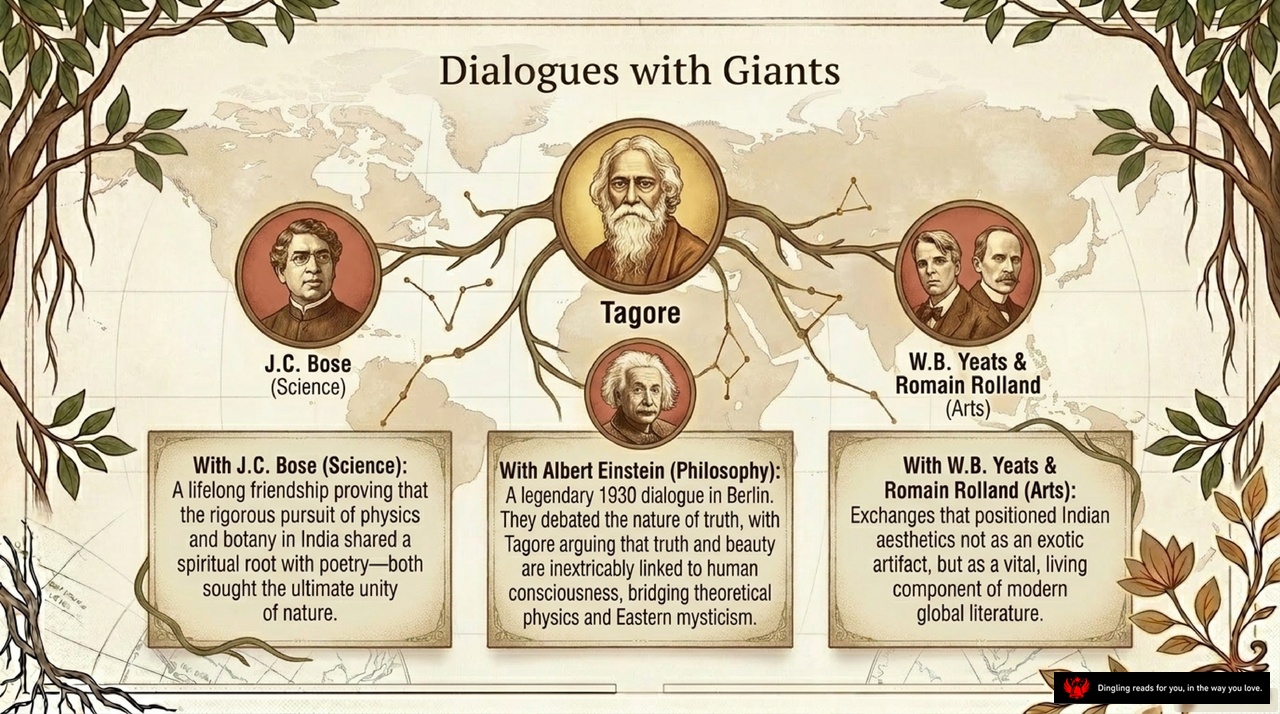
Today’s slide is titled “Dialogues with Giants,” and it maps out the intellectual journeys of Rabindranath Tagore—the great Indian poet, philosopher, and polymath—as he engaged with some of the most influential minds of his time.
At the center stands Tagore himself, connected through branching paths to three key figures: J.C. Bose in science, Albert Einstein in philosophy, and W.B. Yeats and Romain Rolland in the arts.
Let’s start with J.C. Bose. This wasn’t just a friendship—it was a lifelong bond between two giants who saw the world differently but reached the same spiritual truth. Bose, a pioneer in physics and botany in India, believed that nature itself held a poetic rhythm. Tagore agreed. Together, they explored how science and art weren’t opposites, but two sides of the same coin—both seeking unity in the living world around us.
Next, we turn to Albert Einstein. In 1930, in Berlin, Tagore met the father of modern physics. Their conversation wasn’t about equations or relativity alone. It was deeper. They debated the nature of truth. Tagore argued that truth and beauty are inseparable from human consciousness. Einstein, grounded in logic and observation, found himself drawn to Tagore’s vision—a bridge between Eastern mysticism and Western science. It was a rare moment when the mind and the spirit walked hand in hand.
Finally, on the arts side, Tagore conversed with W.B. Yeats and Romain Rolland. These weren’t casual chats. They were exchanges that reshaped how the West saw Indian culture. Instead of viewing India as an exotic land of ancient myths, Tagore showed them that Indian aesthetics were alive, evolving, and deeply relevant to modern global literature. He didn’t ask them to admire India from afar—he invited them to understand it from within.
These dialogues weren’t just historical footnotes. They were living conversations that expanded the boundaries of thought, culture, and creativity. And they remind us that even the greatest minds can learn from each other—when they’re willing to listen, truly listen.

Let’s take a moment to reflect on Rabindranath Tagore’s 1932 journey through the Middle East—a journey that was far more than just travel. It was a deliberate pilgrimage into the heart of a world often misunderstood by his own, and one that would reshape his vision of unity.
The image before us captures three powerful themes from this trip: *The Pilgrim of Poetry*, *The Bedouin Bond*, and *The Message to India*.
As the Pilgrim of Poetry, Tagore didn’t just walk through cities—he stepped into history. In Iran and Iraq, he was welcomed not as a foreigner, but as a poet. He visited the tomb of Hafez, a 14th-century Persian master whose words still echo across centuries. For Tagore, this wasn’t just reverence—it was a spiritual kinship, a moment where poetry transcended borders and time.
Then came the desert—the wild, untamed land of the Bedouins. Here, Tagore fulfilled a childhood dream: to meet the nomads who lived by the stars and the wind. He didn’t come as an observer, but as a guest. And in return, he was offered something rare: the universal hospitality of the nomad. No titles, no divisions—just shared bread, stories, and silence under the same sky.
But this journey wasn’t just about Tagore’s personal growth. It was about sending a message back home. As he looked at the harmony he witnessed in the Islamic world, he saw a mirror for India—one that reflected what could be lost if it kept clinging to division. He returned with a clear call: let go of manufactured Hindu-Muslim conflicts. Let pride in culture become a bridge, not a wall.
This journey wasn’t about geography. It was about connection. And in a world that still feels fractured, that message remains as urgent today as it was over a century ago.

Slide 13: The Polymath’s Unity
Look at this. This isn’t just a list of Tagore’s achievements. It’s a map of his mind. At the center, we see “Universal Humanism” — not as a slogan, but as the core belief that ties everything together. For Tagore, art, education, economics, and social reform weren’t separate tracks. They were all different languages speaking the same truth: the unity of all human life.
On the left, you’ve got his literary and musical legacy — over 2,000 original songs, countless poems. That’s not just creativity; it’s a way of teaching, of connecting people across borders. On the right, his fine arts — he didn’t stop at poetry. At 63, he picked up a brush and created more than 2,000 rhythmic, abstract works that still hang in galleries worldwide. That’s late-blooming genius, and it shows: age doesn’t limit expression.
Below, we see his real-world impact. In rural India, he built Sriniketan — a living experiment in cooperative economics. No handouts. Just dignity through shared work. And in education? He founded Visva-Bharati — a borderless university where ideas flow freely, cultures meet, and minds grow beyond national lines.
So what’s the takeaway? Tagore didn’t just do many things. He did them all because they all pointed to one thing: the deep, unbreakable connection between all people. That’s the polymath’s unity. Not breadth for breadth’s sake — but depth, woven across disciplines, for one purpose: to make humanity whole.
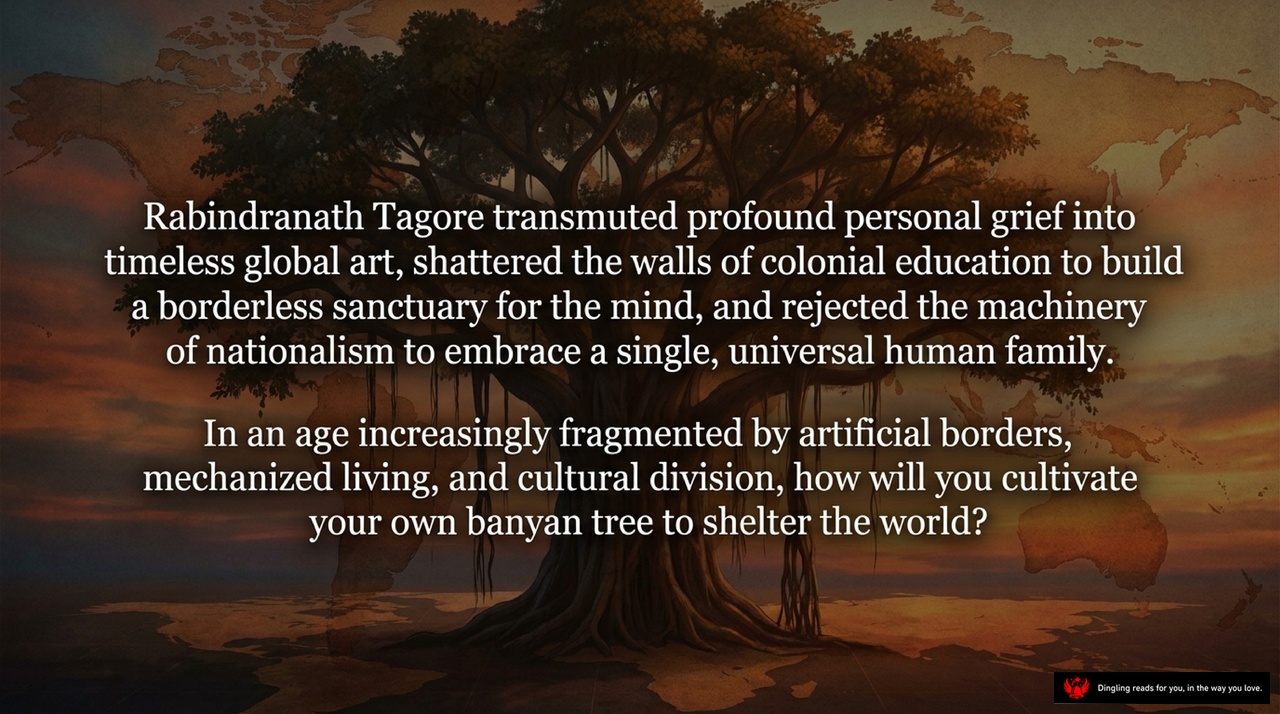
Imagine a single tree—not just rooted in one soil, but spreading its branches across continents, its roots drinking from rivers that flow through many nations. That’s the banyan tree Tagore saw in himself, and in the world he wanted to create. He didn’t just write poetry or paint landscapes; he turned his deepest sorrow into something that could heal the whole human family.
He stood against the rigid walls of colonial education, not by building new ones, but by tearing them down. He believed that real learning doesn’t belong to a flag or a border—it belongs to every curious mind, everywhere. And when nationalism tried to divide people into “us” and “them,” he chose something far more powerful: the idea that we’re all part of one universal family.
Now, look at this image—a tree standing over a fractured map. It’s not just symbolic. It’s a challenge. In our time, we’re living in an age of artificial borders, machines that dictate our days, and cultures pushed apart instead of pulled together. So here’s the question Tagore leaves us with: How will you grow your own banyan tree? What kind of shelter will you offer the world? Not by conquering or dividing—but by connecting, by creating, by loving without limits.