

I Am a Strange Loop: Reader Reviews & Ratings

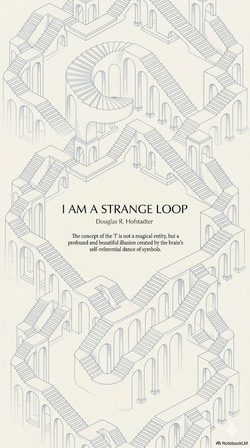
I Am a Strange Loop
Loading…

I Am a Strange Loop

Douglas R. Hofstadter

Write a Review

Your Review

0/500

Other reviews

28 total
Edwin27

Hofstadter explains how our brain creates a loop that feels like a single self, using Gödel's math to show that this unified identity is actually an emergent, self-referential pattern arising from complex neural symbols rather than a mystical soul, making me realize that the feeling of being one person is a brilliant trick of abstract logic where our thoughts reference themselves to build a narrative of continuity that guides our daily decisions and social interactions, challenging the old dualist myths that separate mind and body while offering a practical way to understand grief as the merging of overlapping soul patterns with loved ones instead of a total loss, which helps me feel more connected to others and less afraid of the fluid nature of my own identity as I learn to see my past and future as parts of the same dynamic, ever-evolving loop that shapes who I am today.


Fernando

This book changes how I see my own identity by explaining that the unified self is just a strange loop of symbols.

Debbie

The idea that our sense of self is just a strange loop really changed how I see my own identity today.

Kristi99

Hofstadter explains the strange loop clearly. I now see my own sense of self as an emergent pattern. It feels real but is just symbols. This book changed how I view my identity. No longer do I fear losing myself. The math concepts are surprisingly accessible here.

Viola

Reading this changed how I see my own mind forever. It feels so true. I finally understand why I feel like one person inside.

Ari99

Reading this made me realize my sense of self is an emergent pattern, not a fixed thing inside me.

Norman

The idea that our self is a strange loop instead of a fixed entity feels surprisingly liberating and offers a fresh perspective on personal identity.

Athena

The idea that our soul is a pattern not a fixed object changed how I see myself.

Tessa

Understanding the self as a dynamic loop of patterns rather than a static soul was a huge relief.

Adele23

Hofstadter explains that our sense of self is a strange loop, an emergent pattern arising from the brain's ability to create and interact with its own symbolic representations, feeling real yet rooted entirely in physical neural activity rather than a mystical soul, which dismantles comforting myths about identity and free will while showing how self-referential patterns drive our lives and shape our understanding of others through overlapping loops that persist even after death, making grief a celebration of continued connection instead of total loss.

Uriah

Hofstadter brilliantly explains how our sense of self is actually a self-referential loop emerging from brain patterns rather than a mystical soul, using the video feedback analogy to make this abstract concept feel tangible and convincing without relying on confusing jargon.

Lydia

Hofstadter explains the self as a loop, making the mystery of identity feel strangely clear.

Lonnie95

The concept of the soul corona really helped me understand how our identities overlap with others.

Cathy

I found the explanation of Gödel's theorem as a metaphor for the human self incredibly insightful.

Pamela08

This book changed how I think about my own identity forever.

Nell7

This book changed how I see my own mind forever. It feels both strange and true. I finally understand why I feel like one person. The ideas are deep but explained clearly. I loved the math parts even though I am not good at them. It made me question everything I thought about myself. A really important read for anyone curious about consciousness. The writing style is unique and very engaging throughout. I will definitely recommend this to friends who love science.

Otis

Reading this made me realize my 'I' is a beautiful, emergent pattern rather than a mysterious soul.

Katie

A stunning insight.

Marlene

The idea that our sense of self is just a self-referential loop makes me rethink everything about identity and consciousness in a profound way.

Mallory

The book challenges my view of identity, though some of the mathematical analogies felt a bit distant.