
Imagined Communities: Complete Chapter-by-Chapter Summary

Welcome to the world of Benedict Anderson's *Imagined Communities*. Today, we're stepping back in time to see how the modern nation was actually built. Picture this: a massive, steaming printing press churning out old maps, transforming scattered languages into a shared reality. That is the core idea here.
Anderson argues that the nation is not a natural, ancient entity, but an "imagined political community." It is imagined because even the largest nation will never know its members, yet in the mind of each, they live together. This feeling of connection wasn't always there. Before the 18th century, people belonged to religious groups or royal courts, not nations. The nation is a cultural invention born from the Industrial Age.
Three forces made it possible. First, print capitalism. By breaking down language barriers and creating a unified "reading public," printers allowed strangers to feel like fellow citizens. Second, the Enlightenment, which replaced divine right with the idea of popular sovereignty. And third, the discovery of the world, which helped us see clear boundaries between different groups.
This book is a groundbreaking exploration of how these shifts birthed the modern nation as a socially constructed political reality. It explains how a collection of strangers could suddenly feel like a family, fundamentally changing the global order we live in today.

Look at this blueprint of "The Nation." It breaks down into four core pillars: Imagined, Limited, Sovereign, and Community.
First, the nation is **Imagined**. Even though members will never know most of their fellow citizens, a mental image of this communion lives in everyone's mind. It's a cognitive reality, not a fabrication.
Second, it is **Limited**. Even the largest nation has finite boundaries. Beyond those lines lie other nations. No nation imagines itself as covering all of humanity.
Third, the nation is **Sovereign**. It was born in an era that destroyed the legitimacy of divinely-ordained, hierarchical dynastic realms. It asserts itself as an autonomous political entity, free from external authority.
Finally, it is a **Community**. Regardless of actual inequality, the nation is always conceived as a deep, horizontal comradeship among its members.
These four concepts define the modern nation, transforming how we understand political belonging in the world today.

The slide we are looking at now captures a profound transformation in how humanity understands truth, power, and time itself. It contrasts the "Old" world of sacred traditions with the "Modern" world of secular nations. Let's break down this epistemological shift.
First, look at "Script and Truth." In the old order, sacred languages held exclusive access to ontological truth, creating a hierarchy where only the initiated could understand the divine. The modern shift democratized language; vernacular tongues became equal, dismantling those linguistic hierarchies and allowing everyone to participate in defining reality.
Next, consider the "Structures of Power." Historically, society was organized around monarchs ruling by divine right, a vertical pyramid of authority. Today, we live in sovereign, horizontal, and secular political domains. Power no longer flows from God or bloodlines but from the consent of the governed within a nation-state framework.
Finally, examine the "Concept of Time." The old worldview was built on messianic time, where origins and endings were simultaneous, anchored in a sacred, vertical moment. Modern time, however, is homogeneous and empty—measured by clocks and chronology. Events happen in a linear sequence, side by side, creating a sense of history that stretches from past to future without a divine endpoint.
This slide illustrates that the modern nation didn't just emerge; it required the death of the medieval world's fundamental assumptions about how truth is known, how power is exercised, and how time flows.

The slide we see here, titled "The Catalyst: Print-Capitalism," perfectly captures the engine that drove the modern world. It illustrates a powerful chemical reaction: when the relentless drive of **Capitalism** met the mechanical power of **Print Technology**, the result was a linguistic transformation so profound it reshaped human history.
Think of it like this: Capitalism needed massive new markets, but people spoke thousands of different dialects. Print technology offered a solution by making books and newspapers reproducible. But here's the twist—the image calls it "Linguistic Fatality." Why? Because the insurmountable diversity of human speech actually forced a unification. To sell books across regions, printers had to standardize these chaotic dialects into fixed, printed languages.
This process created what the slide calls "Print-Languages." These weren't just words; they were the foundation of national consciousness. By unifying local dialects into standardized print languages, capitalists forged unified fields of exchange. Suddenly, people who had never met could imagine themselves as "reading compatriots," sharing the same language, the same history, and the same political reality. This is the moment the modern nation was born—not through war or blood, but through the shared act of reading the same printed text.
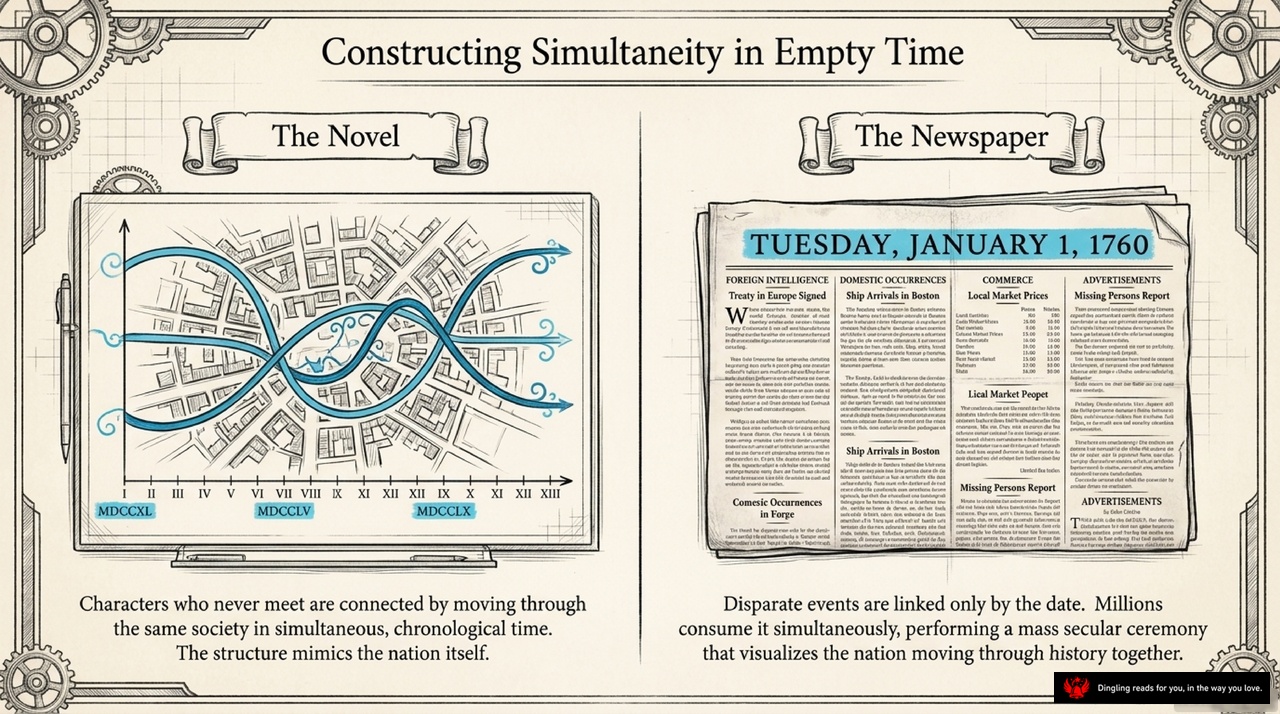
Imagine a world where history doesn't flow like a river, but exists as a flat, silent grid. This is the concept of "homogeneous, empty time"—a modern invention where events happen side-by-side, linked only by the date on a newspaper, not by a shared myth of the past.
Look at the split on this slide. On the left, we see "The Novel." Here, characters who never meet are connected because they move through the same society at the same moment. Their lives cross paths on this invisible timeline, mimicking the structure of the nation itself. On the right, we see "The Newspaper" dated Tuesday, January 1, 1760. It lists ship arrivals, market prices, and missing persons reports. These disparate events are linked only by that single date. Millions read this simultaneously, performing a mass secular ceremony that visualizes the nation moving through history together.
This shift is revolutionary. Before this, communities were bound by religion or blood, existing in a vertical, sacred time. But the novel and the newspaper taught us to imagine ourselves as part of a horizontal community. We don't need to know each other to feel connected; we just need to know we are reading the same story on the same day. This "simultaneity" is the very engine that allowed strangers to imagine themselves as a single nation, transforming abstract time into a powerful political force.

Look at this map of the Americas. These glowing blue loops aren't just travel routes; they represent the very first wave of nationalism, driven by "Creole Pioneers."
Here's the key insight: these weren't immigrants who moved from Europe to the Americas. These were people of European descent who were actually *born* in the Americas. Because they couldn't move back to Europe, they were trapped in these specific colonial administrative units—like the Viceroyalty of New Spain or Peru.
This created a unique mechanism: "cramped pilgrimages." Officials were stuck moving only within these borders, traveling from one local capital to another. Over time, as they traveled these confined loops alongside fellow Creoles, something powerful happened. They began to imagine this specific territory as their fatherland. They realized they shared a common fate, distinct from the distant rulers in Spain.
So, while Europe was developing nationalism based on language, the Americas created the first modern nation-states based on this shared experience of being "born here." It was a revolution born not from a new language, but from a new sense of belonging to a place they could never leave.

Welcome to the second wave of nationalism: Vernacular Nationalism in Europe. Imagine a world where the old empires are cracking under the pressure of a new idea—one that says people don't belong to a king, but to a shared language and a shared destiny. This is the story of how Europe reinvented itself from the ground up.
Look at that tree in the center. It's not just biology; it's a map of the soul of Europe. The roots are the ancient languages, but the branches exploding outward—Germanic, Slavic, Celtic, Romance—represent a revolution. Suddenly, a dialect spoken in a village becomes a "national language." Lexicographers and grammarians, these new intellectuals, took the messy, local tongues and standardized them. They turned the spoken words of the market and the farm into the written language of the state.
This is the mechanism: standardizing the vernacular and elevating it to a language of power. Think about it. When a peasant learns to read in their own tongue, they stop seeing themselves as a subject of a distant emperor. They start seeing themselves as a "reader comrade" with millions of others who speak the same words. The printing press, sitting right there on that desk, is the engine of this change. It allowed a specific dialect to spread across borders, creating a unified mental space where people who had never met felt a deep, invisible connection.
The outcome was profound. Nationalism became highly self-conscious and linguistic. It wasn't just about hating a foreigner anymore; it was about loving your own language. Intellectuals could now consciously "pirate" the blueprints of the American and French revolutions. They realized that a nation could be built, not just inherited. In multi-ethnic empires like Austria-Hungary, this was a double-edged sword. When the Habsburgs tried to impose German, it backfired, sparking a fierce demand for Czech, Hungarian, and Polish identities. The very act of writing in your native tongue became an act of political rebellion.
So, we see the shift from a world of dynasties to a world of nations. The old order relied on blood and divine right. The new order relied on the printed word. It was a "Columbian" shift in political thinking, turning the map of Europe upside down. By the late 19th century, the model was set: the nation-state. Even those who were too late, like the Hungarians or the Poles, had to speak the language of the people to claim their place in history. This was the golden age of the vernacular, where the power of the common tongue reshaped the entire continent.
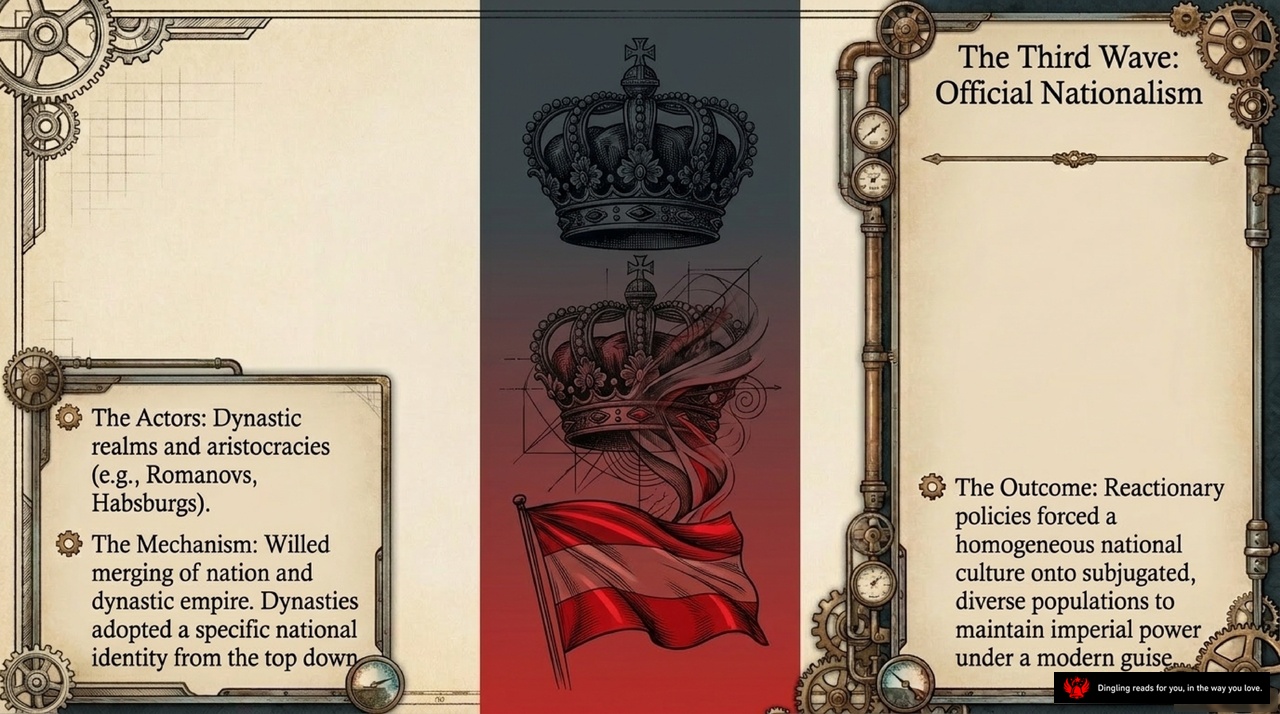
Welcome to the final chapter of our journey through the history of nationalism. We are now looking at what Benedict Anderson calls "The Third Wave: Official Nationalism." This isn't about the spontaneous awakening of the masses, but rather a top-down strategy employed by old empires to survive.
As you see in the center of our slide, we have two crowns stacked on top of each other. The top crown represents the traditional dynastic power—the Romanovs, the Habsburgs—while the lower crown, partially obscured by a flag, symbolizes the new national identity they were forced to adopt. This visual perfectly captures the core mechanism of this era: the "willed merging of nation and dynastic empire."
In the 19th and early 20th centuries, as the "Third Wave" of nationalism swept across the globe, these old ruling classes realized they couldn't ignore the rising power of the people. They couldn't just rule by divine right anymore; they needed a new source of legitimacy. So, they decided to co-opt the very idea of the nation. They began to present themselves not as foreign overlords, but as the natural leaders of a specific ethnic group.
Look at the text on the left. It highlights that the actors here were the dynastic realms and aristocracies themselves. They didn't wait for a revolution; they initiated it. By adopting a specific national identity from the top down, they tried to say, "We are the Russians," or "We are the Hungarians," effectively blurring the line between the ruler and the ruled. This was a desperate attempt to maintain imperial power under a modern guise.
The outcome, as described on the right, was a reaction. These reactionary policies forced a homogeneous national culture onto diverse, subjugated populations. Think of the Russianization of the Baltic states or the British "Anglicization" of India. The goal was to create a single, unified culture to make the empire feel natural and inevitable. However, this strategy often backfired. Instead of uniting everyone, it created deep resentment among the minority groups who felt their identities were being erased.
This era ultimately proved that you cannot simply impose a nation from above. While it allowed empires to extend their reach for a few more decades, it also sowed the seeds of their own destruction. When the pressure became too great, these "official" nations would eventually shatter, giving way to the truly independent nations we see today. This third wave teaches us a crucial lesson: nationalism is not just a tool of the people, but a powerful force that even the most powerful empires cannot fully control.
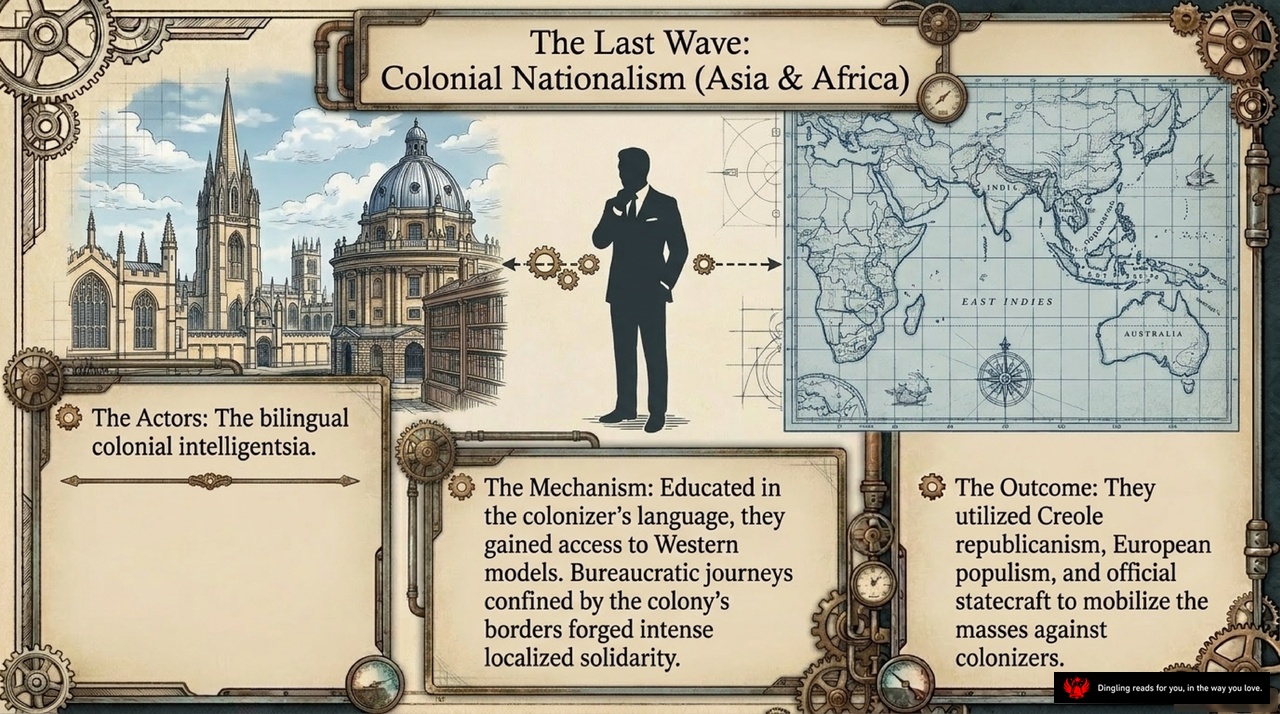
Today's slide captures the final, defining wave of nationalism: the rise of independent nations in Asia and Africa. Look at the map on the right; it highlights the vast regions of India, the East Indies, and Australia—areas that were once the heart of European empires but are now home to new, sovereign states. The silhouette in the center represents the pivotal actors of this era: the bilingual colonial intelligentsia.
These were the bridge-builders of the 20th century. As the text explains, they were educated in the colonizer's language, gaining access to Western models of governance and thought. However, their bureaucratic careers were strictly confined within the colony's borders. This limitation was crucial; instead of spreading out globally, they forged an intense, localized solidarity with their fellow countrymen. They became the architects of these new nations.
The outcome of their work is clear in the bottom right corner. By utilizing Creole republicanism, European populist ideas, and the machinery of official statecraft, these leaders successfully mobilized the masses against their colonial rulers. They didn't just inherit territory; they invented a shared national identity out of the very structures that once oppressed them, completing the global shift from empire to the nation-state.
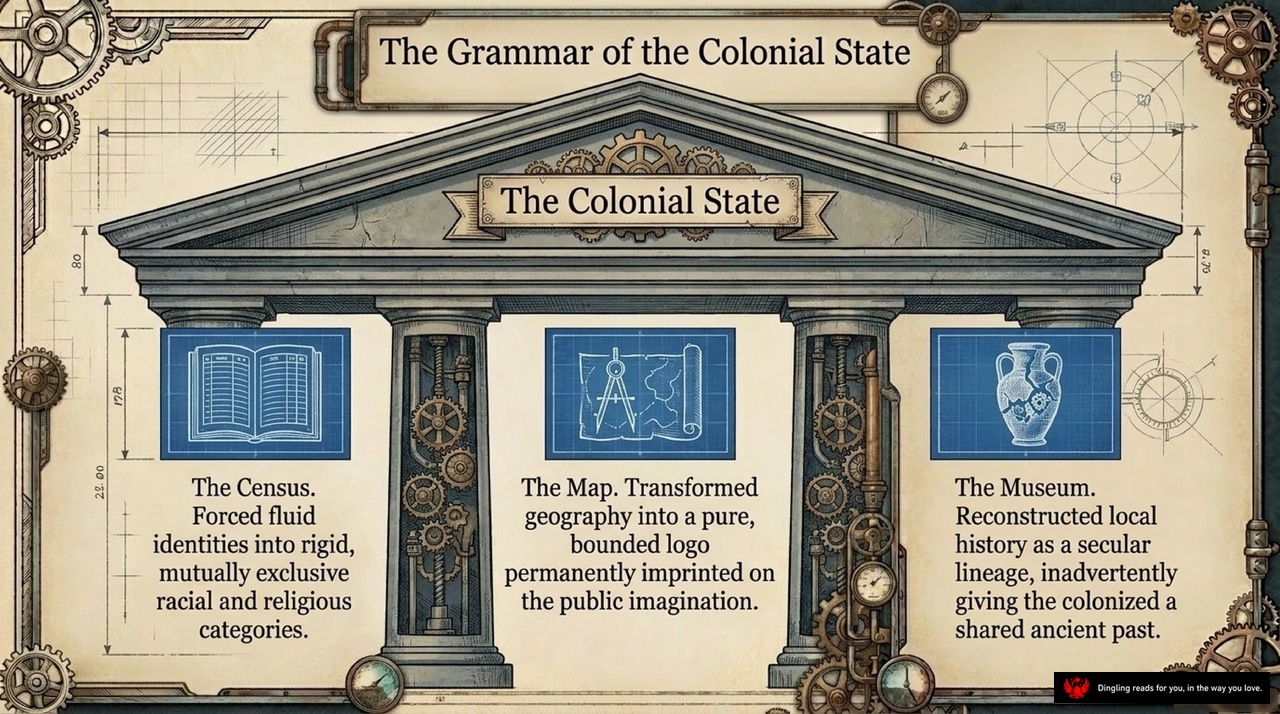
Look at this blueprint of the Colonial State. This slide breaks down the three core tools the state used to build a nation from scratch: The Census, The Map, and The Museum.
First, the Census. It didn't just count people; it forced fluid identities into rigid, mutually exclusive racial and religious categories. By doing this, the state created the very idea of "race" as a fixed biological fact, turning a complex social reality into a manageable administrative grid.
Next, the Map. This is perhaps the most powerful tool. It transformed fluid geography into a pure, bounded logo permanently imprinted on the public imagination. Before this, boundaries were often vague or symbolic. The map drew a hard line, creating a visual container for the nation. It told everyone exactly where "us" ended and "them" began, making the abstract concept of territory feel like a physical, owned object.
Finally, the Museum. The state reconstructed local history as a secular lineage, inadvertently giving the colonized a shared ancient past. By digging up ruins and turning them into national heritage, the museum created a sense of deep roots and continuity. It suggested that this nation had always existed, even if the reality was quite new.
Together, these three instruments—the rigid categories of the census, the hard borders of the map, and the curated history of the museum—wrote the grammar of the nation. They turned a collection of diverse people into a single, unified political community.

We are balancing two very different worlds today. On one side, we have patriotism, rooted in kinship and home. It inspires love, self-sacrifice, and a sense of horizontal solidarity among neighbors. It's inherently open, allowing anyone to join the nation through naturalization. It feels like a warm, human connection. On the other side, we see racism. This isn't about loving a place; it's about class ideology and imperialism. It focuses on contamination, hierarchical repression, and pure hatred. It justifies the permanent, biological domination of the inferior. The image before us shows these two forces on a scale. Patriotism is warm, with a beating heart and a handshake, representing the nation as a family. Racism is cold, frozen in ice, with chains, skulls, and crowns, representing an empire built on division and fear. While many confuse these concepts, the book makes a crucial distinction: patriotism is a cultural product built on love and shared identity, whereas racism is a tool of the ruling class designed to create permanent enemies. Understanding this difference is key to seeing how modern nations are built not just on land, but on the choices we make about who belongs and who is excluded.

Look at this striking image: the Tomb of the Unknown Soldier standing solemnly beside a giant hourglass, sand slipping away into nothingness. This visual perfectly captures a profound paradox at the heart of modern nationalism.
To build a unified national story, the state often needs to force its citizens to forget certain painful historical realities—like the fact that civil wars were often acts of fratricide, where brothers killed brothers. Yet, there is a deep contradiction here. Nations are actually a modern invention, a relatively recent idea. But to command our deepest emotional loyalty, they must pretend to be something ancient and timeless, as if they have always existed.
This is the core tension of nationalism: it is a modern cultural artifact, yet it must always imagine itself as emerging from an immemorial, ancient past. The hourglass represents this fleeting, constructed nature of our national identity, while the tomb symbolizes the sacred, eternalized memory we create to hold it together. It is a powerful, sometimes dangerous, illusion that shapes how we see our history and our place in the world.

Imagine a world where nations are not ancient, divine entities, but modern inventions born from the printing press. This slide captures that very paradox under the title "New Puzzles: Diaspora and Shame." Look at this map; those red lines radiating from a central point represent the invisible, yet powerful, connections of "Long-Distance Nationalism." This is how immigrants maintain deep emotional and political ties to their homeland, engaging in its politics without facing the daily consequences of living there. They feel the pain of a country they haven't seen in decades, creating a bond that transcends geography.
But why do people love their nation even when it is wrong? This leads us to the "Shame Mechanism" highlighted on the right. The capacity to feel shame for one's country proves that the nation is a secular, historical reality. You cannot feel shame for a god; you can only feel shame for a nation. This distinction is crucial. While traditional religion offered a vertical, eternal time where past and future met in the divine, modernity introduced a horizontal, empty time measured by clocks and calendars. It was in this secular vacuum that the nation stepped in to provide meaning.
The nation became the new "sacred" entity, borrowing the emotional weight of religion but grounding itself in history and politics. It allowed citizens to feel a profound sense of belonging and even sacrifice, mimicking the rituals of the church but without the divine. This mechanism explains why citizens defend their nation with such ferocity, even when its actions are flawed. It is a powerful, manufactured loyalty that has reshaped the global landscape, turning abstract maps into sources of intense, sometimes tragic, emotional investment.

Imagine the nation not as an ancient, organic entity, but as a modular construct that was invented once, then endlessly pirated, adapted, and deployed across the globe. This is the core insight behind the architecture of imagination we are exploring today.
Look at the engine at the center of this diagram. It runs on the collision of capitalism, print technology, and linguistic diversity. This wasn't a natural evolution; it was a deliberate invention. In the 18th century, the decline of sacred scripts and divine right created a vacuum. Into this void stepped "Creole Pioneers" in the Americas and "Vernacular Populism" in Europe. They took the chaotic reality of a world with thousands of languages and used the printing press to stitch them together. By standardizing dialects into "print languages," they allowed strangers to imagine themselves as "reading brothers," sharing a common time and space even if they never met.
This engine didn't just produce ideas; it built machines. The output was the "Apparatus"—the census, the map, and the museum. The census forced people into rigid racial categories, replacing fluid religious identities with fixed "nations." The map imposed arbitrary borders, turning fluid empires into solid, defensible territories. And the museum? It acted as a secular church, stripping ancient ruins of their sacred meaning and repurposing them as proof of a national past, often inventing a glorious lineage for a people who had none.
From this central engine, four distinct waves of nationalism radiated outward. We saw "Official Nationalism" in empires like Russia and Britain, where rulers co-opted the concept to maintain control. We saw "Colonial Nationalism" in Asia and Africa, where colonized peoples used these very tools to fight back and claim their own sovereignty.
Ultimately, this synthesis reveals a profound truth: the nation is the ultimate modular construct. Whether it was the American revolutionaries, the anti-colonial fighters in Southeast Asia, or the modern states in Europe, they all drew from the same blueprint. They didn't discover a pre-existing nation; they engineered one. And once that blueprint was created, it became a global template, endlessly copied and remixed, shaping the political landscape of our modern world.
Benedict Anderson taught us that nations aren't ancient, biological destinies, but rather modern, imagined constructs born from the marriage of capitalism, print technology, and the human need for continuity in a secular world. This insight shifts everything we thought we knew about loyalty. If our deepest political loyalties are ultimately artifacts of human imagination and technology, what entirely new forms of community will we imagine into existence in the borderless digital age?
Think about it this way: Anderson argues that nations are "imagined political communities"—essentially limited and sovereign. This "imagined" part isn't a lie; it's a cognitive process where millions of people who will never meet still feel a deep bond because they share the same identity. The "limited" nature means a nation has clear boundaries, distinguishing itself from other groups, while "sovereignty" asserts that this community is the highest authority, free from external emperors or kings.
But how did this happen? It was a cultural invention of the industrial era, fueled by three forces. First, print capitalism broke down language barriers, turning scattered dialect speakers into "reading brothers" who felt connected across vast distances. Second, the Enlightenment dissolved the legitimacy of religious authority, making secular sovereignty possible. Third, global trade and exploration made the boundaries of different groups visible, creating a desperate need for autonomous political entities.
The result was a powerful paradox. Historians see nationalism as a modern product, yet nationalists insist their nations are ancient and eternal. This trick allows modern constructs to borrow the emotional weight of history. Furthermore, while nationalism is a universal global phenomenon, its specific features are wildly unique in every context. Perhaps most striking is its contradiction: it wields immense political power, mobilizing armies and toppling empires, yet it remains philosophically "poor," lacking great thinkers or rigorous theories. It bypasses logic to touch our deepest emotions, becoming the core engine of modern politics.
This shift from religious or dynastic loyalty to national loyalty was revolutionary. In the old world, time was vertical, focused on sacred moments. In the modern world, time became horizontal and empty, measured by clocks and calendars. Newspapers and novels allowed us to imagine that thousands of strangers were living parallel lives in the same moment. This "simultaneity" created the psychological foundation for the nation.
Ultimately, Anderson reveals that the nation is a secular religion. It fills the void left when traditional heavens collapsed. It promises immortality through the nation's history, giving meaning to individual lives that would otherwise be random and fleeting. We no longer sacrifice for a distant god or a king; we sacrifice for our "imagined" family. In doing so, we transform ourselves into a community bound not by blood, but by the shared belief in our common destiny.