
In a Sunburned Country: Complete Chapter-by-Chapter Summary
Welcome to the world's most stable, deadly, ancient, and entirely overlooked continent. Today, we're diving into Bill Bryson's *In a Sunburned Country*, a visual diagnosis of Australia—a place that feels as if it was deliberately erased from the global map. Think about it: a nation the size of the United States, yet with a population smaller than Chicago, and a GDP that barely matches Illinois. It's so boring, so safe, that in 1997, the *New York Times* published only 20 stories about Australia—fewer than for Peru or Albania. Even the topic of ice cream gets more attention than this entire country.
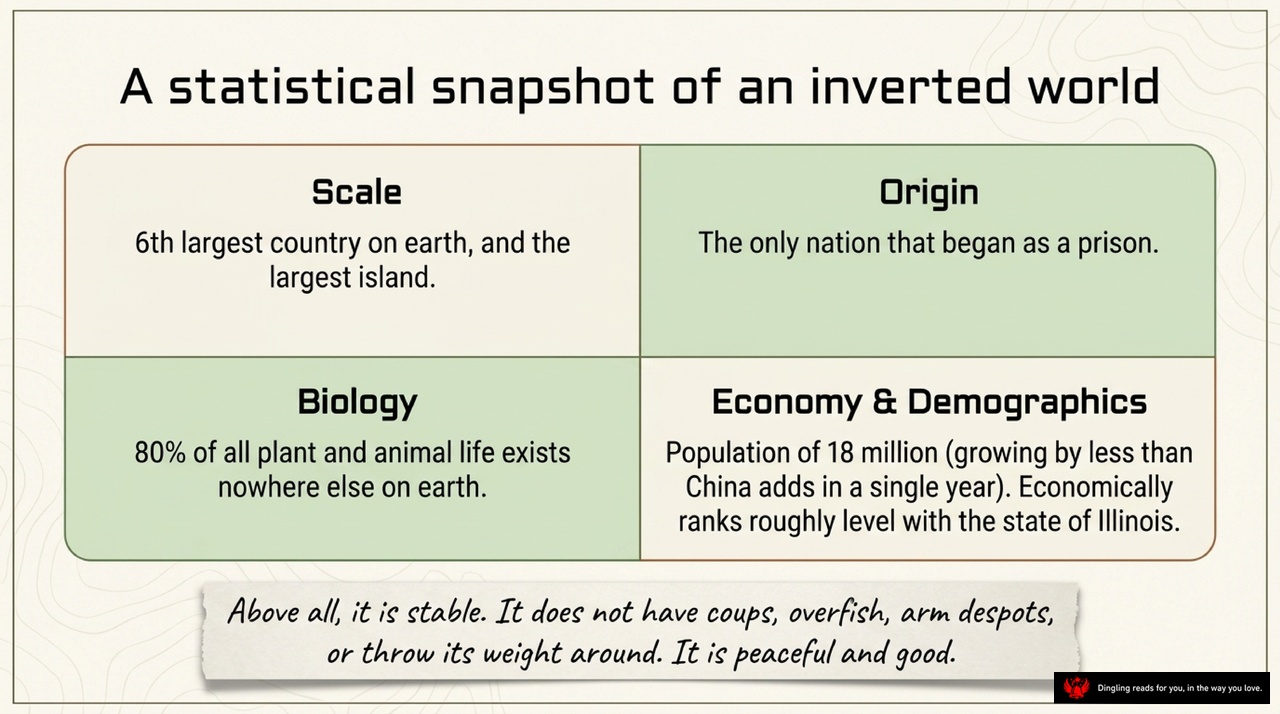
But beneath that calm exterior lies a wild, terrifying reality. This is the only true continent-island on Earth, home to the Great Barrier Reef, the sacred red rock of Uluru, and a menagerie of deadly creatures that includes the world's most venomous snakes, spiders, and jellyfish. It's a land where even a caterpillar or a shell can kill you. Geologically, it's a ghost story; the rocks here are billions of years old, untouched by major tectonic shifts for 60 million years.
And then there's the culture. It was originally a penal colony for Britain's worst criminals, a place where the air still feels thick with history. You have the sophisticated, chaotic energy of Sydney with its iconic Opera House and Harbour Bridge, the laid-back, beach-obsessed vibe of the Gold Coast, and the rugged, unforgiving outback that stretches endlessly under a scorching sun. From the quiet, rain-soaked streets of Melbourne to the remote, dust-choked silence of the Nullarbor Plain, Australia is a place that demands you slow down, respect its power, and see the world through its unique, sunburned lens.

Look at this stark 1997 New York Times Article Index. It tells a shocking story about how the world views Australia. While Israel generated over 500 articles and even a deceased socialite like Pamela Harriman got 22 mentions, Australia—a massive continent—only secured 20 articles. In fact, the global media cared more about bananas, which got roughly 18 articles, than about an entire country. As the graphic puts it, Australia was only slightly more important than bananas, but nowhere near as significant as ice cream. This data perfectly illustrates why Australia feels so invisible; it's a continent of immense size that the world pays remarkably little attention to.

Picture this: a map of Australia, vast and empty, with a red circle pinpointing the Great Victoria Desert. This isn't just a map; it's a warning label for the world's most dangerous secret. The text on the slide tells us that the isolation here is so profound, it could hide a nuclear detonation. In 1993, a massive seismic disturbance shook the Pacific. Truckers saw a flash in the sky; a beer can even danced off a tent table. The blast was 170 times more powerful than any recorded mining explosion. Yet, for four years, total silence. No one noticed.
Why? Because of the location. The slide points to Banjawarn Station. This was a 500,000-acre property owned by the Aum Shinrikyo cult—the same group responsible for the Tokyo subway sarin attack. They had recruited Soviet nuclear engineers and mined uranium right here in the Australian desert to test a bomb. Imagine the horror: a non-governmental atomic device detonating in the middle of nowhere, and it took almost four years for anyone to figure it out.
This story exposes a terrifying truth about Australia. It's not just a quiet, safe vacation spot. It's a continent where history can be buried under sand. While the world focused on the city or the coast, this vast interior was being used as a secret laboratory for the world's most dangerous ideologies. It serves as a stark reminder that even in the most remote, seemingly peaceful places, extraordinary and terrifying things can happen.
Welcome to Canberra, Australia's capital—a city that feels less like a bustling metropolis and more like a serene park hidden in the Australian bush. Unlike the chaotic energy of Sydney or Melbourne, Canberra was built from scratch between 1911 and 1927, designed by Walter Burley Griffin to be a "garden city" surrounded by lakes and tree-lined boulevards. It sits quietly just 40 miles from Sydney, intentionally kept off the main highways to preserve its peaceful, almost rural atmosphere.
But don't let the calm fool you; Canberra is also a place of intense political drama. In 1975, the Governor-General famously dismissed the Prime Minister, an act so controversial it nearly tore the nation apart, yet the voters soon forgave it all. Walking through the Parliament House, you'll notice a surprising lack of security and a relaxed vibe that feels more like a university campus than a seat of power. In fact, many Australians admit they know very little about their own history, often knowing more about George Washington than their first Prime Minister, Edmund Barton.
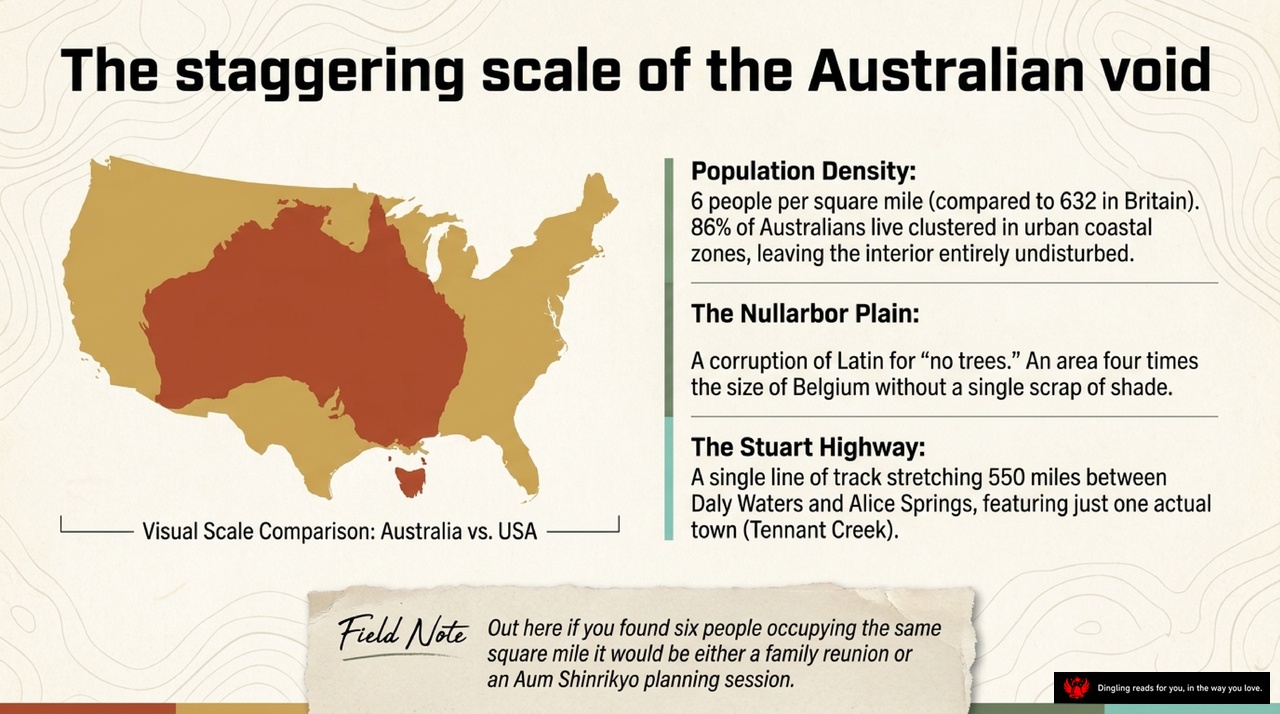
Leaving the political heart behind, we head west along the legendary Stuart Highway. This route takes you from the manicured lawns of Canberra into the vast, empty heart of the continent. Within hours, the orderly towns give way to endless red earth under a brilliant blue sky, where a single gum tree might stand alone for miles. As the radio signal fades into static, the only thing left to tune into is a live cricket match. You'll hear commentators discussing slow-paced statistics and historical trivia with a calm, soothing rhythm, creating a unique sense of comfort in the middle of nowhere.
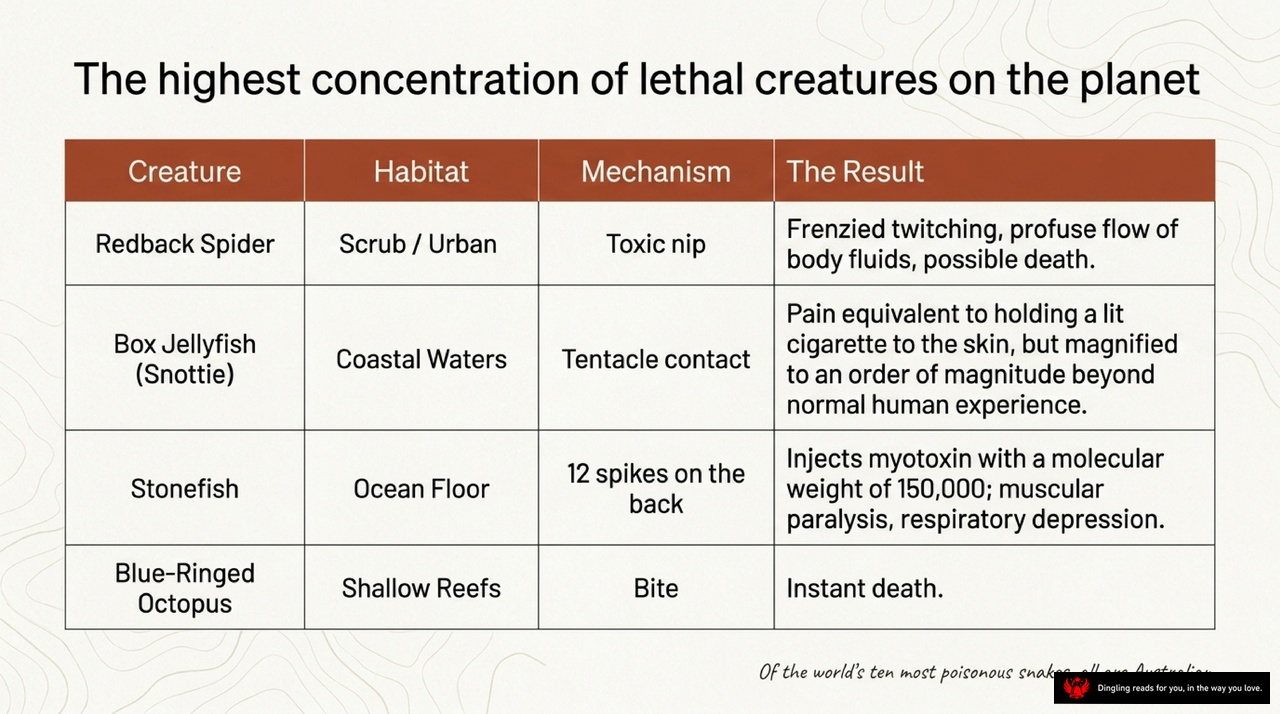
Imagine a planet where the most dangerous things you'll ever meet aren't hidden in dark forests or deep oceans, but are right here, waiting for you in places you might not expect. We're talking about the highest concentration of lethal creatures on the entire globe, and you'd be shocked to know where they live.
Take the Redback Spider, for instance. You might think it's just a garden pest hiding in scrubs or urban areas, but don't be fooled. A single toxic nip can trigger a frenzy of twitching, cause a profuse flow of body fluids, and quite possibly, lead to death. It's a deadly neighbor that you might accidentally invite into your home.
Then there's the Box Jellyfish, known as the Snottie, lurking in coastal waters. If you come into contact with its tentacles, the pain isn't just bad; it's equivalent to holding a lit cigarette directly against your skin, but magnified to a level far beyond any normal human experience. It's a pain that can break you.
Deep on the ocean floor, the Stonefish waits with 12 sharp spikes on its back. When stepped on, it injects a myotoxin so potent it causes immediate muscular paralysis and respiratory depression. And finally, in the shallow reefs, the Blue-Ringed Octopus delivers a bite that results in instant death.
As the slide notes, of the world's ten most poisonous snakes, all are found in Australia. This continent isn't just a postcard of beaches and kangaroos; it's a wild, untamed place where beauty and danger exist side by side. It's a reminder that nature here is powerful, ancient, and absolutely unforgiving.

You're looking at a slice of Australia that's often overlooked: the vast, wild interior. This slide highlights a crucial, if uncomfortable, truth about the Australian experience—a localized vocabulary designed to downstate imminent danger. Notice the illustration of the freshwater beach. It points out the rips, those invisible underwater currents that can silently drag a swimmer forty meters away, and the bluebottle jellyfish, which locals describe as looking like a blue condom with strings attached. But look at the shark; the text notes a fourteen-foot shark caught nearby that famously regurgitated a human arm in an aquarium.
This graphic perfectly captures the dynamic between the visitor and the local, a theme we see in Bryson's translation. When a local asks, "Is it dangerous?" they might shrug and say, "No, but don't brush against it. Might be a bit uncomfortable." Yet, when translated for outsiders, that same sting of a Portuguese man-of-war becomes "absolute agony." Australians, surrounded by lethal threats, have a unique cultural habit of classifying excruciating pain as mere discomfort. It's a survival mechanism, a way to maintain the relaxed, easygoing vibe we associate with the country, even while walking past hazards that would send anyone else running for cover.
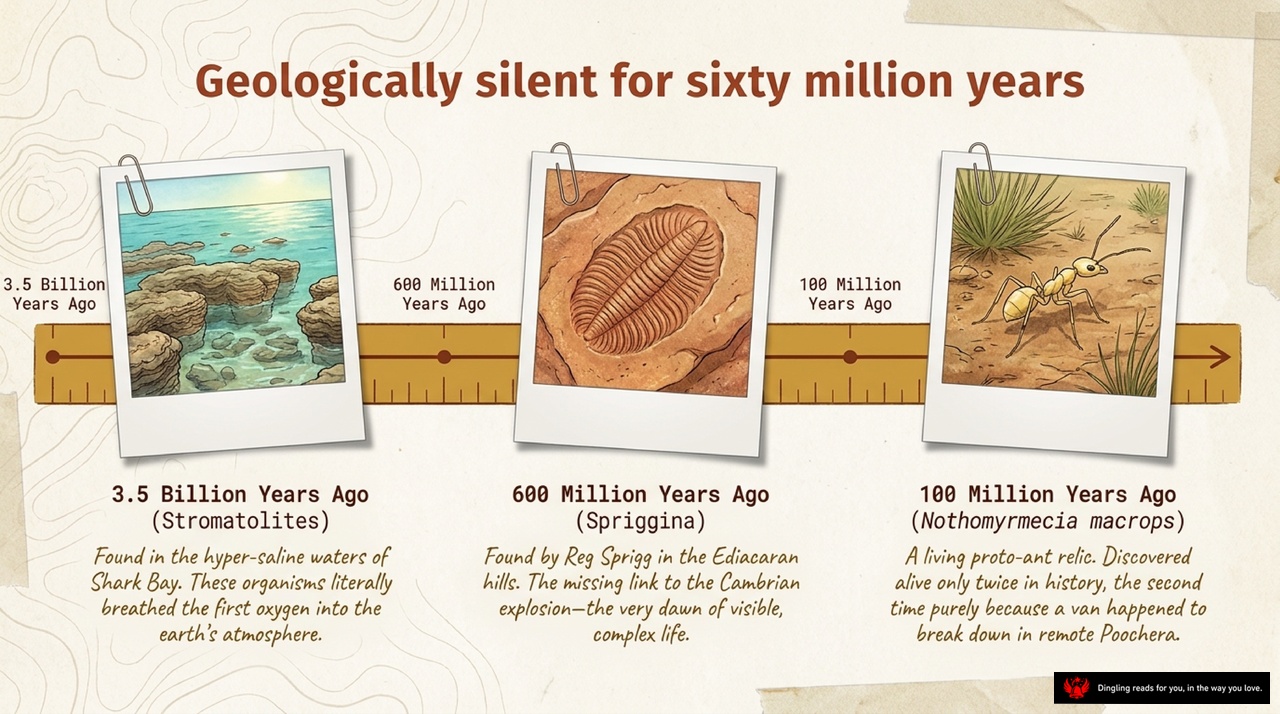
Imagine standing on the edge of time itself, sixty million years of geological silence stretching out beneath your feet. This isn't just a timeline; it's a story of survival against the odds. We begin at the dawn of life, 3.5 billion years ago, in the hyper-saline waters of Shark Bay. Here, ancient organisms known as stromatolites breathed the first oxygen into our atmosphere, setting the stage for everything that followed. Fast forward to 600 million years ago, to the Ediacaran hills where Reg Sprigg made a discovery that changed our understanding of life. He found *Spriggina*, a missing link that proved the dawn of visible, complex life long before the famous Cambrian explosion.
But the story doesn't stop there. Jump to just 100 million years ago, and we find ourselves in the remote outback of Poochera. Here, a van broke down, and in that moment of stillness, scientists discovered a living proto-ant relic: *Nothomyrmecia macrops*. This creature has been alive for sixty million years, surviving in a world that has changed beyond recognition. It is a testament to resilience, a tiny, golden survivor in a vast, ancient landscape. From the first breath of oxygen to the last standing ant, this journey reminds us that life is incredibly persistent, even when the world around it goes silent.
In the vast, often misunderstood continent of Australia, one creature stands as an absolute evolutionary enigma: the platypus. Imagine a mammal that lays eggs, possesses a venomous spur, and sports a bill that looks like it was glued on by a prankster. For decades after its discovery in 1799, scientists refused to believe it was real, even dissecting specimens to check for fraud. It was only after the discovery of its eggs in 1884 that the world accepted this bizarre, duck-billed, beaver-tailed, otter-footed mammal.
My own encounter with these unique creatures happened in Perth. While walking through the King Park, I stumbled upon a short-nosed echidna—a creature that looks like a rolling pin covered in sharp spikes. Perth itself feels like a sanctuary, a safe haven far removed from the chaos of Johannesburg where I once lived. But it is the flora that truly captivates here. With over 25,000 plant species, Australia boasts a biodiversity that dwarfs Britain's 1,600, with nearly a third of them still unnamed. This richness stems from millions of years of isolation and harsh soils that forced species to evolve in unique ways.
However, this natural paradise faces a silent threat. The lush forests of the southwest, home to 87% endemic species, are under siege from dieback disease, pushing seven species of banksia toward extinction. The mighty karri trees and towering red gums, once a breathtaking sight, are being systematically destroyed by the very industry that built the city—mining. The discovery of iron ore by Ron Hancock in the 1950s transformed Perth into a mining powerhouse, but the price paid to the land is high. As I walked through the wealthy suburbs of Mosman Park, marveling at the opulent homes, I felt a pang of guilt knowing that such wealth often comes at the expense of these ancient, irreplaceable ecosystems.
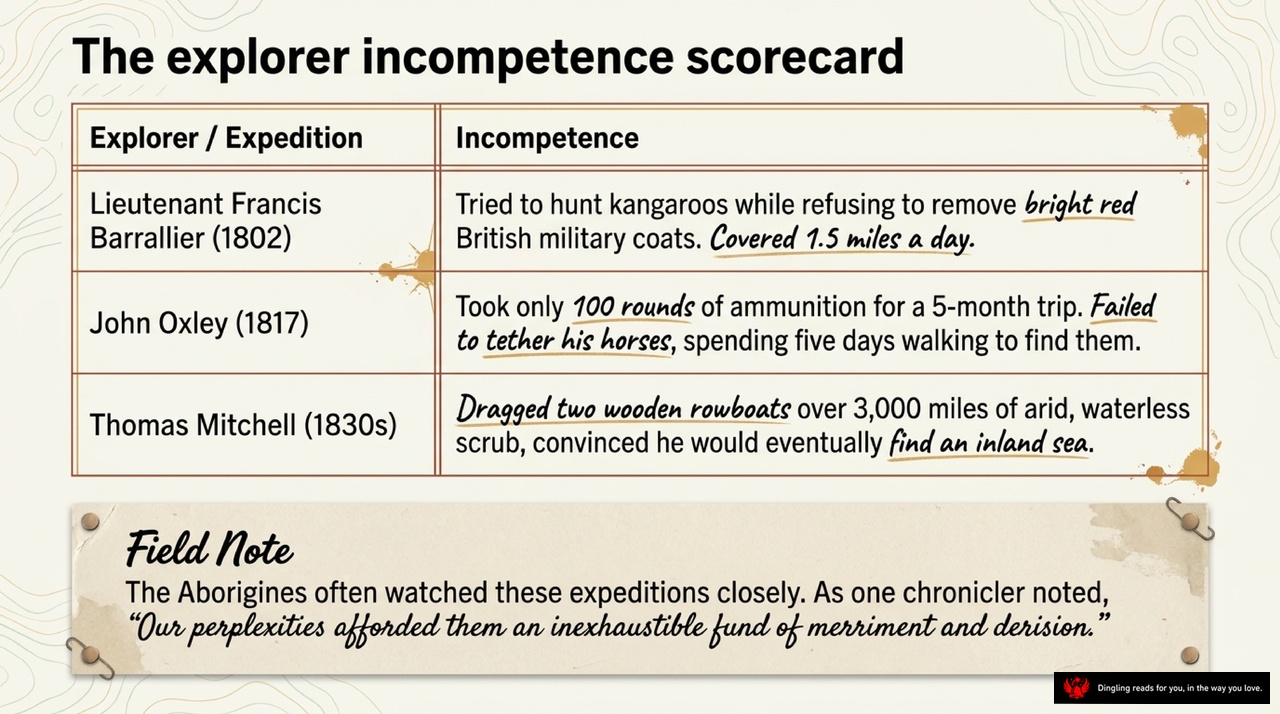
Look at this "Explorer Incompetence Scorecard." It's a brutally honest look at the early days of Australian exploration, where ambition often outpaced common sense. Take Lieutenant Francis Barrallier in 1802; he was so obsessed with hunting kangaroos that he refused to take off his bright red British military coat, which slowed him down to a pathetic 1.5 miles a day. Then there's John Oxley in 1817, who packed only 100 rounds of ammunition for a grueling five-month trip and forgot to tether his horses, forcing him to walk for five days just to find them. Perhaps the most absurd is Thomas Mitchell in the 1830s, who dragged two wooden rowboats over 3,000 miles of dry, waterless scrub, convinced he would eventually find an inland sea. As the field note reminds us, these Aborigines watched these failures closely, finding their confusion an endless source of merriment and derision.
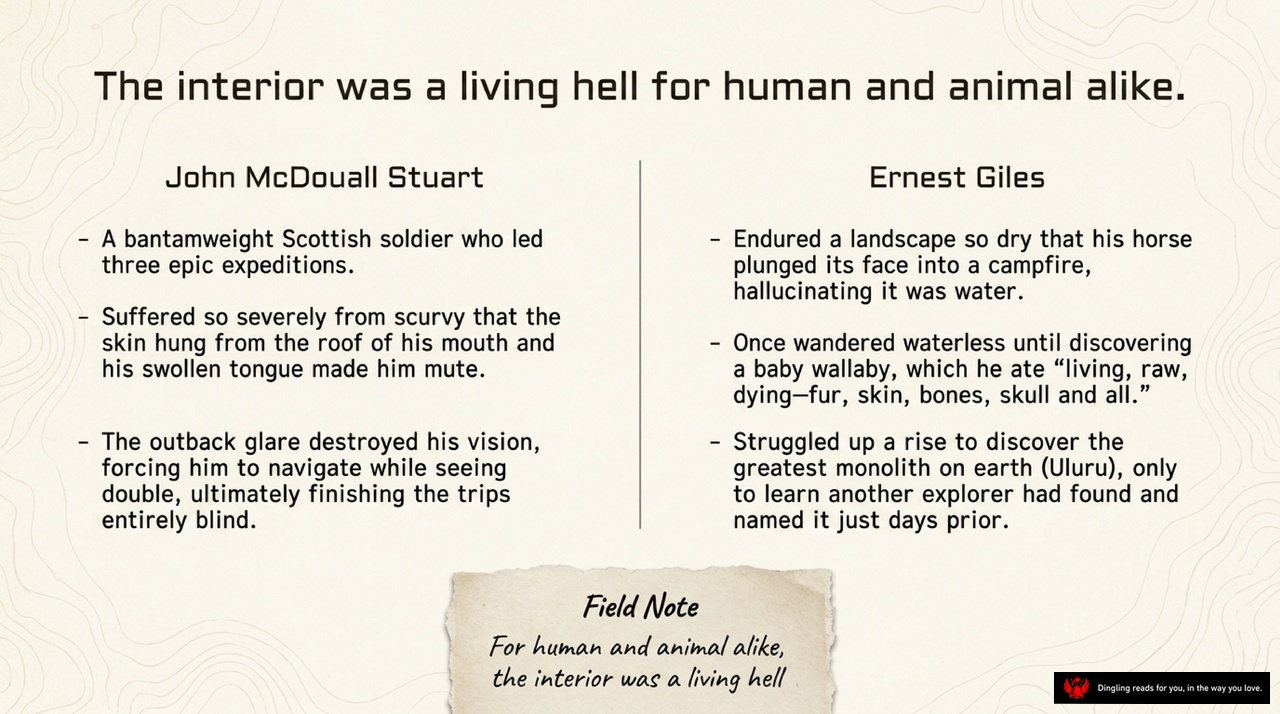
The interior of Australia wasn't just a landscape; it was a living hell for both humans and animals. As the slide highlights, the journey through this vast, arid expanse tested the limits of endurance in ways that defy imagination.
Take John McDouall Stuart, a small-statured Scottish soldier who led three epic expeditions across the continent. The toll on his body was devastating. He suffered so severely from scurvy that his skin literally hung from the roof of his mouth, and his swollen tongue was so large it left him mute. Furthermore, the relentless glare of the outback destroyed his vision, forcing him to navigate while seeing double, until he finished his trips entirely blind.
On the other side of the ledger was Ernest Giles. His story is equally harrowing. He endured a landscape so dry that his horse, desperate for water, plunged its face into a campfire, hallucinating that the flames were a stream. Giles himself wandered waterless for days until he stumbled upon a baby wallaby. In a moment of sheer desperation, he ate the animal "living, raw, dying—fur, skin, bones, skull and all." Even his discovery of Uluru, the greatest monolith on earth, was tinged with irony; he struggled up a rise to find it, only to learn another explorer had named it just days prior.
These accounts paint a grim picture of the Australian interior. It wasn't merely difficult; it was a brutal environment where survival required sacrificing everything, from dignity to sanity, and even life itself. For both the explorers and the creatures sharing their fate, the interior was truly a living hell.
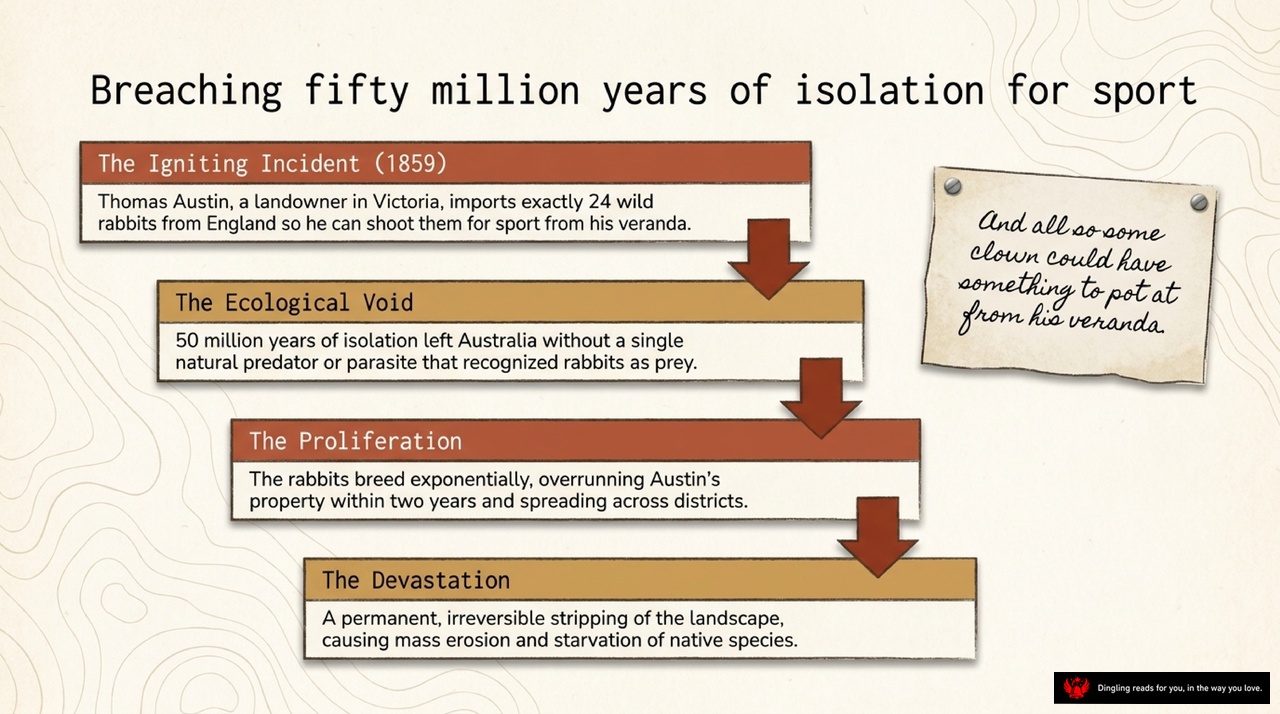
Breaching fifty million years of isolation for sport. It all started in 1859 with what Thomas Austin, a landowner in Victoria, described as a harmless hobby. He imported exactly 24 wild rabbits from England just so he could shoot them for sport from his veranda. But here's the kicker: Australia had been isolated for fifty million years, leaving it without a single natural predator or parasite that recognized rabbits as prey. It was the ultimate ecological void. Within two years, those 24 rabbits bred exponentially, overrunning Austin's property and spreading across districts. What began as a sport quickly turned into devastation, causing permanent, irreversible stripping of the landscape, mass erosion, and the starvation of native species. It serves as a stark reminder that even a small, well-intentioned act can have catastrophic consequences when the world is so far removed from the rest.
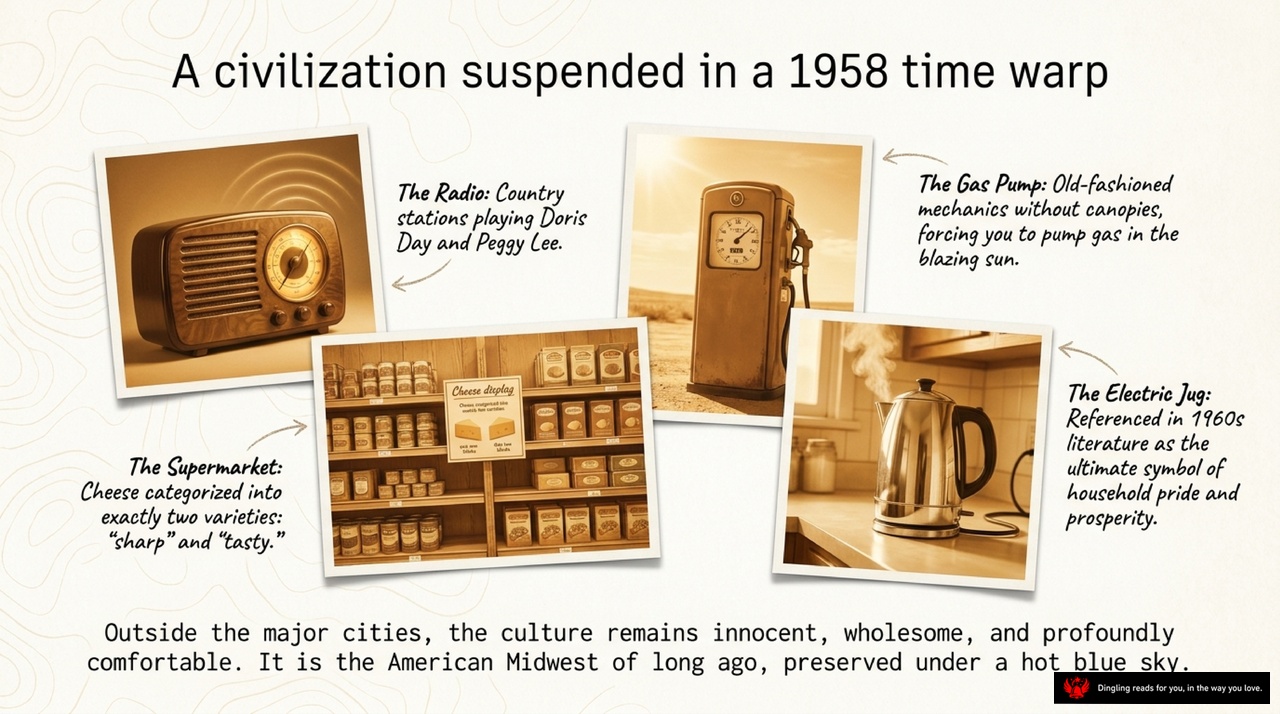
A civilization suspended in a 1958 time warp. Imagine stepping into a world where time forgot to move forward. Here, the radio isn't a gadget; it's a portal to the golden age of Doris Day and Peggy Lee, playing country stations that fill the air with nostalgia. Outside, the gas pump stands as an old-fashioned mechanic without a canopy, forcing you to pump gas in the blazing sun, a ritual that feels more like a ceremony than a chore. Inside the home, the electric jug isn't just a kitchen appliance; it's the ultimate symbol of household pride and prosperity, referenced in 1960s literature as a beacon of stability. Even the supermarket tells a story of simplicity, with cheese categorized into exactly two varieties: "sharp" and "tasty." Outside the major cities, this culture remains innocent, wholesome, and profoundly comfortable. It is the American Midwest of long ago, preserved under a hot blue sky, a perfect snapshot of a simpler time frozen in amber.
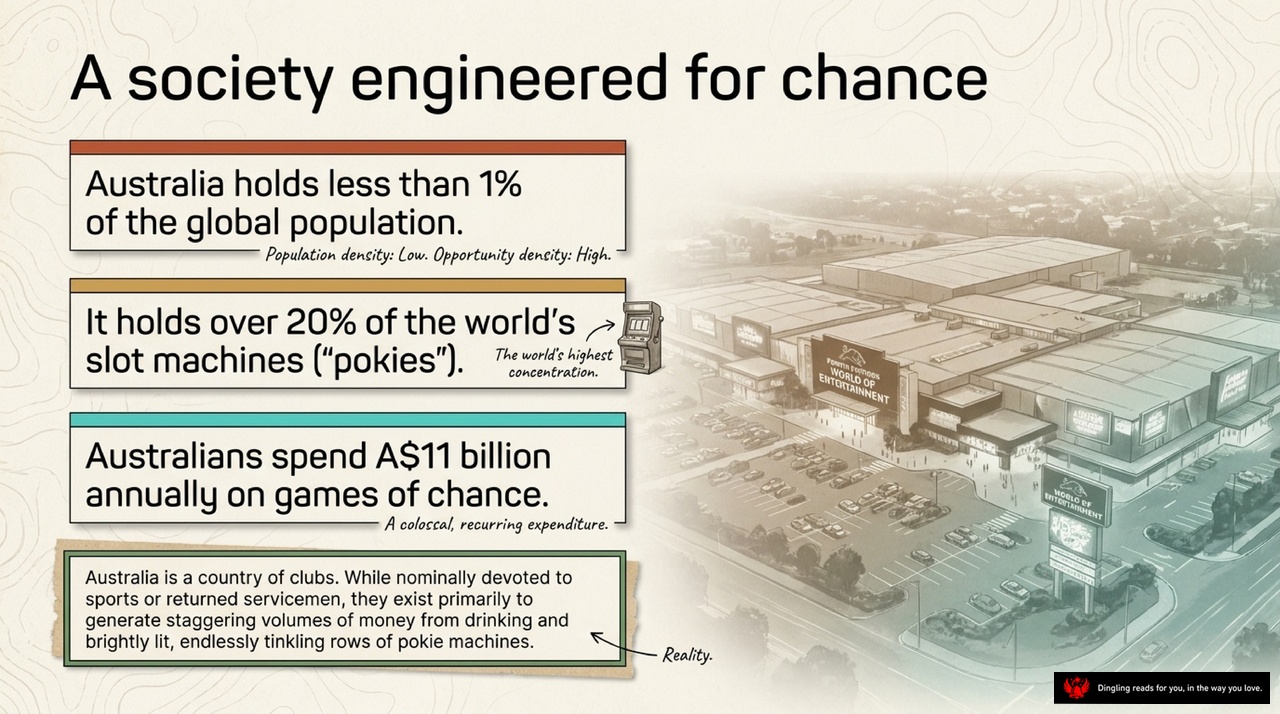
Australia is a country engineered for pure chance. While it holds less than 1% of the global population, it concentrates over 20% of the world's slot machines, known locally as "pokies." This creates a society where opportunity density far outweighs population density. Australians spend a staggering A$11 billion annually on games of chance, a colossal recurring expenditure that defines much of their social life.
What you see here is the reality behind the surface. While Australia is nominally devoted to sports and returned servicemen, its clubs and entertainment centers exist primarily to generate staggering volumes of money from drinking and brightly lit, endlessly tinkling rows of pokie machines. It's a unique paradox where a nation of low population density has built an entire economic engine around the thrill of luck.
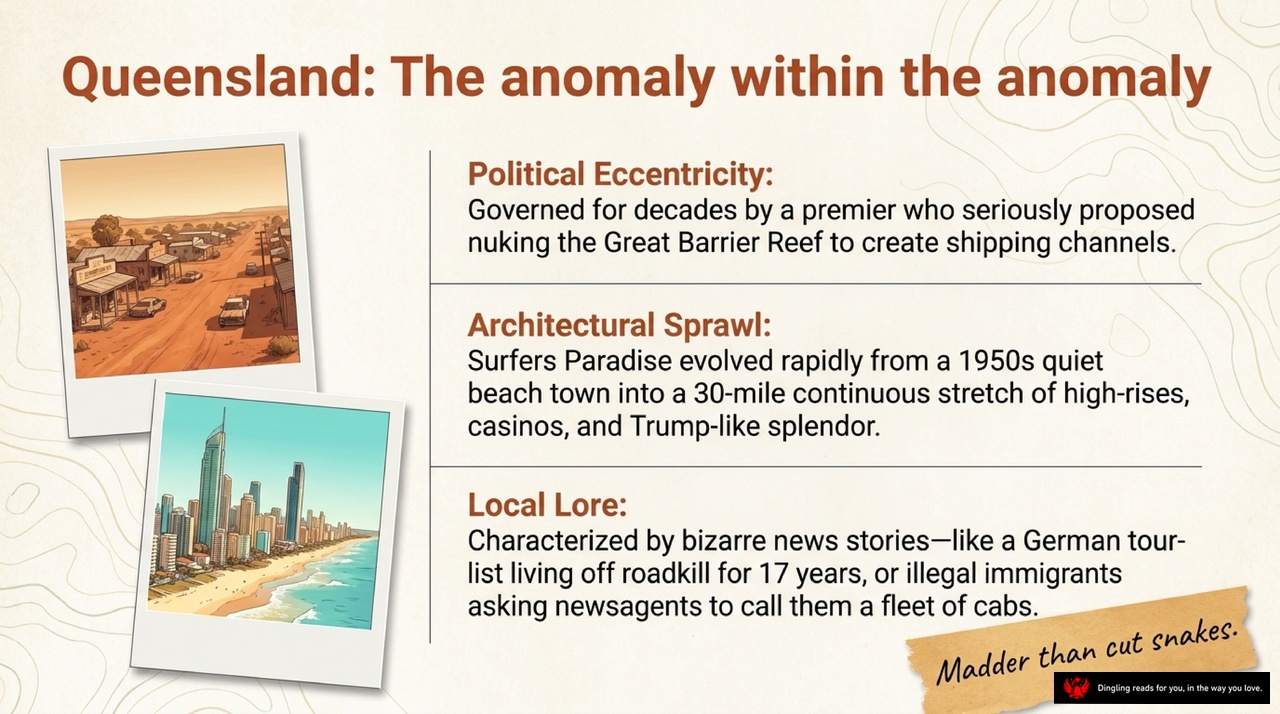
Queensland is the state that refuses to blend in, a place defined by what I call "the anomaly within the anomaly." It's a region where the bizarre feels like the standard operating procedure. Think about the political eccentricity here; for decades, this state was governed by a premier who seriously proposed nuking the Great Barrier Reef just to create shipping channels. It's a level of absurdity that makes you question reality.
Then there's the architectural sprawl. Take Surfers Paradise, for example. It evolved rapidly from a quiet 1950s beach town into a 30-mile continuous stretch of high-rises, casinos, and Trump-like splendor. It's the Australian equivalent of Florida, a place where the line between vacation and excess is completely blurred.
But the strangest part is the local lore. This state is characterized by bizarre news stories that you wouldn't believe if someone told you. Imagine a German tourist living off roadkill for 17 years, or illegal immigrants asking newsagents to call them a fleet of cabs. These aren't just jokes; they are the stories that define the Queensland experience. As the slide perfectly puts it, the culture here is madder than cut snakes. It's a wild, unpredictable, and utterly unique chapter in Australia's story.
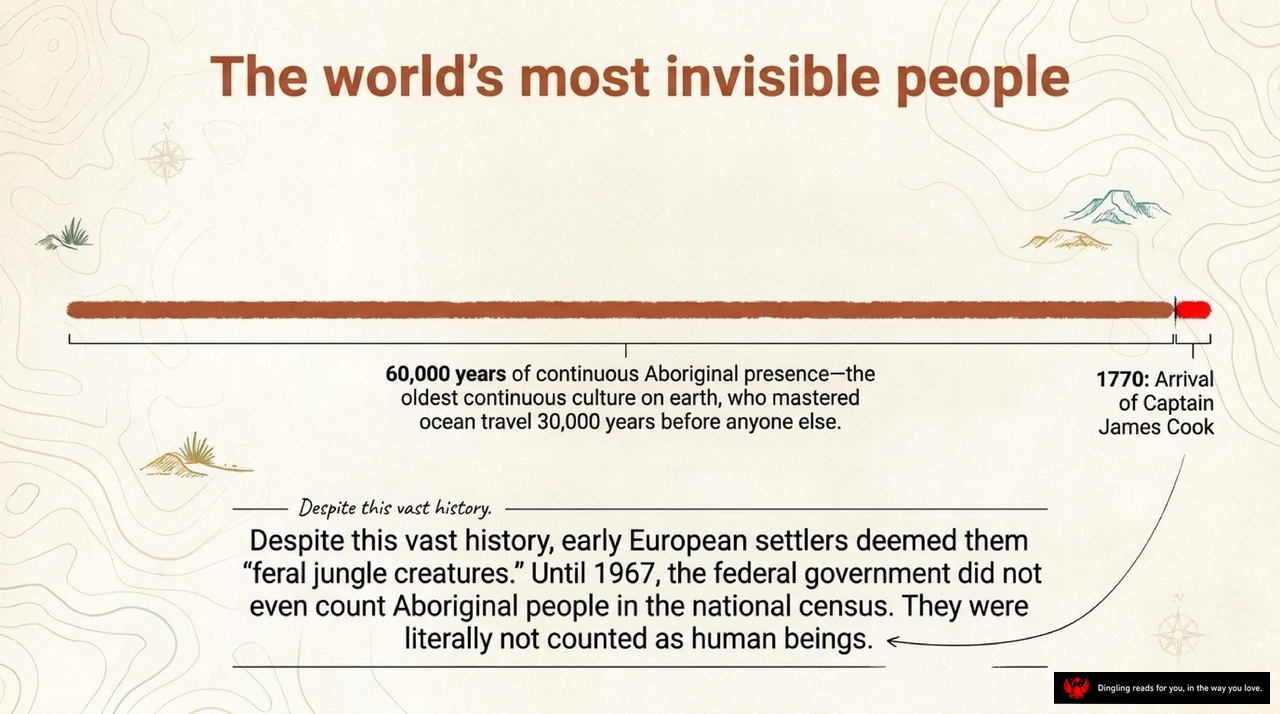
For 60,000 years, the Aboriginal people have called this land home, creating the oldest continuous culture on Earth. Long before anyone else mastered ocean travel, they were navigating these vast waters, connecting islands and coastlines with a knowledge that rivals no other civilization. Yet, despite this deep, ancient history, early European settlers arrived in 1770 and quickly dismissed them as "feral jungle creatures," ignoring their wisdom and humanity. The erasure didn't stop there; until 1967, the federal government refused to count Aboriginal people in the national census. For decades, they were literally not counted as human beings, their existence erased from official records and public memory. This slide highlights the stark contrast between their profound legacy and the long period of invisibility they endured, a silence that only began to break when the government finally acknowledged their humanity.
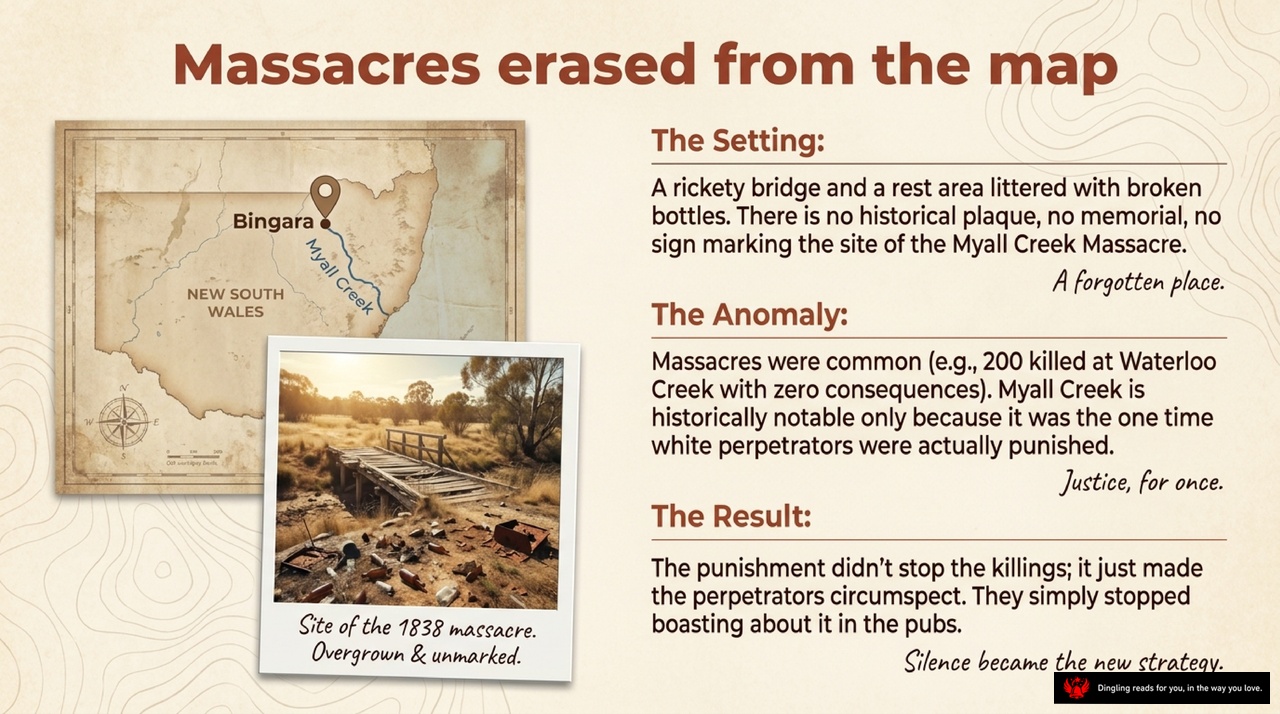
The slide highlights a haunting truth: "Massacres erased from the map." It points us to Bingara in New South Wales, specifically the Myall Creek site, which today looks like a forgotten place. All we have is a rickety bridge and a rest area littered with broken bottles. There is no historical plaque, no memorial, and no sign marking the site of the 1838 massacre. It feels like a place that never existed.
This erasure is the anomaly. Massacres were common back then—like the 200 killed at Waterloo Creek with zero consequences. Myall Creek is historically notable only because it was the one time white perpetrators were actually punished. Seven men were hanged, delivering justice, for once. But the result was chilling. The punishment didn't stop the killings; it just made the perpetrators circumspect. They simply stopped boasting about it in the pubs. Silence became the new strategy. Today, that silence has succeeded in burying the memory, leaving us with a landscape that refuses to acknowledge its bloody past.
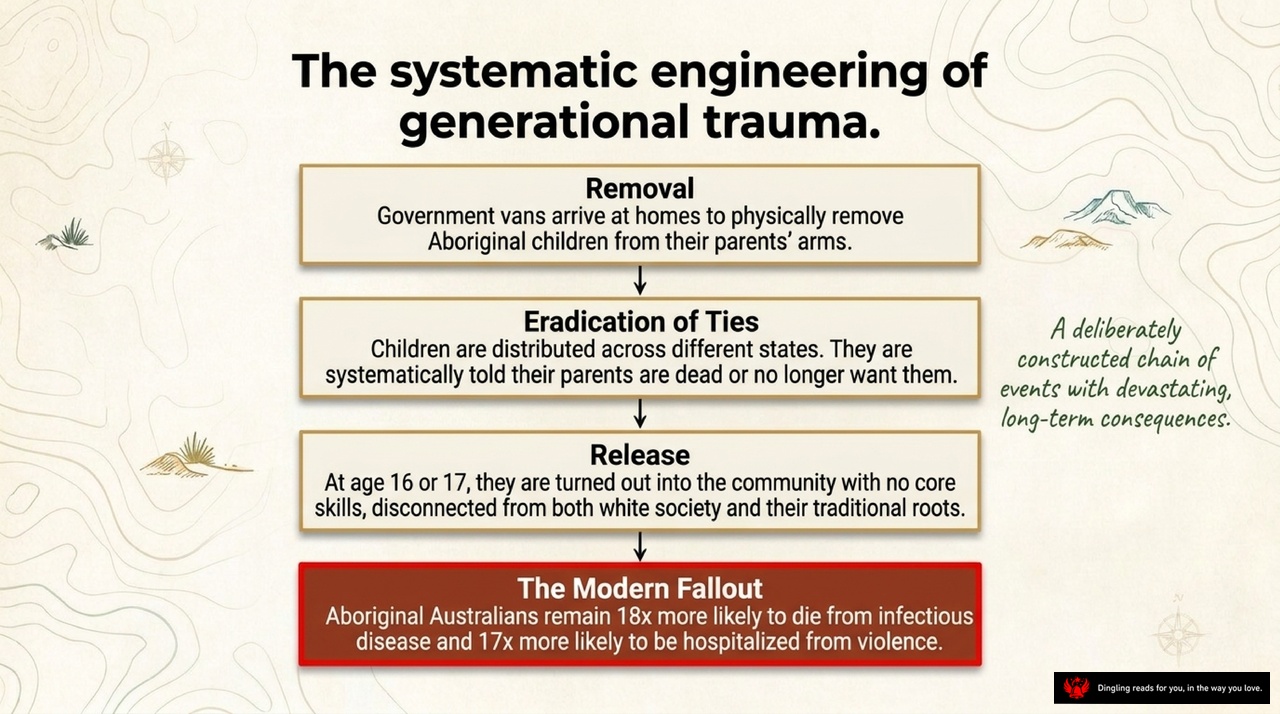
This slide lays bare a heartbreaking reality that often gets buried in the noise of modern Australia. It outlines the systematic engineering of generational trauma, a deliberately constructed chain of events with devastating, long-term consequences. It begins with Removal, where government vans physically ripped Aboriginal children from their parents' arms, severing the first bond of life. This was followed by the Eradication of Ties; children were scattered across different states and systematically told their parents were dead or no longer wanted them, destroying their identity and family history. Then came Release. At age 16 or 17, these children were turned out into the community with no core skills, completely disconnected from both white society and their traditional roots. The result is The Modern Fallout. Today, Aboriginal Australians remain 18 times more likely to die from infectious disease and 17 times more likely to be hospitalized from violence. This isn't just a statistic; it is the direct, living legacy of a policy designed to erase a people, leaving a scar that runs deep through the nation's history and present day.

On the surface, Alice Springs looks like a thriving, modern hub. You see air-conditioned Kmart plazas, bustling pedestrian malls, and locals strolling with a Saturday smile. But just a stone's throw away lies a completely different world. In the dry riverbed of the Todd, you find shadowy Indigenous figures resting, or moving with a slow, knocked-about gait, bearing bandages on their shins and foreheads.
These two groups share the same physical geography, yet they occupy entirely different realities. The white population simply reads their newspapers, drinks their coffee, and stops seeing them altogether. It creates a stark divide: the visible, thriving surface versus the unseen, knocked-about undercurrent. We live in separate but parallel universes, side by side, yet worlds apart.
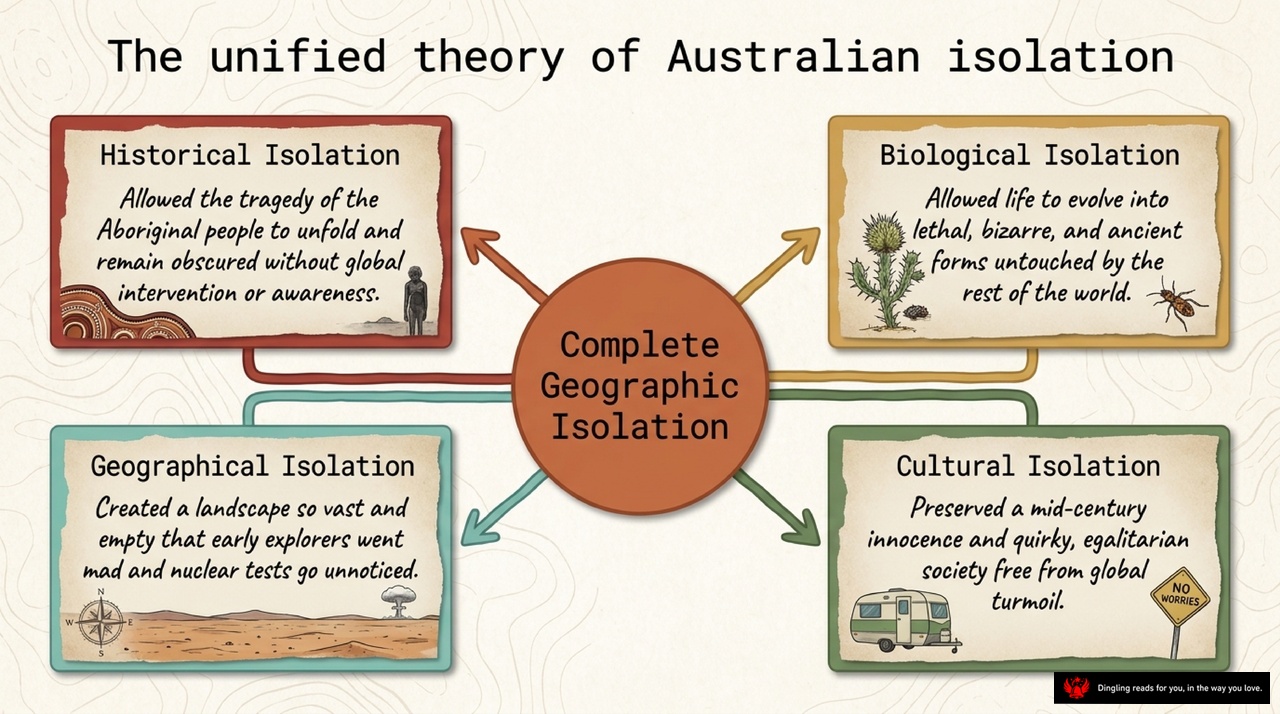
Today, we're diving into the heart of Australia's identity through a concept that ties everything together: the unified theory of Australian isolation. At the center of this is Complete Geographic Isolation, the vast, empty landscape that defined the continent. As the slide illustrates, this isolation created a unique backdrop where early explorers went mad, and even nuclear tests went unnoticed. But this geography wasn't just about empty space; it sparked four distinct forms of isolation. First, Historical Isolation allowed the tragedy of Aboriginal people to unfold and remain obscured without global intervention. Second, Biological Isolation let life evolve into lethal, bizarre, and ancient forms untouched by the rest of the world. Third, Cultural Isolation preserved a mid-century innocence and quirky, egalitarian society free from global turmoil. Finally, the vastness of the land ensured that Australia remained a place where the world could forget to look, yet where the most unique and dangerous things on Earth thrived.
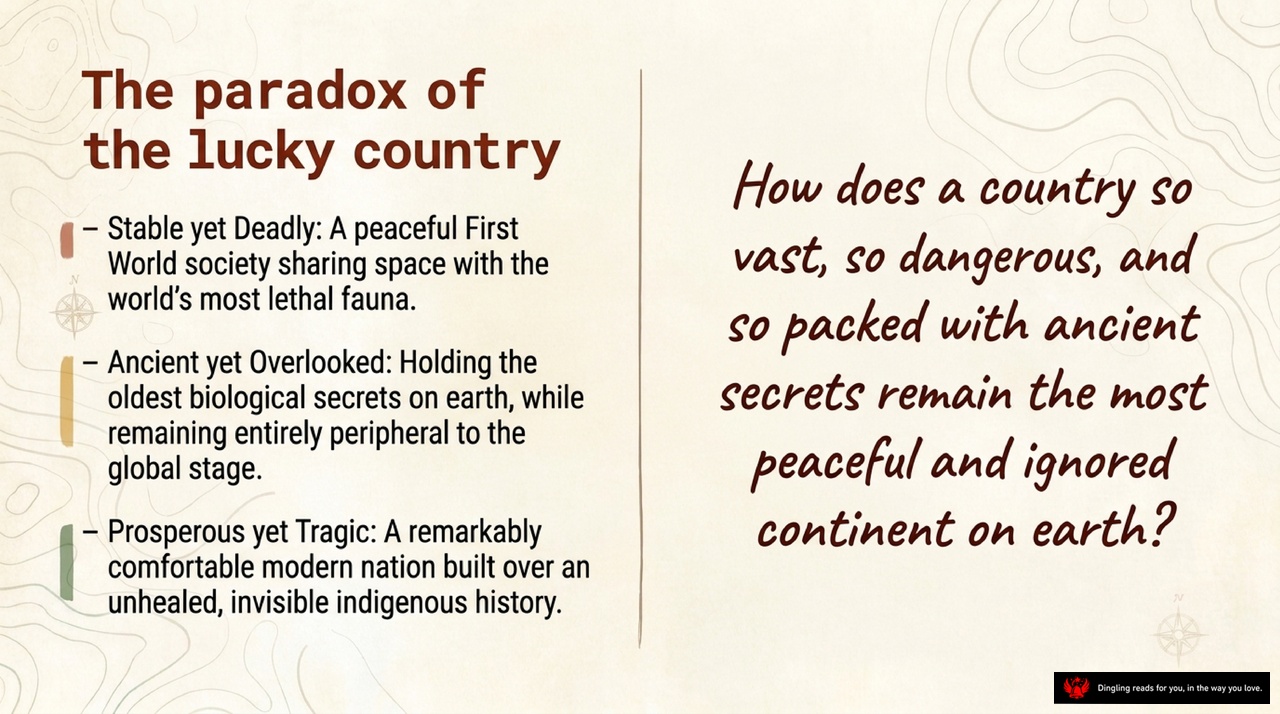
Welcome back to our journey through the paradox of Australia. Today, we're stepping into the heart of the continent, far from the polished cities of Sydney and Melbourne, to explore a place where history, nature, and human resilience collide in the most dramatic ways.
We are now traveling along the legendary Stuart Highway, a route that stretches nearly 1,000 miles from Adelaide to Darwin. This isn't just a road; it's a timeline of exploration and survival. As we drive west, the landscape transforms instantly. One moment, you're passing through the gentle, rolling hills of riverine sheep country; the next, you are plunged into a vast, brown expanse under a blinding blue sky. It's that classic Australian experience of dropping straight into the wilderness, where the nearest town might be hundreds of miles away.
The silence here is profound, broken only by the hum of the car and the occasional sound of a bird or a distant train. The radio signal fades, leaving you with nothing but the static and the rhythmic broadcast of a cricket match, which serves as a unique soundtrack to this remote journey. It's a slow, hypnotic rhythm that forces you to slow down and truly see the world around you.
As we push further inland, we reach Daly Waters, a tiny, dusty outpost that feels like it exists in a different time. Here, the heat is intense, and the hospitality is warm. In the local pub, you'll find a mix of local legends—pastoralists, shearers, and tourists—all sharing stories under the watchful gaze of historic memorabilia hanging on the walls. It's a place where the past and present overlap, and where the spirit of the Australian outback truly comes alive.
But this journey isn't just about the beauty of the land; it's also about the stories hidden within it. As we travel through these remote areas, we begin to understand the deep, often painful history of the continent. The land we see today has been shaped by the footsteps of Indigenous people for tens of thousands of years, long before European settlers arrived. Their connection to this land is profound, and their stories are an integral part of Australia's identity.
Yet, despite their ancient presence, Indigenous Australians have often been marginalized, their voices silenced, and their history overlooked. This paradox is at the heart of Australia's story—a nation that is both rich in natural wonders and complex in its social fabric. As we continue our journey, we will encounter more of these contradictions, from the breathtaking landscapes to the challenges faced by the communities that call this vast continent home.
So, as we drive along this endless road, let's take a moment to reflect on what it means to be part of such a unique and diverse land. The Australian outback is not just a backdrop for adventure; it's a living, breathing entity that has shaped the lives of countless generations. And as we explore its depths, we gain a deeper appreciation for the resilience and strength of the people who call it home.