
In Search of Excellence: Complete Chapter-by-Chapter Summary

Welcome to our deep dive into *In Search of Excellence* by Thomas J. Peters and Robert H. Waterman Jr. Today, we're exploring a timeless lesson from America's best-run companies: how to perfectly balance rational strategy with human-centric management.
The cover art beautifully captures this tension. Behind the bold, abstract brushstrokes representing the messy, creative spark of human innovation, you see a precise, blue-grid blueprint. This visual metaphor is the heart of the book's argument. While we often rely on rigid structures, strategic charts, and cold data to run our organizations, true excellence comes from weaving together the logic of strategy with the warmth of people.
As the subtitle on your slide suggests, the book reveals that the most successful companies don't just optimize processes; they cultivate a culture where rational planning supports, rather than stifles, human potential. They prove that when you empower your people and align them with a shared set of values, you create an organization that is both adaptable and incredibly effective. This isn't just about management theory; it's about designing a workplace where strategy and humanity work in harmony to drive lasting success.

The Rationalist Trap vs. The Excellence Paradigm
On the left, we see the "Rationalist Trap"—the old way of doing business. It focuses purely on numbers and cost-cutting, treating people like cogs in a machine and demanding absolute certainty before taking any action. This approach often leads to analysis paralysis, where the fear of the unknown stops progress dead in its tracks.
But on the right, we have the "Excellence Paradigm." Here, the focus shifts to meaning, values, and quality. Structure becomes simple and fluid, treating employees as unique assets motivated by autonomy. Most importantly, action is defined by a tolerance for ambiguity and a preference for rapid experimentation.
The key insight at the bottom sums it all up: Soft is Hard. While the soft elements of culture and people are often overlooked, they are actually the hardest, most structural drivers of long-term success. True excellence isn't about perfect data; it's about empowering people to learn, adapt, and win.

The McKinsey 7-S Framework isn't just a chart; it's a blueprint for true organizational change. As the slide illustrates, genuine transformation requires aligning all seven elements, permanently elevating human factors to structural imperatives.
We often focus on the "Hard S's"—the rational, easy-to-quantify parts. That includes Strategy, your plan for competitive advantage; Structure, the org chart and reporting lines; and Systems, the formal processes and IT infrastructure. These are the visible bones of your company.
But look at the other three. These are the "Soft S's," and they are equally critical. You have Shared Values, the core beliefs guiding the company; Skills, your distinctive institutional capabilities; Staff, the people and their development; and Style, the behavioral patterns of leadership.
The key insight here is that these elements are deeply interconnected. You can't just tweak the structure or launch a new strategy and expect magic. If your culture, your values, or your leadership style doesn't align with your strategy and systems, the change will fail. True excellence happens when all seven variables work in harmony, turning abstract human potential into a tangible, competitive advantage.

Look at this slide: "The 8 Attributes of Excellence." These aren't just buzzwords; they are the DNA of the world's most enduring companies.
First, we see a Bias for Action. It's about moving fast, learning, and iterating rather than getting stuck in endless analysis. Next, being Close to the Customer. Great companies don't just sell to customers; they listen to them and build their entire strategy around real human needs.
Then, Autonomy and Entrepreneurship. These firms empower their people to take risks and innovate, treating employees like partners rather than cogs in a machine. Productivity comes through People, not by squeezing them harder.
They are also Hands-On and Value-Driven. Leaders aren't hiding in boardrooms; they are walking the floor, embodying the values they preach. They Stick to the Knitting, meaning they focus on their core business and don't get distracted by trendy diversifications.
They maintain a Simple Form with Lean Staff, avoiding the bloat of complex matrix structures that kill efficiency. Finally, they master Simultaneous Loose-Tight Properties: they hold a tight grip on core values while giving teams the freedom to experiment and solve problems their own way.
In short, excellence isn't about perfection; it's about a culture that balances freedom with focus, and action with integrity.

Great companies don't just talk about strategy; they break massive, bureaucratic problems into small, actionable pilot projects. As the slide illustrates, this is the power of "chunking." Instead of getting stuck in endless analysis, they use a temporary task force—often a small group of senior staff locked in a room for just three days—to solve major issues quickly. They demand a solution, build a prototype, and then immediately disband the group. This approach replaces the paralysis of over-planning with rapid, pragmatic experimentation. By keeping these teams small and short-lived, they avoid the bureaucracy that kills innovation, proving that sometimes, the fastest way to solve a complex problem is to cut through it with a focused, temporary team.

Attribute 2: Close to the Customer. Here's the truth that separates good companies from great ones: top-tier companies don't just make products; they view themselves as service businesses first, regardless of what they manufacture.
Look at Frito-Lay. They set a standard of 99.5% service level. Their execution is extreme: sales reps will drive through hurricanes or spend hundreds of dollars to restock a single $30 display of potato chips. Why? Because the symbolic commitment to the customer overrides short-term cost analysis.
Now look at IBM. Their standard is simple: Service is the ultimate differentiator. Their execution is a 24-hour resolution rule. If a system goes down, global experts are flown in immediately. Sales reps are heavily penalized if a customer returns equipment, ensuring accountability remains long after the sale.
This isn't just about being nice. It's about embedding service into the DNA of sales, production, and R&D. When you treat your customers as partners rather than transactions, you build loyalty that no competitor can buy.

Innovation isn't just about having brilliant ideas; it's a numbers game. It requires championing individuals, not just managing R&D pipelines. As we've seen with 3M and DEC, the most successful companies don't rely on complex matrices or rigid hierarchies. Instead, they build a specific ecosystem where creativity can actually survive and thrive.
Look at this Venn diagram. It shows the three essential pillars of this innovation ecosystem. First, you need The Product Champion. This is the obsessive, often unreasonable visionary who pushes the product forward against all odds. They are the ones who see the opportunity when others see a risk.
But a champion alone isn't enough. You need a second pillar: The Executive Sponsor. This is the senior leader who protects the champion from corporate bureaucracy and secures funding. Think of it as a "bootlegger" role—someone willing to bypass red tape to get resources to the people who need them most.
However, even with a champion and a sponsor, the third element is absolutely critical: The Environment. This must be a culture that tolerates failure and demands high volumes of experimentation. As 3M famously put it, "Thou shalt not kill a new product idea." The organization must be willing to accept that many experiments will fail, viewing those failures as necessary steps toward success.
When these three circles overlap—creating that 45% intersection area—you get the magic. You create a space where risk-takers are protected, resources are available, and the culture rewards trying. It's a system where the individual's drive meets the organization's support, turning the abstract concept of "innovation" into a measurable, repeatable reality.

Attribute 4: Productivity Through People. Here's the core idea: treating workers as adults and partners yields exponential productivity over strict oversight.
Look at this seesaw. On one side, we have "The Illusion of Control"—the heavy weight of micromanagement and rigid rules. On the other, we have "Trust & Autonomy," glowing with the energy of true human potential. The research is clear: leaning too far into control actually drags performance down, while empowering people lifts the entire organization.
Consider the "Noise Switch Experiment." Psychological studies show that when workers are exposed to constant noise or chaotic interruptions, their performance tanks. But here's the twist: if you give them a "kill switch"—the authority to turn off the noise, even if they never actually press the button—their error rates plummet instantly. Why? Because the mere knowledge of autonomy drastically improves human performance. It's not about the noise itself; it's about the feeling of control.
This isn't just theory; it's real-world application. Companies like Dana Corporation and McDonald's have ditched massive policy manuals in favor of single-page philosophies. They trust the experts—the people actually operating the machines—to make the decisions. When you stop trying to control every detail and start trusting your people, you unlock a level of productivity that rigid oversight simply cannot match.

Values are not just words written in a memo; they are the behaviors modeled by executives on the front lines. As this slide illustrates, the journey from the abstract plan in the boardroom to the concrete action at the frontline is where true leadership happens.
We see here the concept of Management By Wandering Around, or MBWA, pioneered by Hewlett-Packard. It's about stepping out of the office to engage in informal, spontaneous communication with staff at all levels. When leaders are visible and accessible, they don't just enforce rules; they embody the company's values.
Look at the second point: Visible Standards. Think of Ray Kroc at McDonald's. He didn't just trust his managers; he regularly inspected franchises for QSC&V—Quality, Service, Cleanliness, and Value. His presence on the ground ensured that the promise made to customers was actually delivered, every single day.
Finally, consider the Power of Myth. Great companies cultivate legends and stories about their founders and heroes. These narratives transmit core values far more effectively than any corporate policy manual ever could. They create an emotional connection that logic alone cannot achieve.
The diagram shows a clear path: moving from the theoretical structures of the boardroom to the messy, dynamic reality of the frontline. It's a reminder that while we might have perfect strategic plans, it is the actions of our people, guided by visible leadership and shared stories, that ultimately drive success.

Attribute 6: Stick to the Knitting. Never acquire a business you don't know how to run.
Look at this diagram. Right in the center is your "Core Competence." Everything great starts here. But look at what happens when you try to expand outward without staying connected to that core. That's "Unrelated Diversification." You see the sparks flying? That's the danger zone.
In the 60s and 70s, companies fell into the "Conglomerate Trap." They believed management was a generic skill that could be applied anywhere. They thought if they were good at running one business, they could run any business. This led to disastrous acquisitions. A classic example is Heublein, a liquor company that acquired KFC. They assumed marketing was the only variable that mattered. They failed to realize they had zero expertise in managing a fast-food retail floor. Synergy is often just an illusion.
Excellence requires staying close to the businesses, products, and operational realities you deeply understand. If you acquire something you don't know how to run, you aren't building a new empire; you're just diluting your own strengths. Don't let the desire for growth trick you into losing your identity. Stick to the knitting.

Look at this architectural blueprint. It's not just a drawing; it's a blueprint for how the world's most successful companies actually operate. Notice the title: "Organizational Agility." And look at the structure itself. Instead of a complex, tangled web of departments, we see a temple with three sturdy pillars supporting a single, clear roof.
This visual perfectly captures the seventh attribute of great management: Simple Form, Lean Staff. The text on the slide makes a bold point: complex environments do not require complex matrix organizations. They require underlying simplicity. Think about it. Ford used to have 17 layers of management, while Toyota managed to do it with just five. That's the power of stripping away the unnecessary.
Let's break down these three pillars. On the left, we have "Stability." These are the simple, product-based divisions that handle the daily, foundational work. They are the bedrock. In the middle, we have "Entrepreneurship." This is the golden flow pouring through the structure—small, autonomous, highly motivated units given the space to innovate without red tape. This is where the magic happens. And on the right, we have "Habit-Breaking." These are temporary, ad-hoc task forces designed to solve specific problems and immediately disband, preventing bureaucratic buildup.
Notice how the diagram connects these elements to two distinct worlds. At the bottom left, we see "The Boardroom," representing the abstract plan. At the bottom right, we see "The Frontline," representing concrete action. Great organizations don't get stuck in the boardroom planning for years; they translate that abstract plan into immediate action on the frontline.
The message is clear. To build true agility, you need a structure that is simple enough to understand, lean enough to move fast, and flexible enough to adapt. Don't build a maze; build a temple where stability supports innovation, and where action always follows the plan.

Welcome back. Today we're diving into Attribute 8, the ultimate paradox of excellence: combining fierce centralization with radical decentralization. Think of it as a spinning top—stable at the core, but wild and fast on the outside.
Look at the diagram. We are "TIGHT on Core Values." Excellent companies are rigidly, unapologetically uncompromising regarding their core principles—product quality, customer service, and central culture. This isn't up for debate. It's the anchor.
But simultaneously, they are "LOOSE on Execution." Everything else is decentralized. Workers are granted extreme autonomy, encouraged to experiment, allowed to fail, and trusted to execute their daily work in whatever way they see fit.
This balance is the secret sauce. It's not about being either rigid or chaotic; it's about having a strong spine while letting your limbs move freely. It's the difference between a machine and a living organism.
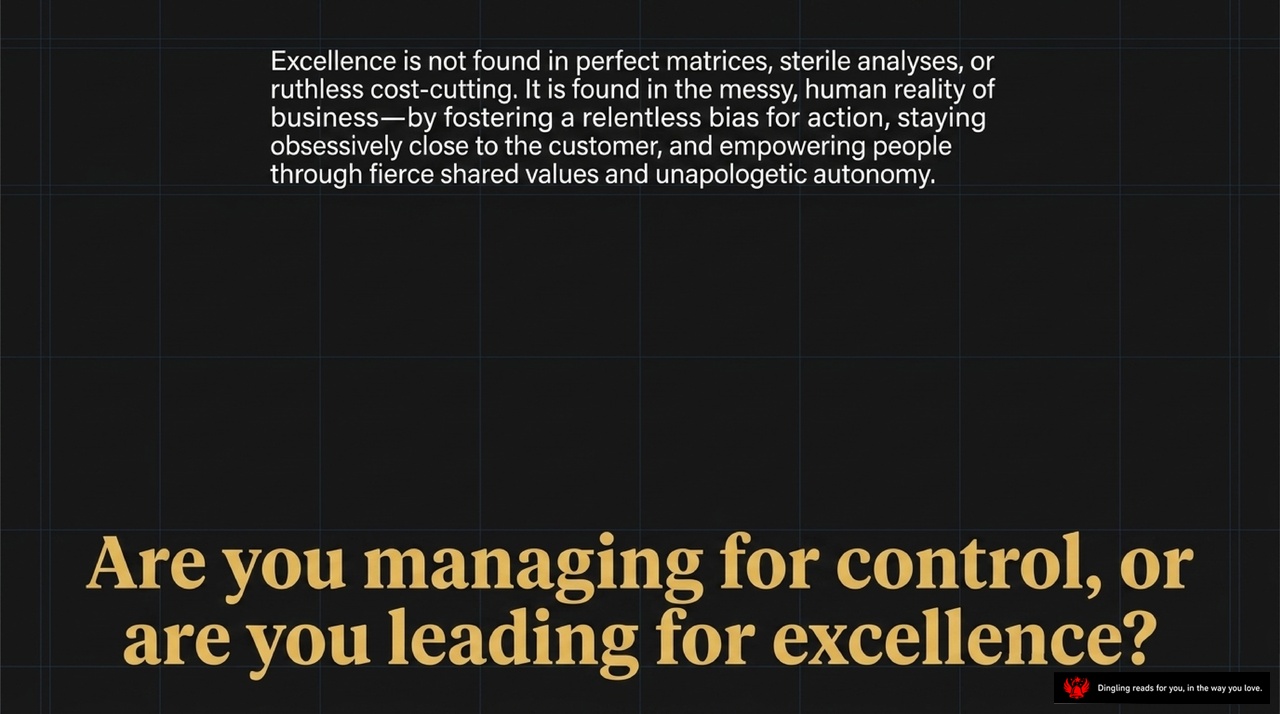
Excellence isn't found in perfect matrices, sterile analyses, or ruthless cost-cutting. It is found in the messy, human reality of business.
Look at the text on your screen: "fostering a relentless bias for action, staying obsessively close to the customer, and empowering people through fierce shared values and unapologetic autonomy." These aren't just buzzwords; they are the DNA of the world's best companies.
Think about the old way of managing. We used to believe that if we built a perfect organizational chart or ran a complex cost-benefit analysis, everything would work. But history shows us that's a trap. When you try to manage everything for control, you kill the very things that make a company great: agility, trust, and innovation.
Instead, the most successful organizations do the opposite. They prioritize action over endless analysis. They don't hide behind spreadsheets; they get their hands dirty and stay obsessively close to their customers, listening to real needs rather than relying on theoretical models.
But maybe most importantly, they empower their people. They build a culture where employees have the autonomy to make decisions and the shared values to guide them. When you trust your team, you don't need a complex matrix to hold them together. You get results.
So, here is the ultimate question for you to consider today: Are you managing for control, or are you leading for excellence? The choice defines not just your company's structure, but its future.