
In the Wilderness: Complete Chapter-by-Chapter Summary
Welcome to today's session. We are diving into a lost literary masterpiece from 1953 titled *In the Wilderness* by Liu Qing. This book confronts the corrupting nature of power and the raw human struggle of a newly born era.
Set against the backdrop of vast, golden fields at dusk, this story captures a pivotal moment in history. It follows Zhu Mingshan, a thirty-year-old cadre from Northern Shaanxi, as he leaves the safety of the provincial headquarters to take on a challenging role in a county. His journey is not just a physical trip across the Wei River Plain, but a deep internal battle between old revolutionary habits and the demands of building a new society.
As he travels, the atmosphere is electric with patriotism. Passengers discuss the Korean War and land reform, but beneath this enthusiasm lies a complex reality. Zhu Mingshan carries a heavy burden—not just the luggage in his box, but the memories of his wife, Gao Shenglan, who has drifted away from their shared ideals, becoming consumed by domestic life. He represents the idealistic yet struggling generation trying to bridge the gap between theory and practice.
This narrative explores how power can distort even the most well-intentioned leaders and how the transition from war to peace tests the resolve of every individual. It is a story about the wilderness of the human spirit, where the path forward is often unclear, and the cost of progress is paid in personal sacrifice and emotional turmoil. Join us as we explore the depths of this powerful tale.
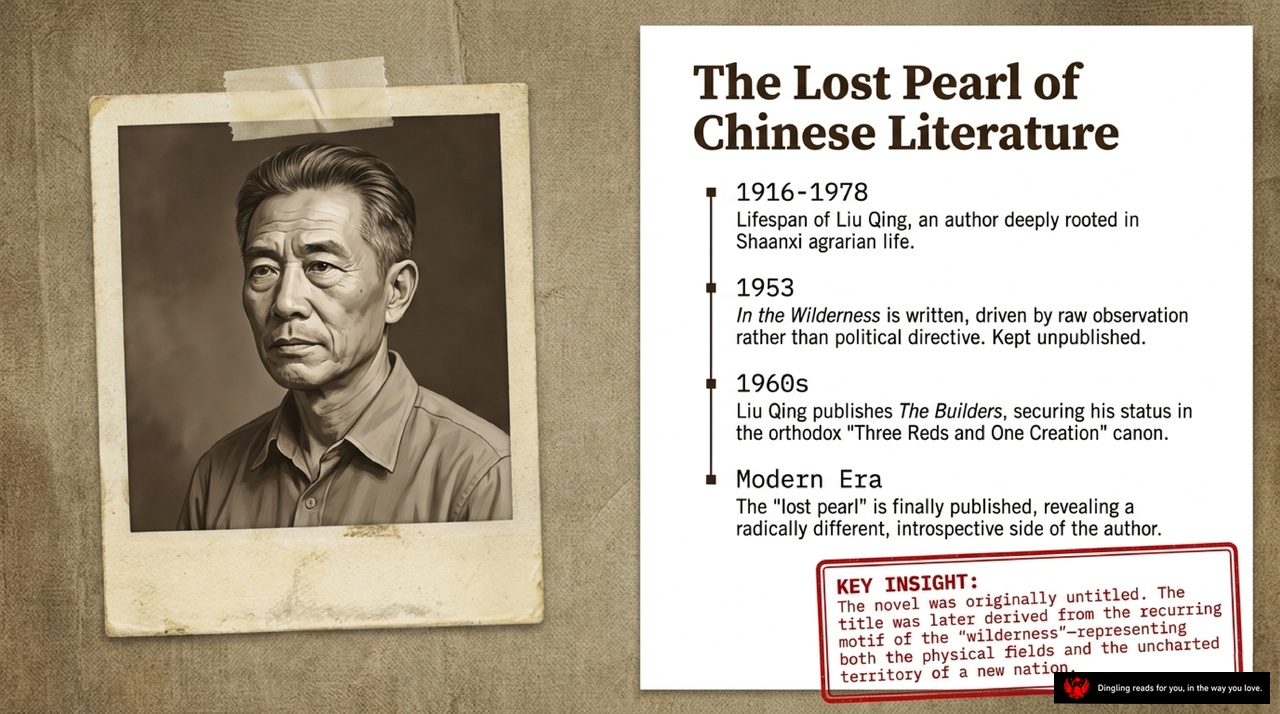
In the summer of 1951, a new chapter began for China's agricultural landscape, but for many leaders, it was a test of their true mettle. This slide introduces us to the two pivotal figures at the heart of this story: Liu Qing, whose life spanned from 1916 to 1978, and the novel *In the Wilderness*, written in 1953.
On the left, we see a portrait of Liu Qing, an author deeply rooted in the agrarian life of Shaanxi. His journey was complex. In 1953, driven by raw observation rather than political directives, he wrote *In the Wilderness*. Tragically, this masterpiece was kept unpublished at the time, becoming a "lost pearl" of Chinese literature.
Fast forward to the 1960s, when Liu Qing published *The Builders*. This work secured his status within the orthodox "Three Reds and One Creation" canon, a safe and celebrated path for an official writer. However, it wasn't until the Modern Era that the true "lost pearl" was finally revealed to the world, unveiling a radically different, introspective side of the author that had been hidden for decades.
The key insight here is profound: the novel was originally untitled. Its name, *In the Wilderness*, was derived later from a recurring motif representing both the physical fields of Shaanxi and the uncharted territory of a new nation. This duality perfectly mirrors the internal conflict of the era—where the physical struggle for survival met the ideological struggle for a new society.
This story isn't just about a book; it's about the courage to speak truth to power and the cost of silence. Liu Qing's life teaches us that while official narratives can be constructed and celebrated, the most powerful truths often come from the quiet, unrecorded corners of human experience, waiting for the right moment to be rediscovered.
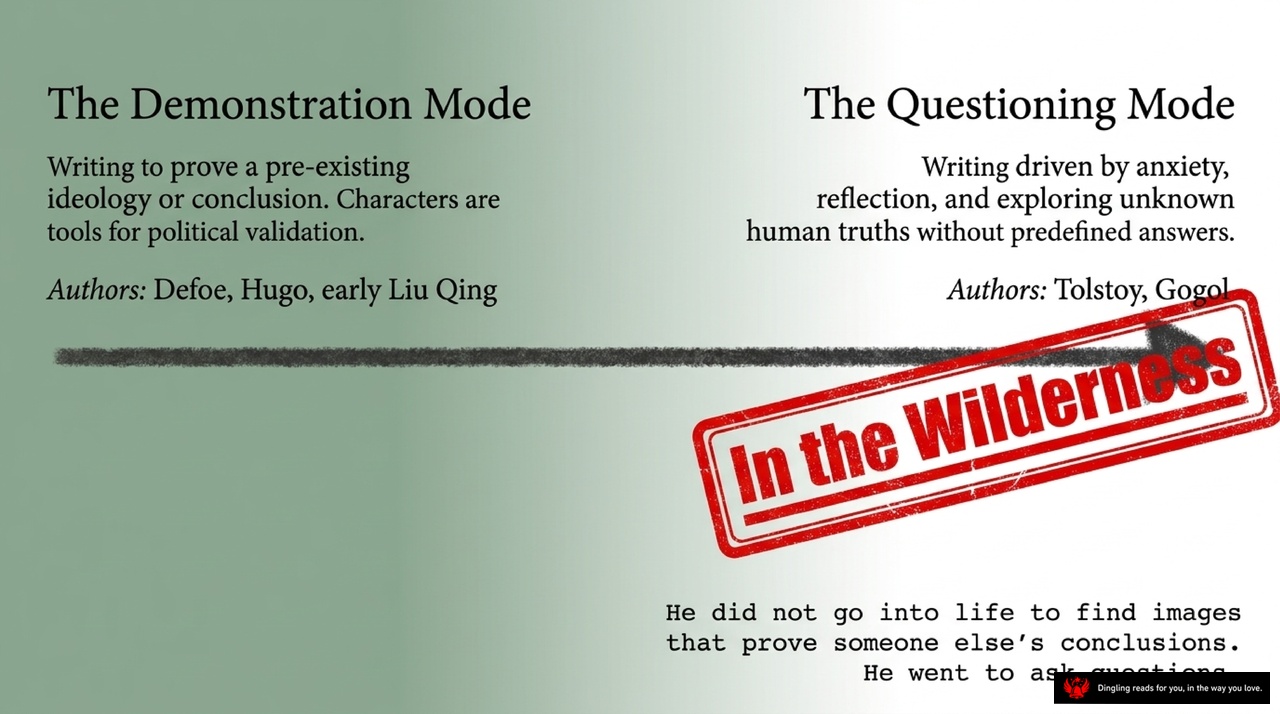
On the left, we see "The Demonstration Mode," where writing is used to prove a pre-existing ideology, treating characters merely as tools for political validation. Think of authors like Defoe or Hugo. But on the right, we have "The Questioning Mode"—writing driven by anxiety and reflection, exploring unknown human truths without predefined answers. Here, we find Tolstoy and Gogol. This slide asks us to look beyond the plot and see how the author approaches life itself.
In the book, this distinction comes alive through the character Bai Shengyu. He represents the old guard, the "Demonstration Mode." He feels that the revolution is done, that the land reform is finished, and his historical task is complete. He sees himself as an "old coat," ready to be discarded, and he wants to retreat to his home in Northern Shaanxi to farm. To him, the new work in the cotton fields feels like a burden, something he doesn't belong in. He isn't asking questions; he is justifying his exit.
However, the story challenges this. Through the crisis of the cotton aphids, the narrative forces a shift. The protagonist Zhu Mingshan doesn't just lecture Bai Shengyu; he engages him in the struggle. The book shows that when you stop trying to prove a point and start asking real questions about the people's suffering and the reality of the pests, the old guard begins to change. The red stamp "In the Wilderness" reminds us that this isn't a safe, scripted journey. It is a raw exploration where the characters must abandon their preconceived conclusions and face the terrifying, beautiful unknown of building a new society.
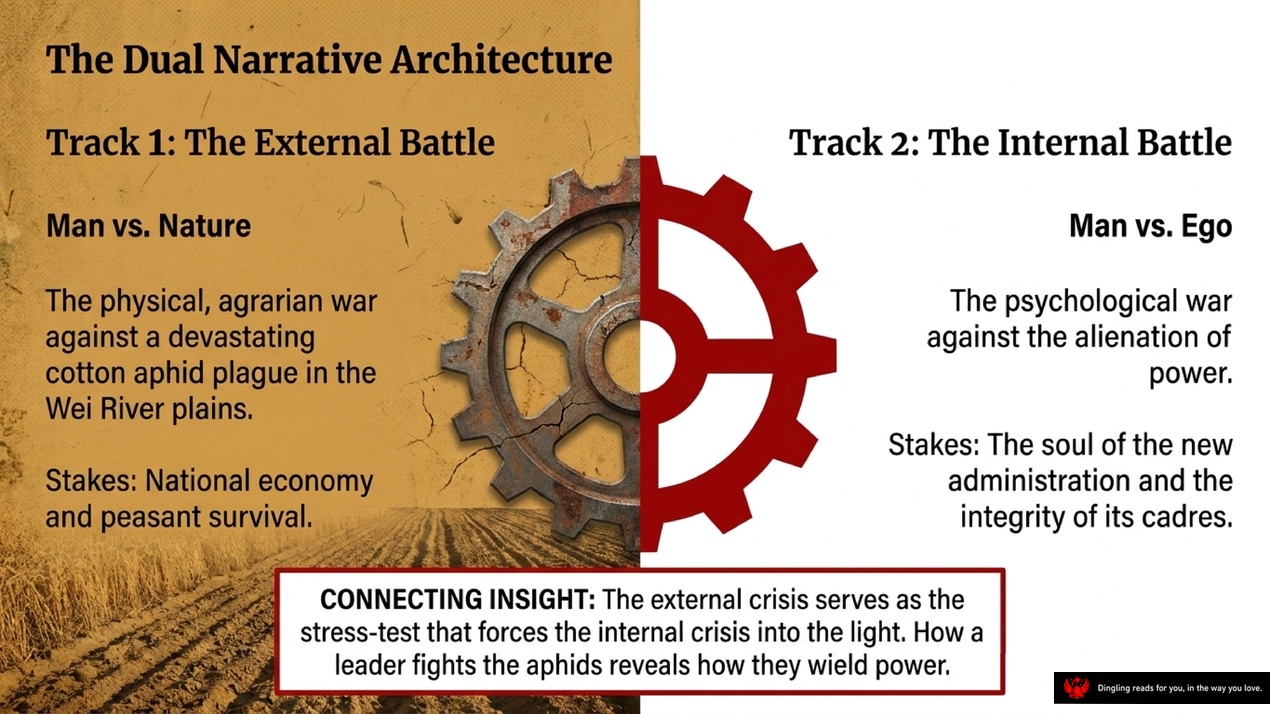
The image before us outlines the "Dual Narrative Architecture," a powerful framework for understanding leadership under pressure. On the left, we see Track 1: The External Battle—Man versus Nature. This is the physical, agrarian war against the devastating cotton aphid plague in the Wei River plains. The stakes here are immediate and life-or-death: the survival of the national economy and the peasants. On the right, Track 2: The Internal Battle—Man versus Ego. This is the psychological war against the alienation of power, where the true stakes are the soul of the new administration and the integrity of its cadres.
Here is the connecting insight that ties it all together: the external crisis serves as the stress-test that forces the internal crisis into the light. How a leader fights the aphids reveals how they wield power. In our story, this plays out sharply between two leaders. On one side, we have Liang Bin, who treats the pest control campaign as a stage for his own ego, imposing rigid commands and prioritizing his authority over the actual needs of the farmers. On the other side is Zhu Mingshan, who recognizes that to win the battle against nature, he must first win the battle against human arrogance. He understands that true leadership isn't about shouting orders from a distance; it's about getting down in the mud, listening to the farmers' local knowledge, and uniting everyone around a shared, practical goal. The aphids don't care about titles or political posturing. They only respond to coordinated action and scientific truth. By forcing his team to confront their own biases and work together, Zhu Mingshan proves that the most effective weapon against both pests and corruption is a humble, service-oriented spirit.

Look at this slide. We are deep in the crisis of the cotton aphids. The threat is absolute: fields turning black, leaves curling, and the very survival of the harvest hanging by a thread. The data is staggering—a single aphid can multiply to 600 trillion in one season. This isn't just an infestation; it's an existential war.
But how did the people react? The peasants fell into fatalism and superstition. They framed this plague as the wrath of "Insect Kings" or heaven's will, waiting for a miracle rather than taking action. Meanwhile, the bureaucratic response was equally flawed. Instead of empowering the farmers, the officials ordered them to fight the bugs through empty speeches and top-down mandates. This created passive resistance, pushing the people further away from the solution.
This disconnect between the terrifying reality of the pest, the paralyzed mindset of the farmers, and the rigid, out-of-touch commands of the leadership is exactly what the story tackles next. It's a moment where the entire system teeters on the brink of collapse, waiting for a new approach to turn the tide.

Look at this slide. We see three distinct circles connected by cracking lines, symbolizing a deepening internal crisis driven by "Cultural Anxiety." At the top, we have "The Peasant-Cadre's Obsolescence," representing veterans like Bai Shengyu who suddenly feel useless and uneducated in the new era of administration. On the right, "The Rise of the Intellectual" shows young, educated cadres clashing with the gritty, practical experience of the old guard. And on the left, "The Marriage Crisis" illustrates how officials are seeking "cultured" intellectual spouses, leaving behind the peasant wives who sustained them during the war.
This tension is captured perfectly in the quote at the bottom: "The remaining enemies are yet to be wiped out... Things we are familiar with will soon be idled, and things we are not familiar with are forcing us to do them."
This is the core of the conflict in the book. On one side, you have the old guard, like Bai Shengyu, who fought hard in the revolution but now feels like a burden because their old skills don't fit the new administrative tasks. They feel their time has passed. On the other side, you have the new intellectuals who have the knowledge but lack the grassroots toughness. This gap creates friction. It's not just about work; it's about identity. The old veterans feel their marriage is crumbling because they can no longer provide the "cultured" life their partners now expect, while the new intellectuals struggle to relate to the reality of the land.
The cracks in the diagram represent the growing divide. The familiar ways of the past are becoming obsolete, and the unfamiliar demands of the new era are forcing everyone to change, but not everyone is ready. This cultural anxiety is the real enemy they are fighting now, even before the external threats are gone.

Look at this comparison matrix. It perfectly captures the clash between two very different leadership styles. On the left, we have Zhu Mingshan, the County Party Secretary. His authority comes from the ground up, built on empathy and real fieldwork. He treats the masses like students to be guided by example, communicating quietly and observing closely. When a crisis hits, he doesn't just issue orders from behind a desk; he literally gets into the mud to test solutions himself. He is the pragmatist who seeks truth from facts.
On the right stands Liang Bin, the County Head. His power is top-down, rooted in bureaucracy and office comfort. He views the people as subordinates to be ordered via edict, obsessed with hours-long speeches and grand oratory. When a crisis arises, he demands problems be solved from his comfortable office, completely detached from the reality on the ground. He represents the alienated official who misinterprets power as privilege.
The book illustrates this divide vividly. While Zhu Mingshan spends his days riding bicycles, mixing with farmers, and testing pesticide mixtures in the cotton fields to win their trust, Liang Bin spends his time delivering long, theoretical lectures that fail to move anyone. Zhu focuses on facts and results, while Liang gets lost in empty rhetoric. This fundamental difference in how they see their role and the people determines everything—from how they handle the cotton aphid crisis to how the entire county functions. One builds a movement from the bottom up; the other tries to impose control from the top down, and the results couldn't be more different.

Look at this slide titled "The Anatomy of Power Alienation." It breaks down a specific type of leadership failure into three distinct parts: the mouth, the posture, and the definition.
First, let's look at "The Mouth." The slide calls this person "The Meeting Addict." In the book, we see this perfectly described in the character of Liang Bin. He spends hours lecturing peasants about cotton aphids, using big words and quoting Mao, but he never actually gets his hands dirty. He believes that talking is working, even while the crops are dying. He wants to be the one speaking, not the one doing.
Next, we have "The Posture," described as "Arrogance and Distance." The slide mentions demanding special treatment like mosquito coils and private rooms while avoiding the fields. This mirrors Liang Bin's behavior. He refuses to work alongside the farmers, insists on a separate office, and treats the masses with a sense of superiority. He views public office as a personal elevation in social class, a way to move up, rather than a service to the people.
Finally, on the right, we see "The Definition of Power Alienation," which lists three symptoms. The first is relying on administrative force rather than scientific persuasion. Liang Bin tries to force farmers to treat pests through orders and fear, ignoring their practical fears and lack of knowledge. The second symptom is treating the masses' reluctance as a political betrayal. When farmers hesitate, Liang Bin sees it as disloyalty, not as a reasonable reaction to their situation. The third symptom is viewing public office as a ladder for personal gain, which is exactly how he sees his position.
In short, this slide illustrates how a leader can become alienated from the very people they are supposed to serve by prioritizing their own image and power over actual results and human connection.
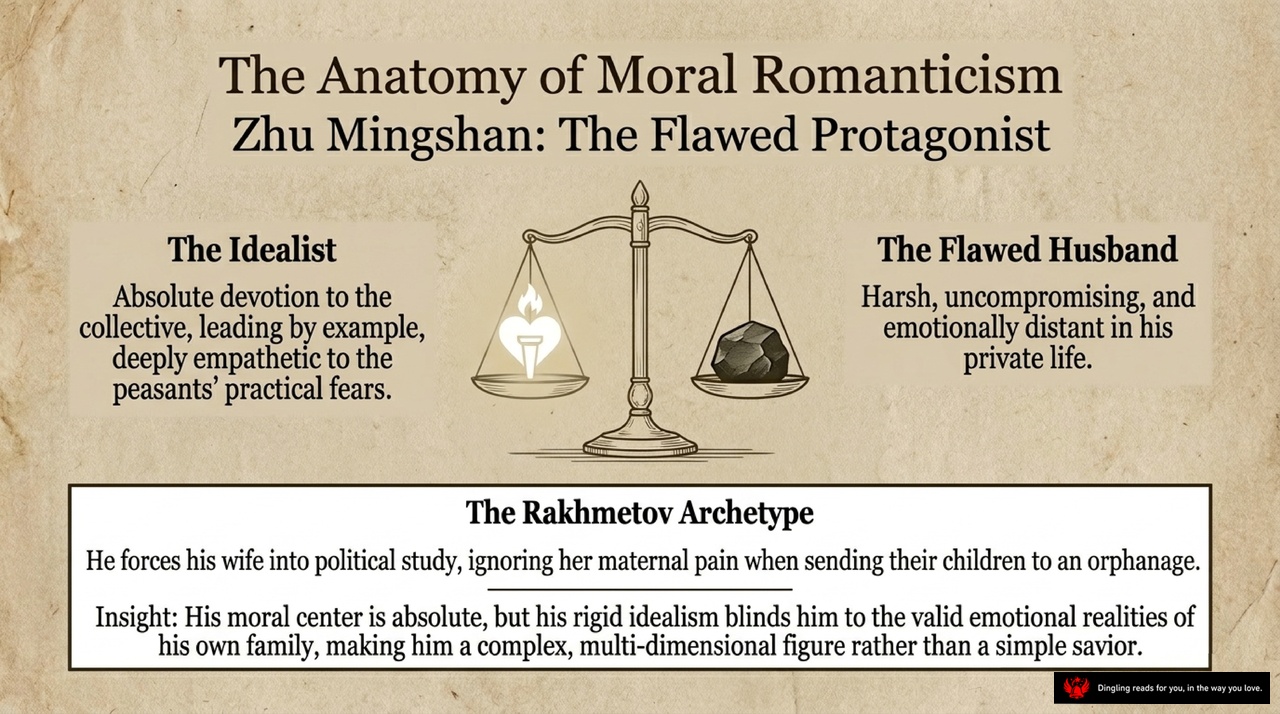
Today's slide breaks down Zhu Mingshan, our protagonist, revealing why he is ultimately a flawed hero. The image highlights a critical tension: on one side, "The Idealist," representing his absolute devotion to the collective and deep empathy for the peasants' practical fears; on the other, "The Flawed Husband," depicting his harsh, uncompromising, and emotionally distant nature in private life.
This duality places him squarely within "The Rakhmetov Archetype." As the text illustrates, Zhu forces his wife, Gao Shenglan, into political study, ignoring her maternal pain when he sends their children to an orphanage. His moral center is absolute, yet his rigid idealism blinds him to the valid emotional realities of his own family. This makes him a complex, multi-dimensional figure rather than a simple savior. He leads by example for the masses but remains emotionally distant from those closest to him, embodying the tragic cost of absolute devotion to the state over the self.
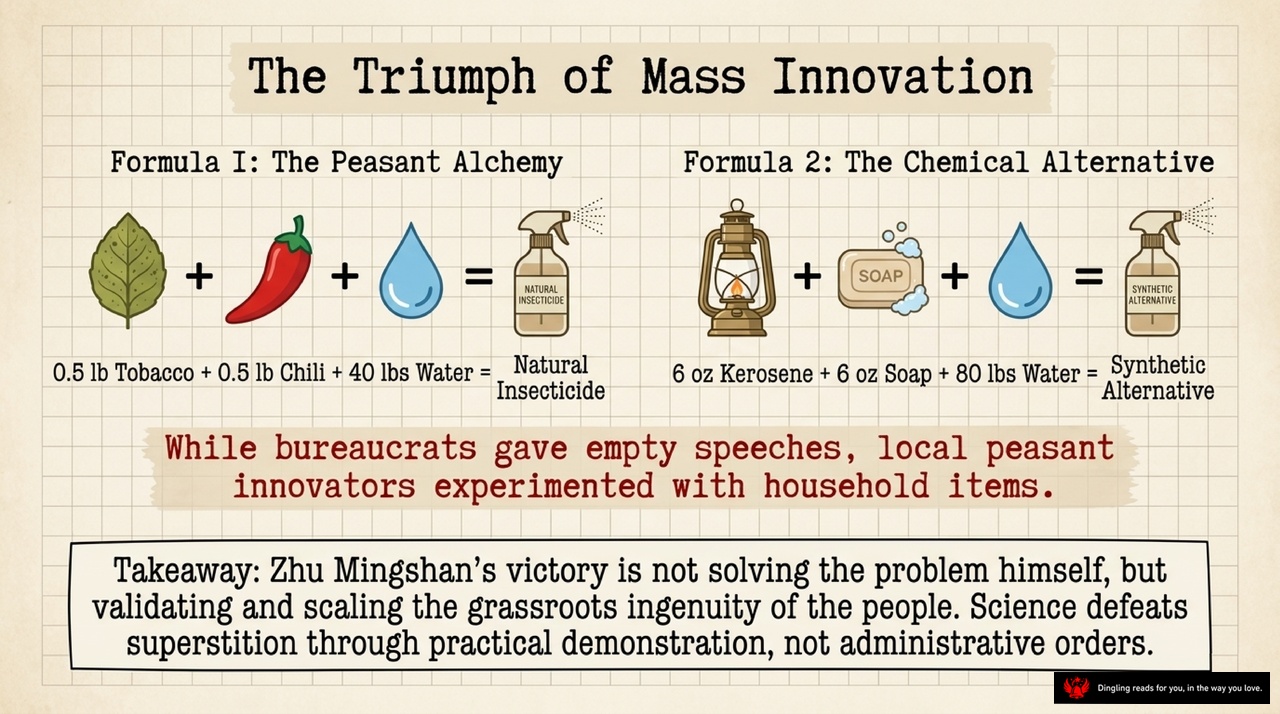
Look at these two simple formulas on the screen. On the left, we have "The Peasant Alchemy": just a leaf of tobacco, a chili pepper, and a splash of water. That's it. No labs, no complex chemicals—just what a farmer finds in his own kitchen. On the right, we see "The Chemical Alternative": kerosene, soap, and water. This is the modern, scientific approach.
But here is the real story: while bureaucrats were giving empty speeches, these local peasant innovators were actually experimenting with household items to solve their problems. Zhu Mingshan's victory wasn't about him inventing a new solution himself. His genius was recognizing and scaling the grassroots ingenuity of the people. He understood that science doesn't defeat superstition through administrative orders or top-down mandates. Instead, it wins through practical demonstration. By validating what the farmers already knew worked, he turned a simple mixture of chili and water into a powerful tool for mass innovation.

Youth and the Search for Ideals: When ambition meets reality, the path to true leadership often requires breaking away from the past. This slide highlights three pivotal archetypes from the novel that define the generation's struggle.
First, we have Cui Haotian, the Practical Worker. Represented by the wrench and gear, he embodies the old guard's strength—earnest, young, and learning that real leadership comes from action, not just holding a title. He understands that authority without service is empty.
On the other side sits Zhang Zhiqian, the Corrupted Intellectual. Marked by the broken scroll and mask, he was once Li Ying's love interest, a symbol of potential lost to bureaucracy. He quickly adopted the arrogance of older officials, becoming addicted to power and losing his way. The red lightning between him and Li Ying signifies a sharp, necessary break.
At the peak stands Li Ying, The Idealist Youth. Guided by the compass, she is energetic and pure, rejecting traditional roles to dive headfirst into fieldwork. Her defining moment comes when she severs ties with Zhang Zhiqian, realizing his ideological hypocrisy. This split isn't just a personal tragedy; it represents the novel's core hope: that the next generation will reject power alienation in favor of genuine service. Li Ying chooses the compass over the mask, proving that true ideals are found in the dirt, not in the office.

Picture this: a character sitting in silence, not just quiet, but carrying the weight of an entire internal storm. The slide highlights a powerful technique called "Direct Description"—the art of showing, not telling. Look at the text: "Bai Shengyu frowned, rubbed his left palm with his right thumb, and kept his head down in silence."
Why do we circle these specific actions? Because Liu Qing, the author, refuses to write "he was anxious" or "he felt inferior." Instead, he paints a picture. The frown and the bowed head visualize the obsolescence felt by an old agrarian guard in a new, intellectual era. He's physically manifesting his inability to speak.
And then, look at the hands. The red callout points to the thumb rubbing the palm. This isn't just a gesture; it reveals deep psychological anxiety regarding his lack of education. It's a physical manifestation of his inner turmoil. In literature, when you want to show a character's struggle without saying a word, you don't describe their feelings; you describe their hands, their posture, and their silence. That is how you make the invisible visible, and that is how you truly connect with your reader.
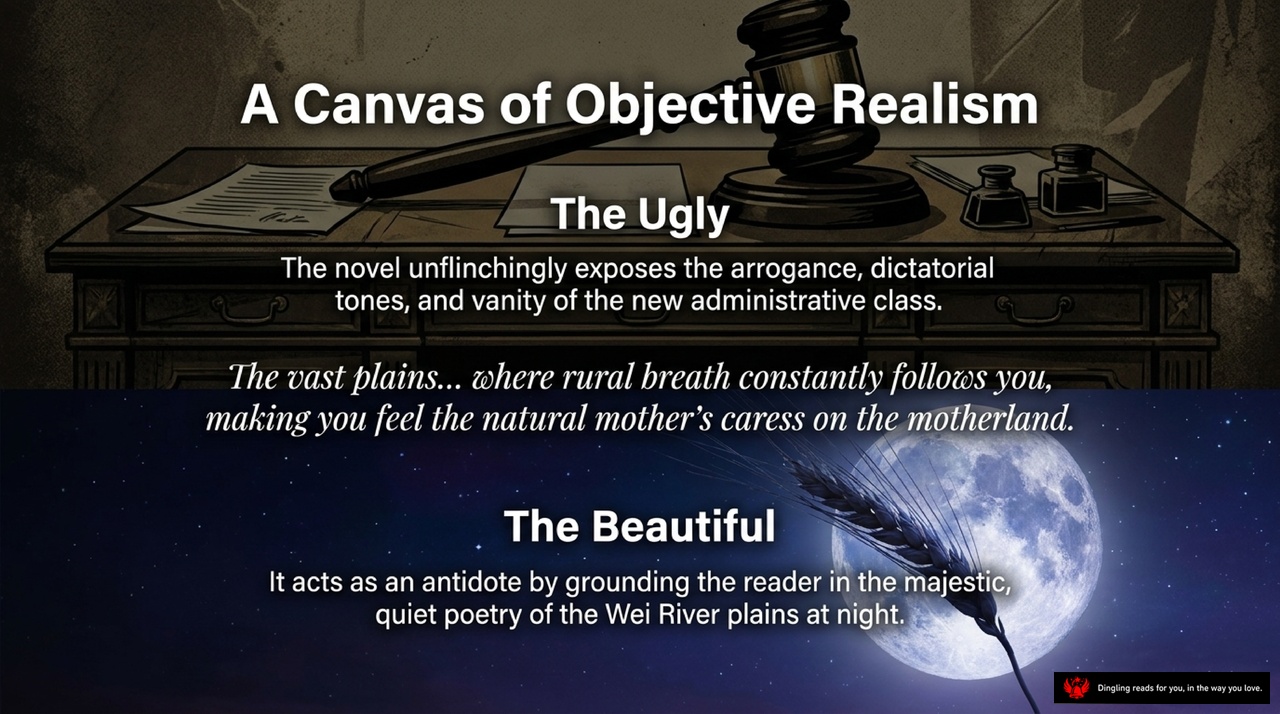
Welcome back to our deep dive into *The Ugly and the Beautiful*. Today, we're focusing on a pivotal moment in the narrative: the battle against the cotton aphids.
This slide breaks down the novel's core aesthetic into two opposing forces: "The Ugly" and "The Beautiful." Let's look at how the text brings these to life.
On the top half, under **"The Ugly,"** we see the harsh reality of the new administrative class. The text describes how the novel "unflinchingly exposes the arrogance, dictatorial tones, and vanity of the new administrative class." This isn't just about personal ego; it's a systemic issue. We see this in characters like County Head Liang Bin, who treats the pest control campaign as a stage for his own authority, demanding that trees be cut down without listening to the farmers, and lecturing for hours while the actual work waits. He represents the disconnect between power and the people, a cold, bureaucratic approach that ignores the living reality of the land.
Now, look at the bottom half, **"The Beautiful."** This is the antidote the story offers. It acts as a grounding force, "grounding the reader in the majestic, quiet poetry of the Wei River plains at night." The text reminds us of "the vast plains... where rural breath constantly follows you, making you feel the natural mother's caress on the motherland." This beauty isn't just in the scenery; it's in the human connection. It's found in the farmers who, despite their fears, eventually come together to fight the pests using simple, shared knowledge. It's in the quiet dedication of workers like Bai Shengyu, who, despite his frustrations, fights for the people he serves.
The novel uses this contrast to tell us that while the "Ugly" of bureaucracy and arrogance can suffocate a community, the "Beautiful"—the resilience of the land and the spirit of the people—ultimately prevails. It's a reminder that true progress comes not from orders from above, but from the collective, grounded effort of the people themselves.

Look at this diagram. It shows a powerful concept: "Walking in the Wilderness." On the outside, we have the physical wilderness—the raw, untamed agricultural plains where humanity battles nature for sheer survival. But look at the center. That is the Ideological Wilderness. It's the uncharted, unmapped political and moral territory of building a completely new society from scratch.
In the story, the characters aren't just wandering through a literal field fighting insects. They are wandering through the ethical wilderness of a new era. With no maps to guide them, some rely on the compass of empathy, while others become lost in the arrogance of their newly acquired power. This is the true challenge of building a nation.
Liu Qing's *In the Wilderness* offers a timeless dissection of human vulnerability in the face of authority, reminding us that defeating external crises is simple compared to the internal battle against the corruption, ego, and alienation that power breeds within ourselves. As we step into the uncharted territories of our own modern era, have we truly conquered the arrogance of power, or are we still wandering blindly in a new kind of wilderness?