
Influencer: Complete Chapter-by-Chapter Summary

Welcome to the book club session on "Influencer," the groundbreaking work by Joseph Grenny and his team. Today, we're diving into the core premise: Influence isn't just about charisma or titles; it's the new science of leading rapid, profound, and sustainable behavioral change. Think of it as the ultimate lever for getting things done.
The book opens with a powerful reality check: leadership is not about the power your position gives you, but your ability to influence others to achieve important goals. Real leaders don't just command; they focus on specific key behaviors that drive results. We see this in action with Danny Meyer, a top restaurant owner who transformed 1,500 employees into a customer-obsessed team not through strict rules, but by systematically influencing their daily actions. Similarly, in high-stakes fields like software development or global health, successful leaders stop trying to control people and start designing the environment and culture so that the right behaviors happen naturally.
This book argues that true influence comes from a systematic approach, not magic tricks or empty speeches. It's about understanding the science behind why people do what they do and using that knowledge to create lasting change. Whether you're a manager, a teacher, or a parent, the principles here offer a roadmap to move from frustration to impact. Let's explore how we can all become influencers in our own lives.

We often judge people based on their character, assuming that bad behavior stems from a flawed personality, laziness, or a simple lack of willpower. This is the "Myth" of the Fundamental Attribution Error. But the reality is far more complex. True influencers understand that behavior isn't driven by who someone is, but by the invisible forces surrounding them.
Look at the diagram. Instead of blaming the individual, we must look at the system. Are there process bottlenecks or information gaps that are preventing action? Is the physical environment designed in a way that makes the right behavior difficult? Are the incentive structures actually rewarding the wrong things?
The truth is, behavior is driven by a complex, interlocking system of unseen forces. We must stop blaming the person and start designing the system. When we shift our focus from moral flaws to structural realities, we unlock the power to create lasting change.

Look at this slide. It lays out the blueprint for creating sustainable change: The Three Keys to Influence. Think of it as a sturdy structure where "Sustainable Change" is the heavy beam on top, supported by three pillars.
First, the pillar on the left is **Focus & Measure**. The image reminds us to define clear, compelling, and time-bound goals. It's not enough to say we want to "save lives"; we need to say, "Save 100,000 lives by June 14 at 9:00 AM." Without that specific target, it's just a wish.
Next, the middle pillar is **Find Vital Behaviors**. We can't try to change everything at once. We need to distill chaotic actions into just two or three specific behaviors that drive 80% of the results. If you can lock in those few critical actions, you can move the entire system.
Finally, the third pillar is **Engage All 6 Sources**. This is about overwhelming the problem by aligning personal, social, and structural forces. You can't rely on just one lever; you need to pull on all of them simultaneously to make the change stick.
When these three keys work together, you stop chasing quick fixes and start building a foundation for lasting impact.

Distilling the Vital Behaviors: How to Cut Through the Noise.
Imagine you have over 100 different things you could do to improve your work or life. It feels overwhelming, right? You're staring at a funnel filled with abstract actions, and you don't know where to start. The key, as this slide illustrates, is to distill those hundreds of options down to just a few "Vital Behaviors."
Think of it like this: most of us spend our energy on the top 98% of activities that don't matter much. But true impact happens in those "Crucial Moments"—the specific points where the right choice matters most. It's the difference between doing something generic and doing the one thing that actually moves the needle.
Look at the examples on the right. In healthcare, it's not about being a "good doctor" in general; it's about the specific action of washing hands before entering a room. In customer service, it's not just being friendly; it's the habit of "Always Be Collecting Dots" to understand guest preferences. In public health, it's not just caring about safety; it's achieving 100% condom usage among at-risk populations.
These aren't vague ideals; they are concrete, observable actions. When you focus on these vital behaviors, you stop trying to fix everything and start fixing what actually matters. You filter out the noise, identify the critical moments where a small change creates a massive result, and suddenly, the impossible becomes achievable. That's the power of distilling your actions into vital behaviors.

The 6 Sources of Influence Matrix isn't just a chart; it's the master key to unlocking real, lasting change. Look at the structure: it splits into three domains—Personal, Social, and Structural—and two dimensions: Motivation, the "Will it?" factor, and Ability, the "Can it?" factor.
True profound change happens only when people are both motivated and able to change across these three domains: within themselves, through their peers, and via their physical environment.
Let's break it down. On the Personal side, we tackle the individual's inner drive and capability. That's where we "Make the Undesirable Desirable" to spark motivation, and "Surpass Your Limits" to build the ability to execute.
Then, we move to the Social layer. Here, we "Harness Peer Pressure" to align everyone's will and "Find Strength in Numbers" to boost collective capability. It's about turning individual effort into a powerful team force.
Finally, the Structural domain handles the environment. We "Design Rewards" to incentivize the right choices and "Change the Environment" to make the desired behavior the path of least resistance.
Most leaders fail because they focus on just one or two of these sources. But as this matrix shows, you need a full-spectrum approach. You must simultaneously ignite the will, build the capacity, leverage your peers, and reshape your surroundings. Only when all six sources work together do you stop asking people to change, and start engineering an environment where change is inevitable.
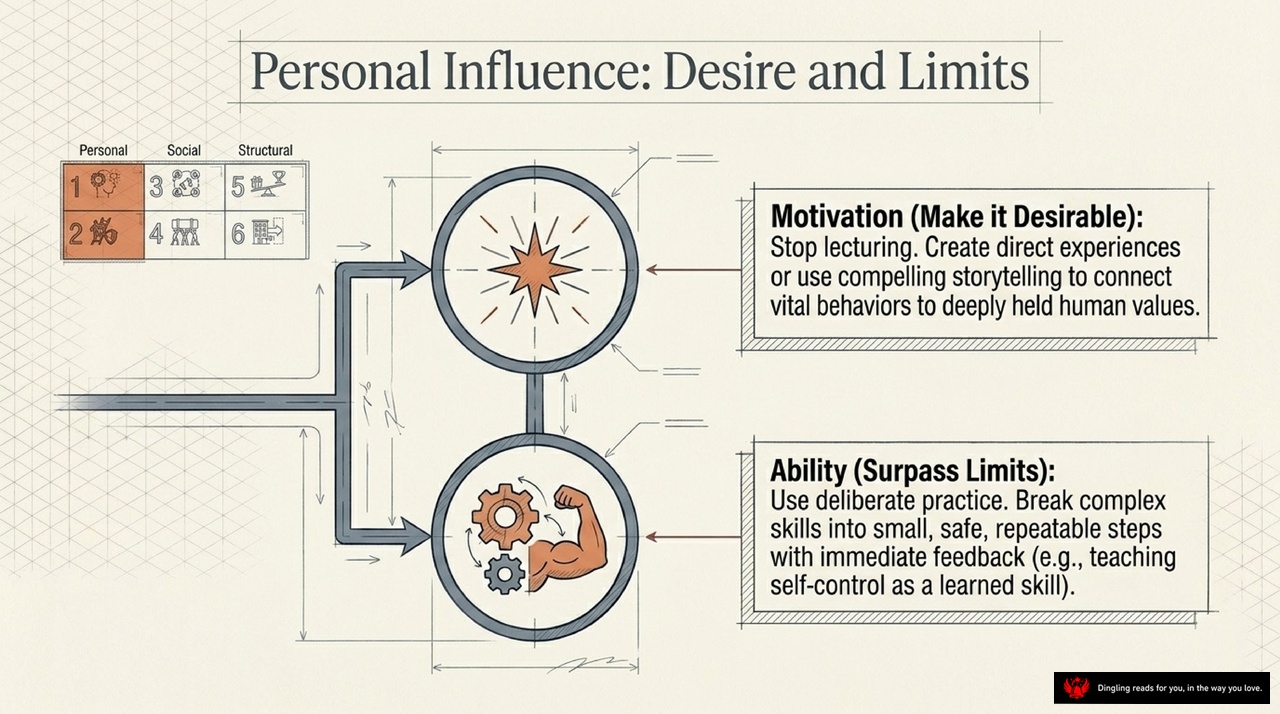
Look at this diagram. It breaks down the entire science of influence into two powerful circles: Motivation and Ability. On the left, you see the six sources of influence split into Personal, Social, and Structural layers. But the magic happens when these layers feed into these two core drivers.
First, we have Motivation. The slide tells us to "Make it Desirable." This means stop just lecturing people. Instead, create direct experiences or tell compelling stories that connect vital behaviors to what people truly value deep down. Think about the doctors who ignored hand-washing rules until they saw the real pain of their patients. That direct experience made the abstract rule suddenly personal and desirable. Without this emotional hook, people simply won't care.
But having a desire isn't enough. That's where the second circle comes in: Ability. The slide says we must "Surpass Limits." You can't expect people to do something if they don't know how. We need to use deliberate practice. Break those complex skills into small, safe, and repeatable steps with immediate feedback. Remember the case of the sex workers in Thailand? They couldn't refuse customers initially. So, experienced mentors coached them with specific scripts until it became a natural, learned skill.
True influence happens when we combine these. We make the behavior desirable so they *want* to do it, and we build the ability so they *can* do it. It's about removing the barriers to success and lighting a fire underneath them.

Social Influence: Peers and Power. This slide maps out the two engines driving real change: Motivation and Ability. On the left, you see the network itself—the Opinion Leader at the center, surrounded by peer nodes connected by varying strengths of influence. But a network alone doesn't move people. That's where the right side comes in.
First, Motivation. Think of this as harnessing peer pressure, but in a smart way. It's not about forcing people; it's about identifying and recruiting respected Opinion Leaders—your highly connected peers who naturally command respect. Once you have them, you create new norms that demand 200% accountability. In this system, peers hold each other responsible. You're turning the group into a self-policing unit where everyone watches out for everyone else.
Second, Ability. This is about strength in numbers. You need to provide social capital by building systems where peers offer real-time coaching, mentoring, and collaborative support during those crucial moments when things get tough. When your peers are your safety net, you're far more likely to succeed. So, it's all about combining the pull of peer pressure with the push of a supportive network to drive behavior change.

Influence isn't just about what people say; it's about what they do. But here's the hard truth: knowing the right behavior isn't enough. If the environment makes the right thing difficult or the wrong thing easy, even the most motivated people will fail.
This slide highlights the second pillar of our framework: Ability. Specifically, it shows how we change the environment to make good behaviors unavoidable and bad ones difficult. Look at the diagram. On the left, under Motivation, we focus on designing rewards. But on the right, under Ability, we change the physical and social landscape itself.
Notice the "Digital Dashboard." This isn't just for data; it's a tool that makes performance visible. When work is transparent, it creates an invisible spatial force that guides behavior. You can't hide your results anymore.
Then look at the "Workflow Barrier." This represents the physical layout or process design. By rearranging the space or the steps in a workflow, we can nudge behavior. We make the path to success the path of least resistance. We make the path to failure a dead end.
Finally, there's the "Reward Token." While we do use rewards, their power is multiplied when the environment supports them. When the space itself encourages the right action, the token becomes a celebration of a natural flow, not a bribe for a struggle.
The bottom right box tells us the core strategy: Nudge behavior through physical layout and data design. Make bad behaviors difficult and vital behaviors unavoidable through invisible spatial forces. We aren't fighting against human nature; we are simply designing a world where doing the right thing is the only logical choice.

The 10X Multiplier Effect isn't just a catchy title; it's the difference between a whisper that gets lost and a roar that changes the game. Look at this visualization: on the left, we have a tiny cube representing success when we rely on just one or two sources of influence. That's the traditional management trap—depending solely on verbal persuasion or throwing money at the problem. It barely moves the needle.
But flip your perspective to the right side. When you combine four or more sources of influence, that small cube transforms into a towering pillar. The text on the right makes it crystal clear: relying on a single source is the fatal flaw of traditional management. It's like trying to drown a problem with a single cup of water. However, when you layer personal motivation, social support, and systemic design together, you increase the likelihood of successful, rapid, and sustainable change by ten times.
The key takeaway here is simple but powerful: don't try to overwhelm the people with your authority; instead, overwhelm the problem with a multi-layered approach. By integrating these diverse forces, you stop fighting against human nature and start working with it, turning a slow, frustrating struggle into a swift, inevitable victory.

Now, let's talk about the final piece of the puzzle: the environment. We've spent a lot of time talking about internal drive and social pressure, but often, the real game-changer is simply redesigning the space where people work.
Think about how we unconsciously act based on our surroundings. In the 1940s, restaurants were drowning in chaos because chefs and servers were arguing over verbal orders. A simple shift in the physical environment—introducing a metal tray system for orders—silenced the conflict and improved service instantly. Similarly, consider a CEO who wanted open communication but found no one speaking up. The culprit wasn't a lack of courage; it was the office layout. High walls, low sofas, and a massive desk created a psychological barrier that literally made employees feel like children in a principal's office. When the environment was redesigned to be more approachable, the culture shifted immediately.
True influencers know that we don't need to fight human nature; we just need to make the right choice the easy choice. Whether it's Taylor optimizing shovel sizes for efficiency, or cities distributing matching paint to stop graffiti, the principle remains the same: remove the friction from good behavior. By adjusting workflows, visibility, and even the physical space, you stop asking people to rely on willpower and start designing a system where doing the right thing is simply the path of least resistance.

True leadership is the science of influence. By pinpointing vital behaviors and systematically leveraging personal, social, and structural forces, any entrenched problem can be solved. You are already shaping the behavior of everyone around you by default; will you now choose to shape it by design?
Think about it. Every day, you are influencing the people in your orbit without even trying. But what if you stopped leaving things to chance and started engineering the outcome? True influence isn't about your title or your charisma; it's about a deliberate strategy.
To master this, you need to stop trying to change everything and instead focus on the few critical actions that move the needle. You also need to pull on three levers: the individual's inner drive, the social pressure of the group, and the structural design of the environment.
When you combine these forces with a clear, measurable goal, you transform from a manager who issues orders into a leader who designs systems for success. It's time to stop reacting to problems and start architecting the behavior that solves them.