
Institutions, Institutional Change and Economic Performance: Complete Chapter-by-Chapter Summary
Welcome to today's deep dive into one of the most influential works in economic history. This page introduces us to Douglass C. North's groundbreaking book, *Institutions, Institutional Change and Economic Performance*.
Think of this book as the foundation for understanding why some nations thrive while others remain stuck. North argues that the invisible rules of the game—the institutions—dictate economic success far more than technology or resources ever could.
As the slide highlights, these institutions are the structural limits that define how we interact politically, economically, and socially. They aren't just laws on a page; they are the actual framework that reduces uncertainty in our daily lives. Whether you are signing a contract, choosing a career, or trading goods, institutions provide the stable expectations needed for complex cooperation to happen.
North breaks these rules into two parts: formal restrictions like constitutions and laws, and informal ones like customs, traditions, and cultural norms. Just like a sports game, having the rules isn't enough; you need referees to enforce them. If the enforcement fails, the game breaks down.
Crucially, North distingu between the "rules" and the "players." Institutions are the game; organizations like governments, companies, or families are the players competing within those rules. And here's the kicker: while organizations play by the rules, they also have the power to change the rules themselves.
This book offers a powerful lens to see how these invisible structures shape our economic destiny. It challenges us to look beyond surface-level policies and ask: what is the actual structure of the game we are playing?
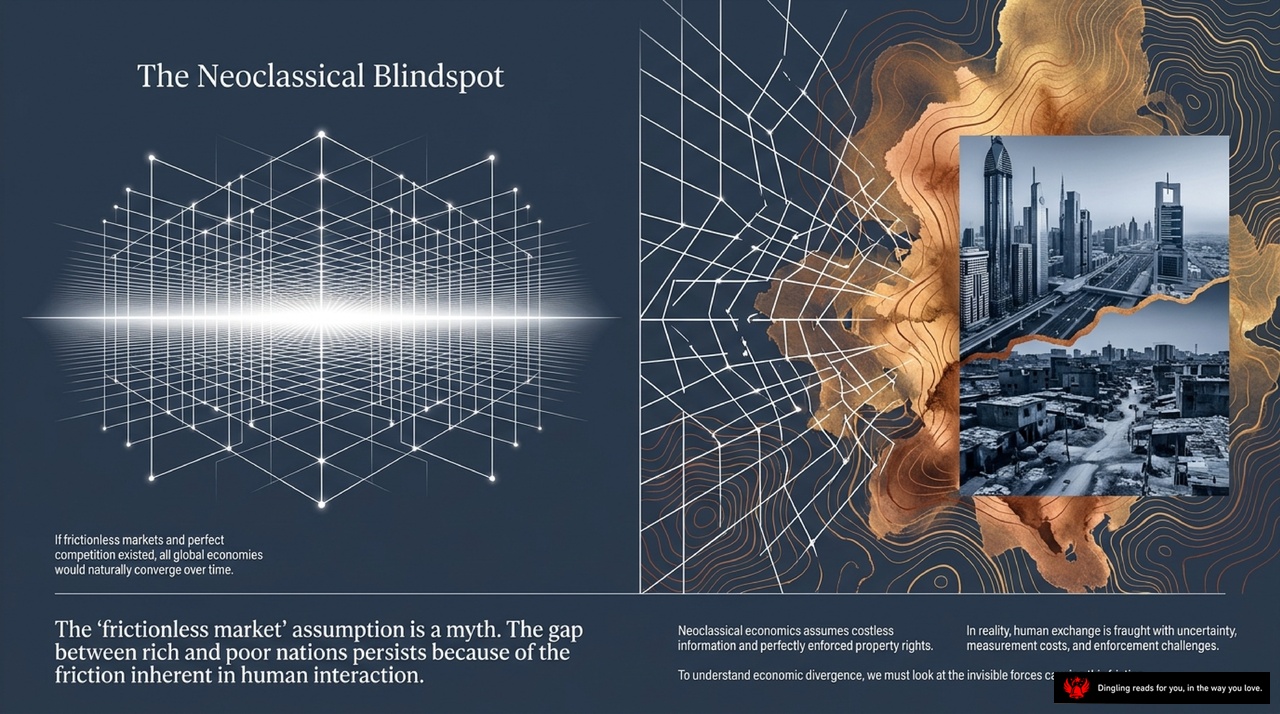
The Neoclassical Blindspot isn't just a metaphor; it's the fundamental flaw in how we've understood the global economy for centuries. On the left, you see that perfect, frictionless grid. Neoclassical theory assumes that if markets had no friction and competition were perfect, rich and poor nations would naturally converge over time. But the image on the right tells a different story. It shows the stark reality: towering skyscrapers standing right next to crumbling slums. The gap between the wealthy and the poor persists not because of market failures, but because of the inherent friction in human interaction.
The core issue is that the "frictionless market" is a myth. Neoclassical economics relies on assumptions of costless information and perfectly enforced property rights. In reality, every exchange is fraught with uncertainty, measurement costs, and enforcement challenges. We live in a world where measuring the value of a service, verifying a contract, or protecting property rights takes time, money, and effort. These invisible costs create a barrier that prevents the automatic convergence we were promised. To truly understand economic divergence, we must stop looking at the idealized grid and start examining these invisible forces—the friction that defines our actual economic landscape.

Defining the Game: Institutions vs. Organizations. Think of society like a massive, high-stakes game. On this slide, we see the field itself—the white lines of the pitch—and the players running across it. But what exactly are we looking at?
On the left, you see "Institutions." These are the Rules of the Game. They aren't the players; they are the boundaries, the laws, property rights, and even the unspoken customs that structure how we interact. They create the incentive structure for our entire society. Without these rules, there is no game to play.
On the right, we have "Organizations." These are the Players. Whether it's a firm, a political party, a school, or a labor union, these are groups of individuals bound by a common purpose. They are the teams trying to win within the established rules.
Here is the critical dynamic: Rules dictate how the game is played, and organizations are formed to win it. But here's the twist—over time, powerful organizations will try to alter the rules to their advantage. They don't just play the game; they try to change the game itself.
This distinction is everything. Institutions set the stage, but organizations are the ones taking action within that stage, constantly pushing back, innovating, and reshaping the very system they operate within. Understanding this relationship is the key to unlocking how economies grow, stagnate, or transform.
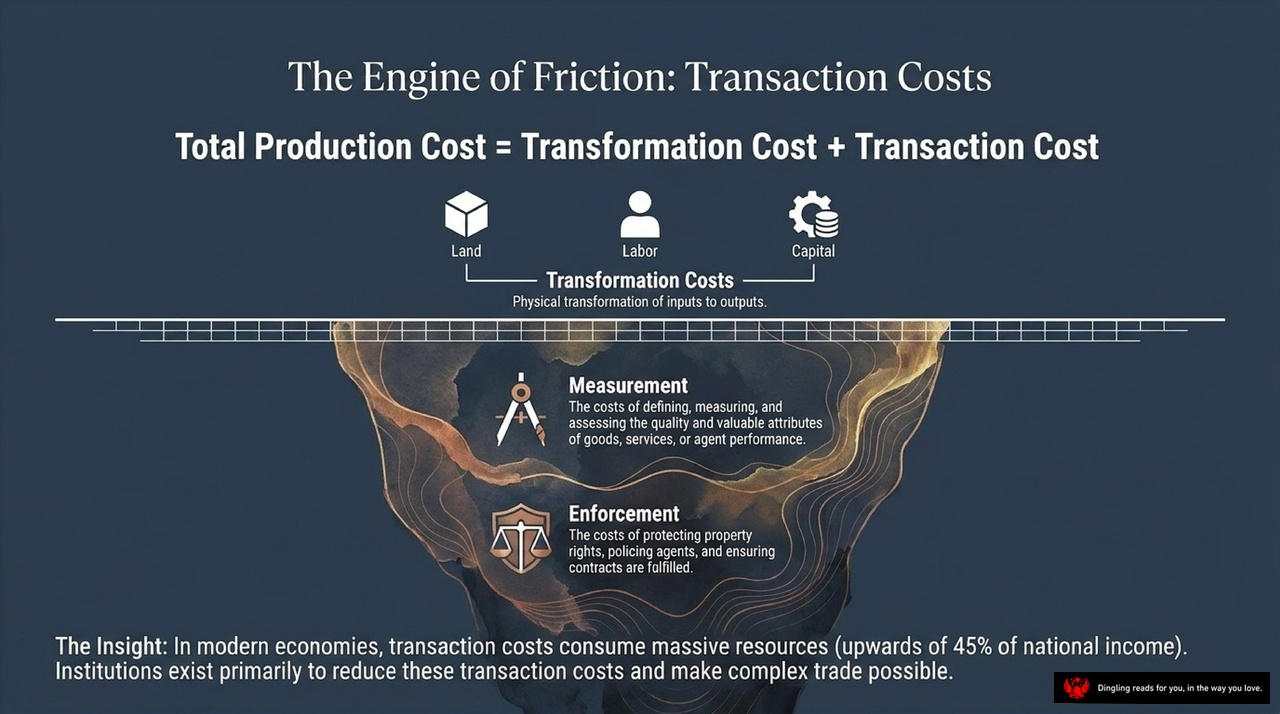
Think of your economy not just as a factory, but as a massive, intricate game. Every time you buy a house, hire an employee, or trade goods, you're paying two types of bills. First, there's the **Transformation Cost**—the obvious stuff like land, labor, and capital. This is the physical work of turning raw materials into products. But hidden underneath, often consuming more than the physical work itself, are the **Transaction Costs**.
Look at the iceberg in our slide. Above the water, we have those traditional inputs. But below the surface lies the real engine of friction: **Measurement** and **Enforcement**. Measurement is the cost of figuring out what you're actually buying—assessing quality, defining value, and dealing with the fact that no two items are exactly alike. Enforcement is the cost of making sure promises are kept, protecting property rights, and punishing cheaters.
Here's the insight that changes everything: In modern economies, these hidden transaction costs can eat up more than 45% of our national income. That's more than half of our GDP spent just on the "friction" of doing business, not on making things. This is why institutions—our laws, customs, and rules—are so critical. They exist primarily to reduce these costs, making complex trade and cooperation possible in the first place. Without them, the economy would grind to a halt under the weight of its own friction.
Think about the last time you tried to buy a house or sign a complex business deal. You probably didn't just look at the written contract; you also checked the reputation of the seller, asked neighbors about the neighborhood, and trusted that the system would hold. This is the core of what we're discussing today: The Dual Framework of Constraints.
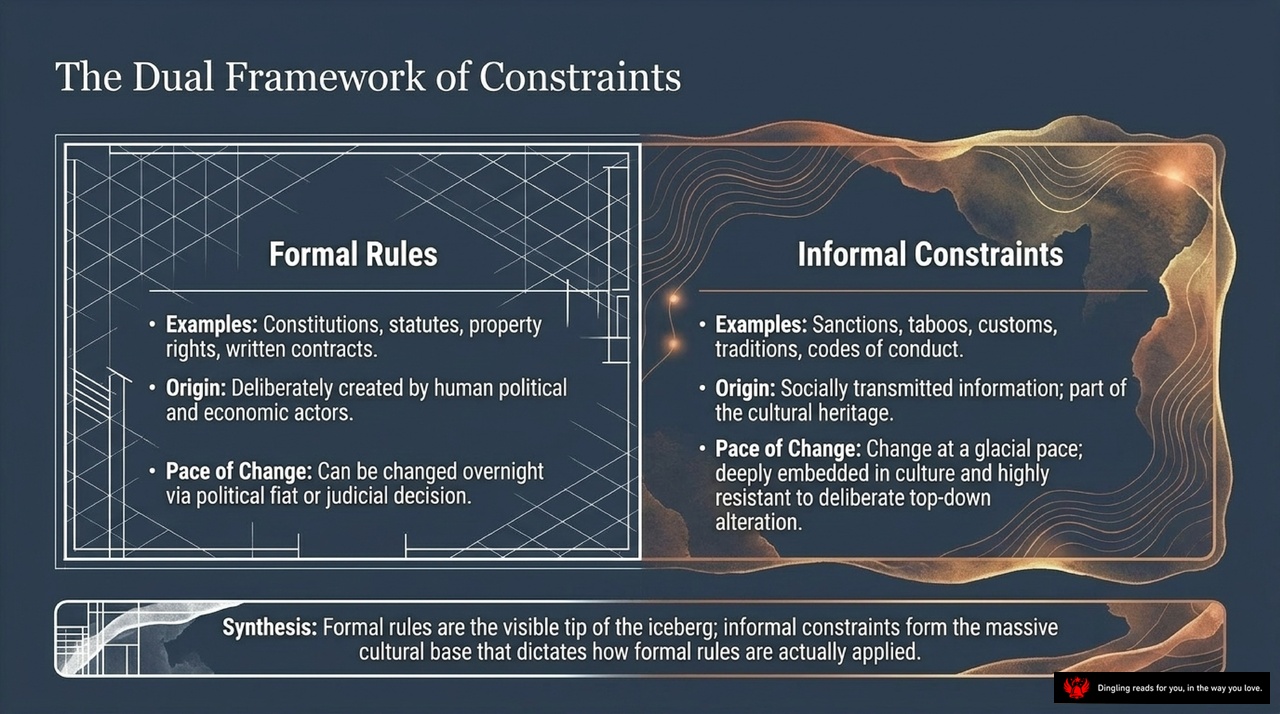
On the left, you see Formal Rules. These are the visible, hard-edged structures we often talk about—things like constitutions, statutes, property rights, and written contracts. Think of them as the blueprints drawn by human political and economic actors. Their defining feature is flexibility; they can be changed overnight through a political decision or a court ruling. They are the deliberate design of our society.
On the right, we have Informal Constraints. These are the invisible forces that actually make the formal rules work. They include sanctions, taboos, customs, traditions, and codes of conduct. Unlike formal rules, these aren't written in a book; they are socially transmitted information, part of our deep cultural heritage. They change at a glacial pace. You cannot simply legislate away a cultural norm or a deeply held belief, no matter how hard you try.
The synthesis at the bottom of the slide ties it all together with a powerful metaphor: Formal rules are just the visible tip of the iceberg. While they look like the governing force, the massive cultural base beneath the surface—the informal constraints—dictates how those rules are actually applied and enforced. In the real world, it is this hidden foundation that determines whether a contract is honored or broken, and ultimately, whether an economy thrives or stalls.
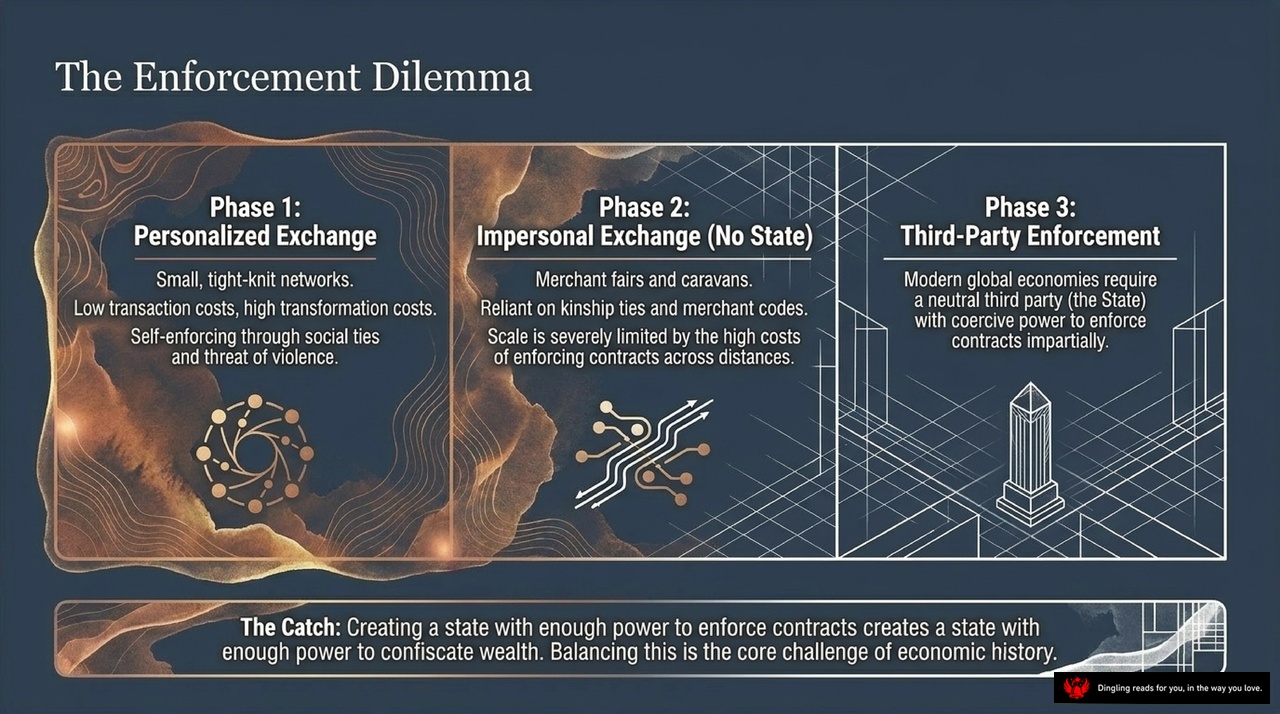
The enforcement dilemma is one of the most critical challenges in economic history, and it boils down to a simple but profound trade-off: how do we scale up trade without letting chaos take over?
As we move from small, tight-knit communities to the vast, impersonal markets of the modern world, we face a fundamental problem. In the first phase, we rely on personalized exchange. Think of your local tribe or a small village. Here, trust is built on face-to-face relationships and the threat of violence. It works because everyone knows everyone, but it hits a hard ceiling. You can't easily trade with someone you've never met, especially across long distances.
To break through this limit, we enter the second phase: impersonal exchange without a state. This is where merchant fairs and caravans come in. Traders rely on kinship ties, religious vows, and strict merchant codes to keep promises. It's a clever workaround, but it's fragile. If a stranger cheats you, there's no one to punish them effectively. The cost of enforcing contracts across distances becomes so high that it limits the scale of your economy. You simply can't build a massive global market on trust alone.
This brings us to the third and most transformative phase: third-party enforcement. Modern global economies require a neutral referee—the State—with the actual power to enforce contracts impartially. This is the foundation of the modern world. It allows for complex, anonymous transactions that drive innovation and growth. Without a government to back up property rights and legal agreements, the intricate web of global supply chains we take for granted today would collapse.
However, there is a catch. Creating a state powerful enough to enforce contracts inevitably creates a state powerful enough to confiscate wealth. This is the core tension that has defined economic history for millennia. The same institutions that protect your business from a cheating partner can also be used by a ruler to seize your assets. Balancing this power is the central challenge of building a prosperous society.
As we've seen, the evolution from personal trust to impersonal markets, and finally to state-enforced rules, is the story of how humanity solved the enforcement dilemma. It's the difference between a stagnant village and a thriving global economy.
Path dependence is the idea that history matters—sometimes more than we realize. Imagine the QWERTY keyboard: it wasn't the most efficient layout, but once it became the standard, everyone learned it, bought equipment for it, and built careers around it. Even when better options appeared, the cost of switching was too high, so we stayed locked in. This is the core of path dependence: once a path is chosen, rewards accumulate for sticking with it, making it harder to leave, even if a better road exists.
This logic applies just as powerfully to institutions. New rules often require a big upfront investment, but once established, they create a whole ecosystem of skills, expectations, and organizations that revolve around them. Think about the U.S. Northwest Ordinance of 1787. It set the rules for western land ownership and banned slavery. Those choices weren't just random; they were built on British legal traditions and political compromises. Over time, land companies, new states, and economic patterns all grew around that original framework. The initial choice shaped the entire future of the American West.
The same dynamic played out between North and South America after independence. Both regions copied similar democratic constitutions, yet their outcomes diverged wildly. In North America, local self-government was already a deep cultural habit; the new rules fit perfectly with existing expectations. In Latin America, the old Spanish system was highly centralized, and people had never experienced real autonomy. So, even though the paper rules were the same, the underlying culture and institutions pulled them back toward authoritarian control. The past didn't just influence the future; it locked them onto different tracks.
Low-efficiency systems can survive for centuries because of this self-reinforcing cycle. Once a society is locked into a non-productive path, special interest groups emerge to protect it. They convince everyone that the current system is "normal" or even necessary, blaming external factors for their struggles. This makes it incredibly difficult to change. Ultimately, the path we take today is the result of countless short-term decisions made by political and economic leaders, filtered through their own beliefs and limited information. These choices may not be the most efficient in the long run, but the momentum of history often carries us forward, making it hard to turn back.
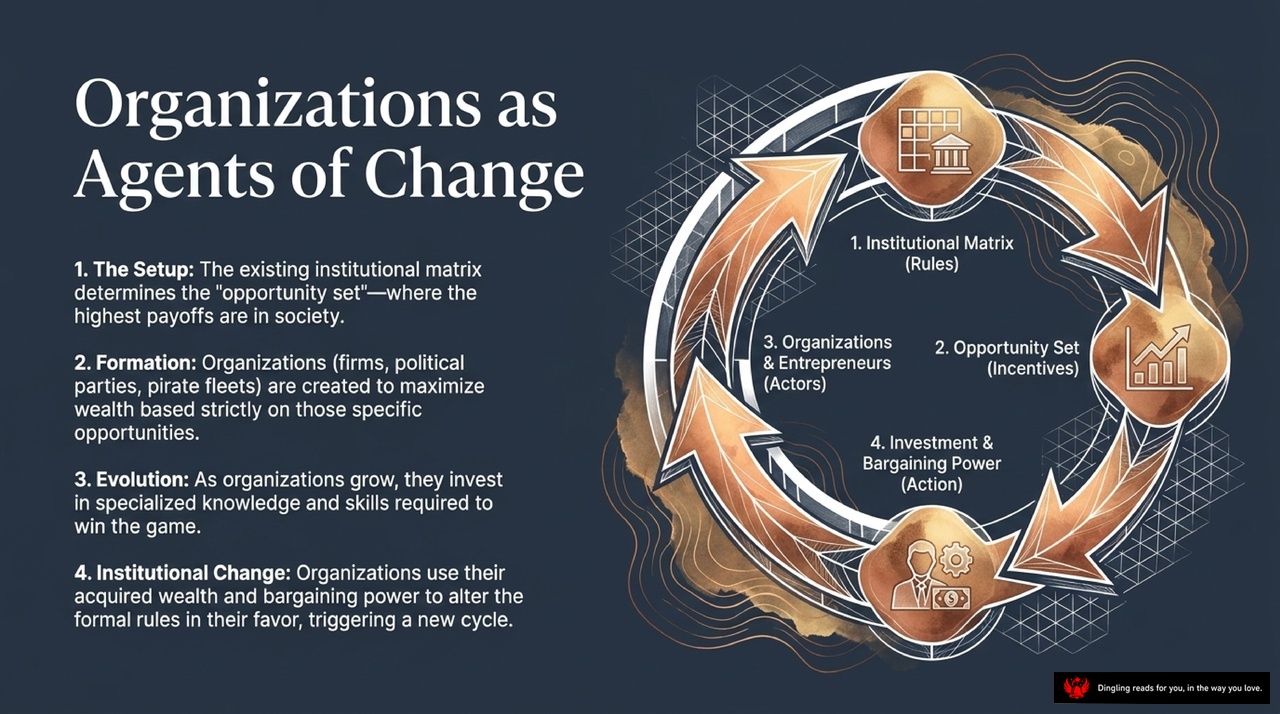
Imagine your economy as a massive, intricate game. Who are the players? Organizations—firms, political parties, even pirate fleets. But here's the twist: they aren't just following the rules; they are the very agents changing them.
Look at this cycle on the right. It starts with the **Institutional Matrix**, the existing rules of the game. These rules define the "Opportunity Set"—essentially, where the biggest rewards are hiding in society. Once organizations spot these high-value opportunities, they form specifically to capture them. They invest in specialized knowledge and skills, just like a team training to win a championship.
But here is where it gets powerful. As these organizations grow wealthier and gain more bargaining power, they stop just playing the game. They start using their leverage to rewrite the rules themselves. They alter the formal regulations to favor their new reality, which triggers a fresh cycle of opportunities and new organizations.
This is the core dynamic we see in history. Think about the 19th-century American rise or the long decline of Spain. In the U.S., organizations like banks and railroads used their success to push for legal reforms that further fueled growth. In Spain, powerful interest groups lobbied to maintain inefficient property rights to protect their short-term gains, locking the country into stagnation.
So, don't just see institutions as static constraints. See them as a living system where the players are constantly reshaping the board. The institutions set the stage, but the organizations are the ones writing the next act. This feedback loop between rules and the actors who follow them is what drives long-term economic success or failure.
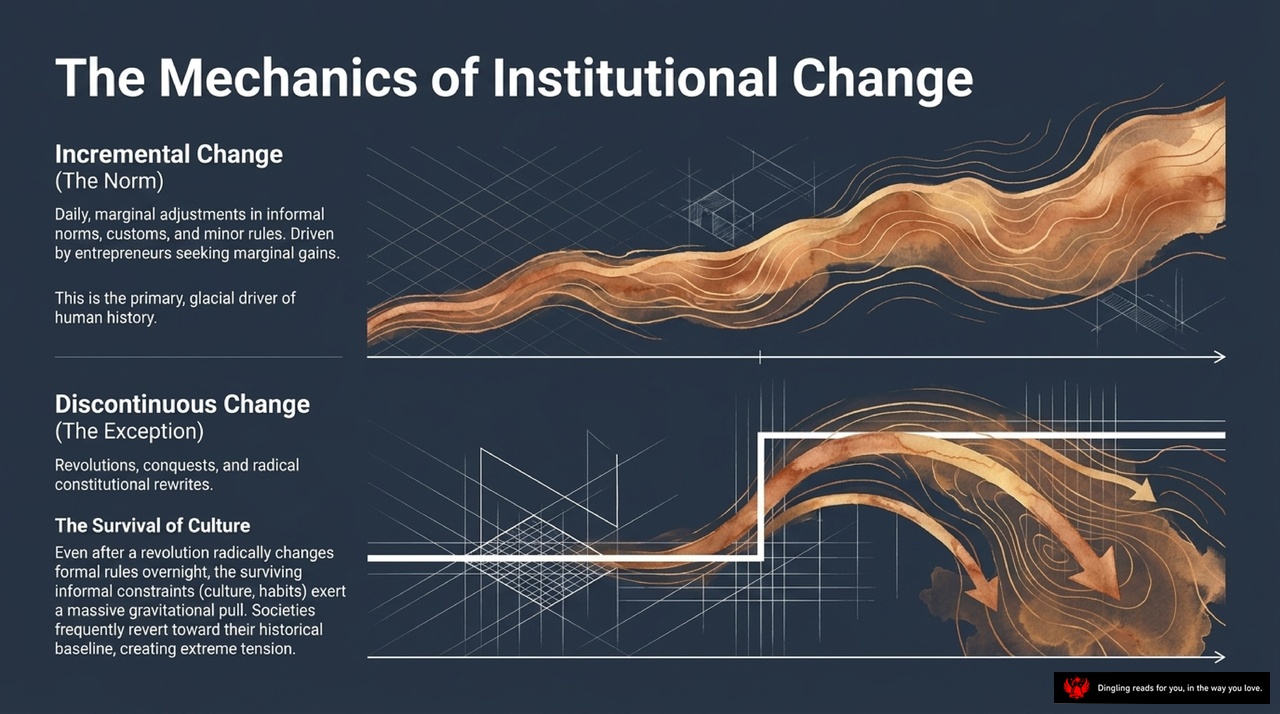
The Mechanics of Institutional Change isn't just about laws on paper; it's about the invisible friction that slows down or accelerates our entire society. Think of history not as a series of sudden explosions, but mostly as a slow, glacial drift. This is what we call incremental change. It's the daily, marginal adjustments in our customs and minor rules, driven by entrepreneurs looking for small gains. This is the primary engine of human history.
But don't get it twisted. Radical, discontinuous change—the kind involving revolutions or conquests—is the exception, not the rule. Even when a revolution radically rewrites the formal rules overnight, the surviving informal constraints, like our deep-seated culture and habits, exert a massive gravitational pull. They pull society back toward its historical baseline, creating extreme tension. That's the survival of culture in action.
The real puzzle here is why societies often revert to old patterns even after a dramatic break. Because while we can change the rules, we can't easily change the mindset. Understanding this tug-of-war between the new laws and the old habits is the key to unlocking why some nations thrive while others get stuck.
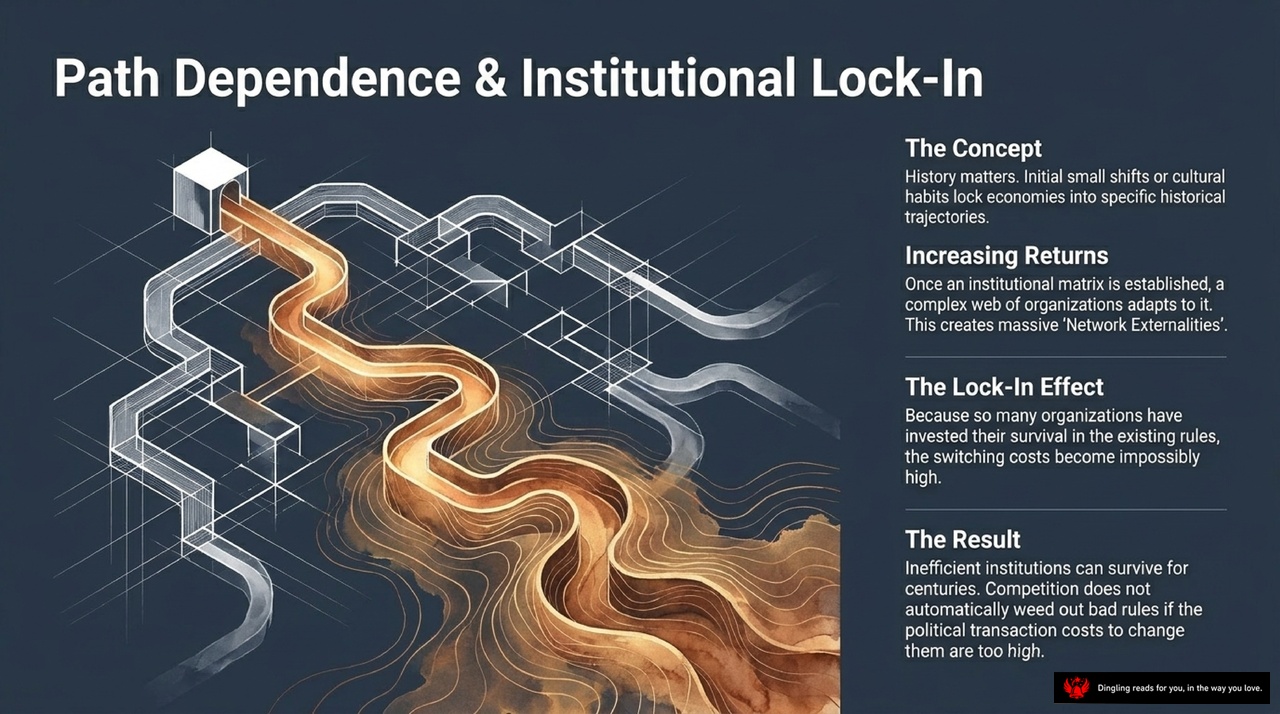
Path Dependence and Institutional Lock-In: Why History Matters
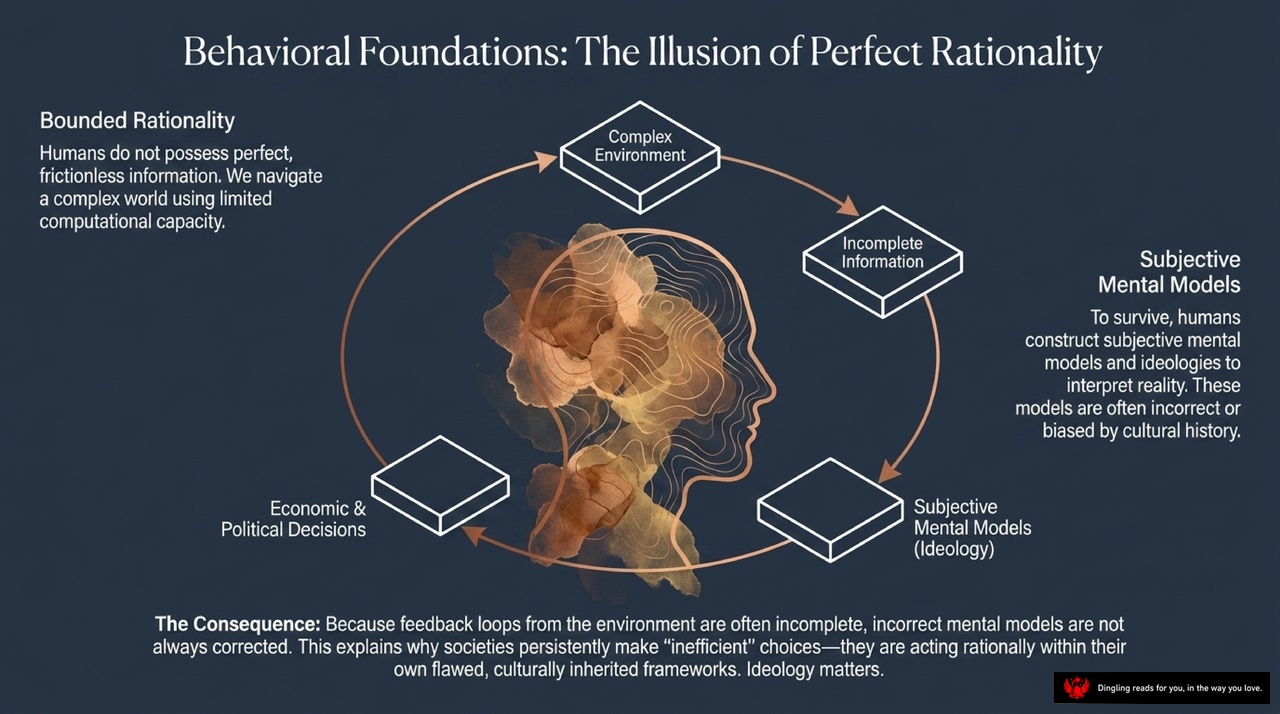
Imagine an economy as a traveler navigating a vast, complex maze. At first, there are countless paths available. But once a traveler picks a route—even a slightly inefficient one—momentum takes over. They invest time and resources along that path, building skills and relationships specific to it. Suddenly, switching to a better, alternative route becomes prohibitively expensive. This is the essence of **path dependence**.
As the slide illustrates, **history matters**. Those initial small shifts or cultural habits lock economies into specific historical trajectories. Once an institutional matrix is established, a complex web of organizations adapts to it, creating massive "Network Externalities." This leads to **Increasing Returns**. Because so many organizations have invested their survival in the existing rules, the switching costs become impossibly high. This creates the **Lock-In Effect**.
The result? Inefficient institutions can survive for centuries. Competition does not automatically weed out bad rules if the political transaction costs to change them are too high. This explains why some nations, despite copying the same formal laws as successful peers, fail to thrive. Their unique history, culture, and initial choices created a self-reinforcing loop that trapped them in a suboptimal path. Understanding this lock-in mechanism is key to grasping why economic divergence persists and why changing the system is often so difficult.
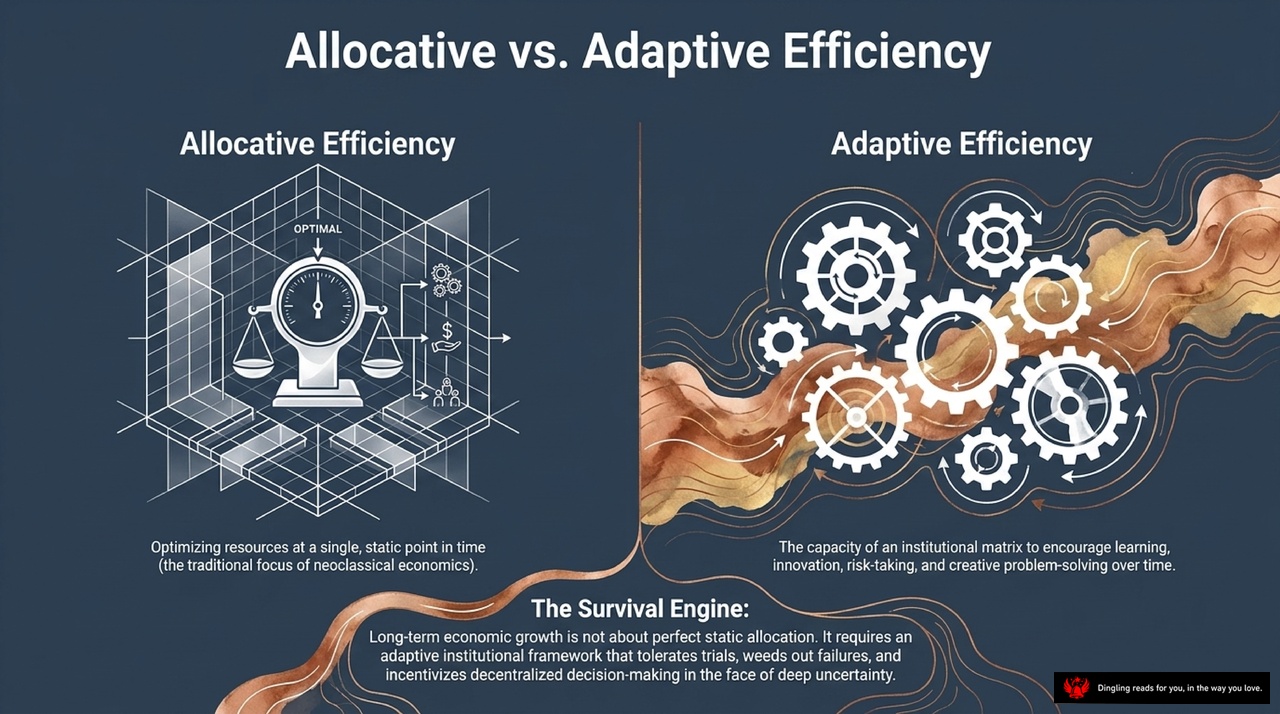
Imagine you've spent years perfecting a recipe, only to find out the ingredients have changed overnight. If you stick rigidly to your old instructions, the result will fail. But if you adapt, tweak the spices, and find new ways to combine flavors, you might end up with something even better. This is the core distinction between allocative and adaptive efficiency.
On the left, we see allocative efficiency. Think of it as hitting a target perfectly at a single moment in time. It's about optimizing resources to match a specific, static demand. This is the traditional focus of neoclassical economics—getting the current mix of goods and services right. It assumes we know the rules and the future won't change. But what happens when the game itself changes?
Now look at the right side: adaptive efficiency. This is about the capacity of an institutional matrix to encourage learning, innovation, and risk-taking over time. Instead of just hitting a static target, it's about building a system where gears keep turning, allowing us to solve new problems as they arise. It's not about perfect static allocation; it's about long-term survival and growth in a world of deep uncertainty.
The key takeaway here is that long-term economic growth doesn't come from perfecting a snapshot in time. It requires an adaptive institutional framework that tolerates trials, weeds out failures, and incentivizes decentralized decision-making. When institutions are too rigid, they fail to adapt to new technologies or social shifts. But when they foster a culture of experimentation and learning, they become a true survival engine, driving an economy forward long after the initial conditions have vanished.
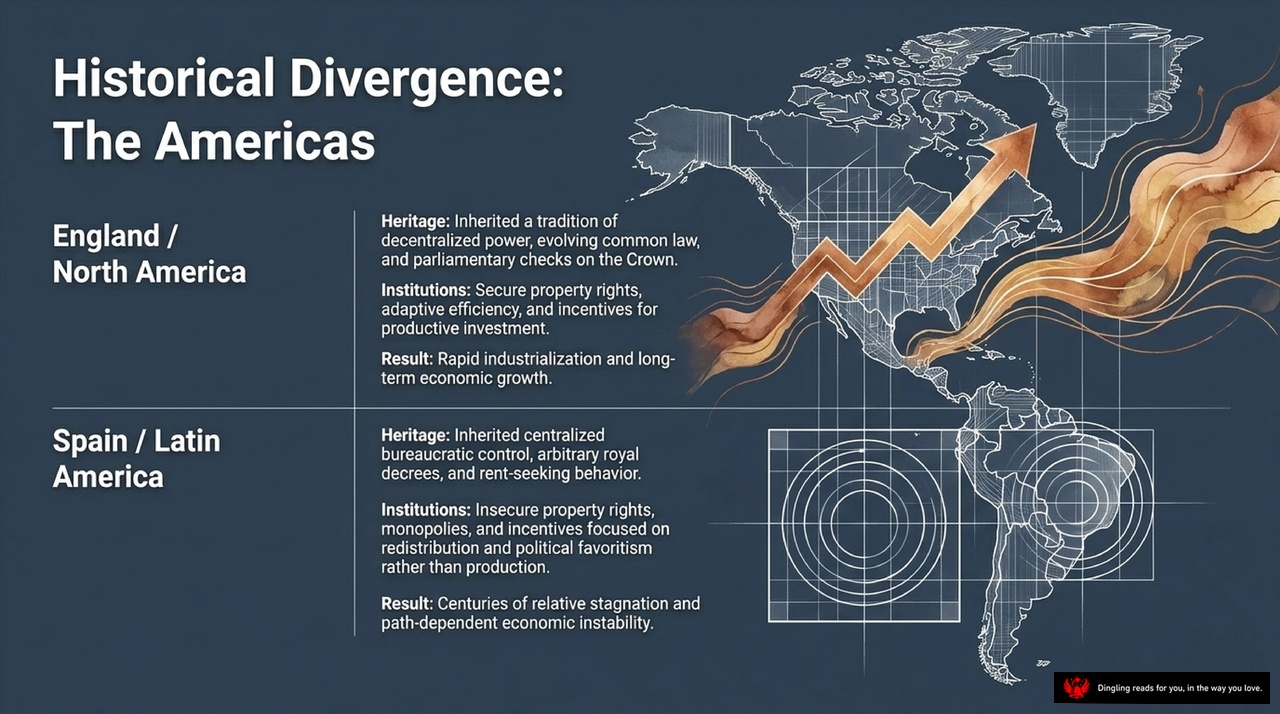
Look at this map. It perfectly illustrates why the gap between rich and poor nations persists today. We see two distinct stories emerging from the same era: the rise of the Americas versus the stagnation of Latin America.
On the left, we have England and North America. Their heritage was built on decentralized power and evolving common law. This created institutions that secured property rights and rewarded productive investment. The result? Rapid industrialization and long-term growth. The upward trend on the map isn't just luck; it was the direct payoff of a system that let people keep what they earned.
Now, look at the bottom right. Spain and Latin America inherited a very different story. Their heritage was defined by centralized bureaucratic control and arbitrary royal decrees. The institutions here focused on rent-seeking and political favoritism rather than production. Property rights were insecure, and the result was centuries of relative stagnation.
This slide captures the core argument of our book: history isn't a straight line. It's a path-dependent divergence. When you start with different rules—different incentives for your people—you don't just end up in different places; you end up on entirely different tracks. One path rewards innovation and growth, while the other traps you in a cycle of instability. The map shows us that the difference isn't geography or resources; it's the invisible architecture of the rules we live by.

Welcome to the next chapter of our deep dive into institutional economics. Today, we're going to visualize a concept that often gets lost in abstract theory: the "Illusion of the Bazaar."
On the left side of our slide, we see the traditional "Suq"—the historic marketplaces of the Middle East and North Africa. This represents a highly decentralized economy that has survived for millennia. But look closely at the friction here. You have constant haggling, varying weights that aren't standardized, and severe information asymmetry. Because there is no formal third-party enforcement or a reliable legal framework, trust is fragile. Entrepreneurs and merchants can't simply focus on improving their products or boosting efficiency. Instead, their skills are forced entirely into exploiting information gaps and navigating the chaos. The market survives, yes, but it hits a hard ceiling where it simply cannot scale.
Now, look at the right side: the Modern Financial Market. This is what happens when we solve those friction points. We introduce standardization, clear rules, and crucially, third-party enforcement. Suddenly, transaction costs plummet. You don't need to haggle over every single item because the rules are clear and the contracts are backed by a neutral authority. This shift allows us to move from personal, face-to-face exchanges to impersonal, large-scale transactions.
The core lesson here is profound: without the institutional scaffolding that reduces uncertainty and enforces contracts, economic activity remains trapped in a low-efficiency loop. The "illusion" is that the bazaar works just fine on its own. But as we've seen throughout our discussion, it's the invisible architecture of rules, enforcement, and trust that transforms a chaotic marketplace into a scalable engine for modern growth.

Today's slide breaks down the entire framework we've been building into a single, powerful visual: **The Institutional Matrix**.
Think of this diagram as the operating system for any economy. It tells us that economic prosperity isn't just about having natural resources or a good location; it is the deliberate result of these four layers working in perfect harmony.
At the very bottom, you see the **Informal Constraints**. This is the foundation—the culture, norms, and ideology that people actually live by. As the text reminds us, these are the "heavy gravity" of a nation's history. Even if a country copies a successful law from another nation, it will fail if the underlying cultural expectations don't match. You can't simply "copy and paste" a successful system; the informal constraints dictate how formal rules are actually implemented on the ground.
Resting on that foundation are the **Formal Rules**. These are the constitutions, property rights, and laws written on paper. But here is the critical insight: these rules are useless without the next layer, the **Enforcement Mechanisms**. This includes self-enforcing norms and third-party enforcers like courts or police. Without reliable enforcement, formal rules are just suggestions, and transaction costs skyrocket.
Finally, at the top, we have the **Organizations**—the firms, state actors, and individuals. These are the players competing within the matrix. Their behavior is entirely shaped by the rules and enforcement mechanisms below them.
The synthesis on the right side of the slide drives the point home: a successful economy constructs a matrix that lowers transaction costs, secures property rights, and aligns individual incentives with societal productivity. Conversely, if you have great formal rules but weak enforcement or conflicting cultural norms, you get a broken system. This is why some nations thrive while others, despite having similar laws, remain stuck. Understanding this matrix is the key to unlocking sustainable growth.
Economic performance isn't just about how much capital you have or how smart your technology is; ultimately, it is dictated by the institutional matrix. Think of this matrix as an intricate web that includes formal rules like laws, but also informal cultural constraints and the enforcement mechanisms that actually make them stick. Together, these elements shape how humans interact and drastically lower the costs of complex trade.
So, here is the critical question we need to face: If our economic destiny is locked in by the path dependence of our institutions, are we consciously designing the rules of our future, or are we merely captives of our past? This slide highlights the tension between the rules we create and the historical forces that constrain us, setting the stage for understanding why some nations thrive while others stagnate despite having similar resources.