
Irrational Exuberance: Complete Chapter-by-Chapter Summary

Welcome to today's deep dive into one of the most influential concepts in modern economics. The image you see right now introduces us to Robert J. Shiller's groundbreaking book, *Irrational Exuberance*. As the title suggests, this work is dedicated to deconstructing the structural, cultural, and psychological forces that drive speculative market bubbles. It challenges the comforting illusion that our economy is purely rational.
Think about the background of this slide, with those fluctuating market indicators like the S&P and VIX. These aren't just random lines; they represent the chaotic reality Shiller explores. He argues that when markets are pushed to unsustainable heights by collective psychology, we enter a state of "irrational exuberance." This isn't about extreme madness, but rather the common human error of getting swept up in the excitement of speculation, ignoring actual asset values in favor of the thrill of potential gains.
Shiller takes us on a journey to understand why these bubbles form, why they persist, and why they eventually burst, proving that history repeats itself not because of economic laws, but because of human nature. Whether it's the stock market or real estate, the same psychological drivers are at play. So, let's turn the page and explore the first chapter of this story.

On the left, we see the illusion: the Efficient Market Theory. It assumes that asset prices perfectly reflect all public information and that the actor behind the scenes is a purely rational, calculating human. But on the right lies the reality: Behavioral Finance. Here, we observe that prices frequently detach from intrinsic value, driven by "animal spirits," social contagion, and raw human emotion. The actor isn't a cold calculator, but a psychologically biased individual easily influenced by the crowd.
Think about the dot-com boom of the late 90s. Prices soared not because of fundamentals, but because of a feedback loop of excitement. As prices went up, more people joined in, convinced that this time was different, ignoring the risks entirely. This isn't just about stocks; it happened in the housing market too, where the belief that land values would always rise created a massive bubble. The grid on the left represents the rigid, orderly world of traditional finance, while the swirling waves on the right show the chaotic, emotional reality where human psychology drives the market's most dramatic swings.

Look at this chart. It's not just a graph of numbers; it's a map of history's most dangerous moments. The title says "Historical Evidence of Exuberance," and for good reason. This visual reveals a repeating pattern: whenever we think we've found a "New Era," history often warns us that we are simply repeating the past.
Notice the four major targets labeled 1 through 4. These represent the four greatest spikes in stock market valuation, known as P/E ratios. Point 1 is the peak of 1901, followed by the roaring twenties in 1929, the Kennedy-Johnson era in 1966, and finally, the Millennium Boom in 2000, which hit a historic high of 47.2. In every single one of these cases, the market eventually crashed. The 1929 peak, for instance, was followed by the Great Depression. The lesson is clear: extreme optimism is rarely a permanent state; it's usually a precursor to a correction.
But the story doesn't end with stocks. Look at the red line tracking below the blue one. This represents real estate. The chart highlights two specific parallels. First, the post-WWII boom, fueled by the GI Bill, which allowed millions to buy homes for the first time. Second, the surge starting in 1998, where housing prices decoupled from actual building costs and population growth. Just like the stock market, the housing market is susceptible to these same psychological bubbles. When everyone believes prices will only go up, they stop looking at fundamentals like income or construction costs and start betting on the future.
The takeaway from this slide is powerful: whether it's equities or real estate, history shows us that "New Era" booms are not unique miracles. They are predictable, repeating historical patterns driven by human psychology. When you see these valuation spikes, remember the targets on the screen. They are not just data points; they are cautionary signals from the past, reminding us that when the crowd gets too excited, the price is often detached from reality, waiting for the next inevitable pullback.

So, we've broken down the 12 structural triggers that fueled the boom from 1982 to 2000. Think of this not as a random list, but as a perfect storm where psychology met policy. First, look at the shift toward an "Ownership Society." As loyalty to employers faded, people turned to stocks and homes as their new safety nets, while tax cuts and deregulation made holding onto gains even more attractive. Then, the internet revolution and 24/7 financial media created a feedback loop, constantly feeding us stories of endless growth.
Don't forget the "Greenspan Put"—the belief that the Fed would always bail us out if things got too scary. This, combined with the baby boomers hitting their prime investing years, created a demographic engine for wealth. But it wasn't just about fundamentals; it was about the "money illusion." When inflation dropped to near zero, people started confusing nominal gains with real wealth, driving prices up without regard for actual value.
We saw this play out in mutual funds that promised safety but took on hidden risks, and in a culture where gambling became normalized. Discount brokerages made trading cheap and easy, turning investing into a casino where everyone felt like a winner. Even the 401(k) plans forced more people into the market, creating a sense of forced exposure. Ultimately, the illusion of safety in mutual funds and the normalization of risk led us to a point where the entire system was betting against itself, setting the stage for the inevitable crash.
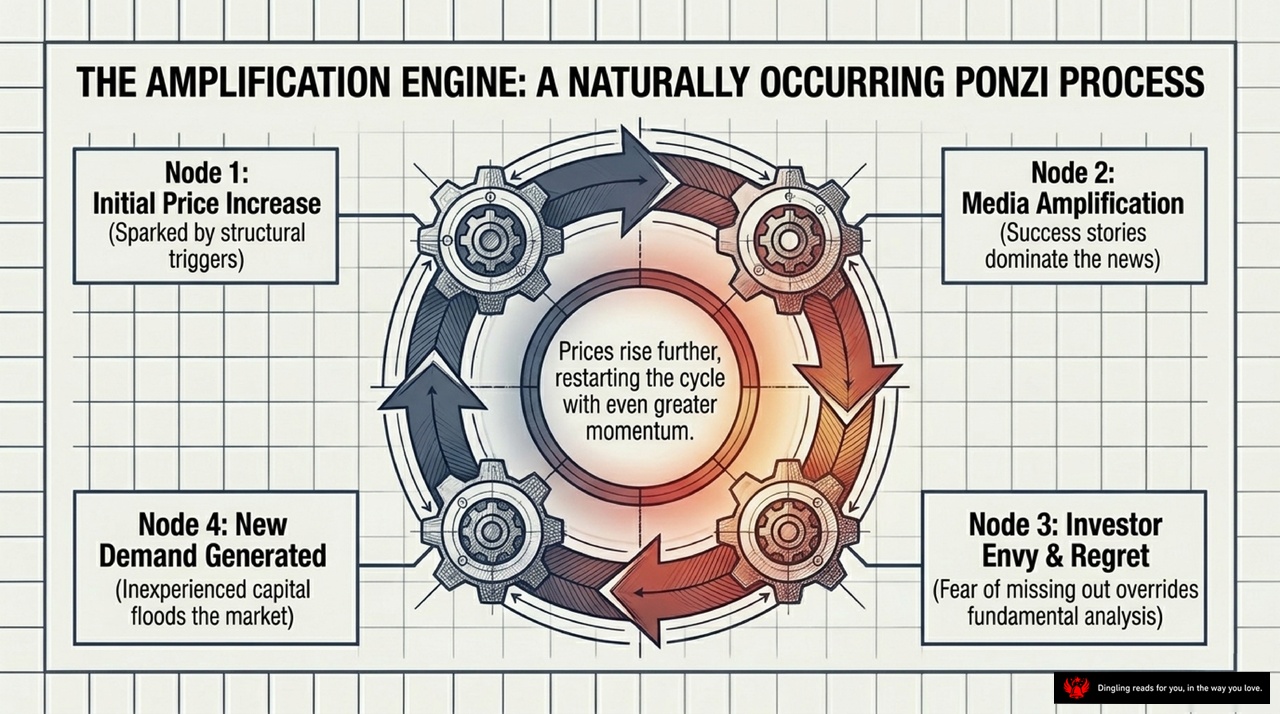
The amplification engine is a naturally occurring Ponzi process, a self-reinforcing cycle that turns small triggers into massive market manias. It starts with Node 1: an initial price increase sparked by structural triggers. As prices rise, Node 2 kicks in: media amplification. Success stories dominate the news, creating a narrative that the trend is unstoppable. This feeds directly into Node 3: investor envy and regret. The fear of missing out overrides fundamental analysis, pushing people to buy simply because others are profiting. This psychological pressure generates Node 4: new demand. Inexperienced capital floods the market, buying at ever-higher prices. As these new buyers push prices up further, the cycle restarts with even greater momentum, creating the illusion of a sustainable boom while actually building a fragile bubble.

Look at this diagram: "Cultural Accelerants: Propping Up the Bubble." It visualizes exactly how a market bubble isn't just about money—it's propped up by two massive pillars of culture.
The first pillar is "The Media Megaphone." Notice how it breaks down into two points: "Finance as Entertainment" and "Price Over Fundamentals." This is the modern reality. We've turned complex economics into a sports game, obsessed with scorekeeping and daily ticker fluctuations. We stop looking at intrinsic value and start chasing the noise. The media doesn't just report the market; it amplifies it, turning every price swing into a headline that fuels the next move.
The second pillar is "New Era" Myths. This is the psychological engine. It relies on the delusion that "This Time is Different"—that new technology or policies have permanently eliminated economic cycles. It's the "Death of History," a collective refusal to learn from past crashes in favor of utopian narratives. We tell ourselves the rules have changed, ignoring the repeating patterns of human behavior.
At the center of this structure, where these two pillars collide, is the "Nexus Point: Normalized Irrationality." This is the dangerous sweet spot. It's the moment when the media's hype meets the public's belief in a new era, making irrational behavior feel completely normal and rational. Together, these cultural accelerants create the perfect environment for a bubble to form and stay inflated, long past the point where the underlying economy can support it.

Look at this "Psychological Diagnostic Matrix." It lays out the stark gap between how we *think* we invest and the messy reality of human behavior.
On the left, we see our cognitive flaws. We suffer from **Overconfidence**, assuming we can perfectly calculate our own errors. We engage in **Magical Thinking**, believing every portfolio success is the result of our personal genius rather than luck. And we fall for the **Representativeness Heuristic**, taking short-term trends and assuming they represent a permanent new reality.
Now, look at the middle column: the **Rational Economic Assumption**. This is the world of textbooks, where investors are assumed to be logical machines. They are supposed to perfectly calculate risk, base decisions strictly on logical causality, and understand that markets eventually revert to a statistical mean.
But the third column, **Behavioral Reality**, tells the true story. In the real world, investors systematically overestimate their knowledge. They attribute success to skill when it was often just a lucky intuition. And instead of waiting for a market correction, they assume that a multi-year bull market is the new normal.
This matrix highlights a critical truth: the market isn't driven by cold, hard logic. It's driven by these psychological biases. When we ignore our tendency to overestimate our control or mistake luck for skill, we aren't just making bad decisions; we are fueling the very bubbles that eventually burst. Understanding this gap is the first step to navigating the market without getting lost in it.

Imagine the stock market not as a cold machine of math, but as a living ecosystem where ideas spread just like viruses. This slide breaks down the anatomy of that phenomenon, specifically looking at "Information Cascades."
First, look at the red cluster on the left. This represents **Word-of-Mouth Transmission**. In the real world, casual conversations often overpower expert analysis. When you hear friends talking about a hot stock, the social pressure to conform silences your independent doubt. You don't buy because you analyzed the fundamentals; you buy because everyone else is talking about it.
Now, shift your gaze to the blue cluster on the right. This illustrates **Attention Cascades**. Our brains have a hard limit; we can only focus on one macro-narrative at a time. Once a boom—like a housing bubble or a tech frenzy—captures the collective imagination, our brains unconsciously filter out all contradictory data. We simply stop seeing the bad news because it doesn't fit the story we are currently obsessed with.
Finally, notice the dense web connecting them both. This is **The Illusion of Consensus**. Investors often assume that others are buying based on secret, superior knowledge. This fear of missing out prompts them to jump in, even though no one actually has inside information or has done real research. It's a self-fulfilling prophecy where everyone buys because everyone else is buying.
As the text reminds us, financial narratives spread through populations identically to viral pathogens. The red nodes are the early adopters spreading the rumor, and the blue nodes are the masses following the herd, ignoring reality until it's too late.
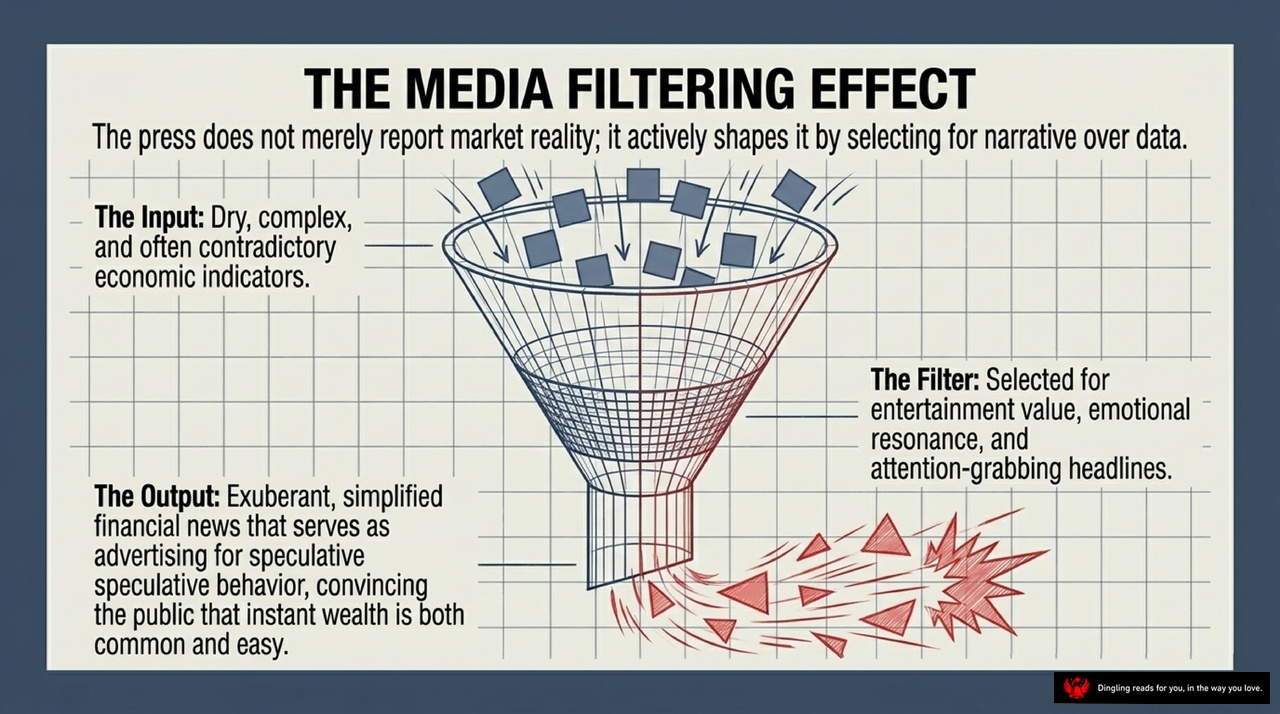
The media doesn't just report the market; it actively shapes it. Look at this funnel: on the left, we have the raw input—dry, complex, and often contradictory economic data. But the press acts as a filter, selecting only what offers entertainment value or emotional resonance. The result? On the right, we get exuberant, simplified headlines that convince the public that instant wealth is common and easy. This isn't just about news; it's advertising for speculative behavior. By prioritizing narrative over data, the media turns complex reality into a story that fuels the very bubbles it describes, making us believe the boom is permanent when it's actually just a carefully constructed illusion.
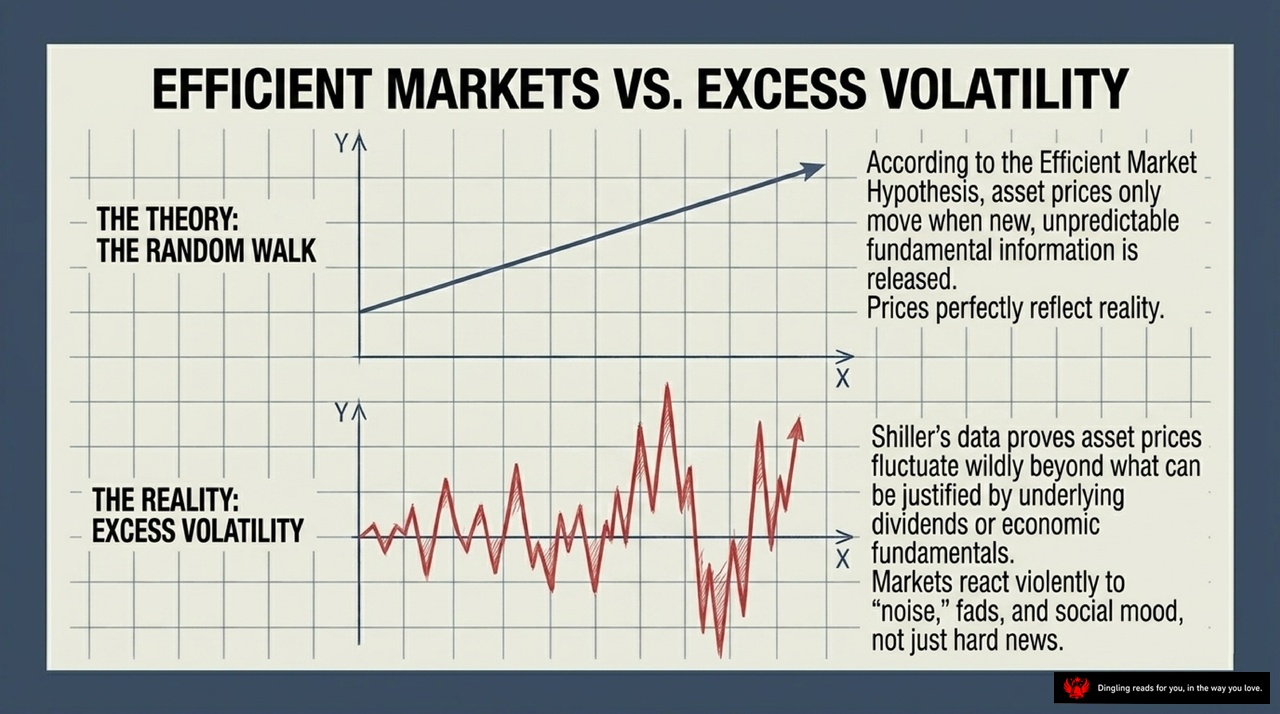
Look at this graph comparing the theory of efficient markets against the reality of excess volatility. On the top, under "The Theory: The Random Walk," we see a smooth, upward-sloping line. This represents the Efficient Market Hypothesis, which suggests that asset prices only move when new, unpredictable fundamental information is released. In this ideal world, prices perfectly reflect reality, rising steadily without wild swings.
But look at the bottom section labeled "The Reality: Excess Volatility." The red line here is jagged and erratic, showing that asset prices actually fluctuate wildly far beyond what dividends or economic fundamentals can justify. As the text explains, markets don't just react to hard news; they react violently to "noise," fleeting fads, and shifting social moods. Shiller's data proves that instead of a calm random walk, we are living in a world of extreme volatility driven by human psychology. This disconnect between the smooth theoretical line and the chaotic real-world data is the core of what we call irrational exuberance.

Look at this diagram: "Cross-Asset Contagion: Stocks to Real Estate." It captures a critical moment in financial history where panic and profit didn't stay in one place; they simply migrated. The slide breaks this down into three distinct phases that drove the bubble from the tech crash into the housing boom.
First, we have **The Catalyst**. On the left, you see the collapse of the dot-com equity bubble combined with aggressive interest rate cuts. When the tech market imploded, capital needed a new home.
This leads us to the center: **The Migration**. This is the most important part of the chart. It shows speculative energy shifting from tech stocks to real estate. The psychology didn't change; the asset class did. Housing was no longer viewed just as a place to live or a shelter. Instead, it became a high-yield, "can't-lose" investment vehicle. People were looking for the same excitement they just lost in the stock market, and they found it in bricks and mortar.
Finally, on the right, we see **The Shared Delusion**. This is where the two bubbles merge. Both the stock and housing booms relied on similar justifications: the belief in a "New Era," massive media amplification, and a complete erasure of historical risk awareness. Investors stopped looking at data and started looking for narratives. The chart perfectly illustrates how a bubble in one asset class can infect another, creating a systemic risk that affects the entire economy.

How do we actually build a society that can withstand the next market bubble? The answer isn't just about predicting the crash; it's about designing a resilient architecture that stops the fever from ever getting this high in the first place.
Look at the three pillars we need to strengthen. First, for individuals, the goal is **Global Diversification**. We need to stop over-concentrating our wealth in domestic equities or a single housing market. It's about disconnecting your personal financial planning from the speculative successes you see on the news. You have to actively **Resist Envy**. When you see others getting rich quickly, don't let that drive your own decisions. Instead, focus on long-term intrinsic value rather than chasing the latest trend.
Next, look at **Institutions**. They must prioritize **Structural Integrity**. This means separating investment banking from objective research to remove systemic bias. If the people selling the stock are the same ones rating it, the game is rigged. Institutions also need **Better Reporting**. We need to shift our focus away from short-term quarterly guidance and toward long-term metrics that actually reflect what a company is worth.
Finally, the role of **Governments** is critical. We need **Policy Dampening**. Instead of using monetary and tax policies to inflame the market, we must design rules that cool it down when it gets too hot. We also need **Enhanced Education**. This means integrating the reality of behavioral finance into public retirement planning. We have to teach people that markets aren't just math; they are driven by psychology, and understanding that is the only way to protect your future.

So, here's the hard truth we need to sit with: speculative bubbles aren't glitches in our math or broken models. They are the natural byproduct of human psychology, social contagion, and the structural incentives of a free market. Look at that question on the slide: if our market architecture is built on human emotion, are our financial decisions driving real value, or are we just chasing the intoxicating echo of the crowd?
Think about it. When prices rise, they don't just reflect earnings; they feed a psychological feedback loop. Rising prices make us feel confident, which draws in more people, which pushes prices even higher, completely ignoring the asset's actual worth. It's not about cold calculation; it's about the excitement of being part of something bigger, the envy of seeing others profit, and the gambler's thrill of the moment.
History proves this isn't a new phenomenon. From the 1929 crash to the dot-com bubble, and now the synchronized spikes in housing markets across cities like Boston, London, and Shanghai, the pattern is identical. Even when fundamentals—like corporate profits or GDP—stay flat, prices soar because the narrative of a "new era" takes hold. We convince ourselves that this time is different, that the crowd is right, and that the value is real. But often, we are just amplifying a collective delusion, mistaking the noise of the crowd for the signal of the market.