
Journey through a hundred years in the Middle East: Complete Chapter-by-Chapter Summary
Welcome to *A Century of the Middle East* by Guo Jianlong. Today, we step into a fractured landscape where an ancient empire meets a turbulent century. As you see the cracked map behind us, this isn't just geography—it's the story of a shattered empire and a hundred-year struggle for identity, power, and peace.
We begin in Istanbul, once the heart of the Eastern Roman Empire. For nearly a thousand years, this city stood as a beacon of Christianity, surviving waves of invaders from Persia, the Arabs, and the Mongols. But in 1453, everything changed. The Ottoman Turks, led by Sultan Muhammad II, breached the walls. The city was renamed Istanbul, and the Christian mosaics were erased, replaced by the call to prayer. This moment marked the rise of a new power that would soon dominate three continents.
At its peak, the Ottoman Empire controlled everything from the Balkans to Egypt, becoming the guardians of Islam and inheritors of the Caliphate. Its wealth came from controlling the Bosporus Strait, the only water route between Europe and Asia. But empires don't last forever. As European powers rose, the Ottomans began to crumble. By the 19th century, they were mocked as the "Sick Man of Europe," struggling against internal rebellion and external pressure from Russia, Italy, and the British.
The final blow came in World War I. When the Ottomans sided with Germany and lost, the empire was dismantled. The Treaty of Sèvres tried to erase it from the map entirely. But the Turkish people refused to accept this fate. Led by Mustafa Kemal, they fought a war of independence, defeating the occupying forces and establishing the Republic of Turkey in 1923. This victory didn't just save a nation; it reshaped the entire Middle East.
However, the collapse of the Ottoman Empire left a legacy of artificial borders. Colonial powers like Britain and France drew lines on maps without regard for local tribes or religions. They created nations like Iraq, mixing Sunni and Shia communities, and Lebanon, balancing Christians and Muslims. These fragile states, built on division rather than unity, would soon become the stage for decades of conflict.
From Istanbul to the ruins of the Ottoman world, we are witnessing the birth of modern Middle East politics—a story written in blood, borders, and the enduring search for belonging.

On the left, we see Mehmet from Turkey, a Shia Muslim waiting in Beirut to join Hezbollah and fight for the Assad regime. On the right stands Mohamed from Denmark, a Sunni Muslim of Pakistani descent, secretly preparing to cross into Iraq and Syria to join ISIS. Despite their different origins and opposing sides, these two young men shared the same hostel room in Beirut, destined for the same battlefield. This image perfectly captures the core theme of "The Illusion of Peace." In the Middle East, borders are often just an illusion, and what we call peace is merely a temporary pause in a perpetual, invisible war. The conflict isn't just about geography; it's a deep-seated fracture between Sunni and Shia identities, a legacy of centuries of division that continues to fuel violence today.

The century of chaos in the Middle East didn't start with a sudden explosion, but with the slow, deliberate shattering of a massive empire. In 1918, the Ottoman Empire, which had held a fragile balance across the region for centuries, finally collapsed after World War I. But the real disaster wasn't just the fall itself; it was what came next. Western powers, specifically Britain and France, stepped in to carve up the land, drawing arbitrary borders on maps that completely ignored centuries of organic cultural and religious boundaries. They created artificial nation-states, forcing distinct and historically opposed groups—Sunni Muslims, Shia Muslims, Kurds, and Maronite Christians—to live side by side in countries where they had never coexisted. This geopolitical trap planted the seeds for decades of conflict. Today, when you look at the map, you aren't just seeing lines; you're seeing the scars of a region that was forced to wear a new identity, one that often clashed violently with its people's true heritage.

The Lebanese Civil War, which erupted in 1975, dragged this small Mediterranean nation into a fifteen-year abyss of sectarian violence and external manipulation. At home, Christian Maronites, Armenians, and Greek Orthodox clashed with Sunni, Shia, and Druze militias, each fracturing further along secular or religious lines and backing different foreign powers. The chaos was fueled by outside actors: the PLO used Lebanon as a base to fight Israel, while Israel invaded repeatedly to clear the threat. Syria entered under the guise of peacekeeping but sought to control the country, shifting alliances between Christian and Muslim factions as its interests demanded. Iran and Iraq fought through proxies, while Egypt, Libya, and even the UN peacekeepers struggled to hold a fragile line in a shifting landscape where no ally was permanent.
The roots of this conflict lay in Lebanon's very creation. During the French mandate, borders were drawn to dilute Maronite power by including Sunni and Shia areas from Syria, creating a complex religious mix. Political power was initially divided by sect—Maronite president, Sunni prime minister, Shia speaker—but subsequent censuses were avoided for fear that a Muslim majority would overturn this balance. The arrival of hundreds of thousands of Palestinian refugees after 1948 further inflamed tensions, as the government denied them citizenship. When the PLO moved into Lebanon in 1970, forming a "green line" of confrontation, the stage was set. The war began in 1975 with a church bombing and retaliatory killings, quickly turning Beirut into a divided city where Christian and Muslim neighborhoods were severed by barricades and fire.
Violence soon transcended sectarian lines, leading to indiscriminate massacres like the 1976 Karantina and 1982 Sabra and Shatila atrocities, where civilians were slaughtered under the watch of Israeli forces. Even after nominal peace, the city remained split, with deep-seated distrust preventing reconciliation. Post-war power-sharing agreements only entrenched sectarian politics, allowing external powers like Syria and Iran to maintain influence through proxy groups like Hezbollah. Today, Lebanon remains trapped in this cycle, a victim of its own fragile confessional structure and the relentless interference of regional and global powers.
The Levant's story is defined by a fault line that runs deeper than geography—it's a fracture in the soul of Islam itself. As we look at the map, we see the Sunni-Shia divide, but the reality is far more visceral and bloody than just a political map. It is a story of "brothers in blood" turned into enemies, where theological differences have fueled a century of regional chaos.
The seeds of this conflict were sown the moment the Prophet Muhammad passed away. The immediate question was: who inherits his leadership? While the early caliphs were chosen through consensus, a faction believed that Ali, the Prophet's cousin and son-in-law, was the only legitimate successor. This disagreement over legitimacy birthed the Shia, or "Partisans of Ali," while the majority who rejected this view became the Sunnis. What started as a theological debate quickly spiraled into the first civil war in Islamic history, setting a precedent for violence that would echo for centuries.
For a long time, the Shia remained a minority, often marginalized and oppressed by Sunni rulers. In places like Iraq and Lebanon, they were the majority in terms of population but held the keys to the kingdom in their hands. But the dynamic shifted dramatically in 1979 with the Iranian Revolution. For the first time, a Shia-majority nation rose to power, creating a beacon of hope and a strategic hub for the entire Shia world. Iran, determined to export its revolution, began to actively support Shia movements abroad. This led to the rise of Hezbollah in Lebanon, a group that evolved from a militia into a state-within-a-state, backed by Iranian funding and weapons. Hezbollah's success proved that the Shia could not only survive but dominate, fundamentally altering the regional balance of power.
This shift created a terrifying "proxy war" dynamic. We saw this play out in Iraq and Syria, where the lines were drawn not just by religion, but by geopolitics. In Iraq, the Shia majority was ruled by a Sunni dictator, Saddam Hussein, who feared the Iranian revolution. In Syria, a Sunni majority was ruled by the Alawite branch of the Shia, Bashar al-Assad. In both cases, the ruling minority felt threatened by the majority, leading to internal instability that external powers exploited. Iran backed the Shia rulers, while Saudi Arabia and the US backed the Sunni populations, turning the region into a chessboard where every move was a battle for influence.
The most tragic example of this cycle is the Iran-Iraq War. It wasn't just about a border dispute; it was a clash of ideologies and sectarian identities. Iraq invaded Iran, fearing a Shia revolution would spread to its own Shia population. The war devastated both nations, leaving Iraq in debt and Iran with a powerful military. But the real cost was the normalization of sectarian hatred. It showed the world that in the Middle East, you could not separate religion from politics. The conflict didn't end with a treaty; it ended with a new, more dangerous reality where the Shia were no longer just a persecuted minority but a formidable geopolitical force.
Today, this legacy is the engine of instability. From the streets of Beirut to the ruins of Fallujah, the Sunni-Shia divide is the underlying current of every conflict. It explains why a war in Syria can ripple into Iraq and Lebanon. It explains why Saudi Arabia and Iran are locked in a cold war that heats up into direct conflict. It is a story of brothers who, instead of building a united Islamic world, built a landscape of mutual destruction. And as long as the question of "who is the true leader of the Muslim world" remains unanswered, the blood will continue to flow.
When we talk about the Sunni-Shia divide, it's easy to get lost in history books, but for the average person on the street in the Middle East, this isn't just about theology—it's about who holds the keys to power. Imagine walking through a city where your neighbor belongs to a different sect, and that difference isn't just a label; it's a fault line that can tear a country apart.
The split began at the very start, right after Prophet Muhammad passed away. The core question was simple yet explosive: who should lead? While many saw Ali, the Prophet's cousin, as the natural choice, others believed leaders should be elected. This disagreement birthed two distinct paths. The Sunni majority eventually accepted the elected caliphs, while the Shia insisted on Ali's lineage as the only legitimate succession. But over centuries, this theological rift hardened into a political reality. For a long time, the Shia were the underdogs. Look at Lebanon or pre-2003 Iraq; in both places, the majority Shia population was ruled by a Sunni elite. It created a deep sense of grievance, a feeling that the system was rigged against them.
Everything changed in 1979 with the Islamic Revolution in Iran. For the first time, a Shia-majority nation seized power and began exporting this revolution. They didn't just want to change their own country; they wanted to reshape the entire region. This shifted the balance of power dramatically. Suddenly, the Shia were no longer just a persecuted minority; they were a rising force with a strategic vision. This is where Hezbollah comes in. Born out of the chaos of Lebanon's civil war and backed by Iran, Hezbollah became the ultimate tool of this new strategy. They provided the Shia in Lebanon with the military strength they had always lacked, turning them from a political minority into a formidable power that could actually challenge Israel.
But the story doesn't end there. This same dynamic played out in Iraq and Syria, creating a volatile "sectarian trap." In Iraq, the majority Shia population was once again ruled by a Sunni dictator, Saddam Hussein. In Syria, the majority Sunni population was ruled by a minority Alawite branch of the Shia. It's a bizarre cycle of minority ruling majorities, fueled by deep mistrust. These neighbors, once part of the same Ottoman Empire, found themselves locked in a deadly game of "divide and conquer." They supported opposing sides in each other's civil wars, pouring fuel on the fire.
The result is a region where religious identity has become a proxy for political survival. It's no longer just about faith; it's about survival in a landscape where your religion determines whether you are a citizen or an enemy. This deep-seated mistrust, born from centuries of conflict and exacerbated by modern geopolitics, has turned the Middle East into a powder keg where the smallest spark can ignite a catastrophic war.

The map of the Middle East wasn't drawn by history; it was sketched by colonizers with straight lines that ignored centuries of fluid tribal movement. When the Ottoman Empire collapsed, Britain and France carved up the region into artificial states like Iraq and Lebanon, forcing together rival sects and separating kin. In Iraq, a Sunni minority was imposed upon a Shia majority, while the Kurdish population was split across three nations, creating a "stateless nation" that has never found peace. Similarly, Lebanon was constructed as a fragile "confessional salad," with power allocated strictly by religion, a formula that inevitably led to violence when demographics shifted.
These arbitrary borders and forced cohabitation created a powder keg. As the old empires faded, new powers like the US and Russia stepped in, often fueling the very conflicts they claimed to resolve. The result is a region where every political decision is filtered through the lens of sectarian identity. From the rise of the Shia-led state in Iran to the Sunni-majority regimes in Saudi Arabia, the divide has hardened into a zero-sum game. Today, we see this play out in proxy wars across Syria, Iraq, and Lebanon, where local grievances are amplified by global superpowers. The tragedy is that the land itself has become a chessboard, and the people living on it are merely the pawns caught in a game they never chose to play.

Lebanon didn't just become a country; it was engineered into a brutal chessboard, turning 10,000 square kilometers into the ultimate proxy battleground. This map reveals a complex web where every line represents a shifting alliance and a hidden agenda. At the top, you see the Maronite Christians, the ruling government fighting desperately to maintain their demographic and political dominance. But they aren't alone; they are connected to Syria, which intervenes not out of altruism, but to maintain regional hegemony and control Lebanese politics.
Look at the bottom left: Israel. Their initial goal was clear—invade to crush the PLO and occupy southern Lebanon. But the PLO, operating as a "state within a state," launched attacks that drew inevitable Israeli retaliation, creating a cycle of violence that trapped everyone. This conflict forced a new player onto the scene: the birth of Hezbollah. In response to the Israeli invasion and the marginalization of locals, Lebanese Shia Muslims formed Hezbollah with Iranian backing. This introduced a lethal new variable to the region, fundamentally changing the balance of power.
Notice how Iran connects to everything. From Syria to Hezbollah, Iran's influence is the invisible thread tying this entire network together. What started as a local dispute between Christians and Muslims evolved into a multi-layered conflict involving global powers, where no side was truly in control, and everyone was just playing a game on a board that was far too small for the stakes involved.
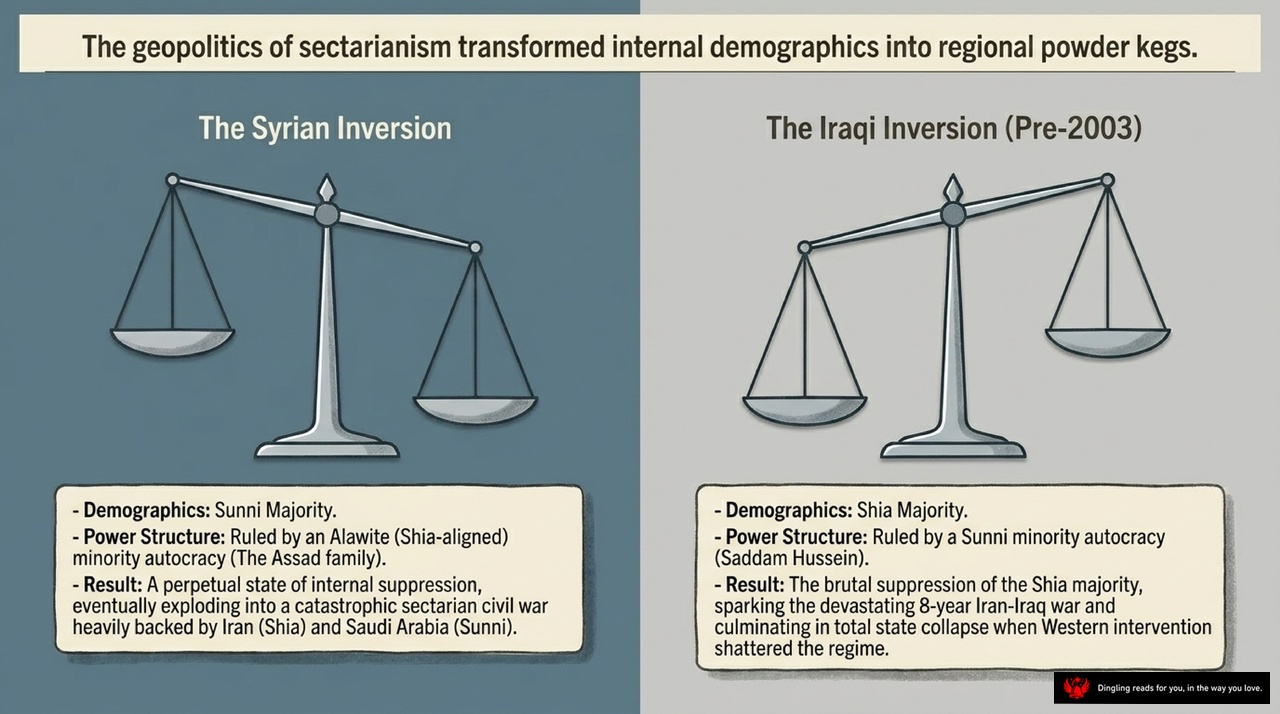
The slide reveals a stark reality: how the geopolitics of sectarianism turned internal demographics into regional powder kegs. Look at the two scales. On the left, we see "The Syrian Inversion." Here, a Sunni majority lives under an Alawite minority autocracy. This perpetual suppression eventually exploded into a catastrophic civil war, heavily backed by Iran and Saudi Arabia. Now look at the right side: "The Iraqi Inversion (Pre-2003)." It's the exact opposite. A Shia majority was ruled by a Sunni minority autocracy under Saddam Hussein. The brutal suppression of the Shia majority sparked the devastating eight-year Iran-Iraq war, culminating in total state collapse when Western intervention shattered the regime.
What this slide illustrates is a tragic pattern of inversion. In both Syria and Iraq, the demographic majority was systematically suppressed by a smaller minority at the top. This isn't just about religion; it's about power structures that refuse to reflect the people they rule. When the balance is this skewed, the result is inevitable chaos. The internal tensions become externalized, dragging neighboring countries into proxy wars and turning entire regions into battlegrounds. Today, these historical inversions still haunt the Middle East, proving that when you ignore the demographic reality of your population, you don't just create instability—you create a ticking time bomb.
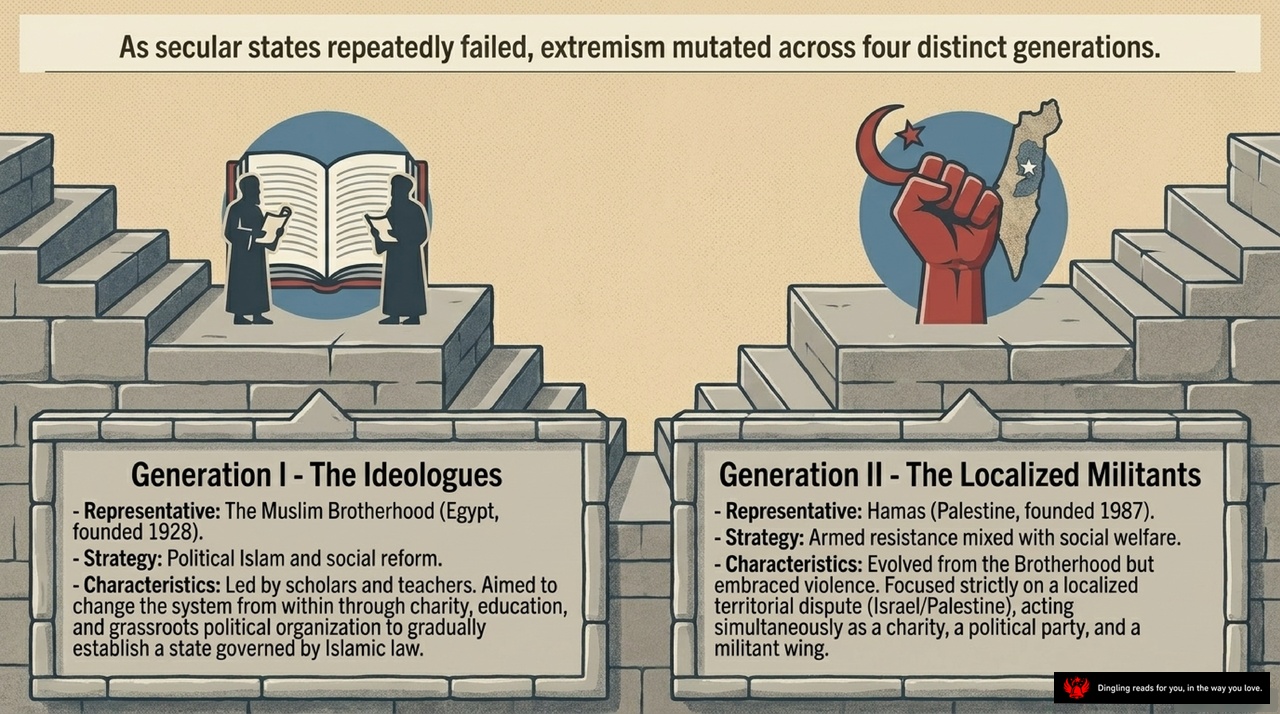
As secular states repeatedly failed to deliver stability or justice, extremism didn't just appear out of nowhere—it mutated, evolving across four distinct generations. Look at the graphic: on the left, we see Generation I, the Ideologues. Represented by the Muslim Brotherhood in Egypt, founded in 1928, these were scholars and teachers who believed in changing the system from within through charity, education, and grassroots politics. They weren't looking for immediate violence; they wanted to gradually establish a state governed by Islamic law, aiming for political Islam and social reform.
But history moved forward. On the right, we see Generation II, the Localized Militants. Taking the Brotherhood's ideas but embracing a much harder path, groups like Hamas emerged in Palestine in 1987. Their strategy shifted from pure social work to armed resistance mixed with social welfare. They evolved from the earlier ideologues but focused strictly on a localized territorial dispute, specifically the conflict between Israel and Palestine. Acting simultaneously as a charity, a political party, and a militant wing, they demonstrated how the movement was becoming more violent and territorial. This transition from peaceful reformers to localized fighters set the stage for the even more radical generations that would follow, showing a clear trajectory from ideology to localized violence.
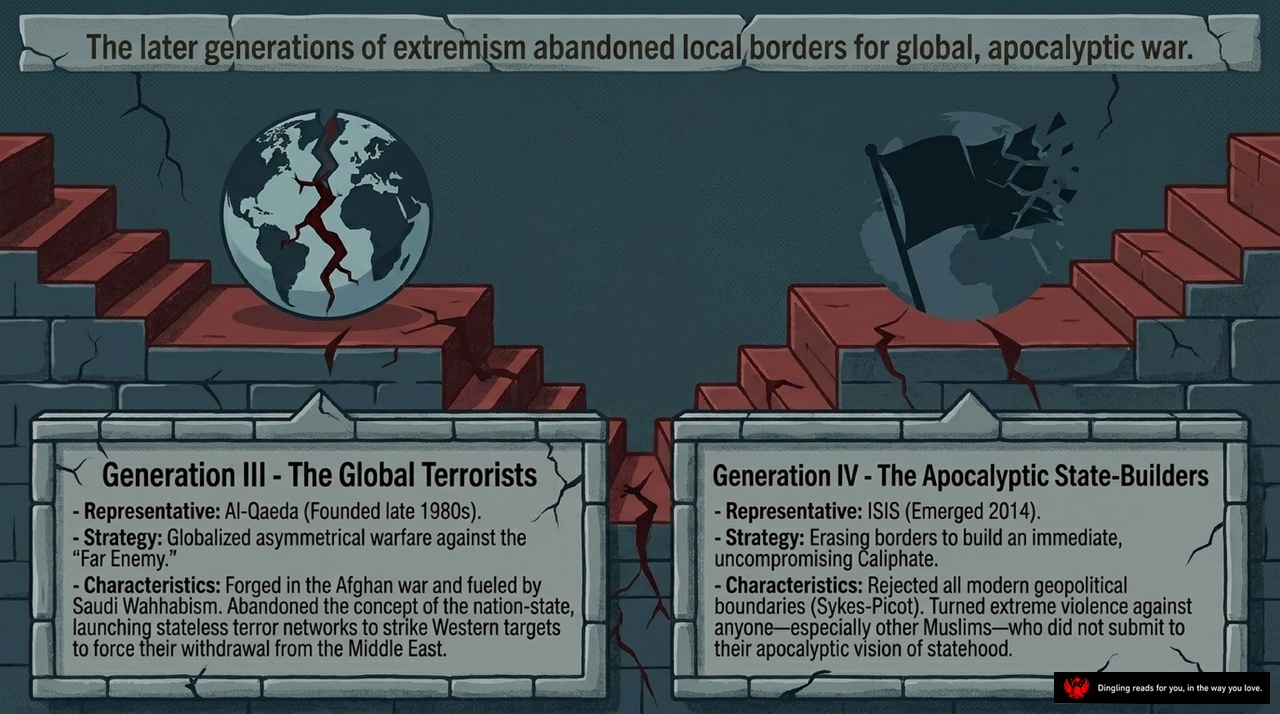
Let's talk about the most dangerous evolution in modern terrorism. As we move from Generation III to Generation IV, the game changes entirely. Look at the shift from Al-Qaeda to ISIS. Al-Qaeda, the representative of Generation III, was about "Global Terrorists." Their strategy was globalized asymmetrical warfare against a distant "Far Enemy." They wanted to force Western powers out of the Middle East. They were stateless, fighting a war of attrition against the West.
But then came Generation IV, the "Apocalyptic State-Builders," represented by ISIS emerging in 2014. This is where things get much darker and more complex. Instead of just attacking the "Far Enemy," ISIS's strategy was something far more radical: erasing borders entirely to build an immediate, uncompromising Caliphate. They didn't just want to fight the West; they wanted to replace the modern nation-state system altogether.
Notice how the text describes this shift. They rejected all modern geopolitical boundaries, specifically the Sykes-Picot lines that carved up the Middle East a century ago. But their violence wasn't just directed outward. They turned extreme violence against anyone who didn't submit to their vision—including other Muslims. If you were a Shia, a Kurd, or even a Sunni who disagreed with their interpretation, you were a target. This is a fundamental change from the previous generation.
While Al-Qaeda sought to pull back from the Middle East, ISIS sought to conquer it and reshape it according to a strict, apocalyptic religious vision. They weren't just terrorists anymore; they were trying to be state-builders, creating a theocracy that would span from the Mediterranean to the Persian Gulf. This move from a global insurgency to an attempt at total conquest marks the terrifying new reality of the current conflict.

The image we see here perfectly captures the tragic, self-perpetuating cycle of the Arab Spring—a paradox where the demand for freedom inadvertently accelerated the collapse of the very states seeking to reform.
Let's walk through this loop together. It begins with **Dictatorship**. For decades, secular military strongmen maintained stability not through prosperity, but through violent suppression. The system was rigid, but it was held together by force.
Then came the **Uprising & The Vacuum**. Citizens successfully toppled the dictator, hoping for a new dawn. But here lies the fatal flaw: there was no mature democratic infrastructure to fill the void. When the old ruler fell, a massive power vacuum was left behind.
Into that vacuum stepped **Extremism Empowers**. Highly organized, pre-existing religious groups—like the Brotherhood or armed radicals—were the only ones ready to fill the power gap. They claimed the vacuum, alienating the broader population and turning a revolution for democracy into a struggle for theocracy.
Finally, we arrive at **The Return to Force**. Terrified by religious radicalism and economic collapse, the populace either embraced the return of a military strongman, as we saw in Egypt, or plunged into total civil war, like in Syria. The cycle then closes, and the wheel turns again, leaving the region in a state of perpetual instability.

The Middle East is stuck in a geopolitical trap that has paralyzed a century of progress. As the slide illustrates, societies here face an impossible trilemma: they can only ever choose two of three forces, always at the catastrophic expense of the third.
First, look at the need for stability. Because the region lacks organic borders, the only way to achieve stability is through brutal dictatorship. Without an iron fist, the state collapses. Second, consider the desire for representation. In these artificial borders, any attempt at democratic representation instantly devolves into sectarian, majority-rule oppression. You can't have true representation without tearing the country apart.
Then there is the third force: the influence of religion. The slide points out that stripping away dictatorship to allow open religion provides oxygen for highly organized extremism. In this shattered landscape, a society cannot easily escape extremism without political openness, but it also cannot open up without risking destruction by that very extremism.
This is the core framework locking the region in place. It is a structural trap where you must sacrifice one pillar to keep the others standing. Choose stability, and you lose freedom. Choose representation, and you invite chaos. Choose religious freedom, and you risk a violent backlash. This isn't just a historical accident; it is the fundamental dynamic driving the conflict we see today.

For a century, the Middle East has been trapped in the debris of the Ottoman Empire. Arbitrary borders, competing religious ideologies, and the relentless interference of global powers have turned the quest for a unified identity into an endless cycle of war and fragmentation.
As the old borders continue to dissolve in the fires of sectarianism and proxy wars, must this region forever pay the price for the world's geopolitical ambitions, or can the fragments ever forge a mosaic of their own design?