
Just Keep Buying: Complete Chapter-by-Chapter Summary

Welcome to "Just Keep Buying" by Nick Maggiulli. Set against a backdrop of vast, shifting icebergs, this book offers a simple yet powerful truth: building wealth isn't about rigid rules or complex theories. It's about continuous action. The core philosophy here is data-driven and proven. Instead of worrying about saving a fixed percentage of your income, the goal is to save whatever you can afford without stress. True financial freedom comes from the ability to act consistently, adapting your savings to your life's realities rather than forcing a lifestyle that doesn't fit. As the title suggests, the path to wealth is found in simply keeping the process going.

So, where exactly should you pour your energy? The slide asks a simple but profound question: "Where Should You Focus Your Energy?"
The answer lies in a concept called "The Wealth Continuum." Think of it as a spectrum moving from saving on the left to investing on the right. The core idea is that your focus shouldn't be static; it needs to shift based on your specific situation.
Look at the diagnostic formula in the center. It compares your "Expected Annual Savings" against your "Expected Annual Investment Growth." This is your compass. If your ability to save money is currently higher than the growth you can get from your investments, your energy belongs on the left: focus on saving and increasing your income. But if your investment growth potential outpaces your savings ability, you should shift your focus to the right: optimize your portfolio.
This dynamic is illustrated beautifully by the timeline at the bottom. In Year 1, when you are likely starting out, you are 100% savings-driven. You have little capital to grow, so your only tool is your paycheck. But as time moves forward to Year 40, the curve flips. By then, you should be 70% investment-driven. Why? Because compound interest needs time and capital to work its magic.
This leads us to a fundamental rule displayed at the bottom right: "Poor save, rich invest." It's not about shaming anyone, but rather describing the natural lifecycle of wealth building. Early on, you build the foundation through discipline and saving. Later, you let that foundation grow through strategic investing. Don't get stuck saving forever if you have the capacity to invest, and don't try to invest heavily when you have no savings to back it up. Find your spot on this continuum, and let that dictate where your energy goes today.

So, why does the "save 20% of your income" rule feel so impossible? The problem isn't your willpower; it's a flawed myth. As the slide shows, rigid rules ignore a simple biological truth: phenotypic plasticity. Just like a salmon adjusts its metabolism to the water it swims in, your savings capacity must flex with your income. Data proves the top 1% save 51% while the bottom 20% save just 1%. Saving is dictated by income capacity, not arbitrary targets. When you stress over a fixed number, you cause more biological harm than financial good. The real solution is adaptability. Don't force a number; simply save what you can, when you can.
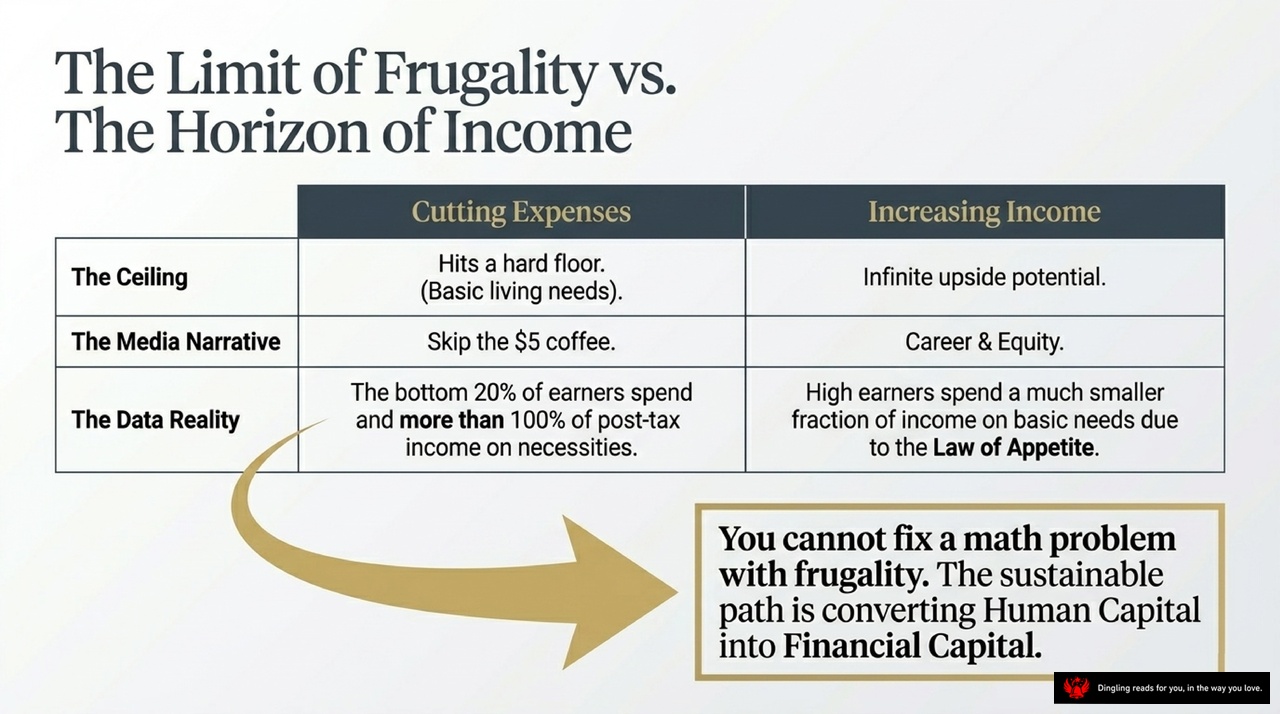
Debt is often painted as a financial monster, a trap that inevitably leads to ruin. But the reality is far more nuanced. Debt is actually a double-edged sword, and its danger depends entirely on how you wield it.
For many, especially those with lower incomes, debt isn't about overspending; it's about liquidity. Think of the "credit card savings paradox." Some people keep their cash in the bank to pay interest on credit cards, not because they are reckless, but because they fear that if they run out of cash, they'll lose access to credit when an emergency strikes. For them, debt acts as a discipline tool, forcing them to pay down balances faster than they could if they just spent their savings.
So, when is borrowing actually smart? The answer lies in two principles: risk reduction or high returns. On the risk side, keeping cash in your emergency fund rather than paying off your mortgage early gives you a buffer against job loss or medical bills. A fixed-rate mortgage also locks in your housing costs for decades, protecting you from inflation. On the return side, borrowing for education, entrepreneurship, or buying a home can be brilliant if the future payoff exceeds the interest cost.
However, there's a hidden cost to debt beyond the interest: your mental health. Studies show a strong link between non-mortgage debt—like credit cards—and anxiety or depression. Mortgage debt, tied to a specific asset and long-term plan, carries far less psychological weight.
The most crucial point is that many families don't choose debt; they are pushed into it by life's surprises. Unexpected expenses happen to nearly everyone eventually. The ability to strategically choose when to borrow is a sign of financial luck and planning.
When it comes to big decisions like college or a house, the math changes. For college, look at the lifetime income premium. If a degree increases your earnings by enough to cover the cost of tuition plus lost wages over your career, it's a sound investment. For housing, remember that a house is often more of a liability than an asset in the short run. You face upfront costs like closing fees and commissions, plus ongoing maintenance that can eat up 1% to 2% of the home's value every year.
Ultimately, the best time to buy a home isn't about market timing; it's about your life stability. If you plan to stay in one place for at least ten years, have a stable career, and can manage a debt-to-income ratio below 43%, then buying makes sense. If not, renting offers flexibility and avoids the burden of maintenance. Match your savings tools to your timeline: keep cash for short-term goals under three years, use bonds for mid-term goals, and let stocks work for long-term wealth.
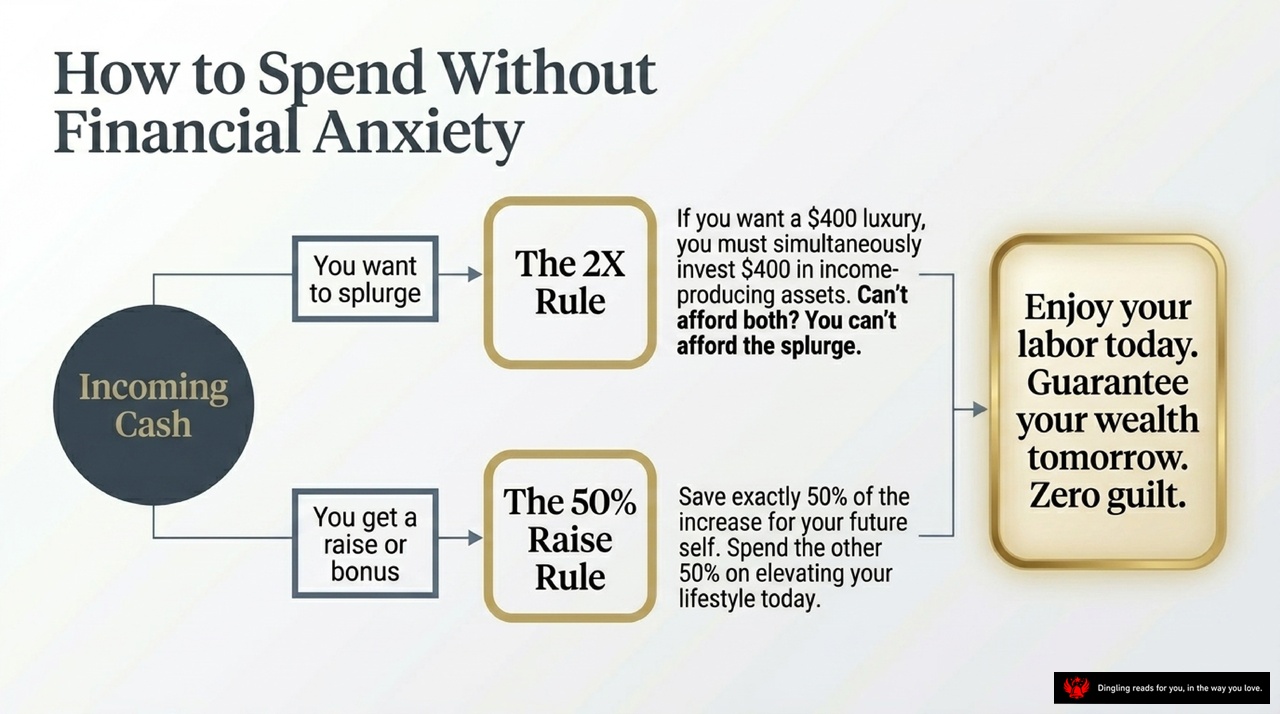
Let's talk about the two biggest hurdles to spending without guilt: the fear of overspending and the anxiety about the future. The slide breaks this down into a simple, actionable flow. It starts with your incoming cash and gives you two distinct paths depending on your situation.
First, if you want to splurge on something nice, like that $400 luxury item, don't just dip into your savings. Apply "The 2X Rule." This means for every dollar you spend on a luxury, you must simultaneously invest that same dollar into income-producing assets. If you can't afford both the splurge and the investment, then frankly, you can't afford the splurge. This transforms your spending from a debt into a balanced act of enjoying today while securing tomorrow.
Second, consider what happens when you get a raise or a bonus. This is where "The 50% Raise Rule" comes in. Instead of spending the whole increase, save exactly 50% of that new money for your future self, and spend the other 50% on elevating your lifestyle today. This allows you to enjoy the fruits of your labor without derailing your long-term financial goals.
By following these two rules, you move from a place of financial anxiety to a place of clarity. As the slide concludes, you can truly enjoy your labor today, guarantee your wealth for tomorrow, and do it with zero guilt. It's not about restricting yourself; it's about balancing your needs with your future.
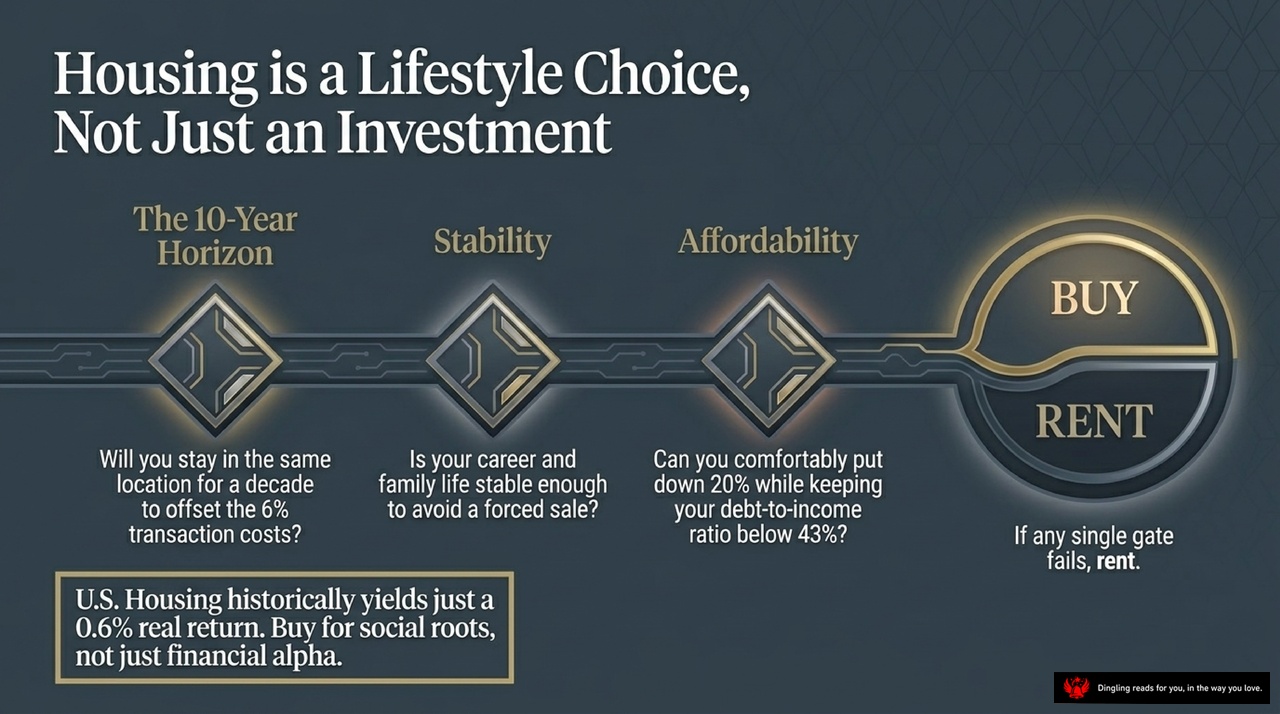
Housing isn't just about chasing financial alpha; it's a fundamental lifestyle choice. Let's look at the three gates you must pass before pulling the trigger on buying. First, the 10-year horizon. Will you actually stay in this location long enough to offset those transaction costs? Historically, U.S. housing yields only a 0.6% real return, so you need that decade of stability to make the math work. Second, stability. Is your career and family life secure enough to avoid a forced sale? If you're planning to move soon, buying locks you into a market you might outgrow. Third, affordability. Can you comfortably put down 20% while keeping your debt-to-income ratio below 43%? This isn't just about having the cash; it's about ensuring you aren't drowning in payments.
Here's the rule: if any single gate fails, rent. The U.S. data shows that for most people, the hidden costs of ownership—maintenance, taxes, and the effort of managing a property—often outweigh the benefits unless you have a very long-term plan. Don't buy just because you think you should; buy only if it fits your life, not just your portfolio.
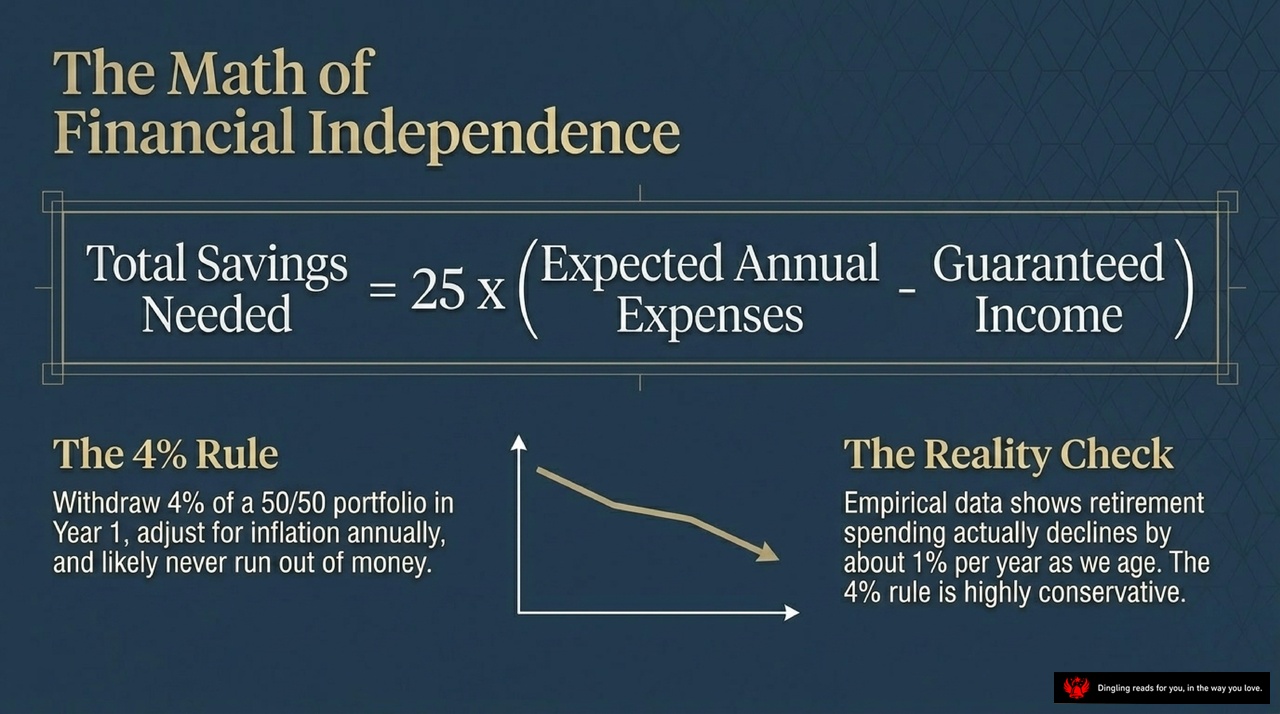
Imagine you are a seasoned investor watching the markets through a stormy window. In March 2020, the S&P 500 plummeted 32% in just one month, restaurants closed, and the NBA paused. It was terrifying, yet amidst the chaos, I saw a florist calmly arranging bouquets. That moment reminded me that life goes on, even when the charts turn red.
Here is the hard math of panic: to recover from a 33% drop, you need a 50% gain. But history is on your side. Data shows that buying when the market falls 30% or more means you have less than a 10% chance of earning less than 5% in the following year. In fact, over half the time, you'll see returns of 10% or higher. If you buy during a 50% crash, your future annualized returns often exceed 25%.
Don't let fear paralyze you. While Japan's stock market is a famous cautionary tale, it's an exception, not the rule. Across 39 developed nations, stocks beat inflation 87.5% of the time over 30 years. Even in a prolonged slump, consistent buying yields positive results. The key is to reframe your expectations. If a market needs five years to recover from a 33% drop, that's an 8% annualized return—right in line with history.
Of course, there comes a time to sell, but only for three specific reasons: rebalancing your portfolio, exiting concentrated or losing positions, or meeting essential financial needs. Avoid selling out of fear or FOMO. By sticking to these rules and trusting the data, you turn crisis into your greatest opportunity.

Why We Must Invest: The Great Conversion
Look at this graph. It tells a simple but terrifying story about the next 40 years of your life. On the left, you see "Human Capital"—the value of your future labor. It starts high when you're young and capable, but it inevitably declines as you age. You can't sell your time back to the market. On the right, you see "Financial Capital"—assets that grow. This is the only way to replace your fading human capital with something that sustains itself forever.
But here's the invisible tax that makes this conversion non-negotiable: inflation. The slide notes that at just 2% annually, inflation halves your purchasing power every 35 years. Cash sitting under a mattress isn't just stagnant; it's guaranteed destruction. Your money literally buys less and less every year.
This brings us to "The Great Conversion." Investing isn't just about making money; it's a mechanical necessity. It is the exact process of swapping your depleting ability to work for self-sustaining assets. If you don't make this switch, you are simply trading a shrinking asset for an eroding currency. The graph shows the crossover point around age 20 to 25. That is when your financial capital must begin to outpace your human capital. Before that, you are building; after that, you must rely on what you've built. Don't wait for the crossover to happen naturally. You must force the conversion now, or risk being left with no labor power and no purchasing power.
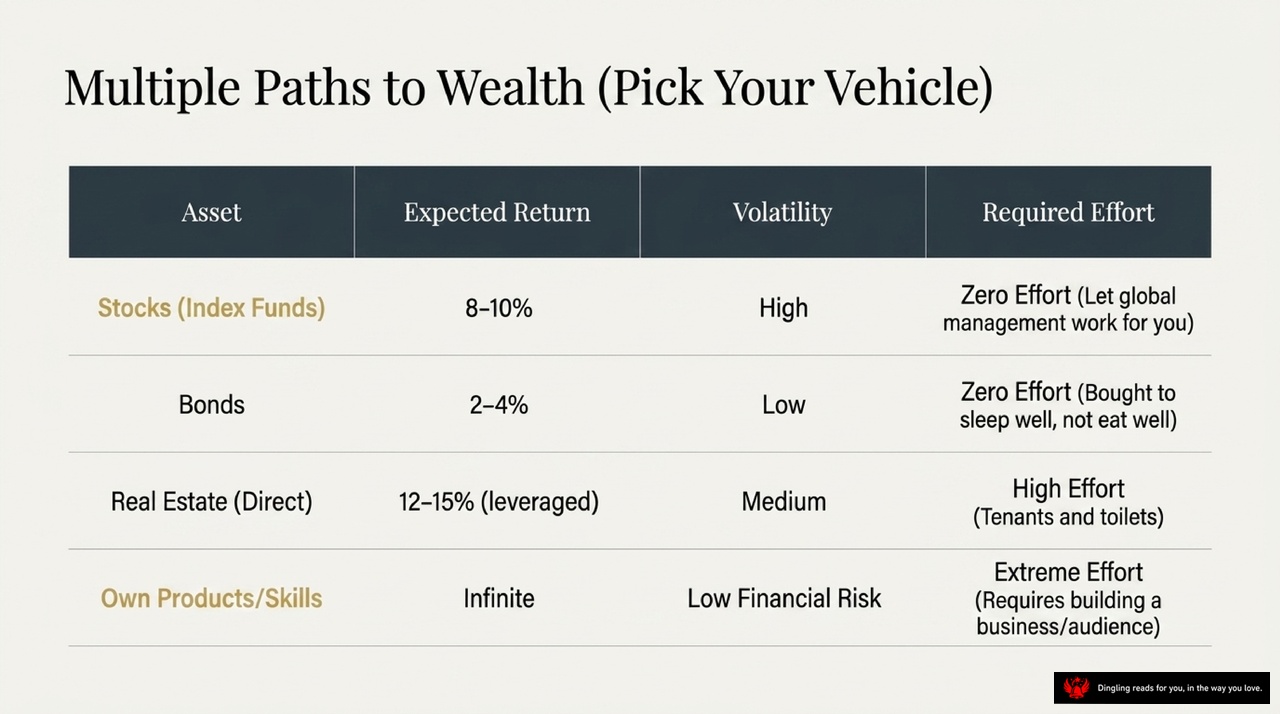
So, you've built a solid portfolio, maybe even diversified across stocks, bonds, and real estate. But here's the hard truth: even the best strategy in the world means nothing if you sell at the wrong moment. The biggest enemy of your wealth isn't the market itself—it's your own panic.
Look at this slide. It lays out the three specific triggers for selling, and you need to stick to them like glue. First, rebalancing. If you let your stock allocation grow from 60% to 90% while bonds shrink, your portfolio becomes dangerously risky. Selling just enough to get back to your target mix keeps you safe without forcing you to sell winners too early.
Second, get rid of concentration risk. If you're holding too much of one stock or asset class, you're gambling, not investing. Sell those positions to diversify. Third, and most importantly, sell only when you have a real financial need—like funding a retirement or a house. Never sell just because you're scared or because a stock dropped.
The irony? We often sell when we're afraid, missing out on the very gains we wanted. History shows that buying when the market is down and holding through the recovery is the only way to truly build wealth. So, keep your plan, ignore the noise, and only sell when your strategy or your life actually demands it.

Have you ever wondered if you'd trade Warren Buffett's entire fortune for just his 87-year-old life? Most of us would say no instantly. Why? Because time is the one asset money simply cannot buy. It can do things cash never can, even move mountains.
Consider Dashrath Manjhi, a man from rural India in 1960. After his wife fell while crossing a treacherous ridge, he decided to carve a path through the mountains himself. With nothing but a hammer and chisel, he worked day and night for 22 years. He built an 110-meter road that cut travel time from 55 kilometers down to just 15. He didn't have the money to hire a construction crew, but he traded his time to create a miracle for his entire village.
This story proves that time is your ultimate asset. The way you invest your time between ages 20 and 40 will directly dictate the quality of your life from 50 to 70. Many young people, like the author did at 23, set ambitious goals—like having $500,000 by 30—inspired by legends like Buffett. But they often fail not because they lack effort, but because they mismanage their time. They focus too much on earning money early on, missing the golden window to build skills and equity that compound over decades.
The hard truth is that while you can earn more money later, you can never get your time back. As we age, we shift from being "growth stocks" with high expectations to "value stocks" with realistic ones. Learning to appreciate the small joys of life as time passes is often more valuable than chasing the numbers we thought we needed.

So, here is the hard truth about investing: timing the market is a trap, but timing your entry is everything. The slide asks a simple question: "Why is now always better than later?" The data shows a clear winner. When you compare "Lump Sum Investing" (LSI) against "Dollar Cost Averaging" (DCA)—which is just spreading your money out over 12 months—LSI wins 80% of the time.
Look at the numbers for stocks: LSI delivers 10.2% returns, while DCA only gets 4.1%. It's the same story for gold and bonds; waiting on the sidelines guarantees you pay higher prices later because markets go up most of the time.
The dilemma is real: should you invest your cash all today, or spread it out? The reason is straightforward. If you wait, you are essentially paying a penalty for inflation and missed growth. But if Lump Sum feels too risky to you, don't fall into the DCA trap. Instead, find the fix: lump sum your money into a more conservative portfolio, like a 60/40 mix of stocks and bonds. Don't let fear make you hold cash that's losing value every single day. Invest now.

Imagine a scenario where you have a crystal ball. You know exactly when the market will crash. You know the absolute bottom. In this game, you are the "Omniscient Dip-Buyer." Your strategy is simple: wait patiently, hold your cash, and only buy the moment the market hits rock bottom.
Now, compare yourself to "The Steady Investor." This person doesn't try to time the market. They just keep buying every month, regardless of whether the market is up or down.
The graph on your screen shows the shocking result of this experiment over 40-year periods. Even with perfect foresight, the Steady Investor beats the Omniscient Dip-Buyer over 70% of the time. Why? Because missing the absolute bottom by just two months drops your win rate to a mere 3%.
The cost of waiting is mathematically higher than the benefit of the dip. When you sit on the sidelines waiting for a crash, you aren't just missing a cheap entry point; you are losing years of compounding growth. The cash you hold on the sidelines earns nothing, while the market continues to rise. By the time you finally buy, you've missed the most important part of the recovery.
This illustrates a powerful truth: trying to time the market is a losing game. The most reliable way to build wealth isn't about predicting the bottom; it's about staying in the game and letting time and consistency do the heavy lifting for you.
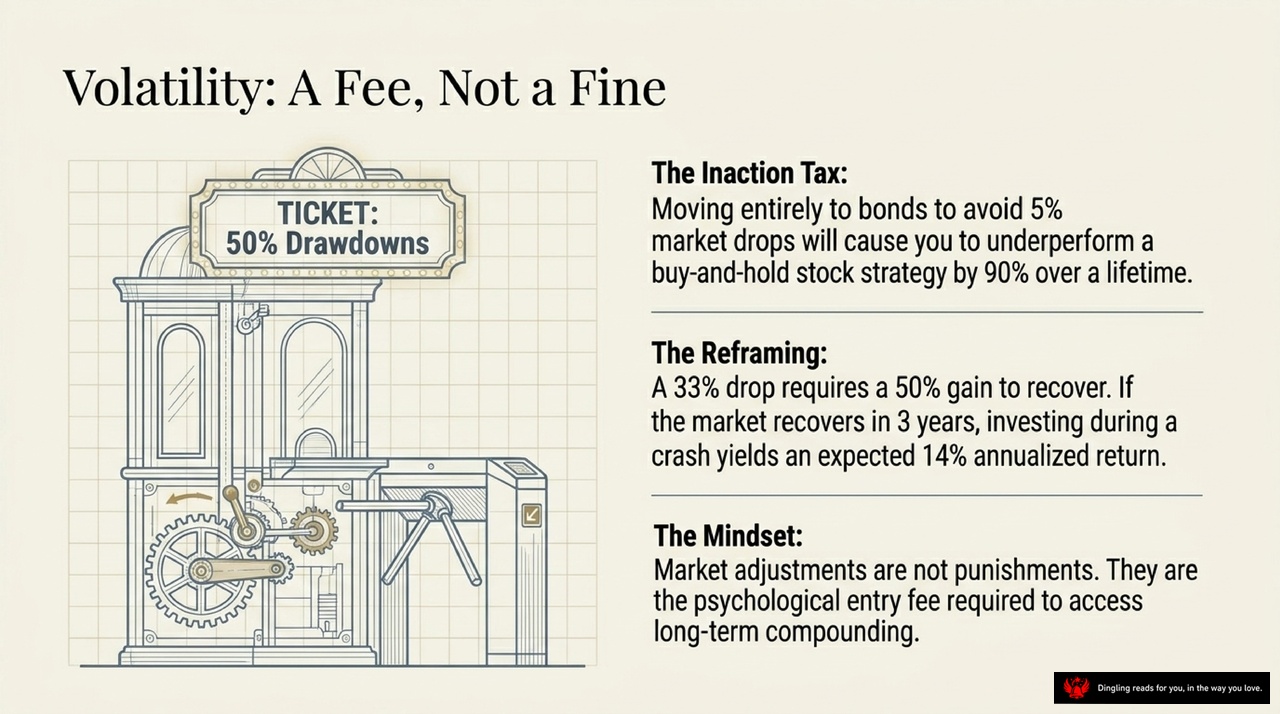
Volatility isn't a punishment; it's actually an entry fee for long-term compounding. Think of market crashes not as a fine you've been penalized for, but as a fee you pay to access the incredible growth that follows. The slide illustrates this perfectly with the concept of "The Inaction Tax." If you try to avoid a 5% market drop by moving entirely into bonds, you will actually underperform a simple buy-and-hold stock strategy by a staggering 90% over your entire lifetime. By trying to protect yourself, you're actually costing yourself your future wealth.
Let's reframe how you look at these drops. The math is brutal but clear: a 33% drop requires a 50% gain just to get back to where you started. It sounds scary, but consider the power of time. If the market recovers in just three years after a crash, investing during that crash yields an expected 14% annualized return. Essentially, the market gives you a massive discount. That temporary pain is the psychological entry fee required to access the long-term compounding machine. So, when the market adjusts, don't see it as a loss. See it as a bargain. Market adjustments are not penalties; they are the price of admission to the greatest wealth-building opportunity of your life.
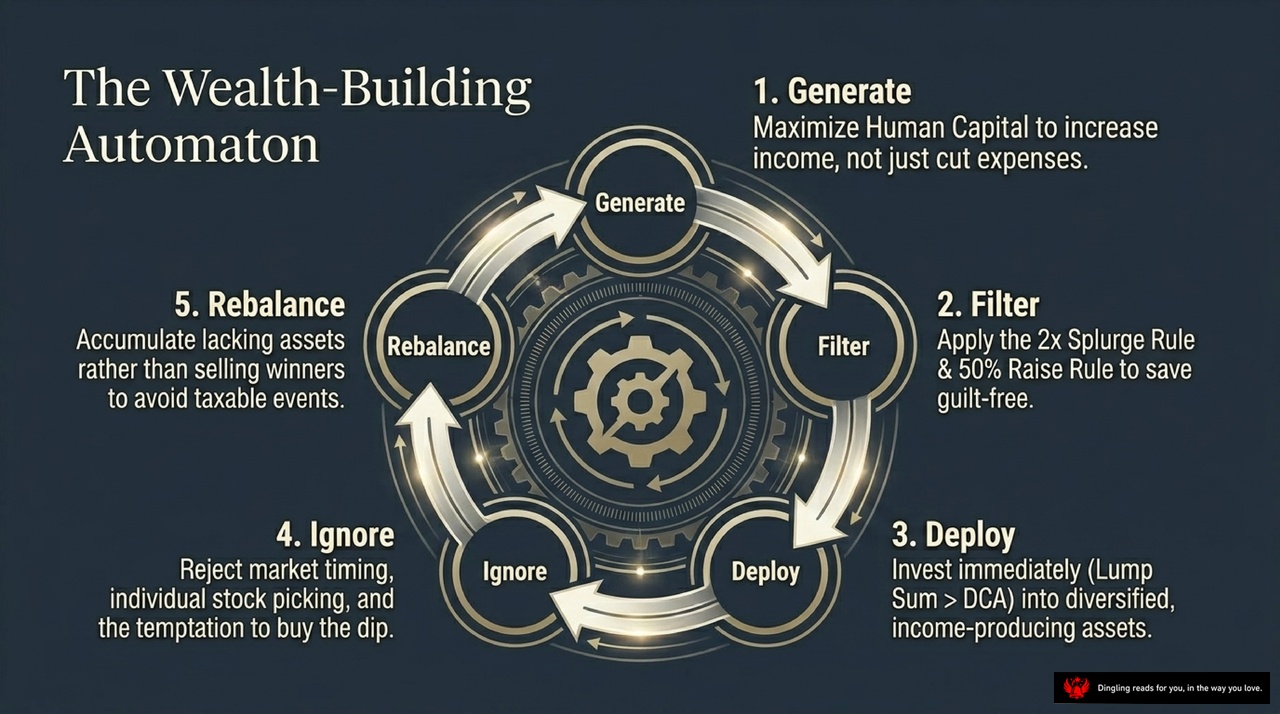
Imagine you're looking at a sophisticated machine designed to build your wealth, a self-sustaining engine that runs on five distinct gears. This isn't about luck or timing the market; it's about a deliberate, automated cycle.
First, the engine starts with **Generate**. The goal here is simple but powerful: maximize your human capital. Instead of just cutting expenses to save money, you need to focus on increasing your income. Your time and skills are the fuel.
Once you've generated income, the second gear kicks in: **Filter**. This is where psychology meets strategy. We apply rules like the "2x Splurge Rule" to make saving feel guilt-free. When you want to spend, you match that amount with an investment or donation, turning consumption into a value-creating act. It's about maximizing long-term satisfaction rather than just avoiding the pain of spending.
Next, we move to **Deploy**. Here, we reject the temptation to time the market or pick individual stocks. Instead, we invest immediately—often using a lump sum rather than waiting for a "perfect" moment—into diversified, income-producing assets. We let the market work for us rather than trying to outsmart it.
As the machine turns, the fourth gear is **Ignore**. We ignore the noise of market fluctuations, the urge to chase hot tips, and the fear of buying the dip. We trust the system and let our investments compound over time without interference.
Finally, the cycle completes with **Rebalance**. Instead of selling your winners to take profits, we accumulate the assets that are lagging. This avoids taxable events and keeps your portfolio aligned with its original risk profile, ensuring the machine keeps running smoothly for decades.
This automaton removes the emotional chaos from investing, replacing it with a logical, repeatable process that builds wealth steadily and reliably.

Imagine a world where you hold every dollar on Earth, yet you're 90 years old. Would you trade all that money just to be young again? The answer is an emphatic yes. This simple question reveals the ultimate truth about wealth: money is a tool, but time is the currency that truly matters.
The essence of real wealth isn't about picking the perfect stock, timing the market, or hoarding cash. It's about the relentless, mechanical conversion of your labor into automated financial capital through continuous buying. When you build assets that work for you, you stop trading your time for money and start letting your money buy time.
But remember: You can always generate more money, but you cannot generate more time. Every hour you spend worrying about the market or counting pennies is an hour stolen from your future. The most valuable asset you possess isn't in your bank account; it's the time you have left to enjoy it. Prioritize building systems that create value so you can reclaim the most precious resource of all—your time.