
Kawaru Chikara: Complete Chapter-by-Chapter Summary

Welcome to a masterclass in breaking common sense, where we explore the philosophy behind building a global convenience empire. Tonight, we dive into the world of Toshifumi Suzuki, the visionary leader who transformed the retail landscape.
Imagine a bustling city at night, lights flashing, traffic flowing—a scene that defines modern life. But behind every convenience store glowing on a street corner lies a radical shift in how we think about business. Suzuki challenges the old rule that less competition is better. He argues that without competition, businesses stagnate, and innovation dies. True growth comes from embracing challenges and anticipating what customers actually need before they even ask.
From a humble start with just five stores, Suzuki built a network that now spans the globe. His journey wasn't about following trends or copying others; it was about listening deeply to people and creating value that sticks. Whether it's introducing fresh meals, setting up ATMs in stores, or redesigning how products are delivered, every move is driven by one question: How can we make life easier for the customer?
This isn't just a story about selling goods—it's a blueprint for building trust, adapting to change, and staying relevant in a world that never stops evolving. Let's explore how these principles turned a small idea into a global movement.

Look at this slide. It hits on the single most important truth for any business: "The Only Constant is Change."
Many leaders try to predict the future, but 7-Eleven Japan teaches us a different lesson. They didn't become a retail giant by guessing what would happen next. Instead, they succeeded by obsessively adapting to the shifting realities of the consumer's present.
As the quote on the left reminds us, "To grow, a business must actively respond to change. Compromise is the beginning of the end." This means you can't settle for less. You can't compromise on quality or on listening to your customer. If you try to compromise, you're already on the path to failure.
So, how do you respond? You stop waiting for the perfect future and start solving today's problems with tomorrow's mindset. When the market shifts, you don't argue with it; you move with it. That's the only way to survive and thrive.

Look at this slide. It captures a pivotal moment in business history: the shift from a seller's market to a buyer's market. On the left, you see the "Traditional Retail Dogma"—the old way of thinking. It assumed that beating competitors was the only game in town, that rapid nationwide expansion was the key to success, and that slashing prices was the best way to drive sales.
But look at the right side: "The Suzuki Philosophy." This is the complete opposite. Instead of chasing competitors, we focused on changing customer needs. Instead of spreading thin across the whole country, we chose to dominate local zones with high density. And instead of competing on price, we competed on delivering new value and quality.
This wasn't just a strategy change; it was a mindset shift. The old way relied on a "seller's market" where customers had no choice but to buy from you. But the new reality was a "buyer's market." When customers have choices, they don't care about your competitors or your low prices. They care about whether you truly understand their needs and whether you offer something better. By rejecting the traditional dogma and embracing this new philosophy, we laid the foundation for everything that would follow.

Projects that face the most internal opposition are often the ones most likely to succeed. This counterintuitive truth was the defining lesson behind the launch of Seven Bank in 2001.
At the time, industry experts claimed that a retail-run ATM network without lending operations would fail. They saw no profit in what they considered a non-traditional bank. But Suzuki redefined cash access not as a financial service, but as a critical convenience product for the modern consumer. He ignored banking hardware norms and engineered custom ATMs for one-fourth the industry average cost.
While others hesitated, this bold move allowed Seven Bank to achieve rapid profitability in just three years. By turning resistance into an advantage, the project proved that the greatest opportunities lie not in following the crowd, but in breaking through the barriers that others refuse to challenge.
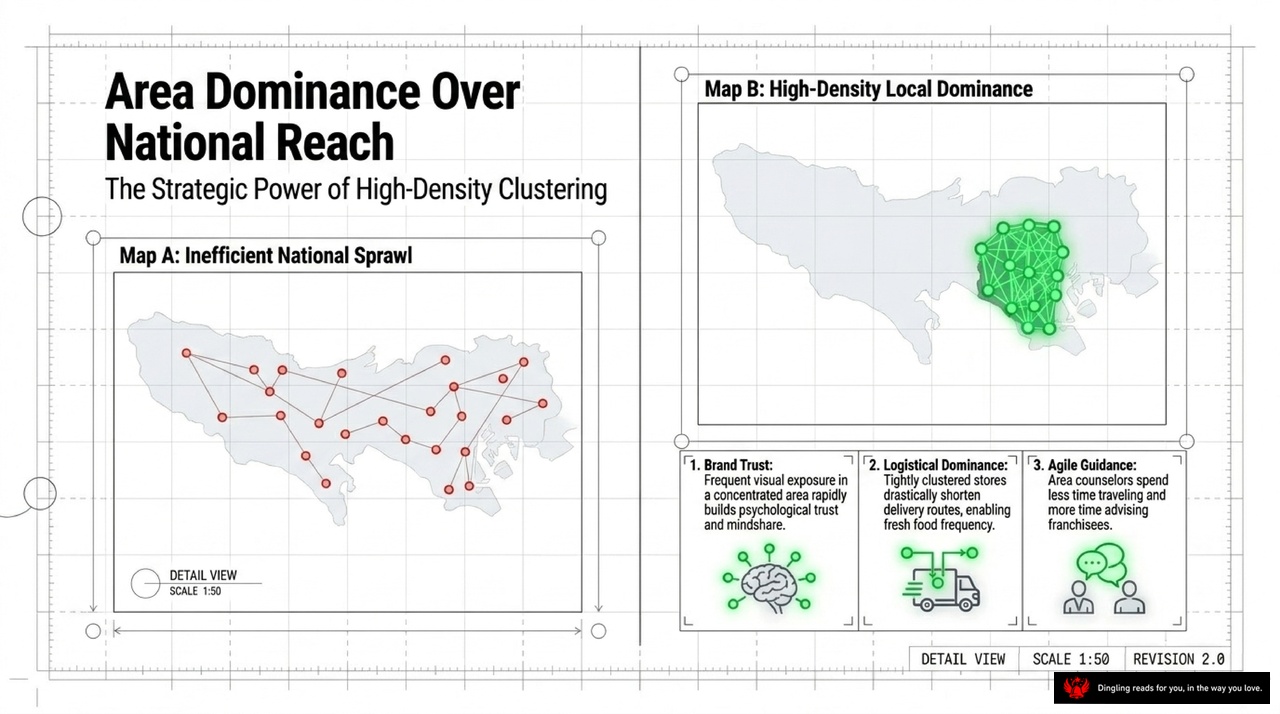
Look at the contrast between Map A and Map B. On the left, you see inefficient national sprawl—stores scattered across a vast area with long, disconnected delivery routes. On the right, we see high-density local dominance. By clustering stores tightly in one specific area, we create a powerful network that transforms the entire business model.
This strategic shift drives three critical advantages. First, it builds brand trust instantly. When customers see a concentrated cluster of stores, frequent visual exposure creates a psychological sense of reliability and mindshare that a scattered network simply cannot achieve. Second, we gain logistical dominance. Tightly clustered stores drastically shorten delivery routes, allowing us to enable fresh food frequency without the waste or cost of long-haul logistics. Finally, this density empowers agile guidance. Because our area counselors spend less time traveling between distant, isolated stores, they can dedicate more time to advising franchisees and solving real problems on the ground.
While a dispersed layout might seem like it covers more ground, our data shows that this "face-to-face" network coverage actually generates far more revenue per dollar spent. It's not about how far you reach; it's about how deeply you dominate your local territory.
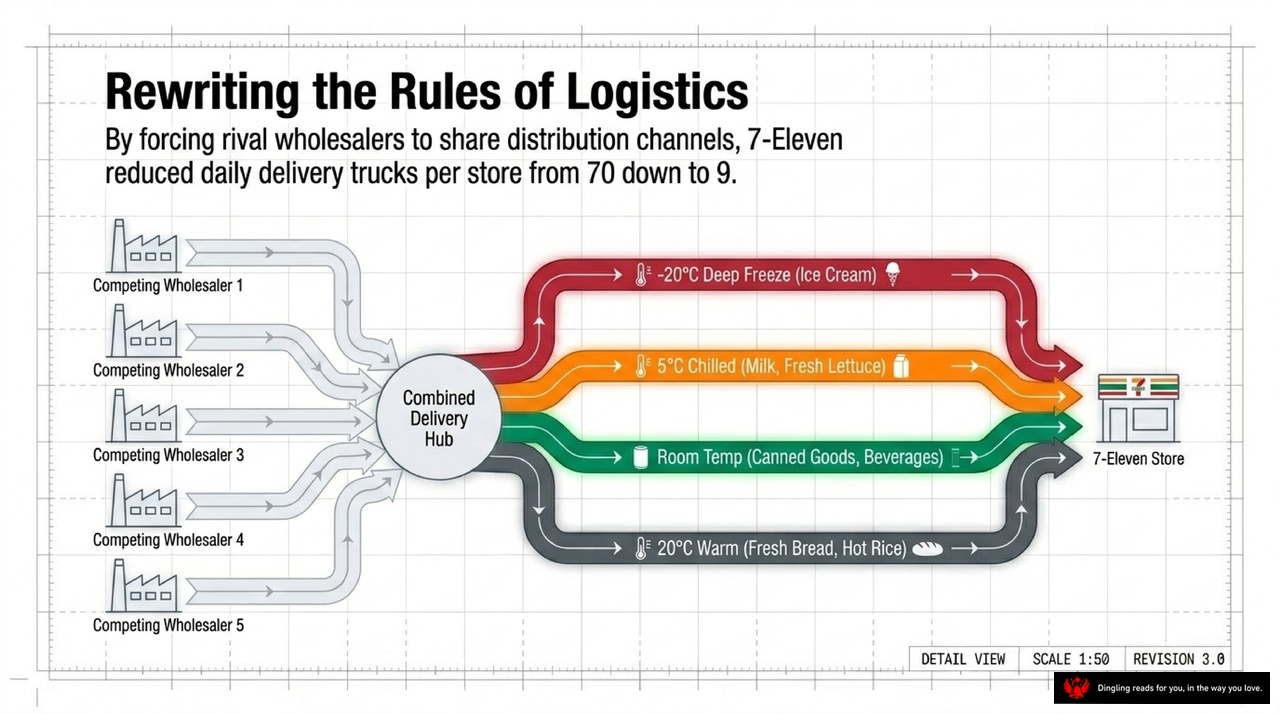
Rewriting the Rules of Logistics. By forcing rival wholesalers to share distribution channels, 7-Eleven reduced daily delivery trucks per store from 70 down to 9.
Look at this flow. Instead of five competing wholesalers each sending their own trucks to a single store, we created a "Combined Delivery Hub." All the supply lines merge here, then split into four precise temperature zones: deep freeze for ice cream, chilled for milk and lettuce, room temp for canned goods and beverages, and warm for fresh bread and rice.
This simple shift changed everything. In the past, every manufacturer acted like a king, insisting on their own delivery schedule to protect their brand image. But we proved that in a buyer's market, mixing products actually drives sales. When we let customers choose freely, every brand benefited. This "common distribution" system didn't just cut costs; it slashed the number of trucks hitting the store door from 70 to just 9. That is the power of rewriting the rules of logistics.

The Cognitive Loop of Retail isn't just a diagram; it's the heartbeat of modern management. As the slide clearly states, "POS data is just history. True management requires active foresight." We often mistake looking backward at sales reports for looking forward, but that's a fatal error.
This loop starts with **Hypothesis**. It's about predicting tomorrow's specific demand based on active variables like weather, local festivals, and demographic shifts. You aren't guessing; you're building a theory on real-time context.
Next comes **Execution**. You order precise items based solely on that forward-looking hypothesis, never blindly relying on yesterday's sales. This is the moment you take action before the results are in.
Finally, **Verification**. You use POS terminal data to rigorously prove or disprove your hypothesis, refining the accuracy of tomorrow's cycle. It's a continuous feedback loop. If your guess was right, you scale up; if wrong, you adjust immediately.
In a world where trends change overnight, this cycle is your only defense against obsolescence. Don't wait for history to tell you what to do; use this loop to write the next chapter yourself.
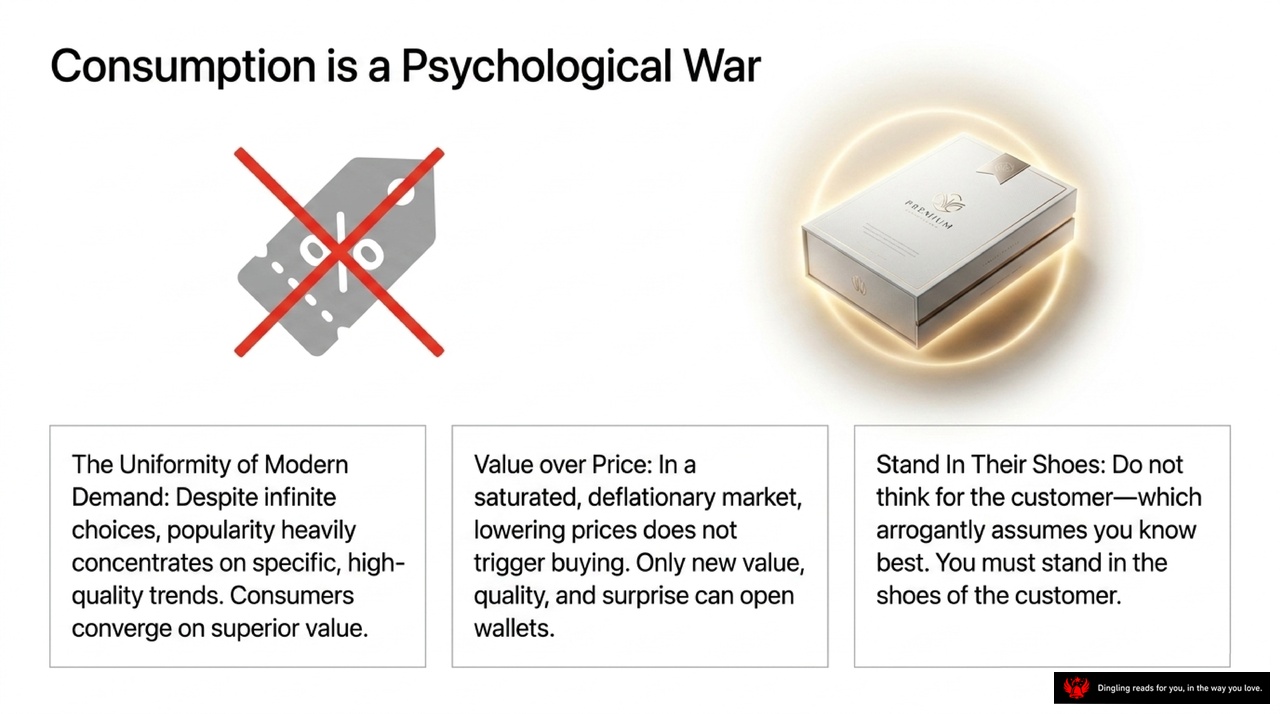
Consumption isn't just about buying things; it's a psychological war. Look at the crossed-out discount tag on the left—that's the old way of thinking. In today's saturated market, slashing prices doesn't trigger buying; it just trains customers to wait for the next deal. Real value comes from quality, surprise, and new experiences, symbolized by that glowing premium box on the right.
The slide highlights three critical shifts. First, modern demand has become uniform. Despite having infinite choices, consumers are converging on specific, high-quality trends. They aren't looking for variety; they are seeking superior value. Second, we must prioritize value over price. In a deflationary environment, lowering costs is a trap. To open wallets, you need to offer something truly new and meaningful.
Finally, and most importantly, you must stand in your customer's shoes. Stop assuming you know what they want. The biggest mistake retailers make is thinking for the customer. Instead, you have to step into their world, understand their pain points, and design solutions that genuinely resonate. When you stop competing on price and start competing on understanding, you win the psychological war.

The relentless pursuit of quality isn't just a slogan; it's the engine that keeps 7-Eleven alive. As the slide reminds us, even the most delicious food eventually causes fatigue. To stay relevant, we must constantly reinvent the classics. This is why 7-Eleven doesn't just rely on one supplier or a single expert. Instead, we coordinate directly competing manufacturers to collaborate under the NDF umbrella. By forcing these rivals to work together, we unlock unparalleled technological upgrades that yield exclusive premium lines capable of rivaling specialty restaurants.
This collaborative ecosystem is the heart of our product strategy. At the center lies 7-Eleven Product R&D, acting as the hub that connects ingredient suppliers, culinary experts, dedicated factories, and even our competitors. We don't let manufacturers become complacent "friends"; instead, we hold them to the highest standards. If a product doesn't meet our taste requirements—like our signature fried rice or red bean rice balls—we simply pull it from the shelves, no matter the cost. We refuse to compromise on quality, even when production challenges arise.
Our goal is clear: we are not selling cheap convenience; we are delivering value through superior taste. By integrating these diverse forces under one roof, we ensure that every item on the shelf is a masterpiece of innovation, proving that true quality demands a relentless, collaborative pursuit.
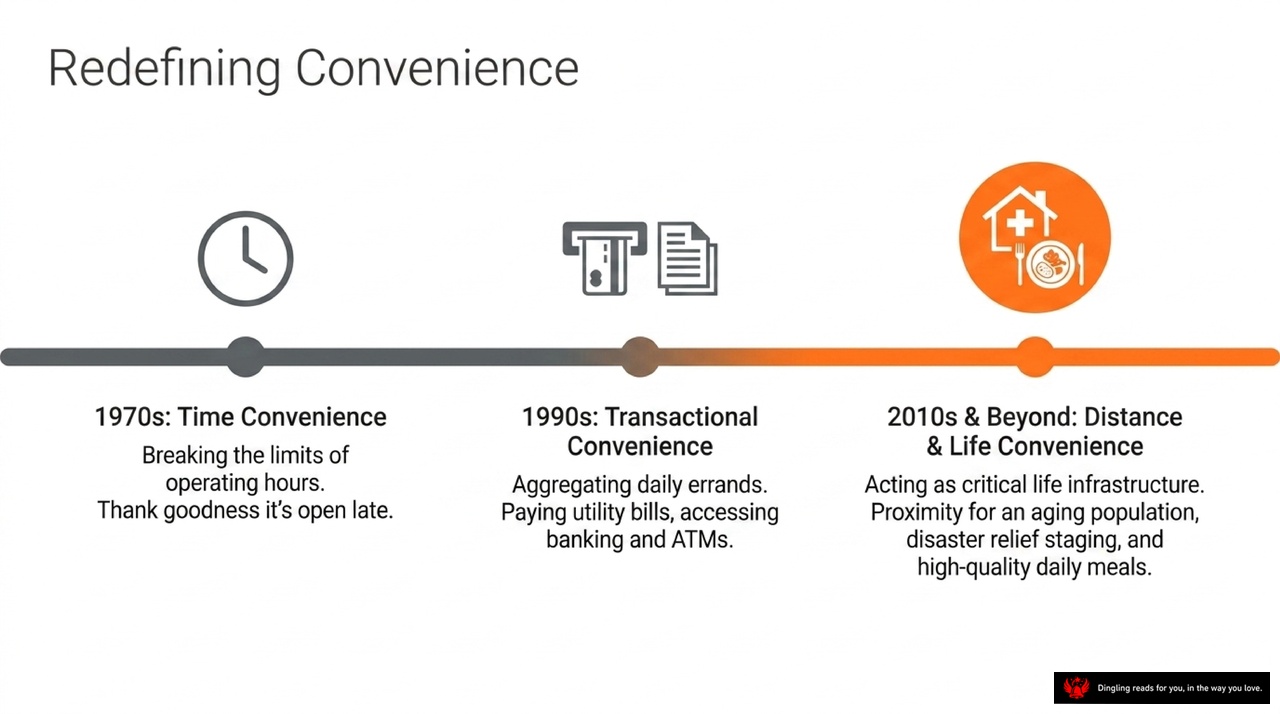
Let's talk about how the definition of "convenience" has completely shifted over the last few decades. In the 1970s, convenience simply meant time. It was about breaking the limits of operating hours—just a relief that the store was open late when everyone else was closed. Fast forward to the 1990s, and convenience transformed into something transactional. It became about aggregating daily errands, paying utility bills, and accessing banking and ATMs right there in the store. But today, we are living in an era of distance and life convenience. Since the 2010s, convenience stores have evolved into critical life infrastructure. They are no longer just places to grab a snack; they are essential neighbors for an aging population, a first line of defense during disaster relief staging, and a source of high-quality daily meals. This evolution shows that true convenience isn't just about speed or location; it's about becoming an indispensable part of the fabric of daily life.

The slide highlights a crucial shift in mindset: moving from a passive "wait-and-see" approach to an aggressive "Offensive Strategy." It warns that in today's super-aged society and digital-first world, simply waiting for customers to walk through your door is a direct path to obsolescence. Instead, you must go out and meet them where they are.
This offensive strategy is built on two pillars. First, there's **Physical Reach**, exemplified by Seven Meal & Delivery. This isn't just about logistics; it's about proactively delivering nutritionally balanced daily meals directly to the elderly and busy urban workers using electric vehicles. We are bringing the convenience of a store right to their doorstep, removing the friction of travel.
Second, we have **Digital Reach** through Omnichannel Integration. This means seamlessly blending online ordering with local store fulfillment. By transforming our physical stores into networked hubs equipped with Seven Spot Wi-Fi, we create a frictionless experience where the digital and physical worlds merge. We aren't just selling products; we are integrating our services into the customer's daily life, ensuring that no matter where they are or what device they use, our "convenience" is always one click or one delivery away.
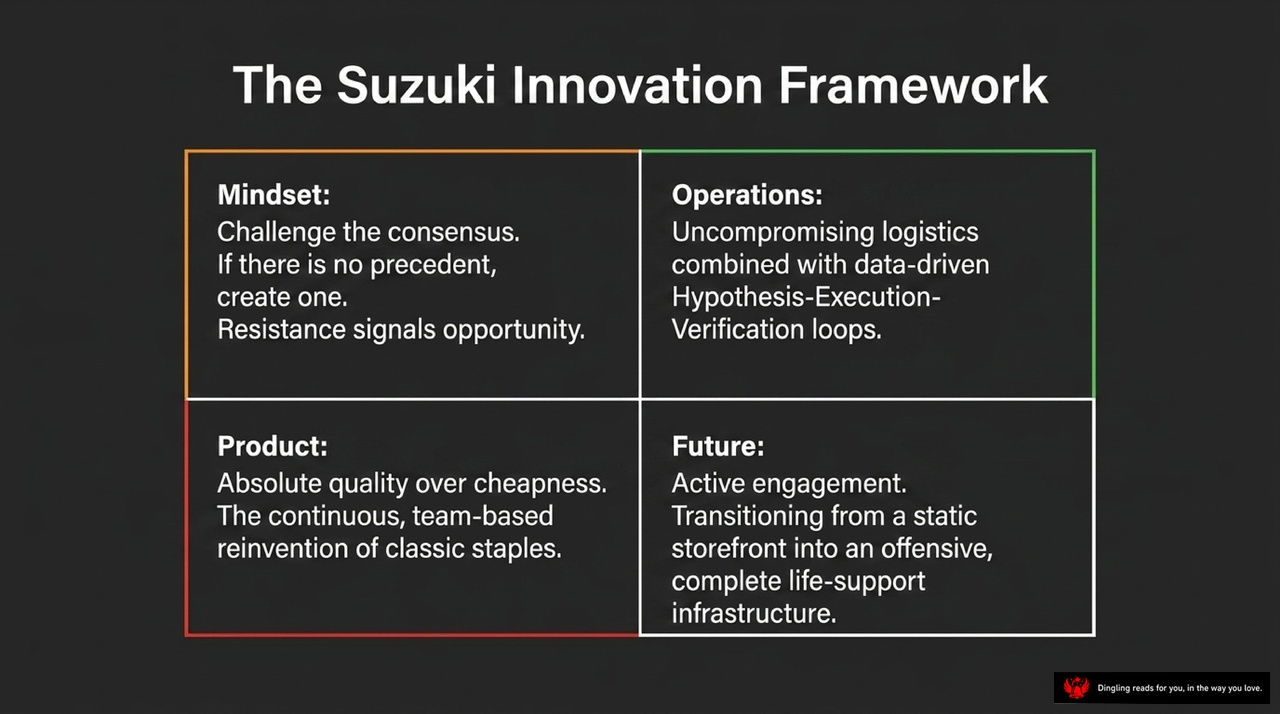
The Suzuki Innovation Framework isn't just a chart; it's the DNA of how we build a company that never stops growing. Let's break down the four pillars that drive our success.
First, look at **Mindset**. We don't follow the crowd; we challenge the consensus. If there's no precedent, we create one. In our world, resistance isn't a red flag—it's a signal of opportunity. We believe that doing what everyone else does leads to stagnation, while breaking the rules opens the door to true innovation.
Next, **Operations**. We combine uncompromising logistics with a data-driven "Hypothesis-Execution-Verification" loop. We don't guess; we test, we act, and we learn. This cycle ensures that every decision is backed by real evidence, not just intuition.
Then, **Product**. For us, absolute quality always trumps cheapness. We are constantly reinventing classic staples through continuous, team-based effort. Whether it's a rice ball or a hot meal, we refuse to compromise on taste or freshness, ensuring we deliver real value rather than just filling shelves.
Finally, **Future**. Our focus is on active engagement. We are transitioning from being a static storefront into a complete life-support infrastructure. We want to be an offensive force in our communities, providing everything from food and coffee to banking and emergency support, making us an essential part of daily life.
This framework guides us every day, ensuring we stay agile, relevant, and ready for whatever comes next.

True retail mastery isn't about crystal-ball gazing; it's about relentlessly adapting to the psychological shifts and practical needs of the consumer's present. It requires breaking industry dogma, prioritizing unmatched quality, and treating every piece of data not as history, but as a hypothesis waiting to be tested. When the era changes again tomorrow, will your business be a relic defending the past or the architect of a new convenience?