
Kingdom of Characters: Complete Chapter-by-Chapter Summary
Welcome to Kingdom of Characters by Jing Tsu. This book explores a 120-year battle: the Chinese writing system fighting against alphabet supremacy. In the late 19th century, Western powers pushed for Romanization, threatening China's cultural identity. But the characters didn't vanish. Instead, they adapted. From the Boxer Rebellion to the digital age, this story shows how Chinese characters survived and thrived. It's a tale of resilience and innovation. We'll see how a logographic system became a global technology. Join us as we uncover the unexpected strength of the Kingdom of Characters.
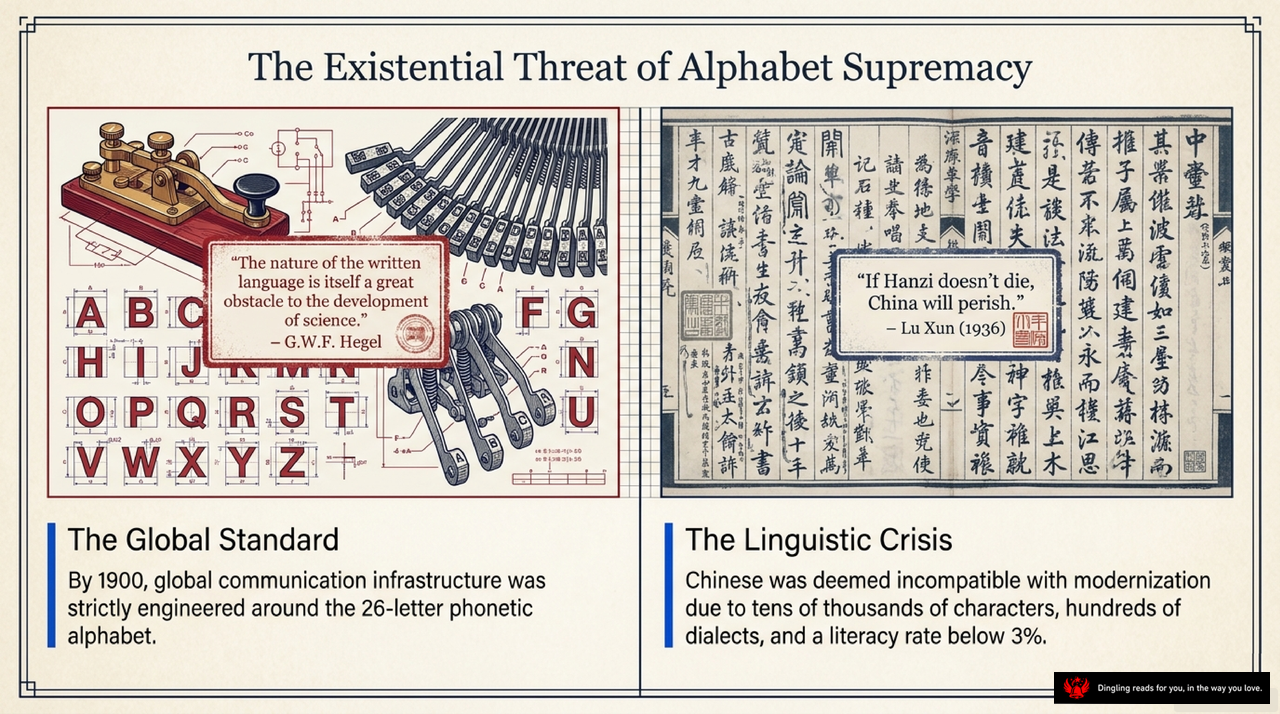
Welcome to this pivotal moment in history. We are looking at the Existential Threat of Alphabet Supremacy. By 1900, the global communication infrastructure was strictly engineered around the 26-letter phonetic alphabet. It became the global standard for everything from trade to science. But for China, this wasn't just a technical preference; it was a crisis. Western scholars, including the philosopher G.W.F. Hegel, argued that the nature of the written language is itself a great obstacle to the development of science. They excluded Chinese characters from their history of progress, viewing them as incompatible with the scientific method.
On the other side of the coin, we see the Linguistic Crisis. Chinese was deemed incompatible with modernization. Why? Because of tens of thousands of characters, hundreds of dialects, and a literacy rate below 3%. Imagine trying to communicate with a global world where everyone speaks a different language, but you have to learn thousands of symbols to read. This disconnect was fatal. The United States viewed China as backward, unable to negotiate concepts like rights or sovereignty because the language lacked the words. Even the US President John Quincy Adams noted that the Opium War was about language barriers, not just trade.
This pressure cooker created a desperate situation. Even Lu Xun, in 1936, famously warned, If Hanzi doesn't die, China will perish. It was a stark realization that the language itself was the barrier. Domestic radicals even proposed abolishing Hanzi entirely. This isn't just about history; it's about survival. The 26-letter alphabet was the key to the modern world, and China was locked out.
This slide captures the moment when China realized it couldn't just copy Western technology; it had to fix its language to access the future. It was the catalyst for reformers like Wang Zhao, who later fought for a phonetic system. This threat wasn't abstract; it was the reason why China had to innovate, adapt, and eventually, transform its very way of speaking to survive in the modern era. The battle for the alphabet was, in essence, a battle for the nation's soul. In that era, the powers of the world were like wolves circling China, and the language barrier was the cage that kept them trapped. To break out, they had to change the script.
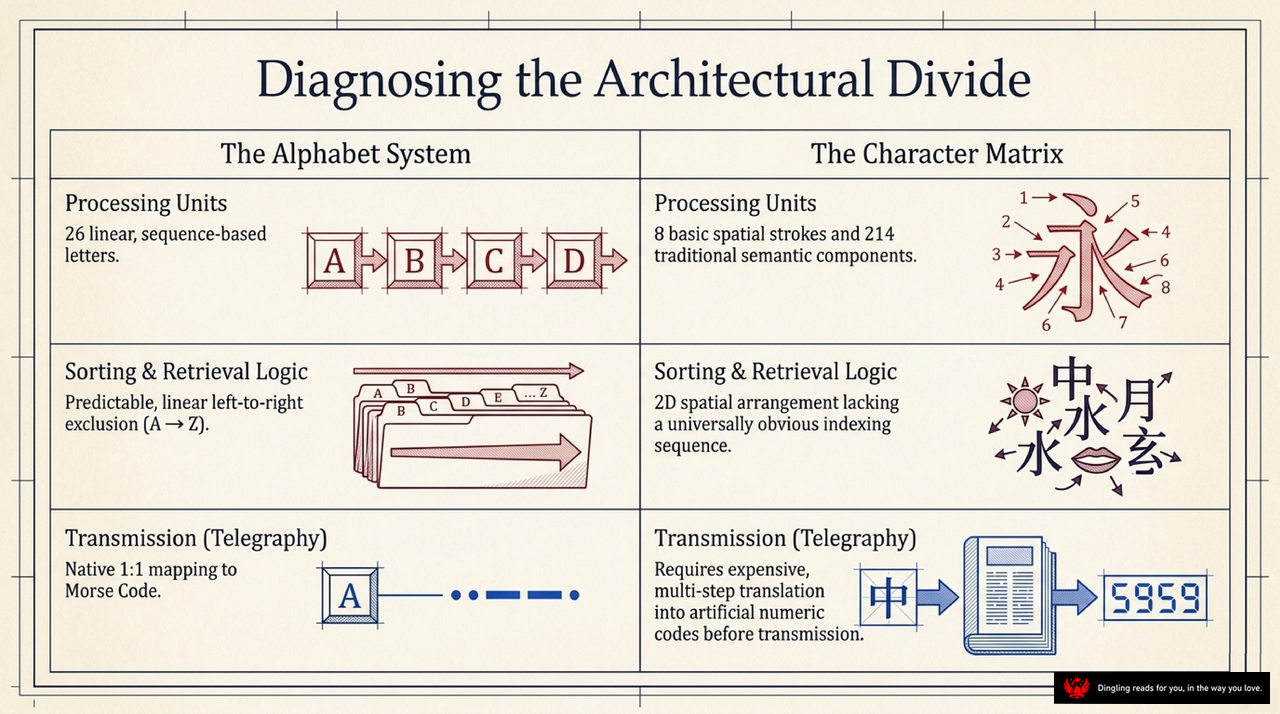
Welcome to the core conflict. Look at this slide. We are looking at the Architectural Divide. This visual comparison sets the stage for the entire century of struggle we are about to explore. On the left, we have The Alphabet System. On the right, we have The Character Matrix.
Let's break down the differences. First, Processing Units. The Alphabet System relies on 26 linear, sequence-based letters. It is simple. You have A, B, C, D, and so on. In contrast, The Character Matrix uses 8 basic spatial strokes and 214 traditional semantic components. Look at the character Yong with its numbered strokes. It is complex and spatial.
Now, consider Sorting and Retrieval Logic. The Alphabet is predictable, linear left-to-right exclusion. It goes from A to Z. It is like a filing cabinet. Characters, however, are a 2D spatial arrangement. They lack a universally obvious indexing sequence. Finding a specific character requires a specific, often confusing, system.
Finally, look at Transmission. The Alphabet has native 1:1 mapping to Morse Code. It is direct. Characters require expensive, multi-step translation into artificial numeric codes before transmission. Notice the 5959 code. It is inefficient and costly.
Why does this matter? This divide wasn't just about design. It was a bottleneck. Western scholars even said Chinese characters were obstacles to scientific development. It wasn't just about writing; it was about modernization. Telegraphy required expensive, multi-step translation. It slowed down communication and made China look backward. Traditional radical sorting methods had flaws. It took too long to find a character.
This divide forced reformers to fight. Wang Zhao tried phonetic alphabets to introduce a linear system. Wang Jingchun fought for telegraph rights to prove the inefficiency. Lin Yutang and Wang Yunwu tried indexing systems to make characters sortable.
This slide summarizes the entire century of struggle. From the 1900s to the digital age. The divide is still visible today in how we think about language. But the reformers paved the way. They understood that to modernize, the architecture of the language itself had to change.
Understanding this divide is key to understanding the Chinese modernization journey. We are not just changing letters; we are changing the infrastructure of thought. This slide explains why the next century was so critical. Now, let's dive into the first story of Wang Zhao.

In 1900, the Chinese Empire was on the brink of collapse, but one of its greatest internal threats wasn't foreign invasion—it was a linguistic divide so vast it threatened the nation's survival. This was the Babel Problem. With hundreds of dialects, officials couldn't communicate with rural populations, and a cohesive national identity was impossible. Western scholars even claimed that the complexity of Chinese characters was a barrier to modernization.
Yet, from this chaos emerged a fugitive innovator: Wang Zhao. After the failed 1898 Hundred Days' Reform, he was wanted for treason. He fled to Japan, only to smuggle a phonetic blueprint back into China, disguised as a wandering monk. His journey is marked on this map, showing his risky route from Tianjin to Japan and back. He was a scholar risking his life to save his country's future.
Wang Zhao's solution was brilliant yet simple. He didn't try to replace characters entirely; instead, he extracted 62 basic structural components from existing Chinese characters to represent pure sound. Look at the character Guo on the screen. He broke it down into these fundamental parts, creating a system that could be learned quickly without needing to memorize thousands of complex strokes.
This wasn't just a theoretical exercise. It became the foundation for standardizing Mandarin, or Guoyu. For the first time, anyone could bridge the gap between spoken dialects and written characters. It allowed a farmer in the south to understand a scholar in the north. Wang Zhao's work laid the groundwork for the unified language we use today, proving that even in the darkest times, a single idea could help an entire nation speak with one voice. By 1906, over half the provinces used his system in textbooks, though he remained anonymous, even imprisoned, to protect it. His legacy lives on in every conversation across China today. He effectively dismantled the Babel Tower of dialects, allowing China to move forward as a unified entity rather than a collection of disconnected regions. His story reminds us that innovation often comes from the margins, and that a single person's courage can reshape the way a civilization communicates.
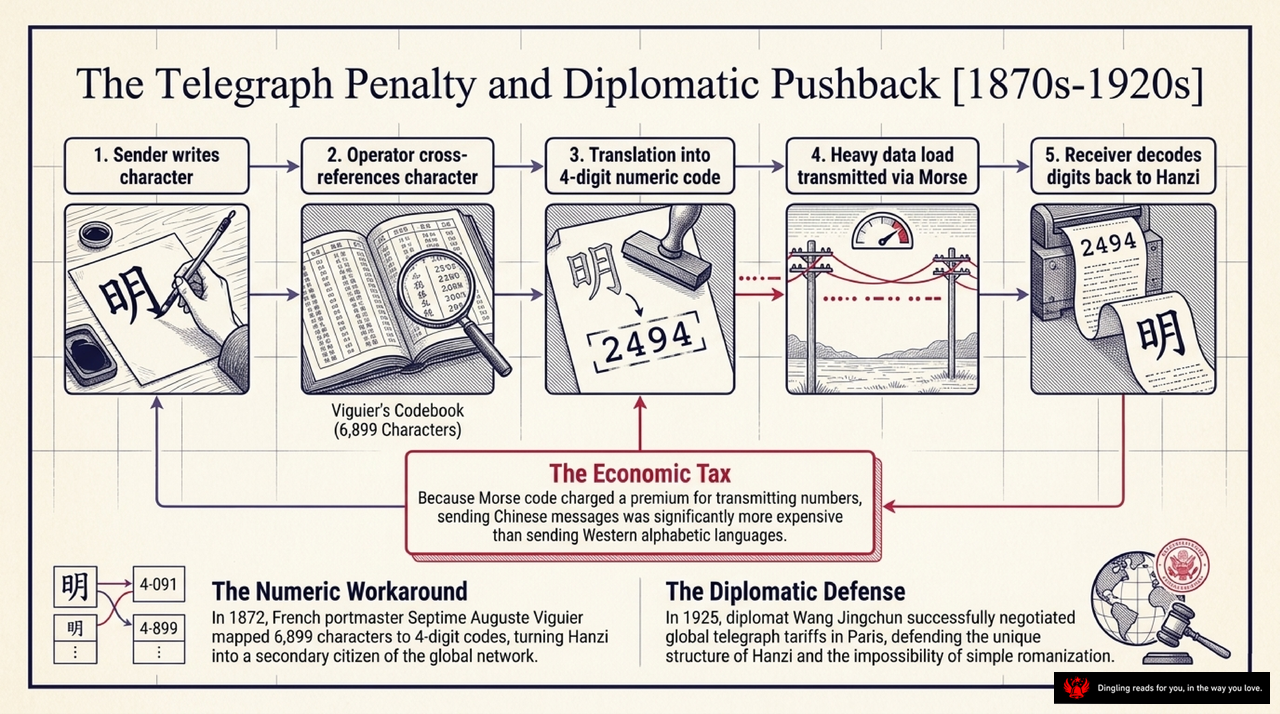
Let's talk about a hidden battle that happened over a century ago. It wasn't about guns or territory, but about data and dignity. In the 1870s through the 1920s, Chinese speakers faced a serious problem when trying to communicate via telegraph.
Look at the diagram. The process was clunky. A sender writes a character. An operator looks it up in Viguiier's Codebook, which contained nearly 7,000 characters. Then, that character gets translated into a four-digit numeric code, like 2494. It gets sent via Morse code, and finally, the receiver decodes the numbers back into the character.
Here's the catch: The telegraph system was designed for alphabetic languages. Sending numbers cost a premium. So, sending a Chinese message was significantly more expensive than sending a Western one. It was basically an economic tax on Chinese communication. Chinese characters were treated like second-class citizens in the global network.
But the Chinese didn't just accept this. They fought back in two ways. First, technically. In 1872, a French portmaster named Viguiier created a workaround, mapping thousands of characters to these four-digit codes. It made Hanzi a secondary citizen of the global network, but at least it worked.
Second, diplomatically. This is where it gets really interesting. In 1925, a Chinese diplomat named Wang Jingchun went to Paris. He didn't just complain; he used international law to negotiate. He successfully argued that the unique structure of Hanzi couldn't be simply romanized. He managed to get the International Telegraph Union to grant China a special clause. Suddenly, Chinese telegrams got a 50% discount. It was a huge win.
Think about this in the context of today. We often talk about digital sovereignty or tech standards. Back then, it was about whether your language could even fit into the infrastructure without paying a penalty. This story is about more than just telegrams. It was about dignity and sovereignty. The Chinese had to prove that their language wasn't just an obstacle to modernization, but a valid part of the global conversation. From Viguiier's codebook to Wang Jingchun's negotiation, it took decades of pushback to finally make the system fair.
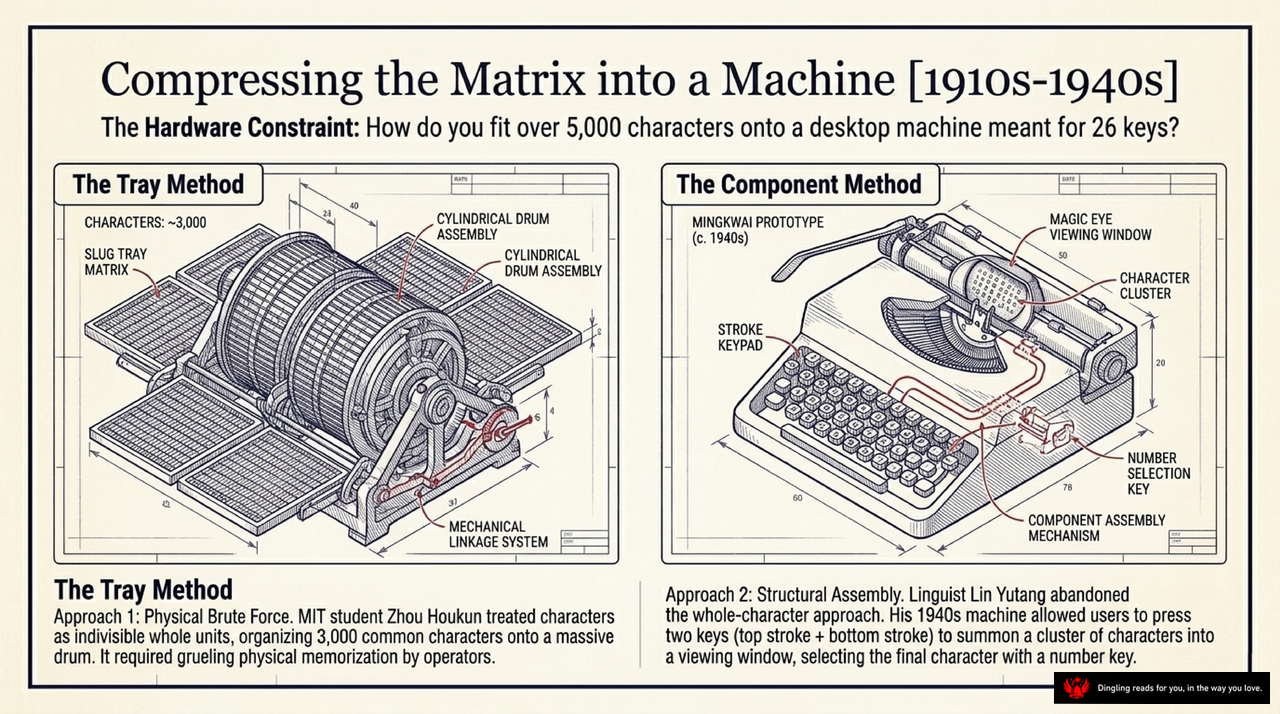
Welcome back. Today we're diving into the hardware struggle of the 1910s through the 1940s. We're talking about "Compressing the Matrix into a Machine."
The core problem here is the Hardware Constraint. How do you fit over 5,000 Chinese characters onto a desktop machine that was originally designed for just 26 keys? It's a massive puzzle.
On the left, we see "The Tray Method." This was Approach 1: Physical Brute Force. Meet Zhou Houkun, an MIT student. He treated characters as indivisible whole units. He organized about 3,000 common characters onto a massive cylindrical drum assembly. You can see the mechanical linkage system connecting the drums. This required operators to do grueling physical memorization. It was like trying to find a needle in a haystack, but with metal type.
On the right, we have "The Component Method." This was Approach 2: Structural Assembly. Linguist Lin Yutang abandoned the whole-character approach. He built a Mingkwai Prototype around the 1940s. This machine allowed users to press two keys—top stroke plus bottom stroke—to summon a cluster of characters into a Magic Eye Viewing Window. Then, you select the final character with a number key. It's a much smarter way to handle the complexity.
So, what's the takeaway? Zhou Houkun tried to force the machine to hold every character physically. Lin Yutang tried to break the character down into components to fit it into the machine. These early battles laid the groundwork for how we type Chinese today. It wasn't just about engineering; it was about rethinking the logic of the language itself to fit into the digital world.
Imagine this: You're on the subway, tapping away on your phone, sending messages in Chinese instantly. Emojis, GIFs, everything flows. It feels like magic. But this fluency didn't just happen. It took a century of struggle.
Back in the late 80s, things were chaotic. Over 400 different input methods popped up. Computers couldn't share documents. A Chinese character in one machine might show up as a question mark on another. It was a digital Babel. Imagine trying to send a file to a friend in Beijing while you're in Taipei. Impossible.
So, what was the fix? Enter Unicode. Joe Becker and a team of engineers wanted a universal code for every character. But it wasn't just about technology. It was politics.
Taiwan rushed to create their own character set, trying to claim cultural heritage. They packed their suitcases with wet glue still on the files. China and Japan had their own standards. The US Library of Congress needed to draft the standard. Everyone wanted a seat at the table.
Eventually, they found a middle ground. The Unicode Working Group was formed. It's been working for over 25 years. They decide which characters get encoded. It's not just about letters; it's about who gets to define the language.
Today, this battle continues. New characters from ancient texts, rare names, even characters from ninja manuals. But the goal is clear: Chinese isn't just a language to be translated; it's a system to be owned.
We are moving from passive users to standard-setters. With AI and massive data, China aims to lead by 2035. The digital revolution isn't just about typing faster. It's about ensuring Chinese characters have a voice in the global digital ecosystem. Language is a dialect with an army and a navy, and today, that navy is online.
In 2018, representatives from Hong Kong and Taiwan argued fiercely over a single character's encoding. It's a microcosm of the larger struggle. China plans to add 500,000 new characters from ancient texts to the standard. This ensures the language evolves, not just survives.
So, when you type a character today, remember: you're not just typing. You're participating in a century-long revolution to reclaim the digital future. This is the new frontier of the Library Race.

The State-Led Refactor: UI and UX. This slide captures a pivotal moment in history where the government didn't just tweak the system; they completely redesigned how the Chinese language works. Think of it as a massive software update for the entire population.
Look at the top left section. It shows the evolution of User Experience. On the left, you see the complex traditional character for "insect" and "love." On the right, they've been streamlined into their simplified forms. Why do this? Because the state realized that complexity was a barrier. As the text explains, to rapidly eliminate illiteracy among peasants and workers, the government standardized 2,235 Simplified Characters by 1986. They removed excess strokes, lowering the barrier to entry. This wasn't just about aesthetics; it was about accessibility. If you can't read, you can't participate in the modern economy.
Now, look at the bottom right. This is the User Interface layer. Even with simplified characters, typing them on a standard keyboard was a nightmare. So, they introduced Romanization. The creation of Pinyin merged decades of competing systems. It adopted a principle of embedding tone directly into spelling, ensuring homophones could be accurately mapped to a 26-letter Western keyboard. This was crucial. It allowed Chinese to speak to the world using the same tools everyone else used.
This state-led initiative transformed the landscape. It unified the language, bridging the gap between different dialects, and laid the foundation for the digital age. While the groundwork started in the 1930s, the 1950s implementation cemented this new reality. Today, when you type a message on your phone, you are using the result of this century-long refactoring. It’s a powerful reminder that technology and design are deeply political choices that shape how we communicate and connect.
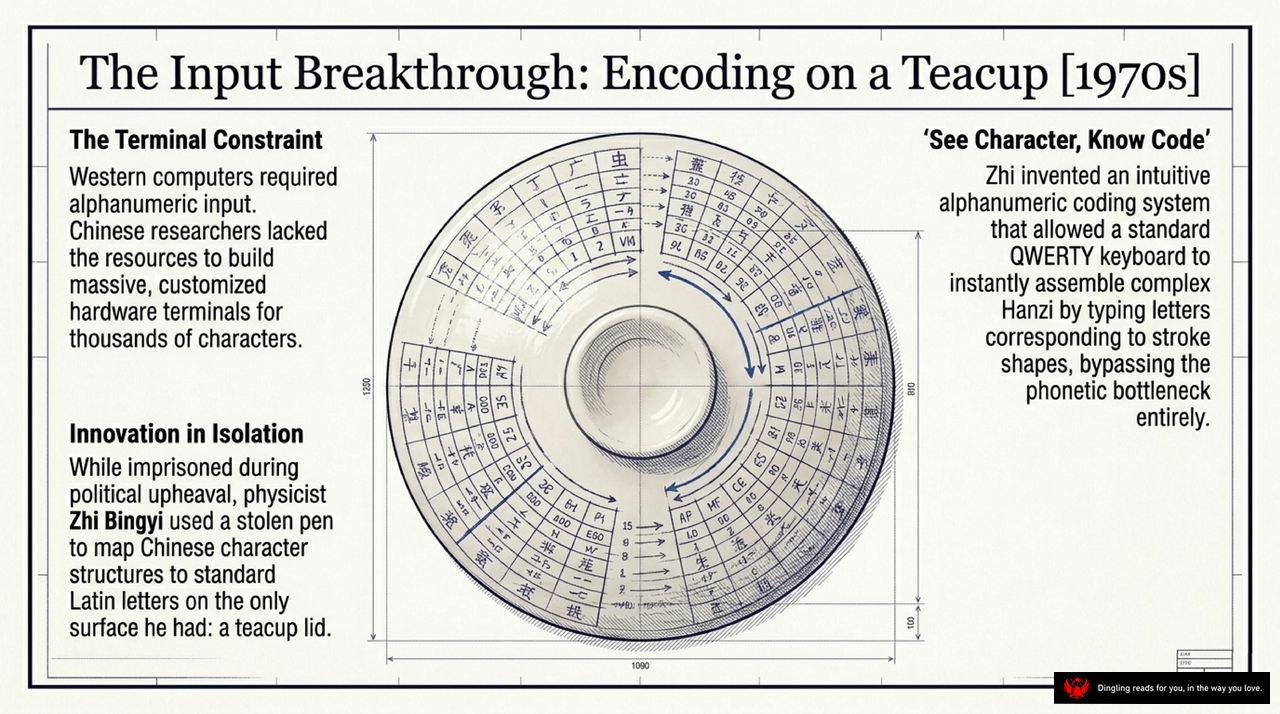
So, let's dive into the Input Breakthrough. Picture the scene in the 1970s. Western computers required alphanumeric input, but Chinese researchers lacked the resources to build massive, customized hardware terminals for thousands of characters. It was a strict terminal constraint. The system simply didn't exist for them.
But then, Innovation in Isolation happened. While imprisoned during political upheaval, physicist Zhi Bingyi used a stolen pen to map Chinese character structures to standard Latin letters on the only surface he had: a teacup lid. Why a teacup? Because he had nothing else. He turned a prison tool into a blueprint for the future. He didn't try to force the computer to speak Chinese. Instead, he taught the computer to read Chinese.
He invented an intuitive alphanumeric coding system that allowed a standard QWERTY keyboard to instantly assemble complex Hanzi by typing letters corresponding to stroke shapes, bypassing the phonetic bottleneck entirely. This was 'See Character, Know Code'. No more struggling with sounds that didn't match the writing. Just look at the shape, type the letter, and boom, the character appears.
He published this in 1978. It solved the input problem. It was a huge moment for Chinese tech. From a prison cell to the digital age. This wasn't just a hack. It was a foundation for the digital age. It allowed Chinese to join the global digital conversation. So, the teacup lid became the keyboard for the future.
The diagram on the slide shows the intricate mapping he did on the lid, connecting every stroke to a letter. This system decomposed complex characters into simple codes, making the impossible possible. It was a victory against the odds. Zhi Bingyi proved that you don't need a supercomputer to innovate. You just need a pen and a teacup.
And that's how the Input Breakthrough happened. This innovation paved the way for the modern digital China we see today. It was a testament to human ingenuity under pressure. Today, we take this for granted, but it wasn't always this easy.
Look at your phone right now. You're swiping, tapping, typing Chinese effortlessly. Maybe even using emojis or GIFs. But have you ever stopped to think how we got here? It wasn't always this smooth. A century ago, Chinese characters were a massive headache for computers. Western systems like ASCII simply couldn't hold thousands of unique characters. Different countries had their own incompatible codes. One computer showed a character, another showed a box. It was absolute chaos.
In the late 80s, there were over 400 different input methods. Silicon Valley engineers and linguists had to step in. They proposed Unicode. A universal code for every character. But here's the twist: it wasn't just a tech problem. It was a battle for cultural identity. When the US Library of Congress started digitizing East Asian texts, who would set the standard? Taiwan rushed to create a character set first, even rushing to get it on a plane before the glue dried. China followed. Japan and Korea had their own opinions. It was a tug-of-war over who defines the digital future of the Chinese language.
The Unicode Working Group spent decades deciding which characters get a spot. Even today, they argue over variants. Is this simplified or traditional form the official one? It's about cultural sovereignty. The quote is powerful: Language is a dialect with an army and navy. Whoever controls the code controls the narrative.
Today, China isn't just following anymore. With massive Chinese data, we are now shaping AI and machine translation standards. The goal? To 2035, lead in AI. The character isn't just a symbol; it's the foundation of a new digital ecosystem. From lead type to laser typesetting, from manual encoding to global standards. We went from being the problem to being the solution. And that's the real breakthrough.
But the battle isn't over. The Unicode Working Group has been operating for over a quarter of a century. They still have a backlog of rare characters. Parents love unique names, so new characters keep getting added. Young netizens play games with homophones and numbers. This isn't just about technology; it's about preserving our culture in a digital world. We are no longer just adapting to Western tech; we are building the future. We are collecting 500,000 new characters from ancient texts. We are using internet slang like 520 for I love you. We are reclaiming our linguistic power. This century-long revolution is finally paying off. We are reclaiming our cultural confidence in the digital age.

In the 1990s and 2000s, the digital world finally demanded a common language for East Asian characters. Before this era, things were a chaotic mess. Look at the clusters on the left. Taiwan used Big5, Mainland China used GB, and Japan had its own JIS standard. They were all mutually incompatible. Imagine trying to send a file from Taipei to Beijing in the 80s. It would just show up as gibberish. The characters were there, but the computer couldn't read them because the encoding keys didn't match.
To fix this, a group of engineers and linguists from around the world came together to form the Ideographic Research Group. Their goal was to integrate all these East Asian characters into a single global standard called Unicode. They wanted a universal code so that any computer, anywhere, could display any character without worrying about where it came from.
But this wasn't just a technical fix; it was a political and cultural battle. You see the magnifying glass in the center focusing on the character for 'bone'. This is the heart of the 'Han Unification' debate. In Taiwan, Mainland China, and Japan, the strokes of this character look slightly different. The slide shows specific details: the stroke angle varies by 0, 100, and 15 degrees. Should these variations be treated as separate characters with different codes, or unified under one master code?
Engineers fought bitterly over this. They had to decide if micro-variations in a character's internal structure warranted separate digital codes. If they unified them, it simplified the system but might erase cultural nuances. If they kept them separate, it preserved tradition but made the system more complex.
This debate defined the 90s and 00s. It wasn't just about technology; it was about who controlled the digital representation of Chinese culture. The result was the Unicode standard we use today, but the struggle over characters like 'bone' reminds us that behind every line of code, there's a complex history of identity and connection. The battle was won, but the scars of that incompatibility crisis remain in how we think about digital sovereignty today. As we move into the AI age, this legacy of unification continues to shape how we interact with language globally, ensuring that Chinese characters remain a vital part of the global digital infrastructure.
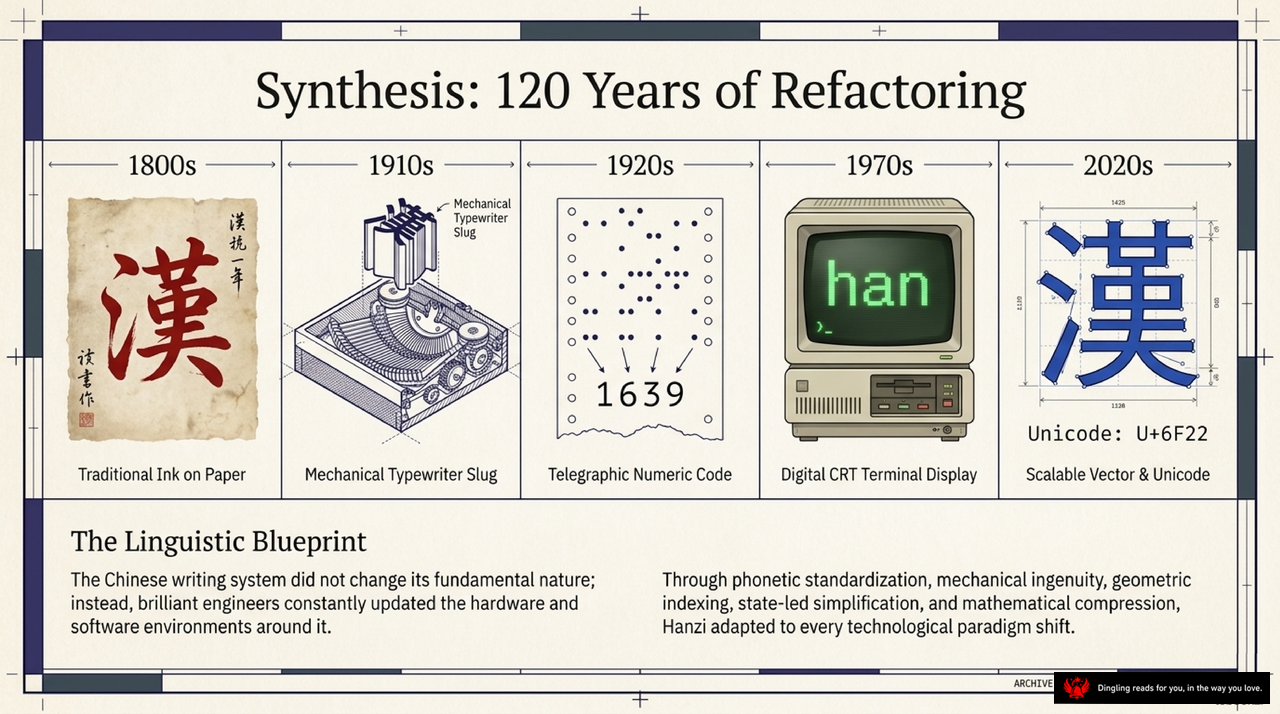
Look at this timeline. It's titled '120 Years of Refactoring,' and honestly, it captures the essence of what happened to Chinese writing. It wasn't about changing the characters themselves, but about the hardware and software around them.
Back in the 1800s, we had traditional ink on paper. Beautiful, but static. Fast forward to the 1910s, and you see the mechanical typewriter slug. This was the era of Zhou Houkun, who was trying to build a machine that could handle Chinese characters just like the West did. It was a huge engineering challenge. Think about him fighting against the limitations of the QWERTY keyboard. Then in the 1920s, the telegraphic numeric code appeared. Think about Wang Jingchun fighting for the right to send Chinese messages without paying double rates. He had to turn characters into numbers just to communicate globally.
Jump to the 1970s. You see that old CRT terminal. This is where the digital revolution kicked in. Wang Xuan and his team developed laser typesetting, finally allowing computers to handle Chinese text efficiently without massive memory usage. And now, we are in the 2020s with Scalable Vector and Unicode. That little 'Han' character you see here? That's U+6F22. It's universal now.
The text at the bottom says it all: 'The Linguistic Blueprint.' The Chinese writing system did not change its fundamental nature; instead, brilliant engineers constantly updated the hardware and software environments around it. Through phonetic standardization, mechanical ingenuity, geometric indexing, state-led simplification, and mathematical compression, Hanzi adapted to every technological paradigm shift. It's a story of resilience. While the West was moving from punch cards to pixels, Chinese writing was doing the same, just with its own unique logic. It's not about replacing the past, but refactoring the future. This 120-year journey shows that language isn't just culture; it's technology. And when you master the tech, you master the future. From Wang Zhao's phonetic letters to Wang Xuan's laser typesetting, every step was a refactoring of the environment, not the character. This allowed the language to survive without losing its soul. The core takeaway is that the system itself remained stable while the tools evolved. This summary perfectly encapsulates the struggle of the last century. It's about survival through adaptation.
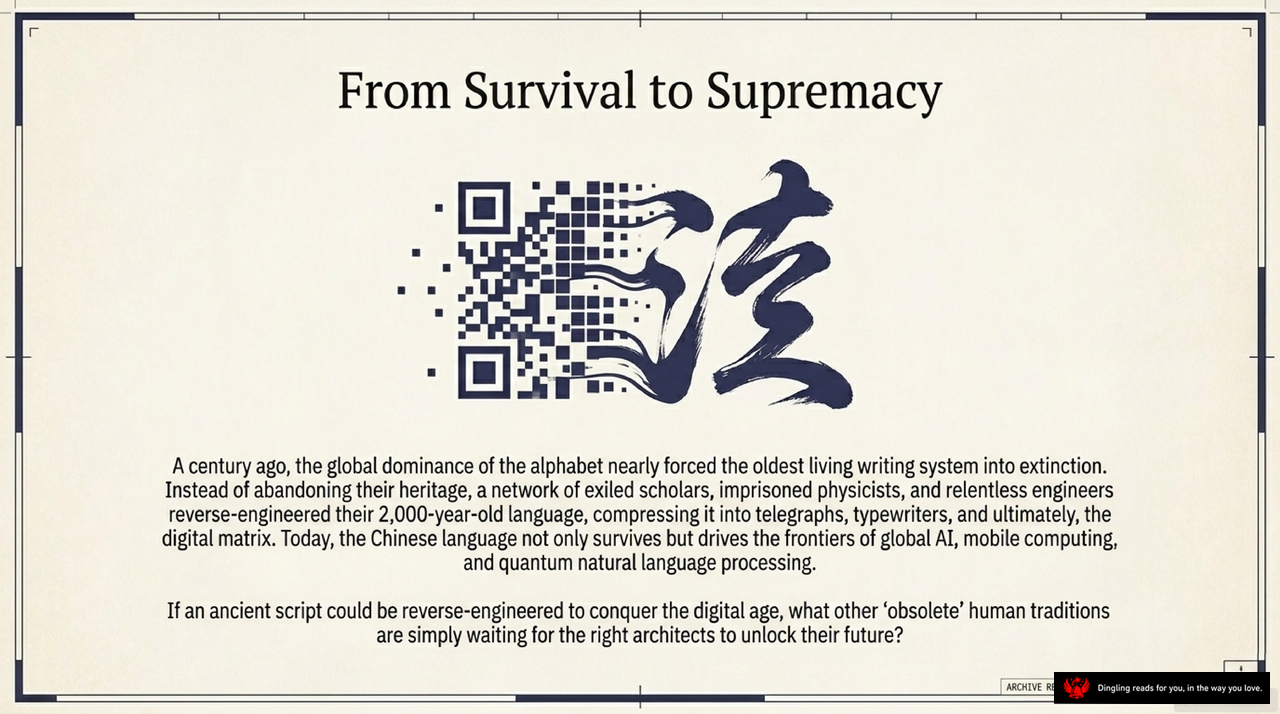
Welcome back. Let's take a moment to reflect on the journey we've just explored together. This slide captures the entire arc of the Chinese script's modern history: "From Survival to Supremacy."
Picture this: A century ago, the global dominance of the alphabet nearly forced the oldest living writing system into extinction. Western scholars argued that Chinese characters were a barrier to science and progress. But the Chinese didn't abandon their heritage. Instead of giving up, a network of exiled scholars, imprisoned physicists, and relentless engineers reverse-engineered their 2,000-year-old language. They didn't just translate it; they compressed it into telegraphs, typewriters, and ultimately, the digital matrix.
Look at that visual here. The QR code morphing into calligraphy represents that exact shift—from analog ink to binary code. It wasn't easy. We saw how Wang Zhao risked his life to push for standardized pronunciation for telegraphs. We saw how Zhou Houkun and others fought to build the first Chinese typewriter against industrial odds. We saw how Wang Xuan and his team developed laser typesetting to break the monopoly of Western technology.
Today, the Chinese language not only survives but drives the frontiers of global AI, mobile computing, and quantum natural language processing. It's not just about reading; it's about computing. The question is, why did we have to fight so hard to get here?
The slide ends with a thought-provoking question: If an ancient script could be reverse-engineered to conquer the digital age, what other 'obsolete' human traditions are simply waiting for the right architects to unlock their future? We often look at our traditions as things of the past, but maybe they are just unoptimized code. We are no longer just users of technology; we are architects of it. The era of survival is over. Now, it's time for supremacy.