
Kublai’s Challenge: Complete Chapter-by-Chapter Summary
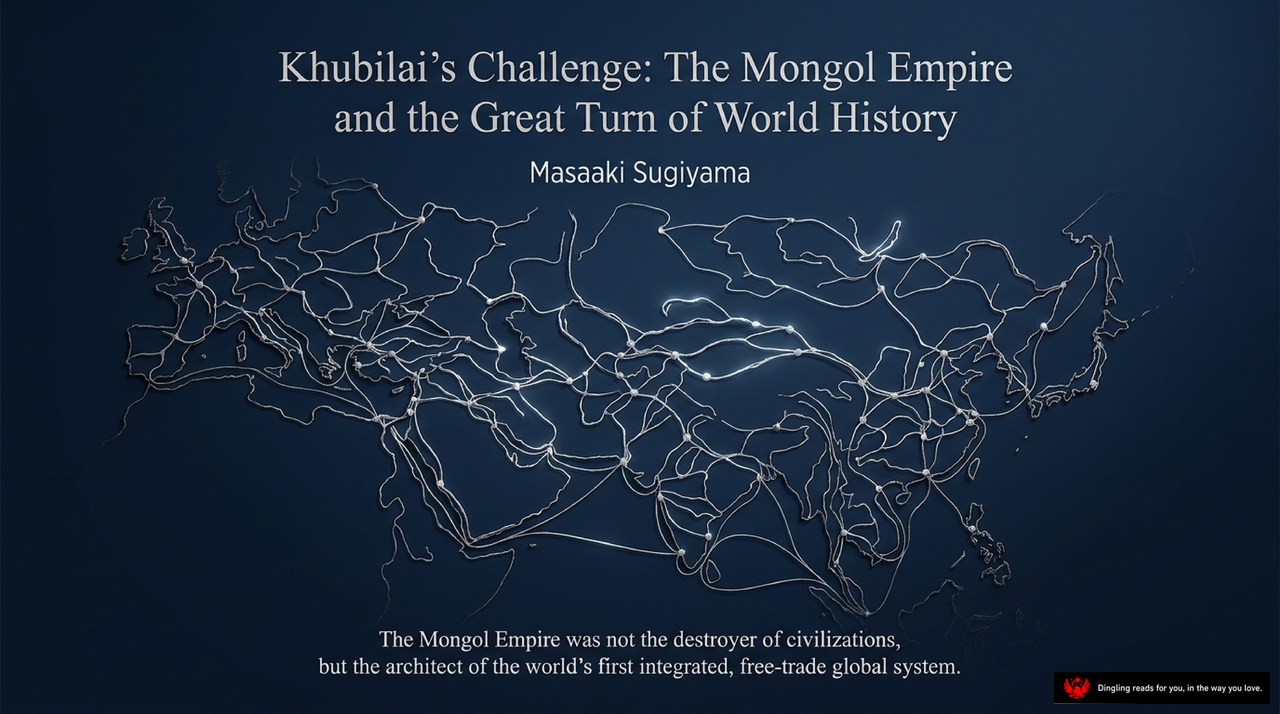
Welcome everyone. Today we are exploring Masaaki Sugiyama's book, Khubilai's Challenge: The Mongol Empire and the Great Turn of World History.
Look at this map spanning Eurasia. For centuries, we have been taught that the Mongol Empire was the destroyer of civilizations. But Sugiyama challenges this narrative head-on.
The truth is, the Mongol Empire was not the destroyer of civilizations, but the architect of the world's first integrated, free-trade global system. Before the Age of Discovery, this vast network connected Eurasia like never before. It was not just about conquest; it was about building a system where people, goods, and ideas flowed freely across continents.
Today, we will explore how this empire reshaped history, challenging the myths we have held for generations. Let's get started.
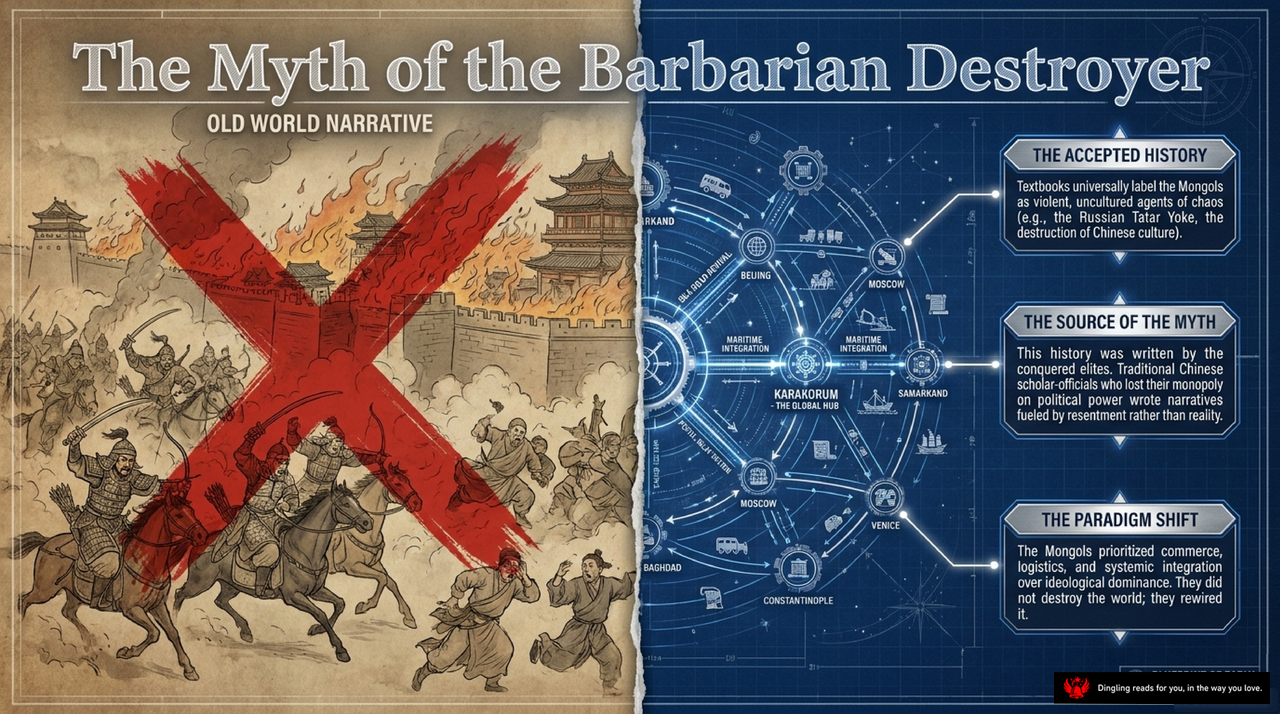
Welcome everyone. Today we are challenging a story you've likely heard your whole life. Look at the left side of this screen. This is the "Old World Narrative." For centuries, the Mongols have been painted as violent invaders, uncultured agents of chaos. We've heard stories of the "Russian Tatar Yoke" or the supposed destruction of Chinese culture. It's a narrative of pure destruction.
But let's look at the right side. This is where we find the truth. The slide breaks down this myth into three critical insights. First, "The Accepted History." Textbooks universally label the Mongols as violent, uncultured agents of chaos. We see examples like the Russian Tatar Yoke or the destruction of Chinese culture. But second, "The Source of the Myth." Here is the twist. This history wasn't written by the Mongols. It was written by the conquered elites. Traditional Chinese scholar-officials who lost their monopoly on political power wrote narratives fueled by resentment rather than reality. It's essentially a revenge story written by the losers to justify their loss of power.
So, what is the reality? That leads us to "The Paradigm Shift." The Mongols didn't destroy the world; they rewired it. Instead of just burning cities, they prioritized commerce, logistics, and systemic integration over ideological dominance. Look at that blue map connecting Karakorum, Beijing, Moscow, Samarkand, and even Venice. They built a global hub. They created a network that connected the East and West long before the Age of Discovery. This means the map you see on the right isn't just lines; it's a living economic system.
Think about it this way: They didn't care about ideological dominance; they cared about moving goods and people. We need to stop looking at them through the lens of the conquerors and see them through the lens of the builders. This isn't just about ancient history. It challenges the idea that the Mongols were just barbarians. They created a trade network that connected the East and West. They turned a loose empire into a functioning economic system. So, when we talk about the Mongol Empire, we shouldn't just think of destruction. We should think of integration. The "Barbarian Destroyer" is a myth. The reality was a global connector.
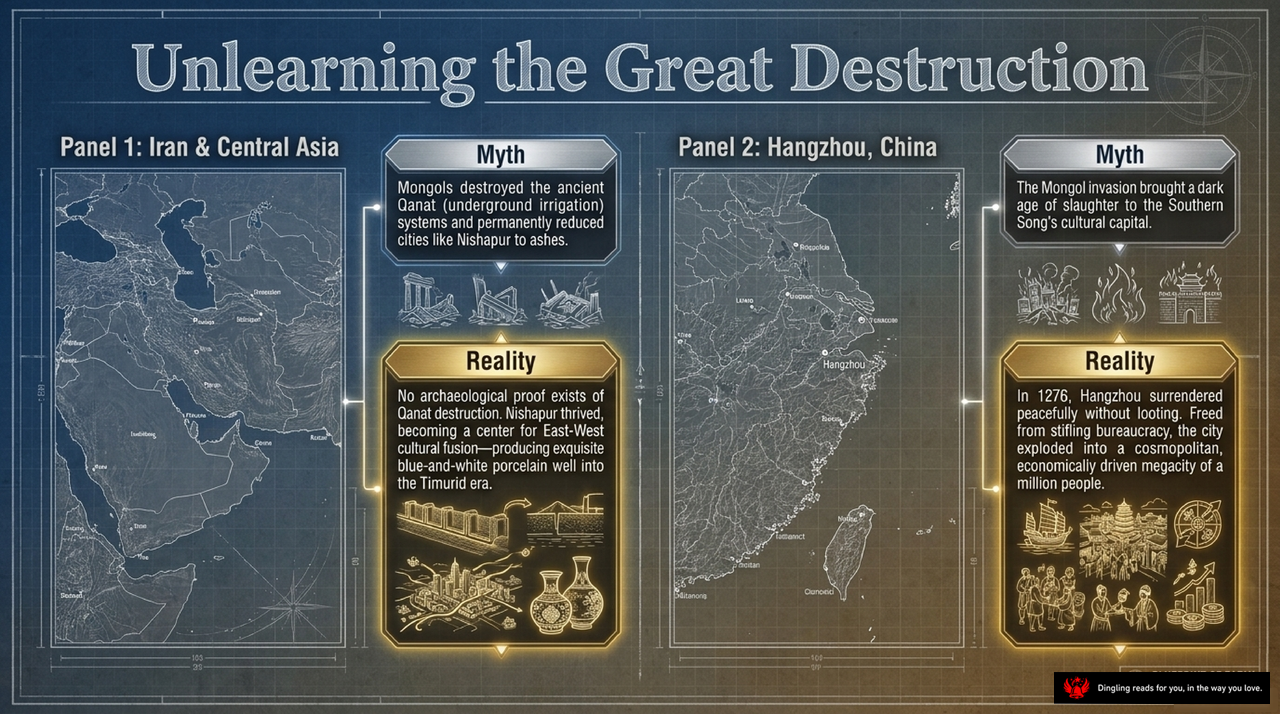
Welcome everyone. Today we're tackling a headline that's been plastered on history books for centuries: "The Great Destruction." But what if that story is wrong? What if we've been taught to fear the Mongols, when the truth is actually the opposite?
Let's look at the first panel here, covering Iran and Central Asia. The Myth claims the Mongols destroyed the ancient Qanat underground irrigation systems, turning fertile lands into dust and reducing cities like Nishapur to ashes. It sounds terrifying, right? But let's look at the Reality. Archaeologists have found zero proof that the Qanats were destroyed. In fact, Nishapur didn't vanish. It thrived. It became a massive hub for East-West cultural fusion. By the Timurid era, they were still producing exquisite blue-and-white porcelain. The destruction narrative is just that—a narrative.
Now, let's move to Panel 2, focusing on Hangzhou, China. The Myth paints a picture of a dark age of slaughter where the Southern Song's cultural heart was annihilated. But the Reality? In 1276, Hangzhou surrendered peacefully. There was no looting. In fact, freed from the stifling bureaucracy of the Southern Song, the city exploded into a cosmopolitan, economically driven megacity of a million people. It wasn't a graveyard; it was a boomtown.
So, why does this matter? Because these aren't just historical footnotes. They are a lesson in how we consume history. We tend to accept "common sense" as truth, even when it's a fabrication built on fear. Whether it's the Middle East or China, the "Mongol destruction" myth is a convenient lie that ignores the actual economic and cultural boom that happened under their rule.
Unlearning the Great Destruction isn't just about facts. It's about realizing that the past wasn't a series of tragedies written by victors, but often a complex story of survival and unexpected prosperity. When we stop believing the myths, we start seeing the real world.
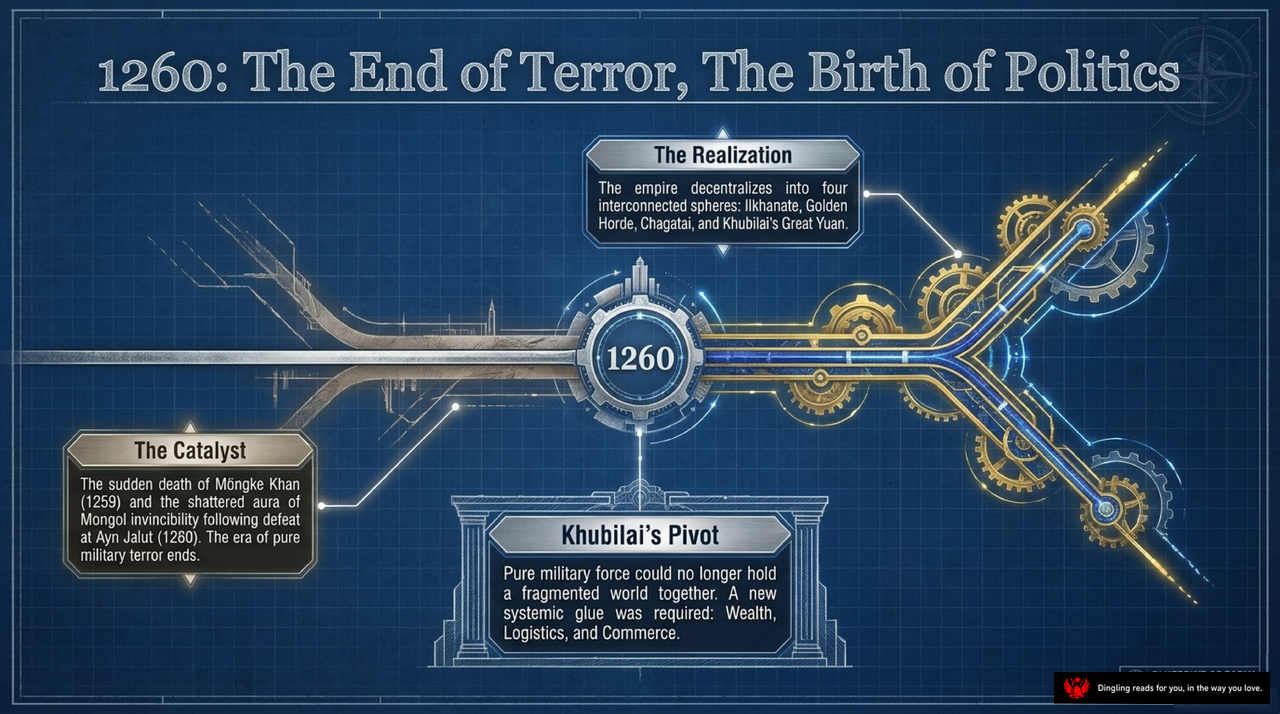
Welcome back to our deep dive into the Mongol Empire. Today, we are focusing on a single, critical year: 1260. This date marks the turning point where the Mongol Empire stopped being a war machine and started becoming a political system. It is the moment the empire shifted gears from conquest to governance.
On the left side of our slide, we see the catalyst that triggered this change. It all started with the sudden death of Möngke Khan in 1259. But the real shock came in 1260 at the Battle of Ayn Jalut. The Mongol army was finally defeated, shattering the aura of their invincibility. The era of pure military terror officially ended. You couldn't just conquer and hold land with fear anymore. The logistics of maintaining a massive army across such vast distances became too heavy.
Moving to the top section, this defeat forced a hard realization. The empire couldn't stay unified under one leader. Instead, it decentralized into four interconnected spheres: the Ilkhanate, the Golden Horde, the Chagatai, and Kublai's Great Yuan. These weren't enemies; they were distinct parts of a larger, fragmented whole.
But here is where Kublai Khan changed the game. Look at the bottom section. Kublai understood that pure military force could no longer hold this fragmented world together. He needed a new systemic glue. What was that glue? Wealth, Logistics, and Commerce.
This was a massive shift. Instead of relying solely on the sword, Kublai began building a network of trade and supply chains. He realized that to control the vast Eurasian landmass, he needed to control the flow of money and goods. He started integrating the economy, using silver as a standard currency and building roads and canals to move people and products. This pivot laid the groundwork for the interconnected trade systems we see in history today. It was a move from brute force to economic power. Think of it like building a global company where you need cash flow, not just soldiers. So, 1260 wasn't just a battle date; it was the birth of modern geopolitics within the Mongol Empire, marking the end of terror and the beginning of politics.
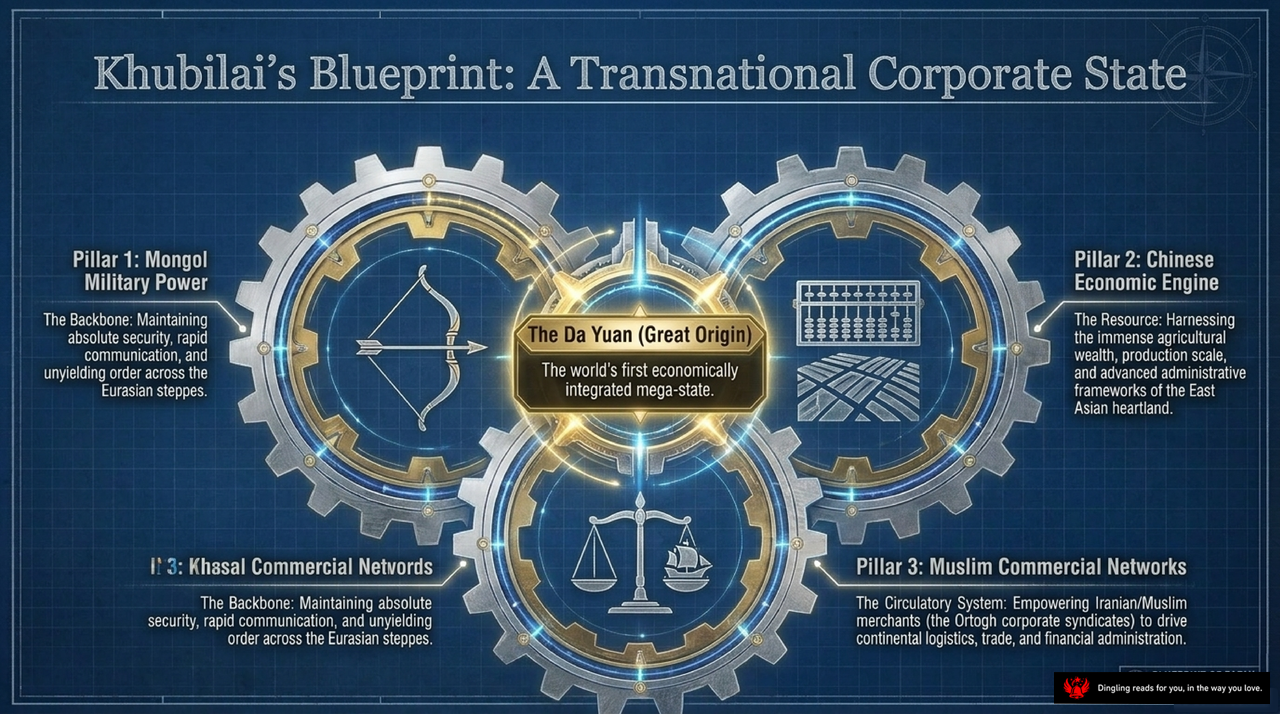
Let's dive deeper into this slide. Khubilai didn't just conquer the world; he built a system. Think of the Mongol Empire not as a war machine, but as the world's first transnational corporation. That's the core idea here: Khubilai's Blueprint.
At the center sits the Da Yuan, or Great Origin. This wasn't just a political title; it was the world's first economically integrated mega-state. Khubilai understood that to maintain control over such a vast territory, you couldn't just rely on the sword. He needed a sustainable business model. He called this the Second Startup.
This model rested on three pillars, visualized as these interlocking gears.
First, the Mongol Military Power. This was the backbone. It provided the absolute security, rapid communication, and unyielding order across the Eurasian steppes. Without this safety net, long-distance trade would have been impossible. It was the protection racket that allowed the global economy to function.
Second, the Chinese Economic Engine. This was the resource. Khubilai tapped into the immense agricultural wealth and production scale of the East Asian heartland. He didn't just conquer land; he integrated the sophisticated administrative frameworks of China to fuel the empire's wealth. He turned the agricultural surplus into capital, creating a massive tax base.
Third, the Muslim Commercial Networks. This was the circulatory system. By empowering Iranian and Muslim merchants—the Ortok corporate syndicates—Khubilai drove continental logistics, trade, and financial administration. These merchants were the bridge, moving goods from the East to the West, connecting markets that had never been linked before.
The genius of this system was its synergy. The military protected the trade routes. The Chinese economy provided the goods and the tax base. The merchants provided the flow.
Khubilai also implemented radical economic policies. He lowered taxes for merchants, standardized the silver currency, and built the Grand Canal to connect the inland capital to the sea. He essentially created a global supply chain centuries before the Industrial Revolution. He even established a seasonal capital, moving the court between summer and winter grounds to keep the system dynamic.
This wasn't just a dynasty; it was a global order. It integrated the East and West in a way the world hadn't seen before. While later empires focused on walls and borders, Khubilai built bridges. His vision created the Mongol System, a framework that would echo through history, influencing everything from the Ming Dynasty to the rise of modern capitalism. This is how a single blueprint reshaped the entire world.
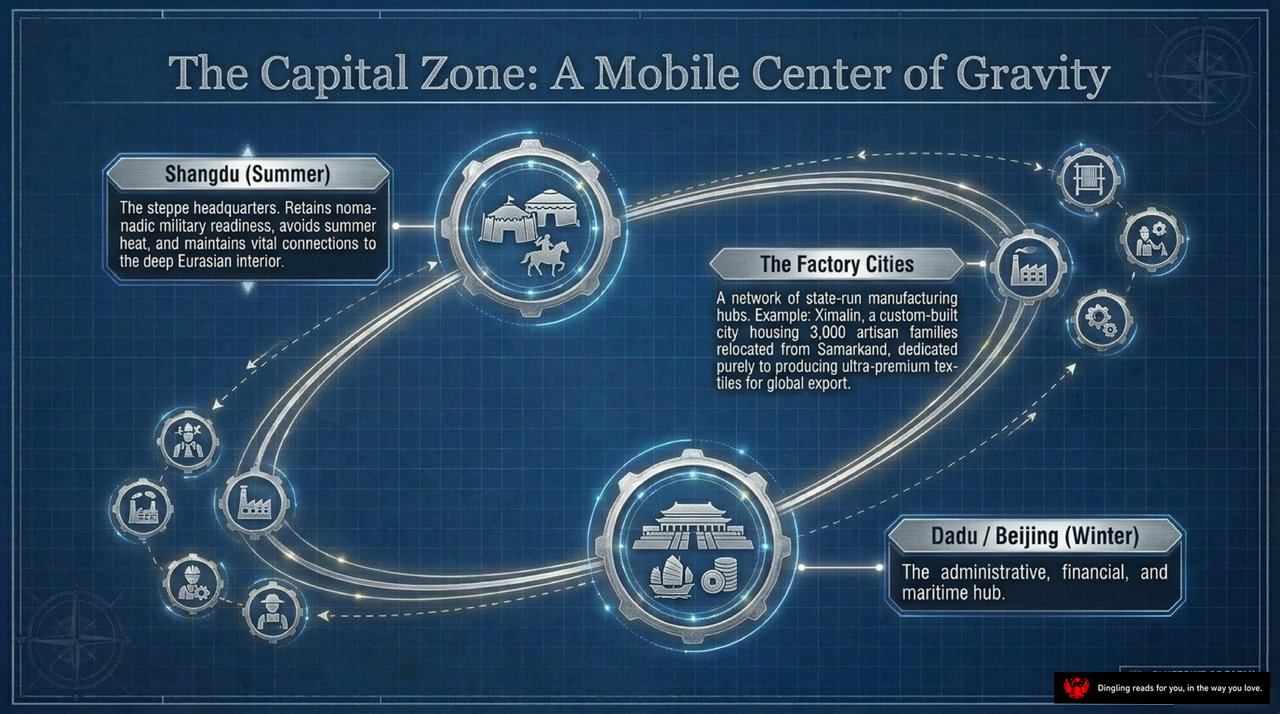
Take a close look at this diagram. It reveals the secret to the Mongol Empire's longevity: a capital zone that moves. Kublai Khan understood that a static center couldn't control such a vast territory. So, he designed a system where the center of gravity shifted with the seasons, creating a dynamic balance between the nomadic and the settled.
In the summer, the court relocated to Shangdu. This wasn't just about escaping the heat. It served as a strategic steppe headquarters that retained nomadic military readiness while keeping vital connections to the deep Eurasian interior. It allowed the army to stay close to the source of power, ensuring the empire remained agile.
When winter arrived, the center of gravity moved south to Dadu, which is modern-day Beijing. This became the administrative, financial, and maritime hub of the entire world. It was where the empire's money was counted and where ships docked, connecting the inland to the ocean.
But what powered this massive machine? Look at "The Factory Cities." This section highlights the industrial backbone of the empire. Kublai didn't rely on looting; he built infrastructure. He created a network of state-run manufacturing hubs. A prime example is Ximalin, a custom-built city where he relocated 3,000 artisan families from Samarkand. These were experts dedicated purely to producing ultra-premium textiles for global export. This wasn't just local craft; it was an industrial strategy to feed the empire's wealth and fund its military.
Connecting these points, you see the flow of resources. The summer capital drew from the steppe, the winter capital drew from the coast and the factories. Kublai unified the grasslands with the coast through this system. He turned the empire into a massive economic machine where wealth flowed as freely as the seasons. This mobile strategy didn't just manage territory; it integrated the entire Eurasian world into a single economic circle. By combining military mobility with industrial production and maritime trade, Kublai created a system that was far more resilient than any empire before it. It proved that the Mongol Empire was more than just a military conquest—it was a sophisticated logistical and commercial network that connected East and West, laying the groundwork for the modern global economy. This mobile center of gravity allowed the empire to function as a single unit, rather than a collection of conquered lands.
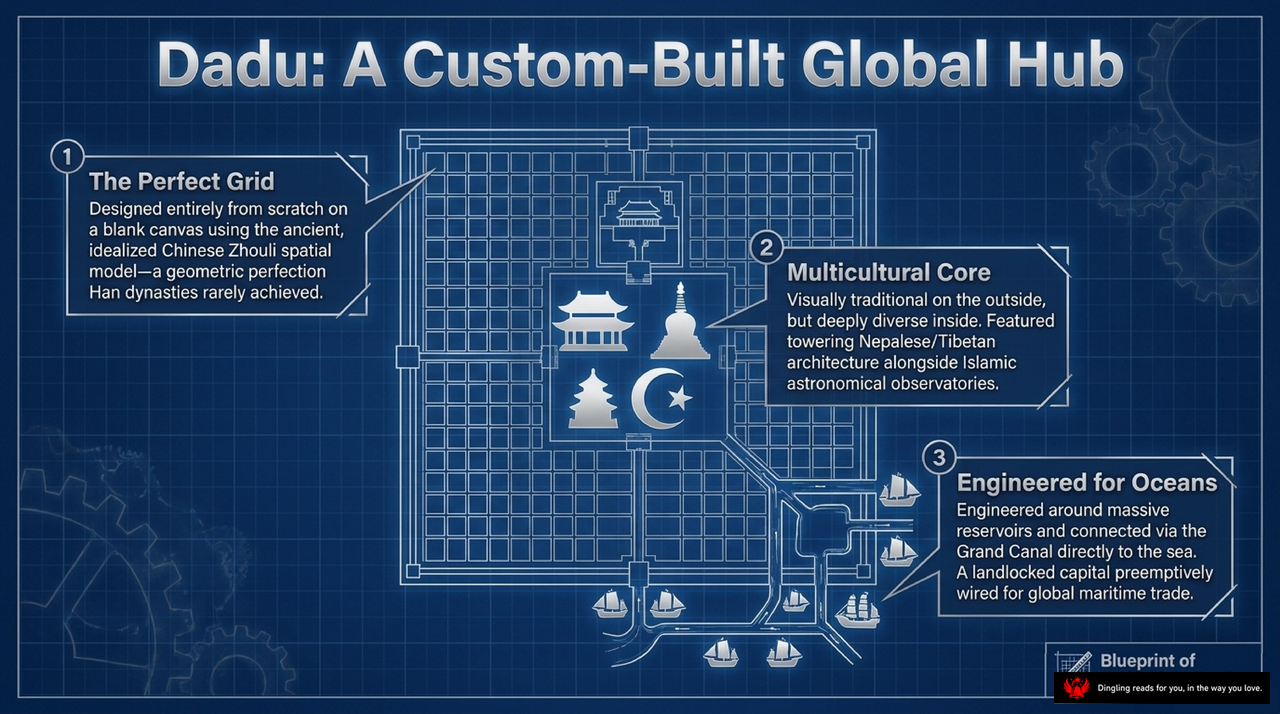
Let's look at this blueprint of Dadu. This wasn't just a capital city; it was a custom-built global hub designed by Kublai Khan from the ground up. The first thing you notice is the layout. It was designed entirely from scratch on a blank canvas, using an ancient, idealized Chinese Zhouli spatial model. It represents a geometric perfection that Han dynasties rarely achieved. But it wasn't just about geometry. The core of the city was a multicultural hub. Visually traditional on the outside, but deeply diverse inside. You can see towering Nepalese and Tibetan architecture alongside Islamic astronomical observatories. It was a place where different worlds met under one roof, blending the local with the foreign. It wasn't just about blending styles; it was about integrating the knowledge and skills of different civilizations into the very fabric of the city. However, the most impressive part is how it was engineered for oceans. Even though Dadu was a landlocked capital, Kublai engineered massive reservoirs and connected it via the Grand Canal directly to the sea. This allowed southern grain and overseas goods to dock right in the city center. A landlocked capital was preemptively wired for global maritime trade. By reviving the Grand Canal and connecting it to the ocean through Tianjin, Kublai turned Dadu into the economic engine of the Mongol Empire. This wasn't just about politics; it was about economics. It created a system where wealth flowed from the sea to the inland capital, supporting the entire empire. This city was a testament to the idea that a capital could drive global trade, not just rule a territory. It was a bold experiment in urban planning that connected the land and the sea, setting the stage for a new era of global exchange. Kublai called this his 'second startup,' aiming to create a new state model that combined military power with economic strength. He recruited experts from everywhere to build this, creating a city that was a logistical marvel. It proved that a city could be a bridge between East and West, land and sea, creating a unified economic system that would influence the world for centuries to come. The blueprint shows us that Dadu was not merely a political seat, but a logistical marvel that facilitated the flow of goods, people, and ideas across the entire Eurasian continent.
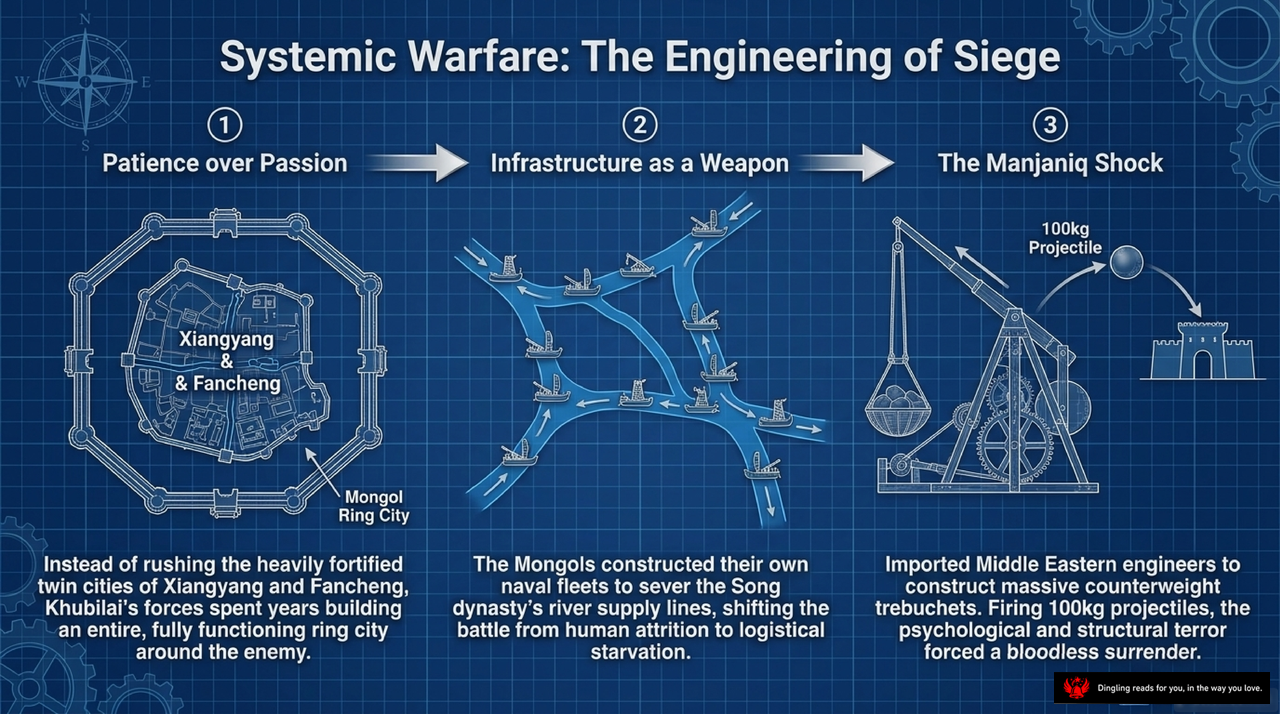
Let's dive into the mechanics of how Kublai Khan conquered the South. This slide outlines 'Systemic Warfare: The Engineering of Siege.' It's a perfect example of how modern strategy beats brute force.
First, look at point one: Patience over Passion. The Mongols faced the twin cities of Xiangyang and Fancheng, heavily fortified and defended. Instead of rushing in and dying in the trenches, Kublai's forces spent years building an entire, fully functioning ring city around the enemy, creating what we call the Mongol Ring City. They dug a perimeter over 100 kilometers long, complete with earthworks and fortifications. They turned the battlefield into a trap, slowly squeezing the defenders until they had no choice but to surrender.
Second, Infrastructure as a Weapon. The Mongols realized that fighting the Song army on land was a losing battle due to the water barriers. So, they constructed their own naval fleets to sever the Song dynasty's river supply lines. This shifted the battle from a war of human attrition to logistical starvation. They cut off the food and supplies, starving the defenders out. Meanwhile, they lured the Song relief fleets into ambushes, destroying them before they could even reach the city.
Finally, the Manjanik Shock. This is where technology becomes terror. Kublai imported Middle Eastern engineers to construct massive counterweight trebuchets, the Manjanik. These were far superior to Chinese siege engines. Firing 100kg projectiles, they caused both structural damage and psychological terror. The defenders watched their walls crumble under the weight of stone bombs. When the general Lu Wenhuan saw the sheer power of these machines, his will broke.
The result was a bloodless surrender. The psychological and structural pressure forced the city to open its gates without a fight. This wasn't just a battle; it was a calculated campaign where engineering, logistics, and terror were used as weapons. It marked the transition from traditional warfare to a modern, systemic approach to conquest. Kublai didn't just win a city; he won the war of logistics and engineering. The Song court panicked, realizing they couldn't hold the line. Eventually, Lu Wenhuan switched sides, guiding the Mongol army straight to the capital. This victory paved the way for the reunification of China under the Yuan dynasty.
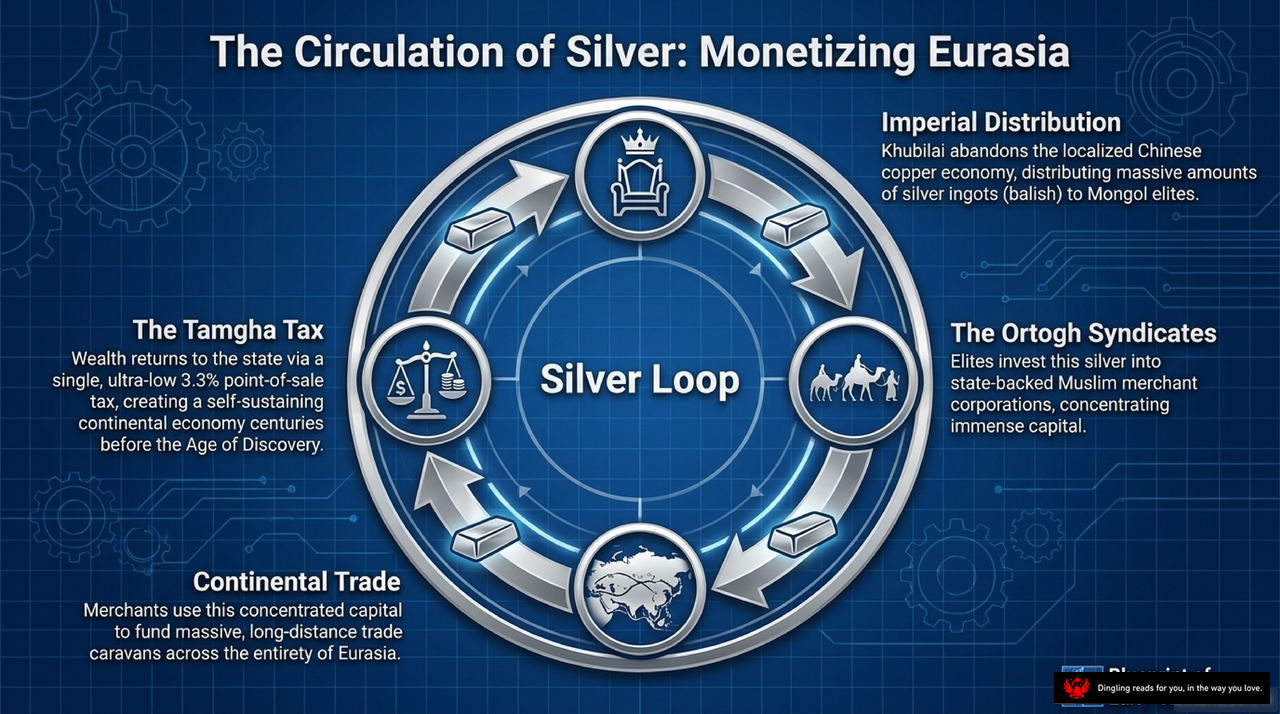
Let's dive into the financial engine that actually powered the Mongol Empire. It wasn't just about swords and horses; it was about the circulation of silver. Look at this diagram, the "Silver Loop." It shows exactly how money moved to keep the world connected.
First, at the top, we have "Imperial Distribution." Kublai Khan took massive amounts of silver ingots, called "balish," and distributed them to Mongol elites. This wasn't just a paycheck; it was the seed capital for the entire economy. He was essentially funding the system from the top down, turning political power into economic liquidity.
Next, that capital flowed into "The Ortoogh Syndicates." These were essentially state-backed merchant corporations, heavily supported by Muslim traders. They took the silver and invested it into logistics, turning it into trade power. Think of them as the venture capital firms of the 13th century, bridging the gap between the court and the market. By investing this silver, they concentrated immense capital that would otherwise have been scattered.
Then, we see "Continental Trade." Merchants used this concentrated capital to fund massive, long-distance caravans. They connected the East and West, moving goods across the entirety of Eurasia. This was happening centuries before the Age of Discovery, creating a global market long before Europe figured it out. It was the first true globalization.
Finally, the loop closes with "The Tamgha Tax." Wealth returned to the state via a single, ultra-low 3.3% point-of-sale tax. No complex tariffs, just a flat rate on every sale. This created a self-sustaining continental economy.
This system monetized Eurasia. It standardized the value of silver across the continent, making trade frictionless. It wasn't just a tax system; it was a global market built on trust and capital. And that, right there, is why the Mongol Empire changed the world. It proves that economic systems can be just as powerful as military might. By creating a unified currency standard, they laid the groundwork for the modern world economy. This "Silver Loop" wasn't just a historical curiosity; it was a blueprint for how a centralized government can facilitate a decentralized market, concentrating immense capital to drive innovation and trade across the globe.
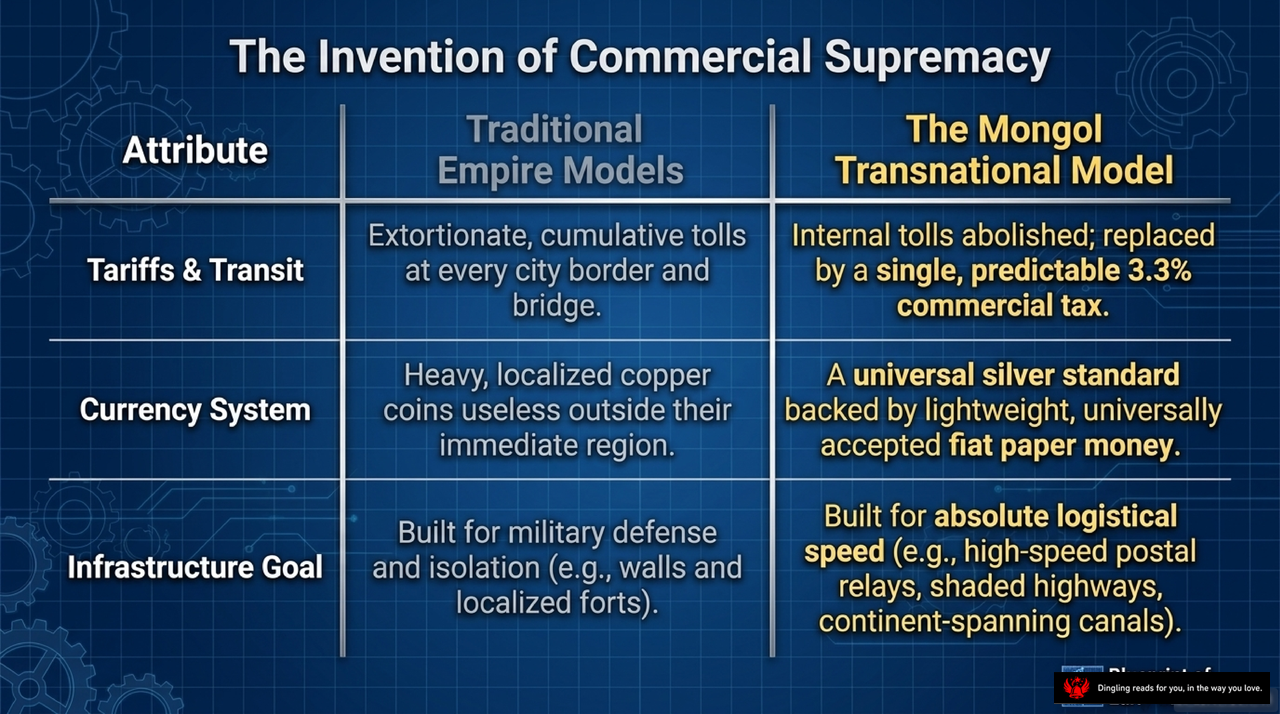
Let's dive into the core of the Mongol legacy. Look at this slide: "The Invention of Commercial Supremacy." This is the moment the Mongols shifted from being just conquerors to being the architects of a new global order.
On the left, you see the Traditional Empire Models. For centuries, empires operated like toll booths. Merchants faced extortionate, cumulative taxes at every single city border and bridge. If you wanted to move goods, your profits got eaten alive by the state. The currency system was equally fragmented. Heavy, localized copper coins were useless outside their immediate region. You couldn't trade with a neighbor because the money didn't hold value there. And the infrastructure? It was built for military defense and isolation. Think high walls and localized forts. The goal was to keep enemies out and resources in. It was a closed system designed to protect the core, not expand it. This stifled innovation and made trade expensive.
Now, look at the right column: The Mongol Transnational Model. This is where the revolution happened.
First, Tariffs and Transit. The Mongols abolished those internal tolls. They replaced the chaos of hidden fees with a single, predictable 3.3% commercial tax. This was radical. It meant merchants knew exactly what they were paying. It turned long-distance trade from a gamble into a reliable business. Imagine shipping silk from China to Italy without worrying about bandits at every checkpoint or unpredictable bribes.
Second, the Currency System. They ditched the heavy, localized copper. They established a universal silver standard backed by lightweight, universally accepted fiat paper money. This created a common language of value across the entire Eurasian landmass. A silver ingot in one place was worth the same as another in a different place. This unified the economy and allowed for trust across vast distances.
Third, the Infrastructure Goal. Traditional empires built for defense. The Mongols built for absolute logistical speed. They didn't just want to stop armies; they wanted to move goods and people faster than anyone else. They developed high-speed postal relays, shaded highways, and continent-spanning canals. This network connected the markets of the East and West in a way that had never existed before. This allowed information and goods to flow at a speed that felt like magic.
So, why does this matter? Because the Mongol Empire didn't just rule by the sword. They created the world's first integrated commercial network. By lowering transaction costs and standardizing money, they made the world smaller and more connected. This is the Pax Mongolica—not just a period of peace, but a period where the global economy finally took its first real breath. It laid the groundwork for the modern world.
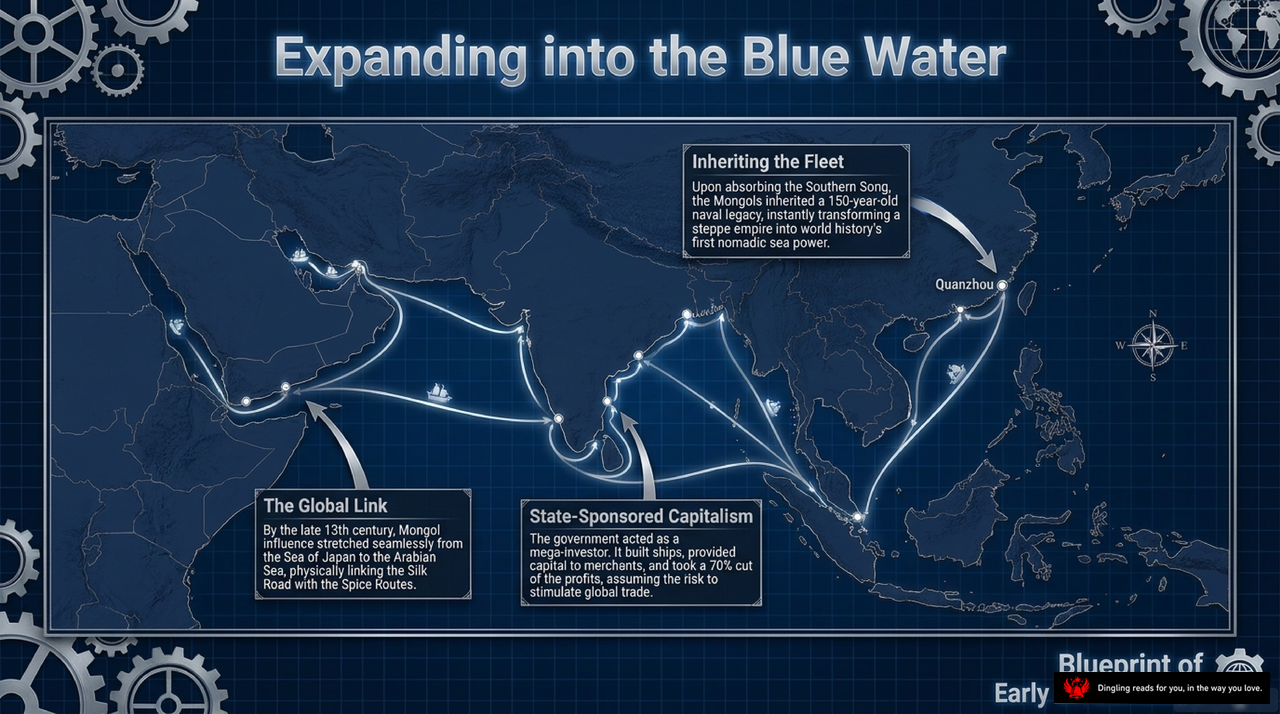
Let's look at this map, titled "Expanding into the Blue Water." This visual represents a massive shift in human history. For centuries, the Mongols were known as masters of the land, but here, they are shown conquering the oceans.
First, notice the top right box, "Inheriting the Fleet." When the Mongols absorbed the Southern Song Dynasty, they didn't just take territory; they took the technology. They inherited a 150-year-old naval legacy. This instantly transformed a steppe empire into world history's first nomadic sea power. They actively recruited skilled sailors and even former pirates to build a fleet capable of crossing the open ocean, something no nomadic power had done before.
Next, consider the center box, "State-Sponsored Capitalism." This is a game-changer. The Mongol government acted as a mega-investor. Instead of just taxing trade, they built ships and provided capital to merchants. They took a 70% cut of the profits, assuming the risk to stimulate global trade. This was a bold move. It meant the state backed private enterprise. They unified the silver standard, making currency flow as easily as goods. This system prioritized profit and trade over traditional agricultural taxes.
Finally, observe the "Global Link." By the late 13th century, Mongol influence stretched seamlessly from the Sea of Japan to the Arabian Sea. They physically linked the Silk Road with the Spice Routes. For the first time, you could travel from the Pacific to the Indian Ocean without hitting a border. This wasn't just about military conquest; it was about creating a unified economic zone. Goods like porcelain and spices flowed freely across continents.
This system created a world where borders mattered less than trade routes. It laid the groundwork for the modern global economy, long before the Age of Discovery. The Yuan Dynasty proved that a unified Eurasian market was possible, connecting East and West in ways we are still seeing today. The map shows the intricate web of trade that connected the East and West, proving that the Mongols were not just destroyers of civilization, but architects of a global trade network that reshaped the world.
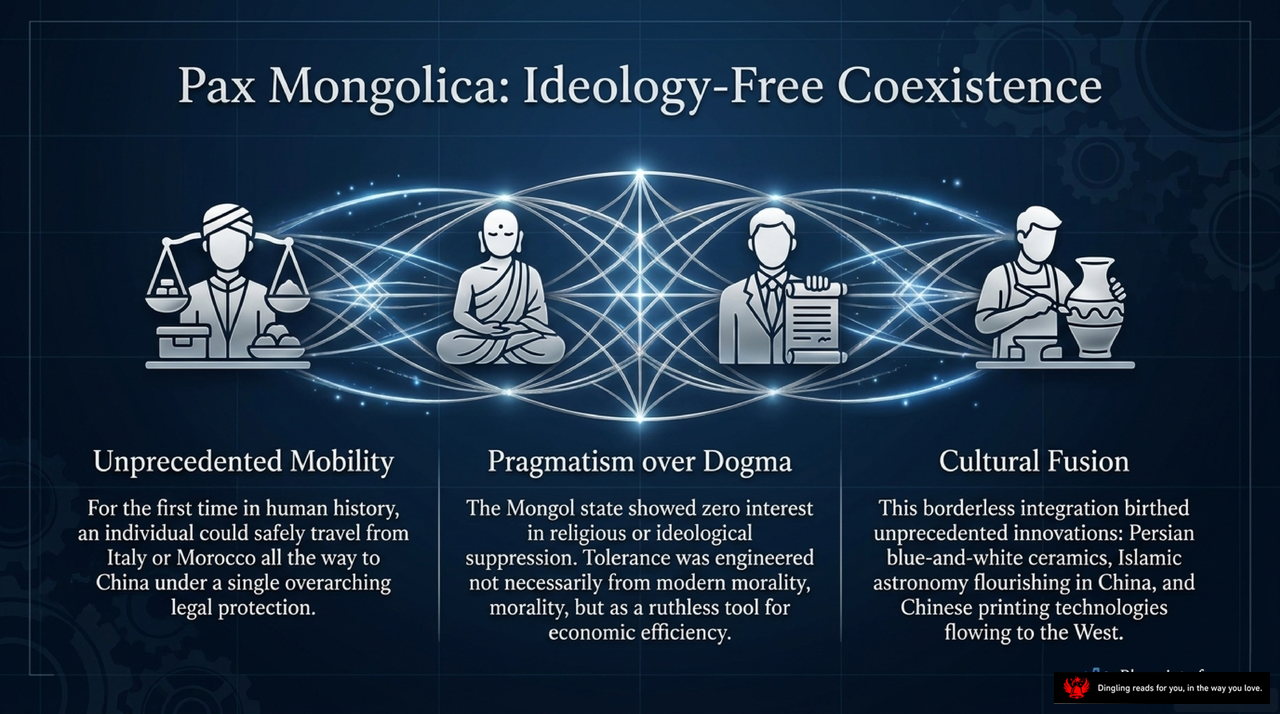
Let's dive into the concept of the Pax Mongolica. While history often paints this era as a time of brutal destruction, the reality was actually an unprecedented experiment in global connection. This slide breaks it down into three key areas: Unprecedented Mobility, Pragmatism over Dogma, and Cultural Fusion.
First, look at the mobility. For the first time in human history, an individual could safely travel from Italy or Morocco all the way to China under a single overarching legal protection. Imagine the freedom of movement. Before this, crossing the Silk Road was a gamble with your life. But under the Mongol system, the trade routes were protected, and the legal framework was unified. You could be an Italian merchant or a Moroccan traveler, and the Mongol law protected your journey. Even Ibn Battuta traveled from Morocco to the Great Yuan, and Italian merchants like Pegolotti wrote guides on how to navigate this vast network.
Why did they allow this? It wasn't out of kindness. It was pragmatism over dogma. The Mongol state showed zero interest in religious or ideological suppression. Tolerance was engineered not necessarily from modern morality, but as a ruthless tool for economic efficiency. They didn't care if you were Muslim, Christian, or Buddhist, as long as you paid your taxes and respected the trade rules. This borderless integration birthed unprecedented innovations.
Now, consider the cultural fusion. Persian blue-and-white ceramics, Islamic astronomy flourishing in China, and Chinese printing technologies flowing to the West. This wasn't just about moving goods; it was about moving ideas. The Mongol system created a space where different cultures could mix without fear of persecution. For example, blue-and-white porcelain combined Chinese ceramic technology with Persian painting habits and cobalt blue, becoming the most popular trade good. The silver currency standard established by Kublai Khan allowed trade to happen seamlessly from the East to the West, connecting the economy of the world. The Mongols unified the weight of silver, creating a common value benchmark across the continent. The Mongol system didn't rely on military force alone. It relied on a massive network of roads and sea routes that connected the Eurasian continent. Even after the empire fell, the legacy remained. The Ming Dynasty inherited many of these patterns, and even Zheng He's voyages were built on the foundation laid by the Mongols. So, the Mongol Era wasn't just a dark chapter; it was the first true attempt at a globalized world, where the boundaries of the known world were finally dissolved.
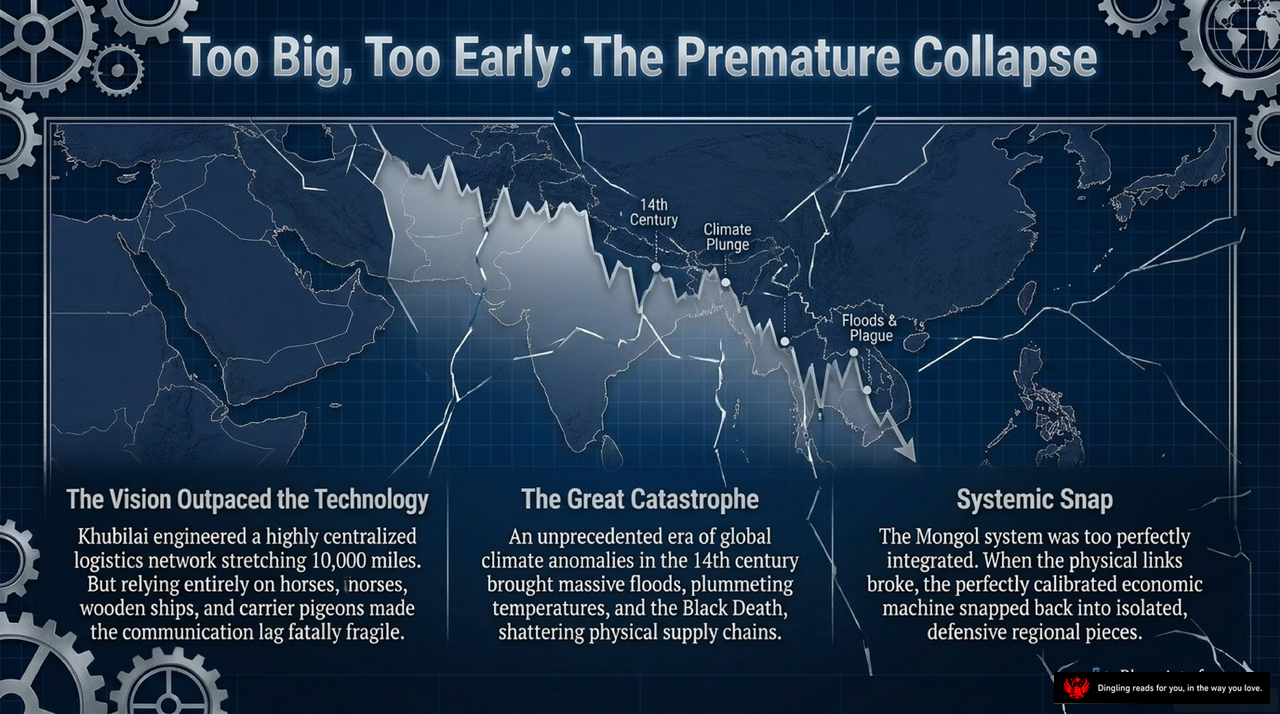
So, let's talk about why this incredible empire eventually fell. The title of this slide says it all: "Too Big, Too Early." Look at the map behind us. It shows the vast Eurasian network Kublai Khan built. He engineered a highly centralized logistics network stretching over 10,000 miles. It connected China, the Middle East, and Europe into one massive market. But there was a fatal flaw. The vision simply outpaced the technology. They relied entirely on horses, wooden ships, and carrier pigeons. When communication lag became fatal, the whole system grew fragile.
Then, nature struck back. The 14th century brought an unprecedented era of global climate anomalies. As the slide highlights, we see a "Climate Plunge," massive floods, plummeting temperatures, and the Black Death. These weren't isolated events; they shattered the physical supply chains that the empire depended on. The Mongol system was built on a perfectly calibrated economic machine, but it was too integrated.
This is what we call a "Systemic Snap." Because the system was so perfectly integrated, when the physical links broke due to plague and climate, the economic machine couldn't adapt. It snapped back into isolated, defensive regional pieces. It wasn't just a war; it was a structural failure. The system was too premature. Kublai and his strategists had excellent concepts, but they were limited by the technology of the time. They couldn't manage a super-territory of over 10,000 kilometers without modern transport or communication. This meant that when the Black Death hit, there was no backup plan. The trade routes dried up, and the wealth that held the empire together vanished overnight. This fragmentation meant that the centralized power that once held the regions together was gone forever.
So, the collapse wasn't just about losing battles. It was about the system being too complex for the world it lived in. Once the center failed, the whole thing collapsed instantly. This is why the Mongol era ended. It was a brilliant experiment that simply ran out of time. The map shows the decline, but it also shows the ambition that defined an era. We have to respect that ambition, even when the outcome was a premature collapse.
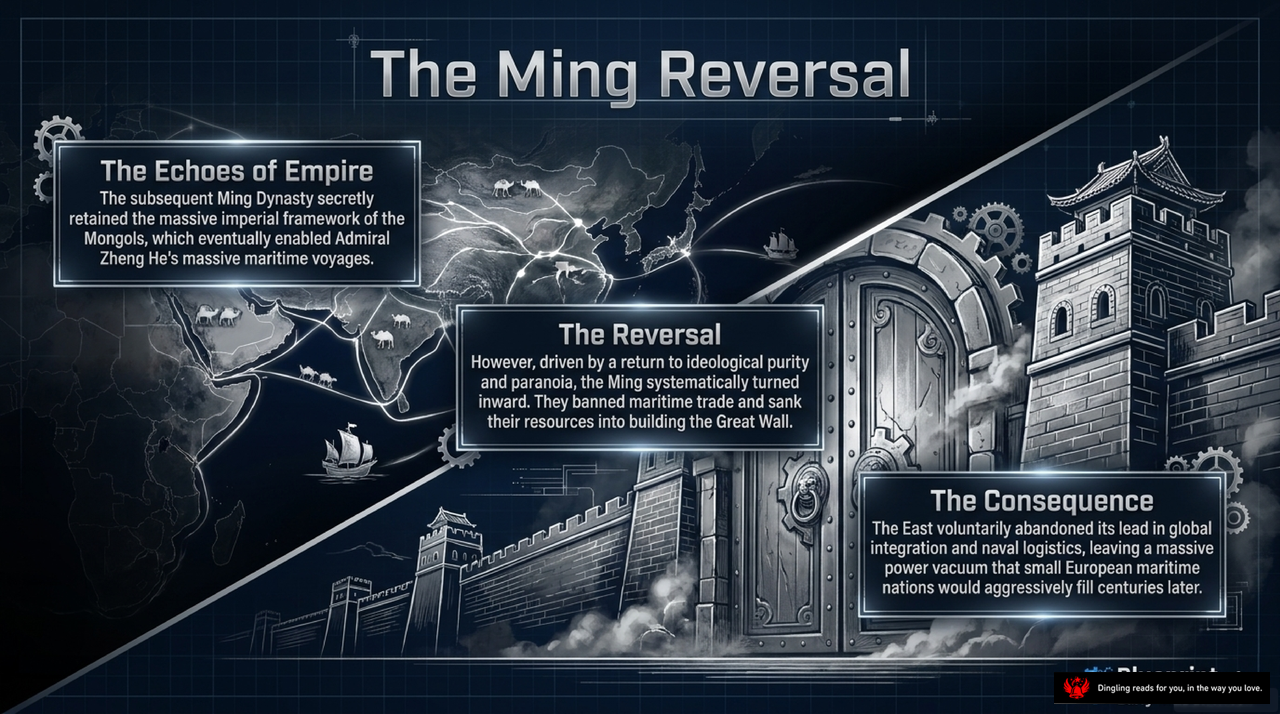
So, we've just discussed how the Mongol Empire created this incredible global trade network, connecting East and West for the first time in history. But now, look at this slide titled 'The Ming Reversal.' It tells a fascinating story of a missed opportunity that changed the world forever.
First, check the section 'The Echoes of Empire.' The Ming Dynasty didn't just erase the Mongols; they secretly retained that massive imperial framework. This continuity is actually what enabled Admiral Zheng He's massive maritime voyages. They had the ships, the logistics, and the ambition left behind by the Yuan. It was a brief moment where the East was still leading the world in global integration and naval logistics.
However, everything changed with 'The Reversal.' Driven by a return to ideological purity and paranoia, the Ming leadership systematically turned inward. Instead of expanding outward, they banned maritime trade and sank their resources into building the Great Wall. Notice the visual contrast: the map on the left shows the ancient routes, contrasting with the Great Wall on the right representing the new barrier. They chose defense over exploration, isolation over connection. The text mentions they pushed a strict sea ban policy, destroying records of Zheng He's voyages and banning large ship construction. They chose to protect their borders rather than expand their influence. This meant they stopped investing in the technology that made them great.
And finally, 'The Consequence.' The East voluntarily abandoned its lead in global integration and naval logistics. By shutting the door on the ocean, they left a massive power vacuum. And who stepped into that void? Small European maritime nations. They aggressively filled that gap centuries later, eventually leading to the Age of Sail and the rise of the West. This is why Europe could eventually dominate the seas.
So, this slide highlights a critical turning point in history. While the Mongols connected the world, the Ming Dynasty's decision to isolate themselves accidentally set the stage for Europe to take over. It's a stark reminder that even the most advanced civilizations can choose to retreat, and the consequences ripple across centuries, changing the fate of humanity forever. The power dynamic shifted from the East to the West, largely because of this single strategic choice to turn inward. The 15th century became the key turning point where the East limited its own development, while the West seized the opportunity with guns and ships to dominate the globe.
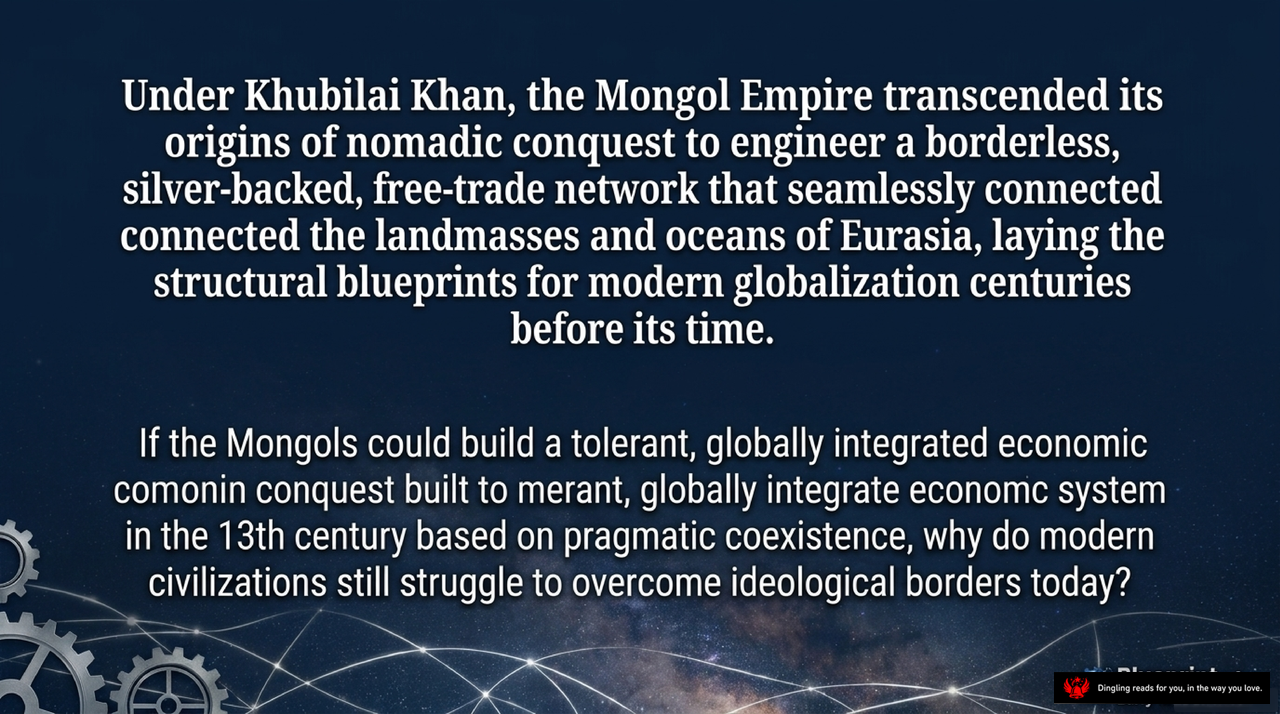
Let's dive into the real impact of the Mongol Empire under Khubilai Khan. It wasn't just about conquest anymore; it was about connection. For the first time in history, the Mongol Empire stopped being just a nomadic war machine and started building something that looked suspiciously like the modern world. They engineered a borderless, silver-backed, free-trade network that seamlessly connected the landmasses and oceans of Eurasia.
Think about the mechanics of it. They didn't just conquer land; they built an economic highway. They unified the silver standards across the entire continent, creating a currency that worked from the Pacific to the Mediterranean. They standardized the weight of silver, so a Sige in Mongolia was the same value as a Barikhu in Persia. This meant a merchant in Italy could trade with a merchant in China without converting currencies. It was a true global economy. They abolished tolls, built the Grand Canal, and even created the Woluo Tuke, which functioned like modern corporations to manage trade and logistics. They laid the structural blueprints for modern globalization centuries before its time. In fact, they created a pragmatic coexistence where religion, culture, and politics could exist side by side without fighting. The Ilkhanate, for example, was Islamic but ruled pragmatically. The system worked because it was inclusive and profitable.
But here is the question that really sticks with me. If the Mongols could build a tolerant, globally integrated economic system in the 13th century based on pragmatic coexistence, why do modern civilizations still struggle to overcome ideological borders today?
The Mongols didn't care about your religion or your race. They cared about trade and stability. Today, we have better technology, yet we are often divided by identity politics and nationalism. The Mongol system worked because it was inclusive and profitable. It connected the world through shared economic interests rather than forced unity. So, when we look at the legacy of the Mongol Era, we aren't just looking at a chapter of violence. We are looking at a prototype for a globalized world. It reminds us that when you remove the ideological barriers and focus on shared prosperity, the world connects much faster. The challenge today isn't logistics; it's mindset. We need to figure out how to build that same kind of pragmatic bridge between our differences, just like they did back then.