
Law and Society in Traditional China: Complete Chapter-by-Chapter Summary
Welcome to our exploration of "Law and Society in Traditional China" by Ch'ü T'ung-tsu.
As you see on this scroll, this book isn't just a history of ancient statutes. It's a sociological analysis of how Confucian ideology and family structures actually shaped the legal foundations of imperial China.
In traditional China, the law wasn't separate from daily life. It was woven directly into the family unit. The book argues that the rigid hierarchy of the clan, the father's absolute authority, and the moral duties of Confucianism became the very rules of the land. From marriage to inheritance to criminal punishment, the legal system was designed primarily to protect and enforce the family structure.
We're going to see how a simple family argument could become a capital crime, and how the emperor's power was often overshadowed by the needs of the family. This is a look at a world where the law and the moral code were one and the same. Let's turn the page and begin.

Welcome back. Today we're exploring the core of traditional Chinese legal systems. Look at the title on this slide: "The Spirit of Traditional Law". The image shows two pillars: Society and Law, connected by gears. This visual tells us they were inseparable.
First, notice this box: "Not an Isolated Entity". This is crucial. In imperial China, you couldn't understand the law just by looking at legal texts. Law was formulated exclusively to maintain and consolidate existing social institutions and moral orders. It was deeply embedded in society, not separate from it. For example, laws regarding family ethics were actually legal requirements.
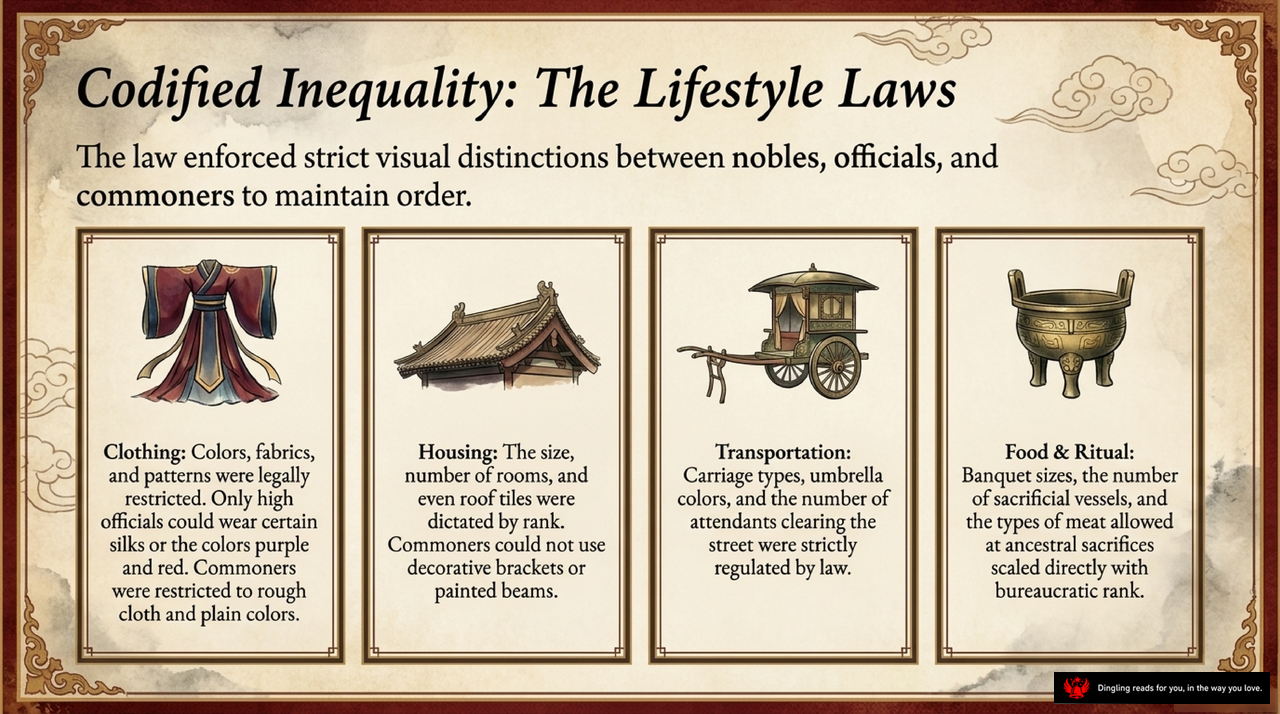
Then, look at "The Two Pillars". These are the fundamental characteristics of ancient Chinese law. The first pillar is Familyism, or Patriarchy. Think about the father's absolute authority over the family. He held economic and legal power, including the right to discipline children. If a child disobeyed, the father could punish them severely, and the law supported this. The second pillar is Class, or Hierarchy. Social status determined everything, from what you could eat to how you could marry. The law protected these distinctions, ensuring the upper classes kept their privileges while the lower classes remained in their place. For instance, strict rules governed clothing and housing based on your rank.
Finally, the "2,000-Year Continuum". From the Han dynasty to the Qing dynasty, despite minor dynastic shifts, the fundamental spirit and legal framework remained remarkably unchanged as a single cohesive entity. This system, rooted in Confucian ethics and legal codes, persisted for over two millennia.
So, the law wasn't just about punishment; it was about maintaining the structure of family and class. This continuity defined the legal culture for millennia. The "Spirit of Traditional Law" was essentially the spirit of the family and the hierarchy, woven together into a single, unchanging system. This is why we see such consistency in historical legal records.
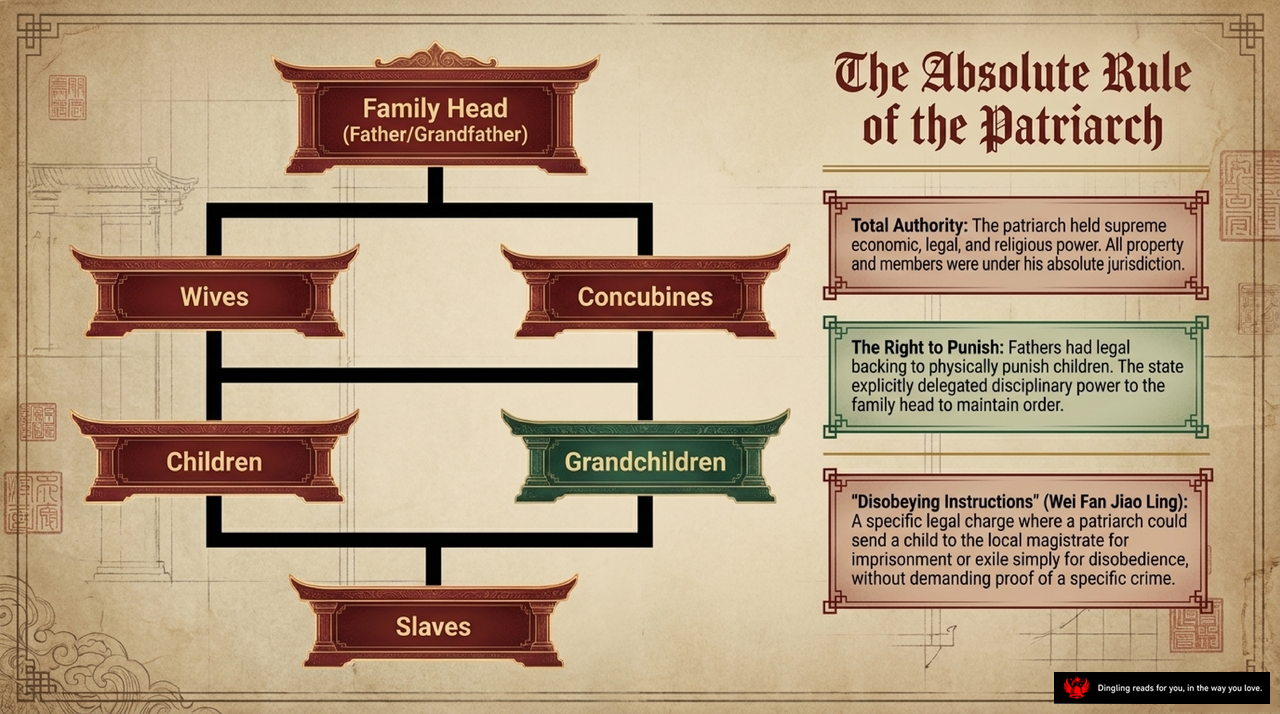
Welcome back to our deep dive into traditional Chinese society. Let's focus on this slide, which illustrates the absolute rule of the patriarch. This isn't just a family tree; it's a map of power. At the very top sits the Family Head—usually the father or grandfather. He is the undisputed boss. Everyone below him, from wives and concubines to children, grandchildren, and even slaves, is subordinate to his will.
Notice how the hierarchy flows downward. The patriarch holds total authority. This means he controls not just the family's daily life, but also economic resources, legal decisions, and religious rituals. Nothing belongs to anyone else but him. Even the wives and concubines had no independent status.
Now, let's look at the specific powers listed on the right. First, Total Authority. Every member of the family was under his absolute jurisdiction. You didn't have your own property or voice.
Second, The Right to Punish. This is a crucial point. Fathers had legal backing to physically punish their children. Even if a son was grown up, he could still be beaten or disciplined. The state explicitly delegated this disciplinary power to the family head. It wasn't just a father's whim; it was the law.
Finally, there's the Disobeying Instructions charge, or Wei Fan Jiao Ling. Imagine this in a modern context: if a parent felt a child was simply being disobedient, they could send that child to the local magistrate for imprisonment or exile. The law didn't require proof of a specific crime like theft or violence. Just the act of disobeying instructions was enough grounds for severe punishment. The parent could even decide when to release the child.
This structure ensured that the patriarch's word was law within the home, and the state's legal machinery backed it up. It created a system where family hierarchy was the foundation of social order. This rigid structure meant that individual autonomy was almost non-existent. The family was a microcosm of the state, and the father was the emperor of his own domain. This power dynamic extended to the very bones of society, ensuring stability through strict control. It's important to understand that this wasn't just about culture; it was a legal reality enforced by the government.
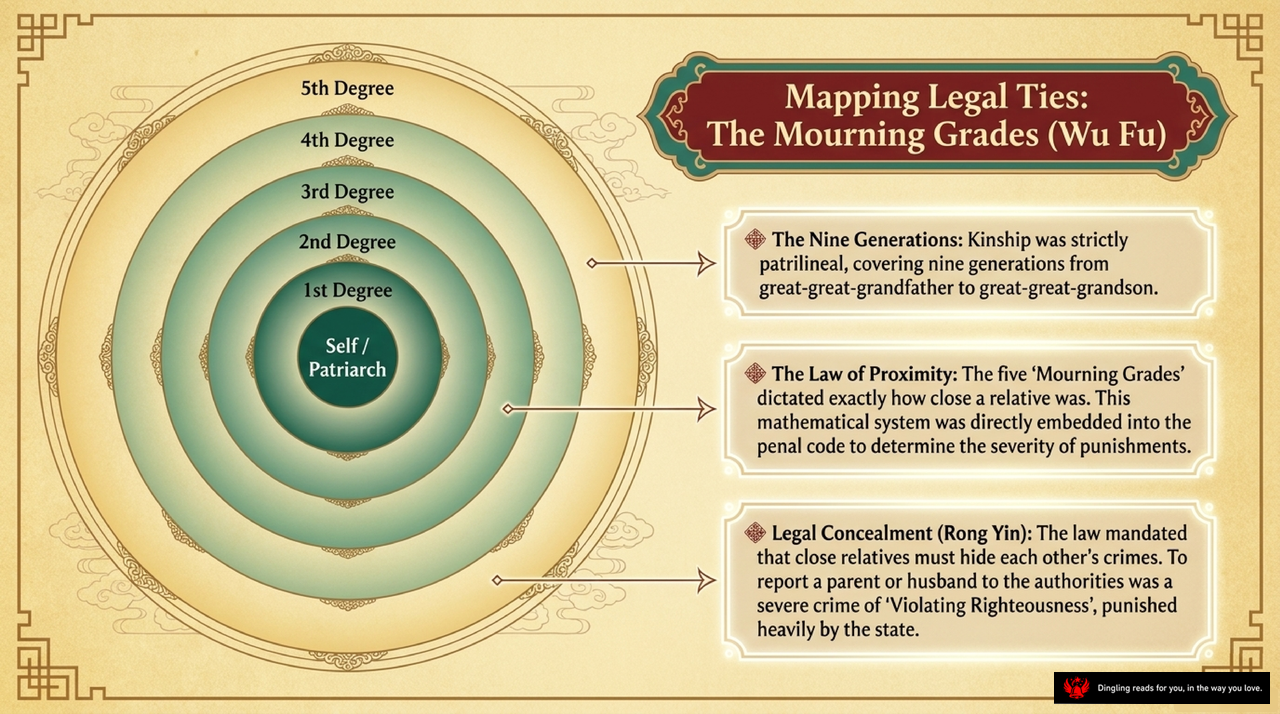
Look at this diagram. On the surface, it looks like a target, but in traditional China, these concentric circles were actually a map of legal obligation. This is the system of the "Mourning Grades," or Wu Fu.
At the very center is the Self, or the Patriarch. Everything radiates outward from there. The rings represent the "Nine Generations"—a strictly patrilineal line stretching from your great-great-grandfather down to your great-great-grandson. In this system, your mother's side was considered distant, but your father's side was the core of your identity.
Notice the five rings labeled as degrees. This isn't just about how long you wear black clothes during a funeral. This is a mathematical system embedded directly into the penal code. The Law of Proximity meant that the closer you were to the center, the heavier the punishment for harming you. If you hurt a distant cousin, the penalty was light. But if you hurt your father, it was a capital offense. The law literally measured the severity of a crime based on how many rings you were away from the victim.
This system also created a powerful duty of protection, known as Legal Concealment, or Rong Yin. Because the family was the primary unit of society, the law mandated that close relatives must hide each other's crimes. You couldn't simply report a parent or a husband to the authorities. Doing so was considered a severe crime of "Violating Righteousness," punishable by the state. This meant the family acted as its own first line of defense, shielding its members from the outside world, even if it meant breaking the law.
Ultimately, this diagram shows that in traditional Chinese society, you were never truly an individual. Your legal rights and responsibilities were defined entirely by your position within these rings. You were defined by your distance from the center, and the law was designed to keep you there, protecting the family hierarchy at all costs.
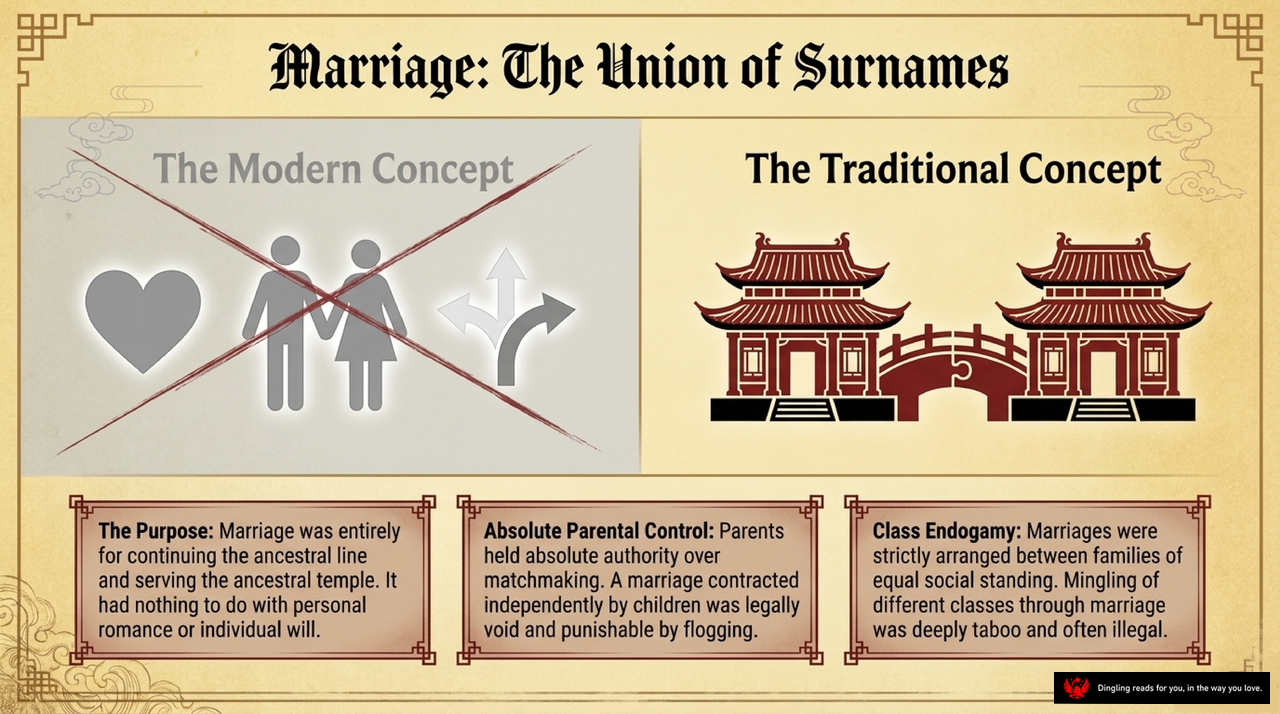
Welcome everyone. Today we're looking at a slide titled "Marriage: The Union of Surnames." This phrase alone captures the essence of how relationships worked in traditional society. On the left, you see the modern concept crossed out—a heart and a couple holding hands. That's because, back then, marriage wasn't about love or individual choice. On the right, you see two traditional buildings connected by a bridge. That represents the union of two families, prioritizing the clan over the couple.
Let's break down the three key points at the bottom. First, look at The Purpose. The text says marriage was entirely for continuing the ancestral line and serving the ancestral temple. It had nothing to do with personal romance or individual will. In ancient texts, it was described as "He two surnames," meaning joining two family lines to serve the temple and continue the bloodline. If a man had no son, it was considered the greatest unfilial act because his ancestors would have no one to worship them. So, reproduction was a duty, not a desire.
Next is Absolute Parental Control. Parents held absolute authority over matchmaking. A marriage contracted independently by children was legally void and punishable. Imagine being an adult, yet having zero say in who you marry. If you defied your parents, the law wouldn't protect you. The decision belonged entirely to the father and the family elders.
Finally, Class Endogamy. Marriages were strictly arranged between families of equal social standing. Mingling of different classes through marriage was deeply taboo and often illegal. A noble family couldn't marry into a commoner family, and mixing classes was seen as disrupting the social order. This ensured that status remained within the same group.
So, when we see the image of the traditional buildings, remember that this wasn't about finding a partner. It was about merging two family lines, obeying parental authority, and maintaining class boundaries. Marriage was a political and social contract for the family, not a personal relationship for the individuals. In our modern world, we often prioritize finding "the one." But here, the focus was on the ancestors. The text mentions that ancestors becoming "ghosts without worship" was a major fear. Also, regarding class, the text notes that noble families kept strict boundaries to maintain their high status. Even if you were rich, if you weren't noble, you couldn't marry into a noble family. This strict hierarchy meant that social mobility was almost impossible through marriage. The text also mentions that even if a couple loved each other, it didn't count. The law didn't recognize their bond if it violated the rules.
This system created a society where the individual was just a vessel for the family's future. Love was secondary to the survival of the family line.
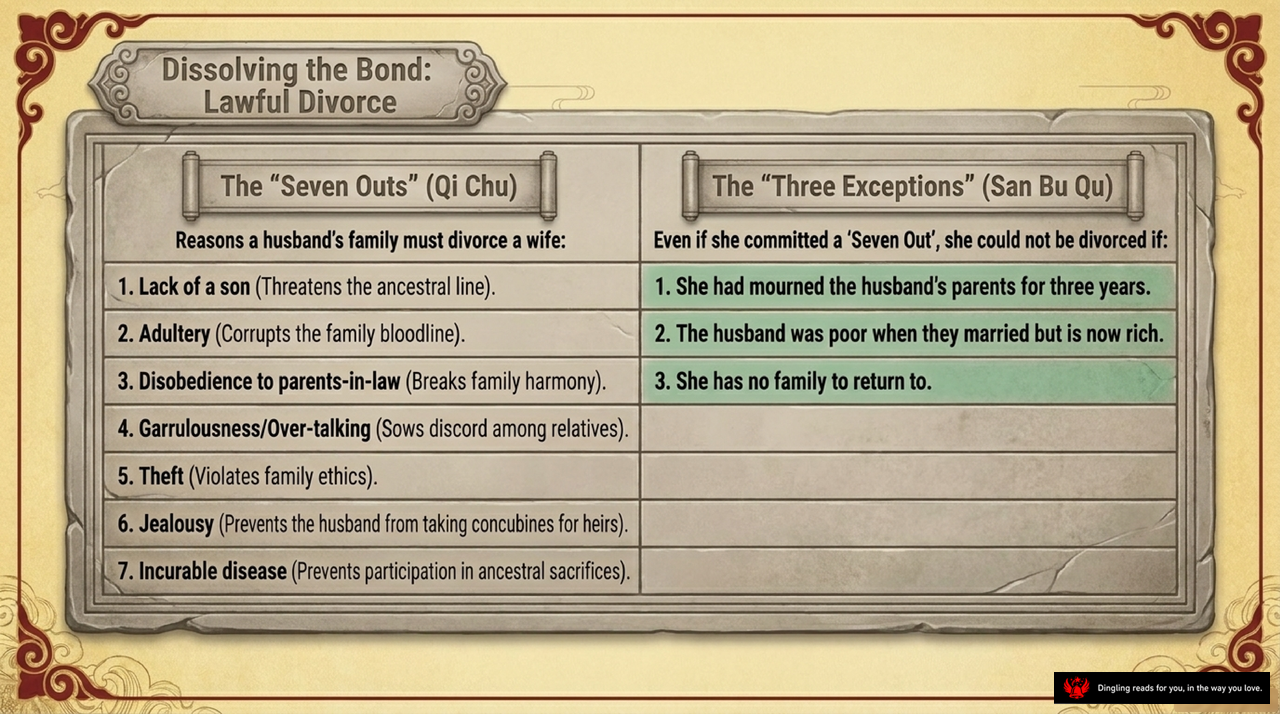
Welcome back. Today we're diving into how marriage ended in traditional China. Unlike modern times where love is the glue, back then, marriage was a contract between families, and divorce was strictly regulated. The husband's family held the power to initiate a divorce, known as the "Seven Outs." These weren't about cheating or fighting; they were about protecting the family's future and reputation. It was all about the clan, not the couple.
Let's look at the list. First, "Lack of a Son." If a wife couldn't produce a male heir by age 50, she was out, because the family line needed to continue. Second, "Adultery." This was a deal-breaker because it corrupted the bloodline. Interestingly, even if a woman fit the "Three Exceptions," adultery still meant divorce. Third, "Disobedience to Parents-in-Law." If she annoyed the in-laws, she was gone. Think of the famous story of Liu Lanzi; she was cast out simply because her mother-in-law disapproved. Fourth, "Excessive Talk." Gossip was dangerous in a tight-knit clan. Fifth, "Theft." Stealing from the family was a violation of ethics. Sixth, "Jealousy." If she refused to let the husband take concubines to secure heirs, she was out. And seventh, "Incurable Disease." If she was too sick to participate in ancestor worship, she couldn't fulfill her religious duty.
So, it sounds harsh, right? But there was a safety net called the "Three Exceptions." Even if a wife committed one of the Seven Outs, she could stay if she met these three conditions. First, if she had mourned her husband's parents for three years, showing deep filial piety. Second, if the husband was poor when they married but became rich later; she was protected from being cast out for financial reasons. Third, if she had no family left to return to, the law wouldn't let her be abandoned into the streets.
The bottom line? Divorce wasn't about personal happiness. It was about maintaining the family structure, the bloodline, and social order. The husband had the right to leave, but the law did put some limits to protect the vulnerable wife. It was a system designed for the clan, not the individual.
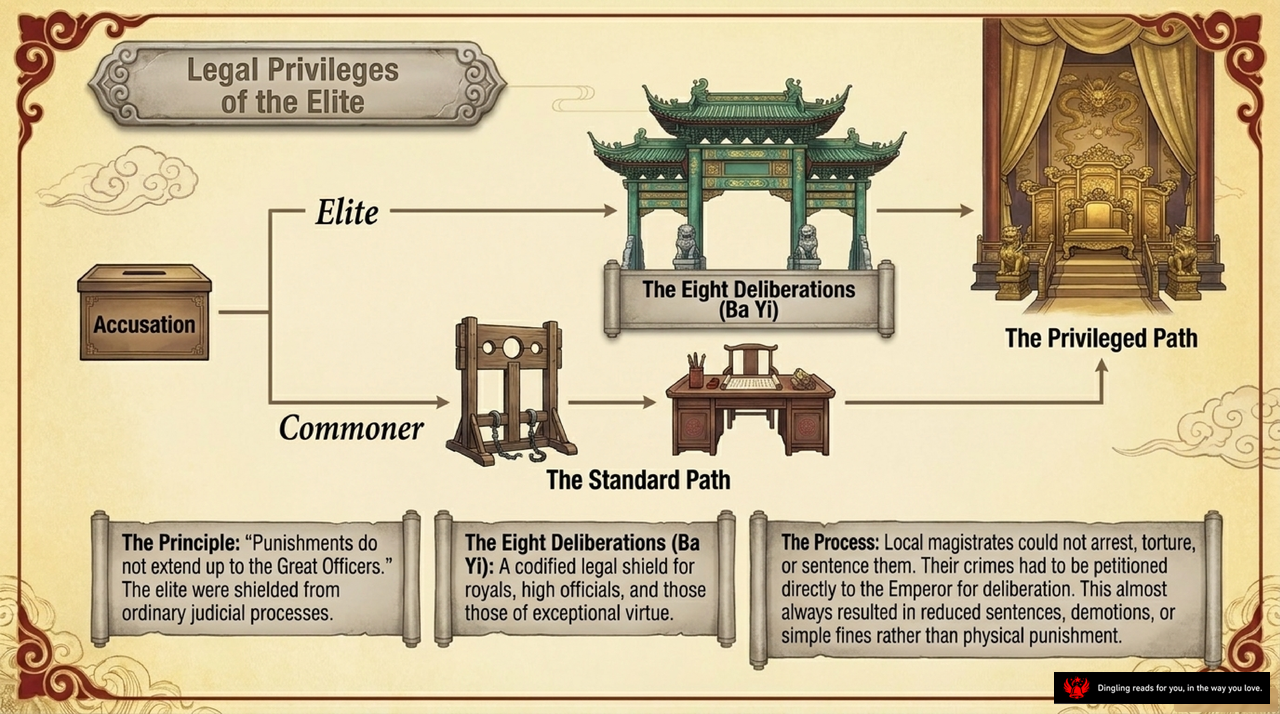
Take a look at this diagram. It shows us the legal privileges of the elite in traditional Chinese society. You can see how the path splits based on your social status. Starting on the left, we see an accusation. If you're a commoner, the path is straightforward but harsh. You go through the standard judicial process, which often ends at the gallows. There's no buffer. You face the full force of the law, where physical punishment is the norm. The image shows the gallows, clearly representing this fate.
But if you're part of the elite, the path changes entirely. You enter 'The Eight Deliberations.' This wasn't just a title; it was a powerful legal shield. The underlying principle was famously stated as 'Punishments do not extend up to the Great Officers.' Now, this doesn't mean they were immune to the law entirely. It meant they were shielded from ordinary judicial processes. Local magistrates were explicitly forbidden from arresting, torturing, or sentencing them on their own. Why? Because their status demanded dignity. If a local official tried to punish them, it could be seen as a challenge to their rank.
Instead, the case had to be petitioned directly to the Emperor. This is the 'Privileged Path.' Because the Emperor held the ultimate power, the outcome was almost always lenient. The elite rarely faced physical punishment. Instead, they received reduced sentences, demotions in rank, or simple fines. The image shows the Emperor's throne, symbolizing this direct access.
This system, known as the 'Eight Deliberations,' applied to royals, high officials, and those of exceptional virtue. It ensured that their social status and dignity were preserved even when they broke the law. For example, under the Tang and Ming codes, officials couldn't be detained without the Emperor's order. Furthermore, even if they were convicted, they could often use their official rank to offset the punishment. This was a unique feature of the system.
So, while the commoner faced the full force of the law, the elite enjoyed a safety net woven into the legal system itself. It highlights how deeply class and status influenced justice in traditional Chinese society. This wasn't just about corruption; it was a structured part of the law, designed to maintain the hierarchy of the time.
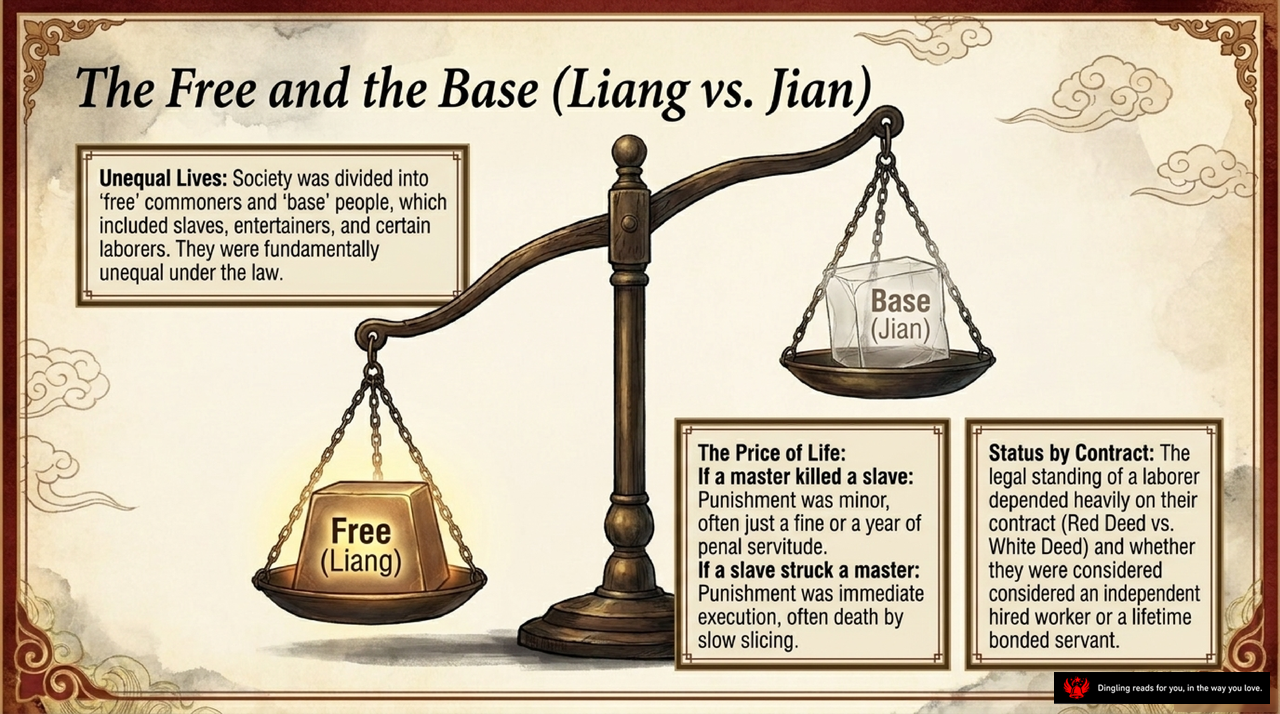
Welcome to this deep dive into the social structure of ancient China. This slide illustrates the stark divide between the 'Free' and the 'Base'. While we often think of class in terms of money, in traditional China, it was about your legal identity.
The scale on the screen shows two sides: the 'Free', or *Liang*, and the 'Base', or *Jian*. The *Liang* included the four main classes: scholars, farmers, artisans, and merchants. The *Jian* included slaves, entertainers, and certain laborers. But the law treated them as fundamentally different species.
Let's look at the 'Price of Life'. This is the most brutal part of the system. If a master killed a slave, the punishment was often minor—perhaps just a fine or a year of penal servitude. The law viewed the slave as property, not a person. However, if a slave struck a master, the punishment was immediate execution. In many cases, it was death by slow slicing. The text explicitly notes that if a master killed a slave unintentionally, he often faced no liability at all. But if a slave even cursed their master, it was a capital offense punishable by strangulation. If they hit the master, it was immediate death.
Then there's the 'Status by Contract'. Not all 'Base' people were slaves. Some were hired workers, like drivers or cooks, who worked under a contract. If they finished their term, they could regain freedom. However, their legal standing depended entirely on that contract. A 'Red Deed' or 'White Deed' determined if you were an independent worker or a lifetime bond. But regardless of the contract, the master held absolute power. The text describes slaves as being legally equated with 'property' or 'livestock'. They had no legal personhood. If a master was an official, killing a servant might only result in a fine or demotion, not even a prison sentence. Conversely, if a servant dared to curse their master, it was a capital offense.
The text also highlights a disturbing privilege: male masters had a default sexual privilege over female servants and even the wives of male servants, often without legal consequence. This was a direct reflection of the master's ownership of the person.
This system wasn't just about class; it was about who had the right to exist and speak. It created a society where the law didn't protect everyone equally, but rather protected the hierarchy itself. The 'Free' could live their lives, while the 'Base' lived under the constant threat of the master's will.
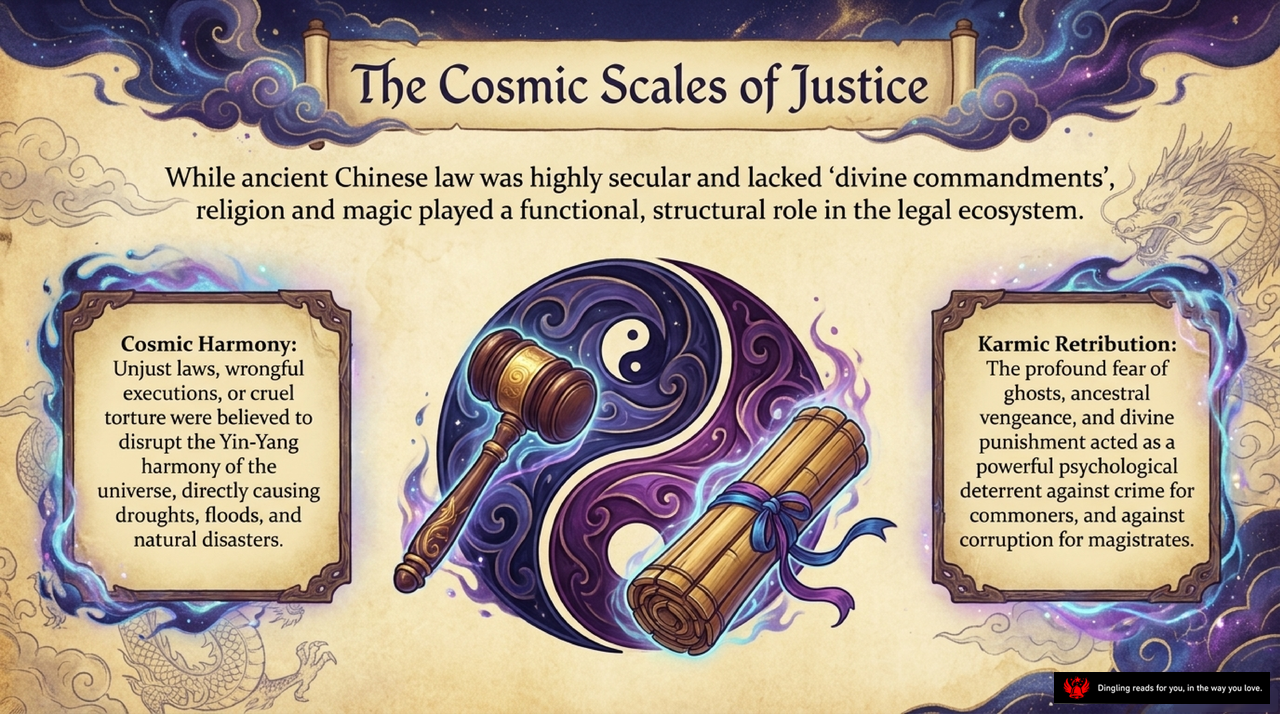
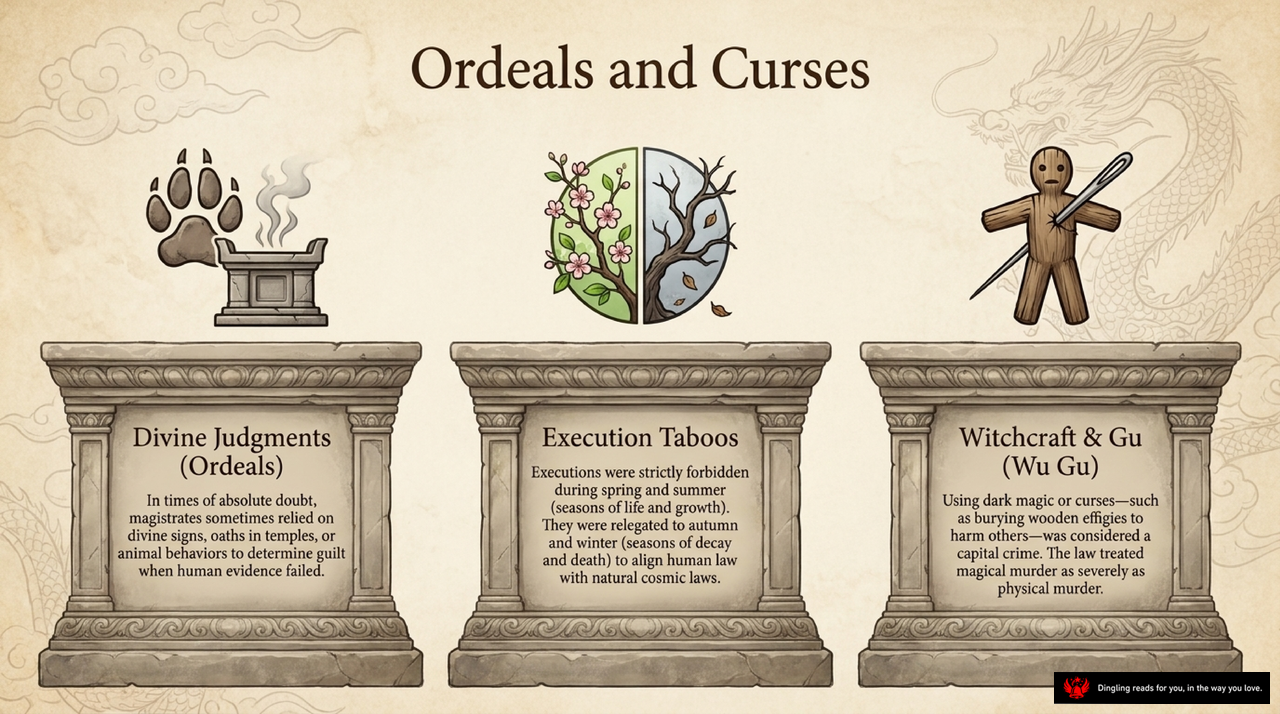
Let's dive into the supernatural side of ancient law. While we often imagine ancient China as purely bureaucratic, the reality was a complex mix of state power and spiritual belief. Today's slide covers three critical areas where the law met the divine.
First, look at 'Divine Judgments.' In times of absolute doubt, when human evidence failed, magistrates sometimes relied on divine signs, oaths in temples, or animal behaviors to determine guilt. Think of the legendary beast Xiezhi, or the practice of seeking truth through the gods. It wasn't just superstition; it was a formal legal tool used to resolve impossible cases when logic ran out. Even though formal law later shifted to interrogation, this belief in divine intervention lingered in the legal culture.
Second, there were strict rules on *when* you could die. The slide notes 'Execution Taboos.' Executions were strictly forbidden during spring and summer, the seasons of life and growth. They were relegated to autumn and winter, the seasons of decay and death, to align human law with natural cosmic laws. Killing someone in the growing season was seen as violating the order of nature itself. This wasn't just a rule; it was a philosophical alignment of state violence with the natural cycle.
Finally, the law took magical thinking incredibly seriously. Under 'Witchcraft & Gu,' we see that using dark magic or curses—such as burying wooden effigies to harm others—was considered a capital crime. The law treated magical murder as severely as physical murder. In fact, using curses to cause death was often punished more harshly than ordinary homicide because it was seen as a threat to the entire social order. The state believed that witchcraft could corrupt the land, so it had to be eradicated completely.
So, in this ancient system, justice wasn't just about what you did; it was about what the gods allowed, when you did it, and whether you were using forbidden magic. It shows how deeply intertwined the legal and spiritual worlds were, creating a system where the law was not just written, but felt as a cosmic force.
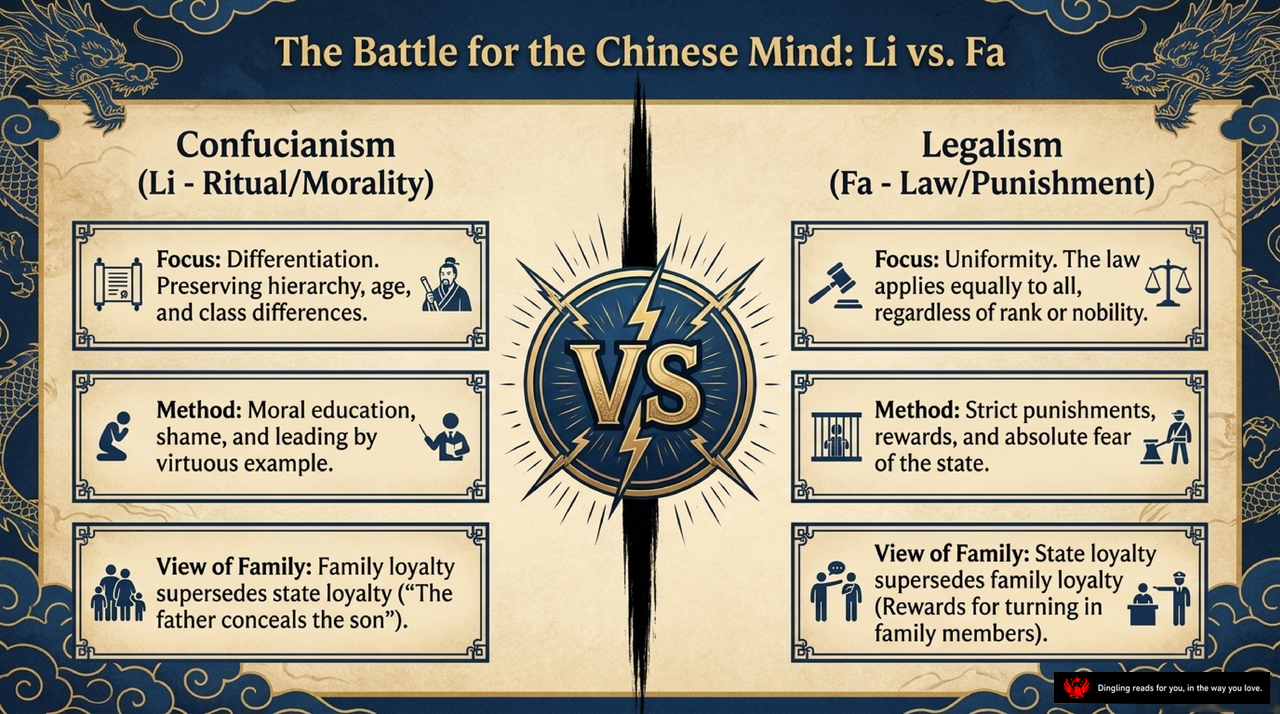
In the heart of ancient China, there was a constant intellectual battle that shaped everything from law to daily life. It was a clash between two philosophies: Confucianism, which focused on "Li," or ritual and morality, and Legalism, which relied on "Fa," or law and punishment. This was the battle for the Chinese mind.
On one side, you had the Confucian approach. Think of it as the philosophy of differentiation. It believed that society needed clear hierarchies—different roles for different people based on age, status, and family. The goal wasn't just to punish bad behavior, but to teach people to be good through moral education and virtuous examples. It valued family above all else. In fact, the law actually protected family loyalty over the state. There was a famous principle where a father could hide his son's crimes, and the state wouldn't punish him. It was about maintaining harmony within the family unit first.
On the other side stood Legalism. This was the philosophy of uniformity. It argued that the law should apply equally to everyone, regardless of their rank or nobility. It didn't care about your social status; if you broke the rule, you paid the price. The method was straightforward: strict punishments and rewards. It relied on the absolute fear of the state to keep people in line. For Legalists, the state's authority was supreme. If a family member broke the law, the state demanded they turn them in. Family loyalty was secondary to state loyalty.
Specifically, on family matters, Confucianism held that family loyalty supersedes state loyalty, famously summarized by the idea that "the father conceals the son." Conversely, Legalism believed state loyalty supersedes family loyalty, offering rewards for turning in family members.
So, while Confucianism tried to build a society based on moral distinctions and family bonds, Legalism tried to build one based on standardized rules and state power. These two forces didn't just exist side-by-side; they fought for the Chinese mind. Eventually, they merged, creating a legal system that honored hierarchy but enforced rules with ironclad penalties. This tension between Li and Fa defined the social order for centuries.
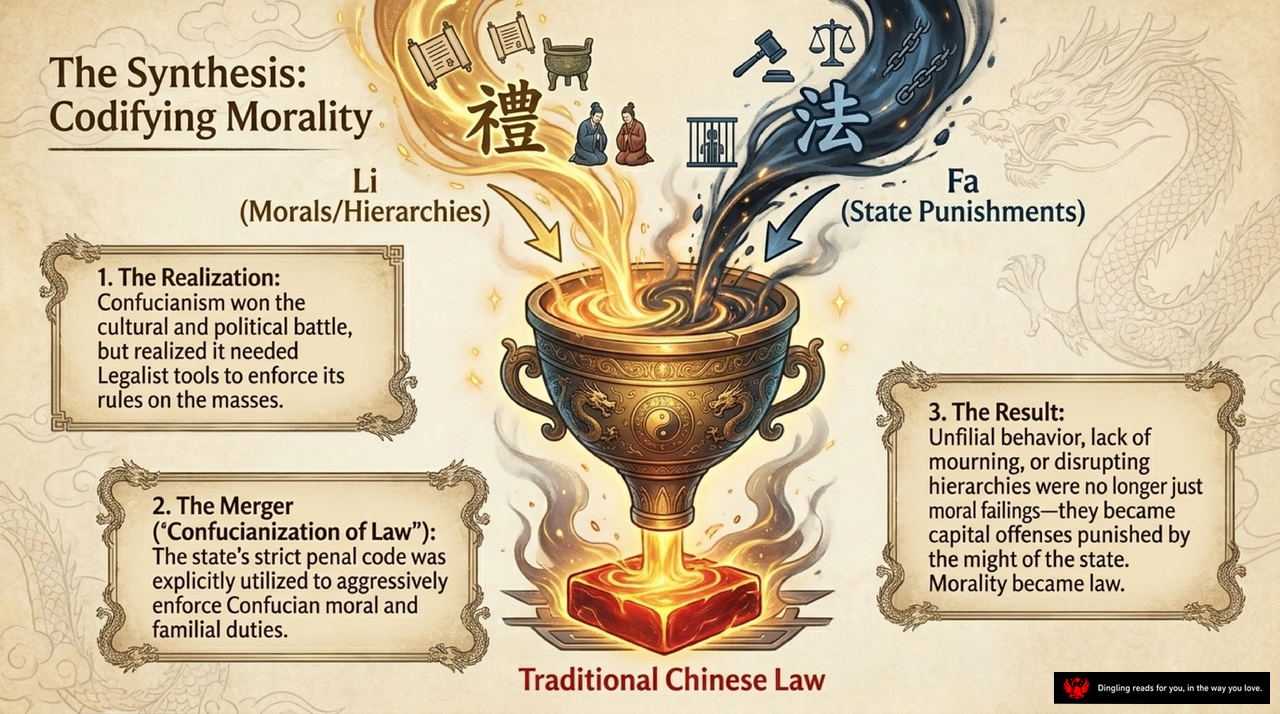
Let's look at the central image here. We see two distinct streams merging into a single cauldron. On the left, flowing in gold, is Li, representing morals and hierarchies. On the right, flowing in dark blue, is Fa, representing state punishments. The title of this slide is "The Synthesis: Codifying Morality," and this visual perfectly illustrates the foundation of Traditional Chinese Law.
The core logic here is fascinating. Confucianism won the cultural and political battle, becoming the dominant ideology of the state. However, the "Realization" phase on the left explains a crucial pivot: winning the culture war wasn't enough. To actually enforce rules on the masses, the Confucians realized they needed Legalist tools. They needed the hard power of the state to back up their soft moral values.
This led to "The Merger," often called the "Confucianization of Law." In this phase, the state's strict penal code was explicitly utilized to aggressively enforce Confucian moral and familial duties. It wasn't just about writing laws; it was about using the law to shape behavior according to Confucian ethics.
The result, shown on the right, is profound. Morality became law. Behaviors that were once just moral failings—like unfilial behavior, lack of mourning, or disrupting hierarchies—were no longer just private family matters. They became capital offenses punished by the might of the state. If you offended your parents or broke the family order, the government stepped in with the full force of the law.
This fusion created a unique system where ethics and law were inseparable. It wasn't just about punishing crime; it was about upholding the moral order of the family and the state. This synthesis is why Traditional Chinese Law is so distinct from Western legal systems. It built a society where obeying the law was the same as being a good moral citizen. This "Li-Fa" unity shaped Chinese governance for centuries, ensuring that social stability was maintained through the legal enforcement of moral duties. In the end, the distinction between a moral failure and a legal crime effectively vanished, creating a deeply integrated legal culture where the state became the ultimate guardian of family ethics. This system ensured that the law wasn't just a set of rules, but a reflection of the deepest social values.

Think of the traditional Chinese empire not as a cold government, but as a massive, intricate house. This slide shows the 'Architecture of Imperial Stability.' It breaks down how the state actually worked, layer by layer.
At the very bottom, we have the Foundation: The Patriarchal Family. This is where everything started. The father held absolute authority. In fact, the family wasn't just a living unit; it was a micro-version of the state. The father had the power to discipline, control property, and even decide life and death within the home. This concept, often called Wu Fu, meant that the family was the first school of obedience. A father's word was law, and the law backed him up.
Resting on that foundation are the Pillars: Class Inequality and Religious Harmony. You couldn't just be anyone in this society. Your status was written in your clothes, the food you ate, and even the size of your funeral. A noble wore silk; a commoner wore hemp. The book details how even the number of rooms in a house or the materials used for wine vessels were strictly regulated by your rank. Religion wasn't just about praying to a god; it was about ancestor worship and rituals that reinforced your place in the hierarchy. These pillars held the structure up, making sure everyone knew their rank.
Capping it all off is the Roof: State Law enforcing Confucian Li. This is where the government stepped in. But it didn't just punish criminals; it protected the family structure. The law gave legal teeth to the father's power. If a father disciplined a son, the law supported him. If a noble claimed privilege, the law protected it. It aligned state power with daily life. The legal system merged with the concept of Li, or rites, to ensure that social order was maintained not just by force, but by moral duty. Crimes within the family were often treated differently than crimes against strangers, prioritizing family harmony over individual justice.
The summary at the bottom captures the genius of this system. Chinese traditional law was highly successful because it perfectly aligned state power with the natural, micro-level structures of daily life. By giving legal teeth to the father's power, the noble's privilege, and the ancestor's rites, the state transformed every single household into a self-policing unit of the empire. It wasn't about a police force patrolling the streets; it was about the family and the law working together to keep the peace automatically. Every man knew his duty, and every son knew his place, creating a stable society without needing a massive army.
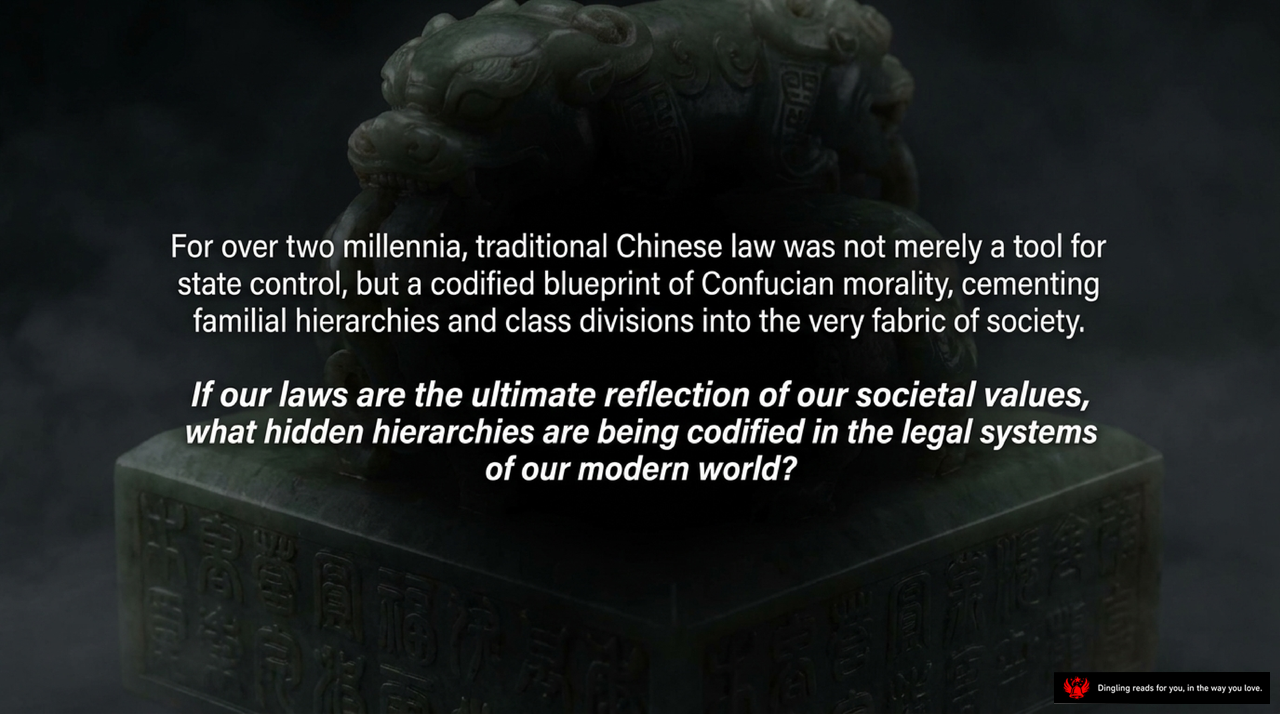
Look at this seal. It represents authority, but in ancient China, authority wasn't just about power. It was about morality. For over two millennia, traditional Chinese law was not merely a tool for state control. It was a codified blueprint of Confucian morality, cementing familial hierarchies and class divisions into the very fabric of society.
Think about what that means. In many modern systems, law and personal ethics are separate. But here, they were fused. The law didn't just punish crimes; it enforced relationships. It demanded filial piety. A father's authority was absolute, and the law backed it up. If a son disobeyed, the punishment wasn't just about the act; it was about the breach of the family order. It cemented the idea that the father's word was law.
And it wasn't just about family. Class divisions were written directly into the legal code. Nobles had privileges commoners didn't. The law told you who was superior and who was inferior based on your birth. A noble killing a commoner was a minor offense, while a commoner killing a noble was a capital crime. It wasn't an accident; it was the design.
So, here's the question this image is asking us: Laws are the ultimate reflection of our societal values. If we look at the legal systems of our modern world, what hidden hierarchies are being codified today?
We often think of law as neutral. But history reminds us that law is never truly neutral. It shapes who gets to speak, who gets to own, and who gets to be safe. As we move forward, we need to ask ourselves: whose blueprint is our modern law actually following? Are there subtle structures favoring certain groups over others, just like those ancient class and family divisions? We need to look past the text of the law and ask what values it truly protects. Because if we don't understand the values behind the rules, we can't truly change the system.
Consider your own workplace or community. Do we treat everyone equally, or do we have unwritten rules that favor those with more power or connections? That's the hidden hierarchy we need to uncover. Understanding the past helps us see the present clearly.