


This book finally explains why traditional Chinese law favored fathers over sons so clearly, revealing how the legal system protected parental power instead of punishing abuse or defending children from violence.
Your Review
This book finally explains why traditional Chinese law favored fathers over sons so clearly, revealing how the legal system protected parental power instead of punishing abuse or defending children from violence.


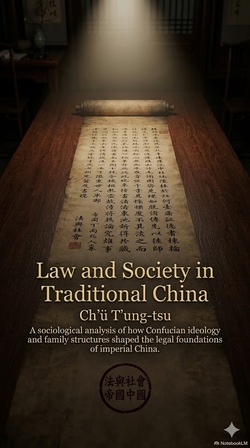
Ch'u brilliantly shows how Confucian ethics and Legalist punishments fused to enforce strict hierarchy, proving that traditional Chinese law was far more intentional and unequal than the myth of pure virtue suggests.

This book really shows how law and family rules were mixed together.

A brilliant dismantling of the myth that ancient China was governed solely by Confucian ethics instead showing the harsh Legalist tools that actually enforced the system.

Ch'u brilliantly shows how law codified inequality in family, class, and gender, proving it was a deliberate fusion of Confucian ethics and Legalist enforcement tools that reinforced rigid social hierarchies.

This analysis of Confucian-Legalist fusion really clarified how ancient laws enforced social hierarchy.

A clear and necessary read that proves traditional Chinese law was far more structured and unequal than the popular belief in pure Confucian rule ever suggested.

Ch'u brilliantly shows how law codified inequality, proving traditional China wasn't just a moral society but a rigid hierarchy enforced by strict Legalist tools.

The analysis of how elite privileges were written into every law, from clothing colors to arrest procedures, clearly proves that the legal system was designed solely to protect the powerful and the rich.

This work effectively dismantles the myth that traditional China was only a society of moral harmony, revealing instead a complex and intentional system built on rigid legal hierarchies.

Ch'u brilliantly shows how Law and Society in Traditional China fused Confucian ethics with Legalist punishment to enforce rigid social hierarchies, revealing that unequal rights were intentionally codified into the fabric of family, class, and gender relations rather than being mere cultural customs, making the legal system a powerful tool for maintaining imperial stability by prioritizing parental authority and elite privileges over individual justice or equality.

Dense but rewarding—note-taking helped.

It is fascinating how the law blended moral ideals with strict punishment to keep everyone in their place, ensuring that family status always dictated your legal rights and social standing.

This book shows that traditional Chinese law wasn't just about Confucian virtue. It actually used strict Legalist tools to enforce family hierarchy and class privilege, making inequality part of the law itself.

Ch'u brilliantly dismantles the myth that traditional China relied only on Confucian virtue, revealing instead a deliberate fusion of ethics and harsh Legalist punishments that codified inequality into law to maintain rigid social hierarchies across family and state.

Ch'u brilliantly shows how family hierarchy became law, making inequality a fixed part of daily life through strict rules on mourning, property, and violence that protected fathers while punishing sons or wives harshly for similar acts, proving that traditional Chinese law was designed to enforce social order by codifying class and gender subordination rather than pursuing moral equality or fair justice for all individuals regardless of status.

This book dismantles the myth that traditional Chinese society was held together purely by Confucian virtue. It reveals a legal system that was far more intentional and hierarchical than most people realize. The insight that law codified unequal rights into social fabric is truly eye-opening.

Ch'u brilliantly shows how law enforced hierarchy by protecting fathers while punishing sons, proving the system prioritized order over equality. The analysis of the Eight Deliberations system reveals how elites avoided harsh penalties through legal exemptions reserved only for nobles, while commoners faced immediate execution for similar crimes. This fusion of Confucian moral ideals with Legalist punishment tools created a rigid structure where family status dictated legal standing, ensuring that every rule from mourning rituals to property rights worked together to maintain the patriarchal order. By debunking the myth of a purely ethical society, the book exposes the deliberate design behind laws that subordinated women, slaves, and lower classes, making clear that justice was never blind but always served the interests of the powerful. Understanding this helps explain why modern Asian societies still emphasize collective harmony over individual rights, as the historical roots of these values lie in a legal framework that valued social stability above all else.

Ch'u brilliantly reveals how traditional Chinese law fused Confucian ethics with Legalist tools. He shows that the system wasn't just about moral guidance but also about strict, codified punishments to enforce social hierarchy. For instance, the text details how fathers could discipline sons with physical force without legal repercussions, while a son striking his father faced immediate execution. This fusion of moral ideals and harsh enforcement ensured that everyone stayed in their designated place within the rigid social order. The book also highlights how the five mourning grades dictated legal punishments based on kinship proximity, making family status the primary determinant of legal standing. By debunking the oversimplified view of a purely virtuous society, Ch'u provides a nuanced understanding of how law and society interacted to maintain stability through inequality. His analysis of the Eight Deliberations system further illustrates how elites enjoyed significant exemptions from arrest and punishment compared to commoners. Overall, this work offers a powerful lens for understanding the complex interplay between culture and law in imperial China, moving beyond Western-centric legal theories to appreciate the unique mechanisms that sustained traditional Chinese society for millennia.

Ch'u reveals how traditional law fused Confucian ethics with harsh Legalist punishments to enforce strict social hierarchies, proving that moral ideals alone could not maintain order without the threat of severe, codified penalties that protected elite privileges and suppressed lower classes, fundamentally changing my understanding of how ancient China balanced moral expectations with brutal state control to stabilize society through a rigid system where family status dictated legal standing rather than individual innocence or guilt.