
The Leadership Code: Complete Chapter-by-Chapter Summary

Welcome to *The Leadership Code* by Dave Ulrich, Norm Smallwood, and Kate Sweetman. This isn’t just another leadership book—it’s a revelation. The authors reveal that between 60% and 70% of what makes leadership effective is actually universal, predictable, and learnable. Think of it like a secret code hidden in plain sight. If you can crack it, you unlock the blueprint to truly elevate your impact as a leader. This book is for anyone who wants to stop guessing and start leading with clarity, confidence, and real results. Let’s dive in.

Stop chasing perfection. Stop waiting for a magical list of traits that will make you a leader overnight. Here’s the truth: great leadership isn’t about being born with special qualities—it’s about mastering a blueprint.
This slide breaks it down into two parts. First, you’ve got the Universal Code—the 60 to 70 percent that every great leader shares, no matter their industry, background, or personality. Think of this as your foundation: communication, empathy, decision-making, accountability. These are learnable skills. You can practice them. You can grow them.
Then, there’s the second layer: The Differentiators—the remaining 30 to 40 percent. This is where context matters. It’s how you adapt your core skills to your team, your company culture, market conditions, and your unique brand. It’s the art of customization.
But here’s what most people get wrong: they spend all their time trying to figure out the differentiators before they’ve even mastered the basics. Don’t do that. Master the universal 60-70% first. Build your engine. Then, let the rest follow naturally.
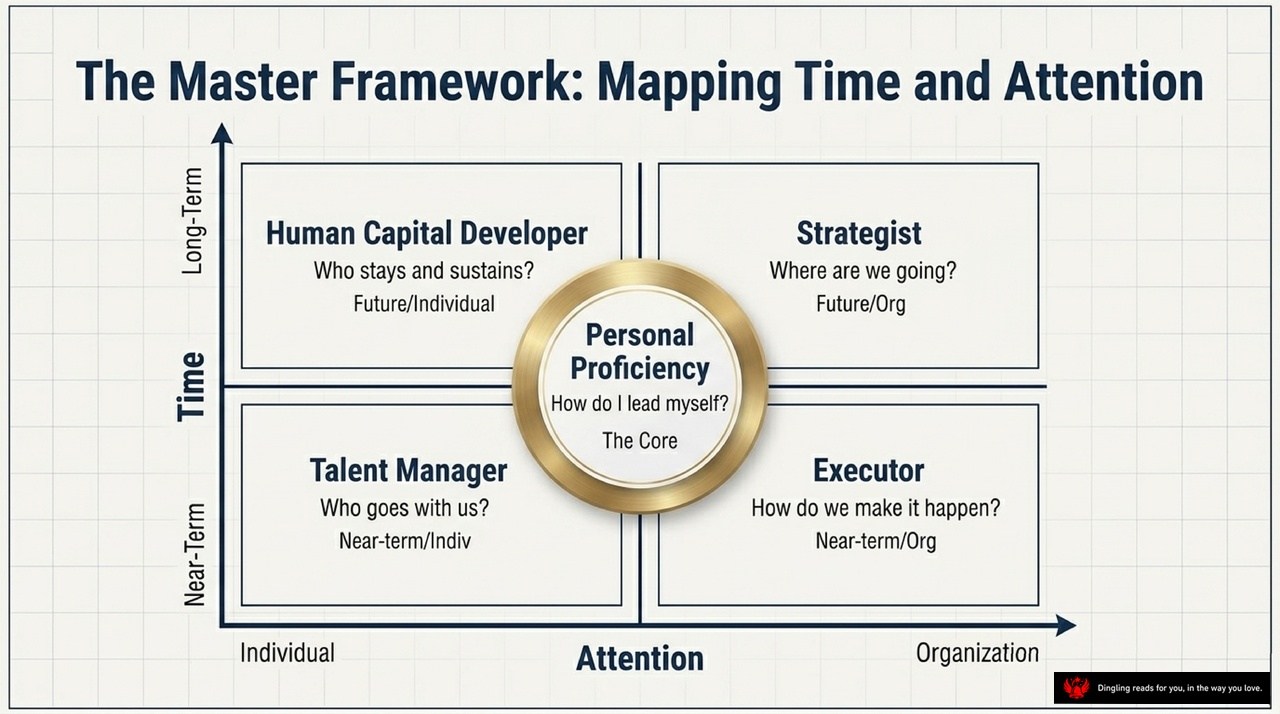
Welcome to the Master Framework—a simple yet powerful way to map how you spend your time and where you direct your attention. Think of it as a compass for leadership, helping you decide not just what to do, but who to lead and where to go.
This chart breaks everything into four key roles based on two things: time—whether you’re focused on the near term or the long term—and attention—whether you’re working on yourself or on the organization.
In the bottom right, you’ve got the Executor. This is where you focus on making things happen today, within your team or company. It’s about execution, getting results, and moving forward.
Next, move up to the Strategist. Here, you’re thinking ahead—where is the organization going? What’s the vision? This quadrant is all about long-term planning and organizational direction.
Now shift left to the individual side. At the bottom, you have the Talent Manager. This is about who’s coming along with you in the near term—your team, your people, your immediate circle. It’s about building relationships and managing people today.
Finally, look at the top left: the Human Capital Developer. This is where you invest in people over time—how do you grow them? Who stays with you in the future? It’s about sustainability, development, and long-term impact.
And right in the center? That’s Personal Proficiency—the core. It’s about leading yourself first. How do you manage your own time, energy, and focus? Because if you can’t lead yourself, you can’t lead others.
So this framework isn’t just theory—it’s a practical tool to help you balance short-term wins with long-term growth, and personal growth with organizational success. Use it to align your actions with your values, and to make sure you’re spending your most valuable resource—your time—on what truly matters.

Now, let’s dive into Rule 1: The Strategist. Think of this role as the compass of your organization—the one who answers the big question: Where are we going? It’s not just about setting a direction; it’s about aligning long-term focus with what the whole team cares about.
On the right, you’ll see a layered model that breaks down how strategy actually lands. At the center is Execution—because no matter how great your plan, if it doesn’t get done, it’s just talk. Surrounding that is Strategy, which acts as the bridge between where we are and where we want to be. And at the outermost ring is Customer Voice—the heartbeat of everything. It reminds us that strategy isn’t built in a vacuum; it’s shaped by real people, real needs, and real markets.
To make sure that vision sticks, we use what I call the Six Elements of Strategic Landing. First, Ambition—creating an emotional pull toward the future. Second, Action—turning values into daily behaviors. Third, Customer Focus—bringing external demands into our internal culture. Fourth, Discipline—making sure every department pulls in the same direction. Fifth, Bottom Line—being clear about financial and strategic goals. And finally, Motivation—tying personal futures to the bigger picture.
When all six elements click together, strategy stops being abstract and starts driving real results.
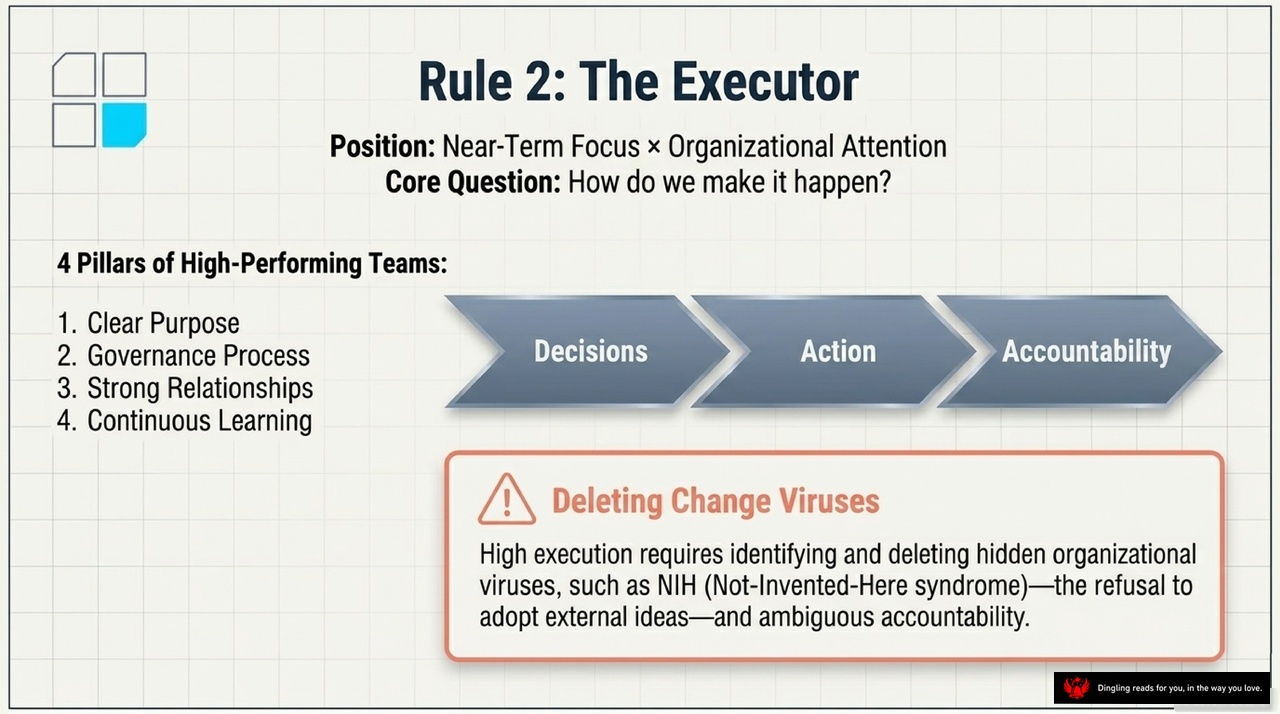
Rule 2 is all about The Executor—the person who bridges the gap between vision and reality. This role isn’t just about getting things done; it’s about aligning near-term focus with what the organization actually cares about. The big question here? How do we make it happen?
To succeed, you need four pillars: clear purpose, a solid governance process, strong relationships, and a culture of continuous learning. These aren’t just nice-to-haves—they’re non-negotiables for high-performing teams.
But here’s where it gets real: execution doesn’t stop at decisions and action. It demands accountability. That’s the third leg of the process—without it, everything falls apart.
And let’s be honest, there are hidden viruses that can kill your momentum. One classic example is NIH—Not Invented Here syndrome—the stubborn refusal to adopt ideas that come from outside your team. That kind of thinking creates ambiguity, blocks progress, and ultimately undermines trust.
So if you’re leading or working in an execution-heavy environment, remember: delete the viruses, own your decisions, act with purpose, and hold yourself and others accountable. That’s how you turn strategy into results.

Rule 3: The Talent Manager. This isn’t about managing tasks—it’s about managing people. Specifically, it’s about balancing what employees face with what they need to thrive. On the left, you’ve got the demands: globalization, technical changes, quotas—things that pile up fast. On the right? Resources like autonomy, coaching, flexibility, and technology. The core question is simple but powerful: Who goes with us? Because not everyone will. Talent Managers don’t just say “stay harder.” They ask, “What do you need to stay engaged?” That’s where the Burnout Equation comes in: when demands exceed resources, burnout happens. But here’s the fix—don’t just lower demands. Add counterweight resources. That’s how you keep equilibrium. And the best Talent Managers? They don’t just assign work. They identify each person’s signature strengths and align them with what the organization needs. That’s how you maximize engagement, reduce burnout, and build a team that actually wants to grow with you.

Here is the spoken-word script for Slide 6.
**Slide 6 Script**
Now, let’s talk about Rule 4: The Human Capital Developer. This is where the focus shifts from managing tasks to managing people. The core question here is simple but critical: Who stays and sustains the organization?
To answer that, we look at the 4-Stage Career Evolution Pipeline. Think of this as the natural lifecycle of talent within your company. It starts at Stage 1, the Dependent. This is where individuals are learning the ropes under your guidance. They rely on you for direction and structure.
As they grow, they move to Stage 2: Independent. Here, they become recognized expert contributors who can operate with autonomy. But the pipeline doesn’t stop there. The most critical transition happens at Stage 3, the Mentor. This is where the leader’s job truly shines. As shown in the graph, a leader’s primary responsibility is to ensure smooth transitions between these curves. You must nurture the expert so they can expand their impact by leading and developing others.
Finally, the talent reaches Stage 4: The Sponsor. At this level, they are no longer just contributing; they are shaping organizational direction and wielding institutional power. The visual overlap of these curves illustrates a vital truth: a leader must ensure a continuous pipeline of future talent. You have to be ready to let go of the Dependent so they can become Independent, and eventually, powerful Sponsors who will sustain the business long after you are gone.

Rule 5 is all about Personal Proficiency—essentially, how well you lead yourself. Think of it as the center fulcrum of your entire leadership framework. If you can’t master yourself, you can’t truly lead others.
The big question here is: How do I lead myself?
To answer that, we look at five key dimensions—each one a vital part of your personal growth and leadership capacity.
First, Physical. That’s not just about being fit—it’s about stamina, managing your energy, and staying healthy so you can show up consistently.
Next, Emotional. This is about resilience, controlling your reactions, and keeping optimism alive even when things go wrong.
Then, Intellectual. It’s about learning agility, staying curious, and developing what we call the Clarity Quotient—the ability to think clearly and act with purpose.
Social means building real, supportive networks—people who challenge and uplift you.
And finally, Spiritual. This isn’t necessarily religious; it’s about holding onto your values, integrity, and a deeper sense of meaning that guides your decisions.
Together, these five areas form what we call “The Leadership Mirror”—a reflection of who you are and who you’re becoming. When you work on all five, you don’t just improve as a leader—you grow as a person.

Alright, let’s dive into this one.
This slide introduces what we call the 4-Role Diagnostic Matrix—a framework that helps leaders understand the four essential roles they need to play to build and sustain a high-performing organization. Think of it as a self-check for your leadership style. Are you doing all four? Or are you leaning too heavily on one?
The four roles are Strategist, Executor, Talent Manager, and Human Capital Developer. Each has a core question, a primary action, an ultimate deliverable, and a common pitfall.
Let’s walk through them quickly.
As a Strategist, you’re asking, “Where are we going?” Your job is to map the future, and your deliverable is a clear vision and focus. But if you skip execution, you end up with slogans without action.
As an Executor, you ask, “How do we make it happen?” You drive accountability and aim for measurable results. But without strategy, you risk busy work with no direction.
As a Talent Manager, you ask, “Who goes with us?” You balance demands and resources to keep your team engaged. But if you neglect this, burnout and turnover become real risks.
As a Human Capital Developer, you ask, “Who stays and sustains us?” You manage the career pipeline to build future leaders. But if you ignore succession planning, you’re setting your organization up for long-term failure.
The key takeaway? Great leaders don’t just pick one role—they integrate all four. If you’re missing any, you’re leaving part of your leadership potential on the table.

So, let’s break down this synthesis: forging your leadership brand. Think of it as a powerful equation. On the left, you’ve got “The Leadership Code” — that’s your universal foundation. It’s the five non-negotiable rules that keep any leader structurally sound. Without these, no amount of charisma or personality will save you. But here’s the twist: that code alone isn’t enough. That’s where “Differentiators” come in — your contextual multiplier. These are the things that make your leadership unique to your specific company and culture. Think GE’s focus on sustainable innovation versus Virgin’s rebellious disruption. These aren’t just fluff — they’re the lens through which you apply the universal code. When you multiply the foundation by the differentiator, you get “Leadership Brand” — the output. This is your authentic voice, the way you show up to customers, investors, and employees. It’s not about being generic; it’s about being unmistakably you, tailored to your world. That’s how you build a leadership brand that sticks.
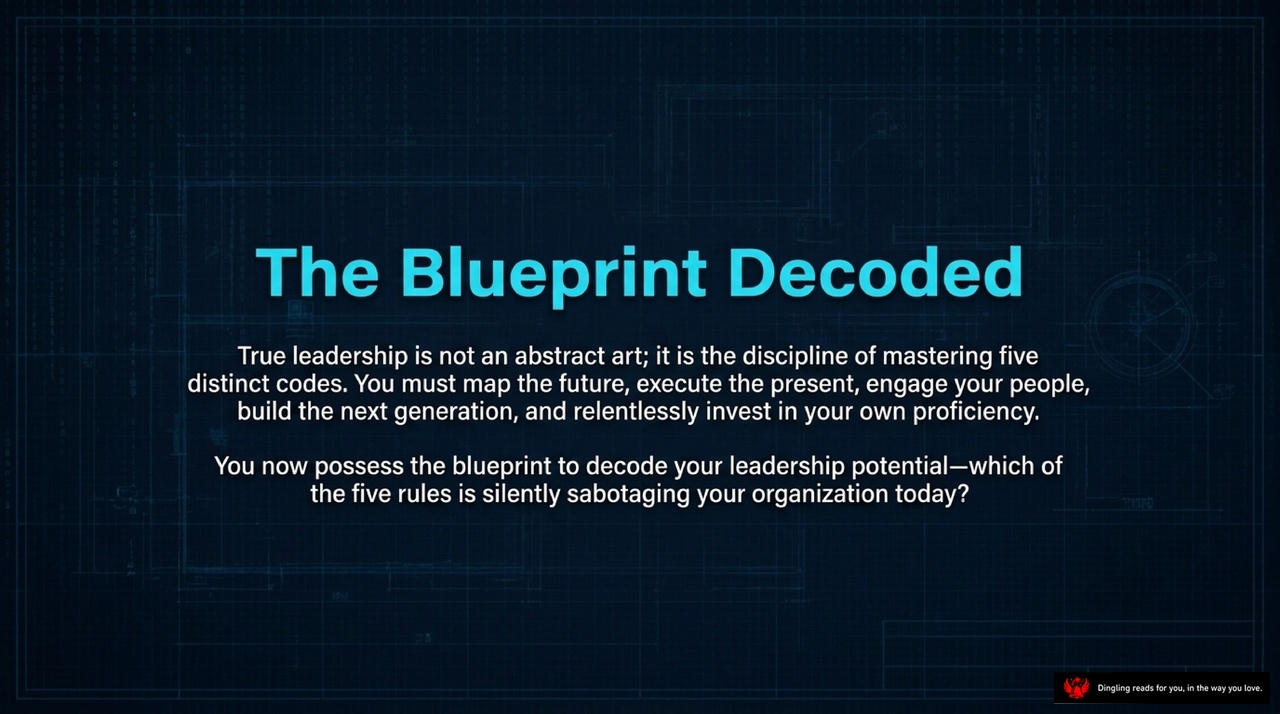
Let’s talk about what true leadership actually looks like. It’s not some abstract ideal or a vague aspiration—it’s a disciplined practice built on mastering five core codes. Think of it as a blueprint, a roadmap for real impact. First, you have to map the future—set a clear direction. Then, execute the present—turn that vision into action every single day. But it doesn’t stop there. You also need to engage your people, build the next generation of leaders, and most importantly, relentlessly invest in your own proficiency. That’s the non-negotiable part. Now, here’s the question: which of these five rules is silently sabotaging your organization right now? The good news is, you now possess the blueprint to decode your leadership potential. So, don’t just read it—apply it.