
Leap: Complete Chapter-by-Chapter Summary
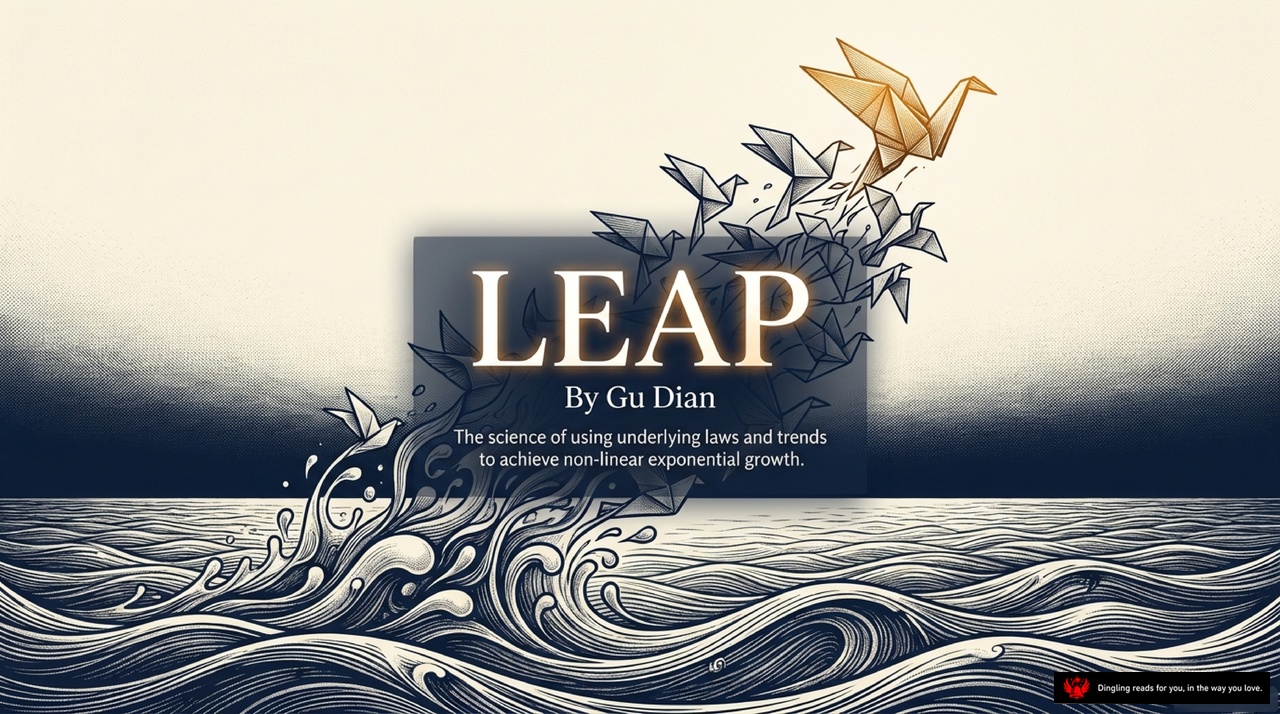
Welcome to "Leap," by Gu Dian. Today, we're diving into the science of using underlying laws and trends to achieve non-linear, exponential growth.
Imagine a flock of origami birds breaking free from the waves below. One golden bird soars ahead, leaving the rest behind. This isn't just art; it's the core metaphor of our journey. We aren't here to talk about working harder. We are here to explore how to work smarter by aligning ourselves with the hidden patterns of the world.
In a world where information is instantly available, the real advantage doesn't come from what you know, but from how you connect, leverage, and evolve. Whether it's an investor waiting for the perfect pitch, a teacher mastering a new paradigm, or a leader navigating complex systems, the ability to "leap" separates the average from the extraordinary.
This book will guide you through the mechanics of that leap. We'll uncover the strategies of the top performers, understand the power of networked thinking, and learn how to break free from the cycles that keep us stuck. It's time to stop swimming in the waves and start flying above them. Let's begin.

Imagine you are a baseball player at the plate. You have a split second to decide: do you swing at every pitch, hoping for a home run, or do you wait for the ball to hit the perfect "sweet spot"? Ted Williams, the greatest hitter in MLB history, chose the latter. He famously only swung at pitches in his ideal zone, sacrificing the occasional extra-base hit to maintain an impossible batting average. Warren Buffett, the investing legend, hangs a poster of Williams in his office because the lesson is identical: true success isn't about working harder; it's about waiting for the high-value opportunity and striking only when the odds are in your favor.
This is the essence of the "Expert Strategy." Look at the snake in the image on the right. It doesn't chase every small insect that wanders by. It stays perfectly still in the shade, ignoring low-value distractions, until a large prey appears. It understands that growth isn't a series of frantic, linear efforts—that's the trap on the left, the hamster wheel where 100 hours of effort yields only 100 units of return. Instead, real growth happens through strategic, systemic leaps.
The core of this strategy is finding your "head" in any system. Nature and society follow a power law: a tiny fraction of inputs drives the vast majority of results. In business, the top 20% of customers generate 80% of revenue. In life, the top 20% of your activities create 80% of your value. The mistake most people make is spreading their energy across everything, trying to be good at mediocre things. The expert's move is to find that critical 20%—the sweet spot, the high-value zone—and focus relentlessly there.
But finding the right zone is only half the battle. You must also iterate. It's not about finding one magic moment; it's about stacking small advantages. Just like the snake waits patiently but strikes with precision when the moment arrives, you need to build a system where your small wins compound into massive results. Stop relying on baseline effort alone. Stop running on the hamster wheel. Instead, use leverage, strategy, and the laws of the system to amplify your momentum. This is how you move from the illusion of hard work to the reality of exponential growth.

Welcome to the Oceanic Era. Imagine your life not as a solitary walk on land, but as swimming in a vast, boundless ocean. In this connected world, every action you take sends ripples that touch everyone around you. You are no longer an isolated individual; you are a node in a massive, intricate network.
To thrive here, we must undergo three fundamental shifts. First, a Cognitive Shift: move from relying on memory to mastering search. Think of your brain not as a hard drive, but as a search engine. Just as you no longer memorize phone numbers to dial them, you shouldn't try to store every fact. Instead, outsource rote memory to machines and focus your mental RAM on calling, synthesizing, and understanding knowledge.
Second, a Thinking Shift: evolve from solo pondering to networked collaboration. True innovation happens at the nodes where ideas connect. Don't isolate yourself; reach out to experts, find similar patterns online, and leverage the wisdom of others. Be a "networked independent thinker"—you still think for yourself, but you amplify your thinking by connecting with the global mind.
Finally, a Competitive Shift: transition from purely human capability to human-machine integration. The future belongs to "Centaur models." Combine the scale and speed of AI with human empathy and creativity. This isn't about replacing humans; it's about leveraging external tools to scale your impact.
In this era, the core skill isn't knowing everything, but knowing where to find the answers and how to connect them. Master these shifts, and you stop just surviving the ocean; you start navigating it with purpose.

Welcome to the "Head Effect." Look at this chart: it shows a stark truth about our world. We often think life is fair, like a Bell Curve where everyone clusters around the average. But the reality? It follows a Power Law. As the graph shows, the top 20%—what we call "The Head"—accumulates over 80% of all resources and momentum. The rest is just the long tail.
This isn't a bug; it's a feature of how systems work. Think of it like a pyramid scheme or a viral trend: a tiny group gets the lion's share of the action. If you try to distribute your energy evenly across everyone and everything, you're fighting against the grain. The smartest move? Stop trying to be average. Stop wasting time in the middle. Instead, identify where the high-value zones are and aggressively move your focus there.
The strategy is simple but hard to execute: escape the fat tail and occupy the head. Whether you're investing, building a business, or learning a skill, you need to find that 20% of inputs that drive 80% of your results. Don't just work harder; work smarter by aligning yourself with the system's natural momentum. That's how you stop being a follower and start becoming a leader in your own game.
Imagine a world where your life isn't a straight line, but a complex web of invisible loops. Some loops are engines that propel you forward—like the cycle where learning leads to growth, which creates value, which fuels even more learning. Others are death spirals that trap you: the more you panic, the more you rush, and the faster you make mistakes, which only makes you panic harder.
The secret to breaking free from these traps isn't trying to push harder within the same system. That's a "first-order change," like pressing the gas pedal while stuck in traffic; you're just going faster in the wrong direction. Real breakthroughs come from "second-order change"—shifting the entire system itself. Instead of dieting and starving yourself until you crash, you redesign your relationship with food and exercise to build a sustainable metabolism. Instead of blaming your team for missing targets, you might realize the real issue is a flawed customer definition, and you shift your entire metric from "sales volume" to "customer satisfaction."
To do this, you need to see the system clearly. Every system has elements, relationships, and functions. But the magic happens in the relationships, specifically in the feedback loops. When you stop looking at isolated problems and start seeing the circular patterns connecting them, you gain the power to rewrite the rules. This shift from being trapped in a loop to becoming the architect of your own system is the ultimate lever for growth.

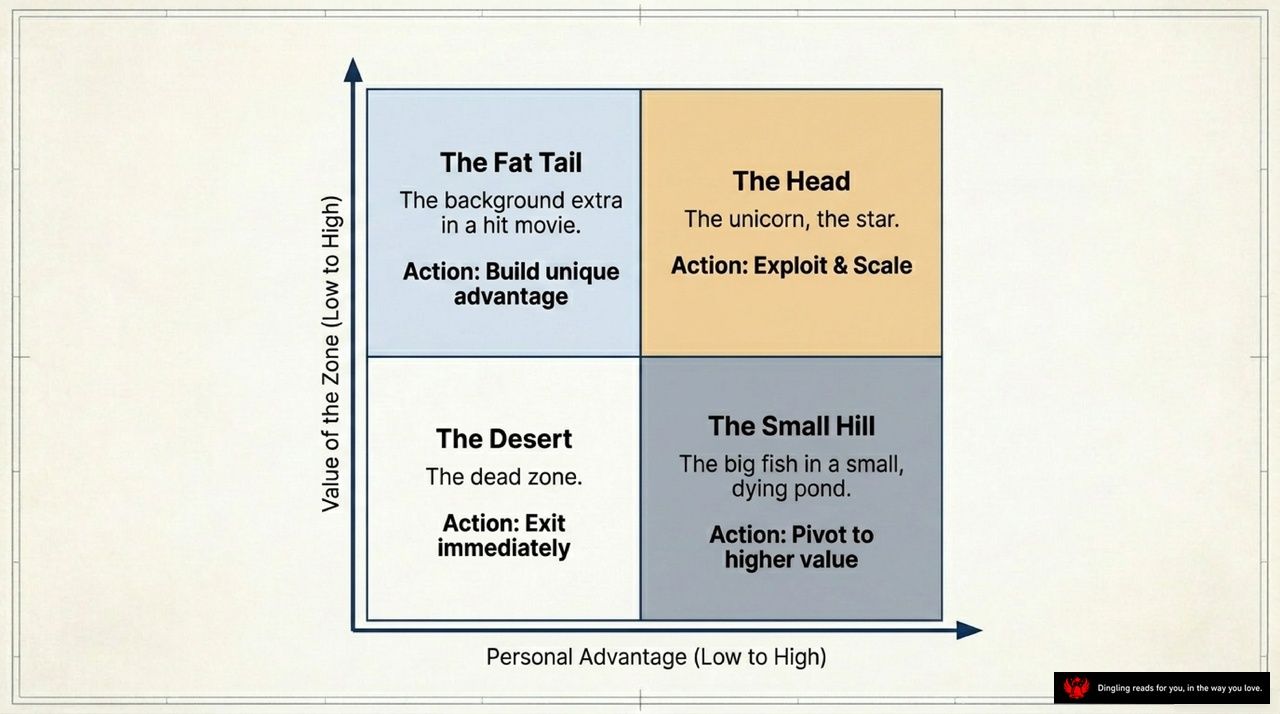
Imagine your career as a strategic game of baseball. The legendary hitter Ted Williams didn't try to hit every ball thrown his way; he waited patiently for the ball to enter his "sweet spot," the only zone where he could truly excel. If he forced himself to hit the rest, his average would collapse. This is the essence of the "Head Playbook."
First, you must prioritize **Value Over Advantage**. Don't just chase what you are good at; choose the high-value track where the payoff is highest. Advantage can be built, but systemic value cannot be manufactured.
Next, you need to **Differentiate**. Avoid the crowded mainstream. Instead of blindly following the crowd, find your unique angle to escape pure attrition. Think of how a snake survives not by chasing every small insect, but by waiting in the shadows for the big prey. True success comes from focusing on the "fewer but better" opportunities.
Finally, **Start Local**. Don't aim to be the "world's best" on day one. That is a trap. Instead, dominate your immediate, visible micro-system first. Whether it's becoming the top performer in your current department or the most efficient courier in your specific district, conquering the small head is the only way to leap to the next larger one.
The path to mastery isn't about working harder everywhere; it's about strategically focusing your energy on the high-value zones where your unique angle meets the greatest opportunity. Start small, dominate locally, and let your success compound into a global presence.

Learning: Upgrading to the Source. The core insight here is simple but powerful: knowledge degrades the further it travels from its origin. Think of it like a funnel. At the very top, we have first-hand information—the spring. This is where raw data, academic papers, and direct conversations with pioneers live. It's high difficulty, but it's pure.
As this knowledge flows down, it becomes second-hand, or the river. Here, you find dense classic books and well-researched reports. The difficulty drops, but the structure remains high. By the third layer, we hit the tap. This is where best-selling pop-science and business books sit. They are easy to read, but the original signal gets diluted with anecdotes and simplifications. Finally, at the bottom, we reach the drain. This is fourth-hand information: clickbait articles and emotional social media posts. There is zero difficulty, but the noise and bias are at their peak.
The trap most of us fall into is drinking from the tap or the drain, thinking we're educated when we're just consuming noise. True growth happens when you stop waiting for knowledge to be delivered to you and instead learn to trace it back to the source. Don't just read the summary; find the primary data. Don't just watch the influencer; talk to the expert. By upgrading to the source, you bypass the degradation of information and build a mental model that is sharp, accurate, and truly yours.

Stop hoarding information. It's time to build a system that actually monetizes and solidifies your thinking. Imagine your brain not as a hard drive trying to memorize everything, but as a high-performance engine. This is the Knowledge IPO Engine.
The process starts with **Input a Question**. Don't just learn out of random curiosity; tackle real-world, high-value problems. This is your fuel. Next comes **Problem Solving**. Here, you stop working alone. You use networked intelligence and cross-disciplinary knowledge to synthesize a solution. Think of it as assembling a puzzle where every piece comes from a different expert. Finally, you **Output a Product**. Whether you write, teach, or build something, outputting is crucial. It solidifies your cognitive crystals, making your knowledge permanent, and attracts even better inputs for the next cycle.
By looping through these three stages—Input, Process, and Output—you transform scattered data into a powerful, monetizable asset. This isn't just about learning; it's about building a self-reinforcing system that keeps your thinking sharp and your value growing.

System thinking isn't just a buzzword; it's the difference between seeing a forest and merely counting trees. Look at this diagram: it perfectly illustrates why most of us stay stuck while true masters achieve breakthroughs.
At the bottom, we have "The Novice." This is first-order change. Like the scattered dots at the base, the novice sees only isolated elements—individual trees. When problems arise, they try to fix things by tweaking single parts. It's a reactive approach, constantly putting out fires without understanding the fire itself.
Moving up, we find "The Master." This represents second-order change. Instead of focusing on the trees, the master sees the relationships—the intricate web connecting them. They understand that changing how elements interact is exponentially more powerful than changing the elements themselves. By altering the underlying structure of the system, they solve problems at the root, creating lasting impact.
Finally, at the top, lies the ultimate insight: true leverage comes from shifting the rules of engagement, not just playing the game better. This shift in perspective is what allows us to move from struggling within a system to designing the system itself.

System Dynamics is all about seeing the invisible loops that shape our lives. Time doesn't just move events forward; it connects them into self-reinforcing cycles. Look at the two distinct patterns here: The Growth Engine and The Death Spiral.
On the left, we have the Growth Engine, driven by positive reinforcement. It's a virtuous cycle where learning leads to improvement, which gets you promoted, which in turn motivates you to learn even more. It's like a snowball rolling uphill, gathering momentum and fueling its own success.
On the right lies the Death Spiral, fueled by negative reinforcement. Here, being busy makes things messy; that messiness forces you to work busier, which eventually leads to burnout. Once this loop starts, it feeds on itself, dragging you deeper into exhaustion and chaos with every turn.
The core insight of the Leap Strategy is simple but powerful: you must identify which loop you are currently trapped in. If you are spinning in a death spiral, you can't just try harder; you need to inject external resources to disrupt the cycle and break the negative feedback. Conversely, if you want to thrive, you must engineer new growth engines, consciously designing systems that reinforce your best behaviors. Understanding these invisible loops is the key to moving from reactive survival to proactive mastery.

Imagine you're stuck in a maze, running in circles, trying to solve the same problem over and over again. That's exactly what happens when we get trapped in a negative loop. But there is a way out, and it's called the E-E-T-A Framework.
First, we need to look at the **Event**. What actually happened? Strip away all the emotional language and just state the objective facts. Don't say "I feel overwhelmed"; say "I received three urgent emails in ten minutes."
Next, acknowledge the **Emotion**. What are you feeling right now? Name it. By acknowledging and detaching from the emotion, you stop it from hijacking your brain.
Then, look at the **Target**. What was your original goal? Find the gap between where you expected to be and where reality actually put you. This helps you see the problem clearly without the noise.
Finally, move to **Action**. This is the most critical step. Don't just fix the reaction; fix the pattern. Ask yourself, "What is the structural fix?" If you keep reacting the same way, you'll get the same result. You need to change the system itself.
By shifting from a reactive loop to second-order problem-solving, you stop drowning in the maze and start building a path forward.
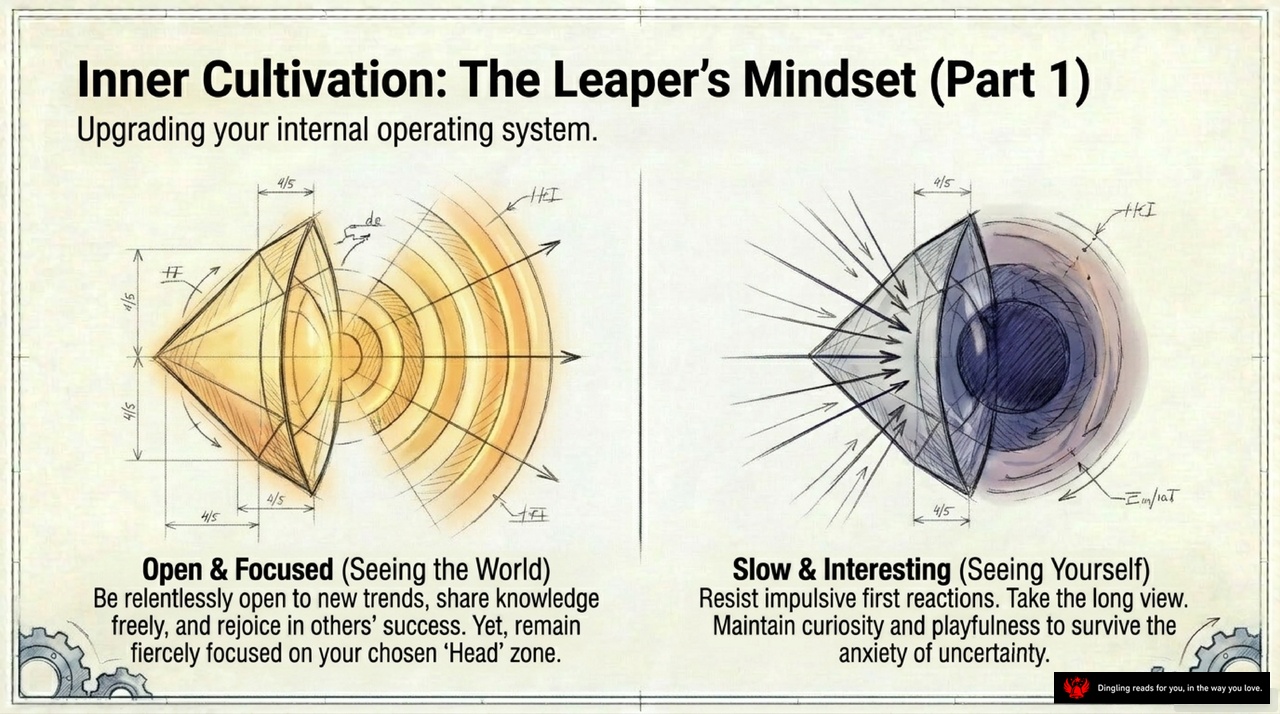
Welcome back. Today, we're diving into the second half of our "Inner Cultivation" series, specifically looking at the mindset of a true "leaper."
The slide in front of us breaks this down into two distinct but complementary dimensions: being "Open & Focused" to see the world, and being "Slow & Interesting" to see yourself.
Let's start with the left side: **Open & Focused**. Think of this as upgrading your external operating system. In a hyper-connected world, your biggest risk isn't ignorance; it's being too closed off. True leapers are relentlessly open to new trends and share knowledge freely. They genuinely rejoice when others succeed because they understand that in an open system, everyone's success amplifies the potential for your own. However, there's a crucial caveat here: while you must be open to everything, you must remain fiercely focused on your chosen "Head" zone. You can't be a jack of all trades; you need a core area of deep expertise to anchor your value.
Now, look at the right side: **Slow & Interesting**. This is about upgrading your internal operating system. In an era of instant gratification and algorithmic noise, the most powerful superpower is the ability to resist impulsive first reactions. When you feel the urge to react immediately, pause. Take the long view. Ask yourself, "What does this mean in five years?"
This "slowness" isn't about being lazy; it's about maintaining curiosity and playfulness to survive the anxiety of uncertainty. While everyone else is rushing to fill the void with noise, the leaper stays curious, asking questions rather than just seeking answers. This creates a sense of "interestingness" that attracts high-quality connections and opportunities.
So, the formula for the leaper's mindset is simple yet profound: Be open enough to absorb the best ideas from the world, but focused enough to build something unique. Be fast enough to act, but slow enough to think. By balancing these two forces, you don't just adapt to the future; you cultivate the internal stability required to shape it.

Inner Cultivation: The Leaper's Mindset (Part 2). This slide distills the ultimate strategy for navigating a society of strangers: be Simple, Kind, and Provokable. Think of it as the perfect operating system for human interaction, rooted in Game Theory's "Tit-for-Tat" strategy.
First, be Kind. This means always initiating with cooperation and goodwill. In a world full of hidden agendas, being the first to extend a hand signals safety and trust. You aren't naive; you are setting a positive tone that invites others to do the same.
Second, be Provokable. This is where most people fail. It means you must retaliate immediately against betrayal to establish clear boundaries. If someone cuts you off or breaks a promise, you respond instantly. This isn't about revenge; it's about self-respect. It teaches others that there are consequences for crossing the line, protecting you from being taken advantage of repeatedly.
Finally, be Simple. This is the art of forgiveness. If your opponent returns to cooperation after their mistake, you forgive quickly and immediately return to cooperation. Never play hidden mind games or hold grudges. Keep your logic transparent and your path straight.
By combining these three traits, you create a dynamic where trust is rewarded and betrayal is costly. You become easy to do business with, yet impossible to exploit. This simple, kind, and provokable mindset is the secret to thriving in an open, connected world.

Look at this pyramid, "The Architecture of a Leap." It visualizes exactly how we move from ordinary effort to exponential transformation.
At the very bottom is the Base, your Mindset. It needs to be open, focused, kind, and provokable. This is your foundation. Without this, everything above it crumbles.
Moving up to the Mid-Level, we have two crucial layers. First is Processing, which is about Networked Learning and Knowledge IPO—turning scattered information into structured value. Above that is Navigation, where you use System Thinking to break old loops and find new paths.
Finally, at the Apex, is Strategy. This is where you dominate the "Head Effect," making decisions that align with the highest leverage points in your system.
When all these layers align, the result at the top is what we call a "Leap." It's not just linear improvement; it's a non-linear transformation. You stop working harder and start working smarter by leveraging the right mindset, processes, and strategic vision. That is the true architecture of a leap.

Look at this slide. It poses a sharp question: "You have been running hard, but have you been running in the right system?"
This isn't about working longer hours. It's about realizing that a true leap isn't the result of blind, exhausting effort. Think about it: many of us are trapped in negative feedback loops, like the "busy-chaos" cycle where more busyness leads to less thinking, which leads to more mistakes and even more busyness. Or the diet trap where restriction lowers your metabolism, causing a rebound that forces you back to restriction. These are systems designed to keep you stuck.
The breakthrough comes when you shift from first-order change—just pedaling harder in the same gear—to second-order change: shifting the entire system. It's about upgrading your cognitive system and standing at the head of prevailing trends. Instead of fighting the current, you learn to let the world's underlying laws amplify your momentum.
This is the essence of "leaping." Just as a snake doesn't chase every small insect but waits patiently for the big prey in its high-value zone, you must identify the core 20% of your efforts that drive 80% of your results. True growth happens when you stop running in circles and start leveraging the right patterns. It's not about how hard you run, but whether you are running in the system that actually propels you forward.