
Learned Optimism: Complete Chapter-by-Chapter Summary

Welcome to a journey that will change how you see the world. Today, we're diving into Martin E.P. Seligman's groundbreaking concept of "Learned Optimism." As the title suggests, optimism isn't just a personality trait you're born with; it's a measurable, learnable cognitive skill that can transform your health, career, and resilience.
Think of it this way: your brain is like a computer running a specific program. For some of us, that program automatically interprets bad events as permanent, universal, and personal failures. But Seligman's research shows we can rewrite that code. By shifting our interpretation style, we move from a state of helplessness to one of personal control. This isn't about ignoring reality or pretending everything is perfect; it's about choosing how we respond to life's inevitable challenges. Whether you're facing a career setback, a health issue, or simply the ups and downs of daily life, adopting this mindset gives you the power to bounce back stronger. It's time to take control of your own narrative and unlock the potential for a more resilient, fulfilling life.

The slide reveals a stark contradiction: while societal wealth, freedom, and education have climbed steadily over the last 50 years, clinical depression has skyrocketed by 10 times. This is the "Epidemic of the Oversized Self." We've been taught that the cure for unhappiness is simply to feel good, but this flawed antidote has stripped us of real-world resilience, creating a generation that is both fragile and depressed.
The root cause lies in how we interpret failure. Instead of viewing setbacks as temporary or external, we've learned to blame ourselves for everything. This self-centered lens turns ordinary struggles into catastrophic personal failures. The solution isn't to manufacture a fake sense of self-worth, but to recalibrate our internal gauge. True self-esteem isn't a destination we manufacture; it's a reflection of how we interact with the world. By shifting from a permanent, personal view of failure to a temporary, situational one, we can stop the cycle of despair and build the resilience needed to thrive in a complex world.

Imagine a simple diagram showing a broken network turning into a paralyzed block, and finally, a vibrant, interconnected web of green nodes. This visual journey perfectly captures the core message of our book: apathy isn't something you're born with; it's a habit you learn, and more importantly, a habit you can unlearn.
The first panel illustrates "Uncontrollable Adversity." Think about a time when you tried your best, but nothing seemed to work. Maybe a project failed despite your efforts, or a relationship ended no matter what you did. When actions repeatedly fail to affect outcomes, your brain biologically records that effort is futile. It's like the dogs in our experiments who learned that no matter how they struggled, the electric shock would continue. They stopped trying because they learned helplessness.
This leads to the second stage: "Cognitive Paralysis." Look at that mental block forming in the middle. Even when the environment changes and success becomes possible, the subject remains entirely passive. This is the essence of depression—it's the ultimate human expression of learned helplessness. You know the feeling, right? You have the chance to succeed, but you just can't bring yourself to move. You've convinced yourself that nothing matters, so why bother?
But here is the good news, shown in the third panel: "The Cure." The image shifts from gray and broken to bright green and dynamic. Helplessness is un-learned only by forcibly demonstrating that actions do directly produce results. You have to break the cycle. You have to prove to your brain that you actually have control. By taking action and seeing results, you rebuild the neural pathways that were damaged by failure. You move from a state of despair to a state of agency.
So, remember this: if you feel stuck, it's not because you lack ability. It's because you've learned to believe you have no control. But that belief is just a story your brain told you in the past. It's not the truth. You have the power to rewrite that story and reconnect with the vibrant, active life waiting for you.

Imagine a world where your explanation of failure literally dictates your future. As this slide illustrates, your "Explanatory Style" is the automated lens through which you view bad things, governed by three critical dimensions: Permanence, Pervasiveness, and Personalization.
First, look at Permanence, or Time. Do you see adversity as forever, or just for now? A pessimist thinks, "I'm done," while an optimist sees it as temporary. Next is Pervasiveness, or Space. When one thing goes wrong, do you feel it ruins your entire life, or just that specific area? This dimension, paired with Permanence, determines your level of hope. Finally, there is Personalization, or Ego. When failure strikes, do you blame yourself entirely, or do you recognize external circumstances?
Here is the crucial takeaway: Permanence and Pervasiveness control your behavior and how long you stay stuck in hopelessness, while Personalization shapes how you feel about yourself. If you consistently view setbacks as permanent, pervasive, and personal, you train yourself for learned helplessness. But if you can reframe these events as temporary, specific, and external, you build Agency and learned optimism. This shift isn't just about feeling better; it's about unlocking the resilience needed to succeed in sports, business, and life.

Imagine you are a sales rep at a massive insurance company, like MetLife. You're on the phone, and the person on the other end just hangs up on you. What's your internal monologue? Do you think, "I'm a terrible salesperson; I'll never succeed," or do you think, "This client was busy; I'll try again with the next one"? This split-second thought determines everything. That's what we mean by decoding the internal monologue.
The chart on your screen breaks this down using what psychologists call the "3 Ps." It compares how pessimists and optimists process the same events. Look at the first row, Permanence. When a bad thing happens, a pessimist thinks, "I am stupid," treating it as a permanent, unchangeable trait. An optimist thinks, "I didn't study hard enough this time," viewing it as a temporary behavior. It's the difference between a heavy ball that never moves and a network of connections that can adapt.
Next is Pervasiveness. A pessimist takes a single failure and makes it universal. If a professor is unfair, they convince themselves, "All teachers are unfair." They let one bad event ruin their entire world. An optimist keeps it specific: "Professor Smith is unfair." They isolate the problem so it doesn't infect their whole life.
Finally, Personalization. When things go well, a pessimist externalizes the success, thinking, "I just got lucky." They dismiss their own skill. An optimist internalizes it, thinking, "I am highly skilled." They take credit for their own achievements.
Here is the golden rule at the bottom: Pessimists externalize success and internalize failure. Optimists do the exact opposite. They take credit for wins and blame external factors for losses. This isn't just about feeling good; it's about resilience. By shifting your internal monologue from permanent and universal to temporary and specific, you stop the spiral of hopelessness and start building a life where you can bounce back from any setback.

Look at this graph: "Talent plus Motivation plus Optimism equals Success." It's a powerful equation, and the data behind it is striking.
In the context of life insurance sales—a field defined by constant rejection—traditional hiring tests simply failed to predict who would actually succeed. But when we looked at the data, the results were undeniable. Applicants who failed standard industry tests but scored in the top tier for optimism outsold the pessimistic group by a massive 21% in Year 1, and by an even staggering 57% in Year 2.
Why does this happen? It all comes down to the mechanism of optimism. Optimism dictates perseverance. When a pessimist hits a wall of rejection, they stop. They see a "No" as a final verdict. But an optimist treats that same "No" as just a statistical step toward a future "Yes." They don't see the wall as a stop sign; they see it as a hurdle to jump over.
This isn't just about feeling good; it's about the difference between giving up and keeping going. While talent gets you in the door, it is this relentless optimism that allows you to close the deal. As we've seen throughout our discussion, from the resilience of elite athletes to the longevity of healthy individuals, the ability to maintain a positive explanation style in the face of failure is the ultimate competitive advantage. So, don't just rely on your skills. Cultivate your optimism, because in the end, it is the one trait that truly separates the winners from the rest.

Have you ever wondered if your mindset could literally change your biology? The image you see here isn't just a diagram; it's a map of how pessimism physically weighs down on your body. Look at the section labeled "Cellular Impact." This is where the real damage happens. When we fall into learned helplessness or pessimistic thinking, our immune system goes into overdrive and shuts down. Specifically, it suppresses T-cells and Natural Killer cells—the very soldiers our body needs to fight off tumors and infections. It's as if your own defense force is being disarmed by your thoughts.
Now, look to the right at the "Behavioral Impact." This connects directly to the cells. Pessimists often subconsciously believe that nothing will work anyway, so they stop adhering to health regimens or seeking medical help. They don't exercise, they ignore symptoms, and they delay treatment. This behavioral inaction allows the cellular suppression we just discussed to worsen, creating a vicious cycle where poor habits lead to a weaker immune system, which then reinforces the feeling of helplessness.
Finally, let's look at the "Longevity Data" at the bottom. This isn't just theory; it's backed by rigorous Harvard longitudinal studies. The data proves that the explanatory style you adopt at age 25 accurately predicts your physical health outcomes at age 60. In other words, the way you interpret your life today is building the physical reality of your future. Pessimism doesn't just make you feel bad; it biologically shortens your life. But the good news is that since this is a learned cognitive habit, it can be unlearned and reversed.

Innoculating children against depression starts long before they ever pick up a pen. Research shows that by age eight, a child's explanatory style—their internal lens for interpreting life's events—is heavily crystallized. This mindset is primarily inherited from listening to how their mother explains everyday adversity.
The image you see here perfectly illustrates the two divergent paths that emerge when failure occurs. On the left, we see the trap of "Trait Praise." When a child hears "You are so smart!" after a failure, they internalize a dangerous lesson: "I failed, therefore I am no longer smart." This leads directly to fragility and helplessness. It teaches them that their worth is tied to a fixed trait, making them believe that any setback is proof of their permanent inadequacy.
On the right, we see the path to resilience. Instead of praising the trait, parents should focus on "Behavior Criticism" regarding effort. When a child fails, the message becomes, "You didn't check your work carefully this time." This shifts the narrative entirely: "Failure is a temporary lack of effort, not a permanent lack of ability." By teaching children that setbacks are just temporary hurdles related to their actions rather than their identity, we inoculate them against the despair of depression. We don't just help them succeed; we give them the unshakeable belief that they can always try again.

Imagine your mind as a complex machine, constantly processing the bad things that happen to you. This is the "Cognitive Reframing Engine" we've been discussing. It starts with **A - Adversity**, the objective bad event, like a client hanging up on your cold call. That event triggers **B - Belief**, your automatic, subconscious interpretation. If you interpret it as "I am terrible at sales," that belief drives you straight to **C - Consequence**, where you feel defeated and stop making calls. This negative loop is the engine of depression and failure.
But here is where the real power lies. The engine has a bypass. Instead of letting the negative cycle run, you can intervene at **D - Disputation**. This is the moment you actively argue with your own automated beliefs using factual evidence. You ask yourself, "Is it true I'm terrible, or just that this one call didn't go well?" By challenging that thought, you break the chain. This leads to **E - Energization**, the resulting biological and psychological shift in your mood and action. Suddenly, instead of stopping, you feel motivated to try again.
The visual shows this shift as a lightning bolt cracking the old, rigid path, redirecting your energy from stagnation into movement. It proves that your reaction to adversity isn't fixed; it's a choice. By mastering this five-step process, you don't just survive the setbacks; you turn them into fuel for your success.

Look at this slide titled "How to Argue With Yourself (And Win)." It presents a powerful four-step method to dismantle catastrophic thinking. The core message here is that simple "positive thinking"—like telling yourself "I am great!"—often fails. Real cognitive shifts require non-negative thinking grounded in harsh reality.
Let's break down these four steps. First is **Evidence**. The slide instructs us to "Act like a detective." When a catastrophic belief strikes, ask yourself: What is the actual, factual proof that this belief is 100% true? Usually, the answer is that there is no proof.
Second is **Alternatives**. The graphic shows arrows diverging, reminding us that nothing happens for just one reason. You must force yourself to list three other temporary, specific reasons for this adversity. Don't settle for a single explanation.
Third is **Implications**. Here, we are asked to "De-catastrophize." Even if your worst thought were true, is it actually the end of the world? Just because something is bad doesn't mean it is fatal.
Finally, the fourth step is **Usefulness**. Visualized by a trash can, this step asks a critical question: Is holding onto this belief serving me right now? If it paralyzes your action, distract yourself and discard it immediately.
By moving through Evidence, Alternatives, Implications, and Usefulness, you stop fighting reality and start winning against your own mind.
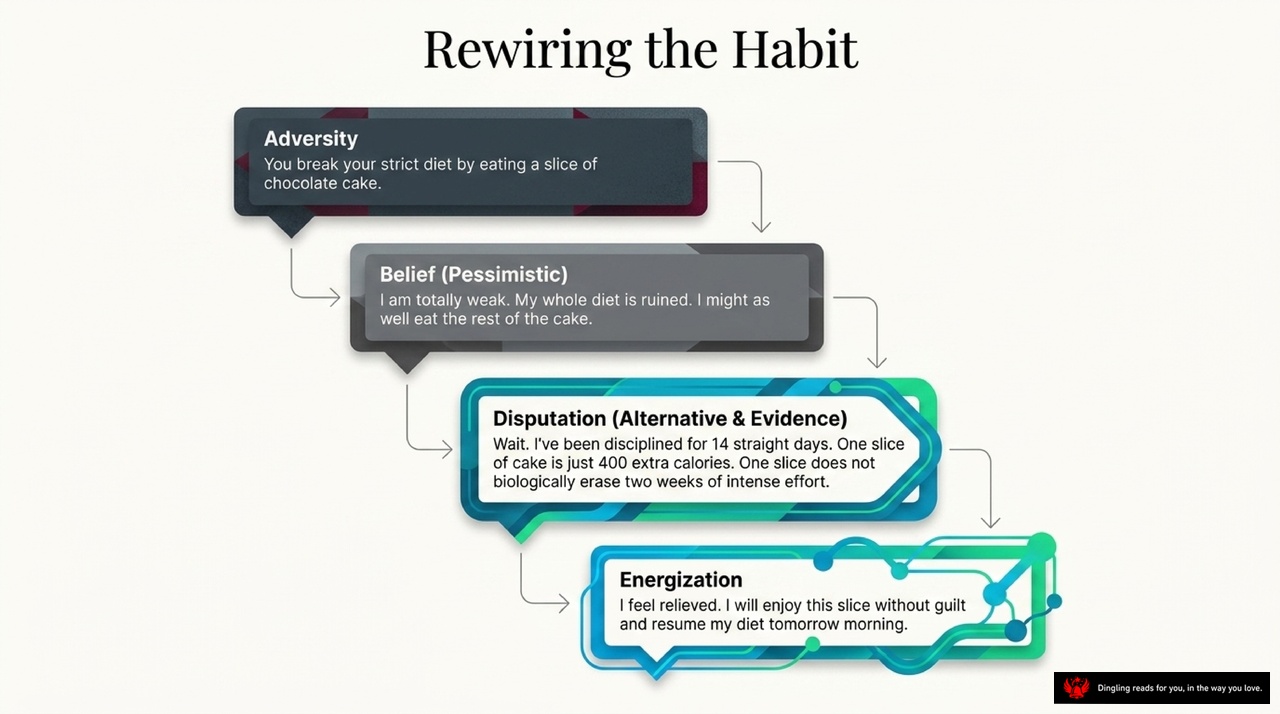
Rewiring the Habit isn't just a catchy title; it's a practical roadmap for taking back control when life throws you a curveball. Let's look at that flowchart on the screen. It starts with **Adversity**: imagine you've been on a strict diet for two weeks, and then, in a moment of weakness, you eat a slice of chocolate cake.
The trap happens next in the **Belief** stage. If your thinking is pessimistic, that one slice triggers a spiral: "I am totally weak. My whole diet is ruined. I might as well eat the rest of the cake." This is the voice of hopelessness telling you that one mistake ends everything.
But here is where you have the power to intervene. That's the **Disputation** step. You pause and look for evidence. You ask yourself, "Wait, I've been disciplined for 14 straight days. One slice is just 400 extra calories. It does not biologically erase two weeks of intense effort." You are challenging the all-or-nothing logic with reality.
Finally, you reach **Energization**. By disputing the negative belief, the guilt vanishes. You feel relieved. You decide to enjoy this slice without shame and simply resume your diet tomorrow morning. This shift from self-criticism to self-compassion is the key to building resilience. Instead of letting one bad day ruin your entire week, you learn to view setbacks as temporary bumps, not permanent roadblocks. That is how you truly rewire your habits.

Look at this matrix we call "The Matrix of Flexible Optimism." It's a simple but powerful tool for navigating life's challenges. The chart plots two axes: on the bottom, we have the "Cost of Failure," ranging from low to high. On the left, we have the "Certainty of the Environment," or how predictable things are.
In the top-left quadrant, where the cost of failure is low and the environment is uncertain, this is the zone for **Optimism**. Think about making a sales call or asking someone on a date. If you get rejected, the cost isn't catastrophic. As the slide notes, optimism fuels the necessary persistence to endure rejection. It gives you the courage to keep trying when the outcome is unknown.
However, move to the bottom-right quadrant. Here, the cost of failure is unacceptably high, and the environment is certain. This is where we need **Mild Pessimism**. Consider a pilot assessing ice on a runway or an engineer checking a bridge's load. If you are overly optimistic here, the consequences could be fatal. Pessimism forces a hyper-accurate, cautious assessment of reality. It acts as a safety brake.
The core insight at the bottom ties it all together: successful lives and organizations require a balance. We need visionary optimists to push boundaries and explore new opportunities, but we also need grounded pessimists to manage existential risk. It's not about choosing one side; it's about knowing exactly when to use optimism to drive forward and when to use pessimism to stay safe.

Optimism isn't something you're born with; it's a cognitive choice you make every single day. As this slide highlights, mastering the ABCDE technique allows you to actively dispute those automatic negative beliefs that hold you back. By doing so, you can rewire your explanatory style, unlocking higher levels of professional success, physical health, and psychological resilience.
Think about it this way: the lens through which you explain today's failure directly determines tomorrow's success. If you view setbacks as permanent, universal, and your personal fault, you're training yourself for despair. But if you learn to challenge the stories you tell yourself—asking, "Is this really true, or just a negative thought?"—you take control.
So, are you willing to actively dispute the stories you tell yourself? The choice is yours to make, and it's the difference between giving up and growing stronger.