
Liar's Poker: Complete Chapter-by-Chapter Summary

Welcome to "Liar's Poker," the definitive insider's account of the greed, bluffs, and financial alchemy that defined Wall Street in the 1980s. Written by Michael Lewis, this book takes you behind the curtain of one of the most notorious investment banks in history.
Imagine a world where a single game of poker could involve millions of dollars, not hundreds. This wasn't just a game; it was a reflection of the entire company's culture. The title itself, "Liar's Poker," perfectly captures the essence of that era—a place where everyone was bluffing, and the only way to win was to out-pretend everyone else.
As we dive into this story, we're about to explore how a young man with an art history degree stumbled into the heart of financial chaos, only to find himself in a jungle where the rules were made up on the fly, and survival depended on who could lie the best. Get ready for a journey into the wild, unregulated world of 1980s Wall Street.

Look at this dollar bill. That serial number right there? It's not just random ink. It's the playing field for a high-stakes game called "Liar's Poker." Imagine players forming a circle, each holding a bill, betting on the frequency of specific digits in those serial numbers. It sounds simple, but the math is brutal. The probability of hitting a specific four-digit sequence is 0.003%, and finding four sixes in forty random digits is a statistical ghost story.
But this isn't just about the math. It's about the psychology. It's a daily test of character, intuition, and ruthlessness. You have to read your opponents, execute the perfect bluff, and know exactly when to call a challenge. That's the blueprint of a bond trader. In the real world, this isn't a game of chance; it's a test of who can survive the jungle. Whether you're trading millions in the bond market or just holding a dollar, the same skills apply: knowing when to bluff, when to fold, and how to outsmart the market before it outsmarts you.

Imagine the ultimate showdown on the trading floor: it's not just about who has the most money, but who has the nerve to double it first. On one side, you have John Gutfreund, the self-proclaimed "King of Wall Street" and CEO, stepping onto the floor with a cigar in hand, ready to assert absolute dominance. He makes his opening bid with a chilling confidence: "One hand, one million dollars, no tears."
But on the other side stands John Meriwether, the "King of the Game," a top trader with an uncanny ability to suppress fear and greed. He doesn't back down. Instead, he delivers a counter-bluff that flips the script entirely: "No, John. If we're going to play for those kind of numbers, I'd rather play for real money. Ten million dollars. No tears."
The result? Gutfreund immediately backs down. This legendary moment teaches us a brutal but essential lesson: on the trading floor, the man who controls the risk controls the power—even over the CEO.

Look at this pyramid. It perfectly captures the brutal caste system that defined Salomon Brothers. At the very top, glowing in green, sits Tier 1: the Bond Traders. These were the absolute apex predators, the "Big Swinging Dicks" who bet the firm's capital and held all the cultural power. They weren't just employees; they were the gods of the 41st floor, generating the massive profits that kept the whole machine running.
Just below them in the middle, highlighted in yellow, are the Salesmen. They were the essential conduits, constantly walking a tightrope between serving the firm's interests and actually serving the customer. They took no personal market risk, but without them moving the traders' inventory to clients, the whole operation would have ground to a halt.
And at the bottom, in the gray section, sits Tier 3: Corporate Finance and Equities. To the elite traders on the 41st floor, these departments were viewed as weak, non-risk-taking "wimps." Being reassigned to Equities was essentially a corporate death sentence, a demotion to the backwater. This rigid hierarchy wasn't just about job titles; it was a culture of survival where only the risk-takers at the top truly mattered, while everyone else was just there to serve them.

Welcome back. Today, we're diving into the dark side of the "training ground" at Salomon Brothers. The slide you see here perfectly captures the brutal transformation of brilliant Ivy League geeks into ruthless market predators.
On the left, we have the **Input**: top-tier graduates with PhDs in math, economics, and physics. These are the smartest people in the room, fresh out of prestigious universities. But look at what happens when they enter **The Crucible**. This isn't a classroom; it's a psychological war zone. The text describes how these intellectuals are stripped of their arrogance and subjected to pranks, screams, and insults. They are taught one harsh lesson: academic theory is worthless compared to raw market instinct.
This pressure cooker creates two distinct **Output Paths**.
First, we have **Output Path A: The Front Row**. These are the "Sycophants." They learn to please, laugh at the bosses' jokes, and desperately try to be accepted into the hierarchy. They trade their integrity for safety.
Second, we have **Output Path B: The Back Row**. These are the "Rebels." They refuse to play the game. They throw spitballs, project apathy, and rely on raw talent and defiance to earn respect from the apex predators.
The story of Salomon Brothers proves that the company didn't just hire talent; it manufactured a specific type of human being. It took people who valued truth and logic and forged them into wolves who believe the only rule is: eat or be eaten. That is the true legacy of the training ground.

Imagine a scale tipping dangerously to one side. On the left sits a briefcase labeled "Hermann the German," representing our innocent client. On the right, a glowing green block with an "S" for Salomon. This visual perfectly captures the core tragedy of "The Salesman's Dilemma."
Here is the story behind this imbalance. A desperate Salomon trader, needing to offload plunging AT&T bonds, convinces Lewis, a rookie salesman, to pitch these toxic assets as a lucrative opportunity to Hermann. Lewis sells $3 million of these bonds to a naive European client. But the market crashes immediately upon sale. Hermann loses his job, while the firm profits.
This brings us to the brutal lesson written in red: "Who do you work for?" In the golden rule of the trading floor, if the firm wins, the client loses. The client's memory is short, but the trader's year-end bonus depends entirely on the firm's success. This slide illustrates a system where survival and wealth are built on transferring risk to the very people who trust you. It forces us to ask the uncomfortable question: when the scales tip, whose side are you really on?

Look at this slide. It lays out the brutal, unspoken rules of the high-stakes game played on Wall Street in the 1980s. The core principle, as Warren Buffett famously warned, is simple: "If you've been in the game 30 minutes and you don't know who the fool is, you're the fool." It's a survival guide written in blood and commission checks.
The slide breaks this down into two distinct camps: The Predator and The Prey. On the left, we have the Predator, represented by the Salomon Traders. Their motivation was purely extraction—maximizing wealth through commissions and spreads. They held an absolute advantage: mastery of complex market data, advanced math, and, most dangerously, psychological manipulation. To them, the game was a zero-sum war where exploiting weakness wasn't just a strategy; it was a moral imperative.
On the right, we have the Prey: the Savings & Loan executives. Their motivation was desperation; they were trying to offload "underwater loans" to save their failing regional banks. Their fatal disadvantage was naivety. They treated high-finance sharks like local golf buddies, lacking any understanding of the bond math. Their view of the game was built on blind trust in Wall Street's perceived expertise, a fatal flaw that would lead to their downfall.
This dynamic perfectly illustrates the tragedy of that era. The predators saw the prey not as partners, but as opportunities to be exploited. They knew exactly how the game was rigged, while the victims were still playing by the rules of a game that no longer existed.

Financial Alchemy: The Birth of the Mortgage Bond. Imagine taking millions of boring, static 30-year home loans—money that was essentially stuck in local Savings & Loans institutions—and turning them into the most liquid, high-octane asset class on Wall Street. This is the four-step transformation that created the mortgage bond.
First, you have the raw material: those illiquid mortgages sitting quietly in banks. Then comes the catalyst, Lewie Ranieri. He realized these stagnant loans could be grouped into massive pools, unlocking value that was previously invisible. Next is the transformation, where Ranieri and Salomon Bros. secured government backing and chopped these pools into tradable slices, creating a highly liquid market. Finally, the result: homeowner debt is successfully commodified into Wall Street's most profitable, multi-billion dollar casino chip. It's a perfect example of financial alchemy—turning something static into something explosive.

The Illusion of Arbitrage isn't just a fancy financial term; it's the very engine that powered the 1980s Wall Street boom, and the diagram on this slide perfectly illustrates how it worked. True arbitrage should be risk-free profit from price differences, but the Salomon Brothers didn't just find those differences—they manufactured them. As the slide shows, they acted as a middleman, taking money from a "Cautious Investor" who only wanted a small, safe premium and passing it on to a "Speculative Gambler" who craved massive risk.
In the middle sat the Salomon Brothers, executing a three-step play on German Warrants. First, they identified a gambler with an unfulfilled urge to bet on German interest rates. Second, they invented a custom derivative, a warrant, that perfectly matched that specific risk appetite. And third, they sold the exact opposite side of that risk to a conservative investor looking for a mild return. The result? "The Cut." The firm created no actual value. They simply packaged risk, matching the fearful with the greedy, and extracted a massive, risk-free fee from the middle. This wasn't just trading; it was the mass manufacturing of risk transfer, redefining what it meant to make money on Wall Street.

Standard mortgage bonds used to be boringly predictable, but Wall Street needed more volatility to engineer massive fees. So, the "rocket scientists" stepped in. They took a homeowner's standard monthly payment and sliced it into two distinct, highly volatile financial derivatives: IO and PO.
The IO, or Interest-Only, lets you receive only the interest payments. It's highly sensitive to rising interest rates. Then you have the PO, or Principal-Only, where you receive only the principal repayment. This is exponentially sensitive to falling rates and refinancing waves.
By isolating these variables, traders like Howie Rubin created instruments so mathematically complex that clients couldn't properly price the catastrophic risk they were actually purchasing. This was the weaponization of risk.

Look at this slide titled "A Culture of Plagiarism & Paranoia." It paints a terrifying picture of the inside world at Salomon Brothers, marked by big red stamps screaming "STOLEN" and "CONFIDENTIAL." The core message here is brutal: in this high-stakes environment, trust didn't exist.
The slide outlines three harsh realities. First, "The Maxim": "Eyes are God's gift, plagiarism is your right." This wasn't just a saying; it was the survival code. In a world where a brilliant, market-making idea—like the German warrant—could be reverse-engineered and stolen by direct competitors within 24 hours, stealing wasn't a crime; it was a necessity.
Second, "The Reality": In the world of high finance, there are no patents. If you weren't faster than everyone else at copying their secrets, you went broke. But the slide reveals something even darker in "The Internal War." The threat wasn't just external competitors; it was the people right next to you. The culture dictated that Salomon vice presidents routinely stole credit from their own junior employees just to secure massive year-end bonuses.
This created a severe corporate liability where trust was impossible. Everyone was an enemy, waiting to snatch your idea or your glory. It was a system designed to breed paranoia, where the only way to survive was to assume everyone was trying to steal from you.

Look at this graph titled "Hubris and the Fall." It perfectly captures the tragic arc of a company that thought it could control the market, only to be crushed by its own arrogance.
The story begins with "The Trigger." As the chart shows, Howie Rubin loses hundreds of millions on unhedged Principal-Only bonds and, in a panic, hides the trade tickets in his desk drawer. This wasn't just a bad trade; it was a desperate cover-up that signaled the beginning of the end.
But the real disaster wasn't the trading error itself; it was "The Paralysis." The slide highlights that management had promoted apex traders who lacked fundamental managerial skills. When the crisis escalated, the leadership was entirely unequipped to handle it. They had built a machine for making money, not for managing risk, and when the machine broke, they froze.
Finally, we see "The Civil War." The Office of the Chairman fractures. Cult-like figures like Lewie Ranieri are abruptly fired. The firm that had commodified risk had fatally lost track of its own identity. The green line of growth turns sharply red, illustrating how quickly a culture of unchecked ambition can lead to a catastrophic collapse.
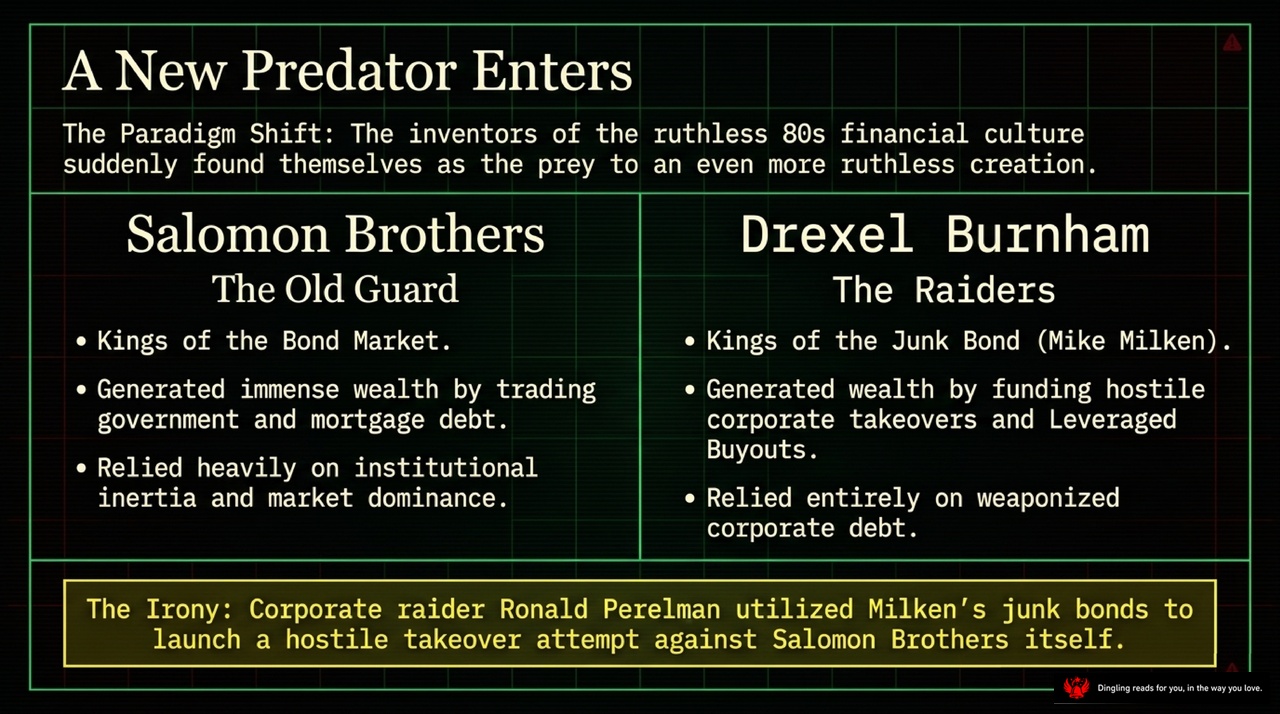
A New Predator Enters. Look at this slide. It captures a brutal irony that defined the late 80s: the architects of Wall Street's ruthless culture suddenly became the prey of an even more ruthless creation.
On the left, you see Salomon Brothers, the Old Guard. They were the kings of the bond market, generating massive wealth by trading government and mortgage debt. Their strategy relied on institutional inertia and market dominance—they were the established power, comfortable in their own skin.
On the right stands Drexel Burnham, the Raiders. Led by Mike Milken, they were the kings of junk bonds. While Salomon relied on the status quo, Drexel weaponized corporate debt to fund hostile takeovers and leveraged buyouts. They didn't just trade; they hunted.
Here is the twist at the bottom. Corporate raider Ronald Perelman used Milken's very junk bonds to launch a hostile takeover attempt against Salomon Brothers itself. It was a perfect circle of destruction: the old guard built the weapons that ultimately destroyed them. The inventors of the 80s financial culture found themselves as the prey to their own creation.

Look at this screen. It captures the exact moment Lewis Lewis, the protagonist of *Liar's Poker*, finally wakes up from the Wall Street dream. The slide is titled "The Epiphany," and it breaks down his realization into three distinct parts: The Realization, The Disillusionment, and The Exit.
On the left, under "The Realization," it highlights a massive $225,000 bonus Lewis received at just 27 years old. But here's the kicker: the text clarifies that this fortune wasn't a reflection of his intrinsic value to society. Instead, it was merely the byproduct of a hollow, zero-sum game. He wasn't creating wealth; he was just redistributing it.
Moving to the right, we see "The Disillusionment." This is where the reality check hits hard. The slide states that this wealth was entirely extracted, not created. The game Lewis played richly rewarded the short-term commodification of ignorance over long-term enterprise. It was a system that paid you to pretend you knew what you didn't, rather than actually building something sustainable.
Finally, at the bottom, is "The Exit." This is the most powerful part of the image. Lewis walks away from the money. Instead of staying trapped as a character within this wreckage, he chooses to be the storyteller of the era. He realizes that being an observer and documenting the truth is infinitely more valuable than being a cog in a machine that burns itself out.
This slide perfectly encapsulates the transition from the wild, reckless greed of the 80s to a moment of profound clarity. Lewis realizes that the casino has no ceiling, but it also has no soul. And so, he leaves the table, taking his story with him, rather than letting the market take his life.

Salomon Brothers didn't just trade bonds; they commodified risk, engineered complexity to exploit ignorance, and forged a ruthless culture that laid the groundwork for modern financial crises. The era of Liar's Poker proved that in unregulated markets, immense wealth is often extracted rather than created.
Look at the ledger in front of us. It represents a system where the brightest minds of a generation were incentivized to build casinos rather than enterprises. When you strip away the moral pretense, the math becomes terrifyingly simple: if you reward people for taking other people's money and gambling it away, who is ultimately left holding the losing hand? It wasn't just about the trades; it was about a culture that celebrated the extraction of wealth at the expense of stability, leaving the market—and eventually the entire system—vulnerable to the very chaos it tried to engineer.