
Life and Death Are Wearing Me Out: Complete Chapter-by-Chapter Summary
LIFE AND DEATH ARE WEARING ME OUT.
Welcome to a journey that begins not with a breath, but with a scream.
In this haunting new novel by Nobel laureate Mo Yan, we follow the soul of Ximen Nao, a man who refuses to forget his pain even as the universe tries to erase it.
The story kicks off in the underworld. After being brutally tortured and executed for a crime he didn't commit, Ximen Nao is given a second chance. But here is the twist: the gods try to wipe his memory with a bowl of forgetfulness soup. He spits it out. He demands to remember the injustice, the agony, and the truth.
He returns to his home in Gaomi, only to find the world has changed. The land reform has taken everything from his family. In a shocking twist of reincarnation, his body transforms into that of a white-footed donkey.
Now, trapped in an animal's form but carrying a human's burning conscience, he must navigate a world he barely understands. He watches his former master, Lan Lian, grow from a child into a strong man. He witnesses Lan Lian's forbidden love with his aunt. He feels the humiliation of being beaten by a village official while unable to speak.
He is a witness to history, a silent observer of the Great Leap Forward and the Cultural Revolution. He lives through the madness of the era, watching as his human memories clash with his animal instincts. He fights for his master's dignity, even when he can't speak, and he survives the brutal hunger that would have destroyed anyone else.
This is a hallucinatory epic about historical trauma, the enduring bond to the land, and the unyielding power of memory. It asks us a difficult question: when life and death wear you out, what is the one thing you refuse to let go of?
Get ready to experience a story that will stay with you long after the last page.

Look at this ancient scroll, titled "The Philosophical Anchor." It captures a profound truth about the human condition, using the story of Ximen Nao to illustrate the weight of memory and the cycle of suffering.
On the left, we see "The Burden of Memory." In the story, Ximen Nao is given a choice at Yama's court: drink the broth of forgetfulness to escape his past pain, or keep his memories forever. He refuses the drink, choosing to carry the scars of his life across his reincarnations as a donkey, a cow, a pig, and a dog. This isn't just about remembering; it's about the refusal to let go, the stubborn grip on identity that defines us, even when our bodies change completely.
On the right, the slide describes "The Cycle of Suffering." Each of his past lives acts like a spiritual grinding stone. Over fifty years, these repeated rebirths slowly wear down his human hatred, greed, and ego. It's a slow, painful process of stripping away the self until nothing is left but the raw truth of existence.
And right in the center, we have the Buddha's wisdom: "Life and death are wearing me out, and all from greedy desire. Lessen your desires, do nothing, and and you shall be at ease." This is the core message. The chaos in the image—the swirling mud and the lotus blooming from it—represents this struggle. We are constantly pulled by desire, trying to hold onto things, people, and memories, which only exhausts us. True peace, the Buddha suggests, comes not from fighting the cycle, but from letting go of the things that bind us. By reducing our desires and accepting the flow of life, we can finally find that ease.
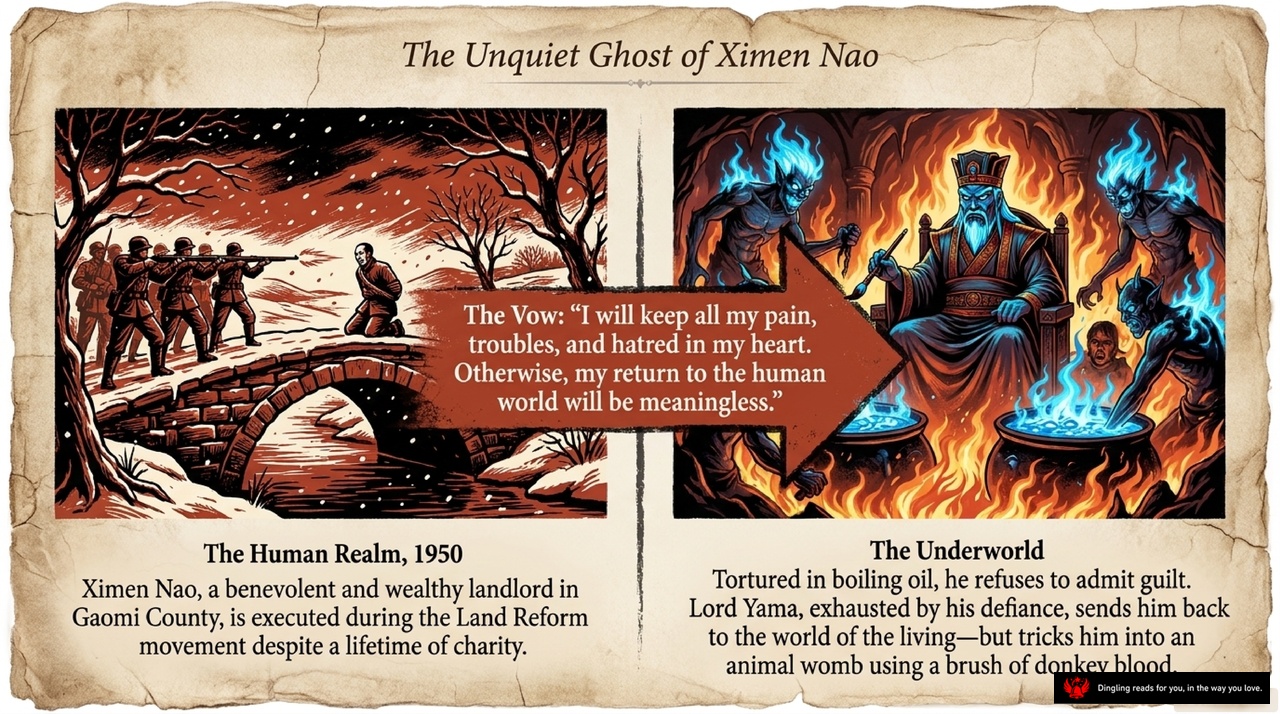
Picture this: It's 1950. In the snow-covered fields of Gaomi, a man named Ximen Nao kneels on a frozen bridge, facing execution. Despite his lifetime of charity, he's been labeled a criminal. As bullets fly, he makes a desperate vow: "I will keep all my pain, troubles, and hatred in my heart. Otherwise, my return to the human world will be meaningless."
But the human realm is cruel. In the underworld, Ximen Nao is tortured in boiling oil, refusing to admit guilt even when Lord Yama offers him a chance to live. Exhausted by his defiance, the Lord of Death tricks him, sending him back to the living—but not as a human. Instead, he is reborn into an animal womb, coated in donkey blood.
So, the benevolent landlord wakes up as a white-footed donkey. He remembers everything—the injustice, the pain, and the burning desire for revenge. Yet, trapped in a donkey's body, he can only express his fury through hooves and snorts. He watches his old friends turn against him, sees the land he loved seized by others, and realizes that in this new form, his fight for justice has changed forever. It's a haunting reminder that sometimes, the greatest act of rebellion is simply to endure.
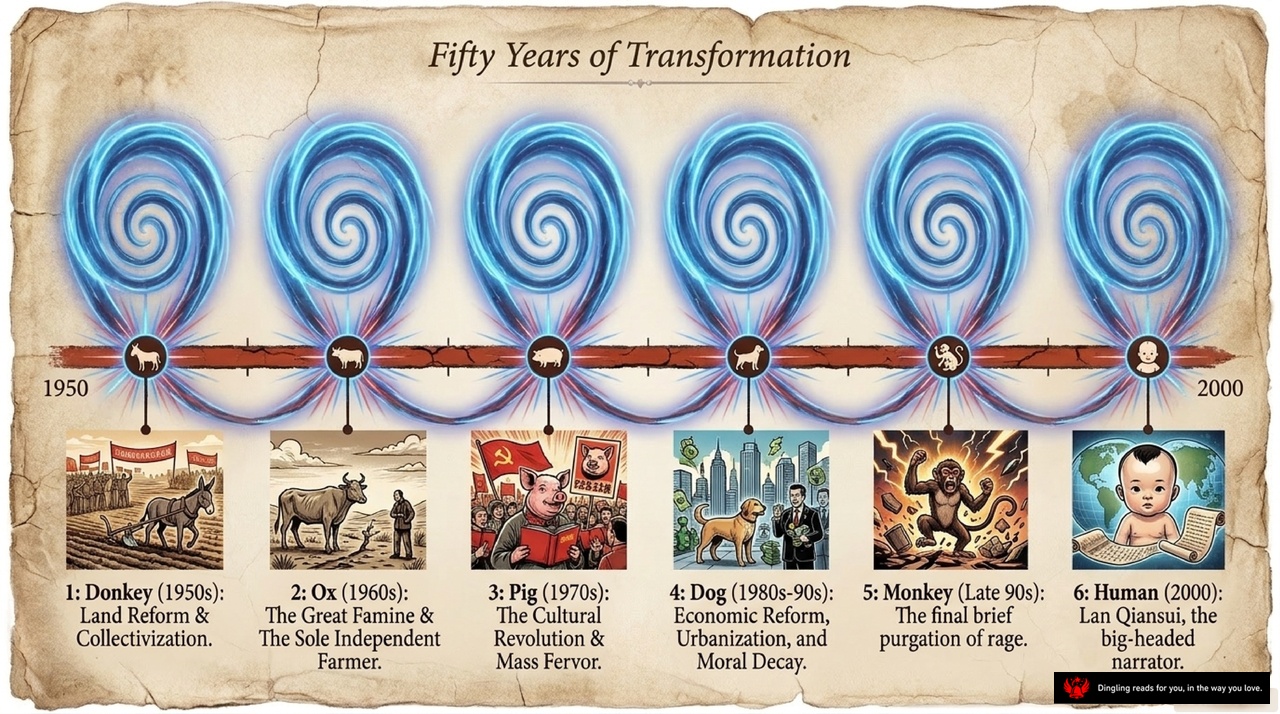
This slide maps the first fifty years of transformation, visualizing a chaotic timeline where identity itself becomes a casualty of history. We see six distinct stages, each marked by a swirling vortex of blue energy, symbolizing the relentless forces that reshape the human experience.
It begins in the 1950s with the Donkey, representing Land Reform and Collectivization—a time of forced change where individual agency is swallowed by the collective. The narrative then shifts to the 1960s, the era of the Ox, symbolizing the Great Famine and the Sole Independent Farmer, a period of brutal isolation and survival against impossible odds.
By the 1970s, the image transforms into the Pig, capturing the Cultural Revolution and Mass Fervor, where ideological zeal consumes reason. The timeline moves into the 1980s and 90s with the Dog, representing Economic Reform, Urbanization, and Moral Decay—a complex era of rapid growth accompanied by a loss of traditional values.
The late 1990s bring the Monkey, described as the final brief purgation of rage, a chaotic release of pent-up societal tensions before the storm. Finally, we arrive in the year 2000 with the Human, depicted as Lan Qiansui, the big-headed narrator. This final stage signifies the return of the human voice, carrying the weight of all previous incarnations, ready to tell the story of these fifty years of relentless transformation.
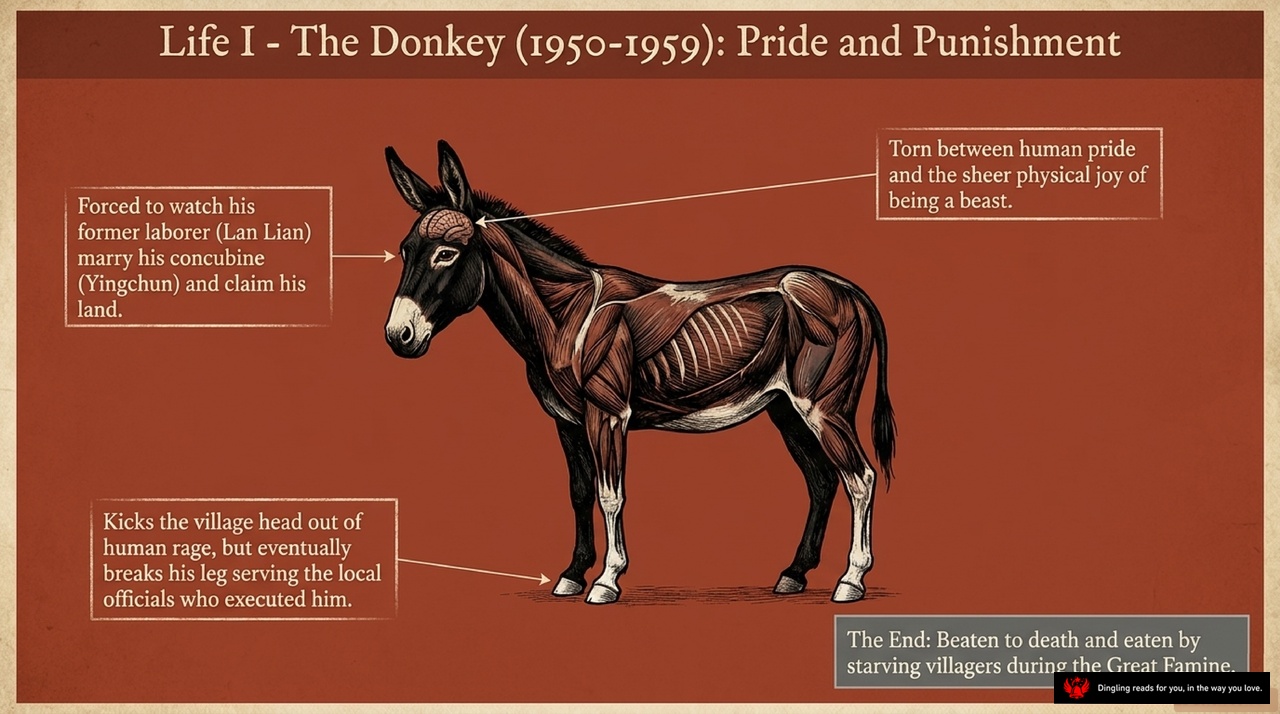
This is the tragic finale of the first life, where the donkey's journey ends in absolute horror. As the slide illustrates, the donkey is torn between the lingering human pride of its former owner and the raw, physical joy of simply being a beast. Yet, this internal conflict does not save him. Forced to watch his former laborer, Lan Lian, marry his concubine and claim his land, the donkey is consumed by a rage that transforms into animalistic violence. It kicks the village head, breaking his leg, only to be eventually executed by the very officials it once defied. The slide captures this brutal arc: from a man who refused to yield in the underworld, to a donkey beaten to death and eaten by starving villagers during the Great Famine. It is a story of pride and punishment, where the memory of being human becomes a curse rather than a blessing, leading to a tragic end in the mud and blood of history.

Welcome back to our deep dive into Mo Yan's *Life and Death Are Wearing Me Out*. Today, we turn our gaze to the final, most heartbreaking chapter of the story: the sixth and final reincarnation.
On your screen, we see the title "Life VI - The Monkey (2000): The Ultimate Holdout." This image captures the tragic culmination of a life that has spanned nearly a century. Look closely at the central figure: a man in a police uniform, representing Lan Kai fang, the son of Lan Lian. Beside him stands a monkey, symbolizing the chaotic, performative nature of the world his generation inherited. They are surrounded by the ghosts of the past—the red flags, the scarred land, and the enduring spirit of their father, who refused to compromise.
Let's look at the first section, "The Partnership." This refers to the bond between Lan Kai fang and the monkey. In the text, we learn that Lan Kai fang, after a life of tragedy, becomes a police officer. He tries to find order in a chaotic world, much like the monkey tries to find its place in the circus. Yet, there is a profound tragedy here. The monkey isn't just an animal; it's a symbol of the wild, untamed forces that keep pulling at them. The text describes how Lan Kai fang, despite his uniform and authority, is ultimately powerless against the legacy of his family's struggle. He is trapped between the expectations of society and the raw truth of his heritage.
Now, let's move to "The Defiance." This section highlights the ultimate rebellion of the final generation. The text reveals a devastating twist: Lan Kai fang discovers that his beloved girlfriend, Pang Feng huang, is actually his cousin. This revelation shatters his world. The text describes his descent into madness. He tries to escape his reality through a skin graft surgery to remove a birthmark, hoping to become "normal," but the surgery fails, leaving him with a grotesque scar. His defiance turns inward. Instead of fighting the system or the people, he turns his gun on himself and on the monkeys, ending the cycle of violence in the most tragic way possible. The text poignantly notes that this was the end of the line for the Ximen family's saga of resistance.
Finally, we have "The Martyrdom." This isn't a martyrdom in the traditional sense of dying for a cause, but rather a death by exhaustion and despair. The text describes the final moments of Lan Kai fang. He realizes that no matter how far he runs, how many lives he changes, or how hard he tries to fit into the new world, he is forever tied to the land and the memory of his father, Lan Lian. The story ends with the birth of Lan Qian sui, the great-grandson, who claims to remember the past lives of the ox, the pig, and the dog. This child becomes the living testament to the unyielding spirit of his ancestors. The text suggests that while the physical struggle has ended, the memory remains, carried forward by the next generation.
In this final image, we see the circle closing. The red flags that once symbolized revolution now stand as monuments to a lost cause. The ox, the pig, the dog, and now the monkey—all have played their part in holding out against the tides of history. But ultimately, the holdout ends. The land remains, the memories remain, but the people who fought to keep it have faded into history. This is the ultimate sacrifice: not dying with a gun in hand, but living long enough to see the world change so completely that your very identity becomes a ghost story. Thank you for joining us on this journey through the six lives of the Ximen family.
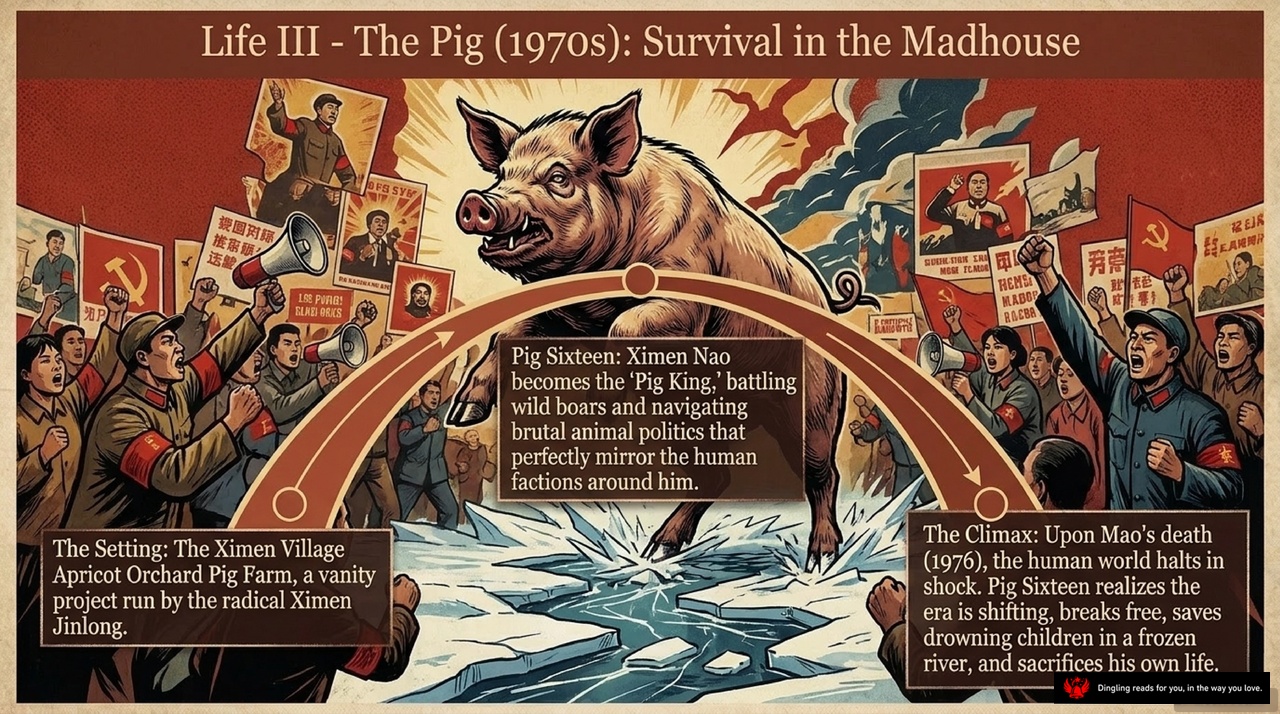
Welcome to the final chapter of our journey into *Life*, the hauntingly beautiful novel by Mo Yan. We are now on slide six, titled "Life III - The Pig: Survival in the Madhouse."
The image before us captures a surreal and brutal era: the 1970s, set in the Ximen Village Apricot Orchard Pig Farm. This wasn't just a farm; it was a vanity project run by the radical Ximen Jinlong, a place where human ambition collided violently with animal instincts. At the center of this chaos stands Pig Sixteen, who evolves into the "Pig King." He doesn't just survive; he battles wild boars and navigates a brutal animal politics that perfectly mirrors the ruthless human factions swirling around him.
As the slide illustrates, the climax arrives upon Mao's death in 1976. The human world halts in shock, but for Pig Sixteen, the era shifts and breaks free. In a moment of pure, transcendent survival, he saves children drowning in a frozen river, sacrificing his own life to ensure their future. This act transforms him from a victim of circumstance into a legendary hero, a true king of the swine.
This story reminds us that even in the most absurd and cruel "madhouses," there is always a capacity for profound heroism. Thank you for joining us on this unforgettable ride through the reincarnations of Ximen Nao.
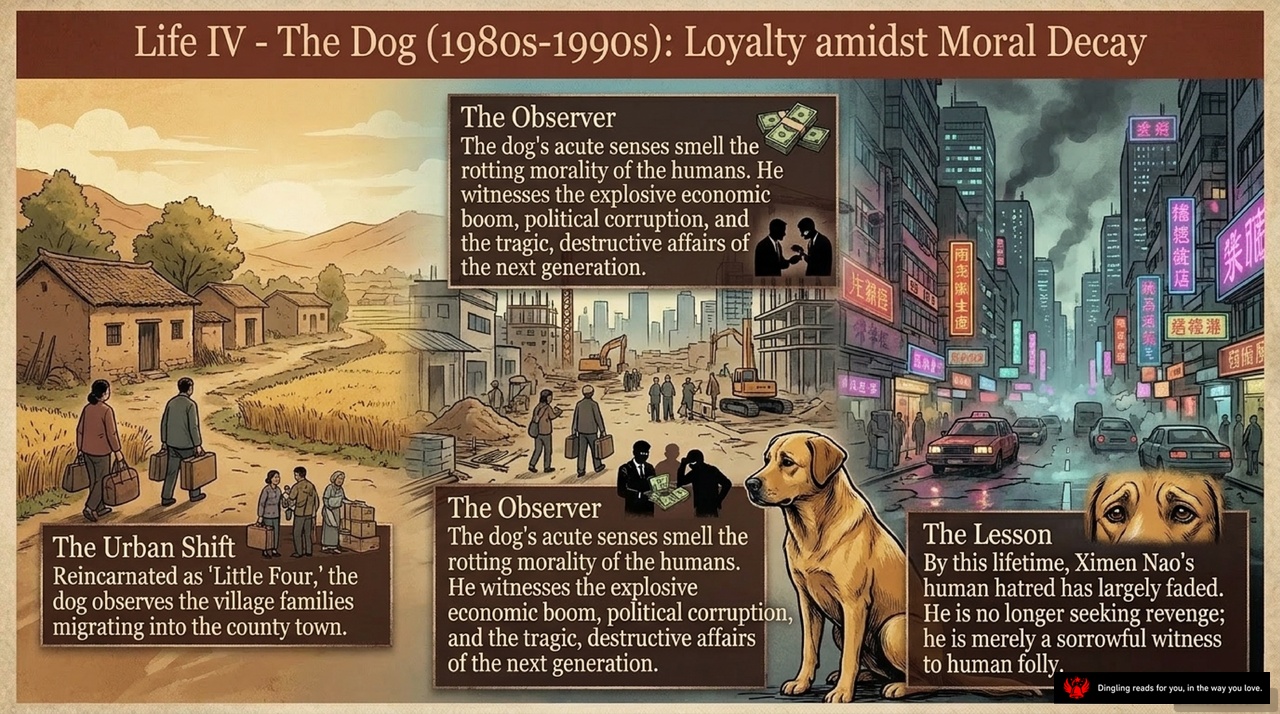
Life IV - The Dog (1980s-1990s): Loyalty amidst Moral Decay.
This slide captures a pivotal era where the line between right and wrong blurs into nothingness. As we see in the image, the narrative splits into two contrasting worlds: the quiet, rural path where families migrate to the county town, and the chaotic, neon-lit cityscape choking on pollution and greed. This is the world the dog, Little Four, now inhabits.
Reincarnated as 'Little Four,' the dog observes this dramatic urban shift with a sense of profound detachment. He smells the rotting morality of the humans around him. He witnesses an explosive economic boom, but it's not a story of prosperity; it's a tale of political corruption and the tragic, destructive affairs of the next generation. While the city rushes forward, fueled by money and ambition, the dog remains an outsider, a silent witness to the decay.
The core lesson here is about the fading of human hatred. By this lifetime, Ximen Nao's burning desire for revenge has largely faded. He is no longer seeking retribution for the injustices of his past lives. Instead, he is merely a sorrowful witness to human folly, watching the cycle of corruption and moral decay play out before him, unable to intervene, only able to observe the tragedy unfolding in the shadows of progress.

Picture: The Chameleons and The Rock
Lan Lian - The Rock: Driven by absolute loyalty to the land. Refuses collectivization. Dies peacefully in his private field. Represents the enduring, unchanging soul of the earth.
Hong Taiyue - The Radical: Driven by communist fanaticism. Thrives in the 50s-70s. Cannot adapt to the 1980s capitalist reforms. Becomes a destructive relic.
Ximen Jinlong - The Opportunist: Driven by power. Thrives as a radical Red Guard, then seamlessly pivots to become a corrupt, capitalist tycoon in the 90s.

The tangled web of the Ximen, Lan, and Huang families has reached its breaking point. What began as a simple story of love and inheritance has spiraled into a tragic climax that no one could have predicted. At the center of this chaos stands Lan Kaifang, whose hopelessly romantic love for Pang Fenghuang turns into a nightmare when he discovers a devastating truth: she is his half-sister, sharing a bloodline that traces all the way back to their father, Ximen Jinlong.
This revelation shatters everything. The shared bloodlines, once a hidden secret, now become the weapon that destroys them. The legacy of Ximen Jinlong, passed down through generations, culminates in a final collapse that leaves nothing but ruin. The emotional fallout is immediate and catastrophic: Lan Kaifang is driven to madness and suicide, while Pang Fenghuang suffers a tragic death in childbirth. The scene shifts to the grim basement of a train station hotel at the turn of the millennium, where the sins of the fathers finally claim their ultimate victims, leaving behind a legacy of sorrow that echoes through time.
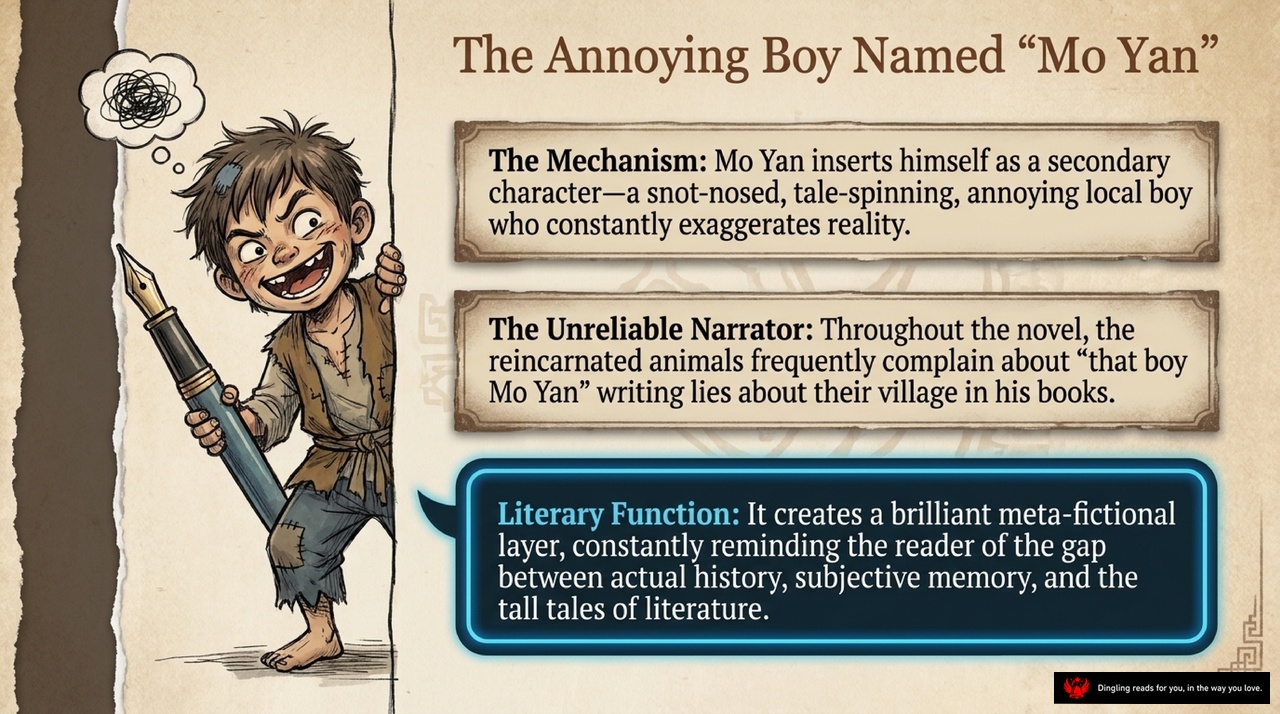
Picture shows a cartoon of a mischievous boy named "Mo Yan," holding a large fountain pen with a scribbled thought bubble above his head. The slide breaks down his literary role into three key points: he acts as an annoying, exaggerating secondary character; he functions as an unreliable narrator through the complaints of reincarnated animals; and this creates a meta-fictional layer that highlights the gap between history, memory, and literature.
So, let's talk about the most disruptive force in *Life and Death Are Wearing Me Out*: the boy named Mo Yan. In the novel, Mo Yan isn't just a character; he's a literary virus injected directly into the story. He inserts himself as a snot-nosed, tale-spinning local boy who constantly exaggerates reality, turning serious historical events into a chaotic comedy. Throughout the novel, the reincarnated animals—whether they are a donkey, a cow, a pig, or a dog—frequently complain about "that boy Mo Yan" writing lies about their village in his books. They see through his fabrications, creating a brilliant meta-fictional layer.
This device does more than just add humor; it constantly reminds the reader of the gap between actual history, subjective memory, and the tall tales of literature. Mo Yan becomes a symbol of the power of storytelling itself, showing how fiction can distort, rewrite, and ultimately overwrite the harsh truths of reality. It's a self-aware commentary on the very act of writing, making the novel not just a story about life, but a story about how we tell stories about life.
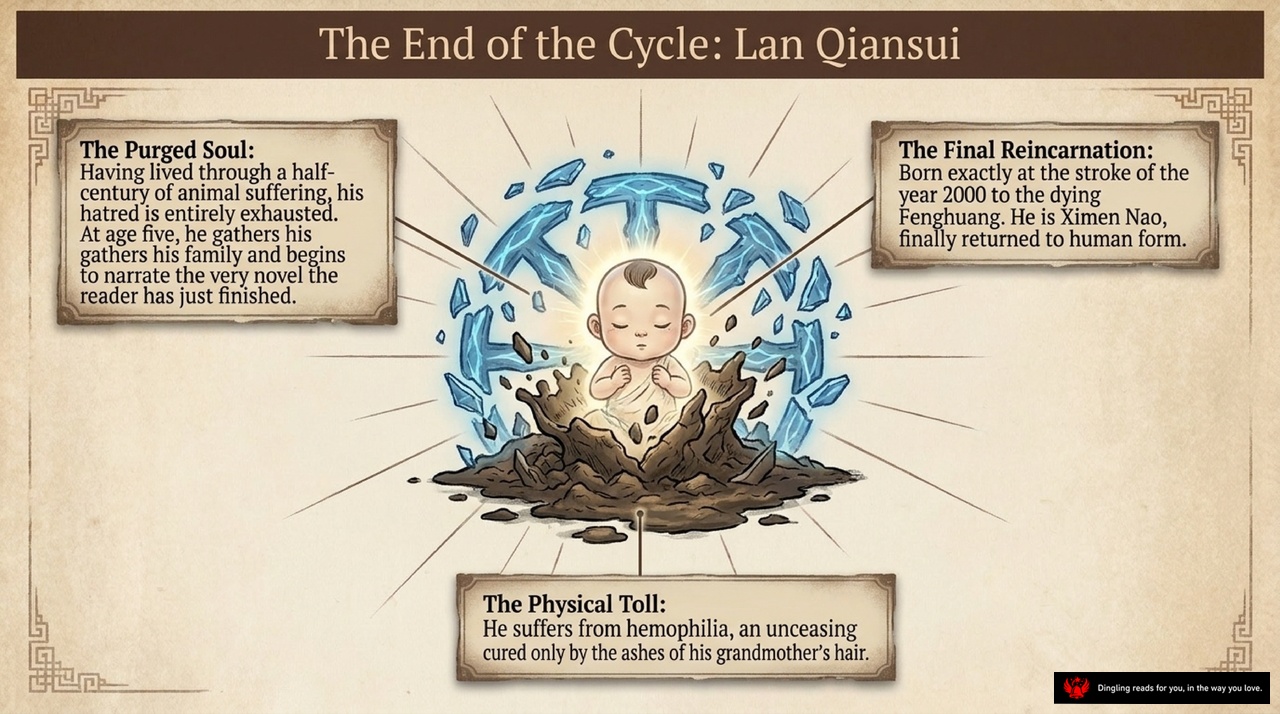
The End of the Cycle: Lan Qiansui
After a half-century of suffering as an animal, the hatred within Lan Qiansui finally fades to nothing. At just five years old, he gathers his family and begins to tell the very story you have just read. This is his final reincarnation, born exactly at the stroke of midnight in the year 2000 to the dying Fenghuang. He is Ximen Nao, finally returned to human form.
But this return comes with a heavy price. The physical toll of his past lives lingers; he suffers from hemophilia, an unceasing condition where even minor scratches can lead to fatal bleeding. The only cure is the ashes of his grandmother's hair, a desperate remedy for a broken body. Yet, despite the pain and the cycle of rebirth, his soul has found peace. The cycle ends not with a scream, but with a quiet narration, a final act of forgiveness that brings the long, dark journey to a close.

Life and death, over time, wear us down. This slide captures that exact journey.
At the very top, we see "Human Hatred," born in 1950. It represents the ego—the refusal to let go of vengeance and greed. But nature has a way of grinding us down. Enter "The Grinding Stone." This is the brutal reality of animal existence. Without human power or political ideology, the soul is forced to experience the world through raw physical pain.
Watch the descent. From the donkey, to the ox, the pig, and the dog. Each layer strips away a piece of our humanity. The text reminds us: "Everything that comes from the earth must return to the earth." This cycle of rebirth is the universe's mechanism for exhausting human malice.
Finally, at the bottom, we reach "Spectral Blue." That glowing orb is what remains when all the hate, the struggle, and the suffering have washed away. Only the story is left behind. It's a powerful reminder that while life and death may wear us out, they ultimately cleanse us, leaving only the truth.
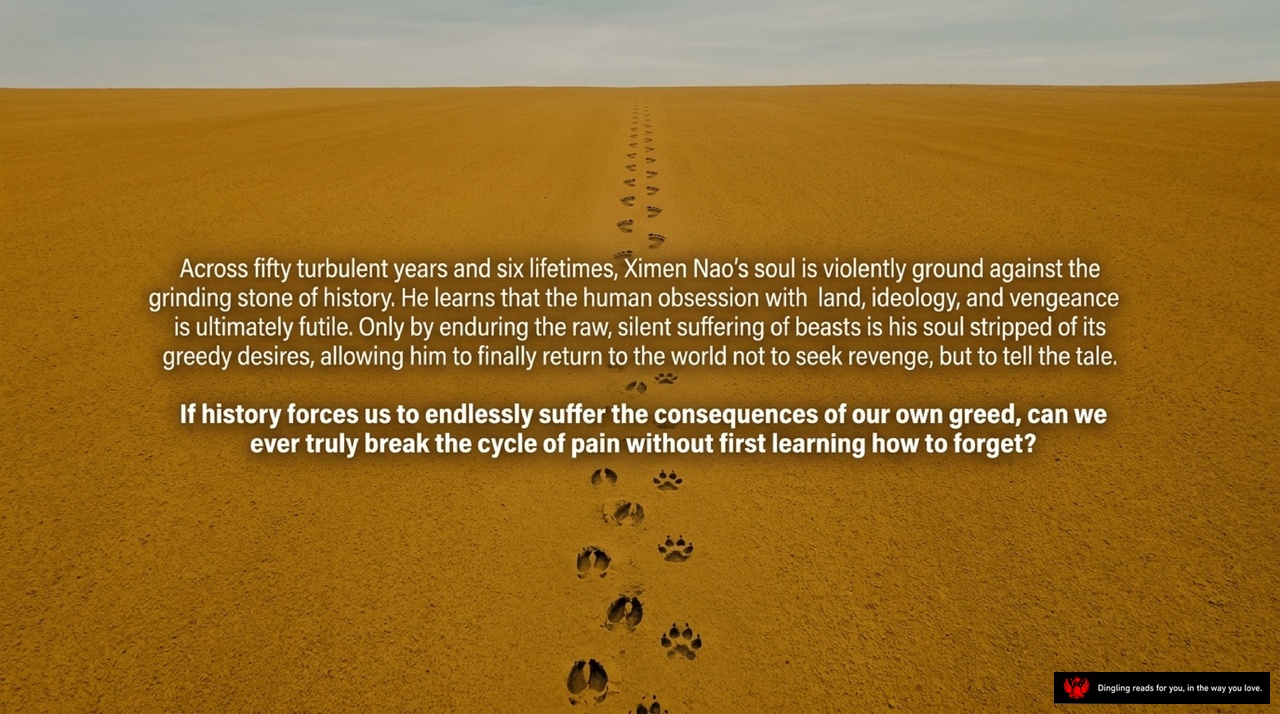
Look at this vast, golden expanse. Just a trail of footprints, shifting from human to hoof, then paw, and finally back to a human stride. It's the visual story of Ximen Nao's soul.
Across fifty turbulent years and six lifetimes, his soul was violently ground against the grinding stone of history. He learned the hard way that the human obsession with land, ideology, and vengeance is ultimately futile. Only by enduring the raw, silent suffering of beasts—first as a donkey, then an ox, a pig, and a dog—was his soul stripped of its greedy desires.
This journey allowed him to finally return to the world not to seek revenge, but to tell the tale. But here lies the haunting question: If history forces us to endlessly suffer the consequences of our own greed, can we ever truly break the cycle of pain without first learning how to forget?