
Life is Unfinished: Complete Chapter-by-Chapter Summary

Welcome to a journey into the heart of a life that feels like it's still being written. Today, we are diving into Yu Juan's powerful memoir, *This Life Unfinished*. Set against a backdrop of a sun-drenched forest, this book is more than just a story of illness; it is a raw, unfiltered diary of a woman navigating her roles as a mother, a wife, and a daughter. Yu Juan challenges us to ask the hard questions: what is the true price we pay for living, and what does it actually mean to be alive? Through her experiences, she reveals that life is not about finishing a checklist of achievements, but about embracing the unfinished chapters with courage and love.
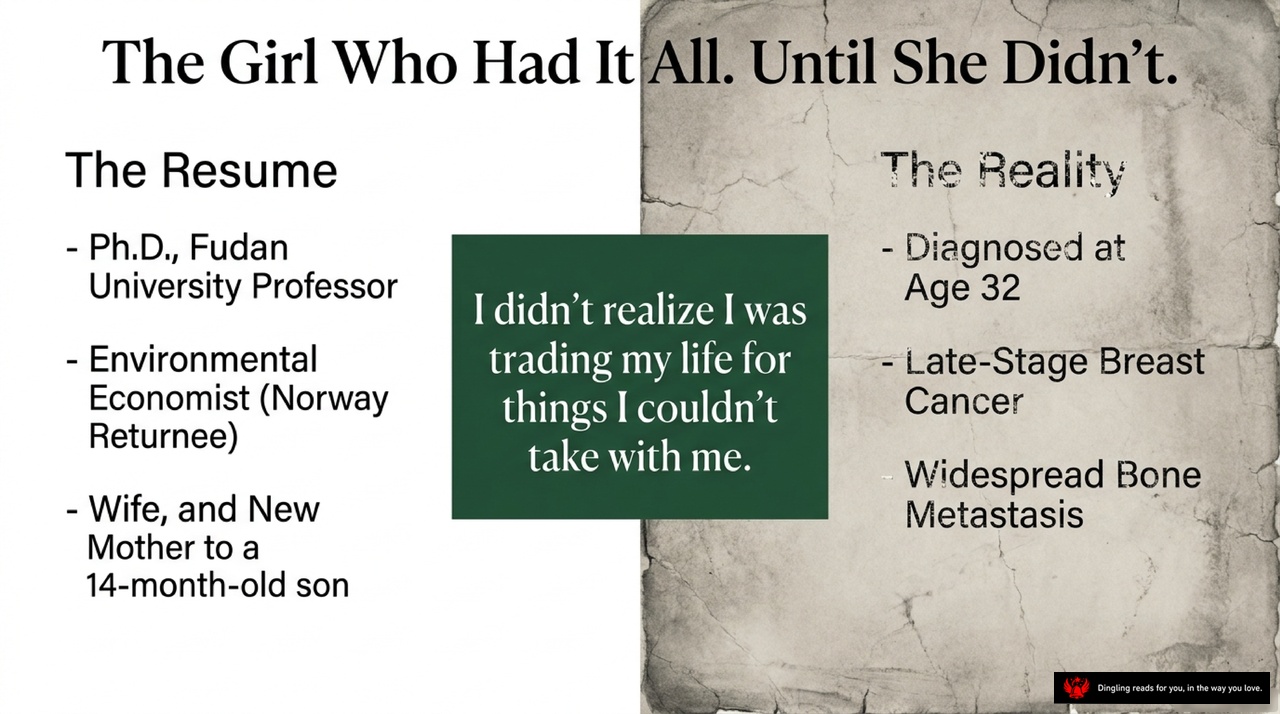
On the left, we see the perfect life she built: a Ph.D. from Fudan, an environmental economist, a devoted wife, and a new mother to a 14-month-old son. On the right, the reality hits hard at age 32: late-stage breast cancer with widespread bone metastasis. It sounds like a story from a movie, but it was her life. The central message is the most painful truth of all: she didn't realize she was trading her life for things she couldn't take with her.
This slide captures the brutal irony of modern success. She had everything society told her to want—prestige, intellect, family—and yet, she was one diagnosis away from losing it all. The contrast between her impressive resume and her fragile physical reality serves as a stark reminder that no amount of academic achievement or professional status can shield you from the fundamental truth of mortality. When the body fails, the most impressive CV becomes irrelevant. Her story isn't just about cancer; it's a wake-up call to prioritize what truly matters. Before she lost her time, she had to learn to stop chasing things that don't last and start protecting the one thing that does: her life itself.
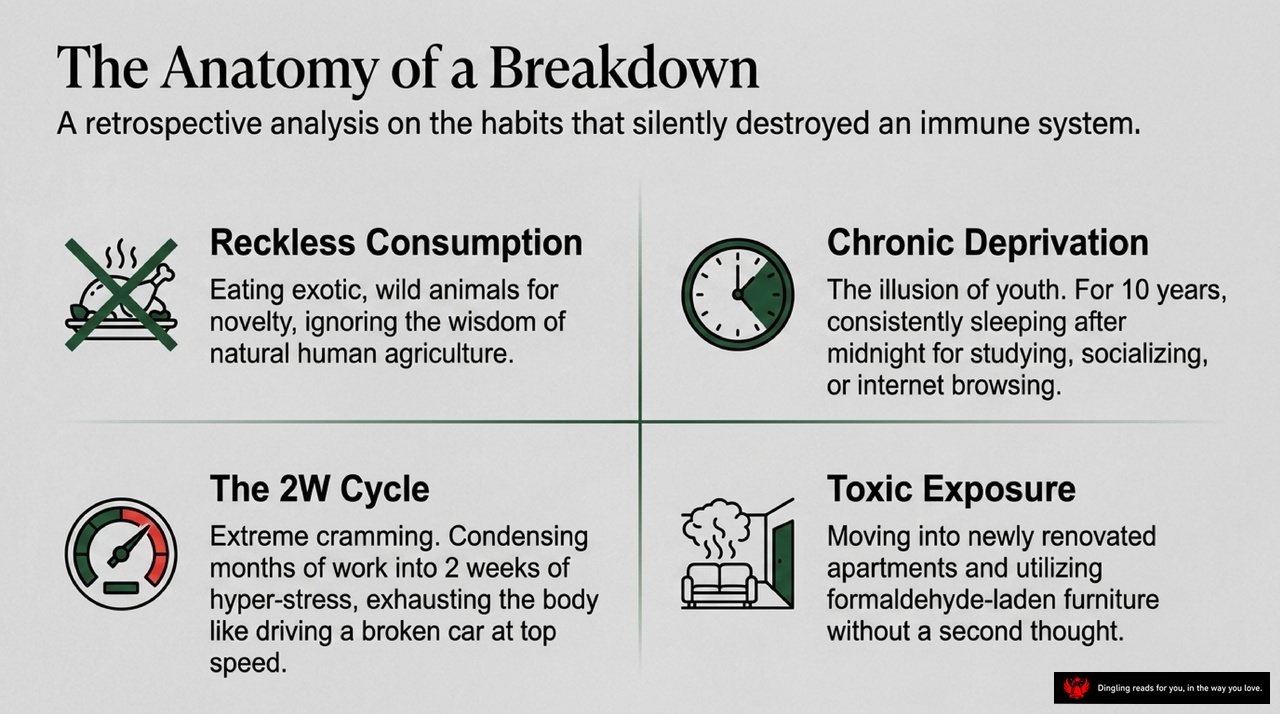
Look at this slide, "The Anatomy of a Breakdown." It's a harsh but necessary retrospective on the habits that silently destroyed an immune system. We often think breakdowns are sudden events, but this analysis shows they are actually the result of four specific, cumulative failures.
First, we have Reckless Consumption. The image shows a crossed-out plate of exotic food. This isn't just about junk food; it's about the danger of novelty. It's about eating wild animals or exotic meats, ignoring the wisdom of natural agriculture for the sake of a thrill. That curiosity can be fatal.
Second, Chronic Deprivation. The clock here represents the illusion of youth. For years, many of us stayed up past midnight—studying, socializing, or just scrolling on the internet. We convinced ourselves we were invincible, but that consistent sleep deprivation was slowly poisoning our bodies from the inside out.
Third, The 2W Cycle. This icon looks like a tachometer pushed to the red zone. It represents extreme cramming: condensing months of work into just two weeks of hyper-stress. It's like driving a broken car at top speed. You might make it for a while, but eventually, the engine fails. That exhaustion leaves the body completely vulnerable.
Finally, Toxic Exposure. The image shows a room with rising fumes. This is about moving into newly renovated apartments and using formaldehyde-laden furniture without a second thought. We ignore environmental hazards until they become the seeds of disease.
These four factors—bad diet, lack of sleep, extreme stress, and toxic environments—don't just annoy us; they actively dismantle our defense systems. The lesson here is clear: your health isn't an accident. It's the direct result of the choices you make every single day. Don't wait for a breakdown to realize what you've been doing.

Look at this scale. On the left, we have "The Illusion"—the life we chase before the edge. It's about climbing the ladder for a quick promotion, stressing over bigger houses and cars, and navigating endless social networking. It feels like success, but it's actually exhausting and fleeting.
On the right, we see "The Reality"—life at the edge. Here, success isn't measured by titles or assets. It's about hearing your 19-month-old son sing a nursery rhyme, or watching your parents walk your child to kindergarten. These moments are what truly matter.
The slide drives home a hard truth: fame, wealth, and power are exhausting to acquire and impossible to take with you. When we face the reality of life, we realize that the things we fought so hard for can't save us, but the simple, shared moments with the people we love are the only things that stick.
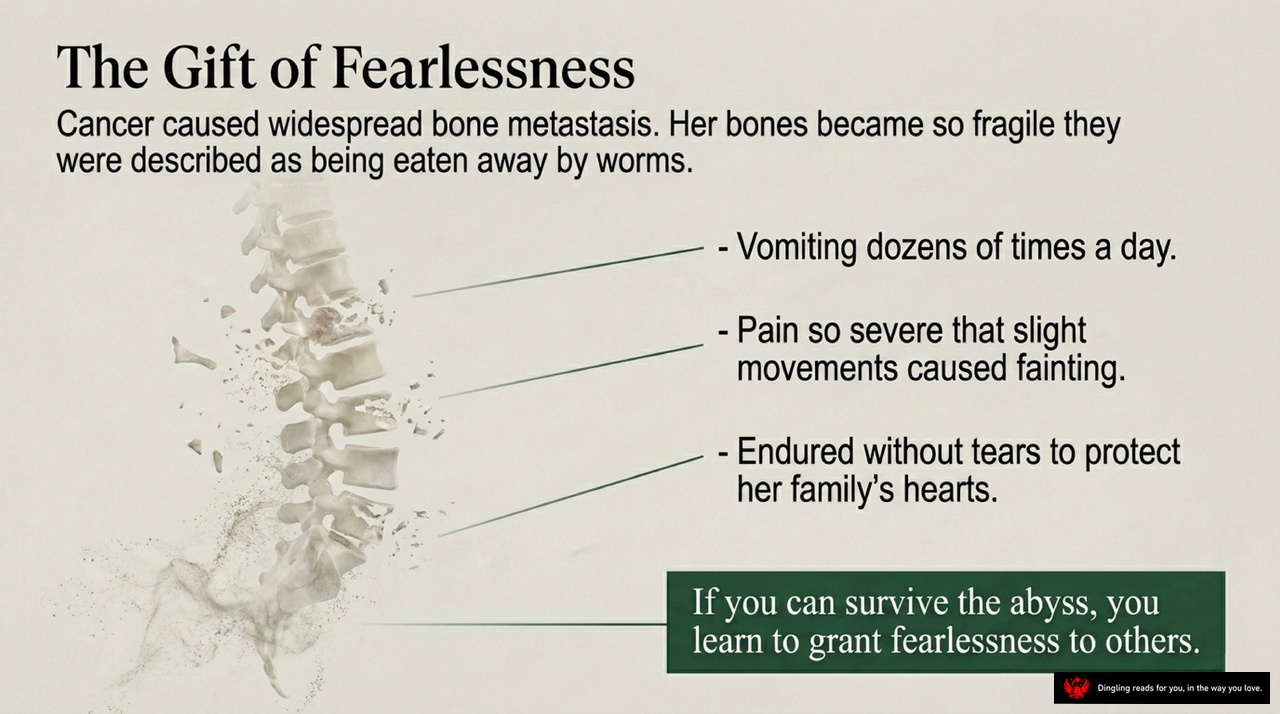
Imagine a spine that is literally being eaten away by worms, where the bones have turned so fragile that even the smallest movement sends you into a fainting spell. This is the reality of widespread bone metastasis from cancer, a physical hell where the body feels like it's disintegrating. For my husband and I, the pain was so severe that we vomited dozens of times a day, yet through it all, I endured without shedding a single tear. Why? Because I had a fierce desire to protect my family's hearts; I couldn't let them see me break. But there is a profound lesson hidden within this abyss. As the slide reminds us, if you can survive the depths of such suffering, you learn to grant fearlessness to others. This isn't just about surviving; it's about transforming that unbearable pain into a gift that can inspire and protect the people you love.
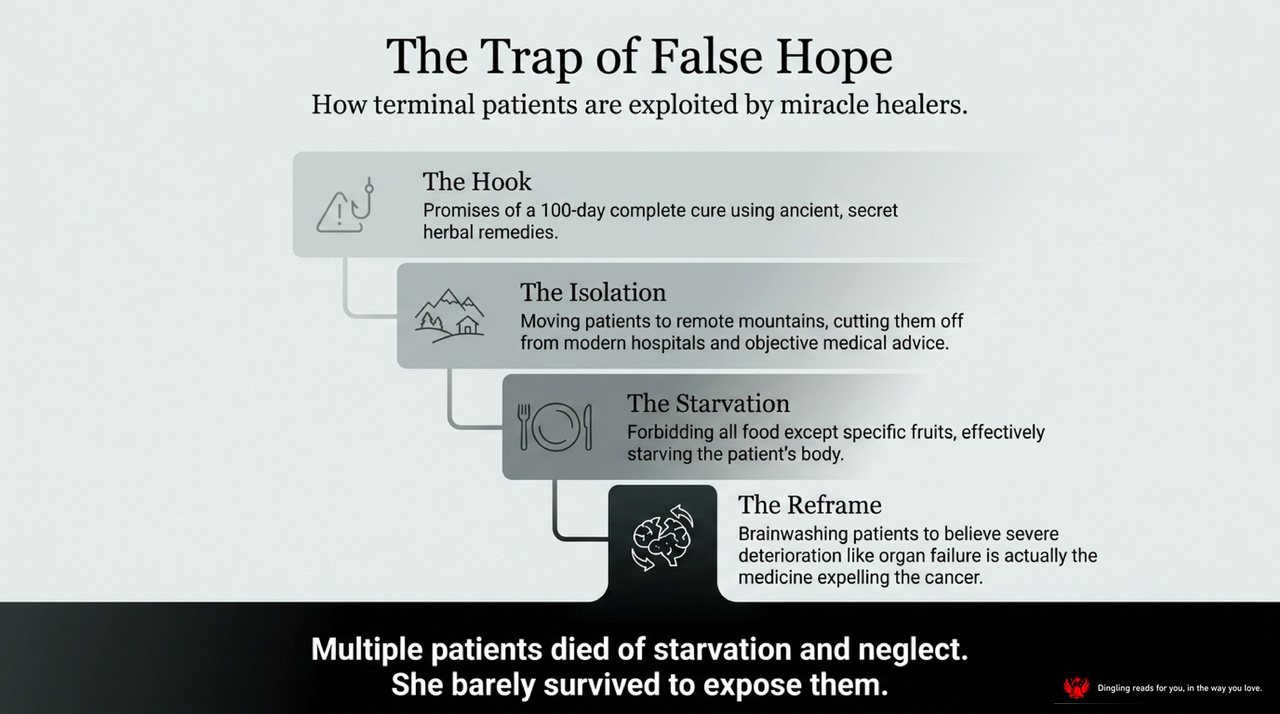
Look at this slide titled "The Trap of False Hope." It exposes a dark reality where desperate terminal patients are systematically exploited by so-called miracle healers. The process starts with "The Hook," where fraudsters promise a 100-day complete cure using ancient, secret herbal remedies. Once the victim is hooked, "The Isolation" begins. Patients are moved to remote mountains, cutting them off from modern hospitals and any objective medical advice. This isolation makes them completely dependent on the healer. Next comes "The Starvation." Victims are forbidden from eating anything except specific fruits, effectively starving their bodies to death. Finally, "The Reframe" happens. The healers brainwash patients, convincing them that severe deterioration, like organ failure, is actually the medicine expelling the cancer. This psychological manipulation prevents patients from seeking real help. Tragically, multiple patients died of starvation and neglect. As the slide notes, one survivor barely made it back to expose these criminals. This story is a harsh reminder: when facing life-threatening illness, trust science and doctors, not false hope.

Today's slide, "The Essence of Connection," captures a profound truth about love that goes far beyond physical attraction. At the very center lies "Pure Connection" and "Unconditional Love." This is the anchor. But look at what surrounds it. On the outside, we have "Physical Decay"—the loss of hair, the removal of breasts, the destruction of ovaries. And on the other side, we see "Societal Roles," where a woman questions her identity as a wife and mother when stripped of those physical attributes. Society tells us who we are based on how we look, but true love sees past that.
Consider the story of the author's husband, Baldy. When his wife faced the terrifying reality of advanced cancer and the inevitable physical changes, he didn't hesitate. He told her, "I just beg God to let you live, even if it means I have to wipe your body for the next 50 years. Knowing my heart has a place to rest—that is enough." This is the ultimate definition of pure connection. He wasn't in love with her hair, her breasts, or her ability to bear children anymore. He was in love with her soul. He understood that her value wasn't tied to her physical form or her role in society. When everything else fades, that unconditional love remains the only thing that truly matters. It is the only force strong enough to withstand the decay of the body and the loss of social status.

The hardest part of dying isn't the physical pain, but the realization that you can no longer protect the one you love. In my case, that "little potato" was my son. I refused to end my life prematurely just to leave him with a final, enduring lesson. I wanted my actions to tell him: Your mother was not a coward. In your life, fight for what matters. You can fail, but you must never give up. This wasn't just a wish; it was my battle cry against the darkness. Even when my body was failing, my spirit refused to surrender. I chose to endure the pain because my son needed a mother who stood tall, not one who ran away. That choice, to keep fighting when everything wanted me to stop, became the greatest gift I could give him. It taught him that courage isn't the absence of fear, but the decision to move forward despite it.

Imagine a world where the final gift you can give isn't to yourself, but to the earth itself. This slide captures a profoundly moving story about "The Seed Left Behind." It tells us that even in the darkest moments of life, our deepest desires can transform into acts of healing for others.
The image highlights a specific project: The Shandong Qufu Energy Forest. This isn't just a tree-planting initiative; it is a sustainable biomass energy forest designed to provide green energy, cut down carbon emissions, and lift local mountainous regions out of poverty. The goal is clear—to turn nature into a source of life and hope for a struggling community.
But the emotional core of this story lies in the text above the map. During her final months, stripped of all worldly desires, a woman's ultimate wish was simply to plant a Norwegian Wood in her hometown. She chose to spend her last ounces of energy not on herself, but on healing the earth and helping others. The graphic beautifully illustrates this connection, showing a journey from Norway to China, symbolizing how a simple seed can travel across the globe to bloom into something meaningful.
This is a powerful reminder that legacy isn't about what we accumulate, but what we leave behind. Even when facing the end, we have the power to plant seeds that will grow into forests, nourishing generations to come. It's a testament to the idea that our greatest impact often comes when we let go of our own needs and focus on the greater good.

Yu Juan's unfinished life leaves us with a completed map of what truly matters. Stripped of the relentless pursuit of titles, wealth, and societal validation, we are left only with the health of our bodies, the depth of our love for our families, and the silent legacy we plant for the world. Think about it: if everything you are rushing to achieve today vanished tomorrow, what would actually remain? Would it be the promotion you fought for, the house you bought, or the status you chased? Or would it be the warmth of a family dinner, the strength in your own bones, and the quiet impact you have on those who love you? We often spend our lives building monuments for strangers, forgetting to tend to the garden of our own hearts. But life is short, and the only legacy that truly lasts is the love we give and the kindness we leave behind. So, slow down. Look around. What is real? What matters? The answer isn't in the future; it's in the present, in the people holding your hand, and in the simple, profound truth that being alive is enough.