
Light of Civilization: Complete Chapter-by-Chapter Summary

Welcome to *Lights of Civilization* by Wu Jun. Imagine a grand journey that stretches from the cosmic dawn to our digital age. This book isn't just about history; it's about the milestones that lit up our path. From the mysterious pyramids of Egypt to the intricate laws of Rome, from the spinning wheel of Mesopotamia to the porcelain that connected the East and West, every chapter reveals how human ingenuity built the world we live in today. Join us as we explore the sparks of innovation that turned ancient dreams into reality, and discover how the fragments of our past hold the keys to our future.

Imagine Earth's history compressed into a single year. January 1st is the moment our planet formed, and we are currently living in the final minutes of December 31st. But what if I told you that the last 59 seconds of this cosmic year represent the entire span of human civilization?
Look at the timeline on the right. By late November, multi-cellular life begins. By December 26th, the dinosaurs go extinct. Then, at 11:30 PM, modern humans appear. And just 29 minutes later, at 11:59 PM, human civilization ignites. This rapid ascent is what we call "The Final Anomaly."
Now, shift your gaze to the left side of the screen. This is "December: The Final Anomaly," highlighted by that brilliant burst of light. While our ancestors were just beginning to scratch the surface of existence, we are already reshaping the universe. From the pyramids of Egypt to the scientific breakthroughs of Newton, and from the silk roads to the industrial revolution, our brief appearance on this cosmic calendar has left an indelible mark.
We are living in a moment of unprecedented acceleration. In the span of a few seconds on this calendar, we have developed cities, written laws, cracked the code of the atom, and reached for the stars. The graph shows not just a timeline, but a story of how quickly we moved from obscurity to dominance.
So, as we reflect on our own history, remember this: we are the final anomaly of a 4.54-billion-year story. Every achievement, every mistake, and every discovery we make right now is happening at the very end of the cosmic year. The question isn't just where we have been, but what we will do in these final, explosive moments before the clock strikes midnight.

Let's talk about the foundations of knowledge. Look at this slide: on the left, we see the Rosetta Stone, representing "The Memory of Species." This ancient Egyptian artifact unlocked 5,000 years of civilization, proving that written language is the ultimate vessel for passing knowledge from one generation to the next. Without this ability to record, our history would have vanished into the mists of time.
On the right, we see a glowing circuit board symbolizing "The System of Merit" from Song China. While Egypt relied on writing to preserve wisdom, China developed civil service exams to create the first large-scale meritocracy. This system drove unprecedented economic and cultural prosperity by systematically organizing talent rather than just recording it.
The key takeaway here is clear: Civilization accelerates when knowledge is recorded through writing, and talent is systematized through institutions. It's not just about having information; it's about building the structures that allow that information and human potential to flourish and spread.

Before the Industrial Revolution, population size was the ultimate metric of a civilization's success, but food production was the engine that drove it. While Europe was still struggling with low-yield farming methods like scattering seeds by hand, China had already revolutionized agriculture thousands of years ago. The Chinese developed advanced ridge-farming techniques, planting crops in raised rows to maximize ventilation and ease of management—a technology Europe wouldn't adopt until the 17th century. This efficiency, combined with superior tools and livestock that could pull three times the weight of their European counterparts, allowed China to produce far more grain per acre. This surplus didn't just feed more people; it freed up labor for crafts, trade, and governance, creating a self-sustaining cycle of growth that Europe couldn't match.
But the real game-changer wasn't just farming; it was how China selected its leaders. While Europe was stuck in feudal systems where power was inherited by birth, or limited to a tiny elite of citizens in Athens, China invented the civil service exam. This system, perfected during the Song Dynasty, offered a meritocratic path for anyone, regardless of background, to rise through knowledge rather than lineage. It broke the glass ceiling of the aristocracy and created a stable, educated bureaucracy that governed with a level of fairness and sophistication that impressed even Western observers like Marco Polo and Matteo Ricci. While European cities were still fighting over feudal privileges, Song China was already boasting of a population of millions, a booming economy where commercial taxes made up 70% of revenue, and a welfare system that included public hospitals and orphanages. From the grandeur of Chang'an to the bustling markets of Hangzhou, China wasn't just leading in population; it was setting the standard for what a modern, complex civilization could look like centuries before the West caught up.

The Renaissance wasn't just a burst of artistic creativity; it was the world's first successful venture capital investment in human capital. As the slide illustrates, this engine was powered by the convergence of two forces: capital meeting art and a specific catalyst.
On the left, we see how the Medici family transformed wealth into intellectual progress. They didn't just fund statues; they financed the revival of lost Greco-Roman knowledge, turning gold into ideas. On the right, we have the catalyst: Cosimo de' Medici. He discovered ancient engineering manuscripts hidden in plague-ridden churches and funded their translation and application. This single act unlocked a flood of innovation.
Look at the results on the right side of the screen. That open book represents the rediscovered knowledge that fueled the era. The Vitruvian Man symbolizes the new focus on human potential and anatomy. The architectural blueprints, like the dome, show how this intellectual fuel was applied to engineering marvels. By investing in people and ideas rather than just land or gold, the Medici created a self-sustaining cycle of innovation. They proved that when you fund the mind, you build the future.

Rome conquered the world with its legions, but it truly conquered the world with its laws. Think about it: while other empires relied on the sword to rule, Rome built a system that could outlive the empire itself.
The story starts in the Roman Republic, where social tensions were so high that people demanded written rules. This led to the Twelve Tables, the first written law code in history. It wasn't perfect, but it was a game-changer. As Rome expanded across Europe, Africa, and Asia, they realized local customs were too messy to manage. So, they evolved their laws into the "Law of Nations," a universal set of rules for everyone, not just Roman citizens.
Fast forward to the 6th century, and Emperor Justinian did something even more ambitious. He ordered scholars to compile all of Rome's legal history into one massive collection known as the *Corpus Juris Civilis*. This work became the blueprint for the entire Western legal system. It established core principles we still use today: the right to private property, the freedom to make contracts, and the idea that the law should be fair and predictable.
Even after the Western Roman Empire fell, these laws didn't disappear. They went underground during the Middle Ages, only to re-emerge in the 11th century when Italian scholars rediscovered them. Suddenly, these ancient principles became the perfect weapon for rising merchants and cities to fight against feudal lords.
By the 18th century, the spirit of Roman law fueled the Enlightenment. Thinkers like Montesquieu and Rousseau used its logic to argue for democracy and human rights. Today, when you see statues of Hammurabi in the US Capitol or study civil law in Germany or Japan, you are seeing the enduring legacy of Rome. Their greatest victory wasn't territory; it was creating a legal framework that continues to shape how we live, trade, and govern ourselves nearly two millennia later.

The Renaissance didn't just happen overnight; it was fueled by one incredibly wealthy family: the Medici. Imagine a single dynasty acting as the engine for Europe's greatest cultural explosion. In Florence, they transformed a struggling city into the cradle of modern art and science.
Take Cosimo the Elder. He didn't just fund buildings; he funded the future. When the Florence Cathedral was stuck with an unfinished dome, Cosimo stepped in to support Brunelleschi. This wasn't just charity; it was a masterstroke of vision. By solving the engineering puzzle of the dome, Cosimo built a legacy that stands today. But his greatest gift was knowledge. He hunted down ancient Greek and Roman manuscripts, creating a library that became the intellectual fuel for the entire era.
His grandson, Lorenzo the Magnificent, took this to the next level. He was the ultimate patron, personally discovering and nurturing geniuses like Michelangelo and Da Vinci. Think about it: without Lorenzo's support, would we have seen *The David* or the sketches that led to *The Last Supper*? He shifted the focus from purely religious themes to celebrating human potential, giving birth to the concept of humanism.
But the Medici impact went far beyond Italy. Their influence traveled through marriage. Catherine de' Medici brought Italian elegance and sophistication to the French court, shaping French culture for decades. Meanwhile, their protection of Galileo allowed him to challenge the old ways. With the Medici's backing, Galileo could develop the telescope and prove that the Earth orbits the Sun, laying the groundwork for the Scientific Revolution.
When the family finally passed the torch in 1743, they left behind more than just art in the Uffizi Gallery. They left a spirit of innovation, a belief that investing in minds creates a brighter future. From a banking family in Florence to the architects of the modern world, the Medici proved that one family could change the course of history forever.

Look at this slide, "The Institutional Advantage." It breaks down how different empires didn't just survive on technology, but on the invisible rules that held them together.
First, we have the Dutch, who mastered Trust. They invented the fiduciary duty and the joint-stock company. This was a game-changer because it allowed investors to trust captains with capital across vast oceans, fueling global trade.
Then, the British, who championed Free Trade. They shifted away from the old mercantilist mindset of hoarding gold and embraced Adam Smith's free market. This maximized societal efficiency, allowing the economy to grow naturally rather than being restricted.
Finally, the Americans, who engineered Design. The Founding Fathers built a nation based on decentralized power and merit, explicitly rejecting the idea that your worth is tied to your bloodline.
The core takeaway here is clear: while empires are built on technology, they are only sustained by superior legal and economic institutions. These frameworks determine whether an empire rises or falls.

Welcome back. Today, we're looking at a pivotal moment in history where the planet literally got smaller.
Look at this glowing map of Europe. This isn't just a pretty picture; it represents a fundamental shift in how humanity organizes itself. The slide highlights two massive drivers: "Transport & Comms" and "The Military Shift."
First, let's talk about the infrastructure. Before this era, moving people and information was slow and local. But then came railways and telegraphs. These tools fundamentally changed the speed and scale of human coordination. Suddenly, you could move armies and messages across continents in hours instead of weeks.
This infrastructure didn't just make travel easier; it dictated the limits of human organization. As the slide powerfully states at the bottom, "Infrastructure dictates the limits of human organization." When you can communicate instantly, you can manage a much larger group of people.
Now, look at the second box: "The Military Shift." This is where it gets fascinating. Prussian General Moltke used these new tools to invent the "exterior lines" strategy. For the first time, commanders could coordinate widely dispersed armies to strike simultaneously. This was a game-changer. It rendered the old Napoleonic warfare model—where generals had to be physically present to command—completely obsolete.
So, the lesson here is clear. When we build better roads and faster communication networks, we don't just change how we travel; we change the very structure of our societies and our wars. The physical world shrinks, and with it, the distance between us all.

Unlocking the Universe. Imagine a world where matter is just an illusion, and everything you see is actually pure energy. This isn't just philosophy; it's the reality we've unlocked. From the macro scale of the Cold War Space Race, which accidentally pushed humanity off our planet, to the micro scale where Einstein, Meitner, and Oppenheimer revealed the immense power hiding inside the atomic nucleus.
But it goes deeper. The discovery of the Higgs Boson, often called the "God Particle," proved that the universe is fundamentally made of pure energy. It's the Higgs field that gives particles their mass, turning that invisible energy into the solid world we touch and see. So, when you look at the stars or hold an object, remember: you are looking at concentrated energy, the very fabric of existence, finally revealed.

Welcome back. Today, we're diving into the explosive moment in history when computation transformed from a theoretical concept into a tool that acts as an extension of the human brain, not just the human hand.
Look at this graph. It's titled "The Computation Explosion," and it captures a symbiotic cycle that changed everything. At the very foundation, we have Turing and Boole. They established that true/false logic became the bedrock of all software. This simple binary code is what allows computers to think.
As that logic took hold, two powerful laws kicked in: Moore's Law and Andy-Bill's Law. Moore's Law tells us that hardware doubles in speed roughly every two years. But here's the key: software expands to consume that extra speed. This creates a feedback loop where costs drive down to zero, effectively putting a supercomputer in every pocket.
Notice how the curve shoots upward. That growth fueled the devices you see floating around the chart—smartphones, smartwatches, AR glasses, and advanced chips. We moved from room-sized mainframes to tools we carry in our hands. This isn't just about faster processors; it's about the democratization of intelligence. The computer has become an extension of our own minds, amplifying our ability to process information, solve problems, and create. This explosion is the engine driving our modern world, and it's just getting started.

Look at this layered structure of the internet ecosystem. We're moving from the early days of Web 1.0, where portals like Yahoo simply pushed information to users, to Web 2.0 platforms like Google and Amazon, where the infrastructure belongs to the companies, but the content and connections are built by us. At the very top sits The Cloud & Data, the fuel that powers it all.
But here is the crucial shift: this isn't just a store anymore. As the slide highlights with "The Bezos Insight," the internet is now an infinitely scalable, standardized platform for external services. It's a utility, like electricity or water. And that brings us to the ultimate truth at the bottom: the greatest internet companies don't compete with their users; they empower them. Instead of fighting for your attention, they build the stage where your creativity and needs can thrive.

The Capital Engine isn't just a metaphor; it's the heartbeat of our financial history. Look at this cycle: Innovation sparks Hype, which inevitably inflates into a Ponzi Bubble, leading to a violent Crash. But here's the twist—the system doesn't just die; it iterates. That's the Silver Lining. Every crash becomes a classroom, forcing regulations to be written in the ashes of disaster, making markets progressively safer over centuries.
This relentless loop is what we call The Great Game. From the South Sea Bubble to the 2008 Crisis, human greed and the dangerous "this time is different" mentality ensure that bubbles inevitably repeat. We are constantly driven by angels and demons, with capitalism advancing only by continuously regulating human greed. It's a high-stakes game where the only way forward is through the fire of the past.

We are a cosmic infant playing with civilization-ending tools; our survival requires a rapid maturation of our stewardship. This isn't just a poetic warning—it's a mathematical reality. Look at the curve labeled "Resource Consumption." It shows an exponential climb, a trajectory that cannot be sustained on a finite planet. The slide calls this "The Math of Doom." Here's the terrifying logic: an 8% annual growth rate doesn't just add up; it multiplies. Over 200 years, that rate increases consumption five million times. The Earth simply cannot support this kind of physical expansion forever. We have hit a hard ceiling, marked here as the "Planetary Boundary." Once we cross that line, the consequences are catastrophic.
But there is a way out, which the slide calls "The Pivot." We cannot continue extracting physical resources at this pace. Humanity must transition from brute-force extraction to technological efficiency and sustainable intelligence. We need to mature quickly, learning to live within our limits rather than trying to conquer them. The image of Earth in the background reminds us that we are all on the same ship. The tools we have built are incredibly powerful, but they are also dangerous if we don't learn how to use them wisely. The challenge of our time is not just about technology, but about wisdom. We must stop chasing endless growth and start focusing on sustainable survival. The future depends on our ability to pivot from a mindset of consumption to one of stewardship.
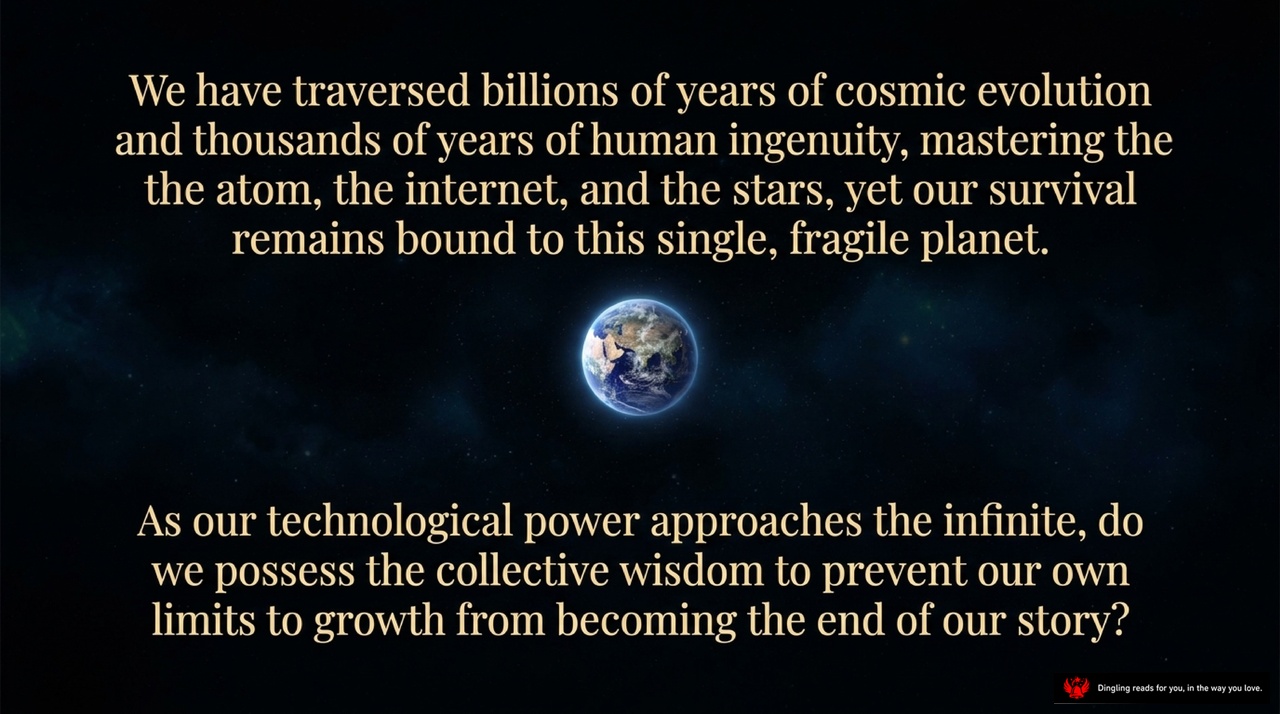
Look at this image of our planet. It's a stunning reminder of where we stand. We have traveled billions of years through cosmic evolution and thousands of years of human ingenuity. We have mastered the atom, we have built the internet, and we have even reached for the stars. Yet, despite all this power, our survival remains bound to this single, fragile planet.
As our technological power approaches the infinite, a critical question arises: Do we possess the collective wisdom to prevent our own limits to growth from becoming the end of our story?
This slide isn't just about Earth; it's a mirror for us. It challenges us to reflect on whether our incredible advancements in science and technology are matched by the wisdom to sustain them. We are standing at a crossroads where our future depends not on how far we can reach, but on how wisely we choose to stay here.