
Listening to Leaks: Complete Chapter-by-Chapter Summary
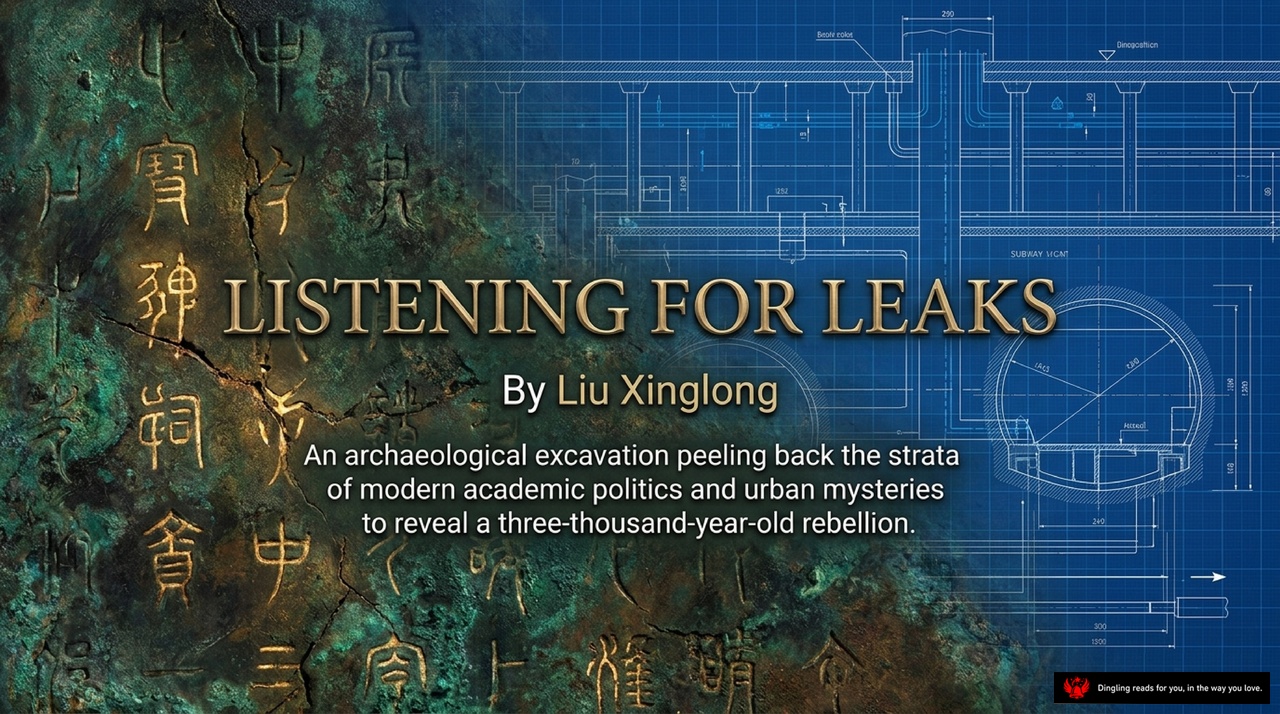
Welcome to the book club for *Listening for Leaks* by Liu Xinglong. Today, we're diving into a story that feels like peeling back the layers of time itself. Imagine an archaeological excavation that doesn't just dig for ancient artifacts, but for the hidden strata of modern academic politics and urban mysteries.
The cover sets the tone perfectly: ancient bronze inscriptions on the left, representing a three-thousand-year-old rebellion, clashing with the precise blueprints of a modern subway on the right. It's a visual metaphor for the book's core conflict—where history meets the present. The title, "Listening for Leaks," suggests that the truth isn't always found in what is seen, but in what is heard. It's about detecting the subtle warnings hidden in plain sight, like a warning letter written in ancient oracle bone script that alerts the protagonist to a critical leak in a subway station.
This story is about a protagonist named Ma Yuezhi, who finds himself at the center of a storm involving a mysterious rebellion, political intrigue, and a family secret spanning generations. As we turn the pages, we'll see how these ancient mysteries ripple through the modern world, challenging everything we thought we knew about history and the people who guard it. So, let's start our journey into this world where the past is never truly buried, and every leak tells a story.
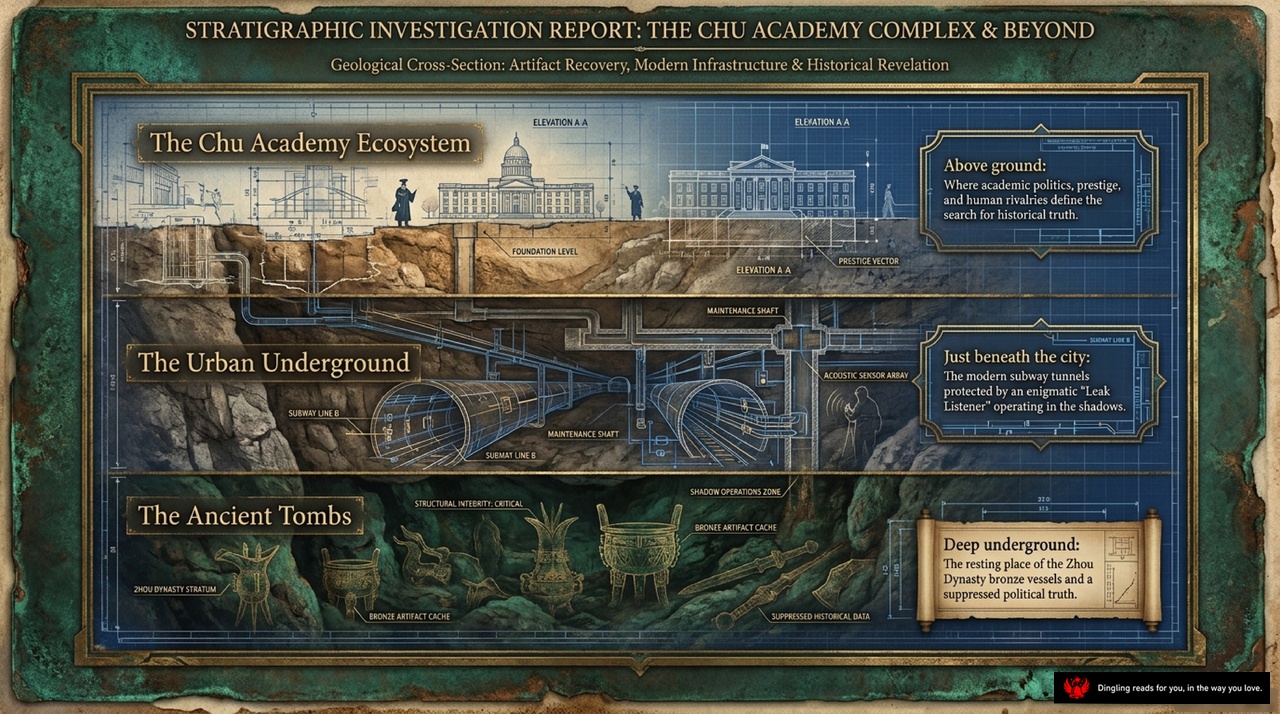
Imagine a city built on layers of secrets, where the surface is a theater of academic prestige and the ground beneath holds the weight of suppressed history. This is the world of *The Chu Academy*, a complex stratigraphic investigation that peels back reality to reveal what lies hidden.
Above ground, we see the **Chu Academy Ecosystem**, a landscape defined by human rivalries and the relentless pursuit of historical truth. It is a place where political maneuvering and personal ambition shape the narrative, much like the characters navigating the corridors of power. But just beneath this polished veneer lies **The Urban Underground**—a network of modern subway tunnels and maintenance shafts, silently monitored by an enigmatic "Leak Listener" operating in the shadows. This hidden layer represents the unseen forces at work, the modern infrastructure that both protects and conceals the past.
Deeper still, we descend into **The Ancient Tombs**, resting places for the Zhou Dynasty's bronze vessels and a suppressed political truth. Here, amidst the structural integrity of ancient strata, lie artifacts that challenge our understanding of history. From the **Bronze Artifact Cache** to the **Shadow Operations Zone**, every layer tells a story of loss, discovery, and the enduring struggle between what is revealed and what must remain buried. This cross-section is not just a geological map; it is a blueprint of memory, inviting us to explore the depths where history truly lives.

This slide breaks down the three key players driving the conflict at Chu Academy: Ma Yuezhi, Zheng Xiong, and Zeng Benzhi. Let's look at how their opposing philosophies collide.
On the left, we have Ma Yuezhi, labeled "The Purist." His methodology is total visual recall; he decodes history through unyielding, solitary observation of physical artifacts. His ultimate ambition is absolute academic truth, completely devoid of administrative titles. He views the missing bronze pieces not as political tools, but as vital historical anomalies to be solved through physical evidence. He is the man of integrity, driven purely by the truth.
In the center stands Zheng Xiong, "The Politician." His approach is all about opportunistic maneuvering, leveraging archaeological discoveries purely for bureaucratic advancement. His goal is total administrative control over the Academy and the Bronze Heavyweights Society. To him, the artifacts are merely political capital to secure his own legacy. He cares less about history and more about power.
On the right is Zeng Benzhi, "The Manipulator." He uses masterful orchestration, even retires at the peak of his career to force the hands of his rivals. His ambition is to protect his family's legacy and definitively shape the Academy's future hierarchy. Most chillingly, he believes the artifacts possess a dangerous psychological weight that can break ambitious men. He sees history as a weapon to control the present.
This grid perfectly illustrates the tension between truth, power, and manipulation. Ma seeks the past for what it is; Zheng seeks the past to rule the present; and Zeng seeks to destroy the future to protect his family's past.

On the left, an ancient warning materializes from the mists of time—a 37-character script, flawless and over three millennia old, dropped right at the Academy gates. It predicts a catastrophic water breach with terrifying precision, down to the exact hour. This isn't just a prophecy; it's a lifeline. On the right, we see the modern crisis unfolding beneath our feet: the subway line C construction is dangerously encroaching on a geotechnical fault zone, mere 70 meters from the Academy. Modern sensors have completely failed, blind to the impending disaster. It is only this ancient text that pinpoints the exact subterranean fissure, halting construction just in time and saving the city. Here, history doesn't just repeat itself; it actively intervenes. The past, preserved in fragile bone and ink, becomes the only shield against the future's chaos, proving that sometimes, the answers we need are buried deeper than we dare to dig.

In this pivotal chapter, the long-simmering mystery of the "Nine Tripods and Seven Dishes" finally begins to unravel, revealing a shocking truth about identity and destiny. The story shifts from academic debate to a personal reckoning.
The breakthrough comes not from digging deeper into the earth, but from connecting the dots between the past and the present. Ma Yuezhi discovers that the missing eighth tripod isn't just a lost artifact; it's a key to his own forgotten lineage. Through the testimony of the mysterious water leak inspector, Zeng Tingchang, and the cryptic clues hidden in ancient texts, a terrifying and beautiful picture emerges: Ma Yuezhi is not just an archaeologist uncovering history; he is a piece of that very history, resurrected.
The climax of this arc involves the tragic figure of Xiao Yu, Ma Yuezhi's lost love from decades ago. It is revealed that she gave birth to twins—a boy and a girl—before her untimely death. The boy, named Qiufeng, grew up to be a significant figure in the local history, while the girl was separated and raised elsewhere. The narrative takes a stunning turn when it connects these lost children to the living characters in the story. The water inspector, Zeng Tingchang, is revealed to be the long-lost son, while the seemingly unassuming Lu Shaolin is the sister. Their arms bear matching tattoos that, when combined, spell out "Ma," confirming their biological bond and their place in the family tree that was once erased.
This revelation transforms the entire investigation. The search for the stolen bronze vessels becomes a journey to reunite a fractured family. The ancient curse of the "Nine Tripods" is reinterpreted not as a political tool for usurping power, but as a warning against erasing human connection. The artifacts were never meant to be hoarded by the elite; they were guardians of a truth that must be remembered. As the characters piece together the final puzzle, the emotional weight of the discovery surpasses the historical significance. It is a story about the enduring power of blood and memory, proving that even when history tries to bury the truth, the living can still bring it back to light.

Nine tripods. Eight tureens. This is the rigid, unbreakable law of the Zhou Dynasty. The nine tripods represent supreme royal authority, and by ritual, they must be accompanied by exactly eight tureens. But look at this display case. We have all nine tripods. Yet, where is the eighth tureen? Instead of eight, there are only seven. This isn't just a missing artifact; it is a glaring historical anomaly, a deliberate rupture in the timeline. The absence of that single vessel suggests either a suppressed rebellion or a tragic royal curse. This missing eighth vessel is the key to understanding the true political struggle hidden beneath the surface of history.

Imagine a world where history isn't just written in books, but hidden upside down in the earth itself. In the pages of *The Chu Qiu Shi Di Ji*, an obscure Ming Dynasty text, we uncover a chilling secret: the legendary lost vessels weren't lost to time or theft. They were deliberately buried upside down as a political punishment by the Zhou Emperor.
Think about that for a moment. For twenty glorious years, these artifacts were celebrated. But then, for three thousand years, they were forced to face the dirt, inverted and silenced. This image of being "buried upside down" isn't just a physical description; it's a powerful metaphor for a civilization's shame and a warning to those who might challenge the established order.
This ancient cipher, revealed through this mysterious text, changes everything we thought we knew about the missing vessels. It tells us that their disappearance was a calculated act of suppression, a way to erase a legacy that threatened the power of the ruling dynasty. As we peel back the layers of this historical mystery, we see that the past is often more deliberate—and more dangerous—than we ever imagined.

Welcome to the final chapter of our journey through the tangled history of the Qiu family. Today, we look at how the past and present finally collide, closing a 40-year-old wound.
Let's travel back to the 1980s. The first layer of secrets began with the illicit exhibition of the Nine Tripods. This was followed by the tragic death of Qiu Feng in his self-made bamboo-tube tomb, and the forced separation of Xiaoyu's newborn twin babies to hide a scandal. These were the buried truths that shaped their destiny.
Now, fast forward to the modern strata. The story comes full circle. We see the physical excavation of Qiu Feng's hidden bamboo-tube tomb by the new generation, bringing him back to life. Then, a modern DNA test matches the Leak Listener to Investigator Mei Yubo, solving the mystery of identity. Finally, we witness the ultimate family reunion, closing a 40-year trauma.
This timeline shows us that while the past is buried, the truth always finds a way to surface. From hidden artifacts to reunited families, history proves that nothing is lost forever.

Look at this puzzle. Two ancient bronze fragments, separated by time and fate, finally coming together. On the left, Fragment A, kept by the abandoned son, a "Leak Listener" who heard the secrets of the earth. On the right, Fragment B, held by the abandoned daughter, the "Investigator" who dug for the truth. When these two pieces lock into place, they don't reveal a royal surname like "Zeng" as everyone assumed. Instead, they form the character "Ma"—Horse. This simple synthesis changes everything. It proves the biological link between the twins, finally unlocking their hidden past. Physical artifacts are just mirrors of broken families; the pieces don't just fit together physically, they fit together historically, finalizing the excavation of a legacy that was deliberately buried.

"The Emperor does not destroy; Heaven destroys." These aren't just words on a screen; they are the chilling verdict of history, carved into the silence of a broken bronze vessel. Look at this shattered tureen, the eighth one from a sacred set. It was never cast. The clay mold was buried, unused, a deliberate act of defiance. In the ancient Zeng State, this was a rebellion so bold it risked the wrath of Heaven itself. Instead of completing the ritual set and bowing to the Emperor's humiliating decrees, they chose to let the set remain incomplete. They refused to be erased. They let the missing piece stand as a monument to their dignity. This isn't just about archaeology; it's about the ultimate power move: sometimes, the most powerful thing you can do is simply refuse to play the game. When authority demands your total submission, the greatest resistance is the courage to leave something unfinished.

History isn't just about digging up old bronze vessels or uncovering buried soil; it's about excavating the deep human ambition, the suppressed trauma, and the courage of ultimate defiance. When we dig deep enough into our own foundations, what missing pieces will we be forced to explain?
This slide captures the core truth of our journey. Throughout the story, we've seen how history is often rewritten by the powerful, whether it's the fabricated legends of the Nine Tripods or the hidden identities of our characters. Ma Yuezhi's life has been a constant excavation—not just of archaeological sites like Qiujialong, but of his own past, his relationships, and the secrets buried within his family. From the mysterious "missing eighth tripod" to the shocking revelation of his own twin siblings, Lu Shaolin and Mei Yubao, every layer he uncovers challenges his understanding of reality.
The image reminds us that true discovery requires facing the uncomfortable truths we've tried to ignore. Just as the bronze vessel in the background stands silent yet heavy with history, our own lives hold stories we may not be ready to tell. The "missing pieces" we seek are often the ones we've lost or chosen to forget—our true origins, our hidden talents, and the people we thought we left behind. As we move forward, we must ask ourselves: what parts of our foundation are still missing, and are we brave enough to confront them?