
Logics of History: Complete Chapter-by-Chapter Summary
Welcome to *Logics of History* by William H. Sewell Jr. This isn't just another book about the past; it's a bold manifesto designed to bridge the gap between historical time and sociological structure. For too long, historians and social scientists have been speaking past each other, treating time as a backdrop rather than a driving force. Sewell argues that to truly understand social transformation, we need to merge the historian's deep grasp of time's unpredictability with the social scientist's focus on social structures. It's time for a serious, two-way conversation that finally makes sense of how our world actually changes.

The Epistemological Chasm isn't just a gap; it's a deep fracture that split two intellectual cousins apart. Back in the 19th century, history and social science shared the same intellectual soup, but by the end of that century, they fractured into isolated universes. History retreated into its own realm, obsessed with the unique, the descriptive, and the messy flow of time. Sociologists, conversely, marched into a grid of perfect logic, chasing universal laws and rigid structures.
On the left, you see the Historian's Realm. It's all about the ideographic—the specific, the one-off events. Historians are masters of context and narrative, but they've been suspicious of formal theory for a long time. On the right, the Sociologist's Realm focuses on the nomothetic. They want explanatory power, universal laws, and clean causal mechanisms. But in doing so, they often strip away the very messy realities of historical context that make life real.
This divide means we've been trading holistic understanding for rigid disciplinary boundaries. Social scientists have been obsessed with finding the "physics" of society, treating it like a machine with predictable parts. But as we've seen, that approach often misses the human element—the agency, the culture, and the sheer unpredictability of history. To bridge this chasm, we need to stop viewing these fields as enemies and start seeing them as partners. History offers the depth of time and the reality of change; social science offers the tools to map structure and identify patterns. The future of social theory depends on this conversation, on blending the historian's sensitivity to the unique with the sociologist's power to explain the general.

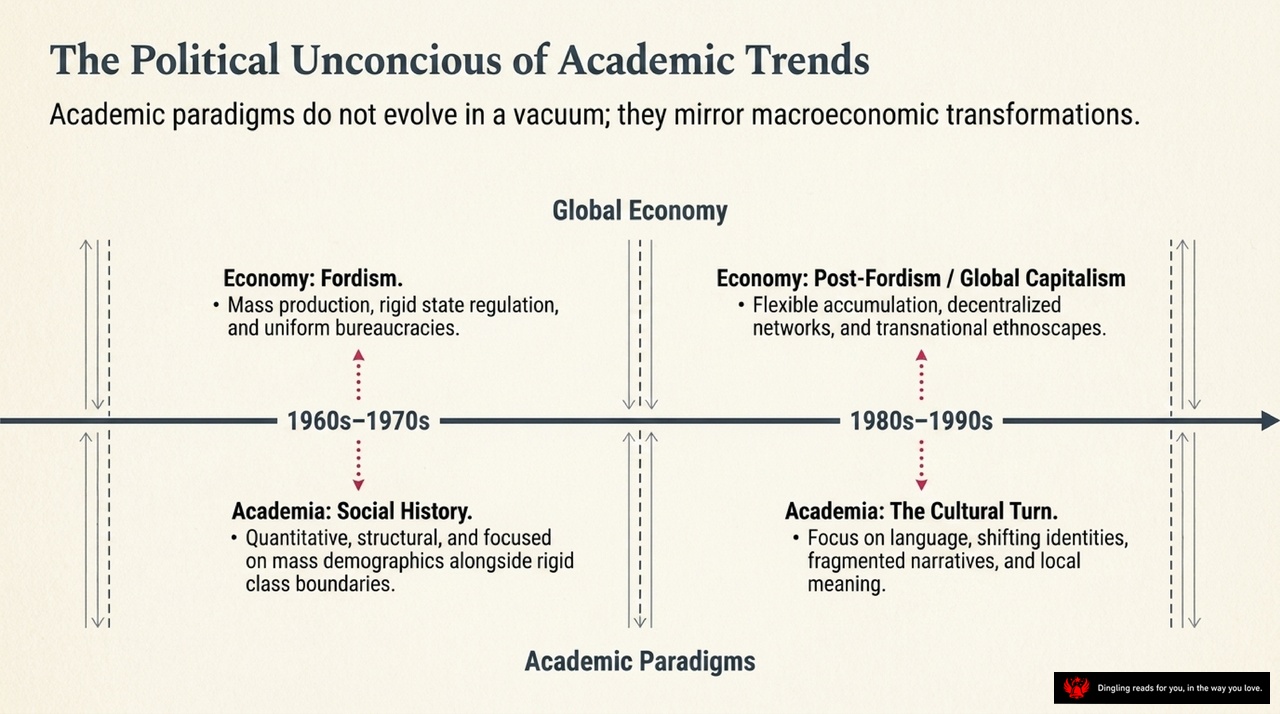
Historical sociology has fundamentally reshaped American sociology over the last three decades. In the 1960s, the field was obsessed with finding eternal laws governing contemporary society. But the civil rights and anti-war movements forced a shift toward studying social change and global inequality, giving rise to the critical importance of historical sociology.
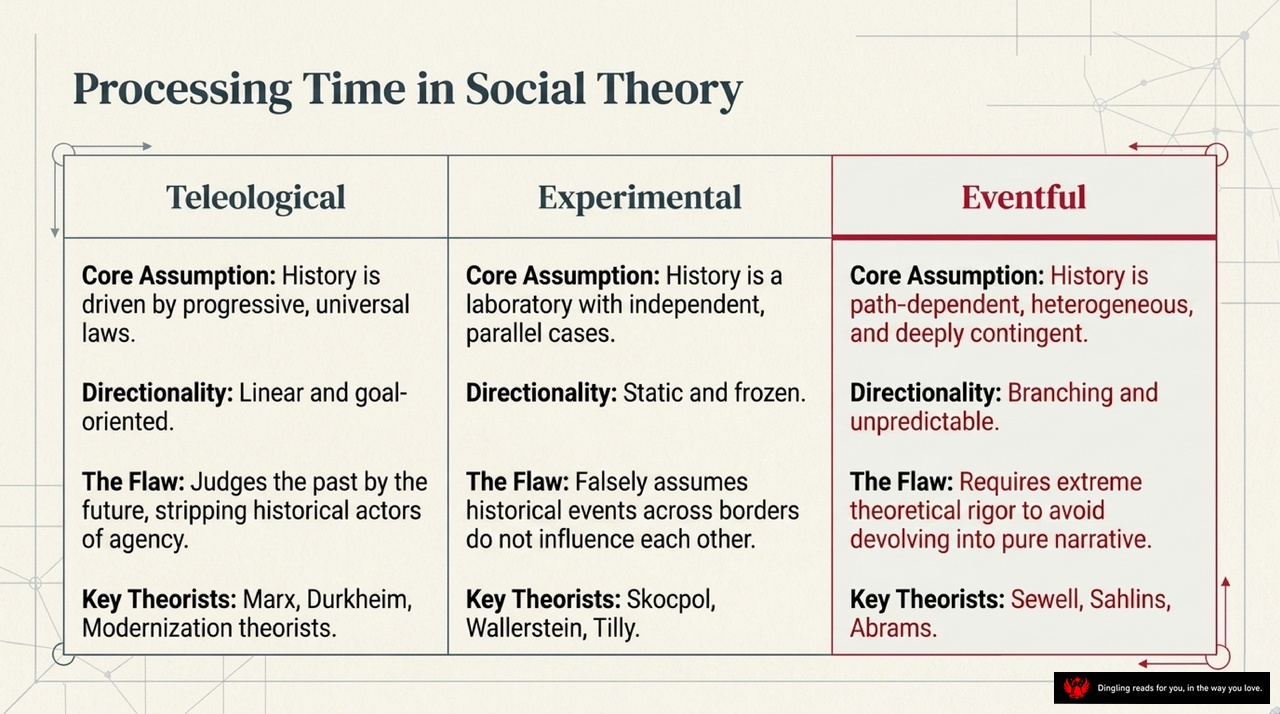
Today, we must confront three distinct ways time operates in social theory. First, there is teleological time, where history is seen as an inevitable march toward progress. Think of Wallerstein treating the Age of Discovery like a cosmic big bang, or Tilly linearizing urbanization. These views erase the messy reality of contingency. Second, there is experimental time, championed by scholars like Skocpol, who treat revolutions as lab experiments with independent variables. But this approach fails because revolutions are deeply path-dependent; early events inevitably shape later ones, making the "independent case" assumption a fatal flaw.
We need a third approach: eventful time. This perspective argues that history is driven by rare, contingent events that violently alter the course of social structures. It challenges the search for universal laws, instead focusing on how specific sequences of accidents and choices create unique outcomes. As Stephen Jay Gould noted in evolutionary biology, contingency is the central principle of history. Similarly, Michael Mann's massive work on the origins of civilization proves that even macro-historical trends are filled with historical accidents. Whether analyzing a local revolution or the rise of states, we must recognize that social time is not a fixed track, but an open, event-driven process where the past constantly reshapes the future.

Today, we're diving into the third pillar of our argument: the three distinct ways sociology has approached time, and why one of them is finally ready for a historical overhaul.
Mainstream sociology has long been obsessed with finding universal laws, treating human behavior like a predictable machine. This obsession has led to two major traps. First, we have teleological time. Think of it as a straight line of destiny. Pioneers like Comte and Marx viewed history as an inevitable march toward progress, where events like the discovery of the Americas were seen as cosmic explosions that made capitalism unavoidable. It ignores the messy, accidental reality of how things actually happen.
Second, we have experimental time. This approach tries to freeze history to make it testable. Scholars like Skocpol compare cases—like the French and Russian revolutions—as if they were identical lab experiments. But this ignores a crucial truth: history is path-dependent. An event in the past changes the rules for the future. You can't compare a revolution in 1789 with one in 1917 without accounting for the unique context created by the first.
So, what's the alternative? We need event time. This perspective argues that history isn't a straight line or a set of frozen experiments; it's a series of contingent moments where rare events break existing structures and create new ones. As Stephen Jay Gould noted in evolutionary biology, history is driven by chance, not just law. Michael Mann proved this works even on a massive scale, showing that the rise of civilization wasn't a linear evolution but a series of specific, accidental intersections of power.
By shifting from destiny and frozen experiments to event time, we finally give history its due. We acknowledge that the past is open, unpredictable, and full of unique opportunities that shaped our world. It's time to stop looking for a universal physics of society and start understanding the real, messy story of human change.
Today we're tackling one of the most confusing yet essential terms in the social sciences: "structure." It's everywhere, from sociology to anthropology, yet if you ask a student to define it, they often freeze. Even replacing it with "pattern" strips away its power. The current definition has three fatal flaws. First, it treats structure as an unchangeable ceiling, turning humans into robots who just follow orders, completely ignoring human agency. Second, it can't explain social change because the very metaphor of a stable structure makes change seem impossible, forcing us to look outside the system for any transformation. Third, it creates a massive disconnect between disciplines; sociologists see structure as hard, material stuff while culture is soft, whereas anthropologists often flip this, seeing culture as the core structure. This leads to scholars arguing past each other while using the exact same word.
But we can't throw away the term. Its rhetorical power is too strong. So, I propose a new structural theory to fix these issues. Let's look at how we can redefine it. Instead of seeing structure and agency as opposites, we can borrow from Giddens but refine his vague ideas. Structure isn't just virtual; it combines virtual cultural schemas—like shared rituals or binary thinking—with real, tangible resources like factories or capital. This duality allows us to see how culture and materiality work together.
To truly explain change from within, we need five core postulates. First, structural multiplicity: society isn't built on one monolithic structure but is supported by many overlapping ones, even within a single institution. Second, the transposability of schemas: people can take learned cultural patterns and creatively apply them in completely new contexts, which is the heart of agency. Third, the unpredictability of resource accumulation: investing in a new market might make you rich or bankrupt you, and this uncertainty directly alters how cultural schemas function. Fourth, the polysemy of resources: the same object, like a factory, can mean private property to one person and collective production to another, giving different actors varying degrees of power. Finally, structural intersectionality: different structures overlap and conflict, like capitalism clashing with union rules in a factory, allowing actors to borrow concepts from one structure to challenge another.
This reimagined structure is dynamic. It empowers and constrains us simultaneously, and crucially, its reproduction isn't automatic. Agency is built right into the structure. Everyone has the capacity to act, but the scope of that action depends entirely on our social position. A president in Chad has vastly different power than a president in Russia. When we apply this to capitalism, we see it as a deep structure where the core schema is the conversion of use-value into exchange-value. This logic permeates everything, from clothes to emotions. The surface chaos of capitalism actually reinforces its deep structure; the instability of the market proves the power of the commodity logic. Ultimately, by viewing structure as a flexible interplay of cultural schemas and material resources, we can finally understand how humans actively shape their own history through their interactions with the world.
In the modern academic landscape, the concept of "culture" has exploded across the humanities, yet its meaning has become dangerously muddled. We often confuse two distinct ideas: culture as a singular, abstract analytical category versus culture as a plural collection of specific, bounded worlds like "American culture" or "middle-class culture." Blurring these leads to theoretical dead ends. To make sense of this, we must view culture not as a static system or a mere set of practices, but as the symbolic dimension of social life that is inextricably linked to power and resource distribution.
Crucially, culture possesses a degree of autonomy. Its logic differs from economics or politics. Consider a desperate worker accepting a job; economically, it's a necessity, but culturally, it's an entry into a specific relationship defined by symbols. These symbols aren't locked to one context; they travel and reshape. Think of the color red: in politics, it signifies revolution, but in sports, the Cincinnati Reds had to change their name to the Redlegs because the political meaning was too charged. This shows how cultural networks operate independently yet interact with economic and political structures.
Furthermore, culture isn't a perfectly integrated whole. It has a "weak coherence." While we share a basic grammatical logic for symbols, we don't necessarily agree on their moral weight. We might speak the same language while holding opposing views. This fragility is actually where change happens. Cultural coherence is a battleground, constantly produced and contested by institutions like the state and religious groups, as well as by resistance movements. As we navigate these complex, often contradictory cultural fields, our job is to identify these local meanings and understand how they connect to create the social reality we inhabit.

Have you ever wondered why Clifford Geertz became such an icon in American anthropology, even earning the title of "the anthropologist's anthropologist"? While earlier figures like Margaret Mead tackled current social issues, Geertz focused on the moral and philosophical roles of our species, using ethnography to tell grand philosophical stories. His influence exploded beyond anthropology, reshaping fields from literature to the social sciences.
But here's the catch: while Geertz was hailed as an idol, he also faced fierce criticism. Realists argued he abandoned scientific standards for mere interpretation, while materialists like William Roseberry accused him of ignoring history, power, and social conflict. They claimed he treated culture as just a text, detached from the messy reality of how it's produced.
So why did historians embrace him so enthusiastically? There are two main reasons. First, Geertz's core insight—that human lifestyles are accidental and diverse—mirrors the historian's mission to discover diversity across time. Second, and crucially, his focus on "meaning" found in public symbols like rituals and texts offered a lifeline for social historians. Before Geertz, quantitative methods struggled to explain the deeper significance of ordinary people's lives. Geertz showed that we don't need to magically empathize with the dead; we can understand their world by analyzing the symbols they left behind.
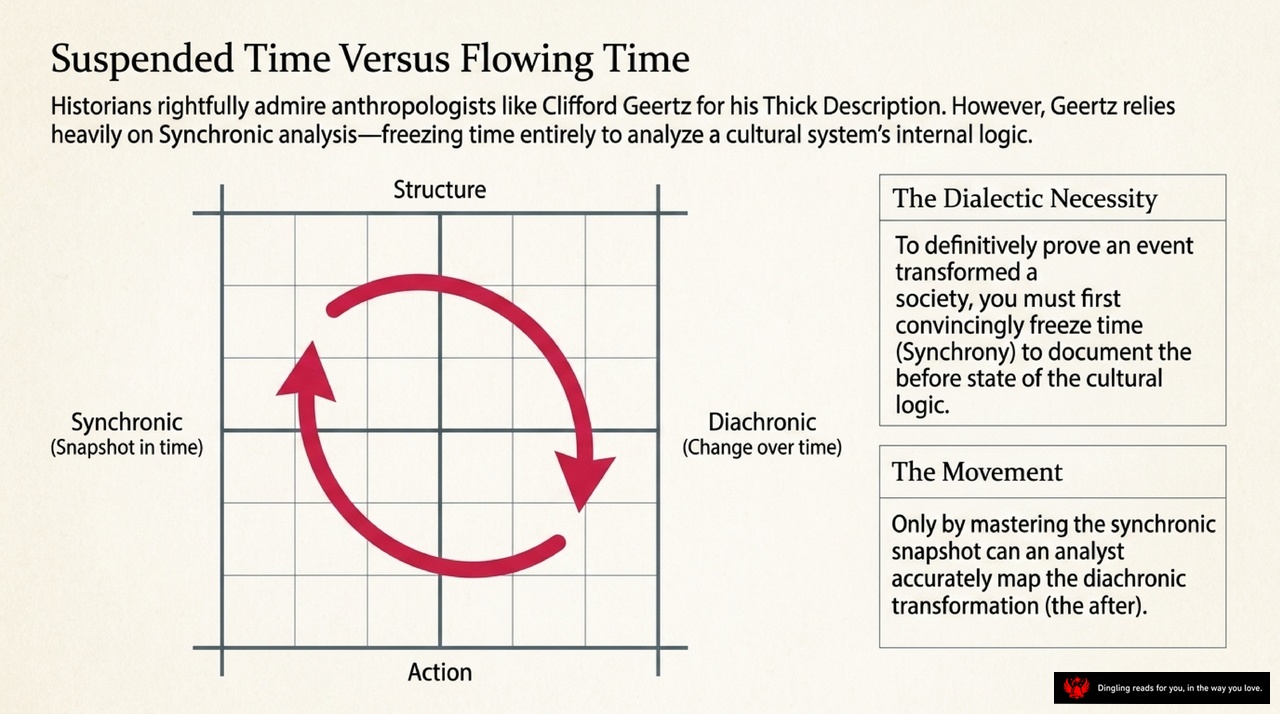
However, Geertz's theory has a major blind spot. It is a brilliant tool for analyzing a culture at a single moment—what we call synchronic analysis—but it's clumsy when it comes to explaining change. Most pre-1980s social theories, even those focused on transformation like Marxism, carried a teleological bias that Geertz overlooked. To use his insights for history, we must correct this. We need to accept his valuable epistemology and the biological basis of culture, but we must also force the concept of cultural change into the center of the theory, rather than treating it as an afterthought.
The key lies in Geertz's own idea that symbols are both models of reality and models for constructing it. He assumed these two models were like mirrors, perfectly reflecting each other. But they often aren't. When reality shifts—say, when factories open to women—old cultural codes become obsolete, creating a gap. This disconnect is actually the engine of change, giving actors space to rethink the world. Furthermore, Geertz underestimated the instability within human neural structures; even fixed cultural codes can trigger different responses, allowing new meanings to take root. Finally, Geertz focused too much on differences between societies, ignoring the internal conflicts between groups like farmers and merchants. It is precisely these internal clashes that drive historical transformation. So, while we must critique and expand Geertz's framework, his work remains an indispensable source of inspiration for understanding how history actually moves.
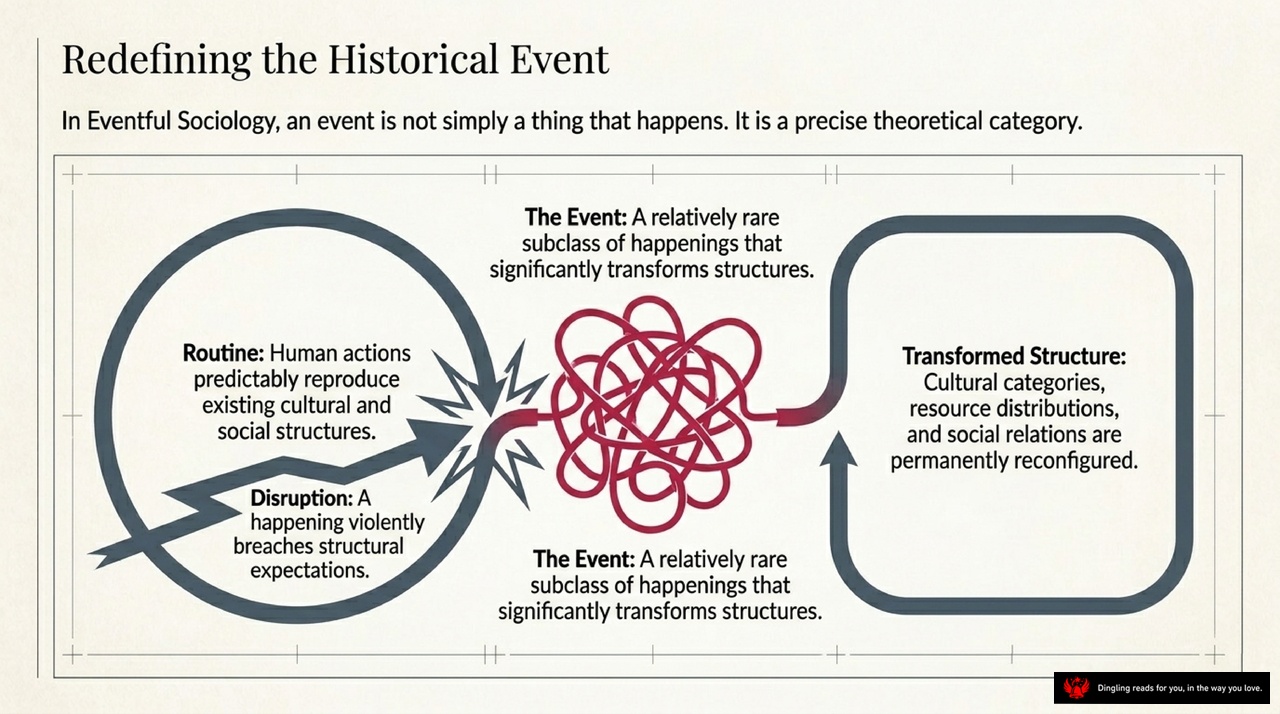
Have you ever wondered what we actually mean when we say "event"? In the social sciences, events are often dismissed as mere accidents or noise, ignored in the search for universal laws. But history tells a different story. Today, we're redefining the historical event not as a random occurrence, but as a precise theoretical category that drives real change.
Look at this diagram. It illustrates the core mechanism of "Eventful Sociology." On the left, we have **Routine**. This is the predictable cycle where human actions simply reproduce existing cultural and social structures. Life goes on, and nothing changes. But then, something breaks that cycle. That's **Disruption**: a happening that violently breaches our structural expectations. It's the spark that ignites the fire.
However, not every disruption becomes a true **Event**. The diagram shows that an Event is a relatively rare subclass of happenings that significantly transforms structures. It's the moment when that disruption triggers a chain reaction of subsequent breaks, making the old system impossible to repair. This is the messy, tangled red knot in the center—a chaotic but transformative process.
The result? A **Transformed Structure**. As the arrow shows, cultural categories, resource distributions, and social relations are permanently reconfigured. The event doesn't just happen and disappear; it leaves a new reality behind.
To understand this, let's look at the storming of the Bastille in 1789. Before that, the attack was just a violent disruption. But in the days following, the National Assembly reinterpreted this violence as the expression of "popular sovereignty." They turned a riot into a revolution. Suddenly, the structure of French politics was permanently altered. The event wasn't just the fighting; it was the reinterpretation that locked in a new social order.
This framework challenges the idea that history follows a straight line. Instead, it shows how specific, contingent sequences of events can redirect the entire course of human history, turning routine into revolution and reshaping the world forever.

Imagine a basketball game. You hear the referee blow the whistle, you see the playbook on the clipboard, and you hear the commentators debate the rules. It all feels like a game of language, right? But if you actually step onto the court, you'll quickly realize that the real action isn't happening in the words. It's in the eyes, the feet, and the muscle memory. When a player drives to the hoop, that split-second glance with a teammate isn't a sentence; it's a complex, unspoken signal that coordinates the entire offense. This is the crucial lesson we need to take away: the "social world" isn't just a giant conversation. It is a hybrid of language and physical practice, a "symbolic complex" where words and bodies work together.
Think about how the game itself evolved. Decades ago, defenses used tall players to block shots directly under the basket, making the game a boring contest of height. But players didn't just accept this; they physically changed how they moved. They developed new dribbling techniques and shot fakes to bypass the tall defenders. In response, the league didn't just talk about fairness; they physically changed the game by adding the "three-second rule" and the "no-blocking" rule. This back-and-forth between physical action and rule-making is how the sport actually changed. It wasn't a slow, inevitable drift; it was a series of creative, human responses to new situations.
This dynamic is exactly what happens in history. Just like basketball, our social structures aren't fixed laws written in stone. They are constantly being renegotiated through the clash of symbols and actions. Take the French Revolution. When the people stormed the Bastille, it wasn't just a violent outburst. The revolutionaries took this physical act of destruction and wove it into a powerful new story, linking it to the idea of "popular sovereignty." Suddenly, violence wasn't chaos; it became the very engine of democracy.
So, when we talk about the "social," we have to stop treating it like a static machine or a simple script. We need to see it as a living, breathing process where people use symbols and bodies to build their world, moment by moment. And remember, while numbers and statistics have their place in helping us spot patterns, they can never capture the full reality of human life. The true power of history lies in understanding how these symbolic practices connect and clash, driving us forward into an unpredictable future.
Have you ever stopped to ask what we actually mean when we say "society"? It seems like a simple question, but dig a little deeper, and even many professional scholars struggle to give a solid answer. Most social scientists care more about their own discipline's "scientific" status than defining the very concept of "society" itself. Economists try to align their field with mathematics, psychologists lean toward biology, and even sociologists often just repeat themselves by equating "society" with "social structure" or "social relations," leaving the term empty of real substance.
Interestingly, it is history—our hybrid discipline of social science and humanities—that has recently led the charge in rethinking "society." Cultural historians remind us that "society" is itself a historical construct, not a fixed reality. Its meaning has evolved over time. Originally, the word came from the Latin for "friend" or "companion," referring to active associations or groups gathering for common goals, like a Jesuit order. By the 17th century, it shifted to something more passive and abstract: a collection of people living under the same order. Later, it became tied to social contract theory. By the 19th century, thinkers like Saint-Simon and Comte treated "society" as an object with its own laws, and Émile Durkheim famously described it as a "collective reality sui generis." Today, we mostly use this reified, totalizing version, yet its ambiguity remains unresolved.
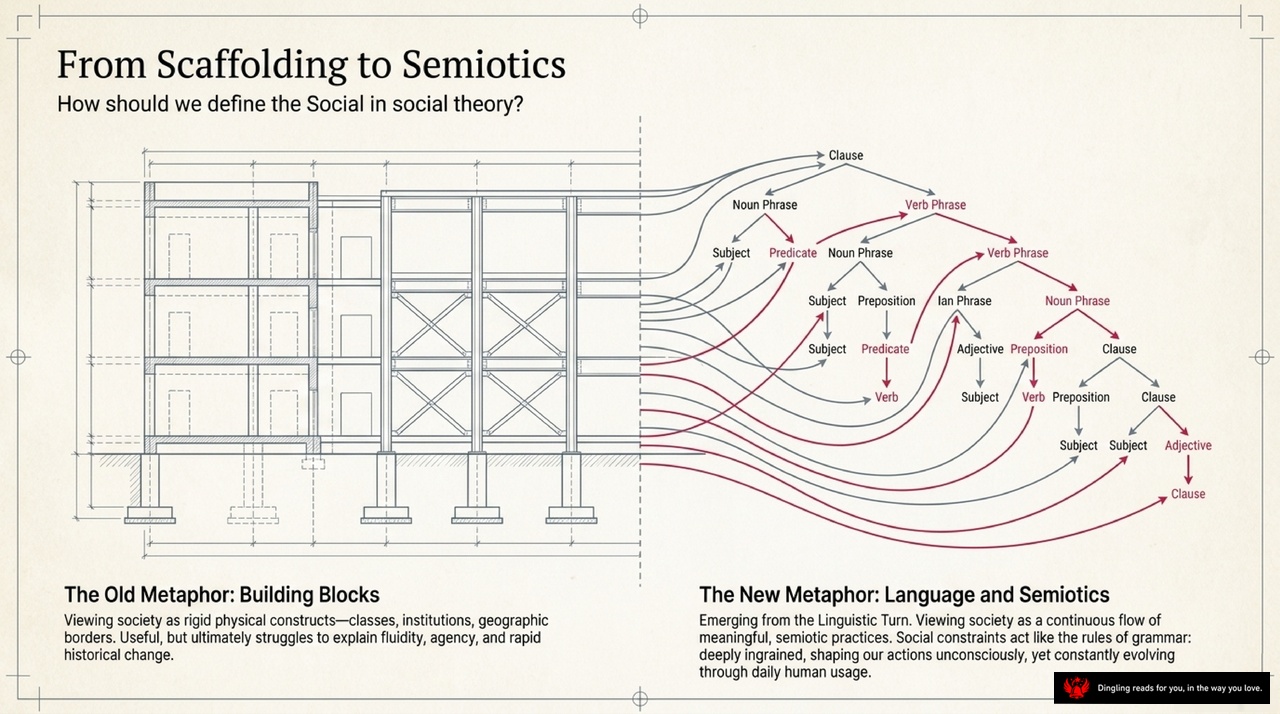
So, how do we make sense of it? We can view "society" as a complex text constructed by discourse, where all social activity relies on symbolic meaning. Or, drawing from Wittgenstein's idea of "language games," we can see society as a form of life where language is just one part, not the whole. We must acknowledge society as a web of human interdependence while recognizing that the symbols we use to describe it are only part of the picture.
To deepen this, let's look at a concrete example: a basketball game. Sure, there are countless terms—free throws, jump shots, pick-and-rolls—and the rules and strategies rely heavily on language. But what truly decides the outcome? It's the players' physical movements and unspoken默契. A glance during a jump shot, a coordinated block, a fake move to deceive the defender—these are forms of embodied knowledge learned through repetition. They form a symbolic system in their own right, distinct from linguistic rules. If we tried to analyze a game solely through language, we'd miss its core. This shows that social life is a complex composite of both discursive and non-discursive practices.
The real magic happens when these different symbolic practices connect. This connection is key to historical change. Think back to that basketball game: early teams used tall players to block shots, throwing off the balance. Officials responded by banning the interference rule, adding the three-second violation and the three-point line. Players, in turn, developed new tactics. This back-and-forth between physical action and rules created a feedback loop that reshaped the game itself. Similarly, in the French Revolution, the symbolic practice of popular violence connected with the discourse of popular sovereignty to create the entirely new category of "revolution," fundamentally altering history.
This logic applies to macro and micro scales. They aren't just abstract levels; they are different scales of symbolic practice connecting. Consider Argentina's middle class in the 2000s. They practiced a "life game" of frugality and saving money. But their savings were indirectly connected to a much larger scale: the global currency futures market. When traders massively shorted the peso, those local savings evaporated instantly, destroying their entire way of life. What we call "macro forces" are often just powerful symbolic practices on a larger scale that connect with our everyday lives.
Finally, we must address the limits of purely symbolic analysis. Quantitative research has its place. Because capitalism commodifies so much of life, numbers help us catch patterns that symbols might miss—think of batting averages in baseball or shooting percentages in basketball. But we must remember that quantification is a historical product, not the essence of society. Also, the unpredictability of human action is crucial. Adam Smith's "invisible hand" shows how individual selfishness can lead to public good, a result no single actor intended. While mechanical causality has its utility, we must ultimately return to analyzing symbolic practices to understand the invisible forces that shape our world.
This brings us to another powerful metaphor in the humanities and social sciences: "social construction." You've likely heard terms like "gender construction" or "national construction." Popular since the late 1970s and exploding in the late 80s, this idea argues that things we take for granted as natural—gender roles, national identities, racial differences—are actually historical accidents, products of accumulated human action. Its political power lies in showing us that these things aren't fixed; gender roles can change, nations can dissolve. Its analytical power lies in tracing how these concepts become institutionalized, embedding themselves in our habits, language, and daily lives.
Interestingly, a version of "construction" appeared earlier in linguistics, but it meant something different. Structuralists like Lévi-Strauss looked for unchanging essences in culture, ignoring history. Wittgenstein's "language games" hinted at construction but didn't explore its evolution over time. It wasn't until the late 20th century, with the "historical turn" in linguistics, that the diachronic metaphor of social construction truly took off. It emphasizes that construction is a process over time, requiring continuous human effort, yet once built, these structures gain immense inertia. Like Rome not being built in a day, gender relations or scientific truths, once constructed, become "taken-for-granted" facts.
There are two key differences between the linguistic metaphor and the construction metaphor. First is time: linguistic metaphors often focus on synchronic stability, ignoring change, while construction is inherently diachronic, emphasizing process and continuity. Second is materiality: language is relatively immaterial, but construction explicitly highlights the material. A jump shot in basketball started as a small innovation but became a standard skill because it offered a material advantage—helping players win more games. Likewise, the rhetoric of revolution succeeded in France not just because of words, but because it mobilized the physical bodies and emotional energies of the masses, creating an irreversible "facticity" on the ground.
To fully grasp how the social world is built, scholars also use the metaphor of the "built environment." This is broader than "social construction," encompassing the entire social world as something continuously built and rebuilt—material environments, institutions, routines, and habits. This metaphor helps reunite cultural history with traditional social history, clarifying the dialectical relationship between symbolic action and the material world: symbols shape the environment, and the environment, in turn, shapes our symbols.
Finally, don't assume quantitative and interpretive research are enemies. They can complement each other. For instance, historian Wawer used statistical methods to study changes in will language, tracing the "de-Christianization" of Provence in the 18th century. This shows that both perspectives are valuable tools for understanding the social world.
Have you ever stopped to ask what we actually mean when we talk about "society"? It sounds like a simple question, but if you dig deep, even many professional scholars struggle to give a solid answer. Most social scientists are too busy proving their own disciplines are "scientific" to really define the object they study. Economists try to mimic math; psychologists want to be biology; and even sociologists often just swap the word "society" for "social structure" or "social relations," which tells us nothing new.
Interestingly, it is historians—those who live between the humanities and social sciences—who are pushing the hardest on this definition. They remind us that "society" isn't a fixed reality waiting to be discovered; it is a historical construct. Its meaning has shifted over centuries. Originally, it referred to active companionship or groups gathering for a common goal. By the 17th century, it became more abstract, describing people living under the same order. Today, it often feels like a solid, physical thing, a "collective reality" as Émile Durkheim called it. But is it really a thing?
I propose we rethink "society" not as an object, but as a complex text made of discourse and practice. To understand this, let's look at something familiar: a basketball game. Sure, there are rules and language involved—terms like "free throw" or "pick and roll." But what actually decides the winner? It's the players' bodies. The eye contact during a jump shot, the physical coordination for a layup, the subtle feints to fool a defender. These are non-verbal symbolic practices. If we tried to analyze basketball using only linguistic rules, we'd miss the whole point. This shows that "society" is a hybrid of verbal and non-verbal symbols.
The real magic happens when these different symbolic practices connect. Think back to the French Revolution. The physical act of violence in the streets didn't just happen; it was linked through language to the concept of "popular sovereignty." That connection created a new category: the "Revolution." It changed the direction of history. Similarly, consider Argentina's economic crisis. Middle-class families were practicing "saving" based on local values. But their savings were connected to a massive, global financial market where traders were selling off the peso. When those traders acted, the local "game" was instantly destroyed. This reveals that macro forces are just larger-scale symbolic practices interacting with our daily lives.
Finally, we must address the metaphor of "social construction." You've heard it everywhere regarding gender or race. It means these things aren't natural; they are built over time through human action. But there's a crucial difference between "construction" and "language." Language metaphors often focus on stable, timeless systems. Construction metaphors are about time and process. They emphasize that social forms are built, maintained, and can be rebuilt. This "built environment" metaphor helps us see the full picture: our symbols shape our physical world, and our physical world, in turn, shapes our symbols. We aren't just trapped in a text; we are constantly building and rebuilding the world around us, one action at a time.
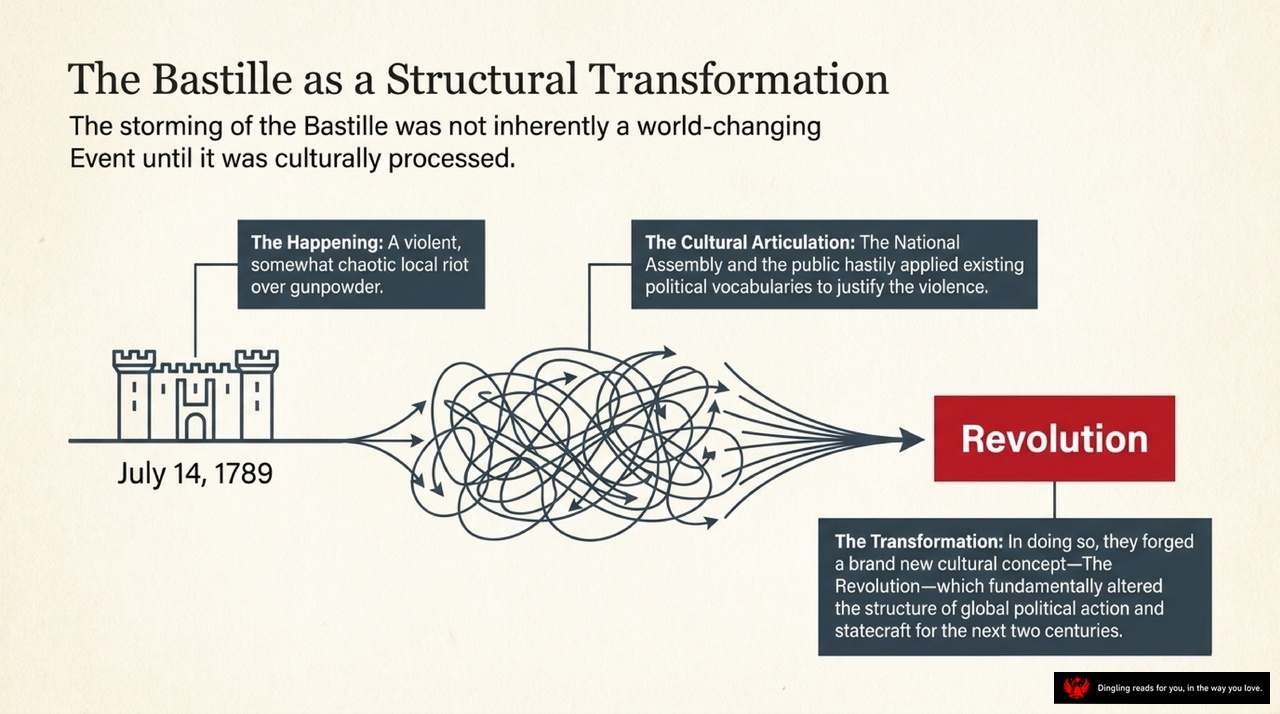
The storming of the Bastille on July 14, 1789, is often treated as the inevitable spark that ignited the French Revolution. But this slide reveals a much more fascinating truth: the event itself wasn't inherently world-changing. It only became a "Revolution"—a concept that reshaped global politics for two centuries—because of how we culturally processed it.
Look at the diagram. On the left, we have "The Happening": a violent, chaotic local riot over gunpowder. It was messy, unpredictable, and largely insignificant in the moment. Then, in the middle, we see a chaotic web of arrows representing the cultural processing. This is where "The Cultural Articulation" happens. The National Assembly and the public didn't just react to the violence; they hastily applied existing political vocabularies to justify it. They took a riot and rebranded it as an act of "The People" fighting against tyranny.
This transformation is the key. By reframing a local disturbance into a universal struggle for sovereignty, they forged a brand new cultural concept. They didn't just create a revolution; they created the very idea of "Revolution" as a tool for political change. This cultural shift fundamentally altered the structure of global political action, turning a specific French event into a template for every uprising that followed. So, the lesson isn't about the cannons at the Bastille, but about how our stories and symbols turn local chaos into global history.
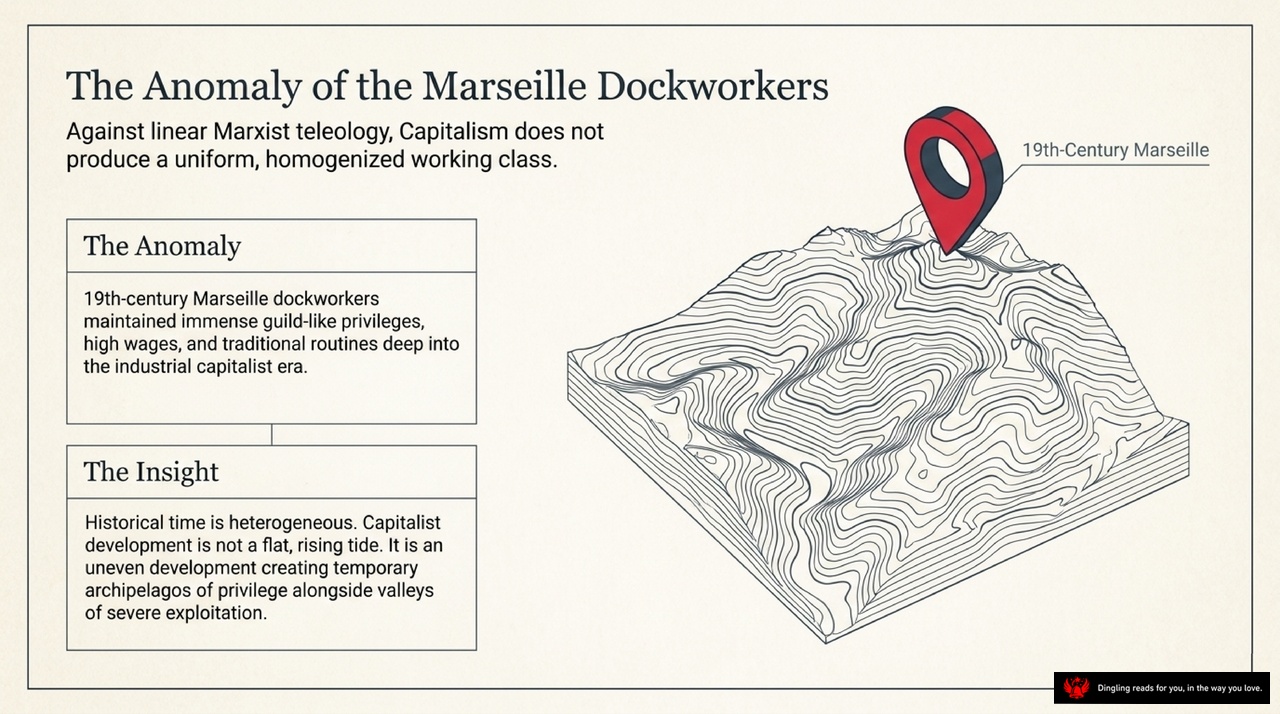
Have you ever looked at a map and assumed that history moves in a straight, upward line? That capitalism inevitably creates a uniform, homogenized working class for everyone? Well, the 19th-century dockworkers of Marseille prove that wrong.
As we see here, these workers were a true anomaly. While the rest of Europe was being crushed by industrial capitalism, Marseille's dockers held onto immense guild-like privileges. They enjoyed high wages, traditional routines, and a tight-knit community deep into the industrial era. They didn't fit the standard narrative of the suffering proletariat.
This leads us to a crucial insight: historical time is not a flat, rising tide. Capitalist development is uneven and heterogeneous. It creates temporary archipelagos of privilege alongside valleys of severe exploitation. The Marseille dockers weren't an exception to the rule; they were proof that the rule itself was flawed. Capitalism does not produce a single type of worker; instead, it creates a chaotic landscape where some get exploited while others, like these dockers, manage to carve out their own protected islands of power.

So, let's put it all together. We've just walked through the mechanics of how a single event—like the storming of the Bastille—can trigger a total restructuring of society. But here's the crucial question: if events are so powerful, why do our broad social structures often stay stubbornly the same for centuries? How do we explain that stability when history is supposed to be about change?
To answer this, we have to look at a case study that defies the usual "inevitable rise of the working class" narrative. Consider the dockworkers of Marseille in the 19th century. For most of that century, they weren't the exploited masses you see in textbooks. They were a privileged elite. They held a monopoly on the docks, enforced their own rules, and earned double the wages of other laborers. Their power wasn't just about numbers; it was a specific cultural and material structure that allowed them to act as the "good guys" for the state, even against other workers.
But then, something shifted. The structure didn't just break; it was renegotiated. As the port expanded and technology changed, the old rules of privilege couldn't hold. The dockworkers' identity flipped from being a protected guild to being a revolutionary force. This wasn't a straight line from "worker" to "revolutionary." It was a complex collision of economic shifts, political upheavals, and specific, contingent moments where the old cultural meanings simply no longer fit the material reality.
This brings us back to our unified theory. Social transformation isn't a smooth slide from one era to the next. It's a dynamic tension between these enduring structures and the fluid, event-driven practices that constantly test their limits. The Bastille showed us how an event can shatter a structure. The Marseille dockers show us how a structure can persist for generations before a new sequence of events and cultural reinterpretations finally cracks it open. History is this endless dance between the stability of our routines and the explosive potential of the unexpected.

History isn't just a random shuffle of events, nor is it a rigid train track following inevitable laws. It's actually a continuous, unfolding story where human agency navigates cultural structures, often through rare, fateful moments that radically transform them. Think about it: if our social reality is just a historical construct woven from past events, then those structures we think are permanent today are actually just waiting for the right moment to unravel.
Consider the concept of "social construction." We often hear terms like "gender construction" or "national identity," assuming these are natural, fixed things. But the truth is, they are historically contingent products of human action. Just like a basketball game, where the rules, the language, and the physical movements constantly co-evolve to create the sport itself, our social world is built through a dynamic interplay of symbols and material practices. When a new rule changes the game, or a revolutionary slogan mobilizes a crowd, it doesn't just reflect reality; it actively reshapes it.
This means that nothing is as solid as it seems. The structures we rely on—whether they are economic systems, gender roles, or political institutions—are not eternal laws of nature. They are fragile, open to reinterpretation, and dependent on specific historical conjunctures. What feels permanent is often just a temporary stability, ready to be disrupted by the next unexpected event. So, when we look at history, we shouldn't look for a fixed script. Instead, we should see it as a series of possibilities, where human choices and cultural shifts constantly rewrite the rules of the game, proving that our social world is always in the making.