
The Long Tail: Complete Chapter-by-Chapter Summary
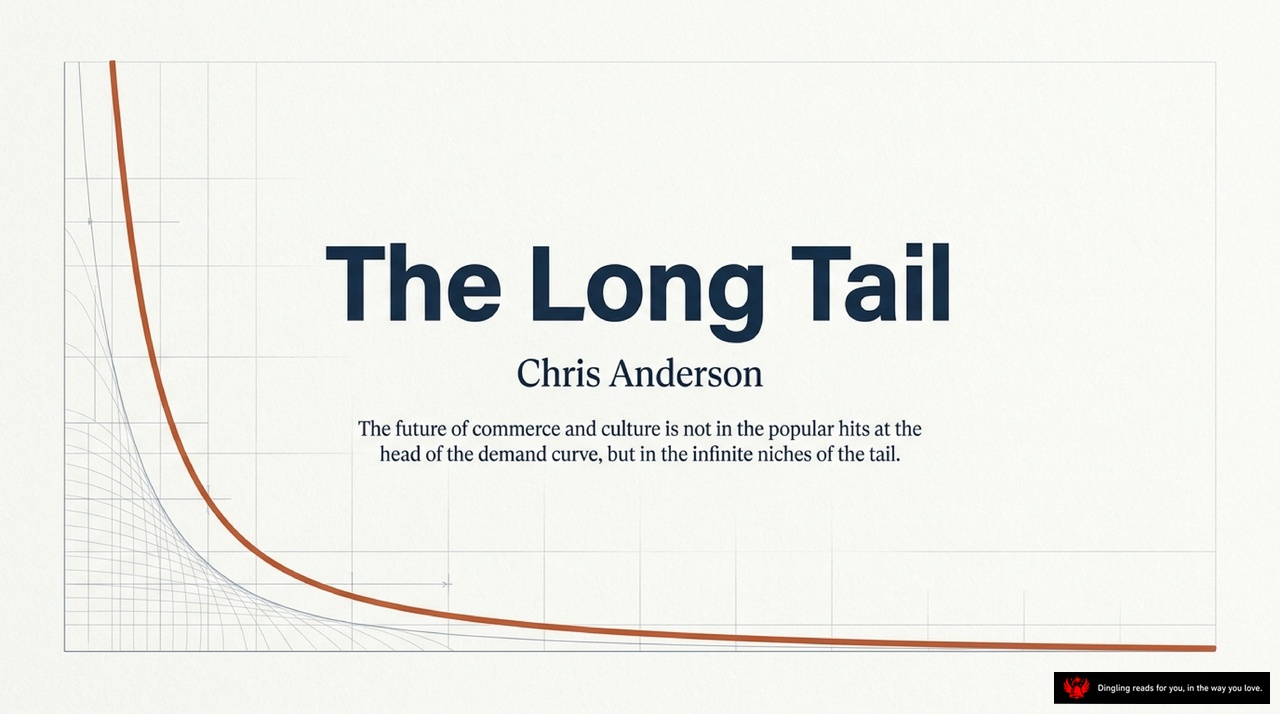
Welcome to today's session on "The Long Tail," a concept that fundamentally reshaped how we think about commerce and culture. Created by Chris Anderson, this idea challenges the long-held belief that only the biggest hits matter. As you see on this slide, the core message is clear: the future isn't about the popular hits at the top of the demand curve, but rather in the infinite niches of the tail.
For decades, we were trapped by the limitations of the physical world. Think about it: a record store could only hold so many CDs, a radio station could only play so many songs, and a movie theater needed a large crowd to survive. These physical constraints forced businesses to focus only on the few products that could sell in huge volumes, effectively ignoring millions of other potential interests. This created a culture of homogeneity where everyone consumed the same mainstream hits.
But the digital age broke these shackles. With infinite digital shelf space, storage costs that are nearly zero, and algorithms that connect niche products with their specific audiences, the "long tail" of obscure items has become a massive market. It's not just about finding a rare book or an old song anymore; it's about the realization that when you aggregate enough small demands, they equal or even surpass the power of the mainstream. We are moving from a world of scarcity, where we had to choose the biggest hits, to an era of abundance where every unique interest can find its audience.
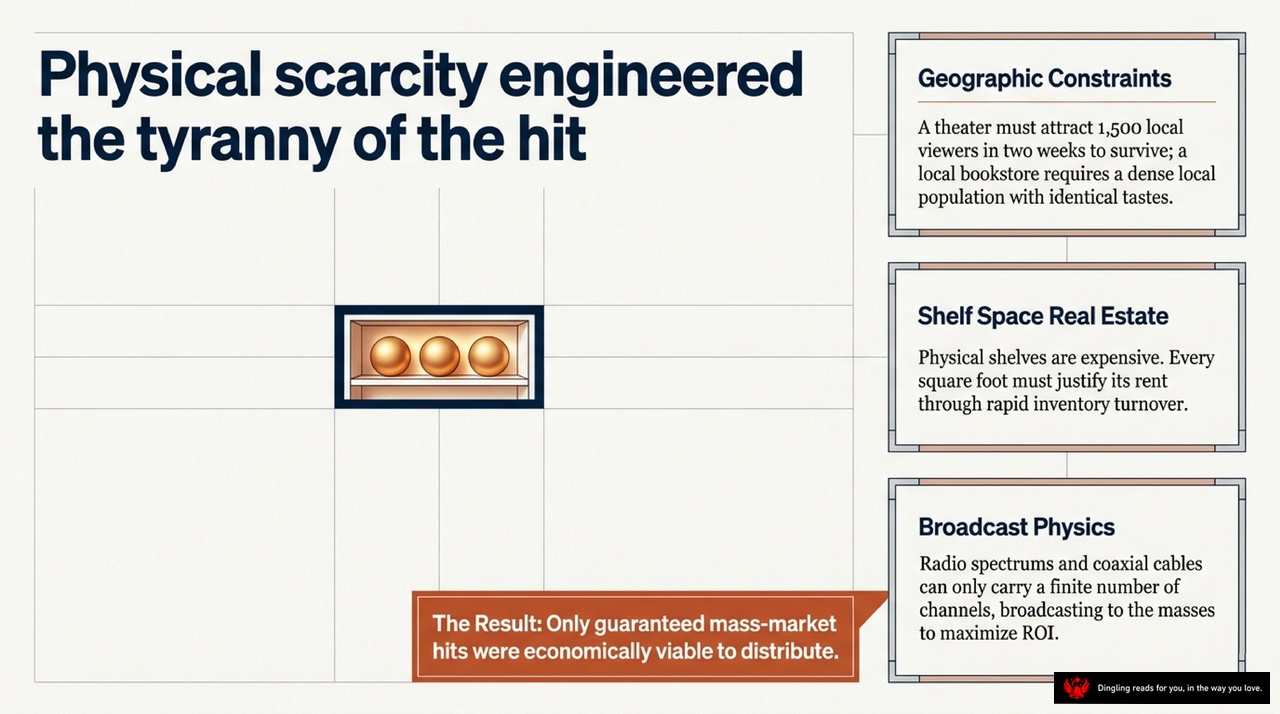
Physical scarcity engineered the tyranny of the hit. In the old world, geography was a hard limit. A theater had to pull in 1,500 local viewers in just two weeks to cover its rent, and a bookstore needed a dense neighborhood with identical tastes to survive. If your audience was scattered, you simply didn't exist.
Then there's shelf space real estate. Physical shelves are expensive, and every square foot must justify its rent through rapid inventory turnover. This forces retailers into a zero-sum game: every spot given to a blockbuster means a niche product gets pushed out. Supermarkets charge premium fees for prime eye-level spots because they sell five times better than the bottom shelf. It's a brutal filter that only lets the loudest hits through.
Broadcast physics added another layer of restriction. Radio spectrums and coaxial cables can only carry a finite number of channels. To maximize ROI, broadcasters had no choice but to focus on the masses, looping the same popular shows and chart-topping songs. There was simply no room for the niche.
The result? Only guaranteed mass-market hits were economically viable to distribute. We were trapped in a narrow mainstream culture, forced to accept whatever the big players decided was popular. But this wasn't nature; it was engineering. The rules of physics and economics conspired to silence everything that didn't scream for attention.
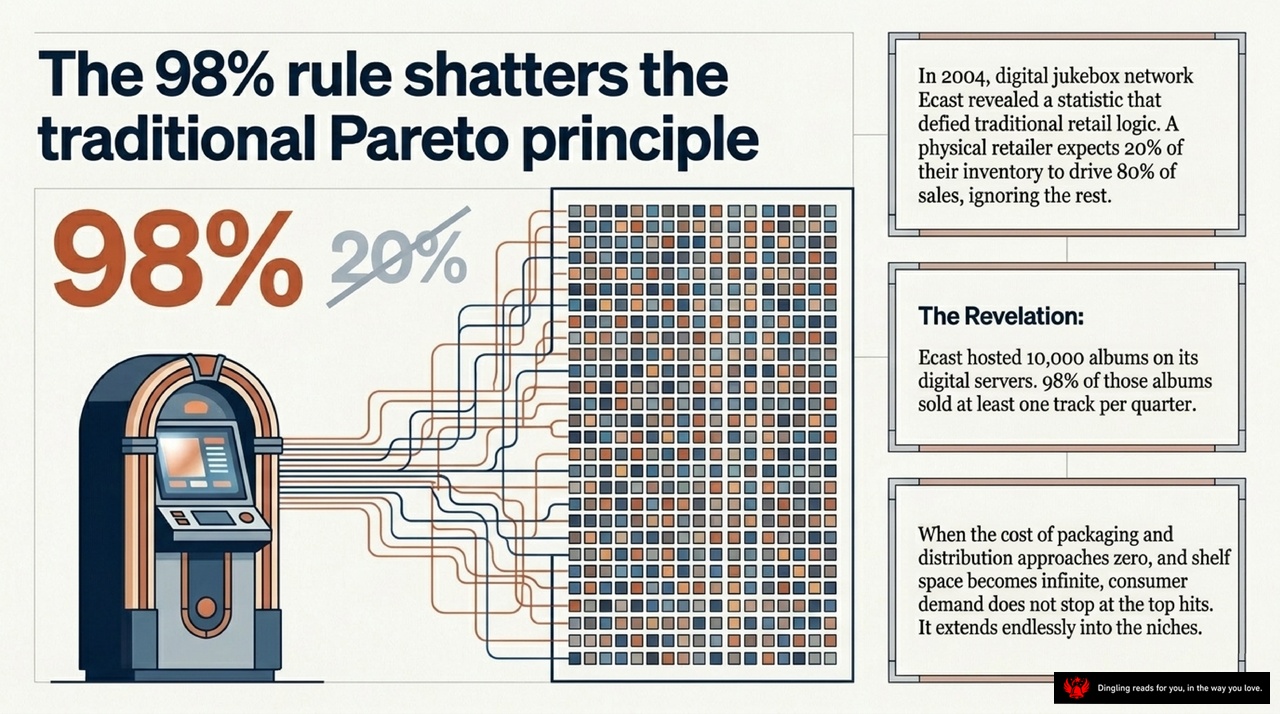
Imagine a world where the old rules of business don't apply anymore. For decades, we've been taught the Pareto Principle: that 20% of your products drive 80% of your sales. It makes sense for a physical store, right? You have limited shelf space, so you only stock the hits. But what happens when you remove the limits?
In 2004, a digital jukebox network called Ecast dropped a bombshell statistic that shattered this traditional logic. While a physical retailer expects only 20% of inventory to drive the bulk of sales, Ecast hosted 10,000 albums on its digital servers, and here's the revelation: 98% of those albums sold at least one track per quarter.
Think about that. When the cost of packaging and distribution approaches zero, and shelf space becomes infinite, consumer demand doesn't stop at the top hits. It extends endlessly into the niches. The "98% rule" proves that in a digital age, the long tail isn't just a supplement to the mainstream; it's a massive, thriving market waiting to be discovered.

Look at this chart titled "The mathematical anatomy of infinite choice." It visually captures a fundamental shift in how we understand value. On the left, we have "The Head," labeled as "The Hits." This represents high volume with scarce supply—the traditional domain of Blockbuster, Wal-Mart, and Top 40 Radio. It's the steep, dark blue curve where a few massive products dominate the market.
But look to the right. That long, flat orange line stretching out? That is "The Tail," or "The Niches." Here, volume is low for any single item, but the supply is infinite. Think of the digital ecosystems of Amazon, Netflix, and iTunes. The economic insight at the bottom right reveals the real story: the collective area under this infinite tail is equal to, or even larger than, the area of the head.
This means millions of micro-markets combine to rival the mainstream mass market. We used to believe only the biggest hits mattered because physical shelves and radio airwaves were too expensive to fill with everything. But in a digital world with zero storage costs, those tiny, overlooked interests aggregate into a massive force. The biggest wealth, as the book suggests, is actually born from the smallest sales. The tail isn't just a leftover; it's a treasure trove waiting to be unlocked.
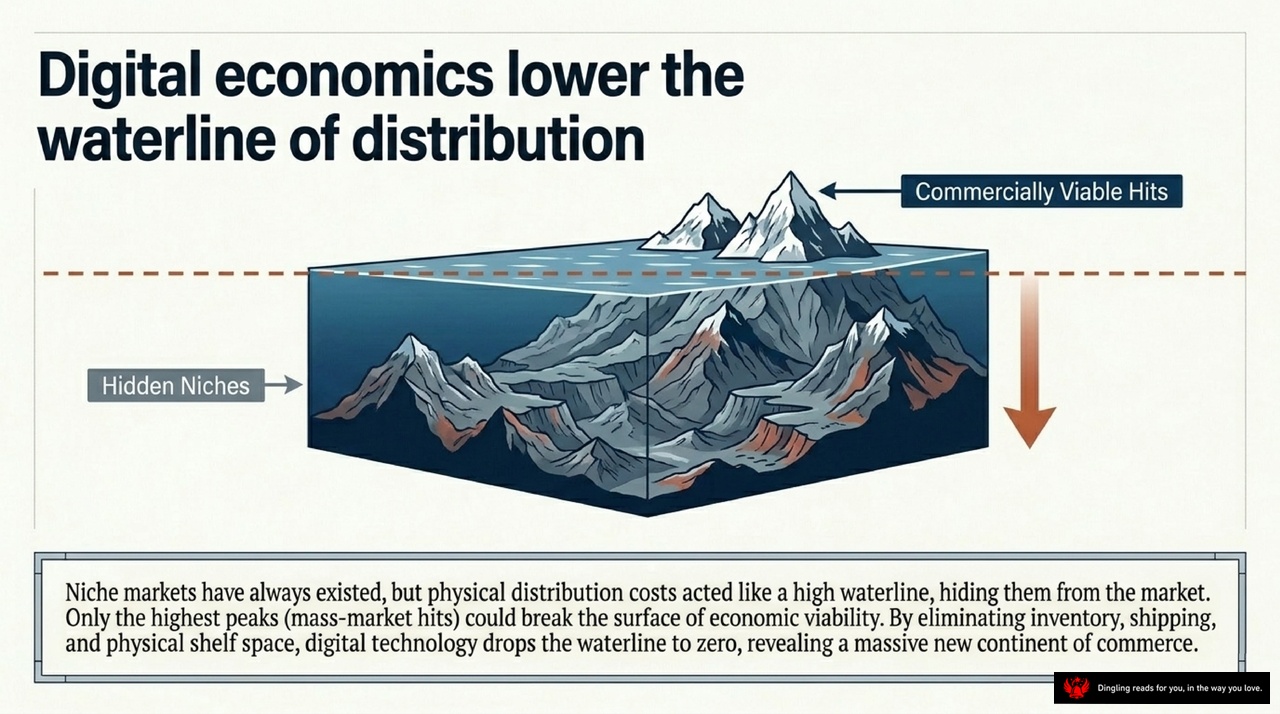
Imagine a mountain range where only the tallest peaks break the surface, while the rest remain hidden beneath a high waterline. This is the reality of the physical world, where high distribution costs and limited shelf space act like that waterline, hiding vast amounts of commerce. In traditional retail, only the biggest hits—those massive peaks with enough volume to cover the cost of inventory and shipping—could ever be seen by consumers. Everything else, the hidden niches, was effectively invisible.
But digital economics changes the rules entirely. By eliminating inventory, shipping, and physical shelf space, technology drops that waterline all the way to zero. Suddenly, the entire submerged mountain range emerges. We don't just see the top few peaks anymore; we reveal a massive new continent of commerce filled with millions of products that were previously impossible to sell. This shift doesn't just add a few new items; it unlocks a hidden market where the aggregate demand for these niche products is actually larger than the mainstream market we thought we knew. The waterline is gone, and the long tail is finally visible.
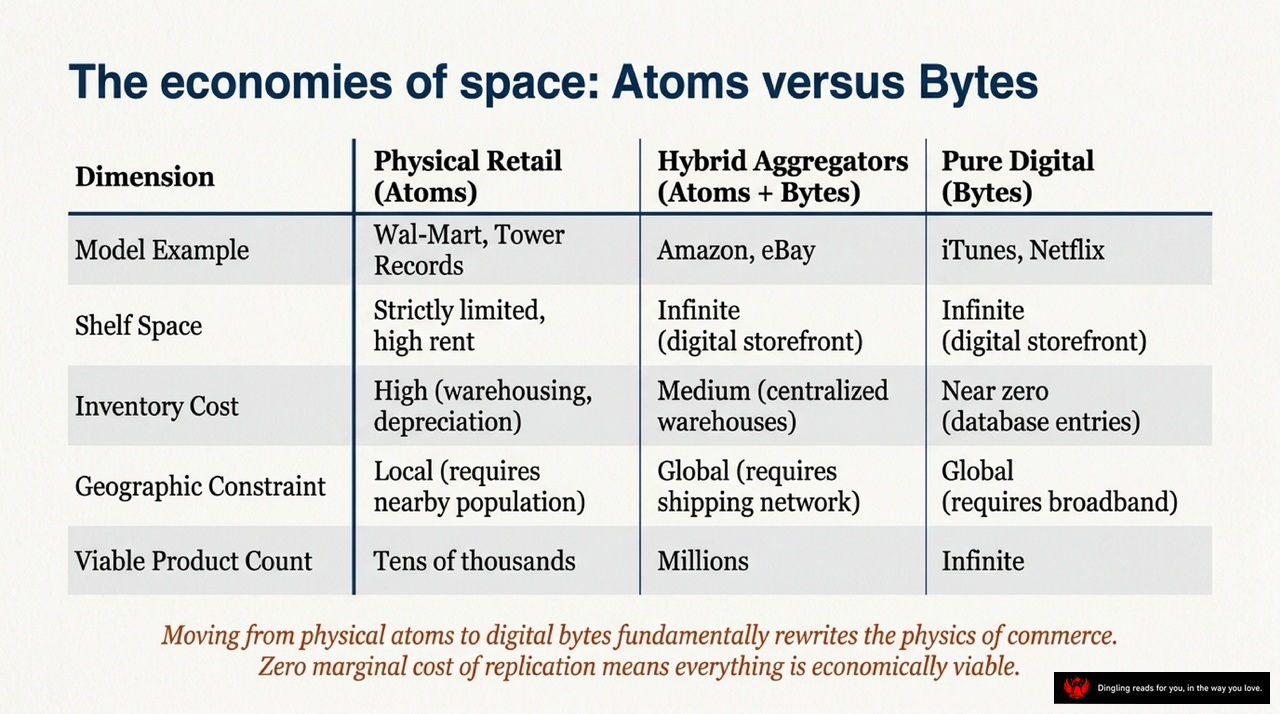
Today's slide breaks down the fundamental shift from "Atoms" to "Bytes," illustrating how the economics of space have rewritten the rules of commerce.
On the left, we have **Physical Retail**, represented by giants like Walmart or Tower Records. The constraints here are brutal: shelf space is strictly limited and comes with high rent. Inventory costs are heavy due to warehousing and depreciation, and you are geographically locked to a local population. Because of these physical limits, you can only stock tens of thousands of products. Every slot on the shelf is a zero-sum game; if a hot item takes a spot, a niche product is pushed out.
In the middle, we see **Hybrid Aggregators** like Amazon and eBay. They bridge the gap. They offer an infinite digital storefront, which eliminates the physical shelf limit. Inventory costs drop to medium levels because they can use centralized warehouses. While they are still bound by geography—requiring a shipping network—they can now stock millions of products. This is the transition phase where the long tail begins to emerge.
On the far right is the **Pure Digital** model, exemplified by iTunes and Netflix. Here, the physics of commerce change completely. Shelf space is infinite because it's just a database entry. Inventory costs are near zero since there are no physical discs to ship or store. Geographic constraints vanish entirely; all you need is broadband. This allows for an infinite product count.
The key takeaway at the bottom is profound: moving from atoms to bytes fundamentally rewrites the physics of commerce. When the marginal cost of replication hits zero, everything becomes economically viable. We are no longer forced to choose only the biggest hits to fill our shelves; instead, we can offer the entire spectrum of human interest, turning the "long tail" into a massive, viable market.
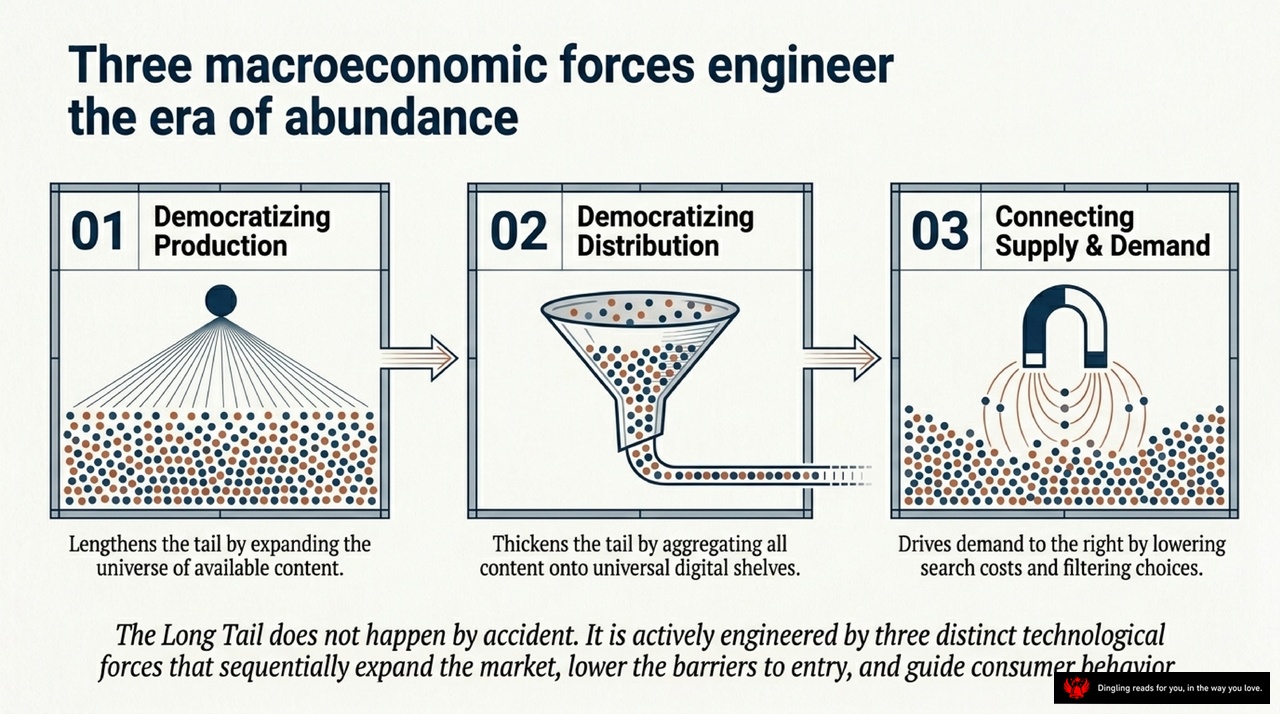
The Long Tail doesn't happen by accident. It is actively engineered by three distinct technological forces that sequentially expand the market, lower the barriers to entry, and guide consumer behavior.
Let's break down these three macroeconomic forces that define our era of abundance.
First, we have Democratizing Production. This is about expanding the universe of available content. In the past, creating music, books, or films required expensive studios and professional gatekeepers. But today, thanks to personal computers and the internet, anyone can become a creator. Whether it's an independent musician recording in a bedroom or a writer self-publishing a novel, the tools are now in everyone's hands. This force lengthens the tail by simply adding millions of new voices and products that were previously impossible to make.
Second, we have Democratizing Distribution. Once content is created, how do we get it to people? In the physical world, you were limited by shelf space and geography. A local record store simply couldn't stock every song, and a bookshop in a rural town couldn't serve a niche interest elsewhere. But digital platforms act as universal aggregators. Think of Amazon or iTunes; they don't just have shelves; they have infinite digital shelves. They aggregate all this diverse content from around the world onto a single platform. This thickens the tail, ensuring that even the most obscure niche product has a place to sit next to the biggest blockbusters.
Finally, we have Connecting Supply and Demand. Having a massive library of products isn't enough if consumers can't find them. In the past, searching for a specific book or song was a tedious, high-cost effort. Today, search engines, recommendation algorithms, and user reviews act as powerful magnets. They drastically lower search costs and filter choices for us. If you have a specific taste, the technology finds it for you instantly. This drives demand to the right, turning those tiny, scattered niche interests into a viable market.
Together, these three forces—producing more, distributing everywhere, and connecting us efficiently—create the Long Tail. They transform a world of scarcity into a world of abundance, proving that the biggest wealth is often found in the smallest sales.

Force 1: Democratized production lengthens the tail. Think about how we used to make culture. For decades, the tools were too expensive—printing presses, recording studios, film cameras. Only big gatekeepers like movie studios and record labels could play. But the PC revolution changed everything. Suddenly, anyone with a desktop computer and some software could rival a professional studio. This shift gave the power to create to millions of amateurs.
Look at the graphic on the left. On top, you have those historic hubs. But now, look at the bottom. That explosion of lines represents modern creators: independent artists, bloggers, and amateurs. Because the barrier to entry vanished, the universe of available content expanded exponentially. We moved from a world with limited shelves to one with infinite supply.
The result? The long tail stretches out infinitely to the right. The barrier to creation is gone, and so is the limit on what we can produce. Instead of being forced into a few mainstream choices, we now have an infinite supply of content. This democratization doesn't just add a few new options; it fundamentally reshapes the market, allowing niche interests to thrive alongside the hits.

Force 2: Democratized distribution thickens the tail. This slide captures the heart of the Long Tail revolution. On the left, you see the magic of the Internet: it drives the cost of reaching an audience to effectively zero. In the old physical world, you needed trucking fleets and retail buyers to move a product. Today, the Internet acts as a universal distribution network, eliminating those barriers entirely.
This leads to the central concept: The Aggregator. Think of giants like Amazon, iTunes, and YouTube. These platforms provide what the right box calls "Infinite Shelf Space." Because the cost of distribution is near-zero, digital aggregators offer limitless inventory capacity. Suddenly, every piece of niche content becomes commercially viable. That's how the tail thickens.
Remember the story of *Touching the Peak*? In a traditional bookstore, that book was long gone, buried by the need for prime shelf space. But on Amazon, the algorithm picked it up based on reader comments and linked it to similar titles. It didn't need a prime spot; it just needed to be findable. This is the power of the aggregator: it breaks the scarcity of physical space, allowing the vast volume of non-hot products to compete with the mainstream. The tail isn't just a sliver anymore; thanks to democratized distribution, it's becoming a massive, thriving market.
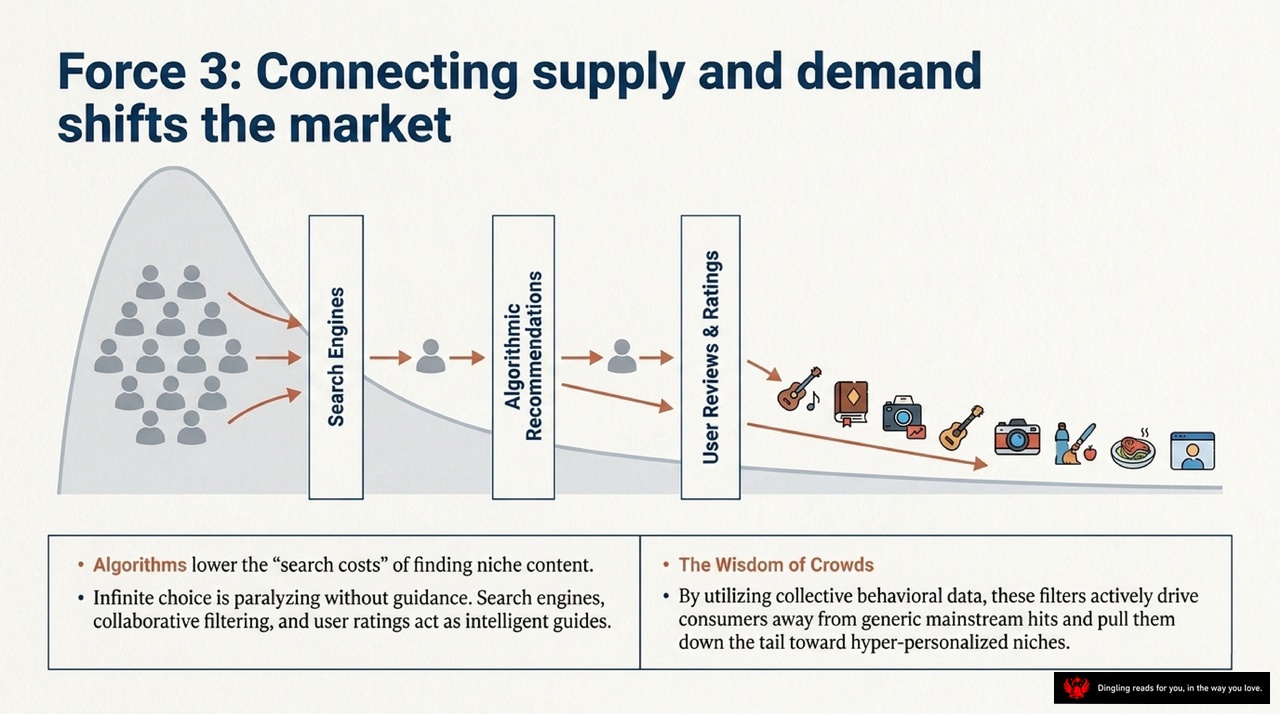
Imagine a world where finding the perfect guitar, that obscure book, or the specific camera lens you've been dreaming about used to feel like an impossible quest. In the past, physical limits—like how many CDs a store could hold or how far a radio signal traveled—forced everyone to listen to the same hits and buy the same bestsellers. It was a game of scarcity, where the most popular items crushed everything else.
But today, the rules have completely flipped. As shown in this slide, three powerful forces are reshaping the market: Search Engines, Algorithmic Recommendations, and User Reviews. These aren't just tools; they are intelligent guides that solve the problem of "choice paralysis." When faced with infinite options, we often freeze. But algorithms lower the cost of searching, instantly connecting you with niche content that fits your unique taste.
This is where the "Wisdom of Crowds" comes in. By analyzing collective behavior, these filters actively pull you away from generic mainstream hits and guide you down the long tail toward hyper-personalized niches. It's a positive feedback loop: you find a niche product, leave a review, and that recommendation helps the next person discover it. This shift means the market is no longer about dominating the center stage; it's about empowering every small corner of interest. The biggest wealth, as the data shows, is actually born from the smallest sales, creating a vibrant, diverse ecosystem where everyone's unique taste finally has a place.
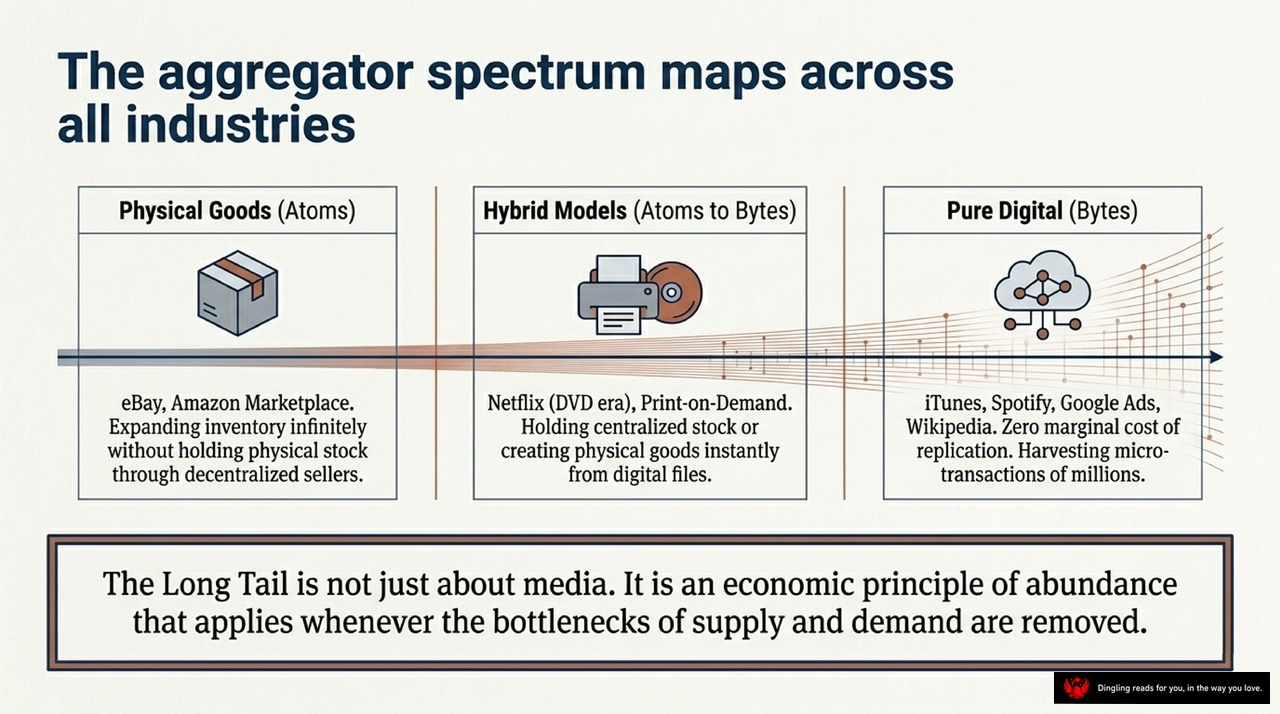
The aggregator spectrum maps across all industries, showing how the long tail principle transforms the economy from atoms to pure bytes. On the left, we see Physical Goods, or "atoms," where platforms like eBay and Amazon Marketplace expand inventory infinitely without holding physical stock, relying instead on decentralized sellers. Moving to the center, Hybrid Models blend atoms and bytes, exemplified by the DVD era's Netflix and print-on-demand services, which hold centralized stock or create physical goods instantly from digital files. On the far right lies Pure Digital, or "bytes," represented by cloud-based giants like iTunes, Spotify, and Google Ads. Here, the marginal cost of replication is zero, allowing platforms to harvest micro-transactions from millions of users. This spectrum illustrates a fundamental shift: the long tail is not just about media; it is an economic principle of abundance that applies whenever the bottlenecks of supply and demand are removed. By eliminating the scarcity of physical shelves and broadcast slots, digital aggregators unlock a vast universe of niche products, proving that true abundance emerges when we stop limiting ourselves to the few and start serving the many.
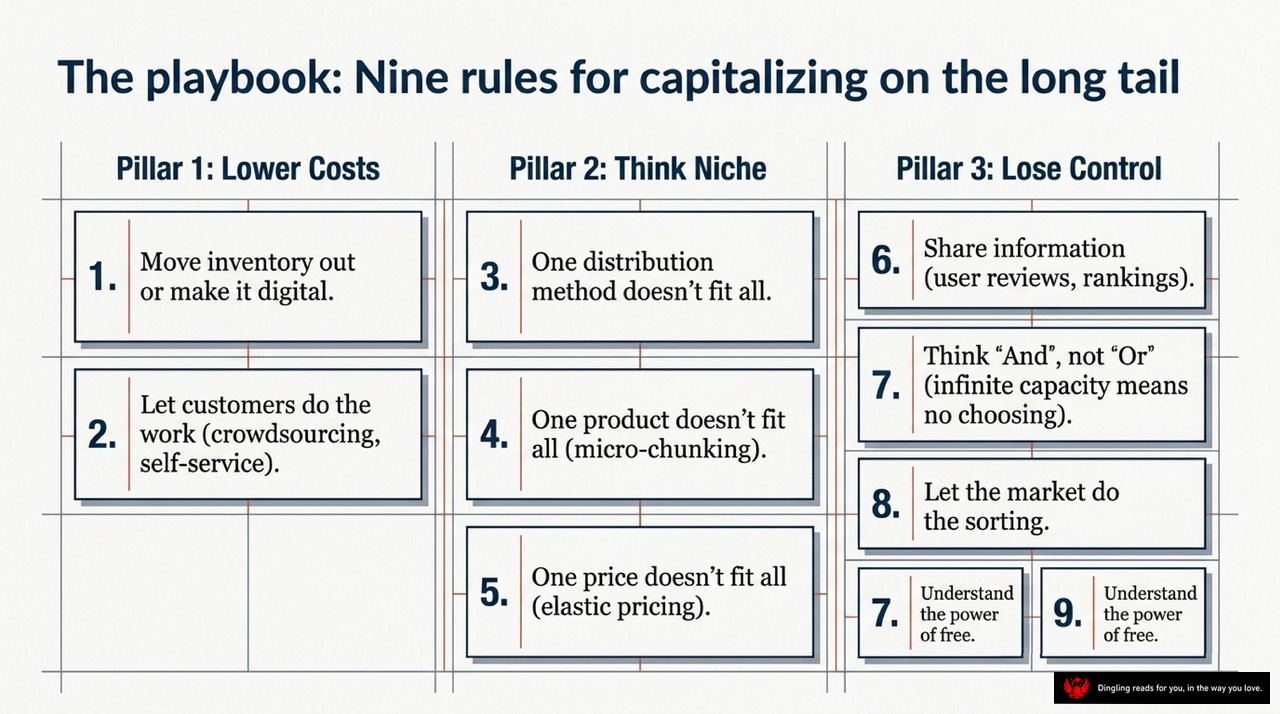
Let's dive into the practical application of these concepts. Think of this slide not just as a list of rules, but as your strategic playbook for unlocking the long tail. We've organized these nine principles into three powerful pillars that guide how you should operate in a digital, abundant market.
First, look at **Pillar 1: Lower Costs**. This is your foundation. Rule number one tells us to move inventory out or make it digital. Why? Because physical space is expensive and limited. Rule number two builds on this by letting customers do the work—think crowdsourcing or self-service. When you stop paying for every task and let your users contribute, you drastically cut your overhead, making it profitable to serve even the tiniest niches.
Next, move to **Pillar 2: Think Niche**. This is where you stop trying to please everyone and start serving specific groups. Rule three reminds us that one distribution method doesn't fit all; you need to meet your audience where they are. Rule four emphasizes micro-chunking—breaking products into smaller pieces so they fit different needs. And rule five is crucial: one price doesn't fit all. You need elastic pricing to capture value from diverse segments without alienating price-sensitive buyers.
Finally, **Pillar 3: Lose Control**. This is the hardest but most rewarding shift. Instead of trying to predict what everyone wants, you share information through reviews and rankings, letting the crowd decide. You stop thinking in "Or" and start thinking in "And"—offering infinite capacity so no one feels forced to choose. You let the market do the sorting, and you embrace the power of free. By understanding that free is a powerful business tool, you can build a platform where the smallest sales aggregate into massive wealth.
In short, to capitalize on the long tail, you must lower your costs, think in niches, and be brave enough to lose control.
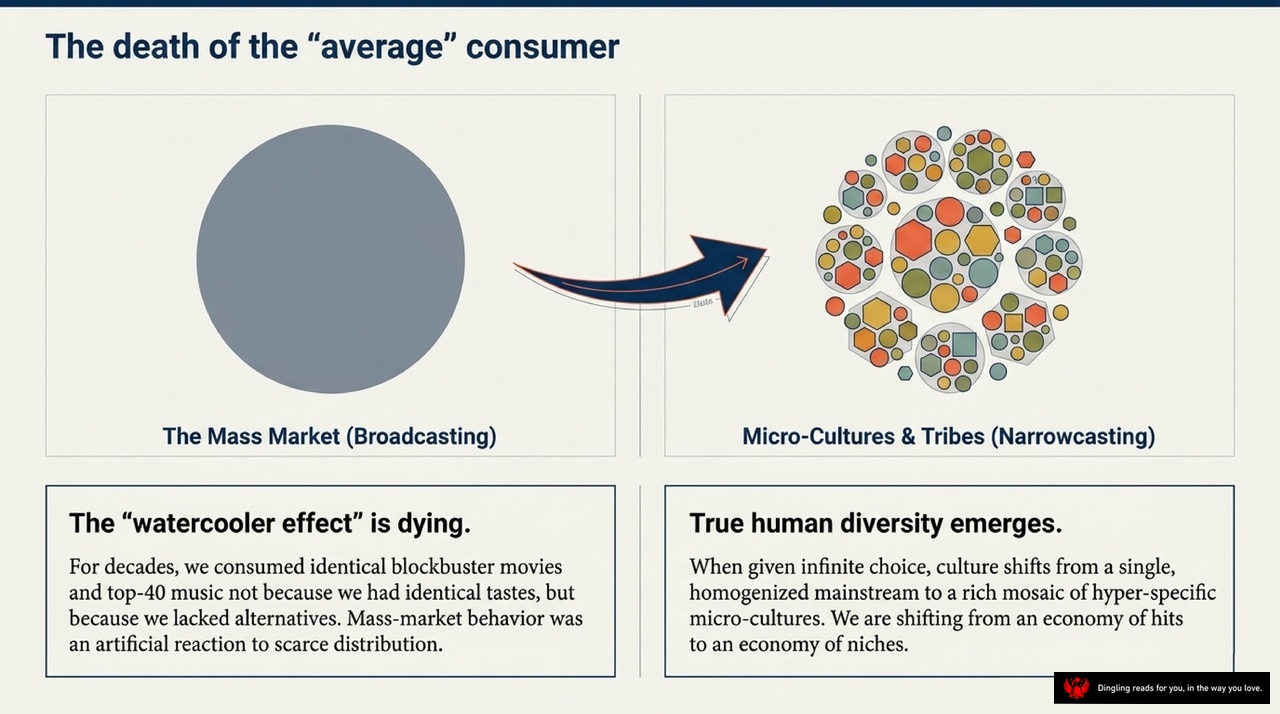
Imagine a world where everyone listened to the exact same radio station and watched the same movie, simply because there were nowhere else to go. For decades, that was our reality. The "watercooler effect" dominated our culture, forcing us into a homogenized mainstream where the only option was to consume identical blockbusters and top-40 hits. But as the slide illustrates, that era of the "average" consumer is dying. We are witnessing a massive shift from the Mass Market to Micro-Cultures.
Look at the transformation on the right: we are moving from a single, gray circle of broadcasting into a vibrant mosaic of tribes and narrowcasting. This isn't just about new technology; it's about the emergence of true human diversity. When we are given infinite choice, culture stops being a forced march toward the popular and starts becoming a rich tapestry of hyper-specific micro-cultures. We are shifting from an economy of hits to an economy of niches.
Think about the old days: we consumed the same things not because we all had identical tastes, but because we lacked alternatives. Mass-market behavior was just an artificial reaction to scarce distribution. Today, that constraint is gone. Instead of fighting over a few empty seats at the cinema, we have found our own communities. Whether you love 80s synth-pop, ambient dub, or a niche documentary, you can find your tribe. The watercooler is emptying out, but thousands of new, more passionate watercoolers are filling up in corners all over the world. We are no longer defined by what the majority watches; we are defined by the unique corners we explore together.
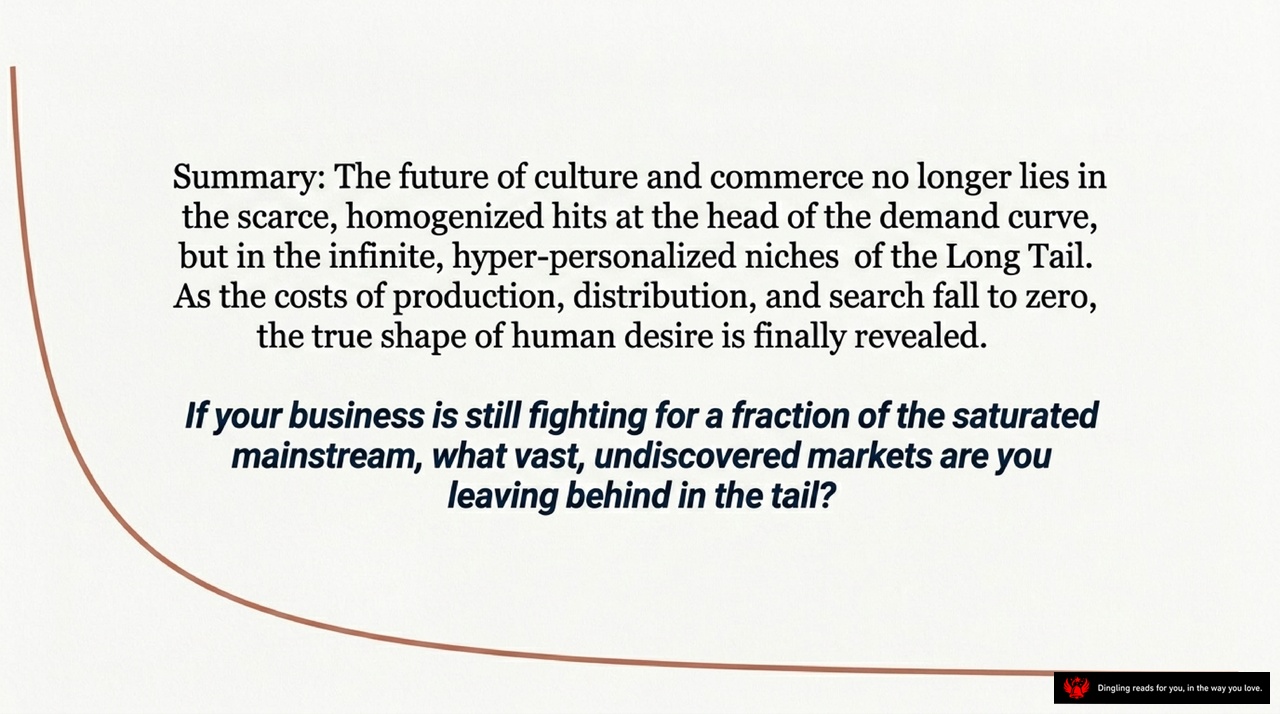
The future of culture and commerce isn't about fighting for a spot on the crowded top of the demand curve anymore. It's about unlocking the infinite, hyper-personalized niches of the Long Tail. As the costs for production, distribution, and search drop to nearly zero, the true shape of human desire is finally revealed.
If your business is still battling for a fraction of a saturated mainstream, ask yourself: what vast, undiscovered markets are you leaving behind in the tail? The answer lies in aggregating those countless small demands that were once ignored by physical shelves and limited broadcast slots. When you connect these scattered needs through digital platforms and collective wisdom, the long tail doesn't just become a supplement to the hit—it becomes a massive, thriving ecosystem all its own.