
Loonshots: Complete Chapter-by-Chapter Summary
Welcome to today's session on *Loonshots* by Safi Bahcall. This book isn't just about wild ideas; it's the physics of how to nurture them. Think of it as the blueprint for turning crazy concepts into the things that win wars, cure diseases, and transform entire industries.
The core promise of *Loonshots* is that the most powerful innovations often start as things nobody believes in. Just like the intricate ice crystals forming on the left side of our slide, these ideas are fragile and complex. But with the right approach, they can break through the surface tension of the status quo, creating ripples that eventually turn into massive waves of change.
We will explore how organizations can move from being rigid structures to becoming dynamic ecosystems that foster breakthroughs. You'll learn about the difference between real failure and "false failure," why some giants fall while others thrive, and how to balance the need for stability with the chaos of innovation. Whether you're leading a startup or managing a global corporation, the principles here will show you how to protect those fragile, high-potential ideas until they find their moment to shine.

Legendary, innovative teams do not lose their edge because they lose their talent. Look at the icons on the left: Pan Am, Polaroid, Nokia. These were once the titans of their industries, pioneers that changed the world. But look at the ice block on the right—they are frozen, cracking apart. Why did these companies that pioneered world-changing breakthroughs suddenly stop innovating and reject the future?
The answer isn't a failure of hiring, intelligence, or even leadership personality. The sudden rejection of a "Loonshot"—a fragile, crazy idea—is actually a structural phase transition. Think of it like water freezing when the temperature drops. Just as water inevitably freezes when the temperature drops, human groups inevitably freeze when structural incentives shift.
In the past, companies like Pan Am and Polaroid thrived by betting on massive technological leaps. But when the environment changed, the very structures that made them successful became their cage. They couldn't adapt because their internal incentives were locked into the old ways. To stay legendary, you must understand that your team's edge doesn't vanish with talent; it vanishes when you fail to recognize that the rules of the game have changed.
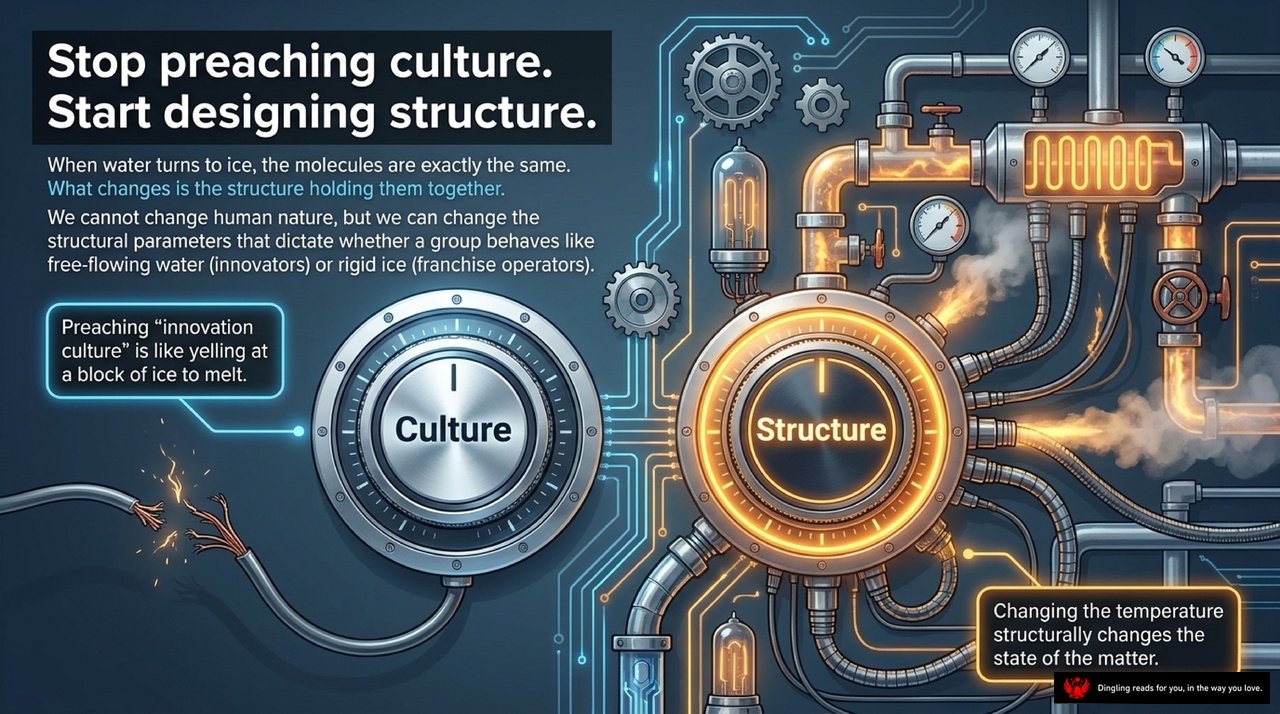
Stop preaching culture. Start designing structure. Look at this image: on the left, a cold, metallic dial labeled "Culture," connected to a frayed, sparking wire. On the right, a glowing, complex engine labeled "Structure," with pipes, gauges, and flowing energy. The message is stark: trying to melt a block of ice by yelling at it is futile. Water and ice have the exact same molecules, yet they behave completely differently because of the structure holding them together. You cannot change human nature, but you absolutely can change the structural parameters that dictate whether your group flows like free-moving water—innovators—or freezes into rigid ice, like franchise operators.
Preaching an "innovation culture" is exactly like trying to melt that block of ice with your voice. It fails because you are ignoring the physics of the system. Real change happens when you adjust the temperature, which is your structure. When you change the structural parameters, you structurally change the state of the matter itself. This isn't about soft skills or values; it's about engineering the environment so that innovation becomes the only logical outcome.
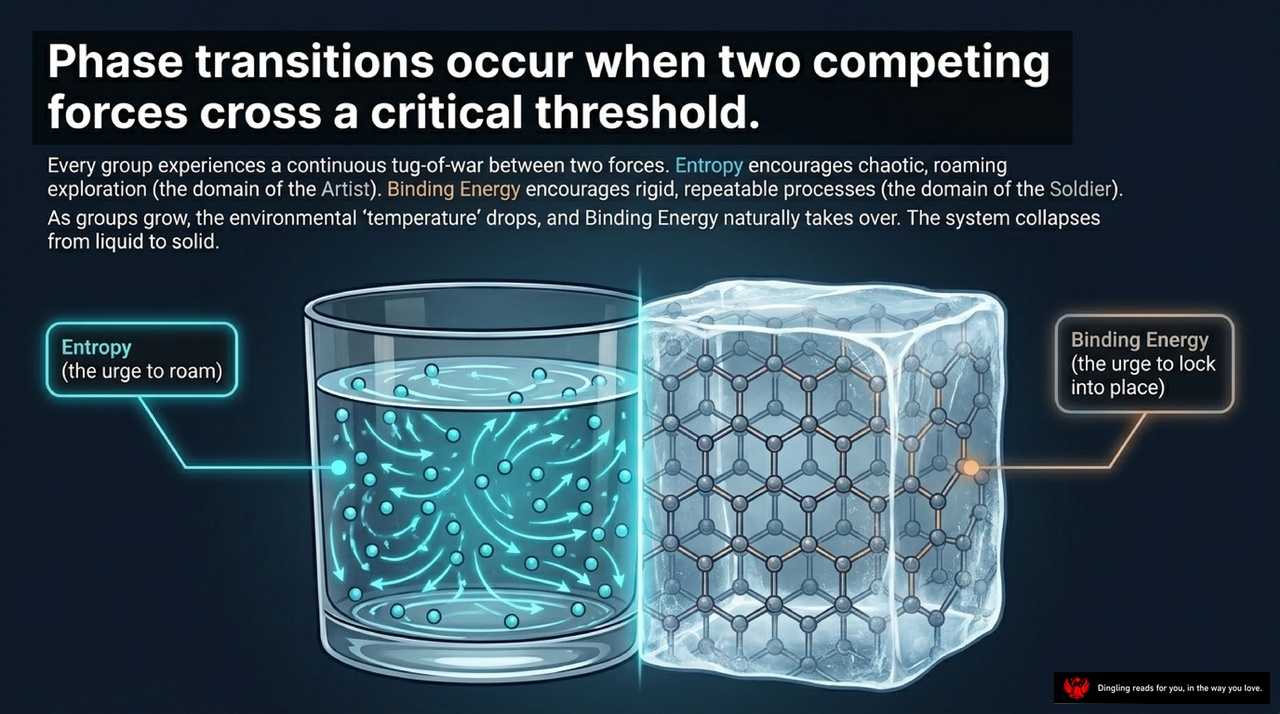
Phase transitions happen when two competing forces cross a critical threshold. Think of it as a tug-of-war between entropy, which drives chaotic exploration and freedom, and binding energy, which enforces rigid, repeatable processes. As systems grow and environmental conditions shift, this balance tips. Just like water freezing into ice, a group can collapse from a flexible, liquid state into a rigid, solid one if the urge to lock into place overwhelms the urge to roam.
In our organizations, this plays out constantly. We need the "Artist" side to explore wild ideas and the "Soldier" side to execute them efficiently. But if we let binding energy dominate without enough entropy, innovation dies. We become a machine that chugs along but never moves forward. The key isn't just balancing these forces, but identifying the control parameters—the levers we can pull. Whether it's team size, incentives, or communication patterns, adjusting these parameters allows us to keep our organization in a fluid, creative state rather than letting it freeze into bureaucracy. Understanding these thresholds is the difference between a thriving ecosystem of ideas and a stagnant, predictable machine.
Imagine your organization as a complex system where small shifts can trigger massive, unexpected changes. This is the power of "phase transitions." Just like traffic flow, a road can handle cars smoothly until vehicle density hits a critical threshold. At that exact moment, a tiny disturbance—like one car changing lanes—doesn't just cause a ripple; it triggers a domino effect, instantly turning smooth flow into gridlock. The system has fundamentally shifted states.
This concept applies directly to your business. Every organization has its own "control parameters"—things like team size, incentive structures, or communication patterns. When these parameters cross a hidden critical value, your company can snap from a state of high innovation to one of bureaucratic stagnation. For instance, when a team grows beyond roughly 150 people, the personal bonds that drive creativity often dissolve. Suddenly, political maneuvering replaces collaboration, and "invisible axes" chop off your best ideas.
But you don't have to wait for disaster to strike. You can actively manage these transitions. Think of it like controlling a forest fire. By adjusting parameters—such as allowing small, controlled burns to reduce fuel density—you can keep the system below the critical threshold where a wildfire becomes inevitable. Similarly, by flattening your hierarchy or redesigning rewards to favor project outcomes over political climbing, you can shift your organization back into a "smooth" state where wild ideas thrive. Understanding these invisible tipping points empowers you to guide your company away from chaos and toward sustainable, explosive growth.

Missing either flavor of a Loonshot will cause an empire to fall. This slide breaks down the two essential types of breakthroughs that keep organizations alive: P-Type and S-Type.
On the left, we see the P-Type Loonshot, represented by the iconic Polaroid camera. These are radical product breakthroughs that everyone initially thinks will fail until they suddenly render old technology obsolete. Think of Bell Labs' transistor or Polaroid's instant film. These are sudden, dramatic disruptions that create entirely new markets. If you miss these, you lose your relevance overnight.
On the right, we have the S-Type Loonshot, illustrated by the Walmart storefront. These aren't about new gadgets; they are strategy breakthroughs. They involve a new way of doing business using existing technology. Competitors often dismiss them as unprofitable because the disruption is gradual and invisible. But once they take hold, they quietly swallow the market. Walmart's rural focus and Google's ad algorithm are perfect examples. If you miss these, your empire slowly crumbles from within.
The key takeaway is clear: you cannot survive on just one. Relying only on flashy product innovations leaves you vulnerable to slow-moving strategic shifts. Conversely, focusing solely on business models without technological leaps can eventually make your offerings irrelevant. True resilience comes from balancing the sudden shock of a P-Type breakthrough with the steady erosion of an S-Type strategy.

Imagine you are a gardener, not a dictator. This is the core lesson we've been building toward: the difference between a "Moses" who dictates every step and a "Gardener" who cultivates an ecosystem.
Look at the diagram on the screen. It illustrates the five-step cycle of the **Moses Trap**, where a visionary leader accidentally becomes the organization's biggest bottleneck.
It starts at **Step 1**: A visionary leader successfully champions a "loonsight"—a bold, risky idea that initially works brilliantly. Because it succeeds, **Step 2** happens: the leader is elevated to a "Holy Moses" status. They are seen as infallible, the sole source of truth.
This is where the trap springs. Because the leader is now viewed as the ultimate authority, **Step 3** occurs: they begin dictating which ideas live or die based purely on personal preference. They stop listening to the market or the data, trusting only their own intuition.
Consequently, **Step 4** follows: the "soldiers"—the core franchise and the operational teams who keep the lights on—are neglected and demoralized. The leader pours all resources into their favorite new projects while starving the business model that actually pays the bills.
Finally, **Step 5**: the ecosystem collapses under the weight of the leader's ego. When the leader inevitably makes a mistake or leaves, the company has no backup system. It becomes entirely dependent on one human's intuition, which inevitably fails.
This isn't just theory; it's the story of giants like Pan Am and Polaroid. Juan Trippe and Edwin Land were brilliant visionaries, but they fell into this trap. They became so obsessed with their own "loonsights" that they ignored the strategic shifts happening around them. They didn't build a system; they built a cult of personality.
To escape this, we must shift our mindset. We need to separate the "artists" who dream from the "soldiers" who execute, and then balance them dynamically. We must stop asking, "What do *I* want to build?" and start asking, "What system allows the best ideas to emerge?"
Be the gardener. Water the soil, prune the branches, but let the forest grow on its own. That is how you avoid the trap and build a company that lasts.

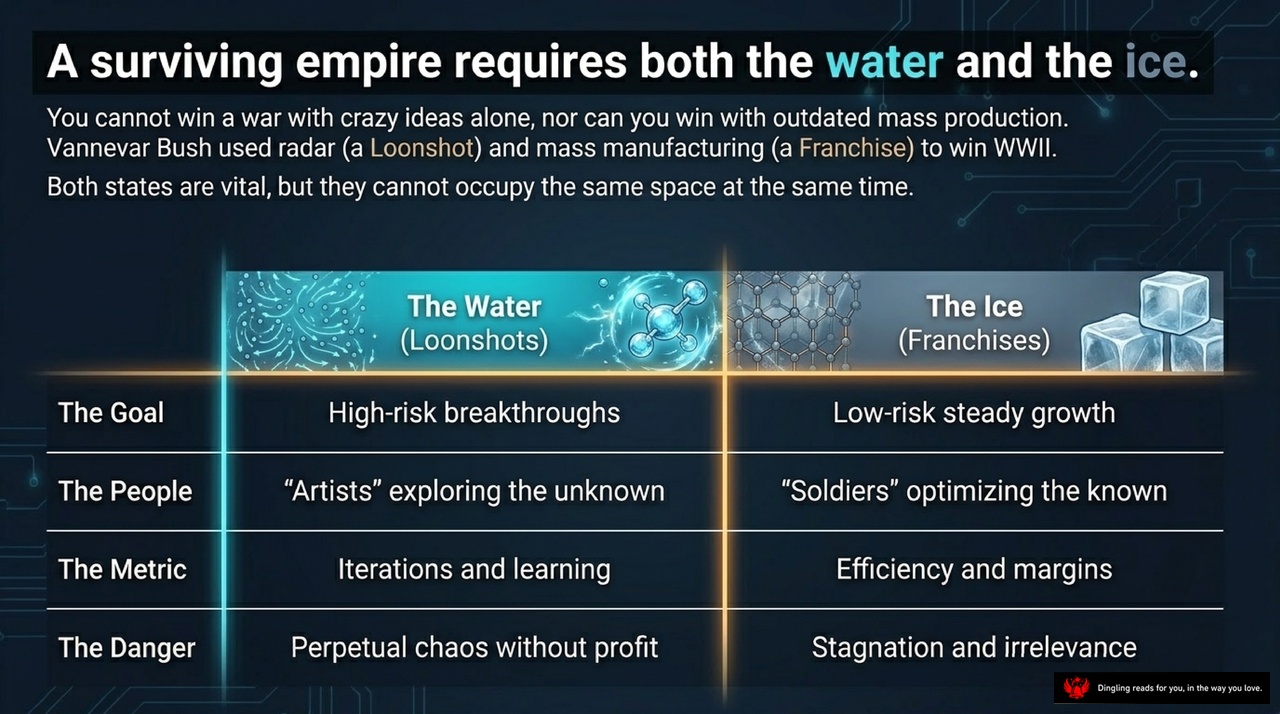
The secret to sustained innovation isn't about picking the perfect idea; it's about managing the ecosystem so that "artists" and "soldiers" can survive together on the edge of a phase transition. Think of your organization like water at exactly 32 degrees Fahrenheit. At this precise temperature, ice and water coexist in a state of dynamic equilibrium. If you heat it up too much, everything melts into chaos; cool it down too far, and everything freezes into stagnation.
Your role as a leader is not to be Moses, blindly selecting the "winning" ideas and ignoring the rest. Instead, you must be a Gardener. Your job is to manage the ecosystem, adjust the temperature, and ensure that both the creative, experimental teams and the efficient, execution-focused teams thrive side-by-side. You don't force a single outcome; you create the conditions where innovation can emerge naturally from the tension between stability and change. Just as nature finds balance at the freezing point, your organization needs that same delicate balance to achieve true, lasting innovation.

Rule 1 is all about enforcing strict phase separation. Think of it as building a physical and organizational firewall between your "artists"—the people driving early-stage, fragile ideas—and your "soldiers," who run the core business with rigid financial metrics.
The image clearly illustrates this divide. On the left, you have the R&D Lab, represented by that fluid, organic blue shape. This is where your wild, unproven concepts live. It needs to be loose, experimental, and free from immediate pressure. On the right sits the Operational Core, depicted as a structured grid of gears and charts. This is the domain of efficiency, strict KPIs, and predictable execution.
The critical element here is the "Firewall" in the middle. The diagram shows a red "X" blocking the flow of "Rigid Metric" from the Operational Core into the R&D Lab. Why? Because early-stage ideas are astonishingly fragile. If you subject them to the harsh standards of the core franchise too soon, the soldiers will crush them before they can even take root. It's like trying to protect water from ice; you must keep the two states separate to allow the liquid to flow and evolve.
This isn't just about drawing lines on an org chart; it's about protecting the water from the ice. By physically and organizationally separating these two worlds, you give your artists the breathing room they need to innovate without being suffocated by the need for immediate efficiency. Only when an idea has matured enough can it safely cross that firewall and join the operational core.
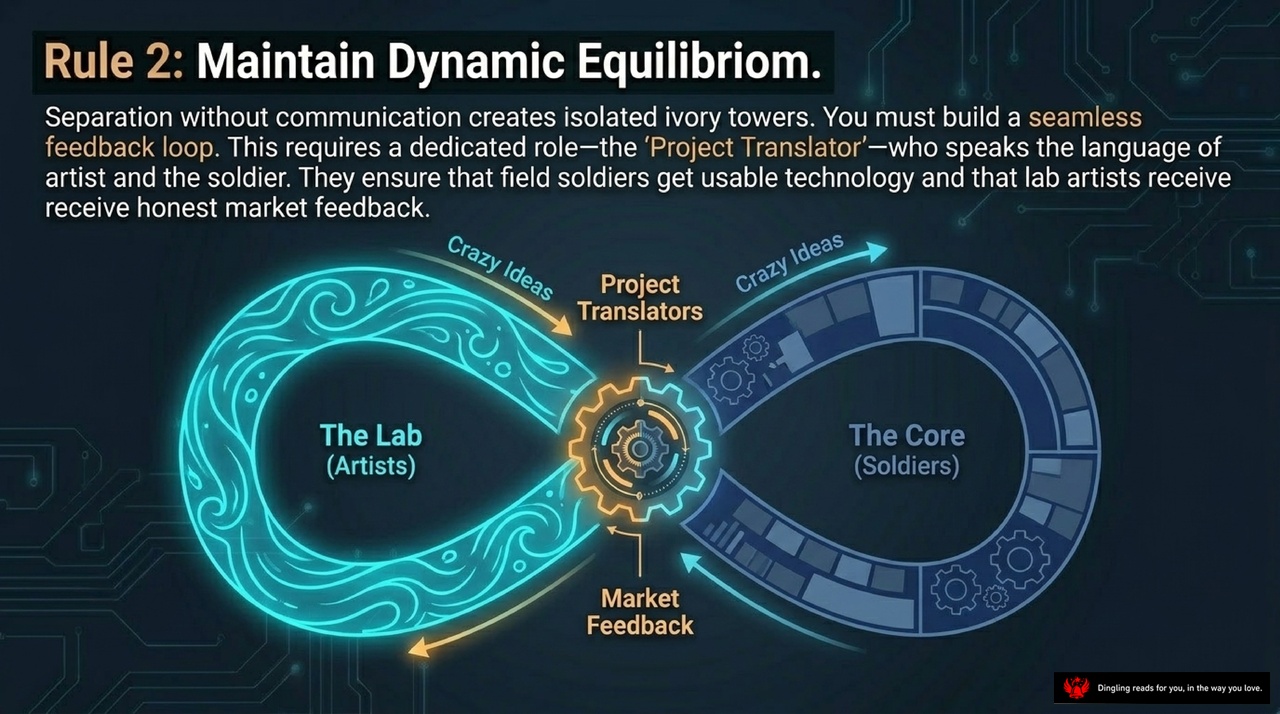
Rule 2 is all about maintaining dynamic equilibrium. Think of your organization as a system where two distinct forces must coexist without collapsing into one another. On the left, you have "The Lab," your artists and innovators, where crazy ideas are born in a fluid, creative environment. On the right, you have "The Core," your soldiers and operators, where those ideas are refined into reliable, usable technology for the real world.
The magic happens in the middle, where your "Project Translators" act as the critical gears connecting these two worlds. These translators speak both the language of the artist and the soldier. They ensure that field soldiers actually get usable technology, while lab artists receive honest, unfiltered market feedback. Without this seamless feedback loop, you end up with isolated ivory towers: brilliant ideas that never leave the lab, or rigid processes that crush creativity from the outside.
As the diagram illustrates, this isn't a static balance; it's a continuous cycle. Crazy ideas flow from the lab to the core, get tested against reality, and return with market feedback to fuel the next round of innovation. If you break this loop, your organization stagnates. But when you maintain this dynamic equilibrium, you create a resilient engine for growth where creativity and execution constantly feed each other.
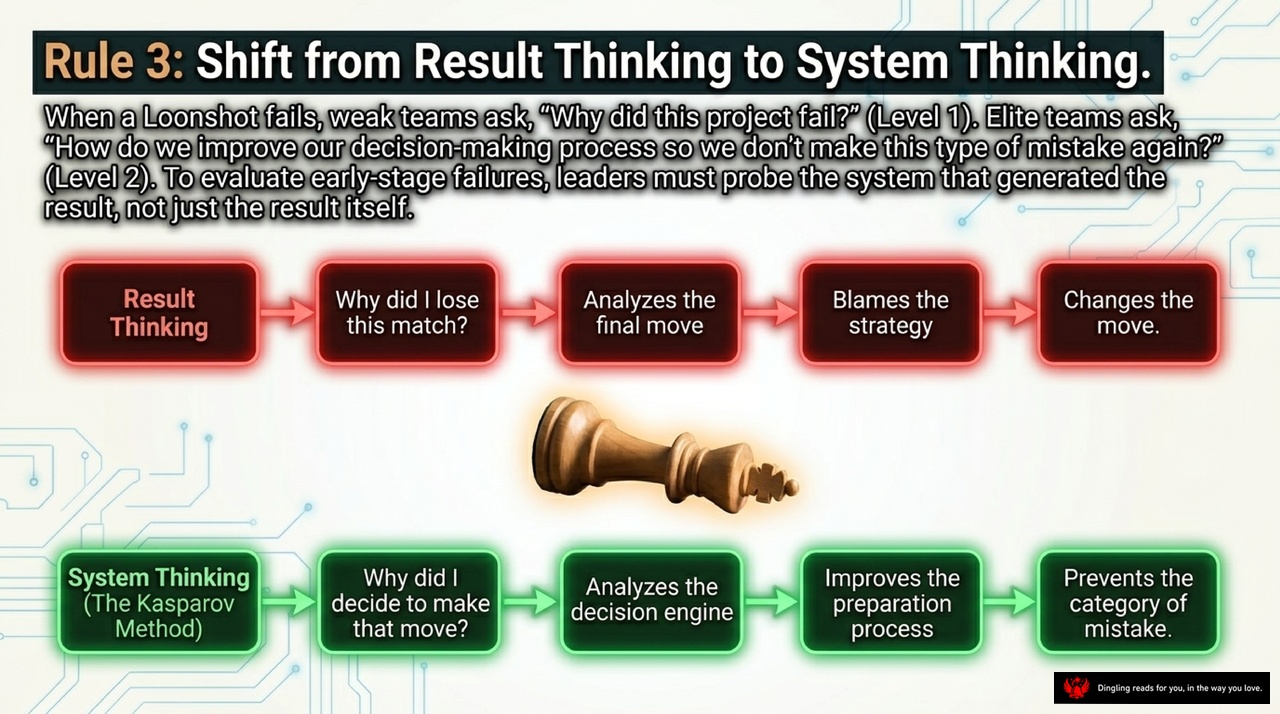
Imagine a chess piece lying on the board—a fallen king, a lost queen, or simply a wrong move. When a team fails, the instinct is often to look backward at the final result: "Why did we lose this match?" or "Why did this project crash?" This is Result Thinking, and it's a trap. It leads us to blame the strategy, analyze just the last move, and simply change the tactic next time. We treat the symptom, not the disease.
But elite teams, the ones that actually win in the long run, ask a different question. They don't look at the board; they look at the player. They ask, "How did we decide to make that move in the first place?" This is System Thinking. Instead of blaming the strategy, they analyze the decision engine itself—the preparation, the information gathering, and the logic used to reach that conclusion. By improving the process that generated the error, they prevent the category of mistake from ever happening again.
This shift is the core of Rule 3: moving from Result Thinking to System Thinking. It's about probing the system that created the failure, not just the failure itself. Whether you're running a software startup or managing a global corporation, the lesson is the same. Don't just ask why the outcome was bad. Ask why your team made the choices that led to that outcome. Because if you fix the engine, you don't just win the next game; you ensure you never lose again.

The physics of the shift: The corporate tug-of-war.
Have you ever wondered why brilliant innovators eventually turn into rigid bureaucrats? It's not about a lack of talent; it's about the incentives flipping. In a startup, the financial and emotional reward for a project succeeding is massive. You are the hero. But as the company grows, an individual's equity stake shrinks, while the financial perks of political promotion grow. Eventually, playing politics becomes mathematically safer and more rewarding than championing a crazy idea.
Look at the graph on your screen. The horizontal axis represents Team Size, and the vertical axis is Reward. We have two opposing forces. On the left, we have "Stake in Outcome." In small teams, project success makes everyone a millionaire. Your personal success is directly tied to the project's success. But as the team gets larger, that line slopes downward. Your individual stake diminishes.
On the right, we have "Perks of Rank." As the team expands, the rewards for climbing the corporate ladder—higher titles, more status, and better salaries—start to rise. In large teams, political promotion pays more than project success.
The intersection of these two lines creates a critical tipping point. This is where the corporate tug-of-war happens. When you are on the left side of the graph, you are motivated to innovate because you own the outcome. But once you cross that threshold into large organizations, the math changes. The system rewards you for playing politics rather than for solving hard problems. This is the invisible axe that quietly chops down innovation before it ever sees the light of day. Understanding this dynamic is the first step to designing organizations that actually reward the crazy ideas that change the world.
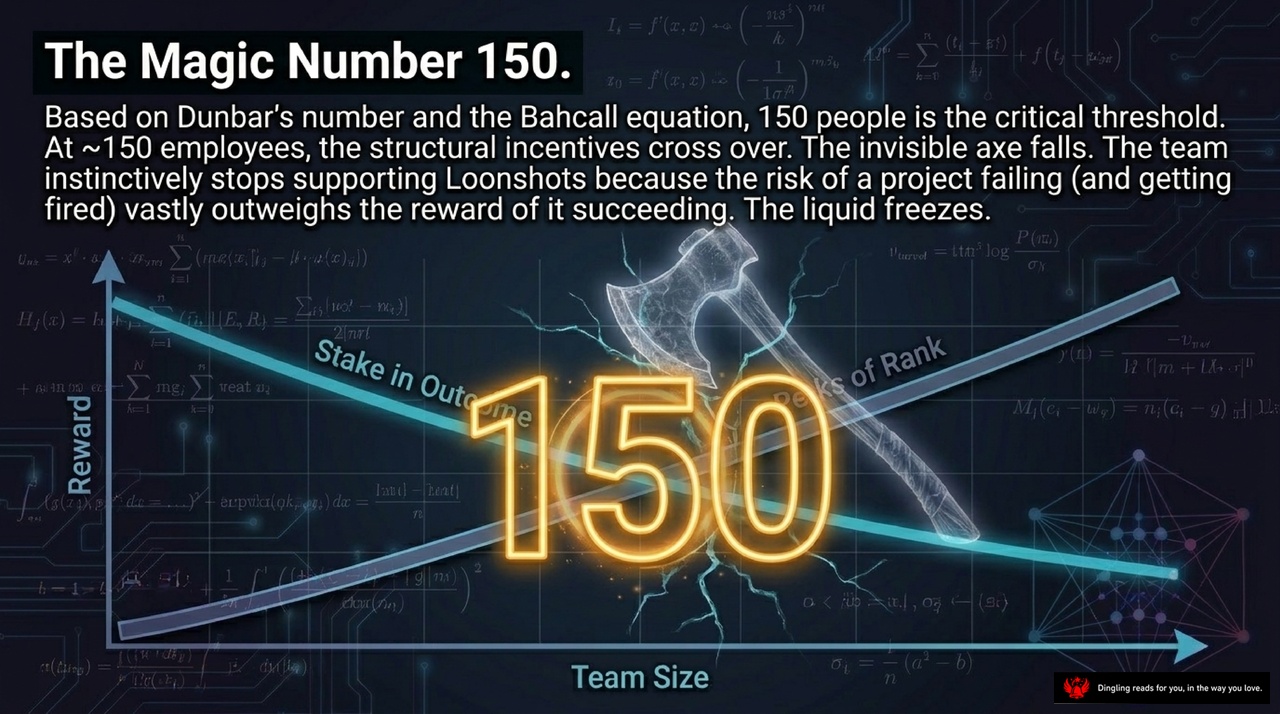
The magic number 150 is the invisible threshold where innovation quietly dies. Based on Dunbar's number and the Bahcall equation, once a team hits around 150 employees, the structural incentives completely flip. You'll see an invisible axe fall from the sky. Suddenly, the team instinctively stops supporting Loonshots because the risk of a project failing—and getting fired—vastly outweighs the reward of it succeeding. The liquid freezes.
Look at the chart: as Team Size grows, the "Stake in Outcome" plummets, while the "Peaks of Rank" shoot straight up. In a small group, your success is tied to the team's success. But cross that 150-line, and the game changes. Your career now depends on climbing the ladder through political maneuvering and resource hoarding, not on taking bold risks. The liquid freezes because everyone is too busy protecting their own position to fuel the next big idea. To keep your organization alive, you must actively break teams back below this critical threshold before the innovation engine stalls forever.
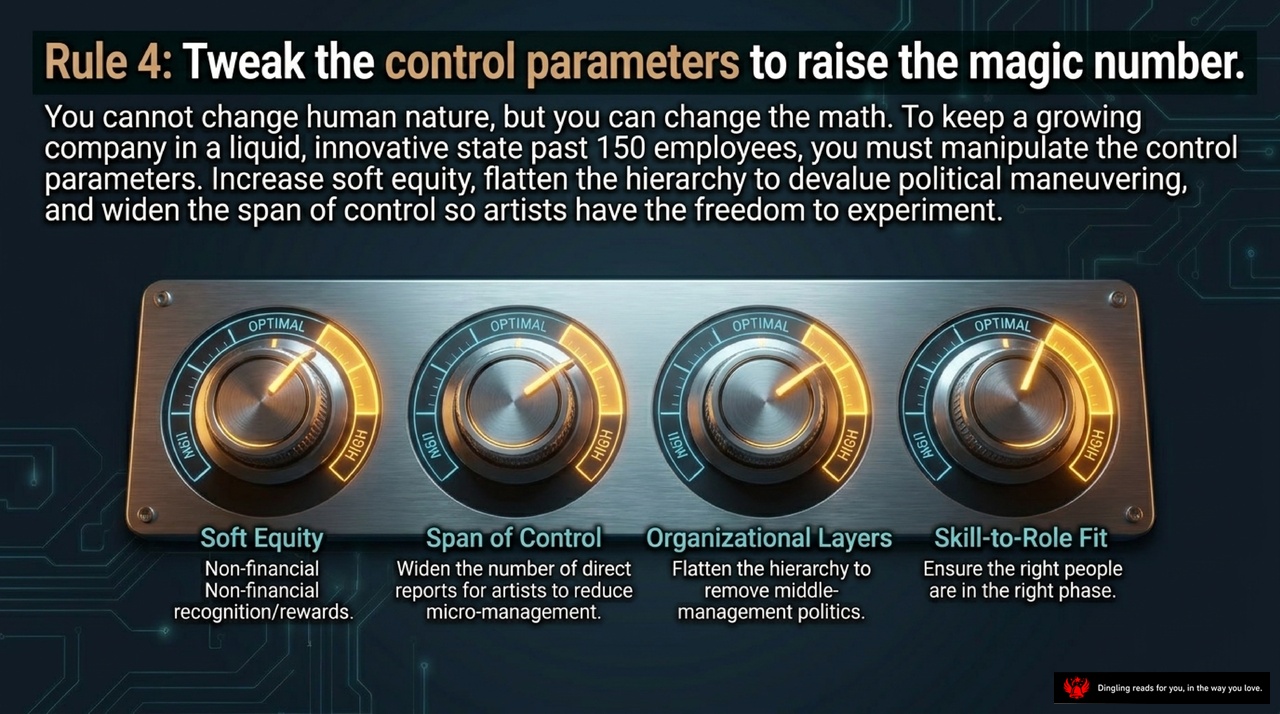
Rule 4: Tweak the control parameters to raise the magic number.
You can't rewrite human nature, but you absolutely can rewrite the math. If you want to keep your company liquid and innovative past the 150-person mark, you have to manually adjust your control knobs. The image shows four specific levers you need to pull to the "High" setting.
First, look at **Soft Equity**. This is about non-financial recognition and rewards. Instead of just chasing money, you need to make people feel valued through status, autonomy, and peer respect.
Next, widen your **Span of Control**. Don't be afraid to have many direct reports. A wider span flattens the hierarchy, which drastically reduces the time wasted on political maneuvering and allows your artists the freedom to actually experiment without getting bogged down in bureaucracy.
Then, flatten your **Organizational Layers**. Strip away the middle management that acts as a buffer for politics. Get ideas from the front line to the decision makers faster so that speed becomes your advantage.
Finally, ensure a tight **Skill-to-Role Fit**. Make sure the right people are in the right phase. If your team isn't aligned with the specific demands of the project, no amount of tweaking will help.
By turning these four dials up, you raise that "magic number," allowing your organization to scale without turning into a stagnant, bureaucratic machine.

Master the Phase Shift. Imagine your organization as a system standing right at the freezing point of 32 degrees Fahrenheit. On one side, you have the rigid structure of "Soldiers"—your core business teams focused on efficiency and execution. On the other, you have the fluid creativity of "Artists"—your innovators exploring wild, unproven ideas. The magic happens not by choosing one side, but by mastering the phase shift between them.
First, you must enforce Phase Separation. Keep your Artists and Soldiers in distinct zones. Soldiers need clear goals and strict processes to deliver today's results, while Artists need loose boundaries and a culture that tolerates "useless" exploration to invent tomorrow's breakthroughs. Without this separation, the pressure of immediate performance will suffocate creativity before it can take root.
However, separation isn't enough; you must build Dynamic Equilibrium. Think of this as creating a seamless feedback loop. The Soldiers provide the resources and the market reality that grounds the Artists' dreams, while the Artists inject new possibilities that keep the organization from becoming stagnant. This balance prevents the "Moses Trap," where a leader's personal obsession blinds the organization to necessary changes.
Next, apply System Thinking. Stop obsessing over short-term outcomes and start evaluating the decisions behind them. When an experiment fails, don't just blame the result. Ask: Was the test design flawed? Did we pick the wrong variables? This mindset helps you distinguish between a "false failure"—a temporary roadblock caused by bad execution—and a true failure, where the idea itself is broken. By fixing the system, you turn dead ends into stepping stones.
Finally, Raise the Magic Number. Adjust your structural incentives to support this entire ecosystem. This means flattening management spans, perhaps moving toward the "Dunbar Number" of 150, so teams stay agile and connected. It means shifting rewards from political climbing to actual project outcomes, and ensuring that the incentives for your Soldiers and Artists are aligned with the long-term health of the company, not just quarterly earnings.
So, the critical question remains: Is your organization currently designed to nurture the crazy ideas of tomorrow, or is it structurally engineered to simply protect the successes of yesterday? Mastering this phase shift is the difference between surviving the present and leading the future.