
Low Carbon and China's Transition: Complete Chapter-by-Chapter Summary

Welcome to our deep dive into the complex reality of low carbon and China's strategic path. Today, we're looking at a stark visual contrast: on one side, the heavy industrial smokestacks of the past, and on the other, the sleek, green skyscrapers of a sustainable future. This image perfectly captures the core tension of our story—the urgent shift from a high-carbon world to a net-zero one.
This isn't just about environmentalism; it's a pragmatic exploration of the forces driving the global climate agenda and how China is responding. As we've seen in recent history, the path to a low-carbon future wasn't always clear. It began with scientific breakthroughs and was amplified by influential voices who turned complex data into a global movement. From the early warnings of Rachel Carson to the political activism of the Green Party, the idea of "low carbon" evolved from a niche concept into a mainstream necessity.
However, the road hasn't been smooth. We've faced fierce debates over climate theory, intense geopolitical battles like the one in Copenhagen, and the heavy reality of energy structures still reliant on fossil fuels. For a rising power like China, the challenge is even greater. Balancing rapid industrialization with the need to cut emissions requires navigating a delicate middle ground. It's about finding the right balance between development and sustainability, avoiding extremes while taking bold, calculated steps forward.
Today, we will unpack the truth behind these headlines, examining how economic interests, international law, and domestic strategy are shaping the future. We'll look at why this transition is so difficult, what opportunities lie ahead, and how nations are competing for the future of energy. Let's get started.

Welcome to the next chapter of our deep dive into the Low-Carbon Era. Today, we're shifting our focus from the scientific foundations and activist movements we discussed earlier to the powerful engine driving this global transformation: **Economics**.
Look at the center of our graphic: **The Low-Carbon Era**. Surrounding it are four pillars. We've covered Science and Activism. Now, let's look at the bottom right: **Economics**, labeled as "**The $2 Trillion Cake**."
This isn't just about saving the planet; it's about capturing a massive new market. The text reveals that the low-carbon transition has evolved from a moral obligation into a fierce global competition for economic dominance. Developed nations like the UK, EU, and the US see this as a chance to lead the Fourth Industrial Revolution, securing their future through green technology and capital. Meanwhile, emerging economies are playing a different game. They aren't just trying to catch up; they are looking for a "lane change," using this transition to leapfrog traditional, high-pollution development models entirely.
Consider the stakes. The text highlights that high carbon emissions create a massive market for low-carbon solutions. Countries like China, with its vast manufacturing base, are turning this challenge into an opportunity. By investing heavily in renewables and green tech, they are not only reducing emissions but also exporting the very technologies that the world needs. It's a race to control the future of energy and finance.
However, this "cake" is contested. The text notes that while the vision is clear, the reality is often messy. Policies face political gridlock, and traditional energy interests push back hard. Yet, the momentum is undeniable. From the UK's early definition of a low-carbon economy to China's recent entry into the global carbon market, the economic logic is becoming irresistible.
In short, the low-carbon era is being built not just in laboratories or through protests, but in boardrooms and stock exchanges. It is a battle for the next trillion dollars in global GDP. As we move forward, remember that the path to a sustainable future is also the path to the next great economic boom.

In 2003, the UK didn't just talk about the environment; they launched a new economic model called the "Low-Carbon Economy." It's a shift from burning fossil fuels to an energy-efficient, low-pollution system where growth and emissions finally decouple. But this isn't just a British idea anymore; it's a global battleground.
Look at the map of power. For decades, the West held the reins, but that's changing fast. Emerging economies like China are rising rapidly, with GDP growth outpacing the West. While developed nations try to lock in their lead through green tech, the rest of the world sees this as the ultimate opportunity to leapfrog traditional industrial paths. It's a high-stakes race where the future of the global economy hangs in the balance.
But here's the twist: this competition isn't purely political or environmental; it's deeply financial. Low-carbon technology isn't just about saving the planet; it's about capturing the next massive market. Countries are racing to dominate the supply chains for renewables, electric vehicles, and carbon capture. The logic is simple: whoever controls the green tech controls the future wealth.
However, the road isn't smooth. The US has struggled with political gridlock, slowing its clean energy rollout. Europe faces the painful economic shocks of shifting away from cheap fossil fuels, with some even restarting coal plants due to energy crises. Meanwhile, emerging economies face a unique double challenge: they need to industrialize and lift millions out of poverty while simultaneously trying to catch up in green technology without repeating the old, dirty mistakes.
The future of low-carbon development isn't guaranteed. It depends on whether nations can balance the urgent need for climate action with the relentless drive for economic growth. It's a complex game of power, money, and survival, and the stakes have never been higher.

The Green Political Awakening isn't just a historical footnote; it's the story of how environmentalism transformed from a fringe protest into a core pillar of global politics.
It all started with the catalysts. Picture the smog-choked skies of London in 1952, where thousands died in a matter of days, or Rachel Carson's groundbreaking 1962 book, *Silent Spring*, which exposed the deadly reality of chemical pesticides. These events didn't just shock the public; they awakened a new ecological consciousness that demanded action.
But ideas alone aren't enough; you need momentum. That's where the 1968 European Student Movements came in. Born from a generation's rebellion against rigid social orders, these radical activists eventually channeled their energy into the New Social Movements, making anti-nuclear and environmental causes their new battlefield. This shift turned abstract concerns into organized resistance.
As the movement gained strength, it moved into institutionalization. Activists stopped just protesting and started building structures. They formed NGOs like Greenpeace and Friends of the Earth, and eventually, they went further by establishing political parties. This was the crucial step of "greening" politics, moving environmentalism from the streets into the legislature.
The result? By the 1980s and 90s, European Green Parties rose to prominence. They forced environmentalism out of the shadows of fringe activism and into the mainstream, making it a matter of political correctness and government policy. This era laid the foundation for everything we see today in global climate governance.

The slide on the left maps out the legal backbone of our climate fight, tracing a clear timeline from 1992 to 2015. It starts with the UNFCCC establishing the baseline, moves to the Kyoto Protocol introducing strict targets and carbon trading, and culminates in the 2015 Paris Agreement unifying 196 nations under a 2-degree warming limit. This framework wasn't just about morality; it created the rules of the game.
On the right, we see the "economic cake" that these rules unlocked. The legal constraints directly fueled three massive drivers. First, Carbon Trading turned emissions into a multi-trillion-dollar market, with the EU ETS and global carbon exchanges becoming financial powerhouses. Second, this race created Tech Supremacy, where dominating renewable technology manufacturing became a key to national economic strength. Finally, the entire shift acted as a Green Stimulus, proving that environmentalism is no longer just a cost, but the engine driving the new industrial revolution.
Put simply, the legal framework provided the rules, and the economic cake provided the reward. It was this powerful combination of regulation and profit that made the low-carbon transition inevitable.

Let's dive into the messy reality behind the "Copenhagen Matrix." This slide perfectly captures the geopolitical chessboard where the Copenhagen summit actually played out.
On the left, you have "The Standard Bearers," led by the EU. Their strategy is clear: enforce strict global targets. Their economic motive? It's not just about saving the planet; it's about exporting their low-carbon technologies and maintaining global regulatory dominance. They want to lead the new industrial revolution.
In the middle, we see "The Pragmatic Reluctants," the Umbrella Group including the US and Japan. Their stance is different. They demand that all nations share the burden equally. But their economic motive is to protect their domestic fossil fuel interests and avoid unilateral economic penalties. They are the brakes on the system, fearing that strict rules will hurt their industrial growth.
On the right, "The Developing Giants," or the BASIC countries like China and India. Their primary goal is to defend the principle of "Common But Differentiated Responsibilities." They argue that they shouldn't be held to the same standards as the developed world. Their economic motive is fundamental: they need the right to industrialize, modernize, and lift their populations out of poverty. They view strict global targets as a threat to their development.
This slide illustrates the core conflict that paralyzed the Copenhagen summit. The EU wanted a single-track system with everyone on the same page. The US wanted to keep things loose. And the developing nations fought hard to maintain the two-track system that allowed them to grow first. It was a battle between regulation, protectionism, and development rights, leaving the world with no clear answer.

The climate debate has evolved into a fierce tug-of-war, and this slide perfectly captures the current stalemate. On one side, we have "The Consensus"—the scientific establishment led by Michael Mann's famous "Hockey Stick" curve and the IPCC's unified warnings about a catastrophic 2-degree warming. This side represents the mainstream narrative that human activity is the primary driver of a runaway climate crisis.
But on the other side, the rope is being pulled hard by three powerful counter-arguments. First, there are the "Data Scandals." We're talking about the leaked emails from the "Climategate" incident and the Himalayan Glacier-gate error, which have severely damaged the credibility of the IPCC. Second, we see "Alternative Theories" gaining traction. Scientists are now proposing that solar activity cycles, rather than carbon emissions, are the real culprits, suggesting we might actually be approaching an Ice Age rather than a warming catastrophe. Finally, there are the "Hypocrisy Critiques," where the media relentlessly attacks the high-carbon lifestyles of the very elite climate advocates who preach austerity from the front lines.
This isn't just a scientific disagreement; it's a battle over trust, data integrity, and who gets to define reality. The rope is tight, and the tension is palpable.

Look at this "Energy Reality Check" dashboard. It's a stark reminder that there is no perfect energy solution, only trade-offs. Let's break down what this means for our future.
On one side, we have Fossil Fuels. They offer high stability because the infrastructure is already built, and we can use them immediately. But the cost is unsustainable carbon emissions, and while we have the technology now, phasing them out remains incredibly difficult.
Then there is Nuclear Energy. It provides zero-carbon, stable base-load power, which sounds ideal. However, the reality check shows severe safety risks and the nightmare of radioactive waste. Plus, the timeline is agonizingly long; building a new plant takes decades, making it a slow bet for immediate needs.
Next up are Solar and Wind. These are fast to deploy and have a quicker timeline than nuclear. But they are highly unstable and weather-dependent, meaning they can't run when the sun doesn't shine or the wind doesn't blow. This forces us to rely on heavy supply chains for manufacturing panels and batteries, creating significant pollution, and grid integration remains a slow, complex process.
Finally, we have Hydro. It offers stable, zero-carbon energy, which is a huge plus. But the environmental cost is severe ecological disruption and massive land displacement. Furthermore, these projects are geographically limited and require multi-decade planning, making them hard to scale quickly everywhere.
The core message here is clear: every energy source comes with a specific set of problems. Whether it's the climate crisis from fossil fuels, the waste from nuclear, the intermittency of renewables, or the ecological damage from hydro, we face a complex puzzle. There is no silver bullet. Solving the global energy challenge requires us to understand these limitations and find a way to balance stability, environmental cost, and timeline across all these options.

Look at this diagram titled "The Emissions Reality Check." It lays bare a stark and often overlooked truth about the global carbon cycle. On the left, we see "Western Consumption Demand" driving the entire process. This demand flows directly into "China's Manufacturing Engine," labeled here as "The World's Factory." Because of this massive industrial output, we see a surge in "High Chinese Domestic Emissions."
But here is the critical part of the graphic: a red wall labeled "Western Carbon Tariffs (CBAM)" stands in the way. The arrows show that these emissions are hitting this barrier, while the blue line representing the original consumption demand bypasses the factory entirely. This visualizes the hypocrisy described at the bottom right: "Punishing the producer while completely ignoring the emissions driven by the end-consumer."
Essentially, Western nations are demanding low-carbon products from China to satisfy their own lifestyles, yet when those products arrive, they impose carbon tariffs on the emissions generated during production. Meanwhile, the actual consumption side—the real source of the carbon footprint—is left untouched. This slide highlights a fundamental contradiction in current climate policy: shifting the blame onto the manufacturer while absolving the consumer of responsibility. It's a system that penalizes the factory for building the goods we want, without ever asking us to change how we live or consume.

China's path to a green future isn't about blindly chasing perfection; it's about mastering the ancient wisdom of balance. Think of the concept of "moderation"—finding the sweet spot between going too far and not going far enough. For a developing nation like China, this means refusing to be trapped in a high-carbon system, but also avoiding unrealistic promises that ignore the reality of industrialization and urbanization.
We see this strategy in action across every sector. Look at the solar power industry: China dominates the supply chain, controlling over 80% of the market for key components like polysilicon and wafers. This isn't just about exporting products; it's about leveraging technological leadership to drive down costs and accelerate global adoption. Similarly, in the electric vehicle sector, a decade of strategic subsidies transformed a niche market into the world's largest, with annual sales skyrocketing from under 10,000 units to over 1.2 million.
But technology alone isn't enough. Real progress requires a solid legal and financial foundation. China has moved from pilot programs in seven cities to a massive national carbon market, covering 4.5 billion tons of emissions. This market creates a clear price signal, forcing companies to innovate or pay for their pollution. Meanwhile, a robust green tax system and billions in fiscal support ensure that the transition is affordable and sustainable.
On the global stage, China plays a crucial role as a bridge. By anchoring its goals to the historical emissions of developed nations, it argues for a fairer climate order—one that respects the right to develop while sharing the burden. This pragmatic approach, rooted in the principle of finding the middle way, allows China to lead the charge without sacrificing the very development that lifts millions out of poverty. It's a blueprint for how the world can achieve a green future without leaving anyone behind.
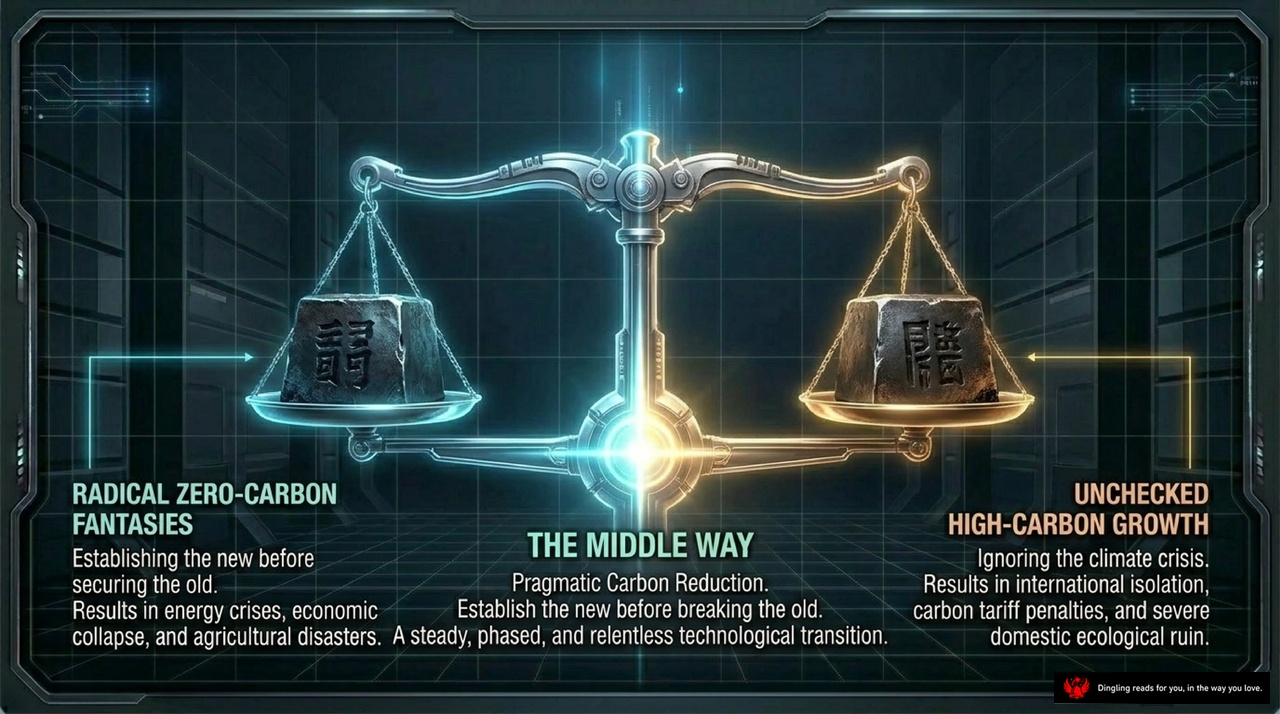
The image presents a powerful visual metaphor: a futuristic balance scale weighing two opposing forces. On the left, the blue side represents "Radical Zero-Carbon Fantasies"—the idea of establishing the new before securing the old. This approach, as the text warns, leads to energy crises, economic collapse, and agricultural disasters. It's a path of extreme idealism that ignores reality. On the right, the gold side stands for "Unchecked High-Carbon Growth," which means ignoring the climate crisis entirely. This results in international isolation, carbon tariffs, and severe ecological ruin.
So, where do we stand? The answer lies in the center: "The Middle Way." This is pragmatic carbon reduction. It's about establishing the new *before* breaking the old, not before it. We need a steady, phased, and relentless technological transition.
Think about this: if we jump too fast into a zero-carbon future without preparing our infrastructure, our economy crashes. But if we keep burning fossil fuels as if nothing is happening, we face ecological collapse and economic isolation. The middle path isn't a compromise on safety; it's the only way to survive. It requires us to innovate now, to build the clean energy systems we need, while carefully managing the transition so our economy doesn't break. It's about balancing ambition with reality, ensuring that our fight against climate change doesn't become a recipe for our own destruction. This balanced approach is the only way forward.
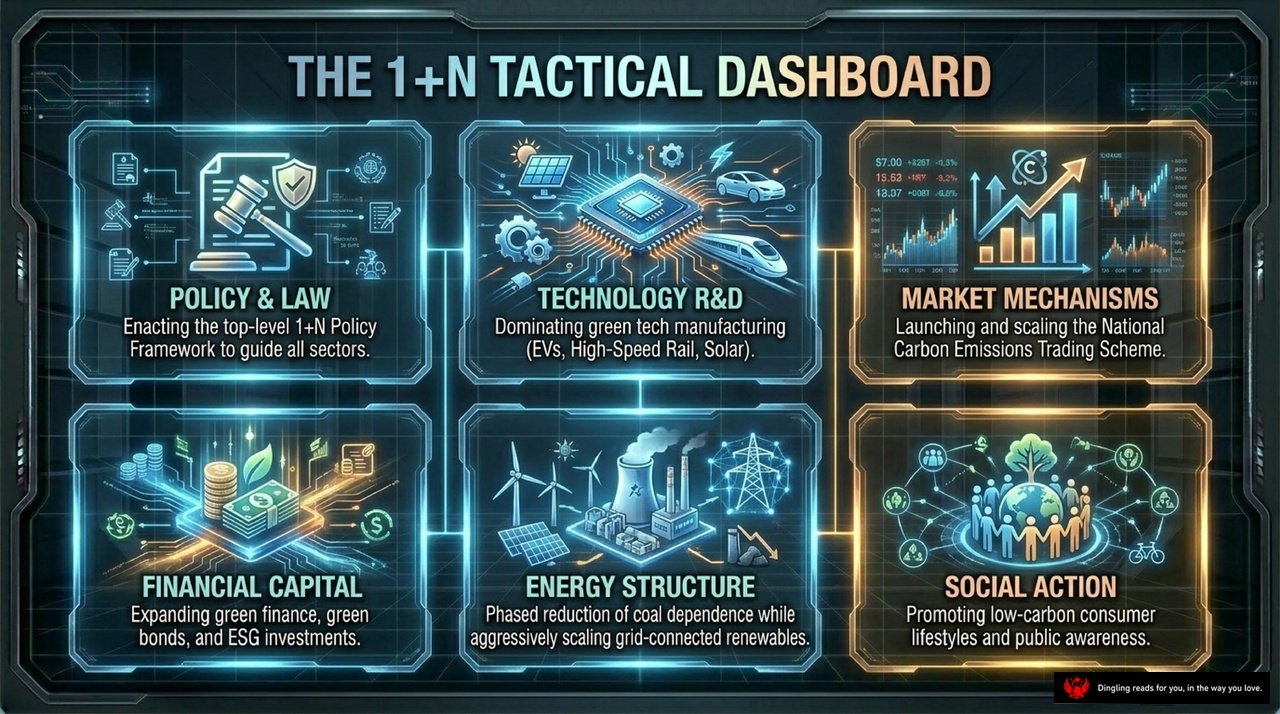
The 1+N Tactical Dashboard isn't just a chart; it's the master blueprint for how we're actually fighting the climate crisis today. Think of it as a command center with six critical levers we need to pull simultaneously.
First, we need **Policy & Law**. This is the foundation. We can't just wish for change; we need to enact top-level frameworks that guide every single sector, setting the hard rules of the game.
Next, we have to dominate **Technology R&D**. This is where the real action happens. We're talking about green tech manufacturing—Electric Vehicles, High-Speed Rail, and Solar power. We need to build the future, not just talk about it.
Then, we leverage **Market Mechanisms**. We launch and scale the National Carbon Emissions Trading Scheme. By putting a price on carbon, we turn pollution into a cost, forcing businesses to innovate or pay up.
Money is the fuel, so we must expand **Financial Capital**. We're looking at green finance, green bonds, and ESG investments. We need to direct trillions of dollars into projects that heal the planet, not destroy it.
But technology and money aren't enough without a solid **Energy Structure**. We need a phased reduction of our coal dependence while aggressively scaling grid-connected renewables like wind and solar. We have to fundamentally change how we power our lives.
Finally, we can't ignore the people. We must drive **Social Action**. Promoting low-carbon consumer lifestyles and public awareness is essential. If the public doesn't buy into this, the policies and technologies won't stick.
This dashboard shows us that solving the climate crisis requires a synchronized effort across politics, tech, markets, finance, energy, and society. It's a total system overhaul, and we're already in motion.

The slide highlights China's strategic "Trial Approach" for tackling carbon challenges, specifically through the creation of Special Carbon Zones. The core idea here is to "Test Locally, Scale Nationally," a strategy that mirrors the successful model of the 1980s Special Economic Zones. Instead of imposing strict carbon policies across the entire country immediately, China is utilizing pilot provinces and cities to experiment with these rigorous measures. A prime example mentioned is the Ordos Zero-Carbon Industrial Park. By isolating specific areas, the government can test the waters with strict regulations and zero-carbon industrial models without risking the stability of the broader economy.
This approach offers a crucial insight: it effectively isolates the economic risks associated with potential transition failures. If a pilot zone struggles, the damage is contained, allowing the nation to learn and adjust before a nationwide rollout. Conversely, if the model proves successful, it can be rapidly scaled up across the country. This method allows China to navigate the complex balance between rapid industrial growth and the urgent need for decarbonization, turning a high-stakes global challenge into a manageable, step-by-step domestic experiment.

The Strategic Bullseye: Navigating Global Pressure isn't just about fighting for survival; it's about mastering the game. At the very center, we see the core principle: Not Abandoning, Not Radical. This means staying firmly within the global system, but refusing to be pressured into economic suicide. We must engage, but on our own terms.
Moving outward to the first ring, we defend our Development Rights. The argument is clear: we must view emissions through the lens of historical cumulative per-capita data, not just current annual totals. Our history of industrialization is different from theirs, and our path forward must reflect that reality.
In the second ring, we Counter Carbon Tariffs. The West is trying to use border adjustment taxes as a weapon, but we have a preemptive strategy: implement domestic carbon pricing. By doing this ourselves, we neutralize their tariffs before they can even hit our exports, protecting our economy from being weaponized.
Finally, in the third ring, we embrace Global South Leadership. This isn't about isolationism; it's about fostering South-South cooperation. We must ensure that developing nations aren't locked out of the 4th Industrial Revolution. By working together, we build a collective force that can reshape the rules of the game, turning a defensive struggle into an opportunity for leadership.

The transition to a low-carbon world isn't just about science; it's a complex geopolitical and economic game. For China, the path forward isn't reckless growth or economic self-destruction, but a pragmatic "Middle Way." This approach relies on a phased, relentless reduction of carbon driven by technological innovation and strategic policy. As the rules of the new global economy are rewritten in carbon, the critical question remains: will your organization be the architect of this transition, or merely a casualty of it?