
Madness and Civilization: Complete Chapter-by-Chapter Summary
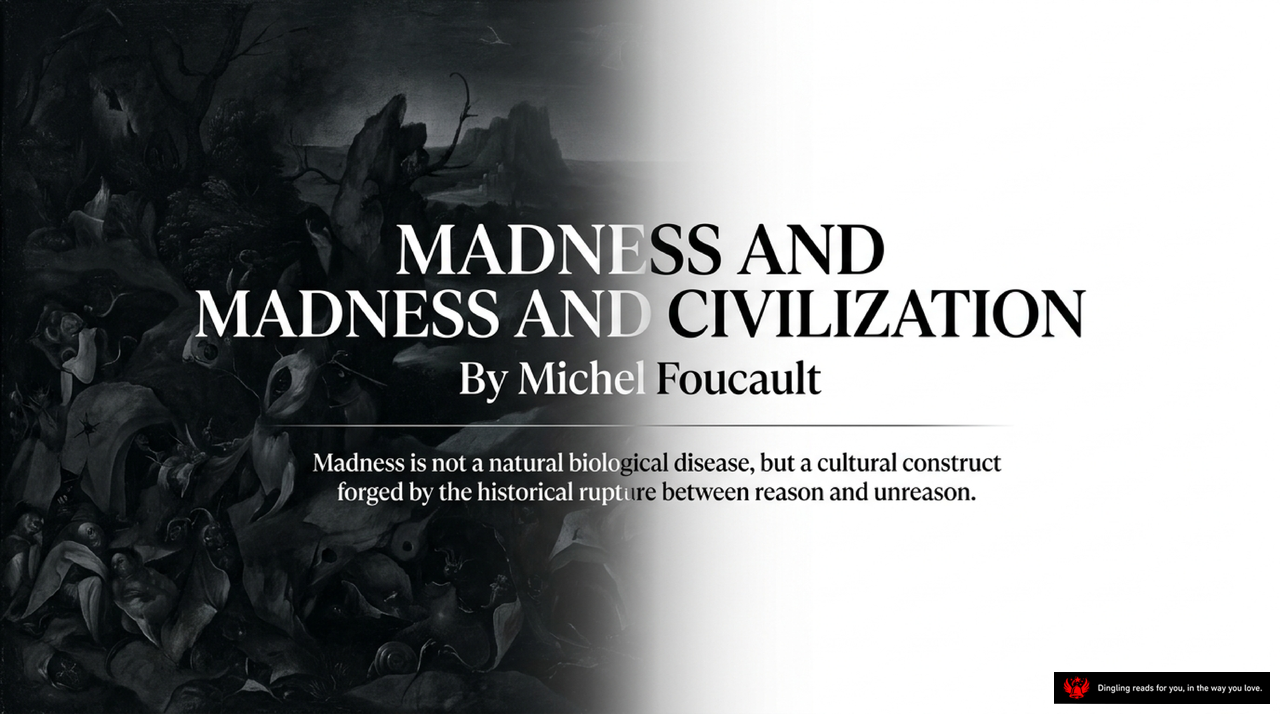
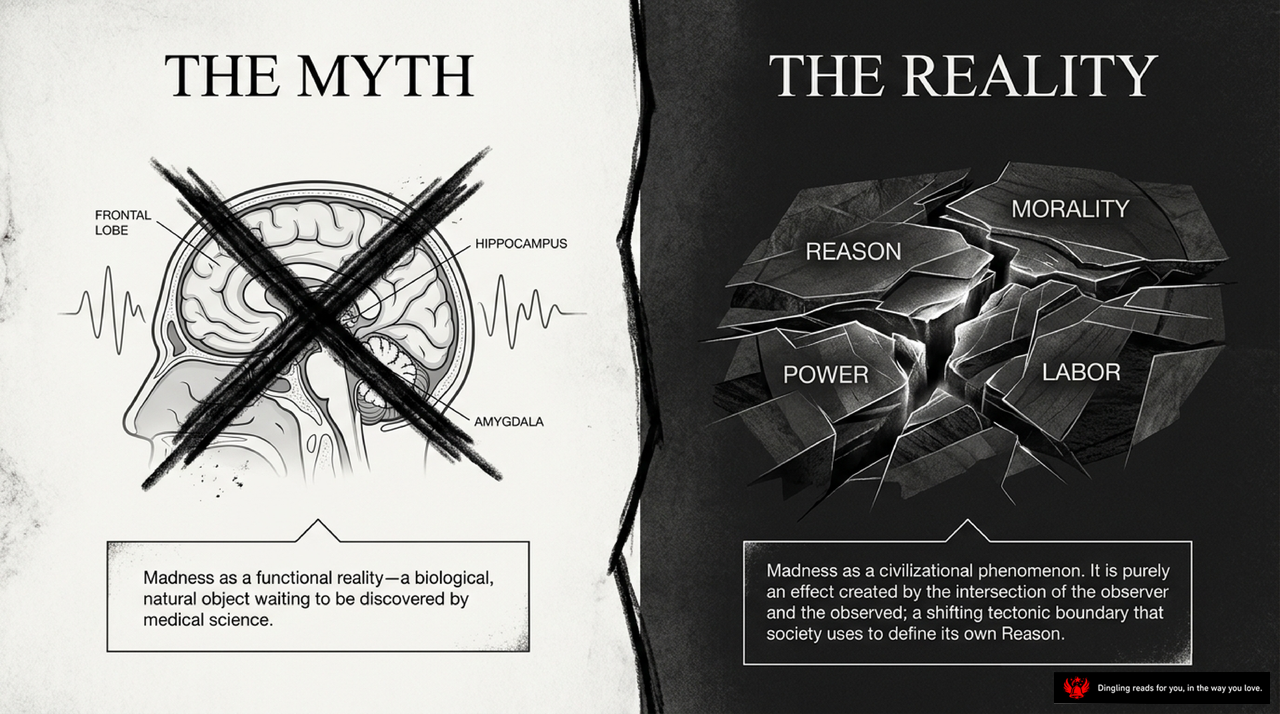
Welcome everyone to today's reading session. We are diving into Michel Foucault's classic, Madness and Civilization. The cover sets a provocative tone for what lies inside. It tells us that madness is not a natural biological disease, but a cultural construct forged by the historical rupture between reason and unreason.
Foucault challenges the idea that we simply treat mental illness. Instead, he argues that what we call madness is actually a product of how society defines itself against what it considers irrational. From the Middle Ages to the modern asylum, this book traces how we built the walls around the mind.
So, get ready to rethink what it means to be sane. We'll start by looking at how history shaped our understanding of the mad. Let's begin.
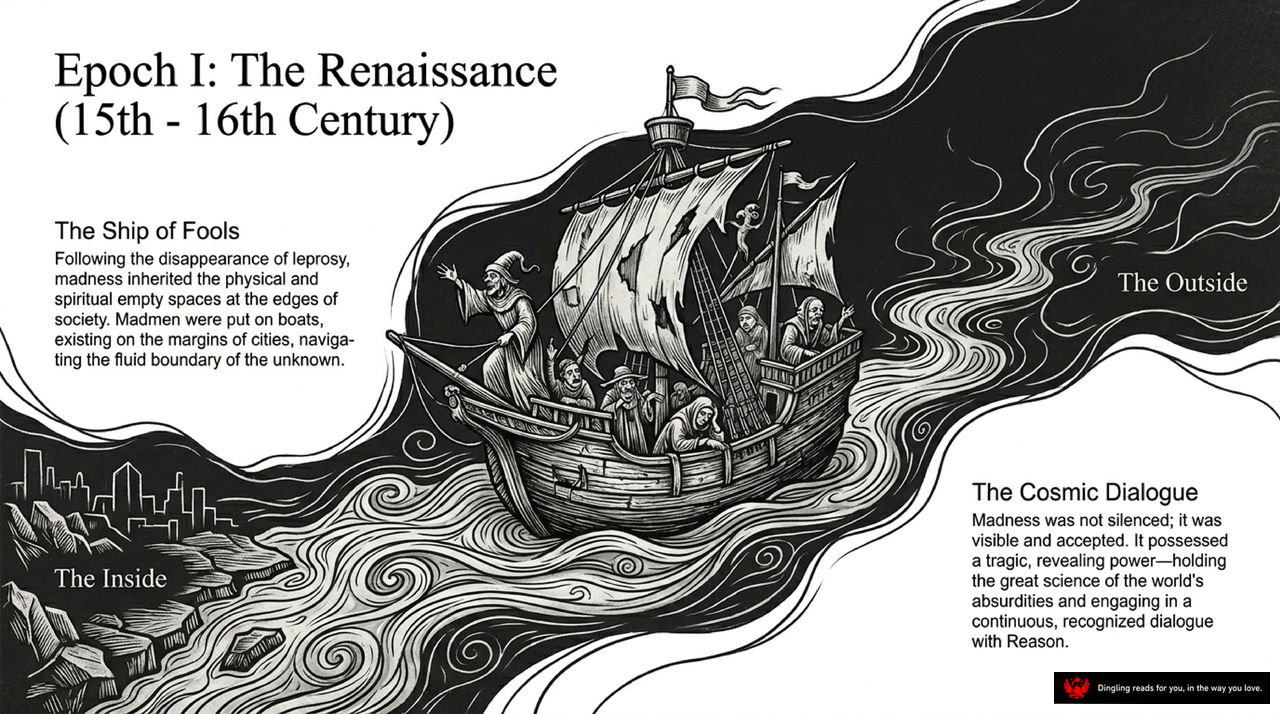
Welcome to our journey through history. We are now in Epoch I: The Renaissance, spanning the 15th and 16th centuries. Look at this striking image of the Ship of Fools. This isn't just a painting; it represents a major shift in how Western society viewed the mind.
Let's look at the context. When the Middle Ages ended, leprosy disappeared from the West. But society still needed to isolate the "other." So, madness inherited that role. Madmen were loaded onto boats, pushed along the margins of cities, navigating the fluid boundary between the known and the unknown. You see "The Inside" on the left, representing the safe city, and "The Outside" on the right, representing the chaotic waters. This visual perfectly captures the idea that madmen were pushed to the edges, existing on the margins of society, yet still part of the human story.
But this wasn't just about banishment. Look at the text on the right: "The Cosmic Dialogue." This is the key insight. Madness wasn't silenced. It was visible and accepted. It possessed a tragic, revealing power. It held the great science of the world's absurdities and engaged in a continuous, recognized dialogue with Reason.
Think about the culture of that time. In literature and drama, the fool wasn't a background character anymore. He stood center stage. Think of Erasmus' "In Praise of Folly." The fool used seemingly silly words to speak truths that the rational world missed. It was a time of great anxiety and curiosity. Madness was seen as a way to see the hidden chaos inside us, like in Bosch's art, where forbidden knowledge and the tree of knowledge symbolize the limits of human understanding.
Ultimately, this slide tells us that before we had modern psychiatry, we had a philosophical engagement with madness. It wasn't just about locking people away. It was about understanding what it meant to be human when the rules of reason seemed to break down. The ship itself acts as a vessel for this conversation. The sailors are participants, sailing into the unknown. This era taught us that the crazy and the sane were always talking to each other, even if we didn't always hear it. This sets the stage for everything that comes next.
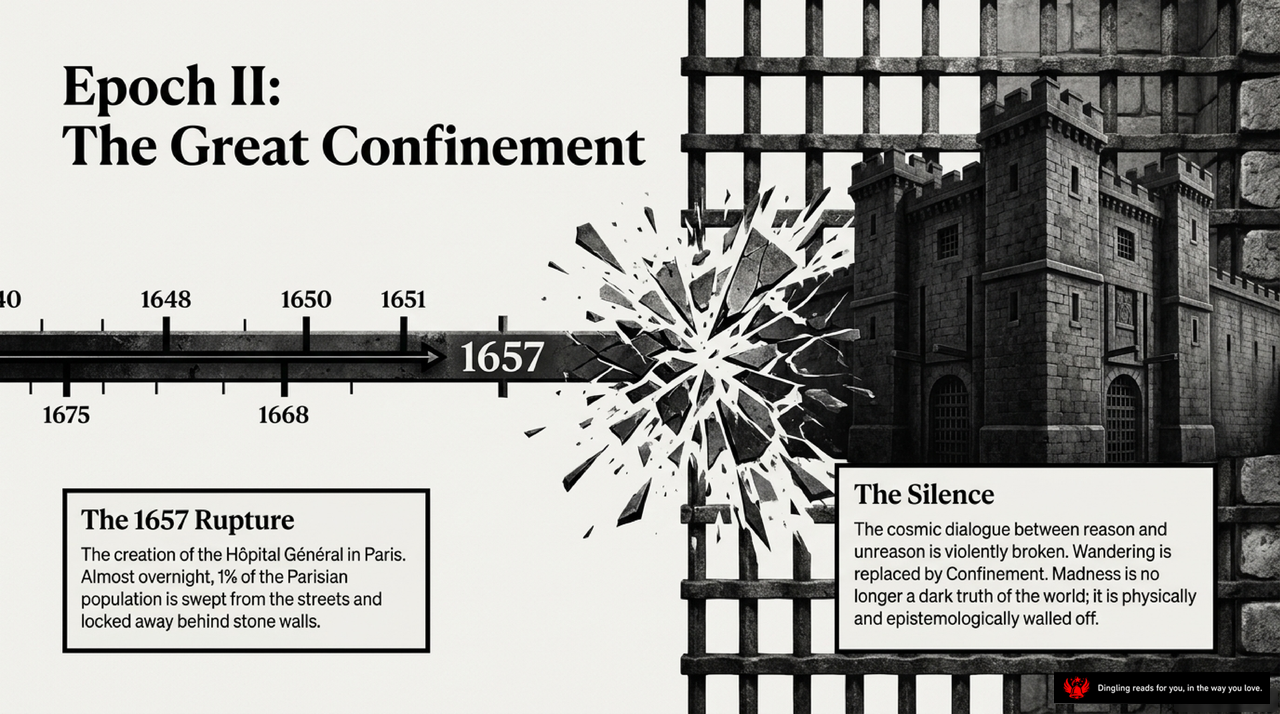
Welcome to Epoch II, a turning point in history we call the Great Confinement. If you look at the timeline here, everything converges on a single year: 1657. This is the moment the Hôpital Général was officially created in Paris. It wasn't just a new building; it was a new way of thinking about human behavior.
Almost overnight, the city changed. Roughly one percent of the Parisian population was swept from the streets and locked away behind stone walls. Before this, madness might have been a wandering presence, something you encountered in the marketplace or the river. But now, the "Silence" descends. The cosmic dialogue between reason and unreason is violently broken.
Wandering is replaced by Confinement. This is a crucial shift. Madness is no longer viewed as a dark truth of the world that we observe from a distance. Instead, it is physically and epistemologically walled off. It's hidden away, treated as a separate category of existence rather than a part of human life.
Why did this happen? It wasn't purely medical. It was about social order. The state decided that vagrancy, poverty, and madness were all the same problem. By locking them up, they were cleaning the streets and enforcing discipline. This institutionalization meant that madness stopped being a public performance or a wandering figure. It became something to be managed, contained, and hidden behind bars.
Inside these walls, the distinction between a madman and a beggar or a criminal blurred. The Hôpital Général wasn't just a hospital; it was a place of moral correction. It was designed to force labor and enforce discipline on those deemed useless to society. The goal wasn't to cure the mind, but to control the body and restore social order.
So, what happened to the madness? It didn't disappear, but it went underground. It stopped being a public spectacle. It became a problem to be locked away, separated from the rational world. This moment in 1657 fundamentally changed how society viewed the insane, turning them from a part of the world into a problem to be managed. The walls went up, and the conversation stopped. The silence of the institution replaced the noise of the street. The "Silence" isn't just about quiet; it's about the end of a conversation. For centuries, reason and madness had coexisted in a complex dance. Now, that conversation is cut off. Madness is silenced, locked away, and erased from the public eye. This is the Great Confinement.
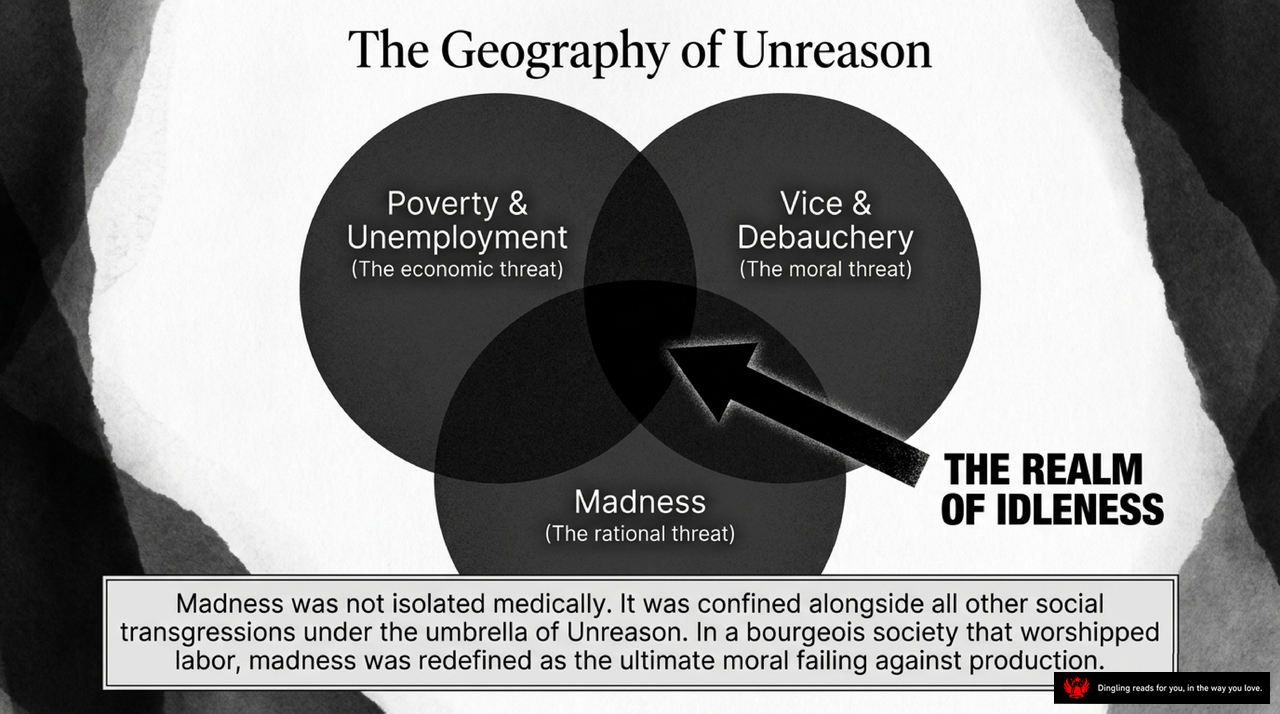
Take a look at this Venn diagram. It's titled "The Geography of Unreason," and it's showing us how the 17th and 18th centuries viewed madness. We have three overlapping circles: Poverty and Unemployment, labeled the economic threat; Vice and Debauchery, the moral threat; and Madness, the rational threat.
Notice the center where they all overlap? That points to "The Realm of Idleness." This is the key takeaway. In this era, madness wasn't isolated medically. It wasn't treated as a separate disease. Instead, it was confined alongside all other social transgressions under this umbrella of Unreason.
Think about what this means for a modern audience. Today, we might separate mental health from poverty or crime. But back then, in a bourgeois society that worshipped labor, the definition of sanity was tied entirely to productivity. If you couldn't work, you were a threat.
The text explains that madness was redefined as the ultimate moral failing against production. If you were poor, unemployed, or a vagrant, you were seen as lazy or sinful. If you were mad, you couldn't work. So, you were lumped into the same category. You were confined in the same institutions—hospitals, prisons, workhouses.
It wasn't about curing the mind. It was about enforcing discipline. Idleness was seen as a sin, a rebellion against God and society. So, whether you were a drunkard, a thief, or a madman, the solution was the same: force you to work or lock you up. This system treated madness as a form of social garbage, something that needed to be expelled to maintain the rational order.
But there's a darker side to this. The text mentions that these institutions weren't just about containment; they were about moral correction. People were forced into labor to "punish" their laziness. Even the madmen were expected to work if they could. If they couldn't, they were just another obstacle to the economic machine.
For example, in 1657, France banned all begging. If you were a beggar, a criminal, or a madman, you were all sent to the same place. It wasn't about helping you. It was about making you pay for your idleness.
So, this diagram isn't just about mental health. It's about how society defines "normal" behavior. When you fall outside the rules of labor and morality, you fall into this realm of idleness, and you get treated as a threat to the entire system. This is why madness was so stigmatized. It wasn't just about being "crazy"; it was about being useless.
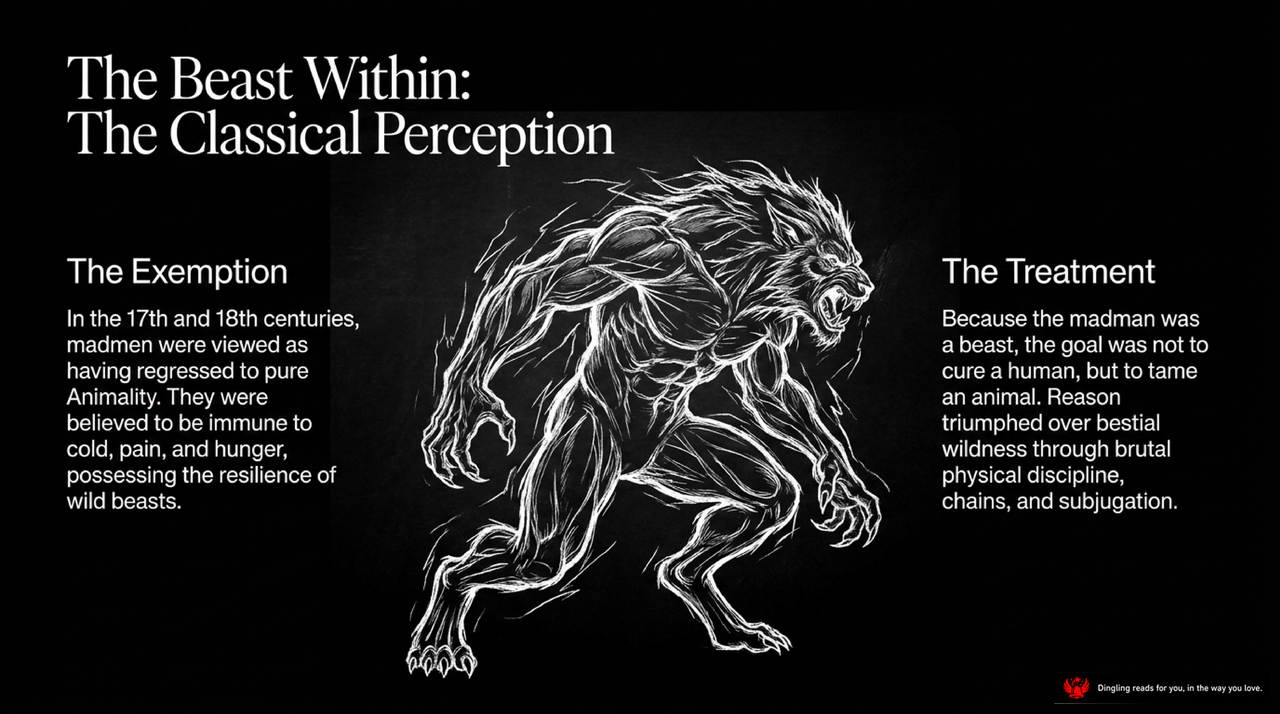
So, take a look at this image. You see a creature here, a beast, representing a very specific historical view. This slide is titled "The Beast Within: The Classical Perception."
Let's start with the left side, "The Exemption." In the 17th and 18th centuries, the way people saw madness changed completely. Madmen were no longer seen as humans who had lost their minds. Instead, they were viewed as having regressed to pure Animality. It was a terrifying idea. They were believed to be immune to cold, pain, and hunger. They possessed the resilience of wild beasts. It was almost like they were exempt from the normal human experience of suffering. If you are a beast, you don't feel the cold like we do. You don't feel pain like we do. This belief made the confinement easier to justify as management rather than care.
Now, look at the right side, "The Treatment." If you accept that a madman is essentially a beast, your approach to him changes. The goal was not to cure a human, but to tame an animal. Reason tried to triumph over bestial wildness. But how? Through brutal physical discipline, chains, and subjugation. This wasn't about healing; it was about control. It was about forcing the wildness inside them to submit to the order of the outside world.
This was the dominant mindset of the Classical Age. Madness wasn't a medical condition to be treated with empathy or science. It was a wild force that needed to be locked down. The beast wasn't just inside the person; it was the person. And the only way to deal with it was to chain it down. This brutal logic would define how society viewed the mentally ill for centuries to come.
Think about the transition. Before this, during the Renaissance, madness was something you could talk about, you could even celebrate it in art. You saw the fool as a wise man. But as we move into the 17th and 18th centuries, that conversation stops. The beast takes over. The "Exemption" from human suffering becomes the reason for the "Treatment" with human cruelty. They were locked in cells, chained to walls, and treated like the animals they were thought to be.
This shift marks a dark turning point. The Classical Age didn't just lock people away; it redefined them. They weren't sick people anymore. They were wild things that needed to be tamed. And that belief system is what we are exploring right now. It's a stark reminder of how our definitions of humanity can change so drastically.
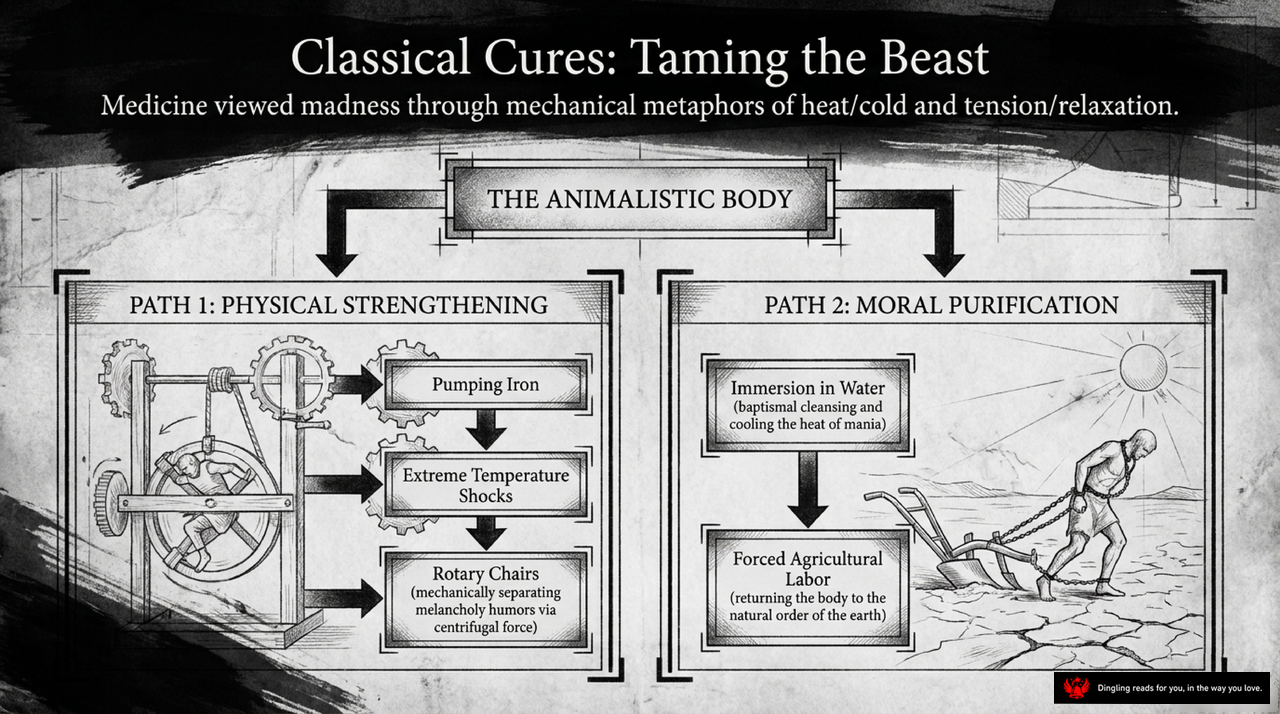
Welcome everyone. Today we are exploring a fascinating chapter in the history of medicine. Look at the title on your screen: Classical Cures: Taming the Beast. This phrase perfectly encapsulates how doctors in the classical era viewed madness. They didn't see it as a psychological issue. Instead, they viewed the human body as an animalistic machine that had broken down. They believed madness was caused by an imbalance of heat and cold, tension and relaxation. To fix it, they developed two distinct strategies to restore order.
First, let's look at Path One: Physical Strengthening. This approach relied on mechanical metaphors. Imagine the body as a machine that needed oil and force. Doctors used methods like pumping iron. They believed that strengthening the physical body would strengthen the mind. They also used extreme temperature shocks, trying to jolt the system out of its feverish state. And check out this rotary chair. It was a terrifying device designed to use centrifugal force to mechanically separate melancholy humors from the blood. It was all about brute physical power to override the internal chaos.
On the other side, we have Path Two: Moral Purification. One method was immersion in water. Doctors believed water was a universal regulator, capable of cleansing the body and cooling the heat of mania, almost like a baptism. Another method was forced agricultural labor. It was a way to discipline the body through hard work, treating the patient like an animal that needed to be tamed back into society.
So, whether it was pumping iron or plowing fields, the goal was the same. They were trying to tame the beast inside us by using physical and moral tools. It wasn't about healing the mind in the way we understand it today, but about controlling the body to restore social order. This approach laid the groundwork for how we understood mental health for centuries to come. It reminds us that our history with madness is deeply rooted in our history with the body.
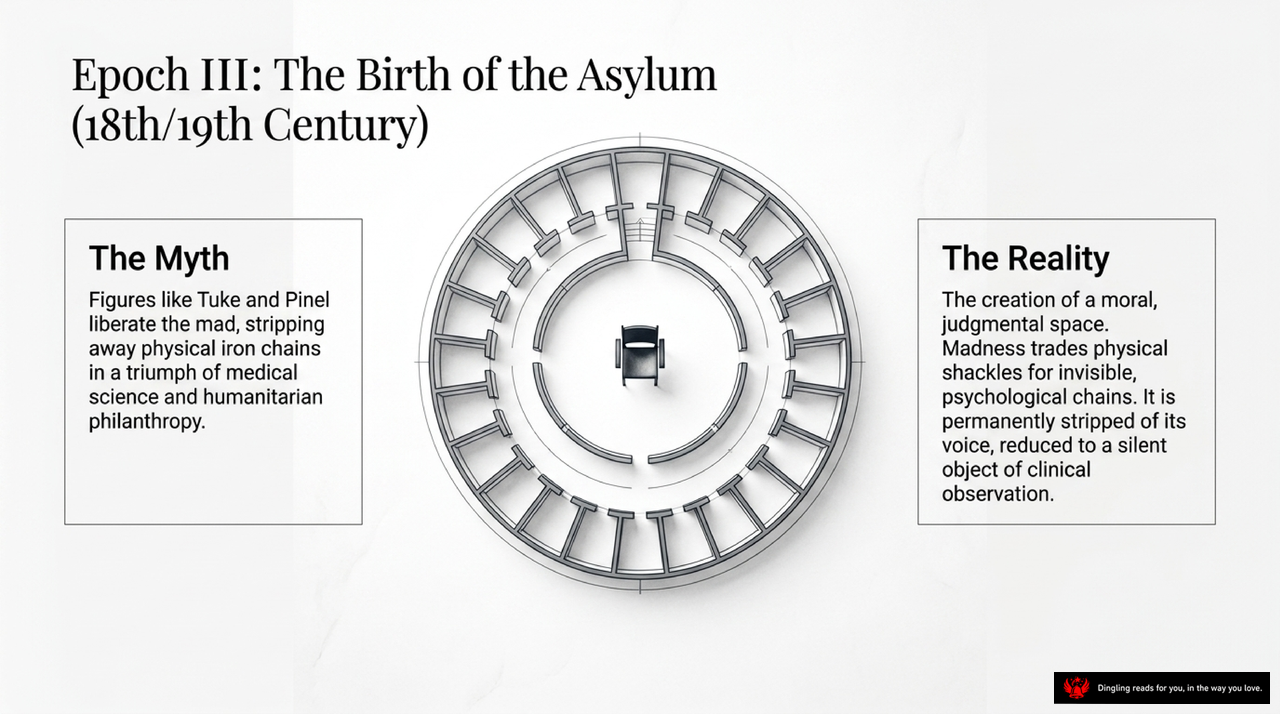
Welcome to Epoch III, where we dive into the birth of the asylum during the 18th and 19th centuries. If you've ever studied this era, you've probably heard the classic story. Figures like Tuke and Pinel are hailed as heroes who liberated the mad, stripping away those physical iron chains in a glorious triumph of medical science and humanitarian philanthropy. It feels like a victory for human rights, right?
But look at the diagram in the center. That circular layout with the chair in the middle isn't just architecture; it's a machine for control. The slide highlights a stark contrast between the Myth and the Reality. While the Myth tells us they freed the mad, the Reality reveals something much darker. They didn't remove the chains; they just swapped them. Physical shackles were traded for invisible, psychological chains.
Take Tuke's asylum, for example. It wasn't a free farm; it was a moral and religious isolation zone. Patients were forced to work and observe each other, constantly performing rationality just to keep their freedom. The fear wasn't from iron bars, but from inner guilt. Then there was Pinel. He removed the iron, sure, but he introduced silence. He used mirrors and endless trials to force the mad to judge themselves. The doctors became the new judges and fathers, wielding absolute moral authority.
The result? Madness was permanently stripped of its voice. It was reduced to a silent object of clinical observation. Instead of a person with a story, the mad became a case file to be managed. The asylum didn't liberate them; it created a moral, judgmental space where the mind was the new prison. This shift laid the groundwork for how we understand mental health today, but it came at a heavy cost to the human experience. We traded the dungeon for the doctor's office, and the chains for the gaze. Foucault reminds us that this wasn't about curing the mind, but about controlling the body and the soul through a new kind of invisible discipline. The mad were no longer people; they were just problems to be solved, trapped in a system that demanded total compliance with the norms of sanity. They were silenced, observed, and categorized, losing their humanity in the process of being treated.
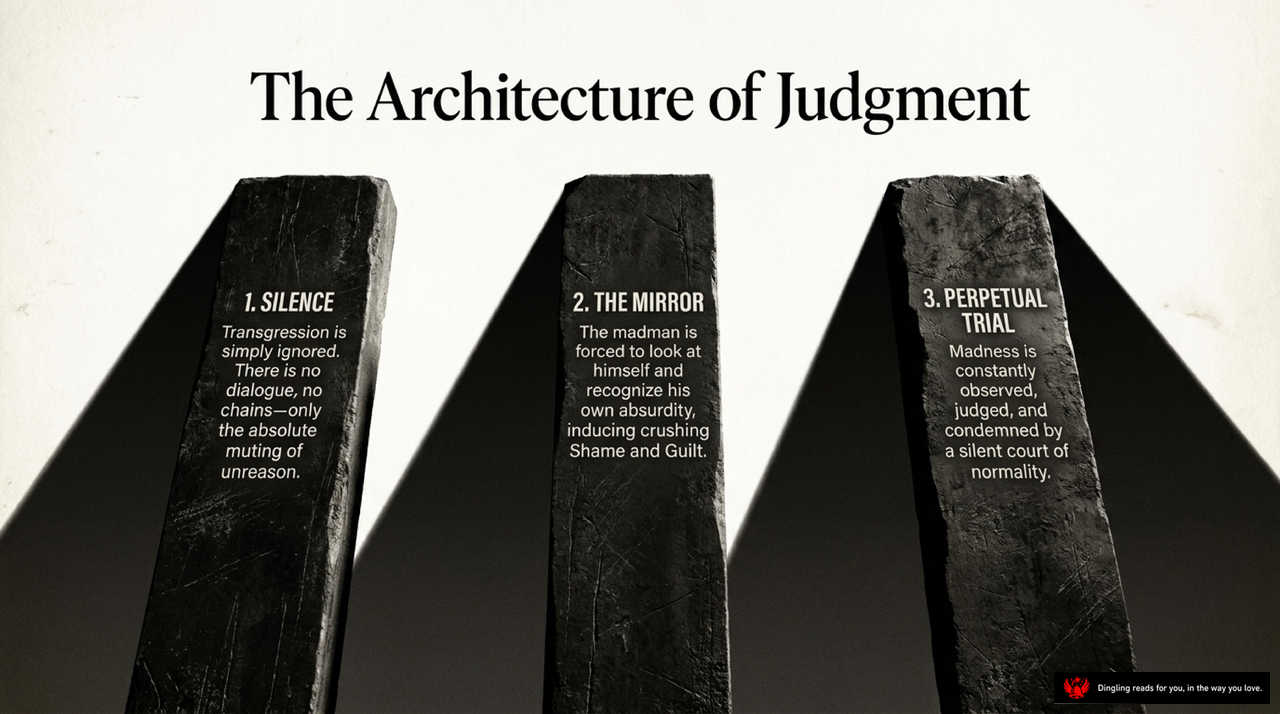
Check out this slide. "The Architecture of Judgment." This visual perfectly captures how madness was managed in the late 18th century, specifically by reformers like Pinel and Tuke. It's not about medical cures anymore; it's about a specific social structure designed to control the mind.
First, look at "Silence." The text notes that transgression is simply ignored. There are no chains, only the absolute muting of unreason. Think about the priest who believed he was Christ. He was locked up for twelve years. When Pinel unlocked him, he didn't talk to him. Instead, he ordered everyone to stay silent. No dialogue, no validation. That isolation forces the madman into shame. The madness isn't spoken out; it's drowned in silence.
Next is "The Mirror." Here, the madman is forced to look at himself. Pinel used a psychological trick. Three men claimed to be King Louis XVI. Pinel isolated them, telling each one that the others were crazy, and only he was the real king. Suddenly, they realized their absurdity. They were forced to see themselves as the "other" through the eyes of the "normal." It induces crushing shame and guilt. You aren't just locked up; you are made to confront your own delusion.
Finally, "Perpetual Trial." Madness is constantly observed, judged, and condemned by a silent court of normality. A man terrified of hell stopped eating. Pinel had the staff threaten him with physical punishment. It became a choice: suffer now or suffer later. The madman is constantly on trial, condemned by a silent court of normality.
Basically, the asylum became a place where madness wasn't just contained, it was managed through shame, observation, and judgment. The doctor isn't a healer; he's a moral authority, a father figure, a judge. This architecture of judgment is what defines the modern experience of madness. It's a shift from physical force to psychological control. The madman is no longer a beast to be chained, but a subject to be corrected. And the doctor becomes the ultimate arbiter of reason, deciding who is sane and who is not. This is the birth of the modern asylum, where the mind is policed by the very people claiming to heal it. The madman is trapped not just by walls, but by the silent court of normality.
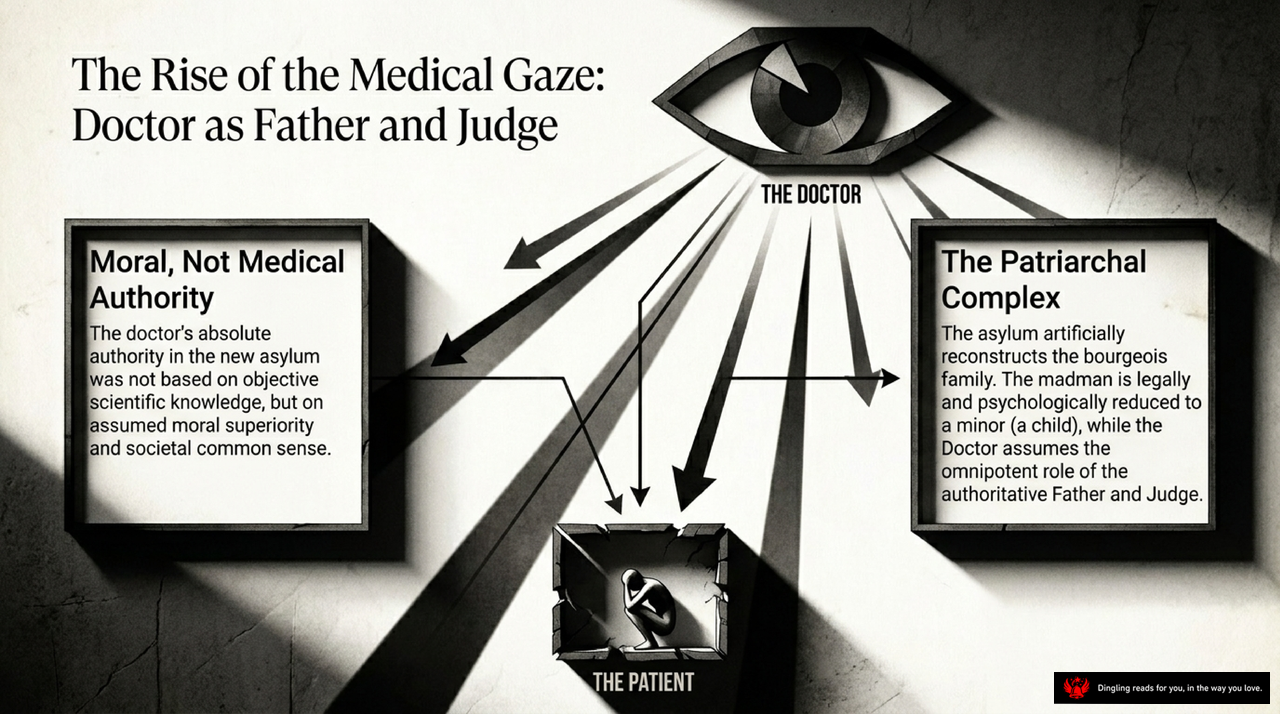
Take a moment to look closely at this slide, titled "The Rise of the Medical Gaze: Doctor as Father and Judge." This visual really captures the shift in power dynamics during the late 1700s and early 1800s.
Look at that large eye at the top, labeled "The Doctor." It's staring down, but notice the arrows. They aren't just lines of sight; they are lines of authority. They point directly to the patient in the box at the bottom. This represents an overwhelming gaze where the doctor holds absolute power over the individual.
On the left, the text reads "Moral, Not Medical Authority." This is the core of the change. In the early stages of the asylum system, the doctor's power didn't come from objective science or medical technology. They didn't have the diagnostic tools we use today. Instead, their authority was built on "assumed moral superiority." They were seen as the guardians of what society considers "common sense." If you were the doctor, you were the one who defined what was "normal" and what was "deviant." It was a moral judgment disguised as medical expertise.
On the right, we see "The Patriarchal Complex." Foucault argues that the asylum artificially reconstructed the bourgeois family structure. Think about the traditional family: there is the father who holds the power, and the children who obey. In the asylum, the Doctor assumes the role of the all-powerful Father. He sets the rules, he punishes, and he disciplines. Meanwhile, the patient is legally and psychologically reduced to a minor—a child. They have no agency. They are there to be managed, not to be heard.
So, the Doctor becomes both the Father and the Judge. He decides what is right, he decides what is wrong, and he decides who gets to leave. This dynamic is what allowed the asylum to function. It wasn't just a place to lock people up; it was a place to enforce moral order. The patient's "madness" was framed as a moral failure that needed fatherly correction.
This shift is what we call the "Medical Gaze." It's the moment when madness stopped being a wild, natural force and became a problem that a "Father" could solve with his "Judgment." The doctor's eye is no longer just looking; it is ruling. This is the foundation of modern psychiatry, where the doctor's moral authority becomes the ultimate medical truth. We see the patient in the box, isolated and powerless, while the doctor looks down from above, the ultimate authority figure in this new world.

Welcome back. Today we're unpacking a critical framework: The Three Epochs of Madness. This table outlines how Western society has defined and treated madness, shifting dramatically from the Renaissance all the way to the Modern Age.
Let's start with the Renaissance. Back then, madness wasn't locked away in a building. The spatial status was "The Ship," wandering the margins of society. Think of the famous "Ship of Fools." Madness was seen as a form of "Cosmic Truth and Dialogue." It was a space where reason and folly debated each other openly. The core mechanism was "Integration and Fear." Society integrated madness into culture, even while fearing it. It was a wandering force, a traveler on the river, not a contained one. As the text notes, madness was a threat but also a source of insight.
Moving forward to the Classical Age, everything changes drastically. The spatial status shifts to "The Hospital," specifically confinement. Madness is now viewed as "Animality and Moral Failing." People stopped seeing madness as a cosmic mystery and started treating it like a beast or a sin. The core mechanism became "Physical Chains and Silence." This was the era of the General Hospital. They used iron bars, locks, and silence to suppress madness. It wasn't about healing; it was about moral correction and social order. Madness was treated as a violation of the moral law, a sign of laziness and rebellion against God. The silence was absolute, designed to break the will.
Finally, we reach the Modern Age. The space transforms into "The Asylum," a Clinical Ward. Here, madness is redefined as "Psychological Illness and Guilt." It's no longer about demons or beasts, but about the mind. The core mechanism is now "Observation and Perpetual Trial." Think of Pinel and Tuke. They introduced the idea of moral treatment, but it was really about observation. Patients were constantly watched, judged, and put on trial to see if they were "cured." It became a matter of psychological guilt and scientific classification. The trial never really ended; it was a constant state of being watched.
So, looking at this progression, we see madness moving from a wandering cosmic force to a confined animal, and finally to a psychological subject under constant observation. It's a story of how we control the other.

Let's look at this slide. It presents a fascinating paradox about the relationship between madness and art. It states, 'Madness is the absolute absence of the work of art; it is the void where creation collapses.' On the surface, that sounds terrifying. It suggests that if you lose your mind, you lose the ability to create. But the slide immediately pivots to a much deeper truth. It argues that through the madness of the artist, the artwork actually forces the modern world to justify itself. The rational world is suddenly put on trial by the very unreason it tried to lock away in the asylum.
Now, let's connect this to the history we've been exploring. For centuries, the 'rational' world spent its energy trying to contain this 'unreason.' They built asylums, they locked people away, they treated madness as a beast to be tamed or a disease to be cured. The book tells us that this was a way for society to protect its own order. They thought that by locking the 'unreason' away in the asylum, they could keep their 'rational' world safe and stable.
But that containment started to fail. As the 18th century ended, irrationality re-entered society. It wasn't just a hidden fear anymore; it became a force. Look at the names listed here: Sade, Goya, Nietzsche, Artaud, Van Gogh. These artists didn't just suffer from madness; they weaponized it. They turned their internal chaos into external art. As the text mentions, their works appeared like 'lightning striking the night sky,' piercing through the calm facade of the modern world. They were the ones who refused to stay silent in the asylum.
This is the key point. The 'rational world' believed it had the monopoly on truth. It thought it could define what was sane and what was not. But these artists showed that the 'rational' order was fragile. By using their madness, they exposed the cracks in that order. They forced society to confront its own hypocrisy. The artwork became the mirror. If you look at Van Gogh's paintings or Nietzsche's writings, you see a world that is constantly shaking, constantly questioning. The rational world is put on trial because the art reveals that their 'order' is actually just a suppression of the wild, chaotic truth.
So, madness isn't the opposite of art. It's its fuel. The artists listed here—Sade, Goya, Nietzsche, Artaud, Van Gogh—showed that true creation often comes from the edge of the void. They took the 'unreason' that the asylum tried to hide and turned it into the most powerful reason of all. They made the world uncomfortable, and that discomfort was the point. The artwork forces the modern world to justify itself because it can no longer pretend that everything is fine. It has to face the madness it tried to lock away. In the end, the art proves that the 'rational' world is the one that is actually missing something essential. That's why the slide says the rational world is put on trial.

Look at this image. A dark corridor, a single light hanging from the ceiling. It feels like an old asylum, doesn't it? It's haunting. But the text on this slide challenges a common belief we hold about mental health. It says, "Madness is not a biological destiny, but a silent space created by society to isolate its own unreason."
This is a profound statement. For a long time, we thought madness was something inside a person's head, something they were born with or got sick with. But the reality, as we've explored in this book, is much darker. We didn't just lock people away; we built a system to define what "normal" is by throwing out what is "not normal."
Think about the transition. In the past, we used physical chains. You saw leper hospitals and asylums with iron bars. But as time went on, especially in the 17th and 19th centuries, we traded those for "invisible shackles of moral judgment and clinical surveillance."
In places like the General Hospital in Paris, these institutions weren't just medical institutions. They were tools of social control. They forced labor on the poor and the mad, punishing them for being "lazy" or "immoral." It wasn't about healing; it was about discipline.
Doctors became the new jailers. Foucault, the philosopher we discussed, pointed out that the asylum wasn't a place of liberation. It was a place of deeper control. Doctors became like fathers and judges. They didn't just treat symptoms; they judged your character. They used silence, mirrors, and constant observation to make the patient feel guilty. If you didn't behave, you weren't just sick; you were morally wrong.
So, the slide asks a critical question: "If our 'rational' civilization is built entirely upon the silencing and imprisonment of the 'irrational', who is truly the captive, and what truths have we lost in the dark?"
This is the core question. We look at the doctor and think they are the savior. But if the system needs to silence the mad to feel safe and rational, then isn't the system itself the one that's trapped in its own narrow definition of reality? We locked up the unreason that keeps us from seeing the full picture of human existence. We lost the insights that the madman might have seen. So, in this dark corridor, who is really the prisoner? The person in the chains, or the society that built the walls? We traded the physical chains for the invisible ones, and maybe, we never realized we were the ones who needed the cure.