
Loading…
Madness and Civilization

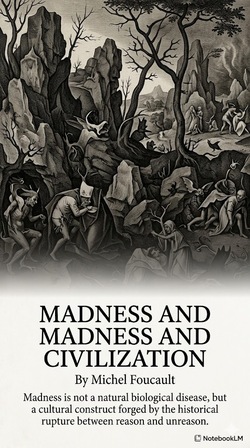
In *Madness and Civilization*, Michel Foucault upends traditional views of mental illness by tracing how Western society has constructed, marginalized, and controlled 'madness' over centuries. Starting with medieval leper isolation—whose exclusionary structures persisted long after the disease faded—Foucault explores the Renaissance's 'fool ships,' which banished the insane as both outcasts and objects of mythic fascination. He dissects the 17th-century rise of mass confinement, where madpeople were locked alongside beggars, criminals, and the unemployed not for treatment, but to enforce social order and moral discipline. Finally, he exposes the 19th-century asylum as a site of subtle, pervasive control: what seemed like humanitarian reform (e.g., Pinel removing chains) was actually a new system of moral judgment, silence, and surveillance. Foucault argues madness is not a natural medical condition but a product of power dynamics, revealing how rationality has defined itself by suppressing the irrational.
Understand the Book
Choose how you want to explore this book.




Explore with AI
 Ask about the book's ideas and how they relate to your life.