


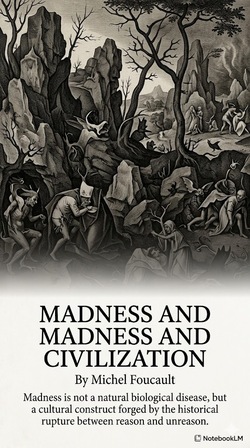
Foucault makes madness feel like a social tool.
Your Review
Foucault makes madness feel like a social tool.

The book reveals madness is a social construct used to control deviance, not a fixed biological flaw inside our brains.

Foucault brilliantly shows how asylums replaced physical chains with moral control, proving that modern psychiatry often silences dissent by labeling non-conformity as insanity rather than listening to different perspectives.

This book completely changed how I see mental illness today.

Foucault shows how labeling people mad protects power structures and social order. The historical shift from excluding lepers to confining the mentally ill reveals that 'madness' is never a fixed biological truth but a moving target shaped by the needs of the era, whether religious, economic, or political. What struck me most was how the 17th-century 'Great Confinement' didn't just lock away the poor and criminal but specifically merged madness with idleness to serve capitalism, turning a diverse group of 'undesirables' into a single threat to be controlled. Even the later 'humane' asylums, like Pinel's, didn't free patients but replaced physical chains with invisible moral shackles, forcing them to conform to strict norms of rationality and work. This insight challenges our modern tendency to pathologize neurodiversity or reject traditional work ethics, reminding us that every diagnosis often serves to police deviance rather than heal the individual, making the book feel startlingly relevant to current debates about mental health.

Foucault argues madness is a social construct shaped by power structures, economic needs, and cultural anxieties of each era rather than an innate biological flaw, challenging the medical view that treats mental illness as a fixed condition separate from the world around us. He traces this history from medieval leper houses used for exclusion to the Great Confinement where governments locked up the poor and mad together to enforce labor discipline during economic crises, revealing how asylums later replaced physical chains with subtle moral control to make patients conform to strict social norms and silence dissent against dominant values, proving that labeling someone as mad is really about enforcing rules for what it means to be a good member of society in any given time.

Foucault argues madness is social, not biological.

Reading about the Ships of Fools made me realize how long history has treated outsiders as things to be washed away by water, and it's chilling to see how that same logic still drives us to banish anyone who challenges the status quo today.

This book makes me feel uneasy about how easily society labels anyone who doesn't fit as crazy, and I worry that today's focus on productivity might be just another form of the old confinement that Foucault describes so clearly.

This book brilliantly traces how madness shifted from a romantic folly to a tool for social control. Foucault reveals that institutions like the asylum didn't free the mad; they replaced physical chains with subtle, insidious moral judgments that forced patients to conform to strict societal norms. Instead of healing, these systems silenced dissent by labeling any deviation from the dominant order as insanity. The historical examples of leper houses and the Great Confinement illustrate how power structures have always defined deviance to maintain stability. Ultimately, Foucault challenges us to question who gets to define sanity today and whose voices are being silenced by our modern definitions of mental illness. This is a radical critique of how we use labels to police behavior. 5/5

Foucault argues that labeling someone mad is actually a way for society to enforce order and silence those who do not fit its narrow definitions of normal behavior, revealing how power structures have historically used the concept of mental illness to marginalize dissenters, exclude the poor, and maintain the status quo by redefining deviance as insanity across different eras from medieval leper houses to modern psychiatric institutions. This perspective challenges the common assumption that mental illness is purely biological, instead suggesting that what we call madness is often a reflection of cultural anxieties and economic needs, making us question who gets to define sanity and whose voices are silenced in the name of reason.

Hard to read but the idea that society creates madness is really thought-provoking.

The idea that Pinel's unchaining was actually a swap of physical chains for moral control really changed how I see modern therapy, because it shows that asylums never freed the mad but just made their obedience more subtle and harder to resist.

Reading this made me realize that labels like "disorder" often just silence people who challenge society's narrow definition of what a normal, productive life should look like.

This book makes me rethink how society defines mental illness today.

Foucault shows how asylums replaced chains with moral judgment, silencing dissent by forcing patients to conform to strict social norms rather than offering real healing, making the doctor a judge of sanity instead of a healer, which reveals how power structures define deviance to maintain order across centuries by labeling anything that challenges the status quo as madness.

Foucault brilliantly shows how madness shifted from a leper's sin to a capitalist tool for controlling idle bodies, revealing that what we call mental illness is often just society's way of punishing those who refuse to work or fit the mold of a productive citizen, making me question every diagnosis I've ever heard about.

Radical rethink of madness.
This book changed my view on mental health by showing that labeling someone mad is often about control, not care, and it made me question why we rush to medicate anyone who simply acts differently from the crowd.

The book connects medieval leper houses to modern ADHD diagnoses in a way that exposes how power defines normalcy, and it made me realize that our current obsession with fixing neurodivergent kids is just the latest chapter in a long story of excluding difference.