
Make It Stick: Complete Chapter-by-Chapter Summary

Welcome to "Make It Stick," the counterintuitive science of successful learning. Co-authored by Peter C. Brown, Henry L. Roediger III, and Mark A. McDaniel, this book challenges everything you think you know about how we learn.
We often believe that the best way to master a skill is to read over our notes repeatedly or cram information before an exam. But the science tells us a different story. True learning isn't about making things feel familiar; it's about making them stick in your long-term memory.
The core principle here is that knowledge must be ready to use whenever you need it. Whether you're a pilot facing an engine failure or a student preparing for a final, the goal is to have that information instantly available in your brain. The most effective way to achieve this isn't passive review, but active retrieval. By testing yourself, recalling information from memory, and even embracing the struggle of forgetting and relearning, you build stronger neural pathways.
Contrary to popular belief, intelligence isn't fixed. Through deliberate practice, reflection, and the right strategies like spaced repetition and interleaving, anyone can improve their cognitive abilities. So, stop relying on the illusion of competence and start using the science of learning to build a lasting, flexible mind.

The Trap of Fluency is a dangerous illusion that keeps us stuck. On the left, you see a smooth, slippery slide representing methods like rereading, highlighting, and massed practice. These tricks trigger System 1 thinking, giving us a false sense of confidence. It feels like mastery, but the knowledge is as fragile as writing in the sand—it vanishes the moment the tide comes in.
In contrast, True Mastery is built on the right, depicted as a rugged, reinforced staircase. This path requires cognitive friction and effortful learning, forcing your brain to engage System 2 thinking. While it feels harder in the moment, this struggle is essential. Every time you push through that difficulty, you etch a deeper, permanent structural pathway into your memory. Don't settle for the easy slide; climb the stairs. Real expertise isn't about how fluently you can read; it's about how deeply you can recall and apply what you've learned under pressure.

Have you ever wondered why cramming for an exam feels so productive, yet you forget everything the next week? The image on your screen reveals the answer: it's all about "Desirable Difficulties."
Look at that orange line. It represents easy, concentrated practice. It spikes high and fast, but it crashes just as quickly. That's because when learning is too easy, it only sticks in your fragile short-term memory. It's ineffective learning.
Now, look at the blue line. This one is different. It shows a pattern of rising and falling over time. This is the power of introducing "calculated friction." By letting yourself forget slightly before you re-study, you force your brain to reconstruct the memory. That struggle is what makes the memory permanent.
This concept is known as "Desirable Difficulties." It means that the things that make learning feel harder—like spacing out your sessions or mixing up different topics—are actually the things that make you smarter. So, don't fear the struggle. Embrace it. Because the friction you feel today is the foundation of the mastery you'll have tomorrow.

You are about to learn why the most effective way to study isn't reading your textbook over and over again. Instead, it's about creating what we call "desirable difficulties."
Look at the cycle on the screen: Test, Fail & Struggle, Reconsolidate. This is the engine of real learning. When you actively pull information out of your brain—perhaps by recalling facts on a blank sheet of paper without looking at your notes—you aren't just checking if you know it. You are physically strengthening the neural pathways.
This process is called the Testing Effect. It feels uncomfortable because you might fail or struggle to remember something immediately. But that struggle is actually the key. When you retrieve a memory after a delay, your brain has to work harder to reconstruct it. This effort forces the memory to be re-consolidated, making it much more durable than if you had just re-read the material.
Think about it this way: if learning were easy, everyone would be an expert. The friction you feel when trying to recall a concept is the signal that your brain is growing. By ditching the illusion of knowing that comes from simply recognizing text, and embracing the challenge of active retrieval, you stop forgetting and start truly mastering complex skills.

Have you ever wondered why some skills stick while others vanish the moment the test is over? The secret lies not in how many hours you spend staring at a textbook, but in the specific way you practice. Today, we're diving into the concept of "Desirable Difficulty"—a counterintuitive idea that suggests making learning harder actually makes it better.
Look at the diagram on your screen. It illustrates the three-step cycle of learning: Encoding, Consolidation, and Retrieval. When you simply re-read notes, your brain creates a false sense of fluency. You feel like you know it, so you stop trying. But this is a trap. True learning happens when you force your brain to work.
That's where Spaced and Interleaved Practice come in. Instead of cramming all your study sessions together—what we call "Blocked Practice"—you should insert time between them. Sleep and time allow your memories to physically consolidate and stabilize, turning short-term traces into long-term knowledge. You might feel frustrated when you can't recall something after a break, but that struggle is exactly what strengthens the neural pathways.
Furthermore, don't just drill one type of problem repeatedly. Mix them up. That's Interleaved Practice. Imagine mixing different shapes and colors in your training, just like the bottom part of the slide shows. It feels slower and more confusing at first, and it might even feel frustrating. But this confusion is critical. It forces your brain to discriminate between problems and apply the correct specific solution. It builds a flexible mental model rather than a rigid script.
Think about a baseball player who only practices hitting one type of pitch. They will be fast, but they will fail when the pitcher throws a curveball. But a player who practices random mixtures of pitches learns to recognize the pattern instantly and reacts correctly. This is how experts operate. They don't rely on rote memorization; they rely on robust, flexible retrieval. So, embrace the difficulty. If it feels easy, you're probably not learning enough.
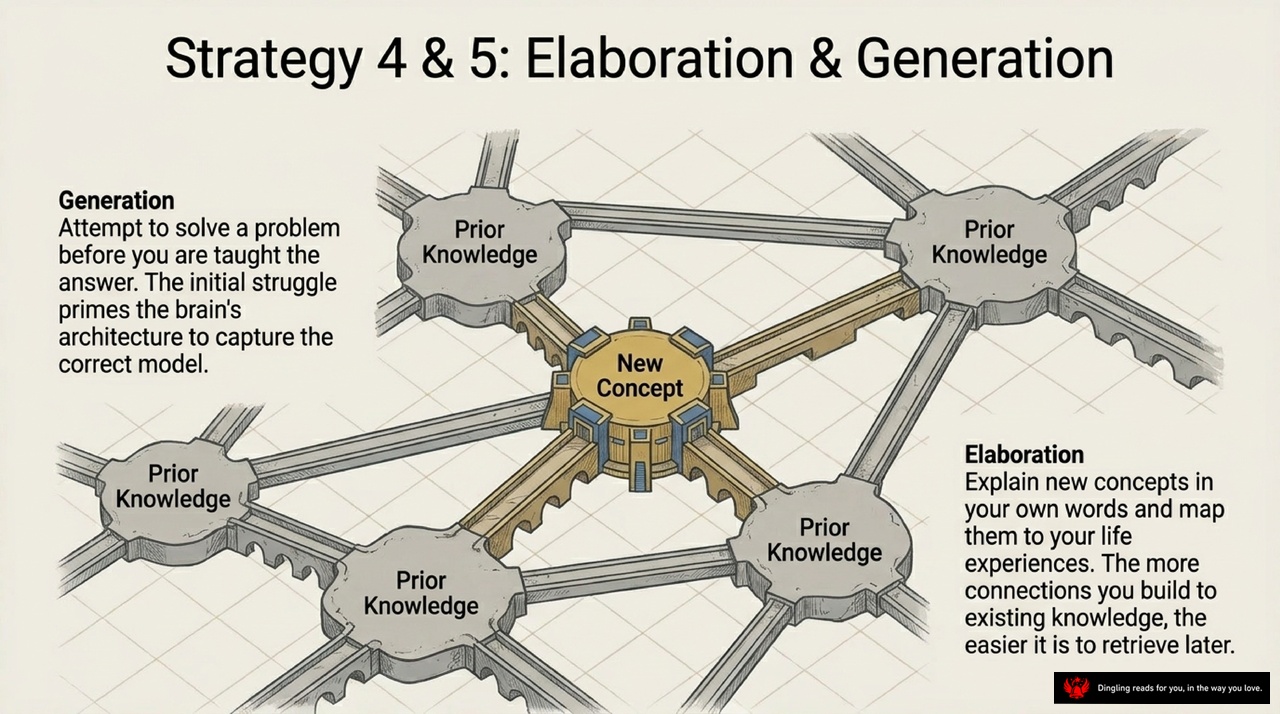
Strategy 4 and 5: Elaboration and Generation. Let's talk about how your brain actually builds new knowledge. Look at this diagram: right in the center, we have a "New Concept." But it doesn't float alone. It's connected to five different nodes of "Prior Knowledge." That connection is everything.
On the right, we have **Elaboration**. This is about taking that new idea and explaining it in your own words, mapping it directly to your life experiences. Think about it: the more connections you build to what you already know, the easier it is to retrieve that memory later. It's like building a bridge; the more supports you add, the stronger the structure becomes.
On the left, we have **Generation**. This is where you attempt to solve a problem before you are even taught the answer. It might feel frustrating at first—that initial struggle is actually your brain priming its architecture to capture the correct model. It forces you to actively reconstruct the information rather than just passively reading it.
So, to truly master anything, you can't just memorize the center point. You have to actively generate your own solutions and elaborate on those ideas by linking them to your past experiences. That is how you turn fleeting information into lasting, usable skill.

So, we've been talking about how the brain learns best when it struggles. Today, we're zooming in on that struggle with a concept called "Desirable Difficulty." It's a game-changer.
Look at this diagram. On the left, we have the "What went right?" loop, and on the right, the "What went wrong?" loop. At the very center, the text tells us that reflection is the cognitive fusion of retrieval, elaboration, and generation. It transforms raw experience into refined expertise.
Think about the skydiver, Mia. She hated falling, but the training forced her into a state of "desirable difficulty." She couldn't take notes. She had to observe, practice, and constantly retrieve information from her memory. When she crashed into another parachute on her third jump, she didn't panic. Why? Because the difficult, spaced-out practice had turned her skills into an automatic reflex.
This connects directly to the "What went wrong?" side of our infinity loop. When things go wrong, or when we struggle to remember something, that's actually our brain doing the heavy lifting. It's forcing us to rebuild the neural pathways. If learning was easy, like just re-reading a textbook, we'd get a false sense of fluency. We'd think we know it, but we wouldn't be able to retrieve it later.
But when we push ourselves—when we try to recall a fact without looking, or when we switch between different types of problems like Mia did with different landing techniques—we create stronger, more flexible mental models. This is exactly what the "generation" part in the center means. You aren't just absorbing info; you are actively building it.
So, don't avoid the struggle. Embrace the friction. Whether it's a pilot analyzing a crash, a student taking a low-stakes quiz, or a business leader solving a complex problem, the path to true expertise always runs through the loop of reflection. It's where you take your raw mistakes and your small wins and fuse them into something new and powerful. That is how you turn experience into expertise.

Learning isn't about how comfortably you feel while reading; it's about how hard you work to retrieve what you've learned. Today, we're diving into the architecture of memory itself, breaking down the three essential stages: Encoding, Consolidation, and Retrieval.
On the left, we see **Encoding**. This is where sensory perceptions—what you see, hear, or feel—get converted into fragile, short-term memory traces. It's the raw data hitting your brain. But here's the catch: if you stop there, that information vanishes. You need the next step to make it stick.
That brings us to the center: **Consolidation**. This is where the magic happens. The brain physically stabilizes those memory traces, assigning them meaning and connecting them to your past experiences. Think of it like building a bridge between your new knowledge and everything you already know. Without this connection, the memory remains isolated and weak.
Finally, on the right, we have **Retrieval**. This is the most critical part. Accessing a memory doesn't just pull it out; it makes it malleable again. Every time you retrieve a memory, you have the chance to update it, strengthening it and re-consolidating it even stronger. It's a cycle of reinforcement.
The key takeaway? If you want to truly master anything, you must move beyond passive reading and actively engage in retrieval practice. It's the only way to transform fragile short-term traces into a robust, flexible network of knowledge that you can rely on when it matters most.

Escaping the Metacognitive Trap isn't just about learning more; it's about learning how to know what you actually know. The image on the left shows the core problem: we are naturally blind to our own ignorance. Poor performers often vastly overestimate their abilities because they lack the expertise to recognize their own errors. This is the "metacognitive trap"—the illusion of fluency where we mistake familiarity for mastery.
The solution, shown on the right, is calibration. Think of yourself like a pilot. You can't rely on gut feelings or the smoothness of a flight; you need to trust your instrument panel. The only way to pierce the illusion of fluency is through objective, low-stakes testing. Treat self-quizzing exactly like a pilot checking their gauges—relying on hard data rather than gut feeling. When you actively retrieve information from your memory, you get real feedback on your knowledge gaps. This process of calibration allows you to escape the trap of incompetence and build a robust, accurate understanding of the world.
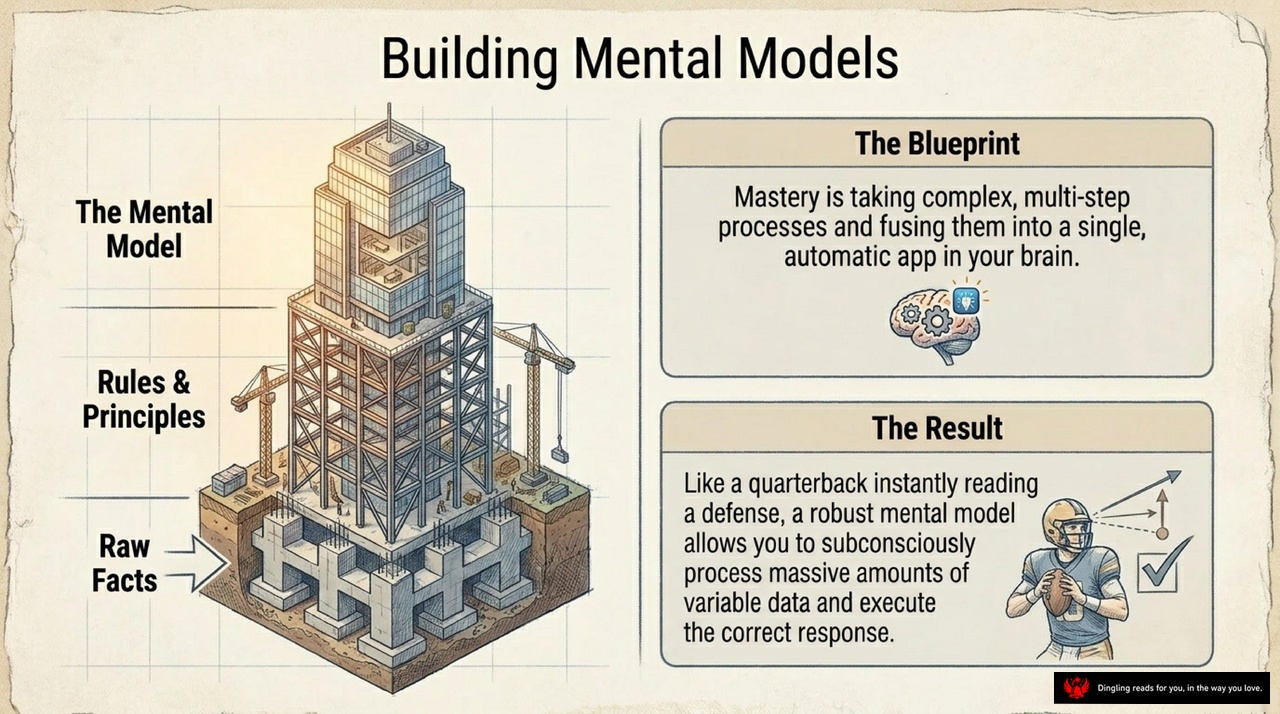
Look at this blueprint for building mental models. It starts at the bottom with raw facts, moves up through rules and principles, and culminates in a fully constructed mental model. Think of it like building a skyscraper: you can't have the top floors without a solid foundation.
On the right, we see how this actually works in practice. The blueprint tells us that mastery isn't about memorizing steps; it's about fusing complex, multi-step processes into a single, automatic app in your brain. It's the difference between consciously calculating every move and playing on pure instinct.
The result? You become like that quarterback on the slide. He doesn't stop to think; he subconsciously processes massive amounts of variable data and executes the correct response instantly. That's the power of a robust mental model. It allows you to handle chaos with calm precision, turning what used to be a struggle into second nature.

Imagine your brain not as a static, pre-installed hard drive with a fixed capacity, but as a dynamic, living structure capable of constant transformation. This slide challenges the ancient myth of "fixed intelligence," replacing it with the powerful reality of neuroplasticity. On the left, we see the "Fixed Mindset," visualized as a rigid, locked fortress. This is the belief that your intelligence is genetic and unchangeable—that if you struggle, you simply aren't smart enough. But the biology of effort tells a different story. Intelligence isn't a limit you hit; it's a capacity you build.
Now look to the right: the "Growth Mindset." Instead of a wall, you have an intricate, expanding network of bridges and pathways. This represents neuroplasticity—the brain's ability to physically alter its structure every time you struggle with a desirable difficulty. Every time you push through frustration and engage in effort, you are literally thickening the myelin sheaths around your neural axons. This insulation speeds up your signals, making you smarter. As the slide reminds us, effort dictates capacity. So, don't fear the struggle; embrace it. That feeling of mental resistance isn't a sign of failure; it's the physical sensation of your brain growing stronger and building new, more efficient connections.

The Master Learner's Toolkit is your ultimate cheat code for mastering any skill. Forget the old-school idea that cramming or passive reading works; science proves the opposite. To truly lock knowledge into your brain, you need to actively fight against forgetting.
First, **Retrieve**. Don't just re-read your notes; close the book and force yourself to recall the core concepts. This active struggle creates stronger neural pathways than passive exposure ever could. Next, **Space** your sessions out. Let time pass between study blocks so that a bit of forgetting happens; this gap makes the next retrieval much more powerful and durable.
Then, **Interleave** your practice. Instead of drilling one type of problem until you get it right, mix different topics together. Yes, it feels harder and more confusing at first, but that's exactly why it works—it teaches your brain to identify the right strategy for every unique situation.
Don't stop there. **Elaborate** by explaining new ideas in your own words, connecting them to what you already know. **Generate** solutions before you look at the answer key; even failing helps you learn. Finally, **Reflect** on your actions to refine your mental models. By combining these six tools, you stop relying on fragile, short-term memory and start building a flexible, long-term toolkit that serves you in any real-world challenge.

True mastery isn't about coasting on the comfort of easy learning; it demands that we lean into the friction of desirable difficulty. Think about it: when you struggle to recall a concept, that struggle is actually your brain building a stronger neural pathway. If everything feels smooth, you're likely just creating an illusion of knowledge.
So, are you building permanent mastery, or just fooling yourself? The answer lies in embracing the discomfort. Whether you're a pilot navigating a crisis or a student tackling a tough subject, the most effective learning happens when you actively retrieve information from memory, space out your practice, and mix up the types of problems you solve. Don't let the fear of forgetting stop you; use that forgetting as a tool to make your memory stick. The friction you feel today is the foundation of your expertise tomorrow.