
Makers: Complete Chapter-by-Chapter Summary

Welcome to the new industrial revolution. Imagine two gears meshing together: one is a glowing, digital blueprint, and the other is a solid, metallic reality. This slide captures the heart of Chris Anderson's book, *Makers: The New Industrial Revolution*.
The core message is simple yet transformative: the digital revolution has finally reached the physical world. For the first time, we are democratizing the tools of invention. This means that anyone, anywhere, can now become a manufacturer.
Think about your grandfather in a garage, or a student in a dorm room today. Thanks to digital tools like 3D printers and open-source designs, the barrier to creating real-world products has collapsed. We are no longer limited by massive factories or huge capital; we can take an idea, design it on a screen, and bring it to life with the same ease as sharing a file online.
This shift turns every person into a potential creator, empowering us to build things we never thought possible. It's not just about making gadgets; it's about reclaiming our ability to shape the world around us. Welcome to an era where the only limit is your imagination.

Look at this split screen. On the left, we have the Digital Economy—just bits, code, and data—worth about $20 trillion. On the right, the Physical Economy—cars, trains, homes, and real-world goods—worth a staggering $130 trillion. That's more than five times the size of the digital world.
For the last two decades, the internet democratized how we create and share ideas online. But now, the next decade is finally applying those same lessons to the real world. The physical economy has been opening up, bringing the power of digital innovation into the tangible stuff we live with every day.
This shift means we are moving from a world where only big corporations could make things, to one where anyone with a laptop and a 3D printer can become an inventor. We are seeing the rise of the "maker," turning DIY spirit into industrial scale. Just like the internet revolutionized software, this new industrial revolution is reshaping manufacturing. It's not just about cheaper labor anymore; it's about empowering individuals to create the products the world actually needs, right from their garage. The future isn't just about bits; it's about atoms, and for the first time, the two are merging to create something truly new.

Look at this slide, "The Collapse of the Inventor's Dilemma." It captures a massive shift in how we build the world today. On the left, we see the 20th-century inventor. Think of my grandfather, Fred. In the 1940s, he was a brilliant mechanic who patented an automatic sprinkler system. But to bring his idea to life, he had to surrender control. He needed access to a mega-factory and relied on high barriers like bank loans or massive corporate R&D to get funded. He wasn't an entrepreneur; he was just an inventor whose brilliant ideas often stayed on paper because the cost to scale was too high.
Now, look at the right side: The 21st-century Maker. The gap between inventing a product and becoming an entrepreneur has collapsed to zero. Today, you don't need a mega-factory; you have desktop digital fabrication right on your desk. You retain full creator ownership instead of handing it over to a corporation. And the funding model has completely flipped. Instead of waiting for risky bank loans, you can leverage zero-equity crowdfunding and global pre-sales. The barrier to entry is gone.
This isn't just theory; it's happening right now. Just like my grandfather dreamed of building his own irrigation system, today's makers can take a CAD file, send it to a global service, and have thousands of units produced without ever leaving their garage. We've moved from an era where only big corporations could innovate to one where anyone with a laptop and a 3D printer can. The "Inventor's Dilemma" is over. The power to create, control, and fund your own vision is finally in your hands. Welcome to the new industrial revolution.

Imagine a world where the captain of a starship can simply say, "Make me a coffee," and the replicator instantly conjures it. Today, 3D printers are the real-world prototype of that sci-fi dream, bringing us closer to a future where you can make anything you imagine. This is the heart of the digital manufacturing revolution: the ability to choose between mass production and personalized customization without paying for expensive manual labor.
To build this future, we rely on four core "desktop factories." First, the 3D printer itself, which acts like a standard office printer but builds physical objects layer by layer from digital files. Whether it's fusing plastic or curing resin, these machines can create everything from tiny plastic parts to human organs. Second, CNC machines use subtraction techniques to carve wood and metal, handling tasks from cutting fabric to shaping airplane fuselages. Third, laser cutters offer incredible precision, slicing complex shapes from wood and plastic, and even breaking 3D models into 2D puzzle pieces that snap together like toys. Finally, 3D scanners capture real-world objects and turn them into editable digital models, letting you tweak a design before printing a custom action figure.
The impact is already here. Dentists use scanners to print custom aligners for teeth correction, while gamers collect custom figurines, and engineers are even printing entire buildings with concrete. But here's the game-changer: unlike traditional manufacturing where costs drop as you produce millions, 3D printing keeps the cost the same for every single unit. You don't need expensive tooling for small batches, and changing a design costs nothing extra. This flips the old economics of industry on its head, empowering individuals to become manufacturers in their own living rooms.

Imagine your garage transforming into a fully equipped factory, right on your desk. This slide captures the core of the new industrial revolution: democratizing the factory floor. We are moving from industrial giants to desktop powerhouses.
Look at the top left: 3D printers. These machines extrude physical objects layer by layer, turning digital files into tangible reality. Next to it, CNC routers take a different approach, using precision carving and milling driven entirely by computer code to shape materials like wood or metal.
In the bottom left, you see laser cutters slicing through wood and acrylic with industrial-grade accuracy, perfect for intricate 2D designs. And finally, the 3D scanners on the bottom right are the bridge between the physical and digital worlds. They capture reality, turning existing physical objects into editable digital files so you can modify and improve them instantly.
Together, these tools mean that industrial-grade precision is now available on a desktop. You no longer need massive factories or huge capital to bring ideas to life. Whether you are prototyping a new gadget or customizing a part, the barrier to entry has vanished. The factory is no longer a distant place; it's in your hands, ready for anyone with a creative spark to start building.

Imagine a world where you can summon any object with the simple command of speech, just like the replicator in Star Trek. Today, 3D printers are the real-world prototype of that sci-fi dream, bringing us closer to a future where we only need to imagine it to make it. But this isn't just about cool gadgets; it's about a fundamental shift in how we value complexity.
Look at the gears on this slide. The core message is simple yet revolutionary: Hardware is the New Software. We are moving from an era where physical objects were rigid and expensive to change, to one where they behave like digital files.
Think about the first gear: "Atoms Acting Like Bits." In the past, if you wanted to change a product, you had to rebuild the factory. Now, a physical object is essentially a digital file. You can remix it, share it globally, and edit it with zero marginal cost. It's the same ease as updating a software patch.
Then, notice the second point: "Modification is Free." Changing a product's design used to require retooling an entire assembly line, costing millions. Today, altering a design just requires changing a line of code. You can innovate instantly without the massive capital expenditure that used to stifle creativity.
Finally, look at the third gear: "Complexity is Free." This is the game-changer. In traditional manufacturing, making a simple plastic block cost the same energy as printing a highly complex, customized interlocking mechanism. But with 3D printing, the cost is identical. The printer expends the exact same energy regardless of how intricate your design is. This means we can finally mass-produce highly customized, unique items without the prohibitive costs that previously forced everyone to buy generic, boring products.
This shift means the rules of economics have flipped. We are no longer bound by the limits of traditional mass production. We are entering an age where the most complex, personalized products are actually the cheapest to make.
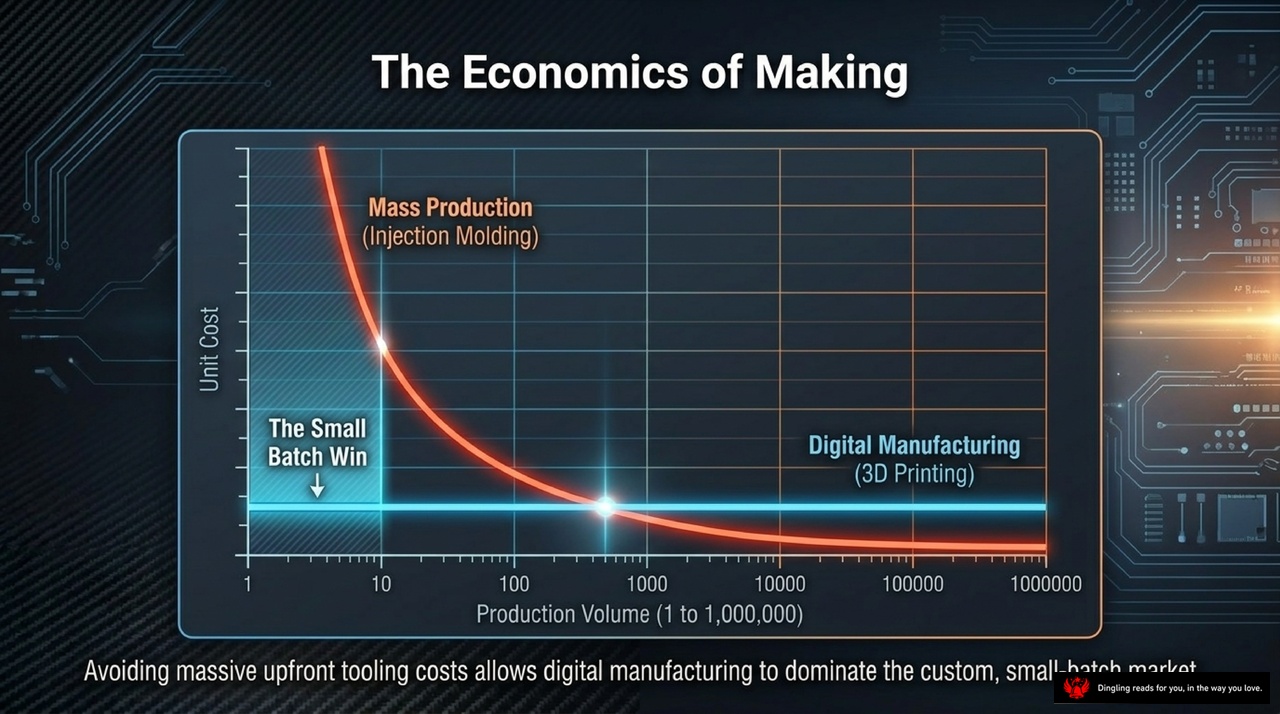
The economics of making is shifting right before our eyes. Look at this graph: on the left, we have the traditional model of mass production using injection molding. You see that steep red curve? That represents the high upfront cost of tooling. It only makes sense when you're printing millions of units. But for small batches, that cost is a killer.
Now, look at the blue line on the right. That's digital manufacturing, powered by 3D printing. Notice how flat it is? Because there are no massive tooling costs. You don't need to build a factory or spend thousands on molds to make just one or ten products. This is the "Small Batch Win."
This shift is everything. It means we can finally dominate the custom market without needing to be a giant corporation. We can avoid the massive upfront costs that used to trap inventors in garages, just like my grandfather did decades ago. Now, anyone with a great idea can take it from a sketch on a screen to a real object in their hands, whether they need just a few units or scale up later. It's the end of the era where only big factories could produce things, and the beginning of a world where your creativity is the only limit.

Look at this slide, "The Long Tail of Things." It perfectly captures the shift from the old world of mass production to the new era of the micro-industrial revolution. On the left, we see a pyramid of identical mugs under a curve that drops off sharply. This represents "The End of Shelf-Space Tyranny." For decades, 20th-century retail demanded millions of identical units just to justify taking up physical shelf space. If you didn't sell a million units, you simply didn't exist.
But look at the right side. The curve flattens out into a massive "10,000-Unit Market." This is where the real opportunity lies. Thanks to desktop manufacturing and online distribution, highly specialized, niche physical products can now find and serve their global audiences profitably. You no longer need to build a factory to reach the world. You just need a great idea and a way to share the design files.
Think about it: in the past, if you wanted a specific part for a vintage MG car or a unique jewelry stand, you were out of luck. Today, you can order it from a maker in Texas or a specialist in Europe, and it arrives at your door. This isn't just about convenience; it's about unlocking the "long tail" of human creativity. Companies like Etsy and specialized online manufacturers allow thousands of small businesses to thrive by targeting these specific, underserved niches. The barrier to entry has collapsed. We are moving from an economy of scale, where you need millions of customers, to an economy of scope, where you can serve thousands of passionate fans with unique products. This is the future of manufacturing—distributed, flexible, and driven by the power of the long tail.

Imagine a world where you don't need to own a factory to build physical products at scale. That is the reality of the Cloud Factory. As the slide illustrates, manufacturing has effectively become a cloud service. Think about it: you simply upload your CAD files and select materials right from your browser, and suddenly, your idea is being manufactured thousands of miles away.
This shift allows production scale to become fluid. It instantly bridges the gap between your desktop prototype and the global supply chain. You can tap into the power of giants like Alibaba for massive volume or specialized services like Shapeways and MFG for custom components, all coordinated from a single laptop. The era of needing a massive upfront investment in heavy machinery is over. Instead, you rent the factory. This democratization means that the constraints of geography and capital are disappearing, allowing anyone with a creative idea to turn it into a tangible product without the traditional barriers of industrial manufacturing.

On this slide, we're contrasting two very different worlds: the rigid, closed corporation governed by Coase's Theorem, and the vibrant, open community driven by Joy's Law. On the left, you see the pyramid of the traditional firm. As the text explains, these companies exist primarily to minimize transaction costs by keeping talent inside their walls. They rely on a hierarchy where the smartest people work for someone else within a single organization.
But look at the right side. That's where the future lies. Joy's Law states that no matter who you are, most of the smartest people in the world work for someone else. This is the essence of the open community. Instead of hoarding talent, open-source hardware harnesses the global "long tail" of creativity. It activates brilliant minds regardless of their geography or formal credentials. As we've seen with everything from 3D Robotics to Local Motors, these communities out-innovate closed R&D labs because they tap into a distributed network of talent. The application is clear: by embracing this open model, we can create products that the world actually needs, proving that the future of manufacturing isn't about building bigger factories, but about connecting smarter people.

The old way of making things is dying. For decades, the global economy relied on a "Mega-Factory" model. Think of it as a massive, rigid assembly line built for one purpose: cheap overseas labor. Companies would ship designs across the ocean, mass-produce millions of identical units in factories thousands of miles away, and then pay high shipping costs to get them back to consumers. It was efficient for volume, but terrible for flexibility.
But that era is ending. Look at the shift to the "Micro-Factory" model. This isn't about building a smaller building; it's about a fundamental change in how we produce. Instead of a single, inflexible line, we now have agile, multi-purpose robotic assembly. These systems can be reprogrammed instantly to make something completely different.
Why does this matter? Because labor arbitrage is over. The cost of shipping goods from overseas has become too high, and the world demands customization, not just commodities. Local, automated assembly now beats cheap offshore labor. By keeping production close to the customer, we slash shipping costs and enable rapid iteration. We can create extreme customization that a giant factory simply couldn't handle. The future isn't about choosing between high-tech and small-scale; it's about combining them. The micro-factory allows us to build the products the world actually needs, right where they are used.

Crowdfunding is no longer just a way to raise money; it's the new capital that reshapes how hardware startups survive and thrive. Look at this cycle: it starts with a Digital Prototype, but instead of waiting for a Venture Capitalist to take a gamble on your idea, you go straight to the customer. Platforms like Kickstarter act as your market validator, proving that people actually want your product before you even build it. This is the magic of Customer-to-Business, or C2B. You get Pre-Sales funding—essentially zero-equity capital—where customers pay for the product in advance, eliminating the risk of building something nobody buys.
Once you have that validation and cash, you move to Cloud Manufacturing. You don't need to rent a factory or hire a massive team; you simply upload your designs to global networks that handle the production for you. Finally, you deliver to a Global audience, bypassing traditional brick-and-mortar limitations. The bottom line is clear: by using these platforms, you are fundamentally de-risking your startup. You skip the old gatekeepers like banks and VCs, turning a high-stakes gamble into a predictable, customer-funded business model.

Welcome to the era of the New Artisan Economy. We are witnessing a fundamental shift where mass-market commodities are losing their appeal, and consumers are ready to pay a premium for authenticity, bespoke design, and a genuine connection to the creator. This is the Maker Premium in action.
On the left, you see the IKEA Effect. It's a powerful psychological phenomenon where people derive higher value from products they help shape, design, or assemble. Think about those wooden joinery details or the leather goods shown here—when you invest your own effort, the product feels more valuable, not just because of what it is, but because of what you made it.
In the center, we have the heart of this movement: the ability to blend high-tech innovation with the raw, tactile quality of traditional craftsmanship. Whether it's precision electronics or custom leather, the future belongs to those who can make things that feel human-made but are built with modern technology. This is how we move beyond the limitations of old manufacturing and create a world where small-scale, global, and artisanal production thrive together.

Synthesis: The New Industrial Ecology. Imagine a world where the agility of software meets the tangible power of hardware. This is the Maker Movement, and it's reshaping everything. At its heart lies a powerful cycle: it starts with an Idea, flows into Digital Design, and then moves to Community Remix, where open-source collaboration fuels innovation. Instead of relying on massive corporations, we leverage Cloud Manufacturing and Crowdfunding to bring products to life, reaching a Niche Global Market. This decentralized engine permanently decouples production from the mega-corporation. It's highly resilient, allowing us to create products the world needs but hasn't even realized yet. From the garage inventors of the past to today's digital pioneers, we are fusing low-cost high-tech with global reach. The era of the factory is evolving into an era of the creator, where anyone with a great idea can build the future.
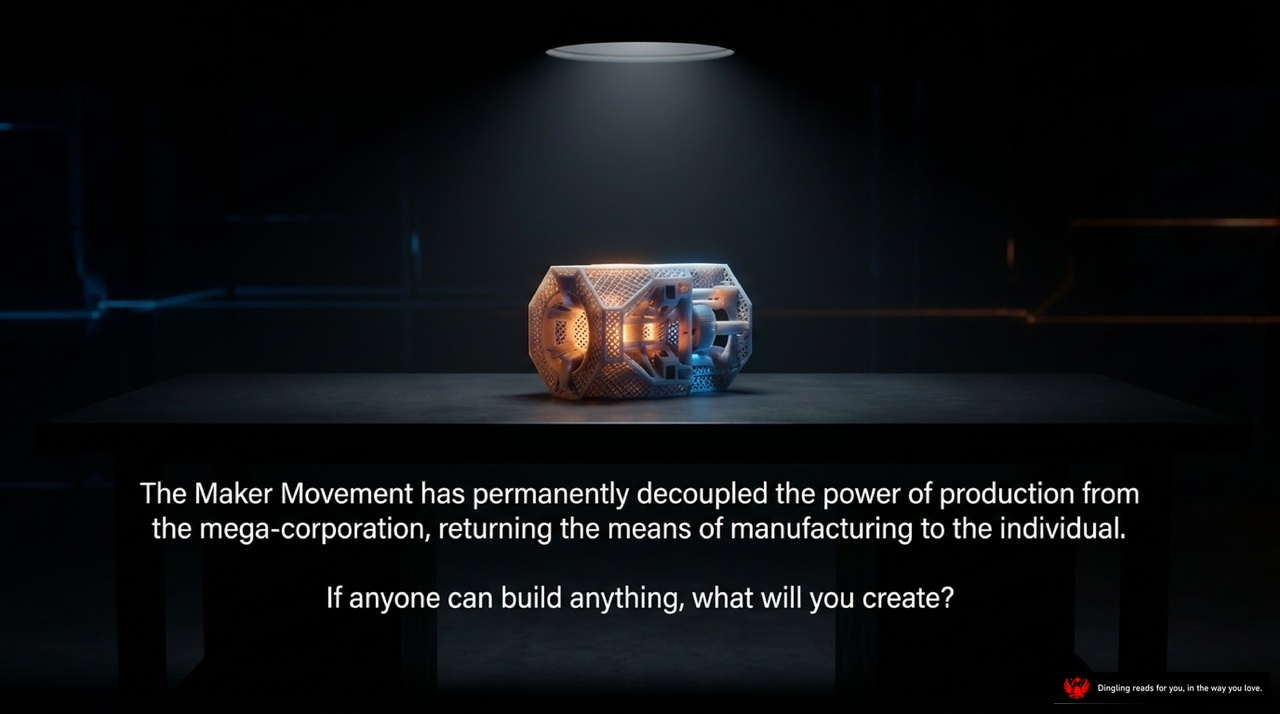
Look at this glowing, intricate object under the spotlight. It represents the heart of the Maker Movement: a machine that proves production power no longer belongs to mega-corporations. For the first time, the means of manufacturing have been returned directly to the individual.
Think about the shift here. In the past, if you had a brilliant idea, you were stuck behind a desk because building a factory required millions in capital and years of bureaucracy. But today, the barrier has vanished. As the slide asks, "If anyone can build anything, what will you create?" This isn't just a question; it's an invitation to a new era where your garage can rival the biggest industrial hubs. The movement has permanently decoupled production from giant companies, allowing anyone to turn a digital sketch into a physical reality. Whether it's a custom toy for your kids, a specialized tool for your business, or a completely new product the world hasn't seen yet, the tools are now in your hands. The era of waiting for permission is over. The era of building anything you can imagine has officially begun.