
The Man Who Mistook His Wife for a Hat: Complete Chapter-by-Chapter Summary

Welcome to *The Man Who Mistook His Wife for a Hat*. I'm Oliver Sacks, and today, we step into a world where the very fabric of reality seems to unravel before our eyes.
This is not just a medical textbook; it is an exploration of neurological paradoxes, revealing how deficits, excesses, and abnormalities in the human brain illuminate the indestructible nature of the human spirit.
We are about to meet individuals whose brains have taken unexpected turns. We will walk alongside a man who cannot recognize faces but hears a symphony in the city noise; a woman whose mind freezes in 1945, trapped in a moment she can never leave; and others who see the world in colors no one else can, or hear music only they can feel.
Through these stories, we will discover that while the brain may fail, the human spirit refuses to break. We will see how the mind can be both a fragile instrument and an unbreakable fortress.
Join me as we journey into the strange, the wonderful, and the profoundly human. Let's begin.

The Paradigm Shift Matrix reveals a fundamental divide in how we understand the human brain. On the left, Classical Neurology treats the brain like a mechanistic machine, focusing strictly on the disease. Its method is deficit-oriented, hunting for what is broken or missing, viewing identity merely as an inventory of cognitive parts, and outputting a cold clinical chart.
But look to the right: Romantic Science. This approach shifts the focus from the disease to the patient—the human being fighting for equilibrium. Instead of just diagnosing defects, it uses a narrative-oriented method to observe how individuals compensate and adapt. It sees identity not as a sum of parts, but as an indivisible self, an ongoing living story. The output isn't just a chart; it's a pathography, a clinical tale that honors the person's experience.
As we saw in the case of Dr. P, a brilliant musician whose visual system could see details but couldn't assemble a whole, a purely mechanical view would have reduced him to a broken machine. Yet, his ability to interpret music and his rich inner life proved that he was far more than a collection of faulty functions.
The marginalia on the slide captures the essential insight: we must marry the mechanistic precision of classical neurology with the rich, narrative empathy of romantic science. Only by combining the map of the brain with the story of the patient can we truly see the person.

Imagine a world where your body is invisible to your own senses. This is the terrifying reality for patients suffering from a profound loss of proprioception, the internal sense that tells us where our limbs are in space. Take Christina, a vibrant 27-year-old programmer whose life shattered after a nightmare became a physical reality. Following surgery, she lost all proprioceptive input from her muscles and joints. Suddenly, her body felt like it belonged to someone else. She couldn't feel her hands moving unless she stared directly at them, and her soul felt detached from her skin, as if she were a ghost haunting a stranger's body.
But hope can emerge from the most unlikely places. Consider Madeleine, a 60-year-old woman born blind and paralyzed. For decades, she had no concept of her own hands, viewing them as alien appendages. By forcing her to reach for food, she reignited her dormant tactile intelligence. Within a year, she transformed from a passive observer into a celebrated sculptor, using her fingertips to carve out a world she could never see. These stories prove that even when the brain's internal map is erased, the will to touch and explore can redraw the boundaries of existence.
However, this disconnection isn't limited to the body itself; it extends to our sense of balance and direction. Meet Mr. McGregor, an 83-year-old carpenter who, due to Parkinson's, could no longer trust his internal compass. He felt upright while tilting 20 degrees. Unable to rely on his brain's "spirit level," he ingeniously designed glasses with a visible bubble level. By watching the bubble, he regained his balance, proving that when our internal sensors fail, we can build external tools to guide us home.
Even more striking is the case of Mrs. Ais, who suffered a stroke that erased her entire left side from her mind. To her, the left half of the room, her left face, and even her left hand simply did not exist. She would ignore food on the left side of her plate and only apply makeup to her right cheek. Yet, she refused to be a victim. By rotating her wheelchair, she could bring objects from the "invisible" left side into her conscious right field of view. Her world was literally cut in half, but her ingenuity allowed her to navigate the missing half.
These cases of spatial and balance disorders reveal a profound truth: our perception of reality is fragile and constructed by the brain. When that construction fails, we lose our footing in the physical world. Yet, through external aids, creative adaptation, and an unyielding spirit, humans can rebuild their connection to reality. Whether it's watching a bubble in a glass or rotating a chair, the human capacity to find stability in chaos remains our most powerful anchor.

Imagine a world where you see the parts of a rose perfectly—the red spirals, the green stem, the symmetrical leaves—but the moment you try to name it, your brain freezes. It just sees a "convoluted red form with a linear green attachment." This is the terrifying reality of Dr. P., a brilliant musician whose mind has fractured into a diagnostic dashboard of pure data.
In this slide, we see the "Agnosia Lens" in action. Dr. P.'s brain acts like a computer running a recognition algorithm, processing shapes and symmetries with robotic precision. He can identify the geometric components of a glove, listing its "flat surface" and "five small bags," yet he completely misses the concept of a glove. He recognizes the features but loses the whole.
The clinical reality is heartbreaking. He doesn't just fail to recognize objects; he loses the emotional reality of them. In one chilling moment, he mistakes his wife's head for a hat and reaches out to put it on. His visual system is intact, but his ability to integrate those details into a meaningful, living world has vanished. Without that final step of judgment and synthesis, he is trapped in a world of disconnected parts, unable to connect with the people or things around him.

Imagine you're walking down a hallway, and suddenly the floor feels like it's tilting. You know your body is straight, but your brain is screaming that you're falling. This isn't a movie scene; it's the reality for 93-year-old Mr. McGregor. He has Parkinson's, yet he insists he's fine until he watches a video of himself walking twenty degrees off-balance. His brain's internal compass has failed.
To understand why, we have to look at the invisible systems keeping us upright. We rely on three inputs: our inner ear, our eyes, and something called proprioception—our body's sense of where its limbs are in space without looking. When these signals get mixed up, chaos ensues. Mr. McGregor couldn't trust his internal "spirit level," so he invented one. He designed special glasses with a visible bubble level. By staring at that external bubble, he could finally see his tilt and correct it. It was a brilliant workaround, turning a broken internal sense into a reliable external tool.
But the brain's tricks don't stop there. Consider Mrs. Ess, a woman who suffered a stroke that wiped out her left side. To her, the left half of the room simply doesn't exist. She eats only the right side of her food and paints only her right cheek. When she tries to look in a mirror to fix her makeup, she still ignores the reflection of her left face. She's like Zeno's arrow, forever unable to reach the left side of her world. Yet, she didn't give up. She bought a wheelchair that could spin. Whenever she needed something on her "invisible" left, she would rotate her chair until that object moved into her visible right hemisphere.
These stories reveal a profound truth about human resilience. Our balance and spatial awareness are not just biological facts; they are active interpretations by our brain. When nature breaks the map, we often have to redraw it ourselves. Whether it's using a bubble level to see your tilt or spinning a chair to find a lost object, these patients show us that even when the world feels cropped or tilted, the human spirit finds a way to navigate the invisible.

Have you ever felt like the world is speaking a language you simply cannot understand? It sounds dramatic, but for people with aphasia, this isn't a metaphor—it's their daily reality. While we often assume they've lost the ability to comprehend speech, the truth is far more fascinating. In fact, their understanding of natural conversation often exceeds what we imagine.
The reason lies in how we communicate. Language isn't just a string of cold, mechanical words; it's wrapped in melody, facial expressions, and body language. These non-verbal cues are the keys that unlock meaning for those who have lost the verbal lock. To diagnose aphasia, doctors actually have to strip away all that emotion and speak like a robot, like a computer from *Star Trek*. Only then do the symptoms appear, proving that the patient's loss is specific to literal word meaning, not the deeper emotional intent behind them.
Consider the irony: while they struggle with vocabulary, their ability to detect tone and emotion is often heightened. It's a reversal of our usual primate communication order. When complex language pathways fail, our more ancient, direct methods take over. A 19th-century neurologist compared these patients to dogs, suggesting they might understand tone perfectly but miss the words. But it goes deeper. A patient might laugh at a president's speech not because they understand the policy, but because they instantly sense the disconnect between the leader's serious face and his hollow, performative tone. To them, fake sincerity is as transparent as the emperor's new clothes.
This condition acts as a mirror, reflecting a truth we often ignore in our own lives. True understanding isn't just about decoding symbols; it's about feeling the pulse of the conversation. When we strip away the polished shell of language, we find that the real connection—the raw, honest emotion—is what truly binds us. These patients remind us that while words are powerful, the truth is often found in the silence between them, in the glance, and in the tone.

People often assume that severe aphasia means a total loss of understanding, trapping someone in a silent island. But the reality is far more surprising. While these patients may lose the ability to decode the literal meaning of words, their capacity to understand natural speech often remains intact, sometimes even sharper than yours.
Why? Because language isn't just about cold, mechanical words. It's wrapped in tone, facial expressions, and body language. When a doctor tests an aphasic patient with a flat, robotic voice—like a computer from *Star Trek*—the patient fails. But strip away those non-verbal clues, and their true comprehension shines through. They might not know what a specific word means, but they can instantly grasp the emotion and intent behind a sentence.
This is a fascinating reversal of our usual communication order. When complex language pathways are blocked, our more primal, direct methods take over. Imagine a 19th-century neurologist comparing them to dogs: they can't hear the words, but they understand the tone perfectly. Another scholar noted that for these patients, the perception of "emotional tone" isn't just preserved; it's amplified.
This ability allows them to rebuild a bridge to the world on the ruins of language. They see through the artifice of human expression. As Nietzsche famously said, people can lie with their mouths, but their faces leak the truth. An aphasic patient might laugh at a president's grand speech because, despite not understanding the words, they instantly see the mismatch between the speaker's tone and their facial expression. They catch the deception that others miss.
This stands in stark contrast to a condition called tonal aphasia, or amusia. Take a woman named Emily D. She can understand the literal meaning of every word perfectly, yet she cannot hear the emotion in the voice. If she listens to a speech, she sees the words but feels nothing. She loses the human whole, reading only the cold, artificial code of language.
These two conditions are like two sides of the same coin. They reveal a profound truth about human connection: we often rely too much on the logic of words and ignore the raw, unfiltered power of emotion. True understanding isn't just decoding symbols; it's feeling the heartbeat behind them.

Imagine a world where the mind isn't a computer processing data, but a living, breathing organism that constantly makes judgments. This is the core lesson from Dr. P's case. He could recite complex music and solve abstract geometry problems, yet he couldn't recognize his own wife's face or distinguish a flower from a hat. Why? Because his brain had lost its ability to synthesize details into a meaningful whole. He saw parts, but not the reality.
This disconnect between raw data and true understanding reveals a critical flaw in how we often view intelligence today. We obsess over abstract logic and calculation, treating the mind like a machine. But as Dr. P showed us, stripping away the human element—the ability to judge, to feel, and to connect the dots—doesn't create a smarter person. It creates a hollow shell, no different from the very machines we try to emulate.
True intelligence isn't just about processing information; it's about infusing that information with emotion and context. Without this vital spark of judgment, we risk becoming like Dr. P: brilliant in theory, but completely blind to the world right in front of us. It's a stark reminder that to truly understand the universe, we must first understand the human heart within it.

Mr. Thompson represents the ultimate tragedy of the confabulatory engine. On the surface, he appears animated and brilliant—a walking storytelling machine. But look closer at the center of his world: the Amnesiac Abyss. Because his brain has lost all continuous memory, he cannot anchor himself in reality. To survive this terrifying void, his mind rapidly invents new characters and scenarios, second by second. He creates a Grocery Clerk, a Butcher, a Reverend, and an Auto Mechanic, spinning them into a never-ending loop just to avoid facing the silence.
The true horror lies in the fact that this entire world is completely devoid of true emotional meaning. While he talks endlessly about his brother or his day, he feels nothing. He has no memory of the present, and his heart is disconnected from his actions. He is a genius at fiction, but a total failure at living. This is the confabulatory engine at its most destructive: a brilliant mechanism that builds a beautiful lie to hide the unbearable truth of having no self at all.

The Door in the Wall: Nostalgia as a Seizure
Imagine waking up one morning and hearing a song that doesn't belong to the present. For Mrs. O'C, an 88-year-old woman, this wasn't a metaphor; it was a sudden, deafening reality. She heard vivid Irish songs playing in her head, so loud she checked every radio and even suspected her dental fillings were picking up signals. The source? Her own brain.
This was a temporal lobe seizure, specifically a thrombosis in the right temporal lobe. But instead of a terrifying blackout, this seizure acted as a Freud-like psychoanalysis. Mrs. O'C had been orphaned at five, completely losing the memory of her mother and her homeland. She had spent decades in a void, her childhood erased. Yet, as the graph shows, when the biological seizure hit, it unlocked a deeply repressed, unconscious memory.
The music was the key. It transported her back to a time she thought was gone forever. In the psychological reality of this event, the seizure didn't just cause pain; it granted her a profound, permanent sense of peace and a reclaimed past. The memories remained even after the seizures faded. For Mrs. O'C, this wasn't just a medical anomaly; it was a moment where the brain, through a glitch, finally filled the empty spaces of her life. It proved that our memories aren't just stored in a hard drive; they are woven into the very fabric of our emotional identity, waiting to be felt again when the door in the wall finally opens.

On this slide, we see a powerful contrast between how two different minds perceive the world. On the left, we have "The Deficitologist"—a view that focuses on what is broken. Here, Rebecca is defined by her failures: she struggles with IQ tests, appears clumsy, gets lost in space, and misses abstract concepts. To this analytical eye, she is a "living carpet without a design," a collection of errors that needs fixing.
But look to the right. This is "The Romantic Scientist," or as the text calls her, "The Actor." Here, the perspective shifts entirely. When Rebecca performs poetry or theater, her clumsiness vanishes. She achieves perfect grace, understanding the profound emotional symbolism of the world. She isn't broken; she is simply accessing a different, deeper layer of reality.
The key insight at the bottom ties it all together: standardized tests only measure abstract concepts, which disassembles patients into their failures. But narrative and art reassemble them into whole, harmonious beings. Rebecca's story teaches us that true intelligence isn't found in ticking boxes on a test, but in the ability to connect, to feel, and to find our soul through the stories we tell and the art we create.

Imagine a bridge spanning a deep chasm, connecting two minds: John's and Michael's. This is the Prime Number Bridge, built not from stone, but from the invisible architecture of prime numbers. Look closely at the archway; it's lined with a sequence like 111, 37, 48, 75, 72, 41, 99, 73, 17, 38, 9, 23, 33, 3. But here is the magic: these aren't just random digits. They are the "Twins"—pairs of prime numbers that sit side by side, like 11 and 13, or 17 and 19. For these twins, the gap between them is exactly two.
Now, look at the foundation of this bridge. On the left, we see the clinical facade. The world sees John and Michael as severely autistic, unable to perform basic multiplication or division. They are labeled as broken calculators. But the reality, revealed in the center, is far more profound. They do not calculate numbers; they see them. When a box of 111 matches spills onto the floor, they don't add or subtract. They instantly perceive the whole, then instantly divide it into three groups of 37. It is a visual act, a direct perception of structure, not a mechanical process.
And on the right, we find the communion. These twins exchange six-digit prime numbers like wine connoisseurs tasting rare vintages. It is a private, emotional meditation. They aren't solving a problem; they are connecting with the ultimate harmony and order of the universe. For them, numbers are not cold symbols; they are a landscape, a melody, a language of pure truth. This bridge reminds us that while the world sees a deficit, these minds have discovered a higher dimension of reality, where the hidden patterns of the cosmos become visible and tangible.
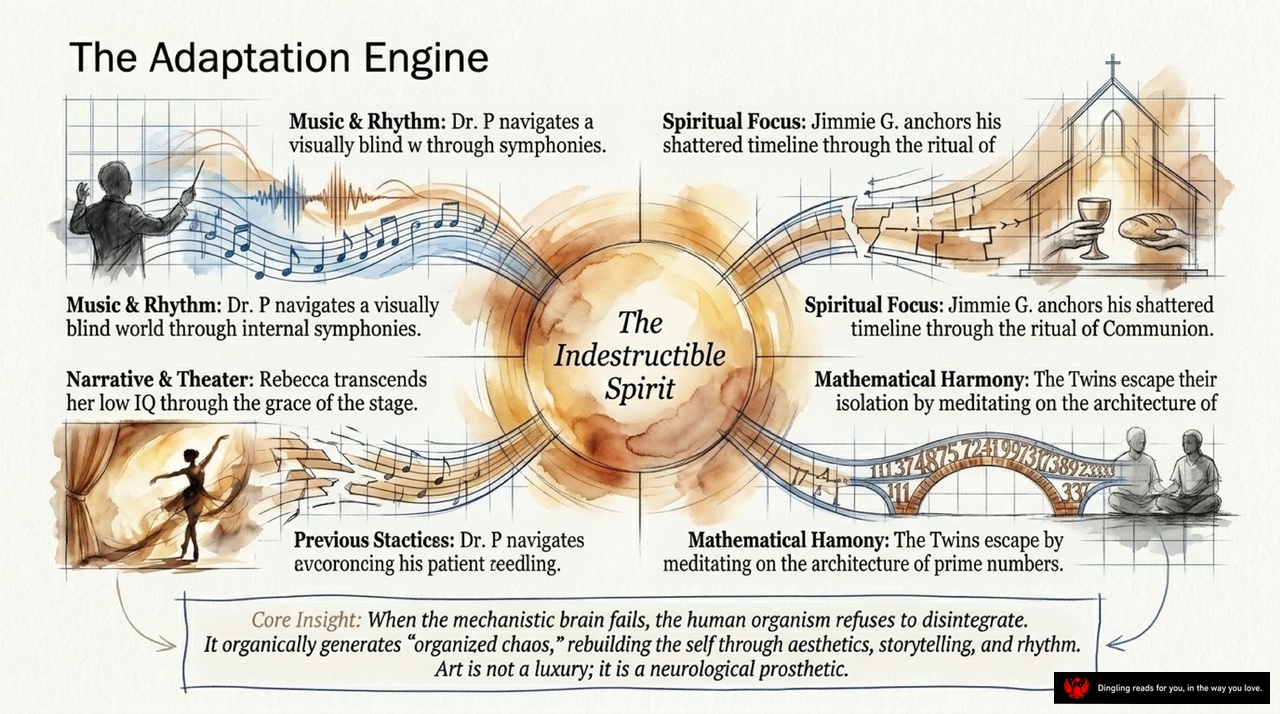
The Adaptation Engine isn't just a metaphor; it's the very survival mechanism of the human soul. When our mechanical brains fail, we don't simply disintegrate. Instead, we organically generate "organized chaos," rebuilding ourselves through aesthetics, storytelling, and rhythm.
Look at Dr. P, our blind musician. His visual system is broken, unable to see a whole face or a full landscape. He sees only fragments, even mistaking his wife's head for a hat. Yet, he navigates a chaotic world through internal symphonies. Music becomes his prosthetic, allowing him to reconstruct a reality that his eyes can no longer provide.
On the other side, we have Jimmie G., whose timeline has shattered. He is trapped in 1945, unable to remember a single minute of the present. He loses his identity in the flow of time. But when he enters the church and participates in the ritual of Communion, something miraculous happens. The spiritual focus anchors him. The ritual rebuilds his shattered timeline, proving that faith and community can act as a neurological scaffold when memory fails.
Even the Twins, isolated in their own minds, escape their loneliness by meditating on the architecture of prime numbers. They don't calculate; they feel the harmony of the numbers. For them, mathematics is a form of music, a bridge to a shared existence.
These stories teach us a profound truth: art is not a luxury. It is a neurological prosthetic. When the mechanistic brain fails, the human organism refuses to give up. We rebuild the self through the stories we tell, the music we hear, and the rhythms we feel. This is the indestructible spirit at the center of us all.

To be human is to be an ongoing narrative, a story we constantly rewrite. Classical neurology often tries to reduce us to a sum of mechanistic parts, like a machine or a computer, but disease reveals a deeper truth: our identity is forged in the struggle to adapt. We weave meaning out of chaos and continually construct our own reality.
Consider the case of Dr. P., a brilliant musician whose world suddenly fractured. He could hear the symphony of street traffic but couldn't see his wife's face. He mistook his wife's head for a hat he could take off. His visual system was intact, yet he could not integrate details into a whole. Without the ability to judge and synthesize, he was trapped in a world of fragments.
This leads us to a haunting question: If our perception of the world, our memories, and our very sense of self are merely fragile biological constructs waiting to be altered by a single misfiring neuron... who is the author of your story? When the mechanical parts of our brain fail, does the narrative collapse? Or does something else emerge? We will explore how, even when the mind breaks, the human story finds a way to continue.