
Management Challenges for the 21st Century: Complete Chapter-by-Chapter Summary
Welcome to the book club. Today, we're diving into Peter F. Drucker's classic work, *Management Challenges for the 21st Century*. This isn't just a history lesson; it's a definitive guide for navigating the massive paradigm shifts happening right now. We're looking at how the knowledge economy is rising and what that means for the future of human organizations.
The core message here is simple but profound: management is no longer just about controlling employees or managing a factory. It's about navigating change, understanding the new economic reality, and focusing on what actually drives performance. Drucker argues that to survive in this complex world, we must stop treating people as costs and start treating them as our most valuable assets. We need to shift our mindset from internal control to external results, and from managing tasks to leading people who are motivated by purpose and challenge.
As we move forward in this series, we'll break down these big ideas into actionable insights. We'll explore how to rethink strategy in a shrinking world, how to lead through constant change, and how to harness the power of information. This book is essential reading for anyone who wants to understand how organizations can not just survive, but thrive in the 21st century. Let's get started.
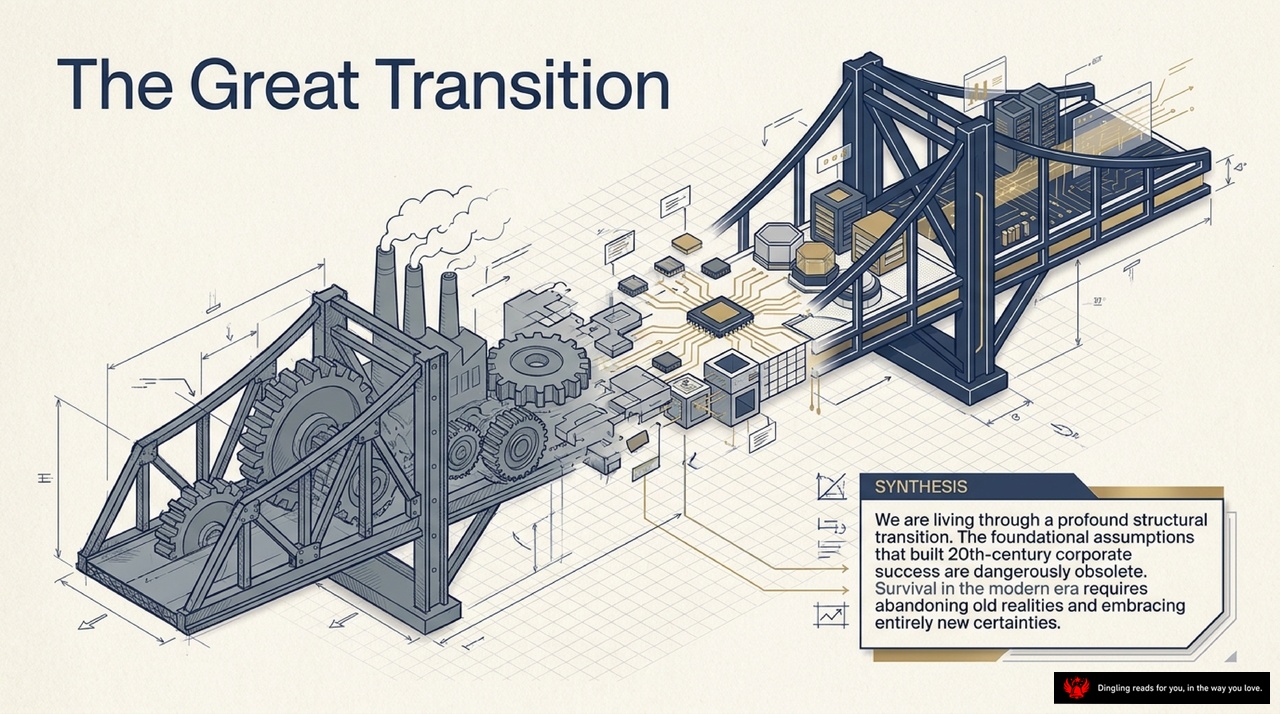
We are standing at the edge of a profound structural shift, often called "The Great Transition." Look at this bridge in our visual—it connects the old industrial era, defined by gears and smokestacks, to a new digital landscape powered by silicon and networks. The text on the right calls this a "Synthesis," reminding us that the foundational assumptions that built 20th-century corporate success are now dangerously obsolete. Survival in the modern era requires abandoning old realities and embracing entirely new certainties.
Think about it: for a century, we assumed that management was just about managing businesses within legal boundaries, using a single "optimal" organizational structure like a hierarchy or a team. We also assumed that technology and customer needs were static, and that the best way to manage people was through command and control. But as the text in your book reveals, these assumptions are broken. The world has moved from an era of physical assets to one where knowledge workers are the core asset. You can't manage a knowledge worker like a factory worker; you can't rely on a rigid structure when the market changes overnight.
The old paradigm treated management as an internal administrative function, focused on cutting costs and following rules. Today, that is a trap. The new paradigm demands that we redefine management as a tool for creating value across the entire economic chain, not just inside our legal walls. It means moving from controlling people to leading them, from optimizing internal processes to capturing external opportunities. If your organization is still running on the old assumptions, it's not just outdated—it's a liability. To survive this transition, you must stop trying to force the world to fit your old model and start building a new one that fits the reality of today.

Welcome back to our deep dive into management's future. Today, we're looking at a fundamental shift in how we think about people within an organization. The slide in front of us highlights a massive transition from the 20th-century mindset to the 21st-century reality, specifically focusing on how we treat "People."
In the 20th century, the dominant assumption was that employees were simply subordinates—fixed costs to be managed and controlled. Think of it as a transactional relationship where the goal was cost reduction. But this paradigm has completely broken down. Today, we know that knowledge workers are the primary source of value. They aren't just following orders; they are the ones who hold the keys to innovation and growth.
The new paradigm flips this script entirely. Instead of managing people as expenses, we now lead them as partners and capital assets. When you treat your team as strategic assets rather than line items on a balance sheet, the dynamic changes from control to collaboration. You stop asking, "How can I cut this cost?" and start asking, "How can I unlock the potential in this person?"
This shift means empowering your team, giving them autonomy, and aligning their personal goals with the organization's mission. It's about leveraging their unique skills and creativity, not suppressing them with rigid hierarchies. By viewing your people as your most valuable investment, you transform your organization from a static machine into a dynamic, adaptive force capable of thriving in an uncertain world. This is the essence of modern leadership: leading partners, not managing subordinates.

Imagine strategy not as a static plan, but as a dynamic bridge connecting your organization's core beliefs to real-world performance. As we've seen, your business assumptions—about your customers, your value proposition, and your path forward—can't just sit in a mission statement; they need a strategic vehicle to turn them into measurable results. Without this bridge, you're essentially navigating a foggy sea, risking missed opportunities or wasted resources on the wrong direction.
Today's slide highlights the "Five New Certainties" that are reshaping how we build that bridge. These aren't optional trends; they are the foundational pillars supporting modern strategy. First, we face **collapsing birth rates in developed nations**. This demographic shift forces us to rethink everything from workforce planning to market demand, moving away from growth-at-all-costs models toward adapting to a shrinking, aging population.
Second, there are significant **shifts in the distribution of disposable income**. Wealth is no longer concentrated in the same way; it's flowing into sectors like healthcare, education, and leisure. Your strategy must align with where the money actually is, not where it used to be.
Third, we need **the redefinition of corporate performance beyond short-term shareholder value**. The old playbook of prioritizing quarterly profits over all else is dead. Today's leaders must balance immediate financial returns with the long-term well-being of knowledge workers, who are the true engine of innovation and growth.
Fourth, **the baseline requirement of global competitiveness** has become non-negotiable. In an interconnected world, there is no "local" advantage. If your productivity or quality doesn't match the global best, your business model is obsolete, regardless of your domestic market size.
Finally, we must navigate **the growing divide between economic reality and political reality**. While the economy operates globally, politics remains fragmented by borders. Your strategy must find the delicate balance between optimizing for global efficiency and respecting local political constraints, avoiding the trap of making decisions solely based on tax incentives or regulatory loopholes.
These five certainties provide the stable ground you need to build a resilient strategy. They remind us that while the world is changing rapidly, these fundamental forces are the constants we must anchor our plans to.
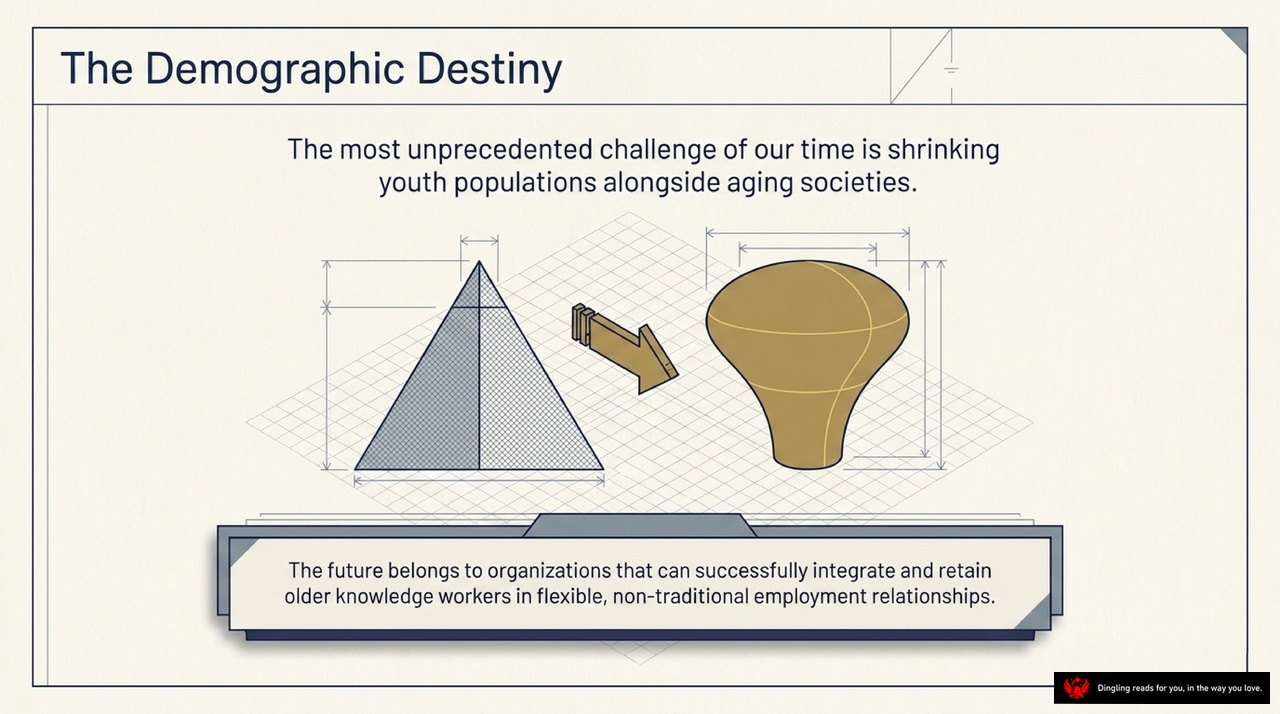
Look at this slide titled "The Demographic Destiny." It captures the most unprecedented challenge of our time: shrinking youth populations alongside aging societies. The graphic perfectly illustrates this shift, moving from a traditional pyramid with a wide base of young workers to a bulbous shape where the top-heavy senior population dominates.
This isn't just a statistical curve; it's a strategic reality that forces us to rethink how we build organizations. The text on the slide offers the solution: "The future belongs to organizations that can successfully integrate and retain older knowledge workers in flexible, non-traditional employment relationships."
In the past, we designed companies for a different demographic, assuming a steady stream of young talent. But today, that assumption is broken. The most valuable asset in our economy is no longer just physical capital or cheap labor; it is the accumulated wisdom of our older, experienced workforce. If we cling to rigid, traditional employment models, we are literally throwing away our greatest competitive advantage.
The organizations that will thrive are those that stop viewing age as a liability and start seeing it as a strategic resource. By embracing flexible, non-traditional relationships—like part-time consulting, mentorship programs, or phased retirement—we can tap into a vast pool of talent that is currently underutilized. We need to build workplaces that are inclusive not just in spirit, but in structure, allowing senior knowledge workers to stay engaged, productive, and integrated into the team.
Ultimately, the demographic destiny isn't a problem to be solved; it's an opportunity to be seized. The future belongs to the organizations that can successfully bridge the gap between generations, turning our aging society into our strongest workforce.

Mandate 1: Becoming a Change Leader. Let's talk about the engine that drives it all: the Change Engine Flywheel.
Think of this flywheel not as a static diagram, but as a self-sustaining cycle where every part feeds the next. It all starts with Organized Improvement. This is the foundation. Just like the Japanese concept of "Kaizen," we need to continuously refine our existing processes. If we aren't constantly tweaking how we do things today, we can't possibly innovate for tomorrow.
Once we have those improvements in place, we move to Organized Abandonment. This is the hardest but most critical step. It's about killing yesterday's successful models to free up resources for new ones. You have to be willing to let go of what used to work so you can build what needs to work now.
From there, we pivot to Systematic Innovation. This is where we create the future through pilot programs and experiments. We don't wait for a perfect plan; we test, learn, and scale. But innovation doesn't happen in a vacuum. It needs fuel. That's where Exploiting Success comes in. We need to starve our problems to feed our opportunities. By analyzing what is working and scaling those successes, we generate the momentum needed to tackle the next challenge.
Finally, the cycle closes with Organized Strategy. This ensures that our continuous refinement and innovations are aligned with a clear direction, constantly refining our path forward.
The core message here, as stated at the bottom of the slide, is simple yet profound: "We cannot manage change; we can only lead it." In a world where stability is an illusion, the only sustainable strategy is to become the architect of your own transformation.

Mandate 2: The Information Revolution. Look closely at this split. On the left, we have IT—Technology and Data. It's all about the hardware, the servers, the raw numbers. On the right, we have Information—Meaning. That's where the real work happens.
Here is the critical shift happening today. The revolution is moving from the 'T' to the 'I'. Executives do not need more data; they need new concepts. Having a massive server room is useless if you can't answer the question at the bottom: What is the meaning and purpose of this information?
Think about it like this: Data is just the fuel, but Information is the engine that drives your strategy. In the past, we obsessed over building bigger engines. Now, the real challenge is understanding where we are actually going. If you have the technology but lack the insight into what that data actually means for your business, you're just driving faster into a wall. The goal isn't to collect more facts; it's to extract the story that turns those facts into actionable decisions.

Think of your organization not as a static entity, but as a living cockpit where the executive sits behind the controls. To navigate the chaos of the modern market, you need more than just gut feeling; you need a precise dashboard. As we explore the new paradigm of management, this dashboard becomes your essential tool for survival and growth.
The first gauge on the left is labeled "Optimal," and it represents your Foundation Information. This is your bedrock. Just like a doctor checks a patient's vitals before diagnosing an illness, you must constantly monitor your cash flow and liquidity metrics. Without this financial stability, no amount of strategic brilliance can keep the lights on. It's the non-negotiable reality of your business.
Moving to the center-left, we have the "High" indicator, which tracks your Productivity Information. In today's economy, simply working harder isn't enough; you need to measure value-added benchmarking and yield. Are you generating real economic value, or just burning resources? This metric forces you to ask if your operations are truly efficient or if they are just busy.
Next is the "Target" gauge, focusing on Competence Information. This is where you track your core competencies and innovation rates. The market doesn't reward what you've always done; it rewards what you can do better than anyone else. This dial measures your unique strengths and your ability to innovate. If your needle drops here, it means your competitive edge is slipping.
Finally, on the far right, we have the "Adjust" gauge for Resource Allocation Information. This is about the smart placement of your capital and human resources. You have limited funds and talent; the question is, where do you deploy them to get the highest return? This gauge ensures you aren't wasting your most precious assets on low-impact activities.
But here is the most critical insight you need to take away from this dashboard: the numbers on these gauges are only half the story. The text at the bottom reminds us that the most critical information is actually external. Your internal metrics tell you how you are performing, but they cannot tell you if you are in the right place. You must understand where your non-customers are and what they value. True leadership isn't just about managing your internal resources; it's about aligning your entire dashboard with the shifting demands of the outside world.

Let's talk about the biggest shift in how we work. For all of the 20th century, the golden rule of management was simple: make manual labor 50 times more productive. We did it with assembly lines, standardization, and strict control. It built the modern world. But here's the hard truth: that playbook is dead. We are now facing Mandate 3, and the challenge is entirely different. The ultimate survival requirement for developed economies isn't about moving boxes faster; it's about doing the exact same thing for the knowledge worker.
Look at the brain in the center of this slide. That represents our new reality. In the past, the most valuable asset was a factory or a machine. Today, the asset is the knowledge worker—the engineer, the doctor, the strategist. Unlike a manual laborer, a knowledge worker can't be managed by a stopwatch. You can't just tell them what to do and expect peak performance. If you try to manage them like machines, you fail.
So, what's the 21st-century challenge? It's realizing that the old rules no longer apply. We need to stop treating knowledge workers as costs to be controlled and start treating them as the core assets that drive our wealth. Their productivity depends on autonomy, innovation, and the right to use their judgment. If we want to maintain our economic edge, we have to figure out how to multiply the output of the human mind just as we once multiplied the output of the human hand. It's the hardest puzzle we've ever faced, but it's the only way forward.

Imagine a seesaw balancing two very different worlds: Manual Labor on one side, and Knowledge Work on the other. This visual perfectly captures the fundamental shift we are facing today. On the left, manual labor focuses on the question, "How do we do it?" The goal is simple: quantity. In this world, the worker is viewed primarily as a cost to be minimized. It's about efficiency through standardization.
But look at the right side. Knowledge work flips the script entirely. Here, the focus shifts to "What is the task?" because the work itself is often defined by the worker's expertise. The goal isn't quantity; it's quality. And perhaps most critically, the worker's status changes from a cost to be cut, to a capital asset to be maximized. Think of your most talented engineer or strategist; they aren't an expense line item; they are your most valuable investment.
This distinction leads us to a core insight at the bottom of the slide: you cannot supervise knowledge workers in the traditional sense. You can't micromanage their every move. Because their value lies in their judgment and creativity, they must manage themselves. Trying to force a knowledge worker into a rigid, command-and-control structure will actually destroy their productivity. The future belongs to organizations that trust their people to manage their own work, turning human potential into the engine of growth.

Managing Oneself: The Internal Audit. Think of this Venn diagram not as a static chart, but as the ultimate filter for your career. True success happens only where three circles overlap: your Strengths, your Values, and your Work Style. If you miss even one, you're not at your "Maximum Contribution."
Let's break it down. First, your Strengths. The slide notes these are discovered "solely through continuous Feedback Analysis." This means you don't find them by taking a test; you find them by comparing your expected results with what actually happens. It's about reality checking yourself over time.
Next, your Values. The slide calls this the "Mirror Test." Ask yourself: "What kind of person do I want to see in the mirror in the morning?" If your daily actions don't align with that reflection, you'll feel drained, no matter how hard you work.
Finally, your Work Style. How do you naturally process information? Are you a reader who needs written reports, or a listener who needs a conversation? Are you an advisor or a decisive leader? Ignoring this mismatch is a common reason for failure.
The goal is to find the sweet spot in the center. When your natural talents match your core values and your preferred way of working, you unlock your maximum contribution. Don't try to force yourself into a mold that doesn't fit. Instead, align these three elements to create a career where you don't just survive, but truly thrive.
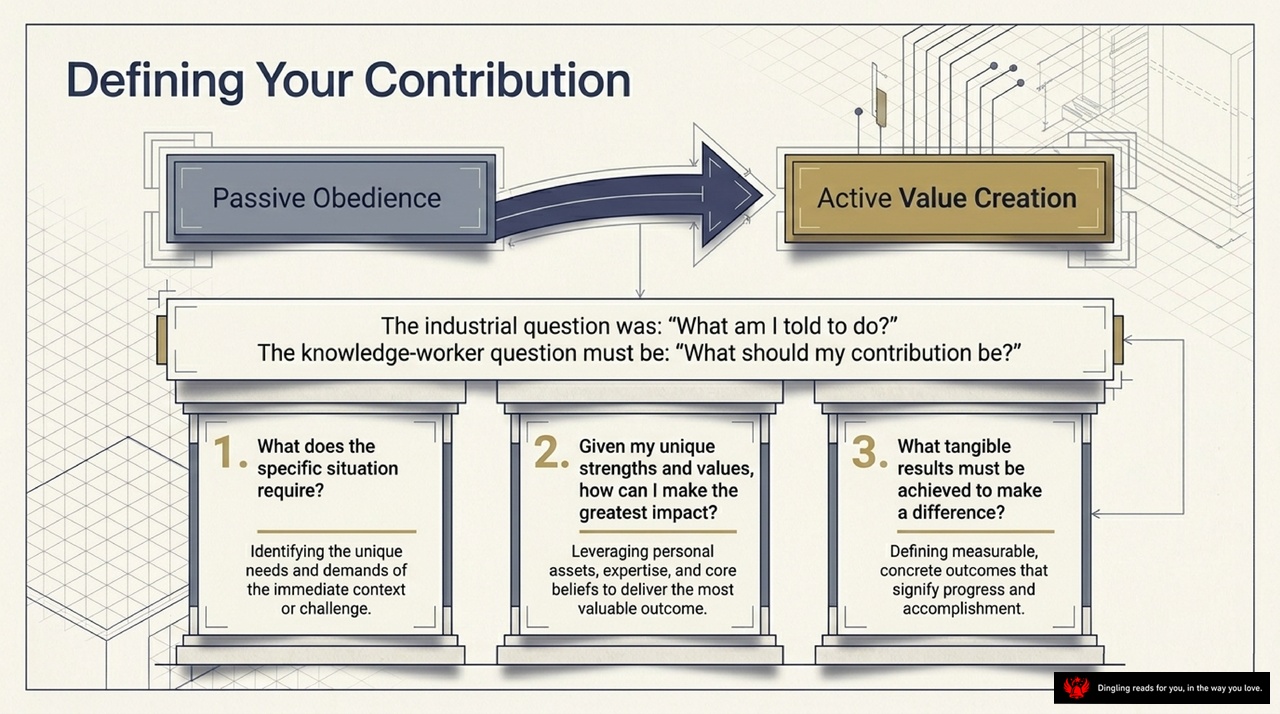
Defining Your Contribution isn't just about showing up; it's about shifting from passive obedience to active value creation. In the old industrial model, the question was simple: "What am I told to do?" But today, as knowledge workers, we must ask ourselves: "What should my contribution be?"
To answer this, we need to look at three key pillars. First, we must identify what the specific situation actually requires. It's not about what we think is important, but about understanding the unique needs and demands of the immediate context or challenge. Second, we leverage our unique strengths and values. We ask ourselves how we can make the greatest impact by using our personal assets, expertise, and core beliefs to deliver the most valuable outcome. Finally, we define tangible results. We need to know what concrete outcomes must be achieved to make a real difference, ensuring our progress is measurable and meaningful.
When we align our specific needs, our unique strengths, and our tangible results, we stop waiting for orders and start creating value. This shift is the foundation of true contribution in the modern world.
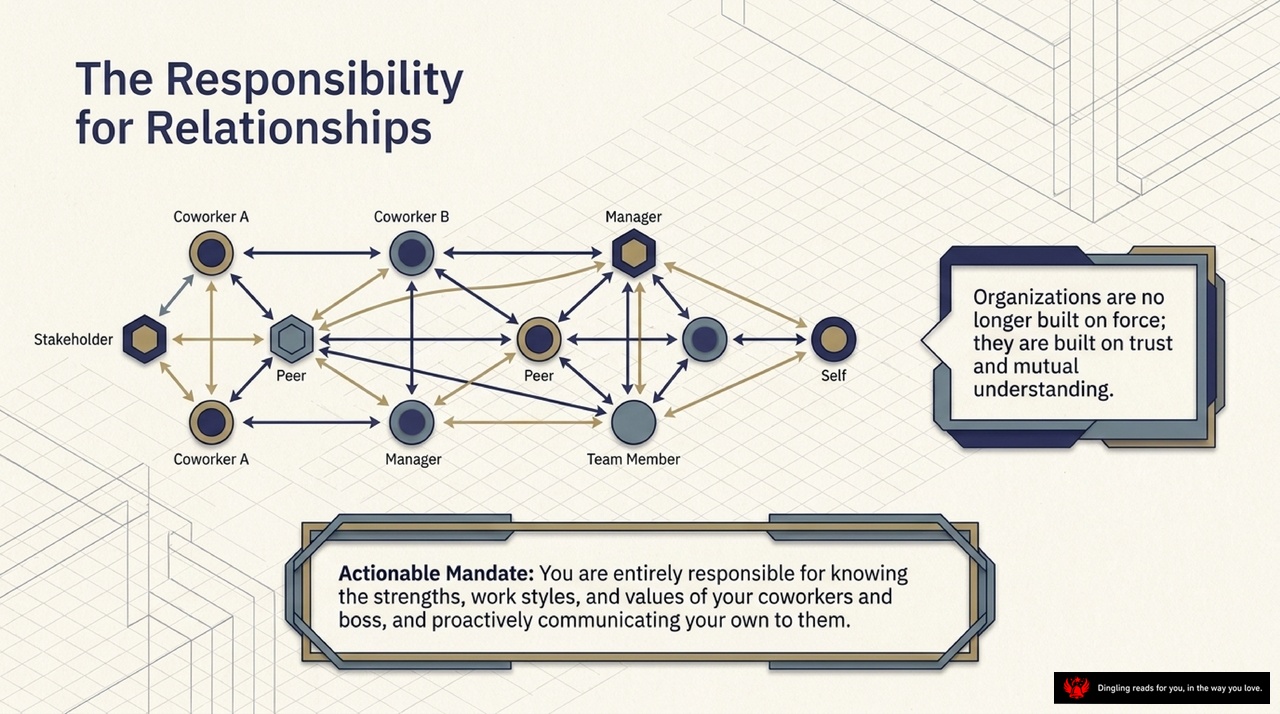
Look at this intricate web of connections. We see Stakeholders, Peers, Managers, and Team Members all linked together. This visual perfectly captures a core truth from the book: organizations are no longer built on force; they are built on trust and mutual understanding.
In the past, management might have felt like controlling a machine from the top down. But today, as this diagram shows, you are entirely responsible for knowing the strengths, work styles, and values of your coworkers and boss, and proactively communicating your own to them. It's an actionable mandate. You can't just wait for information to come to you; you have to actively weave these relationships together.
Think about it: if you don't understand your peer's working style, or if your boss doesn't know what drives you, trust evaporates. The arrows between these nodes represent the flow of that trust and understanding. When everyone knows their role in this network and communicates openly, the organization becomes resilient and agile. It stops being a rigid hierarchy and starts functioning as a dynamic ecosystem where everyone contributes their unique value. So, the responsibility for these relationships isn't shared; it's yours to drive.
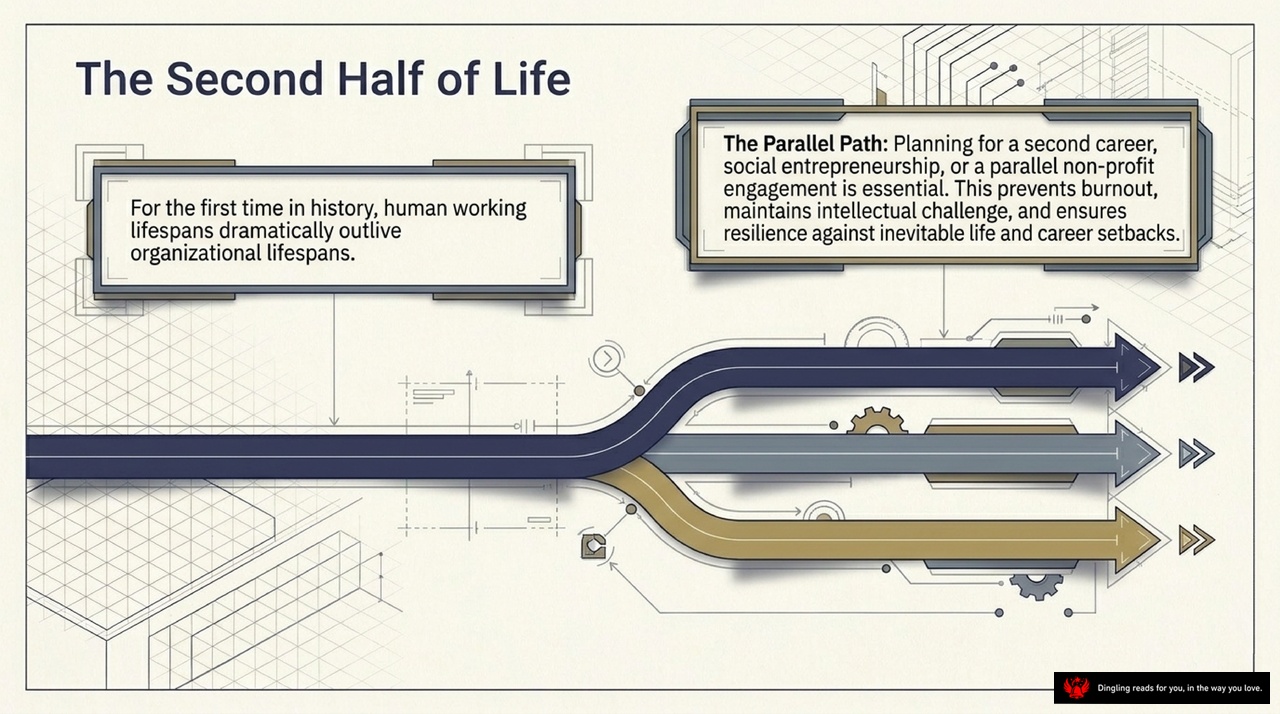
For the first time in history, we are living in an era where our personal working lives are dramatically longer than the organizations we work for. The slide highlights this shift, noting that human lifespans now vastly outlive organizational lifespans. This creates a unique challenge: you might spend 40 to 45 years in your career, but the company you build your life around might only last 30 years.
To navigate this, the presentation introduces the concept of "The Parallel Path." It argues that planning for a second career, social entrepreneurship, or a parallel non-profit engagement isn't just a nice-to-have; it is essential. Why? Because this parallel track prevents burnout, maintains intellectual challenge, and ensures resilience against inevitable life and career setbacks.
Instead of waiting until you are ready to retire to figure out your next chapter, the data suggests you should start planning this parallel path now. By diversifying your professional identity and engaging in different types of work, you protect yourself from the risk of a single organization failing. This approach allows you to stay engaged, keep learning, and build a safety net that traditional career paths no longer provide. In short, your second career isn't something you do after you quit; it's something you build while you're still working.
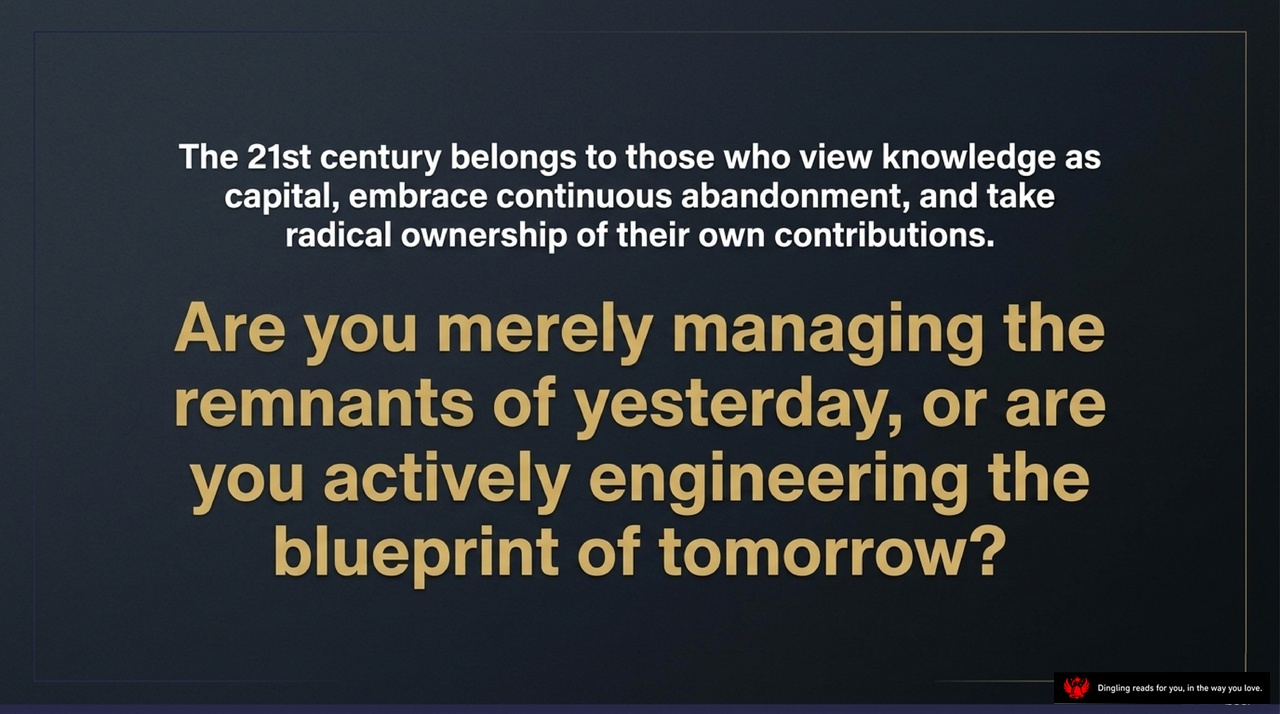
Look at this slide. It asks a powerful question: Are you merely managing the remnants of yesterday, or are you actively engineering the blueprint of tomorrow? This is the ultimate test for leaders in the 21st century. The text above it clarifies the stakes: true ownership of the future belongs to those who view knowledge as capital, embrace continuous abandonment of the old, and take radical responsibility for their contributions.
In the past, many organizations were trapped trying to manage the leftovers of yesterday's models—sticking to rigid structures and outdated assumptions that no longer fit the world. But the new paradigm demands a complete shift. You cannot simply optimize a dying business; you must actively design the next one. This means constantly asking, "If we knew what we know today, would we still be doing this?" If the answer is no, you must abandon it immediately.
True leadership isn't about preserving the status quo. It's about recognizing that the tools and strategies that worked yesterday are likely liabilities today. You need to stop treating knowledge as a static asset and start treating it as dynamic capital that fuels innovation. This requires the courage to let go of what once worked, even if it was successful, and to invest your resources in building something entirely new.
So, the choice is yours. Will you be the manager of the past, clinging to familiar but obsolete methods? Or will you be the architect of the future, using your knowledge to engineer a blueprint that actually works for the world of tomorrow? The blueprint doesn't draw itself; it requires your radical ownership and active engineering.