
Market Wizards: Complete Chapter-by-Chapter Summary

Welcome to our deep dive into the world of financial legends. Today, we're stepping into the minds of the market's most successful traders, as explored in Jack D. Schwager's groundbreaking book, *Market Wizards*.
On the left, you see a stylized visualization of market data—those shifting bars and intersecting lines represent the chaotic yet patterned nature of trading that these wizards have mastered. On the right, the title sets the stage: an exploration into the minds, methodologies, and yes, the madness of the world's top financial traders.
Schwager's work isn't just about numbers; it's about the people behind them. From William O'Neil, who built a fortune with his CANSLIM strategy and strict stop-loss rules, to the legendary David Ryan, who turned a $20,000 account into millions through disciplined execution. We also meet Michael Steinhardt, who dared to go against the crowd, and Marty Schwaiz, a true lone wolf who turned $40,000 into $20 million by separating his ego from his money.
Whether it's Bruce Kovner's focus on intuition versus impulse, Richard Dennis's famous "Turtle Traders" experiment proving that trading skills can be taught, or Paul Tudor Jones's ability to pivot instantly when the market turns, each wizard shares a unique path. They all agree on one thing: risk management is non-negotiable, and emotional control is the ultimate edge.
This book strips away the glamour to reveal the raw truth of trading success. It's not about predicting the future; it's about understanding human behavior, adhering to a proven system, and having the courage to cut your losses when things go wrong. Whether you're a novice or a seasoned investor, *Market Wizards* offers timeless lessons that can transform how you approach the markets. Let's begin our journey by uncovering what separates the winners from the rest.

Look at the stark contrast on this slide. On the left, we see a simple, upward-trending arrow representing the general public's dream: the belief that there is a single, secret formula to beating the market. Everyone thinks success comes from finding that one perfect system.
But look at the right side. Here, we see a chaotic tangle of lines converging into a single point. This visualizes a profound paradox revealed by Schwager's interviews: the world's best traders actually use wildly contradictory methods. Some buy breakouts, while others buy panics; some rely on complex algorithms, while others trust pure intuition. Yet, they all win.
The key takeaway here is clear: the secret isn't the specific system you use. It's the framework you build around it. While your strategy might look nothing like your neighbor's, a strong mental framework allows you to adapt, manage risk, and ultimately succeed regardless of the path you take.

Look at this pyramid. It's the ultimate blueprint for any successful trader, and the text tells us something chilling: every single wizard profiled in the book masters all three layers. Remove one, and the trader inevitably fails.
Let's start at the base, **The Edge, or Methodology**. This is your weapon. It's a highly personalized strategy with a mathematical and statistical advantage. Think of it as the "how"—your specific rules, your entry and exit signals, the math that gives you an edge over the crowd.
Moving up to the middle, we have **The Shield, which is Risk Control**. This is the most critical layer. It's an obsessive, inflexible, and fanatical focus on capital preservation above all else. As the text illustrates with Ed Seykota and Richard Dennis, if you lose your capital, you lose the game forever. This layer is about strict stop-losses, position sizing, and never letting a small loss become a catastrophe.
Finally, at the very top, sits **The Mind, or Psychology**. This is the hardest part to master. It requires total emotional detachment, ego management, and extreme self-awareness. It's about controlling your impulses and sticking to your plan even when you're terrified or greedy.
The text emphasizes that these three elements are interdependent. You can have the best strategy in the world, but without the Shield to protect your capital, you'll go broke. You can have perfect risk management, but without the Edge, you're just gambling. And even with the best strategy and risk controls, if you can't control your Mind, you will fail. True mastery comes only when you integrate all three.

Look at this timeline. It maps out the four distinct schools of thought that define how we actually make money in the markets.
First, on the far left, we have Pure Fundamentals, championed by legends like James Rogers Jr. This approach is all about the story behind the stock. You buy pure value based on global supply and demand imbalances, and then, crucially, you wait for market hysteria to sell. It's about patience and letting the facts catch up.
Moving to the Hybrid approach, pioneered by William O'Neil and Bruce Kovner, we see a blend of the two worlds. They combine macro and fundamental themes with precise technical chart timing. This is the best of both: you pick a great company, but you use charts to time your entry and exit perfectly.
Then, on the right, we have two distinct paths. The Technical approach, led by Paul Tudor Jones and Marty Schwartz, focuses entirely on price action, volume, and momentum indicators to front-run the crowd. They don't care about the news; they care about what the market is doing right now. Finally, we have Pure Systems or Math, used by Ed Seykota and Larry Hite. They rely on computerized trend-following, trading the math entirely and ignoring the news completely.
But here is the most important takeaway from this entire chart. As the quote at the bottom reminds us: "The data source itself doesn't generate alpha. Total, unwavering conviction in the chosen data generates alpha." It doesn't matter which method you pick—fundamentals, hybrids, technicals, or math. What separates the winners from the losers isn't the data source. It's your conviction. You must believe 100% in the system you choose and stick to it without hesitation. That is where the real profit is made.

The Anatomy of a Super-Stock: O'Neil's CANSLIM Framework. This isn't just a chart; it's a blueprint for finding the market's absolute best performers. Look at the center of this radar map. It breaks down exactly what separates a rising star from a fading stock.
First, you need the fundamentals. Look at 'C' for Current Earnings and 'A' for Annual Growth. The rule is simple but strict: you want quarterly earnings up by over 20% year-over-year, and an average annual growth rate of 24% over the last five years. Without this explosive growth, the stock simply won't move.
Then, look at innovation and momentum. 'N' stands for New Developments—think new products, new management, or crucially, new price highs. O'Neil insists you buy stocks that are already breaking out. 'S' is Supply and Demand; you want low floating shares, under 25 million, so there's plenty of room for the price to skyrocket.
But fundamentals aren't enough. You need the market to be with you. 'M' for Market Direction means the stock must align with the broader trend. 'L' for Leader/Laggard tells you to buy the best in the sector, ensuring a Relative Strength index above 80. Finally, 'I' is Institutional Sponsorship. You want strong backing from smart money, but not so much that funds are over-owned.
The slide also highlights a hard truth on the right: finding the best stocks requires doing what feels incredibly uncomfortable. O'Neil proves that true opportunity often means buying high with the intention of selling even higher. It's counterintuitive, but it's the only way to capture the full explosion of a super-stock.

Let's dive into the three distinct philosophies that define professional trading, as outlined in our comparison matrix.
First, we have the **Trend Following** style, championed by legends like Richard Dennis and Ed Seykota. Their core belief is simple yet powerful: "The trend is your friend." They enter the market only on breakouts or when momentum confirms a move. However, their greatest danger lies in ranging or sideways markets, where whipsaws can quickly erode capital.
Next is the **Contrarian** approach, represented by Michael Steinhardt and James Rogers. Their mantra is to "fade the crowd." They look for entry points at peak public hysteria or when fundamentals completely diverge from prices. While this can yield massive returns, the danger here is being completely right but too early, getting trapped before the actual turn happens.
Finally, we have **System Trading**, exemplified by Larry Hite. Here, the philosophy is "Math over mind." Entries are strictly dictated by algorithms with zero discretion. The risk? Over-optimizing models based on past data, which can fail when future market conditions change.
The crucial takeaway from this matrix isn't just knowing these styles, but matching your natural psychological profile to the right one. A natural contrarian will inevitably fail at trend-following. Success requires aligning your personality with your philosophy.

The chart before us tells a simple but powerful story about the "Patience of the Predator." It illustrates that true wealth isn't built on constant action, but on the discipline to wait. As the graph shows, for long periods, the line stays flat—representing time spent doing nothing. This isn't inactivity; it's preparation. It's the moment a cheetah lies in the bush, perfectly still, watching its prey.
This mindset is captured by the "Dennis Principle," which reveals a shocking truth: 95% of Richard Dennis's total profits came from just 5% of his trades. The rest were simply waiting. Legendary investor James Rogers Jr. put it perfectly: "Do nothing unless there is something to do. Wait until you find money lying in the corner, then walk over and pick it up."
The slide also reminds us that wizards don't trade for entertainment or action. They trade solely for asymmetric opportunities. As Mark Weinstein notes, you must wait until the setup is absolutely perfect before striking. Overtrading is the definitive mark of an amateur. By embracing this patience, you stop chasing the market and start letting the market come to you.

The Universal Law of Survival isn't just a catchy title; it's the bedrock of every successful trader's career. Look at that shield on the left—it represents the one thing separating the pros from the amateurs: risk management. As Larry Hite famously said, "If you don't bet, you can't win. If you lose all your chips, you can't bet." This is the harsh but necessary truth of the market.
While market wizards might use wildly different entry strategies—some chasing trends, others playing the long game—they all share one identical, fanatical devotion to risk management. They don't obsess over how much they can make in a single trade. Instead, they focus entirely on how much they are allowed to lose. Before you even pull the trigger, you must know your exit strategy.
This discipline is what allowed legends like Richard Dennis to turn a mere $400 into $200 million, and why Bruce Kovner never lets a single trade risk more than 1% of his portfolio. When you protect your capital ruthlessly, you ensure you're still in the game long enough to catch the big moves. So, remember: your greatest asset isn't your prediction skill; it's your ability to survive the inevitable losses that come with trading.

The Asymmetry of Loss is one of the most brutal, yet often overlooked, truths in trading. As the chart illustrates, the math of recovery is terrifyingly unforgiving. A simple 10% loss demands an 11% gain just to break even. But push that loss to 25%, and you suddenly need a 33% rebound. If you let a position drop 50%, you have to double your entire investment just to get back to zero. This isn't just theory; it's a mathematical trap that destroys more accounts than any market crash.
To survive this asymmetry, we must look to the masters who built their empires on strict discipline. Take William O'Neil, the founder of CANSLIM. He didn't hesitate. His rule was absolute: auto-cut at a 7% loss. No exceptions. He compared investors to turkeys waiting for the market to come back, only to get slaughtered when it doesn't. Similarly, Larry Hite, a legendary commodity trader, enforced a hard cap: never risk more than 1% of your total equity on any single trade. By keeping individual losses small, he ensured that a string of bad trades couldn't wipe him out.
But the most profound lesson comes from Bruce Kovner, a giant in the forex world. His advice is counterintuitive but essential: determine your exact exit point before you even enter the trade. Once you're in, cut your position size in half. This simple act of humility—reducing exposure when things go wrong—transforms a potential catastrophe into a manageable setback. These aren't just rules; they are survival mechanisms designed to keep you in the game long enough to profit from the next big opportunity.

Defense Over Offense: The PTJ Playbook. Today, we're shifting gears from chasing profits to protecting capital. Think of your trading strategy not as an offensive weapon, but as a defensive shield. The goal isn't to get rich today; it's simply to end the day with more capital than you started.
Let's look at the four pillars of this shield. First, Daily Mark-to-Market. This means treating every position as if you just opened it today. Your past entry price is irrelevant to your current risk. If a trade isn't moving as expected within a specific timeframe, hit the brakes. That's your Time Stops rule. Dead money is risky money, so if the market doesn't confirm your thesis, exit immediately, even without a loss.
Next, Scale Back on Drawdowns. When trading poorly, reduce your size. When trading well, increase it. This dynamic adjustment keeps you safe during turbulence. Finally, maintain a Mental Clean Slate. Treat every single position as fresh. Don't let your ego or past mistakes dictate your current actions.
Remember the core message at the bottom: Don't be a hero. Don't have an ego. Always question yourself and your ability. In trading, survival comes from discipline, not bravery.

The slide clearly illustrates a fundamental truth in trading: you must separate your emotions from your money. The image shows a seesaw where "Profit" is heavy and "Ego" is light, suggesting that letting your pride dictate your trades is a recipe for disaster.
As the legendary trader Marty Schwartz famously said, "To hell with my ego, making money is more important." He realized that becoming a winner started the moment he stopped caring about being right. Similarly, Tom Baldwin emphasizes that you must divorce your ego from the money, treating capital strictly as a scoring tool rather than a measure of your self-worth.
The bottom of the slide highlights the critical difference between the amateur and the professional. The amateur holds onto a losing position just to avoid the painful feeling of admitting they were wrong. They fight the market to prove their point. In contrast, the "Wizard"—the true professional—takes the loss immediately to ensure financial survival. As Burt Gilbert puts it, if a trade is bad, get out. Do not hold onto a bad position just to prove to the market that you were right.
Success isn't about being right every time; it's about managing your risk and letting your strategy, not your feelings, drive the decisions.
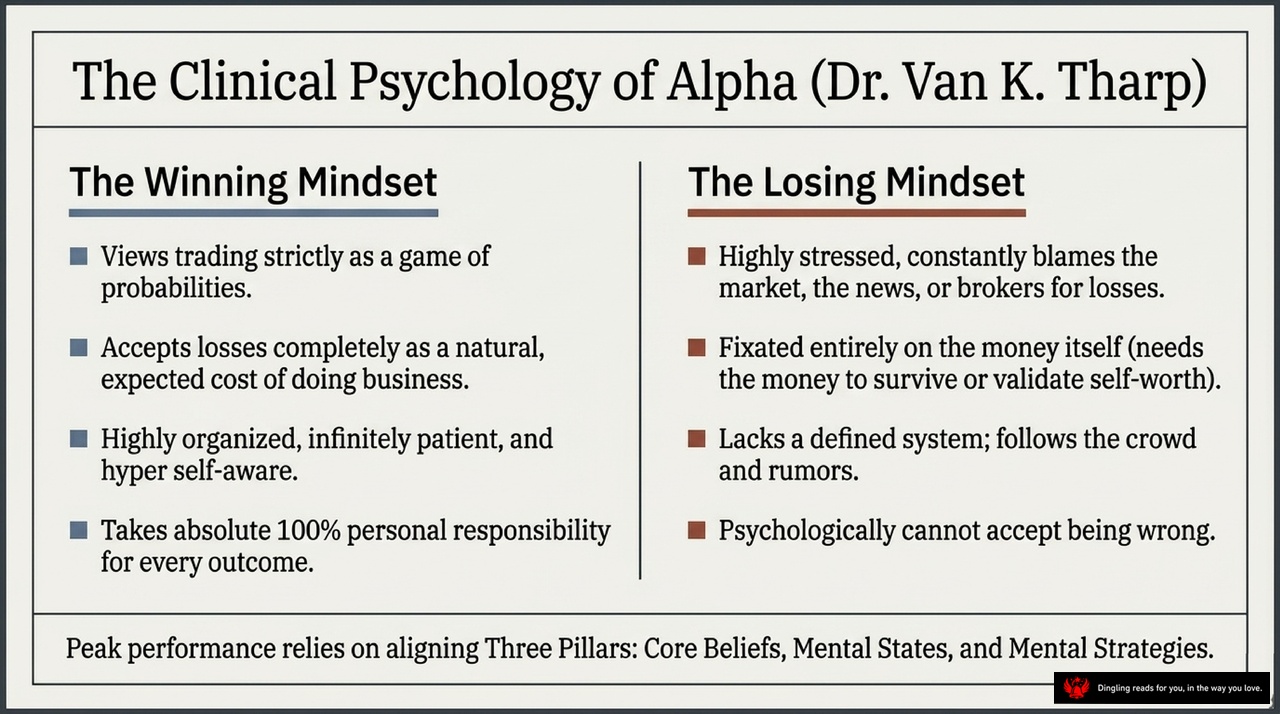
Today's slide breaks down the clinical psychology of trading, a framework developed by Dr. Van K. Tharp. He contrasts two opposing mindsets: the winning mindset and the losing mindset.
On the left, we see the winning mindset. This trader views trading strictly as a game of probabilities. They accept losses completely as a natural, expected cost of doing business, rather than a personal failure. They are highly organized, infinitely patient, and hyper self-aware. Crucially, they take absolute 100% personal responsibility for every outcome, whether it's a win or a loss.
On the right, we see the losing mindset. This trader is highly stressed and constantly blames the market, the news, or brokers for their losses. They are fixated entirely on the money itself, often needing it to survive or validate their self-worth. They lack a defined system, instead following the crowd and rumors. Most importantly, they psychologically cannot accept being wrong, which prevents them from learning and growing.
At the bottom, Tharp reminds us that peak performance relies on aligning three pillars: Core Beliefs, Mental States, and Mental Strategies. Ultimately, the difference between success and failure often comes down to how you handle the inevitable losses and whether you own your decisions completely.
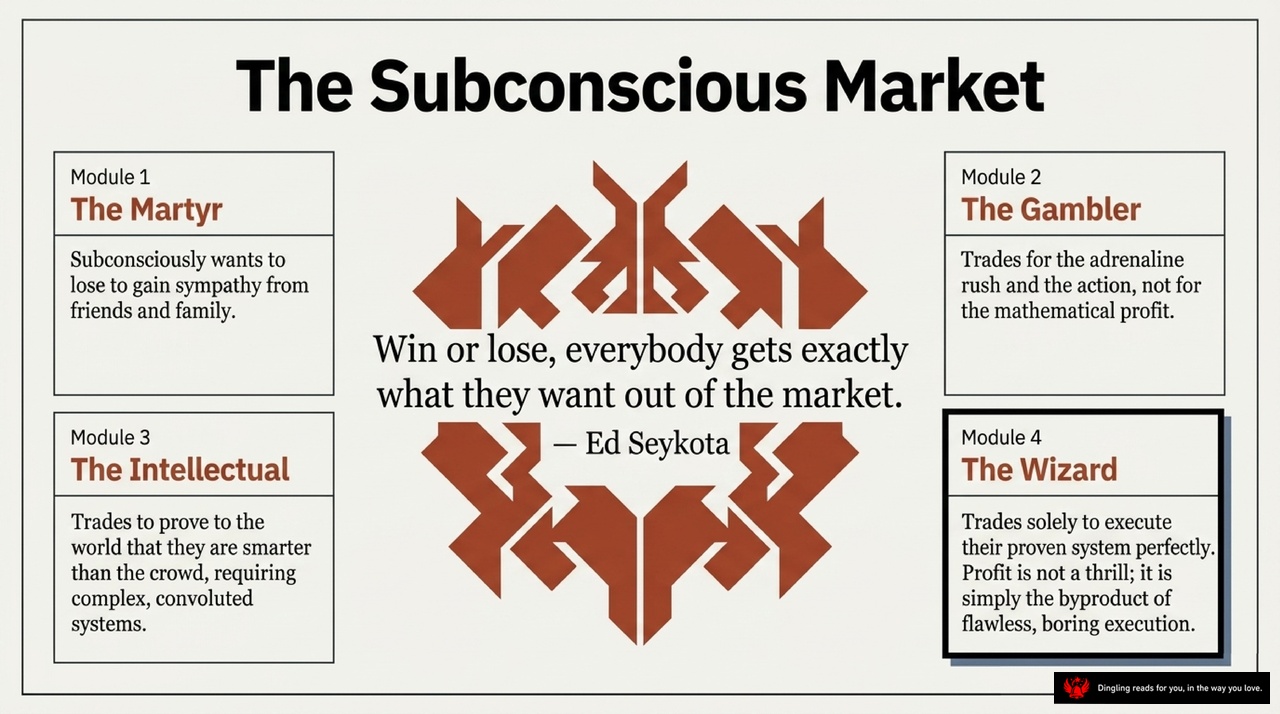
The Subconscious Market isn't just a catchy title; it's the hidden engine driving every trade you make. As the slide illustrates, whether you're a Martyr seeking sympathy, a Gambler chasing an adrenaline rush, an Intellectual trying to prove you're smarter than the crowd, or a Wizard executing a flawless system, the market always gives you exactly what you want. That's the profound insight from Ed Seykota: "Win or lose, everybody gets exactly what they want out of the market."
Look at these four archetypes. The Martyr trades to lose, hoping to gain sympathy from friends and family. The Gambler ignores the math entirely, trading purely for the thrill of the action. The Intellectual builds complex, convoluted systems just to prove they are smarter than everyone else. But then, there is the Wizard—the only one who trades solely to execute a proven system perfectly. For the Wizard, profit isn't a thrill; it's simply the boring byproduct of flawless execution.
This is the core lesson we've explored throughout our journey with legends like Seykota, Ryan, and Schwartz. Success isn't about being right every time or beating the market with a secret formula. It's about aligning your trading behavior with your deepest desires. If you want to be a winner, you must stop wanting to be a martyr or a gambler. You have to become the Wizard, where discipline replaces emotion, and execution replaces ego. The market is neutral; it just reflects your own subconscious intentions.
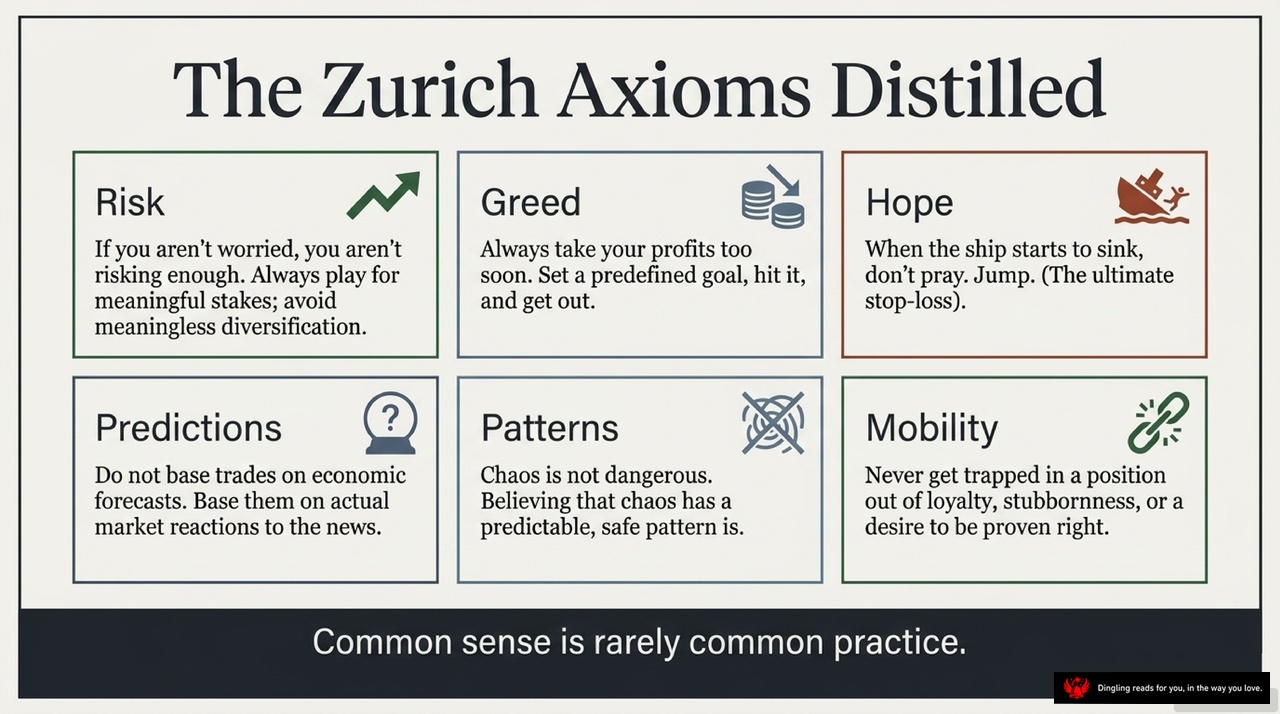
The Zurich Axioms Distilled. These aren't just rules; they are survival instincts for the modern trader.
First, look at Risk. The axiom states: "If you aren't worried, you aren't risking enough." It's a hard truth. You need meaningful stakes. Avoid meaningless diversification. Then, consider Greed. The slide warns: "Always take your profits too soon." Set a predefined goal, hit it, and get out. Don't let greed turn a winner into a loser.
Next is Hope. The image shows a sinking ship. The text says: "When the ship starts to sink, don't pray. Jump." This is the ultimate stop-loss. Hope is your enemy in the market. You must respect Predictions, too. Do not base trades on economic forecasts; base them on actual market reactions. And regarding Patterns: "Chaos is not dangerous." Believing chaos has a predictable, safe pattern is a fatal trap.
Finally, Mobility. "Never get trapped in a position out of loyalty, stubbornness, or a desire to be proven right." As the bottom line reminds us: "Common sense is rarely common practice." These distilled axioms separate the survivors from the victims.
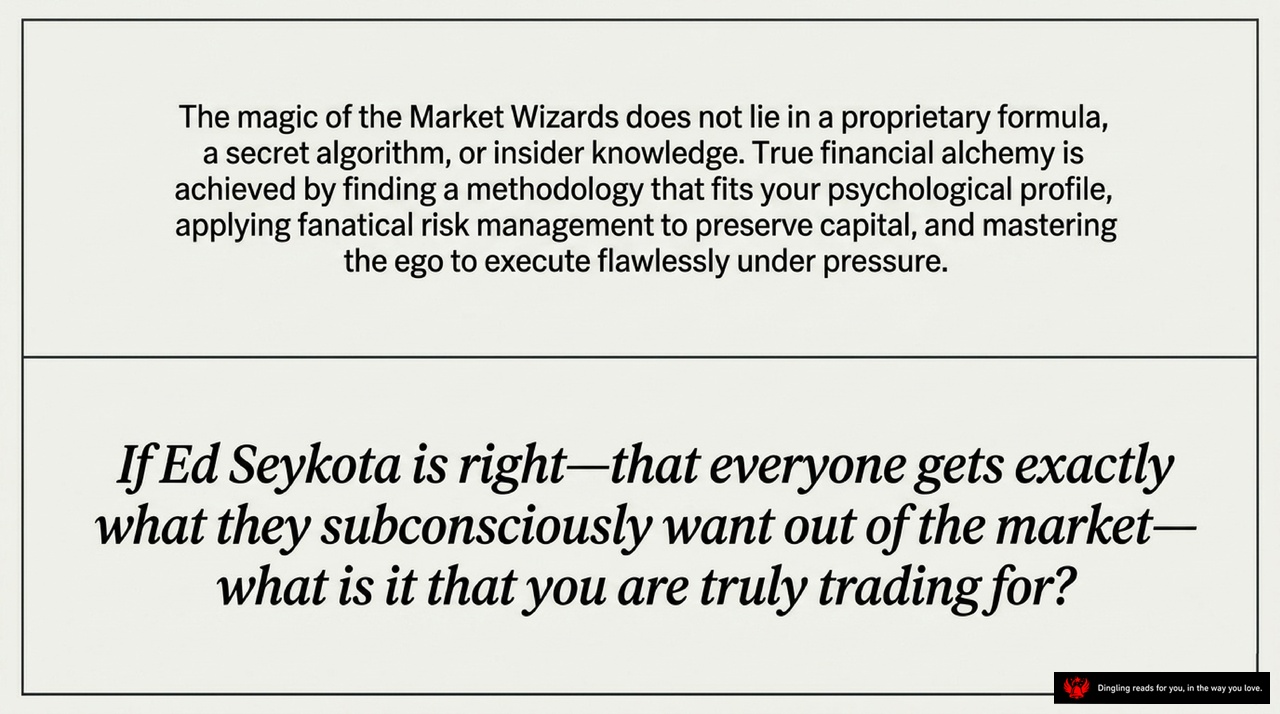
The magic of the Market Wizards isn't about some secret algorithm or insider tip. As the slide reminds us, true financial alchemy comes down to three things: finding a strategy that fits your personality, managing risk with fanatical discipline, and mastering your ego to execute perfectly under pressure.
If Ed Seykota is right—that everyone gets exactly what they subconsciously want out of the market—then let's be honest: what are you really trading for? Are you chasing a lifestyle, or are you actually building the discipline to win? The difference between the winners and the losers often isn't the charts; it's the ability to control yourself when the pressure hits.