
Marketing Management: Complete Chapter-by-Chapter Summary

Welcome to the ultimate blueprint for mastering Marketing Management. Today, we are diving into the foundational work of Philip Kotler and leading scholars to understand how to create, communicate, and deliver value in a dynamic global market.
Many people mistakenly believe marketing is just about selling products, but that is a fundamental misunderstanding. True marketing is a social process where individuals or groups create and provide value to others through exchange. To succeed, you must first distinguish between three often-confused concepts: a need is a basic human requirement like hunger; a want is that need directed toward a specific object, like wanting bread; and a demand exists only when that want is backed by the ability to pay.
Our journey through marketing management traces its evolution from the production era, where companies like Ford focused solely on efficiency, to the modern marketing concept that places the customer at the very center. We will explore how strategic thinking has shifted from simply pushing products to understanding deep consumer behaviors and building long-term relationships. Whether you are launching a new product or optimizing your business strategy, this session will equip you with the essential tools to navigate today's complex marketplace and turn potential customers into loyal advocates.
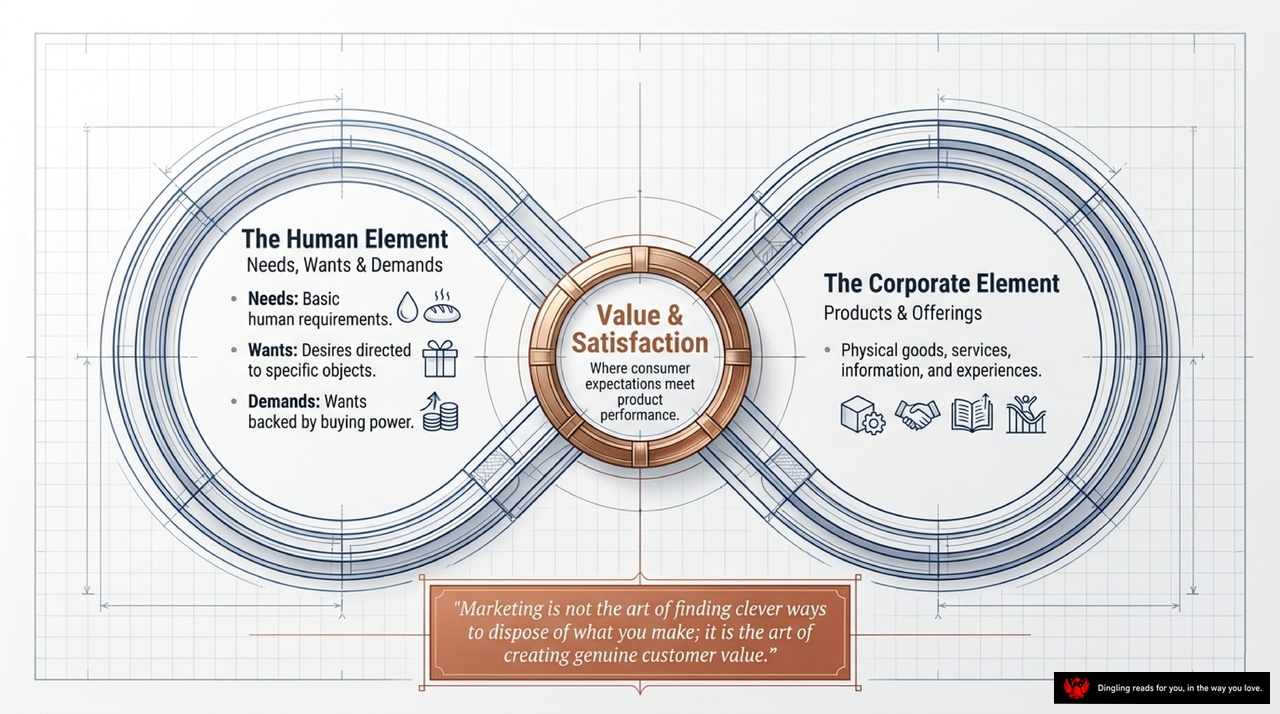
Today's slide breaks down the fundamental engine of marketing: the dynamic relationship between human desires and corporate offerings. On the left, we see "The Human Element," which covers needs, wants, and demands. A need is a basic requirement, like hunger; a want is a specific desire, like wanting a sandwich; and a demand is that want backed by the buying power to make it a reality. On the right sits "The Corporate Element," representing the products, services, and experiences companies create to meet those human requirements.
At the center connecting these two sides is "Value & Satisfaction." This is the sweet spot where consumer expectations actually meet product performance. Marketing isn't just about selling what you make; it's about creating genuine customer value. When a company successfully bridges the gap between what people need and what they can afford, and delivers a product that satisfies them, true satisfaction is achieved. This alignment is the core of any successful business strategy.
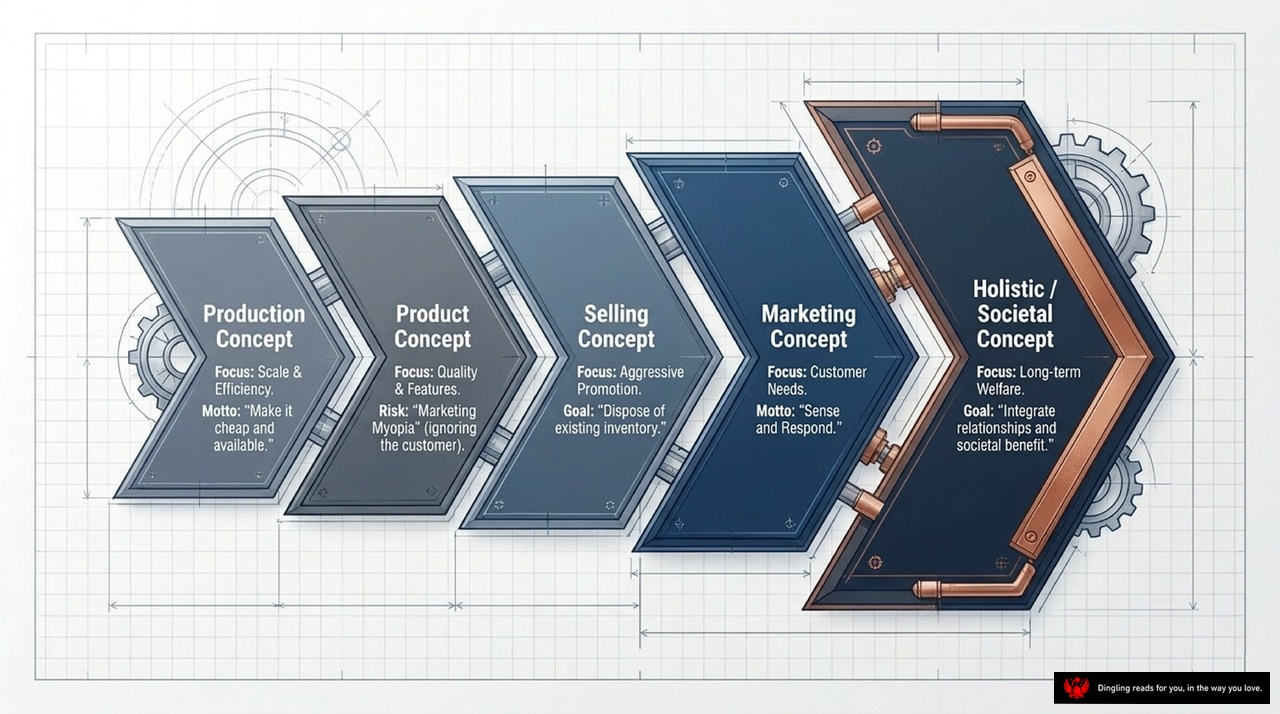
Today's slide maps out the evolution of marketing philosophy, showing how we've moved from a factory-centric mindset to a society-focused approach. It starts with the **Production Concept**, where the motto was simply "make it cheap and available." Back then, companies like Ford believed that if you could produce a product efficiently and at a low cost, customers would buy it in droves.
However, this led to a trap known as **Marketing Myopia**. The **Product Concept** followed, focusing on quality and features. Companies became so obsessed with making the "best" product that they ignored what customers actually needed. For example, a company might build an indestructible safe, only to realize no one wants to drop their safe from a building.
Then came the **Selling Concept**, which shifted to aggressive promotion. The goal here was just to "dispose of existing inventory." This worked well for unsought goods like insurance or encyclopedias, but it still treated the customer as a target rather than a partner.
The real game-changer was the **Marketing Concept**. Here, the focus flipped to "customer needs," guided by the motto "Sense and Respond." Instead of asking what we can sell, we ask what the customer wants. This is the foundation of modern business.
Finally, we arrive at the **Holistic or Societal Concept**. This is the most advanced stage, prioritizing long-term welfare. The goal is to "integrate relationships and societal benefit." Today's successful companies don't just sell products; they build sustainable ecosystems that create value for customers, the environment, and society as a whole. This journey from efficiency to empathy defines the future of marketing.
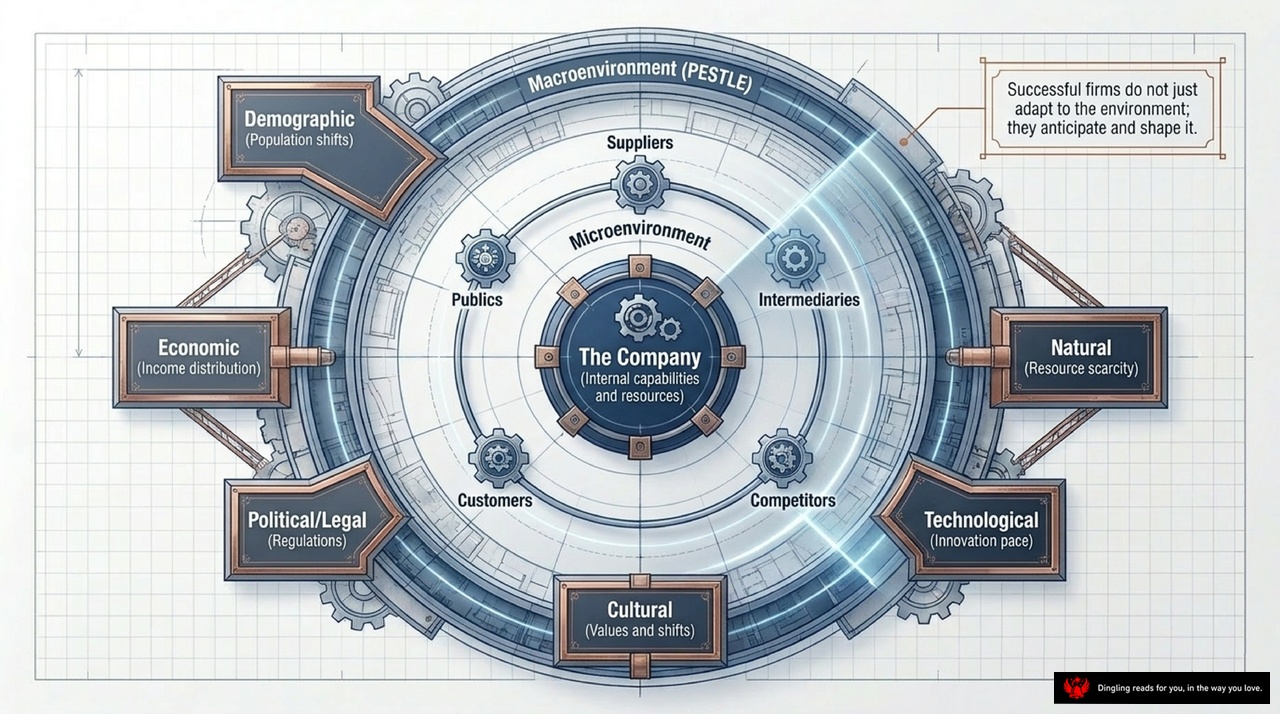
Today's slide visualizes the marketing environment as a complex, interlocking system where the company sits at the very center, surrounded by its immediate micro-environment and the broader macro-environment. Think of the micro-environment as your direct battlefield: it includes suppliers, intermediaries, competitors, customers, and the public. These are the players you interact with daily, and your ability to manage these relationships determines your immediate success.
Surrounding that inner circle is the macro-environment, which we analyze using the PESTLE framework. As the graphic highlights, successful firms do not just adapt to the environment; they anticipate and shape it. This outer ring is divided into six critical forces. First, the Demographic factor, driven by population shifts, dictates who your customers actually are. Next, the Economic environment, influenced by income distribution, determines their purchasing power. Then, the Political/Legal landscape, shaped by regulations, sets the rules of the game. The Cultural element, based on values and shifts, influences how consumers perceive your brand. The Technological factor, driven by the pace of innovation, can disrupt your entire business model overnight. Finally, the Natural environment, defined by resource scarcity, impacts your costs and sustainability.
The core message here is that while the company relies on its internal capabilities and resources, it cannot operate in a vacuum. You must constantly monitor these external gears—whether it's a change in government policy, a new tech trend, or a shift in cultural values—to ensure your strategy remains relevant and resilient in a dynamic world.
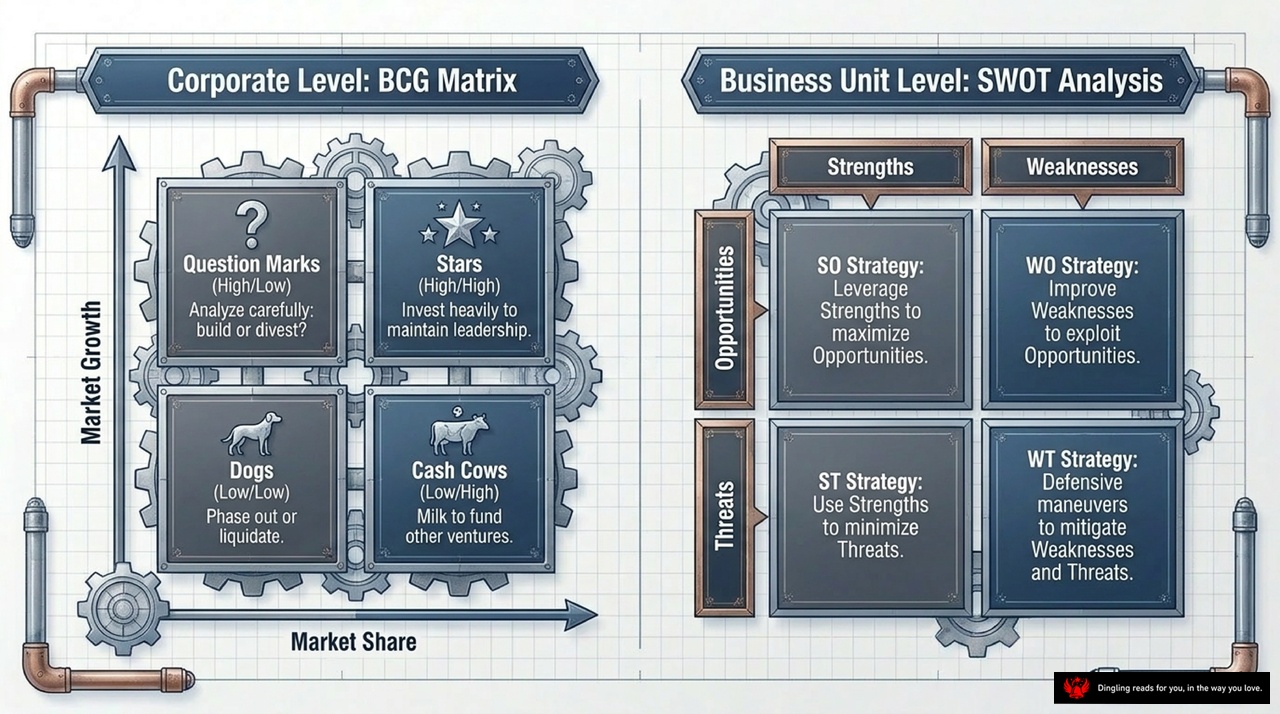
Today's slide breaks down the two most critical strategic frameworks for any business: the BCG Matrix at the corporate level and SWOT Analysis at the business unit level.
On the left, we have the **BCG Matrix**, a tool for managing your entire portfolio of business units. It plots products based on **Market Growth** and **Market Share**. You'll see four distinct categories here. In the top right, you have **Stars**—high growth, high share. These are your leaders; the strategy is to invest heavily to maintain that dominance. Opposite them in the bottom right are **Cash Cows**—low growth but high share. These are your money makers; you "milk" them for cash to fund the stars and question marks. In the top left, you have **Question Marks** with high growth but low share. These are risky; you must analyze carefully to decide whether to build them into stars or divest. Finally, in the bottom left are **Dogs**—low growth, low share. The strategy here is usually to phase them out or liquidate them to free up resources.
On the right, we shift to the **SWOT Analysis** for specific business units. This grid helps you match your internal realities with external opportunities. The top row covers **Strengths** and **Weaknesses**, while the side column shows **Opportunities** and **Threats**. This creates four strategic quadrants. First, **SO Strategies**: leverage your strengths to maximize external opportunities. Next, **WO Strategies**: use opportunities to overcome your weaknesses. Then, **ST Strategies**: use your strengths to defend against external threats. Finally, **WT Strategies**: this is your defensive play—minimizing weaknesses and avoiding threats to survive.
Mastering both the BCG Matrix for portfolio balance and SWOT for tactical positioning is essential for building a resilient, strategic company.
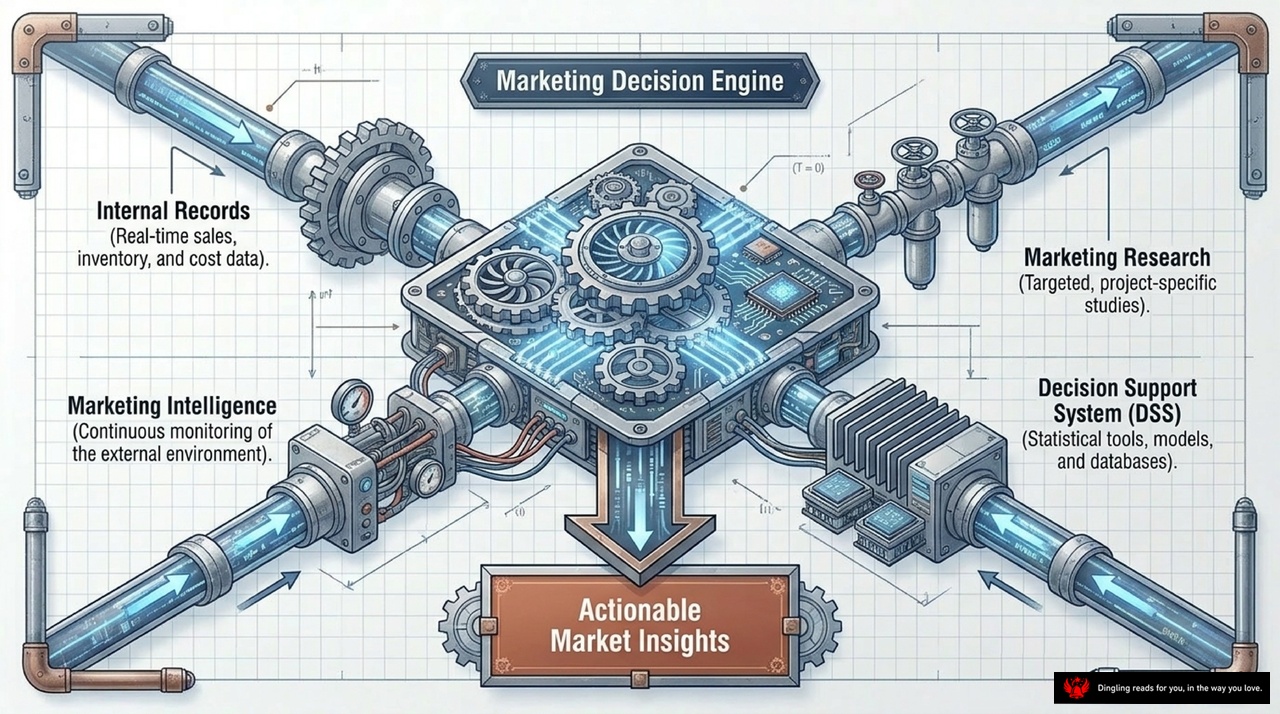
Today's slide visualizes the entire marketing decision engine as a sophisticated, steampunk-inspired machine, where every gear and pipe represents a critical flow of data leading to actionable insights. At the very center sits the "Marketing Decision Engine" itself, the brain of the operation. Notice how it draws fuel from four distinct directions. On the left, we see "Internal Records," pulling in real-time sales, inventory, and cost data—this is the engine's own heartbeat. Below that, "Marketing Intelligence" constantly monitors the external environment, ensuring the machine never operates in a vacuum. On the right, the engine integrates "Marketing Research" for targeted, project-specific studies and connects with a "Decision Support System" that utilizes statistical tools, models, and databases to crunch the numbers. All these streams converge into the central processor, which then outputs a clear, downward arrow labeled "Actionable Market Insights." This isn't just about collecting data; it's about transforming raw information into a strategic advantage. By balancing internal operational metrics with external market intelligence and rigorous analytical models, modern marketing moves away from guesswork and into a precise, data-driven science where every decision is backed by evidence.
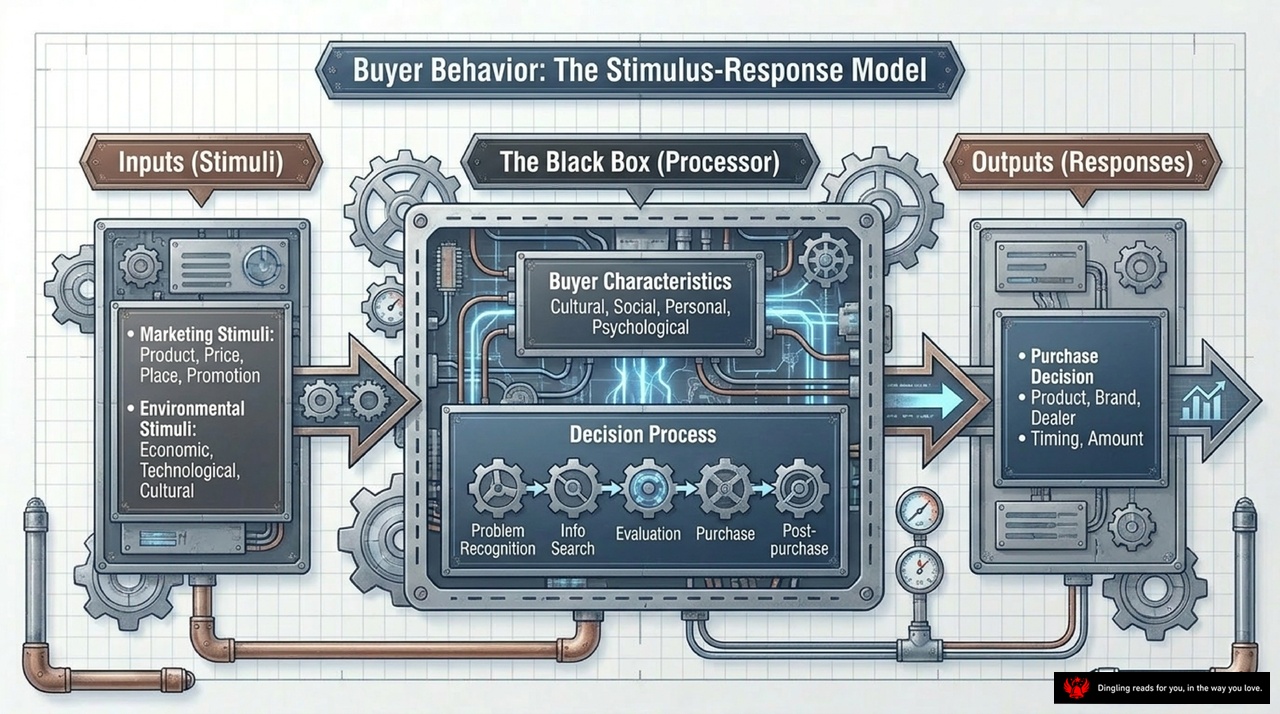
So, we've covered the internal mechanics of marketing—from understanding buyer behavior and crafting the right product to setting competitive prices and building efficient channels. Now, let's zoom out and look at the big picture: how do we actually execute all these strategies?
Think of a marketing plan not as a random brainstorming session, but as a disciplined, rational activity. It's the bridge between your market research and your actual execution. It answers the critical questions: What are we doing? How will we do it? Who is responsible? And when?
There are three main ways companies approach this. Smaller businesses often stick to a single-department model, where the marketing team does it all. Larger corporations, however, prefer a cross-functional approach, bringing together insights from strategy, sales, and finance to create a cohesive plan. Some even hire external experts to bring an objective, fresh perspective.
But having a plan isn't enough; you need to manage it. Marketing management is about setting clear, layered goals—from the high-level vision down to specific tactics for every employee—and then constantly monitoring results. It's not just about hitting a sales number today; it's about evaluating long-term effectiveness and adapting to changes in the market.
Crucially, marketing isn't the job of just one department. It requires "total marketing," where production, finance, and logistics all align around the customer's needs. To make this happen, companies need strong leadership and the right organizational structure. While functional structures are common, many large firms use product-based or matrix structures to ensure agility and focus.
Finally, we have to look beyond borders. Global marketing adds a layer of complexity. You're no longer dealing with one culture or currency; you're navigating diverse economic conditions, languages, and political landscapes. The key is balancing standardization to save costs with localization to respect local nuances. Whether you choose to adapt your product or keep your brand message consistent globally, success depends on understanding that the world is interconnected, and your strategy must be too.

Imagine marketing not as a simple sales push, but as a sophisticated, multi-stage machine designed to connect the right product with the right person. Today, we're diving into the engine of that machine: the STP process—Segmenting, Targeting, and Positioning. Think of it as a funnel that transforms a chaotic, vast market into a clear, actionable strategy.
First up is **Segmenting**. This is where we take the "total market" and slice it into distinct groups. Instead of trying to sell to everyone, we look for similarities among consumers. We use specific variables to cut through the noise: geographic factors like location, demographic traits like age and income, psychographic elements like lifestyle and values, and behavioral data like usage habits. It's about recognizing that not all customers are the same, and grouping them makes the problem manageable.
Once we've sliced the market, we move to **Targeting**. Now that we have our segments, we have to choose where to play. We evaluate each group's potential, looking at demand, competition, and how well it matches our own resources. From here, we pick a path. Do we go for **Mass** marketing to reach everyone with one message? Do we choose **Segmented** marketing to address a few distinct groups? Or do we go narrow, focusing on a **Niche** or even **Micro/One-to-One** marketing to serve a specific individual? This choice defines our battlefield.
Finally, we arrive at **Positioning**. This is the most critical step. It's not just about what we say, but what lives in the customer's mind. We must plant a distinct, competitive image relative to the competition. If you're the "innovator," your positioning is about being first. If you're the "reliable choice," your positioning is about trust. By mastering these three steps—Segmenting, Targeting, and Positioning—you stop shouting into the void and start speaking directly to the people who matter most.
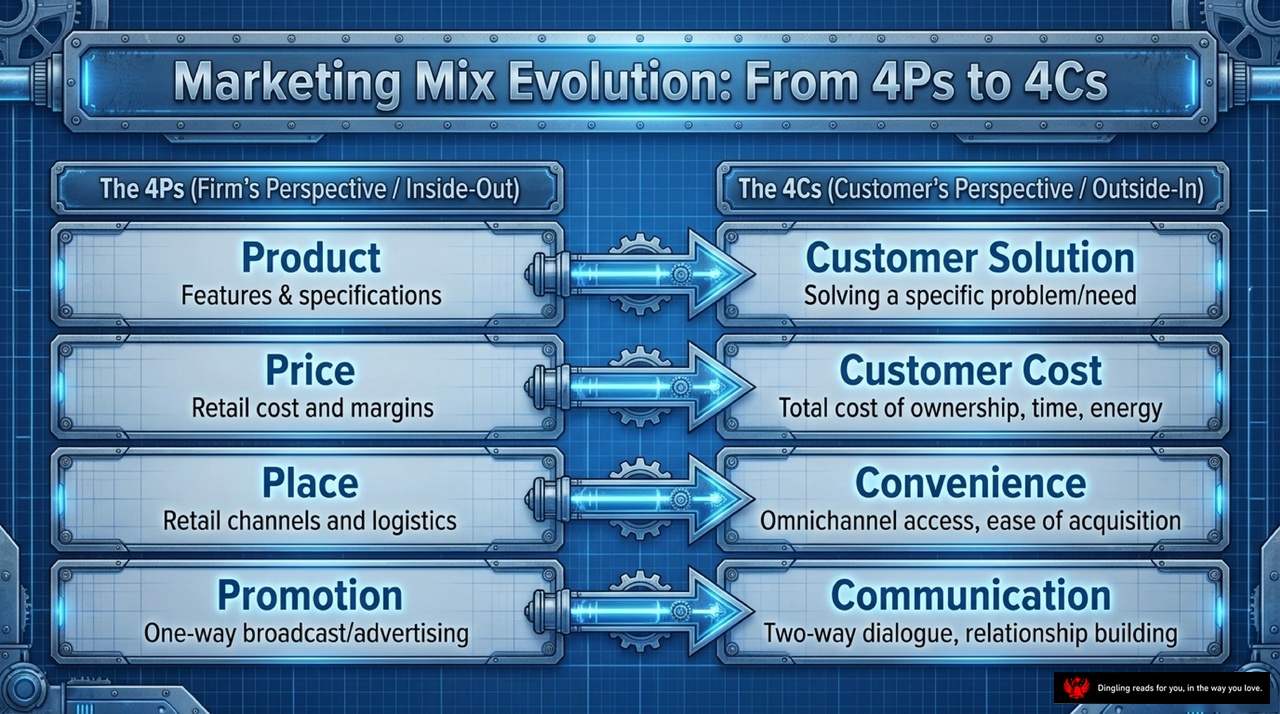
Imagine the marketing world as a giant machine that has completely retooled itself over the last few decades. Today, we're looking at the blueprint of that transformation: the shift from the traditional **4Ps** to the modern **4Cs**.
On the left, you see the old school approach—the **4Ps**. This was the "Inside-Out" strategy, where the firm was in the driver's seat. They focused on their own **Product** features, set their own **Price** margins, chose their own **Place** for distribution, and pushed messages through one-way **Promotion**. It was about what the company could make and sell.
But the arrows on this slide tell the real story: the evolution toward the customer. This is the **4Cs** model, an "Outside-In" perspective that flips the script. Instead of selling a product, you now offer a **Customer Solution** that solves a specific problem. Instead of just setting a price tag, you calculate the total **Customer Cost**, including their time and energy. **Place** transforms into **Convenience**, ensuring your product is accessible across all channels. Finally, **Promotion** evolves into **Communication**, shifting from a monologue to a two-way dialogue that builds real relationships.
This visual perfectly captures why modern marketing isn't just about pushing goods; it's about understanding the customer's entire experience and speaking directly to their needs.
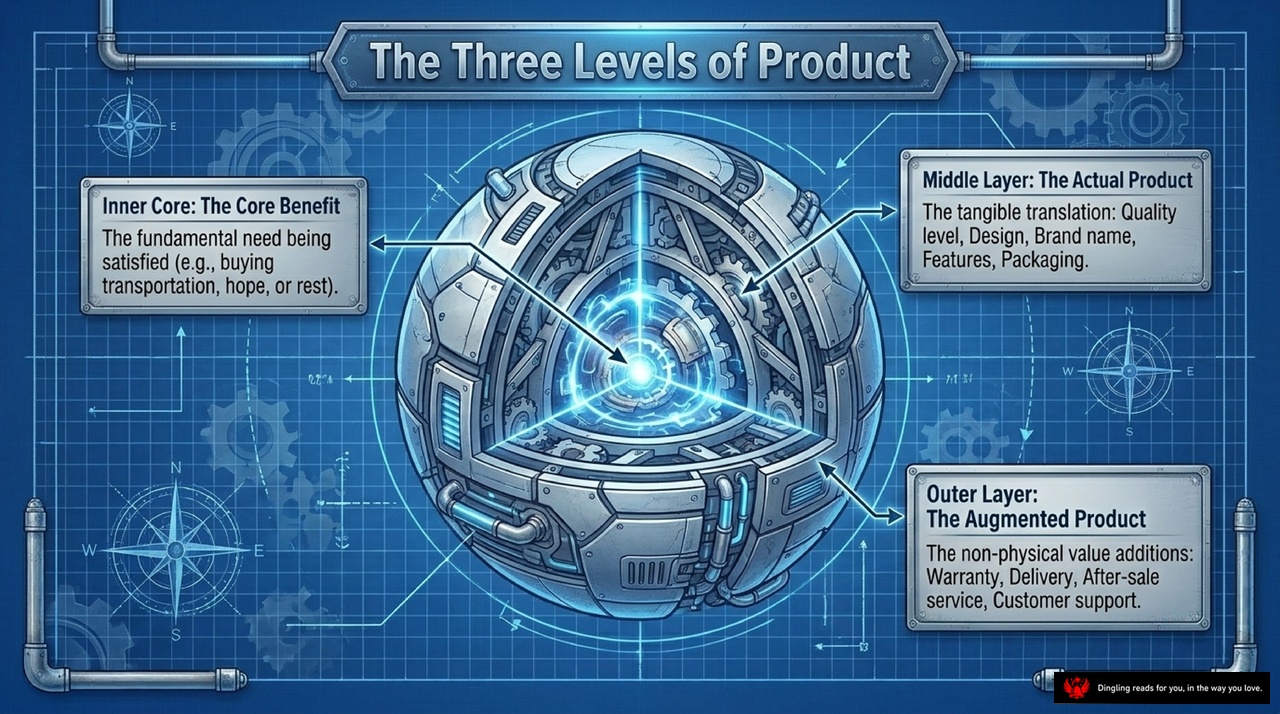
Think of a product not just as a physical object, but as a layered ecosystem of value. This slide breaks down exactly how to build that ecosystem using the "Three Levels of Product" framework.
At the very center lies the **Inner Core: The Core Benefit**. This is the absolute foundation. Before a customer buys anything, they are actually buying a solution to a fundamental need. Whether it's the desire for transportation, hope, or simply rest, this is what they are truly purchasing. If you miss this core benefit, the rest of your product won't matter.
Moving outward to the **Middle Layer: The Actual Product**, this is the tangible translation of that core benefit. Here is where your brand name, design, features, and packaging come into play. This is the physical item the customer holds in their hands, the quality level they can touch, and the specific attributes that make your product distinct from the competition.
Finally, the outermost ring is the **Outer Layer: The Augmented Product**. This represents the non-physical value additions that often decide the sale. Think about the warranty, the delivery speed, after-sales service, and customer support. In today's market, these intangible elements are frequently what separate a good product from a great one.
By understanding and balancing these three levels, you ensure you aren't just selling a thing, but delivering a complete, compelling value proposition that resonates with your customer's deepest needs.
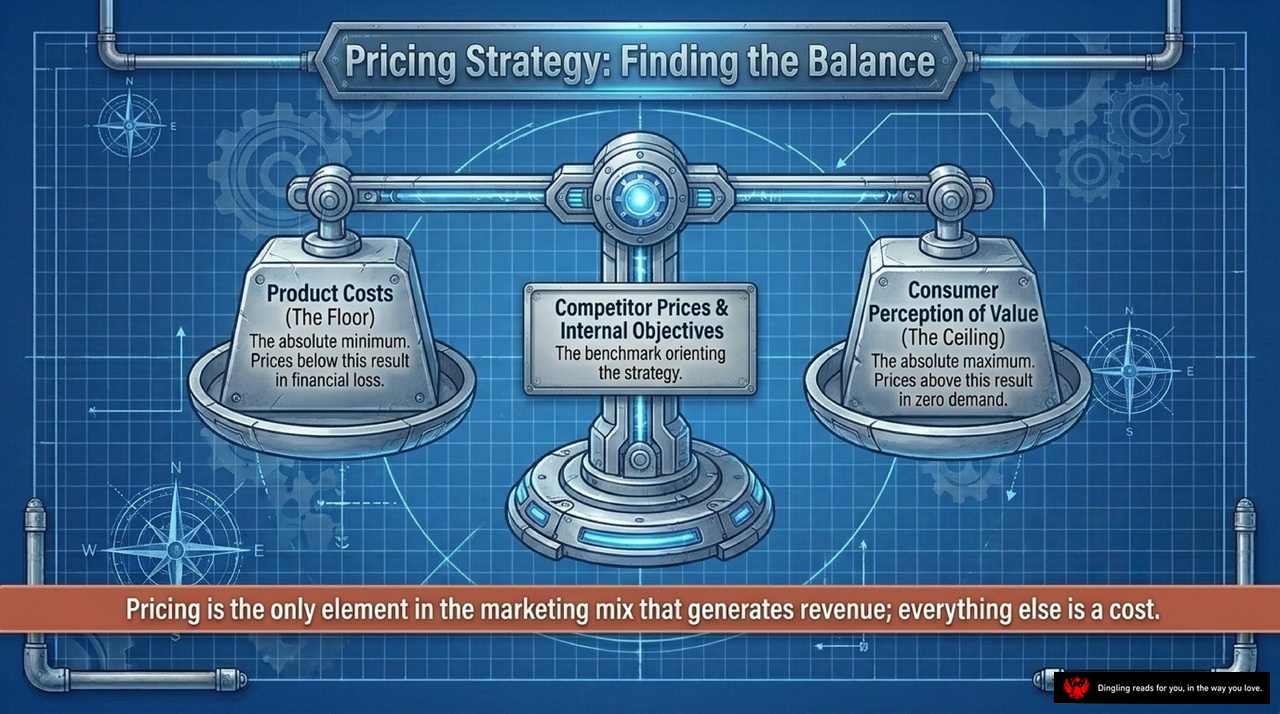
Pricing Strategy: Finding the Balance
Let's talk about the most critical lever in your marketing mix: Pricing. As the slide beautifully illustrates, pricing is the only element that actually generates revenue; everything else—from your product design to your advertising—is ultimately a cost. Getting this balance right is the difference between profitability and loss.
Think of pricing as a seesaw with three key weights. On the left, you have **Product Costs**, which act as your absolute floor. If you price below this point, you are simply burning cash. This is your minimum viable price to stay afloat. On the right sits **Consumer Perception of Value**, which is your ceiling. No matter how cheap your product is, if the price exceeds what the customer believes it's worth, demand drops to zero. You can't force a sale by just lowering the price if the value proposition is missing.
Right in the center, balancing these two extremes, is the weight of **Competitor Prices & Internal Objectives**. This is your benchmark. It's not just about copying the market, but aligning your strategy with what competitors are doing while keeping your own business goals in mind. Your sweet spot lies where these three forces meet: above your costs, below the customer's perceived value, and competitive enough to win. Mastering this balance is the art of pricing.

On the left, we see the **Conventional Channel**: a fragmented path where the Manufacturer, Wholesaler, and Retailer operate as highly independent entities. This structure often leads to conflicting goals and margin disputes, creating friction at every step. Now, look at the right side: the **Vertical Marketing System**, or **VMS**. Here, the Manufacturer, Wholesaler, and Retailer are integrated into a single, unified system. This isn't just a theoretical concept; it's a strategic evolution designed to maximize efficiency and market impact.
Notice the three distinct types of VMS below the unified box: **Corporate**, **Administered**, and **Contractual**. Unlike the disjointed conventional model, a VMS acts as a cohesive unit, aligning everyone from production to the point of sale. This integration eliminates the inefficiencies of the traditional fragmented approach, allowing companies to respond faster to market changes and deliver a seamless experience for the end consumer. In today's competitive landscape, moving from a fragmented channel to a coordinated VMS is often the key to sustainable growth.
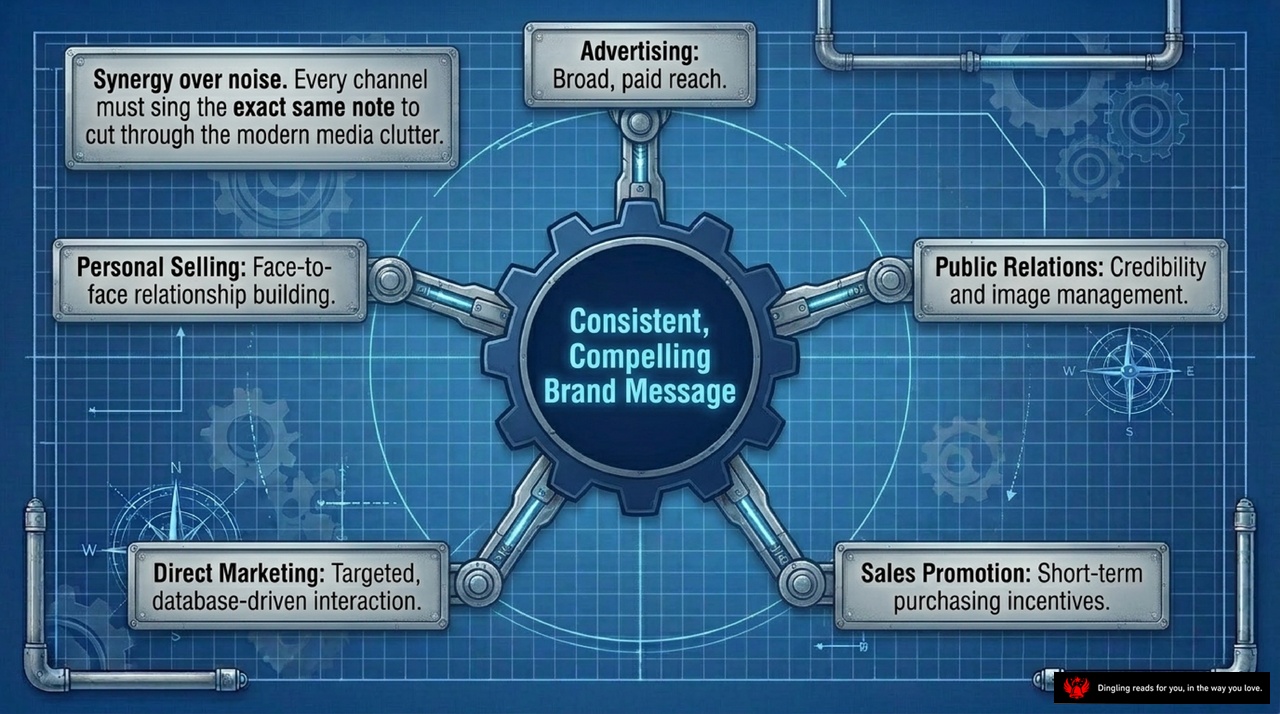
Imagine your brand as a massive, intricate machine, where every gear must turn in perfect unison to create a powerful, singular force. This slide captures that exact philosophy: at the very heart of it all lies a "Consistent, Compelling Brand Message." Without this central anchor, your entire marketing engine risks grinding to a halt or sending mixed signals that confuse your audience.
Surrounding this core are the six essential engines that drive your strategy. First, we have **Advertising**, which acts as the broad, paid reach necessary to capture attention in a crowded world. But notice the top-left box: it emphasizes "Synergy over noise." This is the golden rule. Every channel—from your ads to your personal interactions—must sing the *exact same note* to cut through the modern media clutter. If your message is fragmented, it simply gets lost.
To the right, we see **Public Relations** handling credibility and image management, while **Sales Promotion** provides those short-term purchasing incentives to boost immediate sales. On the left, **Direct Marketing** allows for targeted, database-driven interactions, and **Personal Selling** builds those crucial face-to-face relationships. Yet, none of these six elements work in isolation. They are all connected by that central gear. The goal isn't just to use all six tools; it's to ensure they align perfectly so that your brand feels unified, trustworthy, and unmistakably clear to everyone you meet.
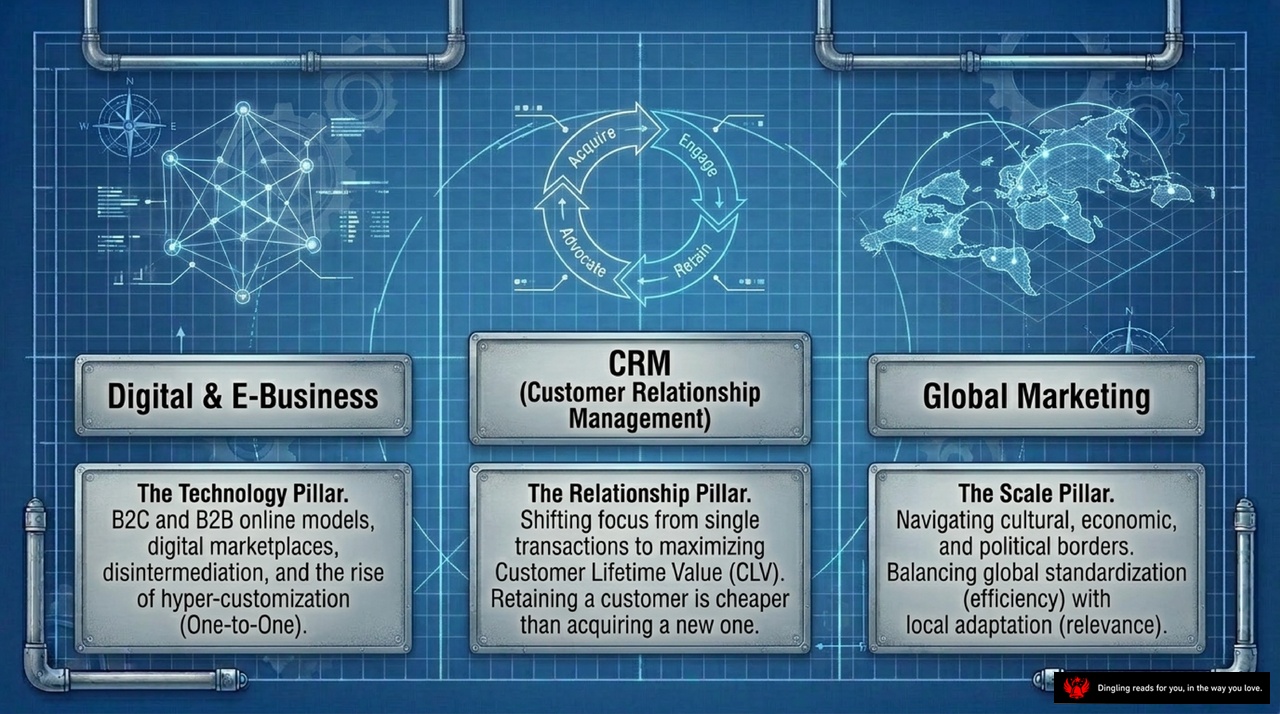
Look at this blueprint-style slide. It lays out the three essential pillars that drive modern business success: Digital & E-Business, CRM, and Global Marketing.
First, on the left, we have the **Technology Pillar**. This is about the digital shift. It's no longer just about B2C or B2B models; it's about disintermediation and hyper-customization. Think "One-to-One." The internet has fundamentally changed how we connect and sell.
In the center is the **Relationship Pillar**, or CRM—Customer Relationship Management. Notice the cycle: Acquire, Engage, Retain, and Advocate. This is a massive shift from focusing on single transactions to maximizing Customer Lifetime Value. The core insight here is simple but powerful: retaining an existing customer is significantly cheaper than constantly chasing for a new one. It's about building loyalty, not just making a sale.
Finally, on the right, we have the **Scale Pillar**, which is Global Marketing. This involves navigating complex cultural, economic, and political borders. The key challenge is balancing global standardization for efficiency with local adaptation for relevance. You can't just copy-paste a strategy from one country to another; you have to understand the local context to succeed.
Together, these three pillars form the backbone of a resilient, scalable, and customer-centric business strategy.
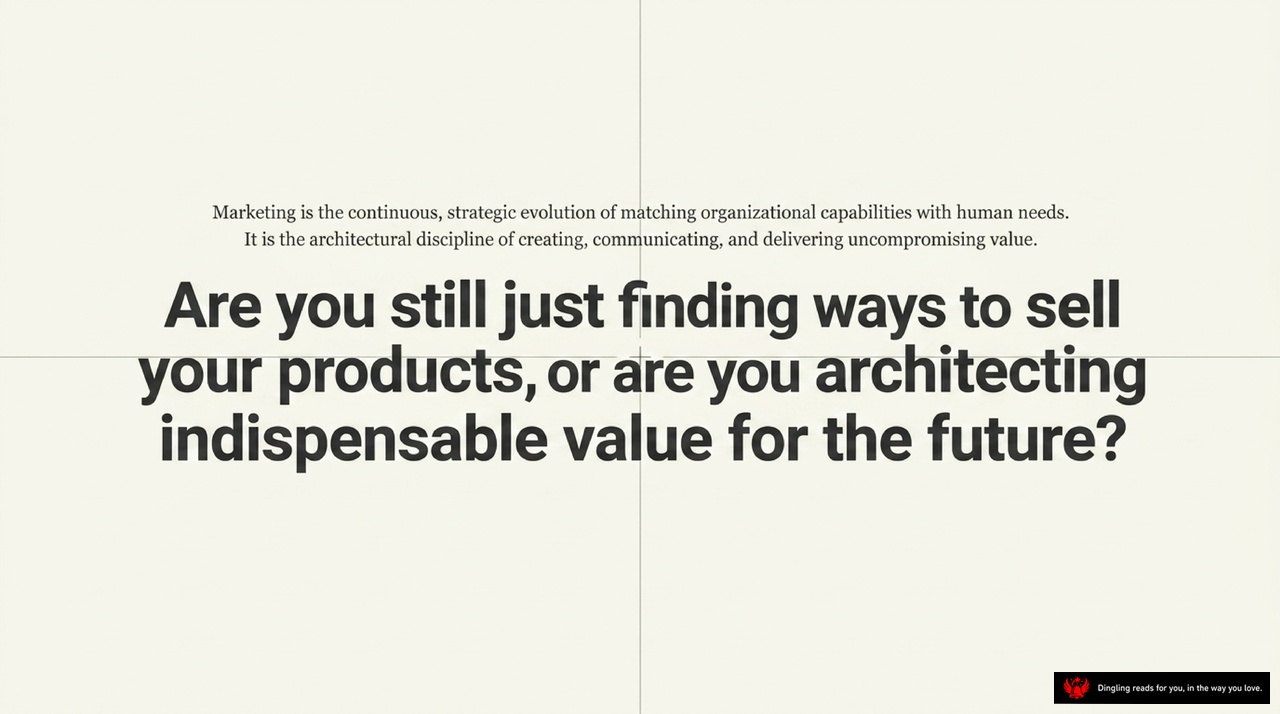
Marketing isn't just about selling products; it's about architecting indispensable value for the future. As the slide suggests, true marketing is the continuous, strategic evolution of matching our organizational capabilities with human needs. It is an architectural discipline focused on creating, communicating, and delivering uncompromising value.
So, the critical question remains: Are you still just finding ways to sell your products, or are you building a future where your value is essential? The answer defines whether you are merely a vendor or a strategic partner. In today's competitive landscape, the difference between survival and dominance lies in shifting from simple transactions to creating deep, lasting relevance. It's about understanding that while everyone can make a product, not everyone can define a necessity.