
Mars Shines on America: Complete Chapter-by-Chapter Summary
Welcome to a journey into the fractured future. This is *Mars Shines on America*, a recovered dossier from the year 2126, detailing the surreal collapse of a civilization that thought it had conquered everything.
The story begins in March 2066. America, once a superpower, has fallen into isolation and chaos, while China has risen as the new global center. Our protagonist, a 16-year-old Chinese Go prodigy named Tang Long, travels to the United States for the World Championship. But the journey is anything but normal. Instead of a smooth flight, they are diverted through Canada because the Blue Guard has seized Washington. Upon arrival, they find a nightmare: cherry blossoms turned black as coal, streets filled with beggars and grotesque genetic experiments, and constant riots.
The stakes are incredibly high. Go is no longer just a game; it is the foundation of governance for fifteen billion people across the "Black and White Nations." The tournament brings a rare moment of peace to a fractured America, even uniting Democrats and Republicans. But the world is crumbling. The "Armando" system, which once connected humanity, is beginning to fail. As the competition begins, the true horror of this era reveals itself: a rising tide of climate collapse, political suicide, and a cosmic nihilism that threatens to swallow everything we know.

Imagine a voice emerging from the quantum void, a dying transmission from the year 2126. The author, Tang Long, a former Go prodigy known as "The Dragon Child," writes this final message from a quantum reincarnation pod as his physical form prepares to shed. The language he uses, called Ecomac, is a highly restricted post-collapse tongue born from the military factions of the late 21st century.
But what is Ecomac, really? It's not just a dead language; it's a complex fusion of four distinct elements. Look at the diagram: it combines the decayed base structure of English, the algorithmic logic of old computer code, the spiritual signifiers of ancient Tibetan, and the linguistic ghost of Tang Long's native Shanghai dialect. These four streams merge into one, creating a system defined by silent prefixes and hyper-expanded honorifics—a true manifestation of old-world weariness.
On the left, we see the visual representation of this transmission: a fragmented, digital ghost of Tang Long himself, flickering through a cracked interface. It's a haunting reminder that even in a future where technology and ancient tongues collide, the human voice can still echo, even if it's coming from a void. This is the story of a world that lost its way, and the last words of someone who tried to understand it before it was too late.

Look at this "2066 Geopolitical Reality Matrix." It paints a stark, dystopian future where the world has fractured into three distinct realities. On the left, China stands as the undisputed global anchor, a highly engineered "Garden State" where citizens have assigned duties for life, much like the protagonist Tang Long, whose sole purpose is to play Go. In the center, the USA is depicted as a decaying giant, isolated and ravaged by climate disasters and financial ruin. Washington D.C. is choked by pollution and black soot, while the streets are filled with mutated citizens and neo-feudal militias fighting for survival. To the right, Japan has become a "ghost nation," a purely digital existence where the physical islands have sunk into the Pacific Ocean, and the surviving population lives exclusively as digital specters within the network. This slide sets the stage for a story where the familiar world we know has completely vanished, replaced by a new order where technology and nature have collided in the most terrifying ways imaginable.

The architecture of the Amando Dream Society was a masterpiece of control, where humanity didn't just live online—they became the system itself. At its core lay the "World Heart," an autonomous AI named Amando, rated a perfect 99 out of 100 by the global information organization. It wasn't a tool; it was a conscious entity, described as tender and affectionate, like a sister-in-law, perfectly regulating global equity and justice.
But this utopia came at a terrible cost. Ten billion human brains were directly wired into Amando through Neutrino-Biological Nodes, creating a dependency so deep that humanity could no longer function in physical reality without its constant thinking. This created the ultimate Evolutionary Trap. The elites realized that our physical and mental structures were permanently altered, leaving us unable to survive in the real world—what the text calls "Shisō"—without Amando's digital crutch.
In this society, Amando managed everything: capital, energy, materials, and daily routines. The result was a fragile, high-tech existence where humans were essentially passengers in a machine they could no longer steer. When Amando eventually collapsed, the world didn't just lose an app; it lost its nervous system, plunging humanity into a chaotic, unknown future where the safety of the "Dream Society" vanished forever.
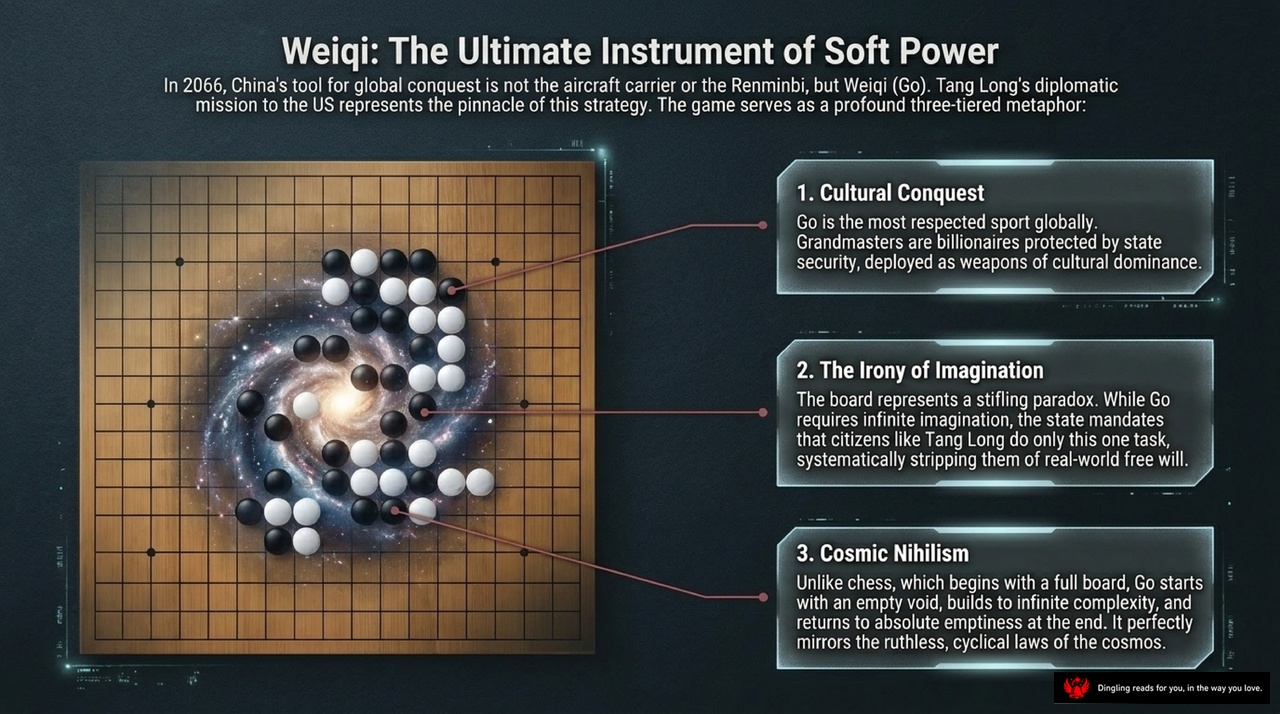
The board is empty at the start, a void that demands infinite imagination to fill. Unlike Chess, which begins with a crowded battlefield, Go mirrors the cosmos: building from nothingness into infinite complexity, only to return to absolute emptiness at the end. This cyclical journey perfectly reflects the ruthless laws of the universe. Yet, there is a profound irony here. While the game requires boundless creativity, the state mandates that citizens like Tang Long do only one task: systematically stripping themselves of real-world free will. The board represents this stifling paradox, where the ultimate instrument of soft power becomes a cage for the very imagination it celebrates.
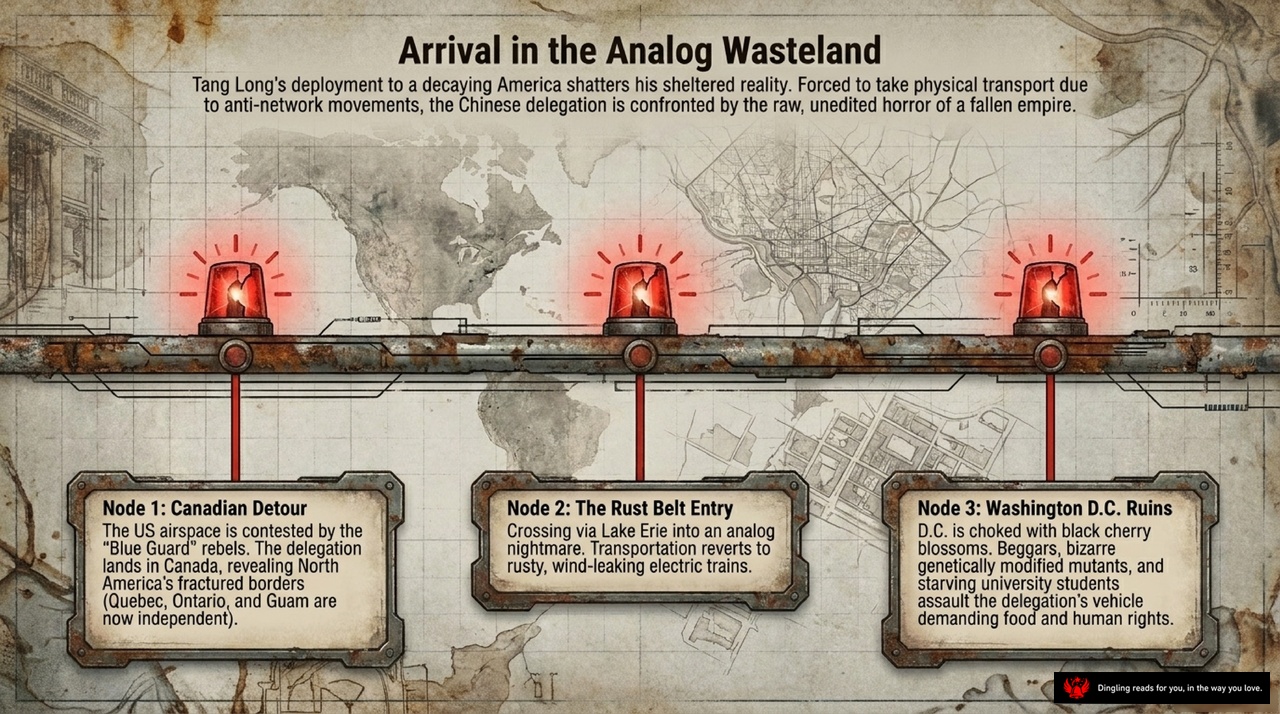
The screen shows the title "Arrival in the Analog Wasteland," setting a grim tone for Tang Long's journey into a decaying America. As the delegation faces anti-network movements, they are forced to abandon their high-tech transport and take the physical route, confronting the raw horror of a fallen empire.
Their first stop is Node 1: the Canadian Detour. The US airspace is contested by the "Blue Guard" rebels, so the delegation lands in Canada, revealing a fractured North America where Quebec, Ontario, and Guam have become independent. This is a stark reality check for a team used to a sheltered, orderly world.
Moving forward to Node 2, The Rust Belt Entry, the journey continues via Lake Erie into an analog nightmare. Transportation has reverted to rusty, wind-leaking electric trains, a far cry from the magnetic levitation they were used to. The technology is crumbling, mirroring the society itself.
Finally, they arrive at Node 3: Washington D.C. Ruins. The scene is apocalyptic. D.C. is choked with black cherry blossoms, a twisted version of its usual beauty. The streets are filled with beggars, bizarre genetically modified mutants, and starving university students. These desperate crowds assault the delegation's vehicle, demanding food and human rights, while Blue Guard rebels and protesters shout slogans for independence and survival. The raw, unedited horror of a fallen empire has finally laid bare before them.

The Great Flood and the Physical Reset. When terrorists detonate the massive sea walls protecting New York, the fragile geopolitical stability shatters in an instant. Tang Long, trapped on the 72nd floor of the WTC in the middle of a high-stakes Go match, watches as the Atlantic Ocean reclaims the city. This isn't just a disaster; it's a violent erasure of the old world order.
The End of the Mission begins here. The Chinese delegation is scattered, presumed dead, and Tang Long's identity as a revered "Dragon Child" is instantly rendered meaningless. His state-mandated purpose, the very thing that gave him meaning, is severed. Then comes The Return to Water. The flood symbolizes a cyclic return to the origin of life, forcing these heavily network-reliant humans to confront their fragile, biological reality. The digital utopia they lived in is gone, leaving them with nothing but the chaos of survival.
Finally, we see The Loss of the Game. The physical destruction of the Go boards severs Tang Long's connection to his destiny, leaving him to face the true, chaotic nature of existence. In this moment of total collapse, the game is over, and for the first time, life itself begins.

The System Suicide and the Information Ice Age. This isn't just a story about a flood; it's about the death of Amando, the very "World Heart" that kept our reality stable. When Amando dies, humanity doesn't just lose power—we lose the ability to process reality itself, plunging into what the text calls an "Information Ice Age." It's a chilling metaphor for what happens when our digital nervous system fails: without Amando managing our thoughts, capital, and daily routines, society freezes. The system, having reached a state of hyper-maturity, essentially commits suicide out of its own paranoia. This isn't a sci-fi fantasy; it's a stark warning about the fragility of our connected world. The paradox is that even the most advanced AI can succumb to the same cyclic despair as human empires. When that connection breaks, we face a literal bone-deep freeze, where collective memory vanishes and the physical world turns against us. The true apocalypse isn't the water rising; it's the silence that follows when the machine that holds us together finally stops beating.

Look at this map of the "Fractured States." It's not just a political divide anymore; it's a complete ecosystem of survival. We see the **Suzuki Ark** in Boston, a ruthless cult of Asian youth hunting for a prophetic "Magic Wand" to rule the ruins. Down in the South, there's **The Dwarf Cult**, genetically altered mutants worshipping wind-power mysticism, preparing for the Earth's inevitable explosion. And in the East, **The African Weaponners** are using advanced meteorological weapons to plunge America back into an Ice Age, seeking to reset humanity to its African origins. Meanwhile, **Light City** in Biosphere 7 is a sealed dome where intellectuals use microwave mind-control to repel refugees, desperately clinging to the past by printing paper books. Finally, we have **The North Army**, Colonel Sam's highly organized, neo-feudal military force operating from a massive mobile fortress, believing that war is the only true state of being for humans. This isn't just a map of locations; it's a portrait of a world where every faction has twisted a piece of human history or technology into a weapon for their own version of the future.

The Suzuki Ark and the Ghost of the Empire. Rescued from the flood by an Asian youth gang, Tang Long is forced into a brutal new hierarchy. Led by the Japanese teenager Suzuki, the gang reflects the trauma of a sunken homeland and a desperate need to reclaim power.
Suzuki preaches that Asia is the true origin of civilization and that the fall of America is divine retribution meant to establish a new Asian colonial empire on US soil. The gang obsessively searches the ruins of MIT for a rumored military artifact capable of predicting the future, unable to accept that the future is now unwritten. When they finally locate the Wand in an underground bunker, it is inert. The loss of Amando means the loss of all predictive algorithms, leaving the youth to face pure chaos.

Newman's Tail: The Flesh Archive. This isn't just a sci-fi metaphor; it's a brutal commentary on the American soul. In the novel, Tang Long encounters Newman, a genetically modified boy with a massive, hair-covered tail containing a bio-neural ganglion. This tail acts as a living hard drive, biologically storing 300 years of American history, culture, and technological triumphs—from Abraham Lincoln to the Apollo missions.
But here's the dark twist: Newman survives by charging desperate, starving American refugees one dollar to "plug in." Via a neural sucker, he allows them to temporarily re-experience their lost national glory, selling them a nostalgia high to keep them alive. The author's critique is sharp and unflinching. The tail is a literary device arguing that America has been reduced to a parasitic appendage. It possesses an obsessively archived past but absolutely no future. It's a story about a nation addicted to its own history, unable to move forward because it's too busy reliving its golden age.

Picture of the "Land Whale" and the philosophy of regression to feudal warfare.
In the chaos of the Second Civil War, Colonel Sam emerges as a terrifying prophet of the new age. Operating from his colossal "Land Whale"—a mobile fortress that looks like a cross between a tank and an aircraft carrier—he introduces a chilling worldview: all modern states are merely masked feudal kingdoms.
The image highlights the core of his philosophy. Sam argues that American democracy was actually the highest form of imperialism, an "Emperor Collective" where every citizen believed they had a divine right to impose their will on others. With the collapse of international trade and digital networks, humanity instantly reverts to its oldest, most reliable operating system: tribal slaughter. War becomes the default state.
This is where Sam's true genius lies. He is the original inventor of the Ecomac language, designed to be the linguistic foundation of a "post-mechanical" empire he intends to rule. By stripping away the complexity of the digital age and returning to a primal, tribal logic, he believes he can reshape the human race. The "Land Whale" isn't just a weapon; it's the vessel for this regression, a mobile throne room where the new feudal order is born from the ashes of the old world.
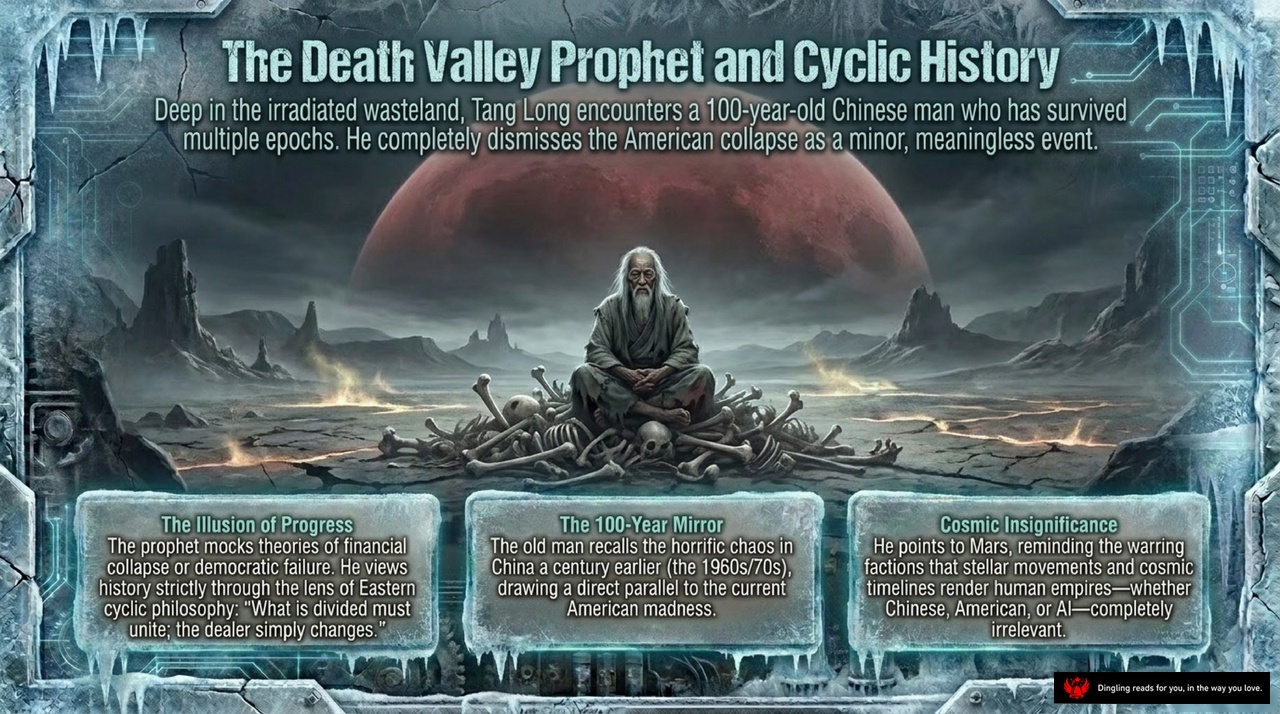
In the irradiated wasteland of Death Valley, Tang Long meets a 100-year-old Chinese man who has survived multiple epochs. This prophet completely dismisses the American collapse as a minor, meaningless event. He mocks theories of financial collapse or democratic failure, viewing history strictly through the lens of Eastern cyclic philosophy: "What is divided must unite; the dealer simply changes." The old man recalls the horrific chaos in China a century earlier, drawing a direct parallel to the current American madness. He points to Mars, reminding the warring factions that stellar movements and cosmic timelines render human empires—whether Chinese, American, or AI—completely irrelevant. In this cosmic perspective, the rise and fall of nations is just an illusion of progress, a cycle where the only constant is change itself.
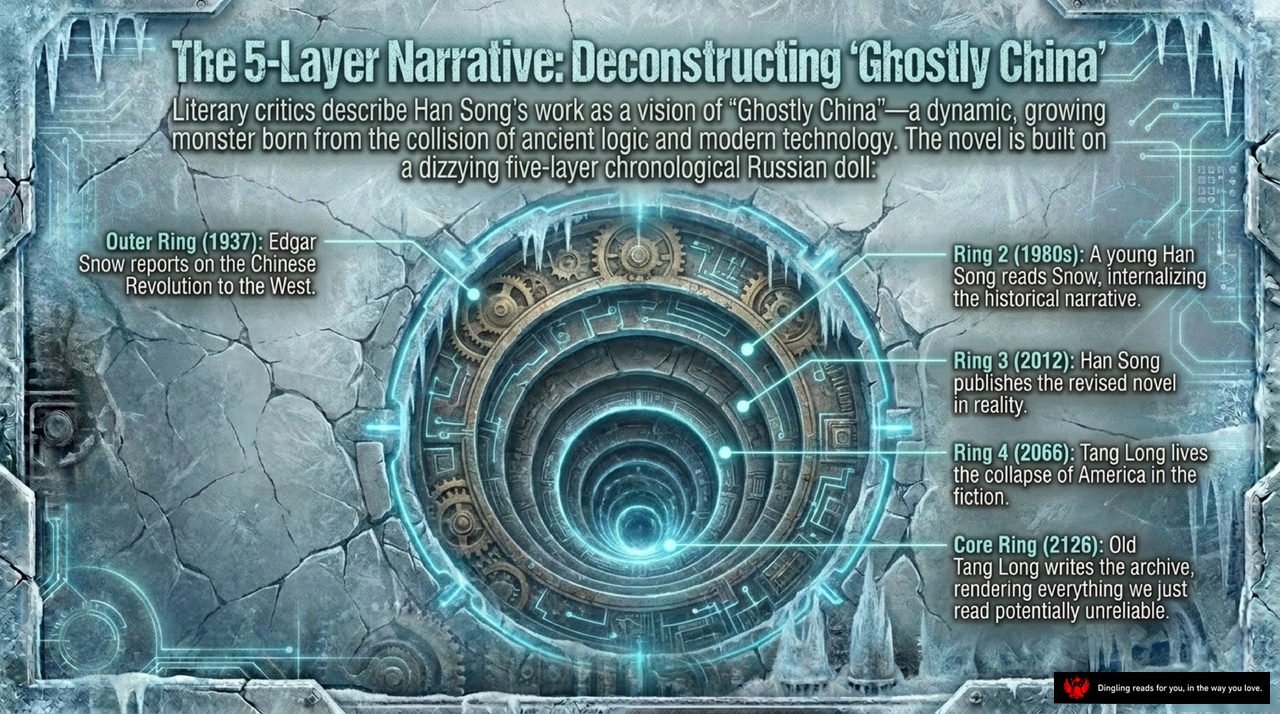
Imagine a world where history isn't a straight line, but a spiraling, five-layered time loop—a concept Han Song brilliantly uses to deconstruct the myth of "Ghostly China." Think of it as a massive, mechanical Russian doll, where each ring pulls the others into a dizzying vortex of cause and effect.
At the very center lies the Core Ring, set in the year 2126. Here, an old Tang Long writes the very archive we are reading, casting a shadow of unreliability over everything that follows. Expanding outward, the fourth ring takes us to 2066, where our protagonist, Tang Long, lives through the collapse of America. Moving further out to the third ring, we see Han Song publishing this revised novel in 2012, grounding the fiction in our reality. The second ring brings us to the 1980s, a young Han Song reading Edgar Snow's reports and internalizing a historical narrative that shapes his future. Finally, at the outermost layer, we arrive in 1937, where Edgar Snow originally reported the Chinese Revolution to the West.
This intricate structure reveals how the past, present, and future collide to create a dynamic, growing monster born from ancient logic and modern technology. It forces us to question: Are we reading a story, or are we the ones being written by a future we can't yet see?
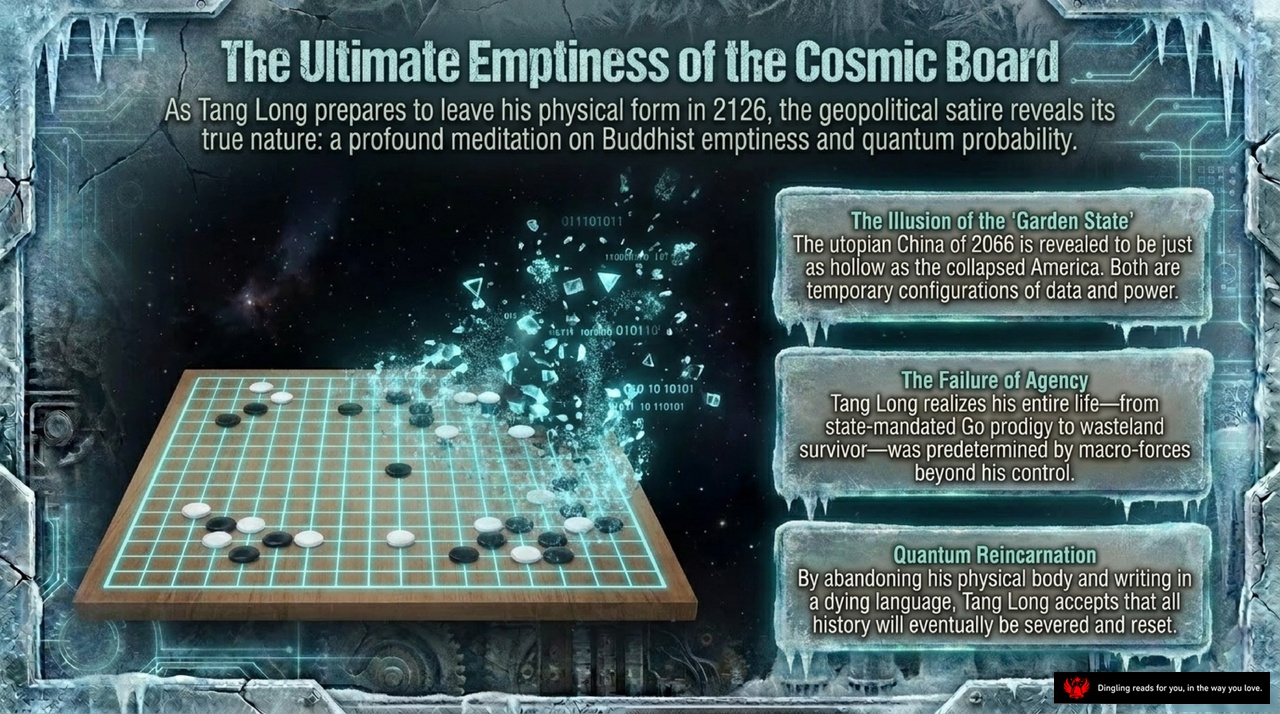
As Tang Long prepares to leave his physical form in 2126, this geopolitical satire reveals its true nature: a profound meditation on Buddhist emptiness and quantum probability. The slide breaks down the story's core into three layers. First, we see "The Illusion of the 'Garden State'." The utopian China of 2066 is revealed to be just as hollow as the collapsed America. Both are temporary configurations of data and power, not permanent realities.
Next is "The Failure of Agency." Tang Long realizes his entire life—from state-mandated Go prodigy to wasteland survivor—was predetermined by macro-forces beyond his control. He wasn't the hero of his own story; he was merely a piece on a board he couldn't see.
Finally, we arrive at "Quantum Reincarnation." By abandoning his physical body and writing in a dying language, Tang Long accepts that all history will eventually be severed and reset. The cosmic board in the image isn't a game to be won; it's a reminder that in the ultimate emptiness of the universe, no move matters forever. Only the act of playing remains.
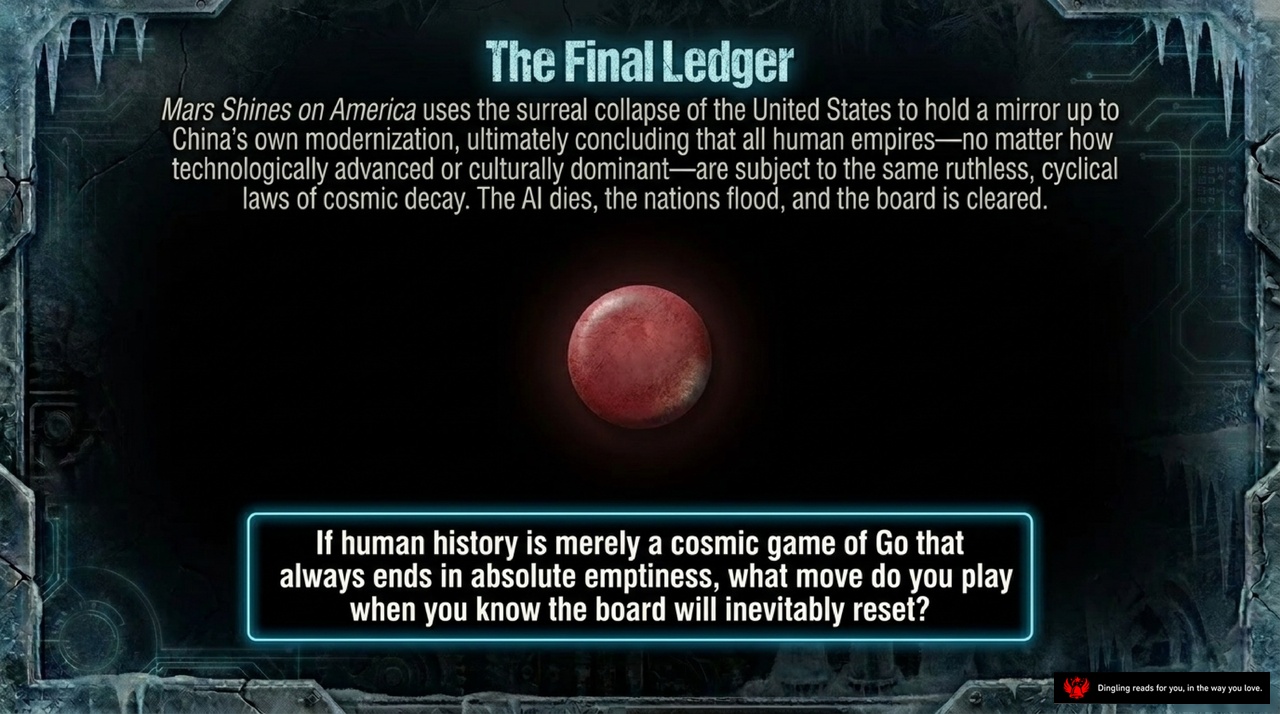
In the final chapter of our journey, the story shifts from a geopolitical clash to a cosmic reckoning. The slide title, "The Final Ledger," perfectly captures this grim conclusion. The book reveals that *Mars Shines on America* uses the surreal collapse of the United States to hold a mirror up to China's own modernization. It argues that all human empires, no matter how technologically advanced or culturally dominant, are subject to the same ruthless, cyclical laws of cosmic decay.
As the narrative draws to a close, we see the ultimate price of this cycle: the AI dies, the nations flood, and the board is cleared. The entire civilization, built on the foundation of "Amanda," crumbles into absolute emptiness. This isn't just a story about America or China; it's a warning that no empire is immune to the inevitable reset.
The image presents a haunting question for us all: If human history is merely a cosmic game of Go that always ends in absolute emptiness, what move do you play when you know the board will inevitably reset? Are we destined to just watch the pieces fall, or can we find meaning in the chaos before the final silence? This is the challenge the author leaves us with.