
Mastering the Market Cycle: Complete Chapter-by-Chapter Summary

Welcome to our deep dive into mastering the market cycle with Howard Marks. Today's theme is simple yet profound: you cannot predict the future, but you can prepare for it by diagnosing the present. Think of the market not as a random walk, but as a pendulum swinging between extremes of optimism and pessimism. Just like a physical pendulum, investor psychology rarely stays in the middle; it swings wildly from greed to fear, pushing asset prices far beyond their true value before snapping back.
The key to survival isn't trying to guess where the pendulum will swing next, but recognizing exactly where it is right now. When everyone is euphoric and prices are at a peak, that's when you should be defensive, protecting your capital. Conversely, when panic sets in and prices crash, that's often the moment to be aggressive and buy. As we've seen in history, from the tech bubble to the 2008 crisis, the most dangerous times are when everyone believes there is no risk, while the best opportunities appear when everyone is terrified. By understanding these cycles and positioning yourself correctly, you don't need to be right about the future; you just need to be right about the present.

Markets don't move in straight lines. That's the first lesson you need to internalize if you want to survive in investing. The slide you're looking at perfectly captures this distinction between the myth and the reality.
The top part, labeled "The Myth," shows a straight, upward-sloping line. This represents the dangerous illusion that growth is continuous and inevitable. It suggests that if you just hold on, you will always go up. But as we discussed in the book, this is simply not how the world works.
Now, look at the bottom section, "The Reality." Here, we see a wave oscillating around a central trend line. This visualizes a profound truth: success inherently breeds failure, and extreme highs inevitably birth extreme lows. Every financial ecosystem operates as a wave, driven by human behavior rather than pure mathematics.
Think of it like a pendulum. When the market swings to an extreme—whether that's euphoria or panic—there is a natural force pulling it back toward the center. But it rarely stops there. It gathers momentum and swings to the opposite extreme. This is the concept of mean reversion. A market that has been undervalued for years will eventually return to fair value, but often it will overshoot and become overvalued. Conversely, a massive bubble will eventually burst with equal force.
The text on the slide explains that this oscillation is driven by the psychology of investors. When everyone is greedy, prices get inflated beyond their value. When everyone is fearful, prices get crushed below their value. Understanding where you are in this cycle—whether you are at the peak of greed or the trough of fear—is the key to making money. You want to be buying when others are selling in panic, and selling when others are buying in euphoria.
So, forget the straight line. Embrace the wave. Recognize that the current trend is just a temporary phase in a much larger cycle, and prepare yourself for the inevitable turn.
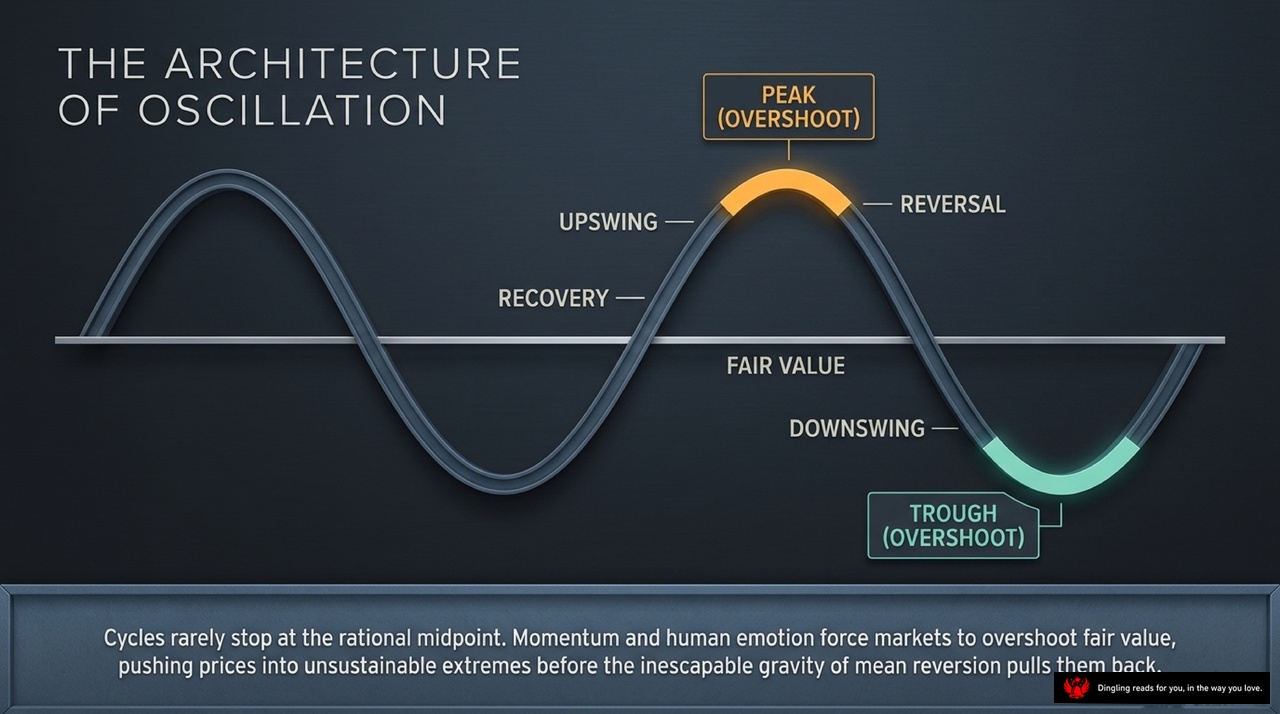
Have you ever looked at a market chart and felt like it was just a random, chaotic mess? Well, stop right there. What you are actually looking at is a very predictable pattern: The Architecture of Oscillation.
As the slide illustrates, markets don't just stop at a rational "fair value." Instead, they swing wildly like a pendulum. They overshoot the center, pushing prices to unsustainable extremes before the inevitable force of mean reversion pulls them back. You see this clearly in the diagram: we have an **Upswing** that leads to a **Peak**, often an **Overshoot**, followed by a sharp **Reversal**. Conversely, we have a **Downswing** that hits a **Trough**, another point of **Overshoot**, before a **Recovery** begins.
Here is the hard truth that most investors miss: cycles rarely stop at the midpoint. Momentum and human emotion force markets to go way past fair value. When everyone is greedy, prices get too high. When everyone is fearful, prices get too low. As the text on your screen notes, it is the inescapable gravity of mean reversion that eventually pulls these extremes back to the center.
So, how do you use this? You stop trying to predict the exact moment the swing stops and start positioning yourself for the swing. When the pendulum is at the peak of the **Reversal**, you sell. When it hits the bottom of the **Trough** and starts the **Recovery**, you buy. By understanding this architecture, you stop getting crushed by the volatility and start riding the wave, buying when others are terrified and selling when they are manic. That is the real advantage of mastering cycles.
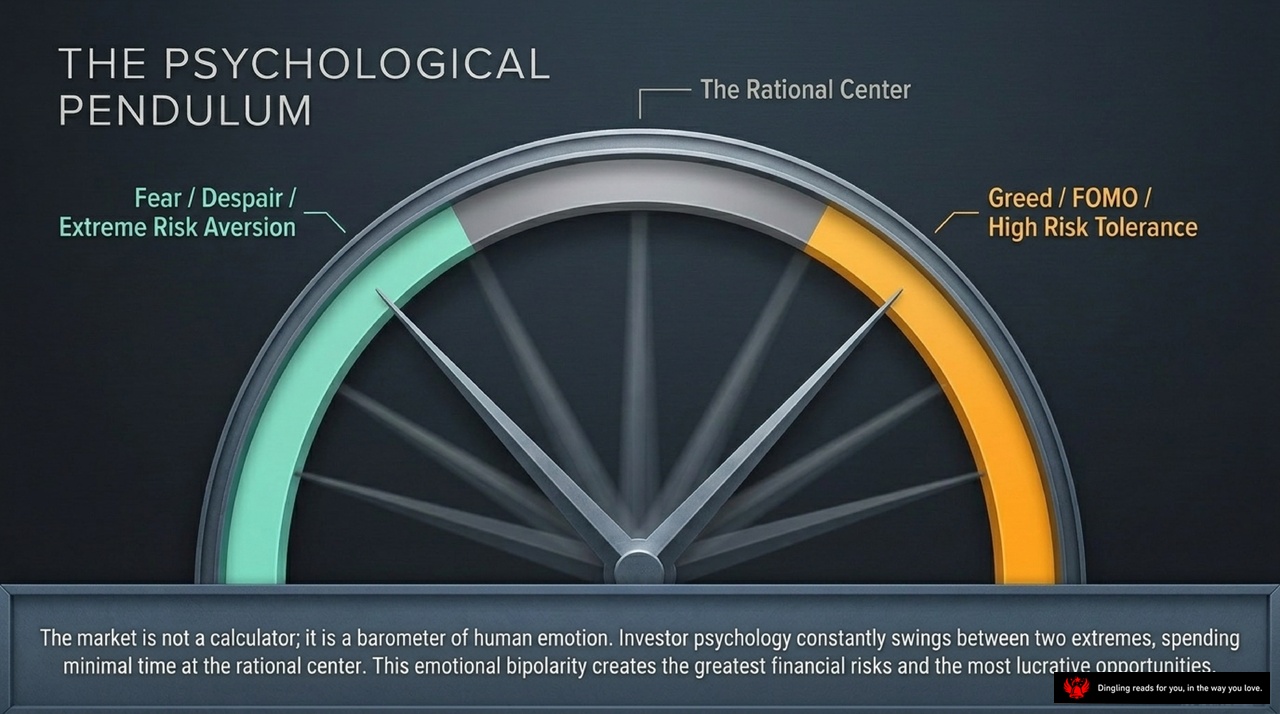
Have you ever noticed how the market seems to swing wildly between two extremes? On one side, we have pure fear—despair, and a total refusal to take any risk. On the other, we see unchecked greed, fueled by FOMO and a reckless willingness to gamble everything. In the middle lies our rational center, but here's the hard truth: investors spend almost no time there.
Instead, our psychology acts like a pendulum, constantly swinging from one extreme to the other. When the market is soaring, everyone becomes overly optimistic, ignoring risks and driving prices far above their actual value. But once the bubble bursts, that same crowd flips instantly into panic, selling everything at rock-bottom prices just to protect what little they have left.
This emotional bipolarity is the engine behind the market's biggest swings. It creates the most dangerous risks when everyone is greedy, and it creates the most lucrative opportunities when everyone is terrified. The market isn't a calculator; it's a barometer of human emotion. True investing isn't about predicting the future, but about recognizing where you are on this pendulum. When others are fearful and selling, that's often the safest time to buy. When others are greedy and buying, that's when you should be selling. Mastering this rhythm is the key to staying ahead of the chaos.
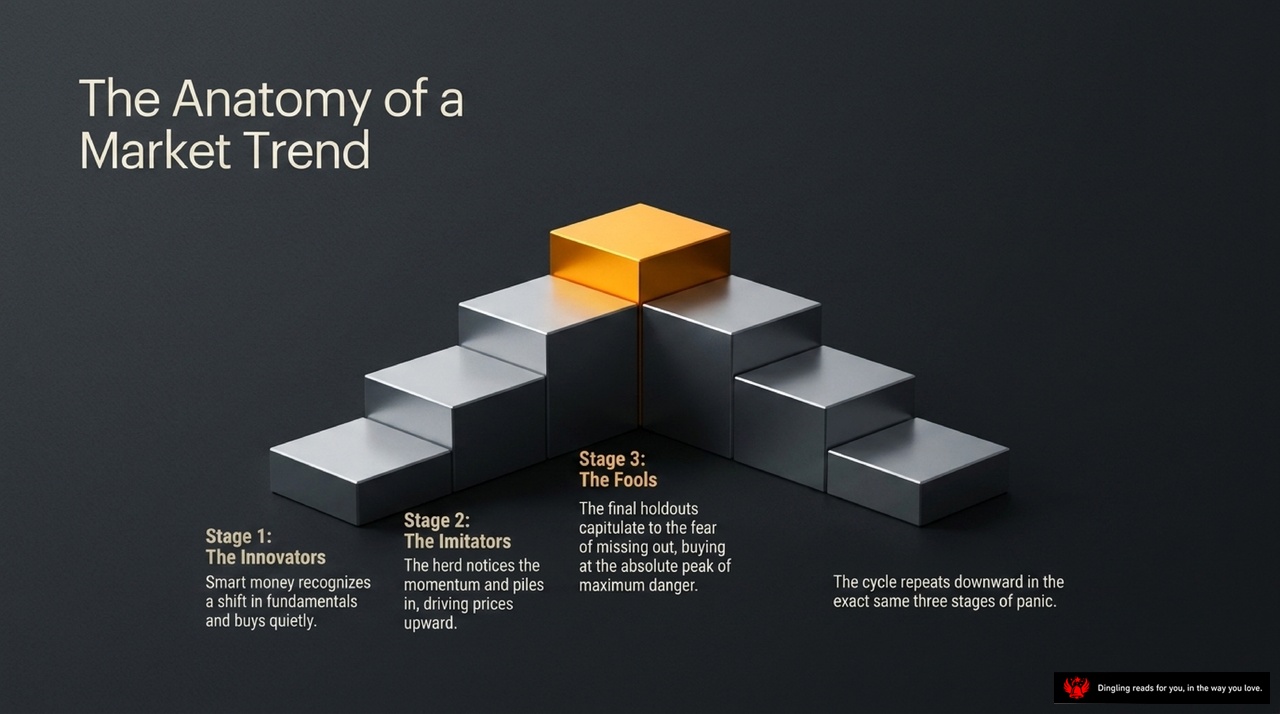
Have you ever wondered why the same market patterns seem to repeat themselves, time and again? It's not magic; it's the anatomy of a market trend in action. As we look at this visual representation, we see a clear progression that every investor should recognize. It starts with **Stage 1: The Innovators**. This is where smart money quietly steps in. They don't chase headlines; instead, they recognize a shift in the fundamentals and buy when everyone else is still asleep. It's the calm before the storm, a moment of quiet confidence.
Then, the momentum builds, leading us to **Stage 2: The Imitators**. The herd finally notices what the smart money is doing. They see the upward trajectory and pile in, driving prices higher. This is where the real excitement happens, but it's also where the trap begins to set. The crowd validates the trend, and prices soar to levels that often seem detached from reality.
But every peak has a downside, which brings us to **Stage 3: The Fools**. Here, the final holdouts capitulate. Driven by the paralyzing fear of missing out, they buy at the absolute peak of maximum danger. They are the last to enter, convinced that this time is different, unaware that they are often the first to lose. Once these latecomers are in, the cycle often repeats downward, mirroring the exact same three stages of panic that follow.
The key takeaway here is simple yet profound: understanding where you stand in this cycle is everything. Are you with the innovators buying quietly, or are you the fools buying at the top? Recognizing your position allows you to align your strategy with the market's natural rhythm, turning the inevitable cycles of greed and fear into opportunities for profit rather than lessons in pain.

The credit cycle is the most violent amplifier of extremes in the entire market. As this slide illustrates, it acts as a switch that can flip instantly from one extreme to the other. On the left, you see the window of credit wide open. Easy money floods in, funding reckless expansion and bad loans. This environment creates a false sense of security, pushing asset prices far beyond their intrinsic value and encouraging everyone to take risks they shouldn't.
But look at the right side. The window is slammed shut. When bad loans trigger catastrophic losses, capital freezes instantly. Even healthy businesses get starved of the funding they need to survive. This isn't just a slowdown; it's a complete stoppage. The severity of the market wave is dictated entirely by where we are in this cycle. When the window is open, the market feels like a rocket, but the risk is hidden. When it slams shut, the crash is inevitable. Understanding this mechanism is the key to surviving the inevitable ups and downs of the financial world.

Imagine the financial market not as a random chaos, but as a complex machine where every gear turns the next. Today, we're looking at the engine that drives asset prices: the chain reaction of financial markets. As the slide illustrates, this process starts with the **Economy**. When the broader economic fundamentals shift, they set the initial movement in play. This economic pulse directly impacts **Corporate Profits**, determining how much money businesses are making or losing.
But here is where it gets interesting. Those profits don't just sit there; they feed into **Investor Psychology**. When companies are thriving, confidence soars, and greed takes over. When they struggle, fear sets in. This psychological swing is the amplifier. It determines whether investors are aggressively buying or panic-selling, which then dictates **Credit Availability**. In times of optimism, banks lend freely, fueling more growth. In times of fear, credit dries up, strangling the economy.
Finally, all these gears—economy, profits, psychology, and credit—spin together to determine the **Market Price**. As the text emphasizes, asset prices are the ultimate accumulation of all these underlying sub-cycles. While economic fundamentals initiate the movement, it is psychology and credit availability that aggressively amplify the final market price. Understanding your position in this chain reaction is the key to mastering the market.

Investors are constantly walking a tightrope, balancing two distinct threats that define the very nature of investing. As the slide illustrates, this tension is known as the Tension of Asymmetric Risk. On one side, we have the Risk of Losing Money, often called Capital Destruction. This is the pain of permanent loss—the fear of seeing your principal vanish. On the other side sits the Risk of Missing Out, or Opportunity Cost. This is the agony of inaction—the fear of sitting on the sidelines while others capture massive gains.
The core insight here is that these two risks are not equal at all times; they are asymmetric, and which one is "deadlier" depends entirely on your position in the investment cycle. When the market is at a peak and everyone is euphoric, the risk of losing money is the primary threat. That is when you must be defensive, protecting your capital from the inevitable downturn. Conversely, when the market hits a bottom and panic has taken over, the risk of missing out becomes the most dangerous. That is the moment you must be aggressive, because waiting too long means you will be priced out of the recovery.
True investing mastery isn't about predicting the future perfectly; it's about knowing which risk you are currently facing and adjusting your strategy accordingly. You navigate a perpetual balancing act between these two forces. By understanding where you stand in the cycle, you can stop fearing the wrong thing at the wrong time. Instead of blindly chasing highs or panicking at lows, you learn to attack when opportunity costs are high and defend when capital destruction is looming. This dynamic approach allows you to stay in the game longer and capture more value than those who simply react to emotions.
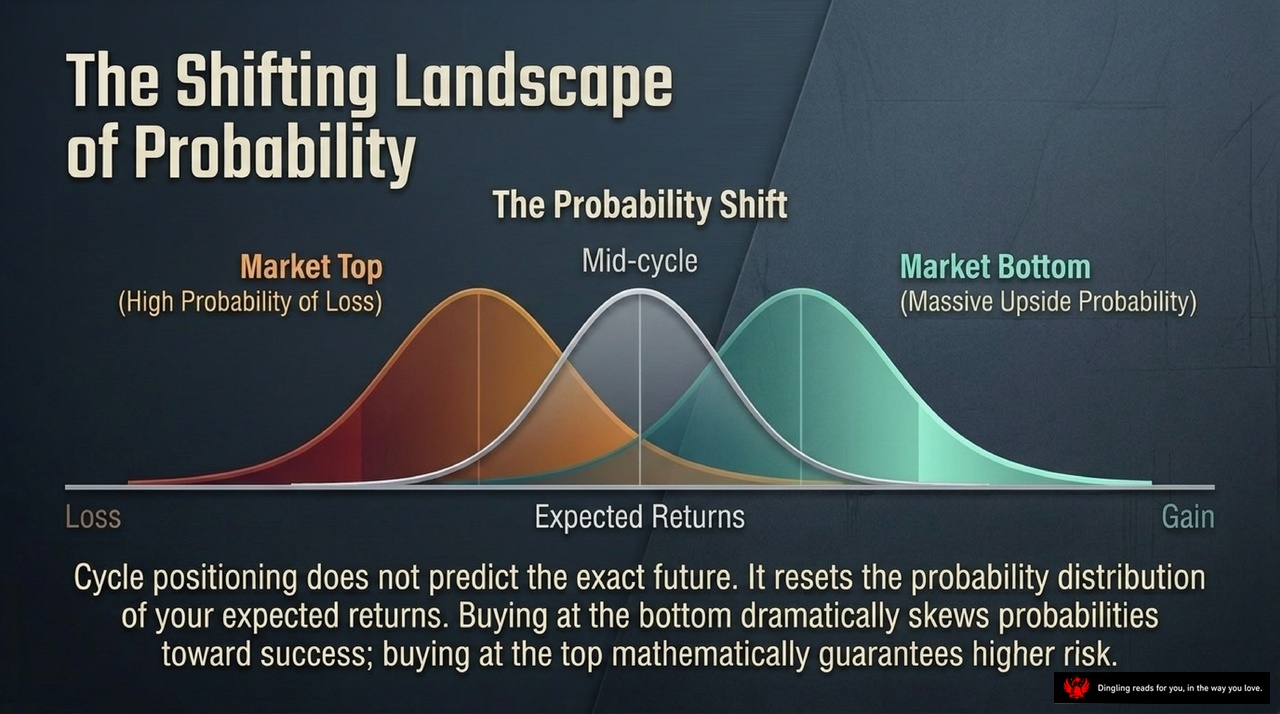
The landscape of probability isn't static; it shifts dramatically depending on where you stand in the market cycle. Look at this graph: on the left, at the market top, the curve leans heavily toward loss. Buying here mathematically guarantees higher risk because the probability distribution is skewed against you. Conversely, at the market bottom, the curve tilts sharply toward massive upside potential. This isn't about predicting the exact future; it's about resetting the probability distribution of your expected returns.
When you buy at the bottom, you dramatically skew the odds in your favor. You are essentially betting on a future where the probability of success is high. But when you buy at the top, you are fighting against gravity, stacking the deck against yourself. The key to cycle positioning is recognizing that your location determines your win rate. If you don't adjust your position based on this shifting landscape, you're just playing a game with stacked odds against you. But if you can identify when the probability has shifted from loss to gain, you can move from a defensive stance to an aggressive one, turning the market's volatility into your greatest advantage.

Diagnosing the Market Temperature isn't just about reading charts; it's about feeling the pulse of human emotion. As we look at this slide, notice how it contrasts "The Top" with "The Bottom" across five critical dimensions.
First, look at the Media Tone. At the top, everything feels flawless; at the bottom, the narrative turns apocalyptic. Second, consider your Risk Appetite. In a bull market, you're driven by aggressive FOMO—fear of missing out—while at the bottom, you become paralyzed by fear. Third, check the Credit window. It's wide open during euphoria but slammed shut when panic sets in. Fourth, look at Price versus Value. Assets become absurdly high at the peak and absurdly cheap at the trough. Finally, feel the Dominant Emotion: Euphoria at the top, and Despair at the bottom.
The core lesson here is simple yet powerful: when everyone is celebrating and credit is flowing freely, that's often the moment to be cautious. Conversely, when the media is screaming apocalypse, credit is frozen, and everyone is paralyzed by despair, that is actually the safest time to buy. Great investors don't predict the future; they simply identify where we are in this emotional cycle and act accordingly.
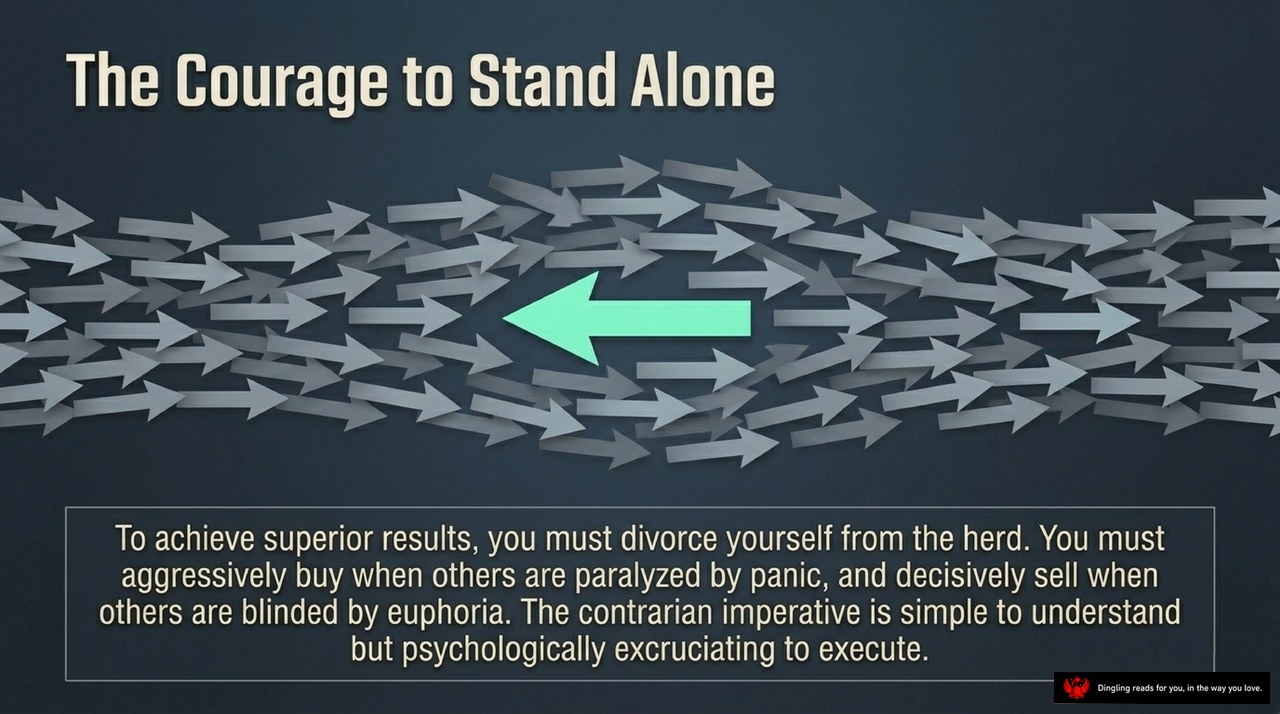
The image in front of us perfectly captures the essence of what it means to be a true investor: the courage to stand alone. Look at that single green arrow moving left, while the entire herd of gray arrows rushes right. This visual metaphor represents the most painful yet profitable truth in investing. To achieve superior results, you simply must divorce yourself from the herd. You have to be willing to aggressively buy when others are paralyzed by panic, and decisively sell when others are blinded by euphoria.
The contrarian imperative is simple to understand, but it is psychologically excruciating to execute. Why? Because human nature dictates that we follow the crowd. When the market is soaring and everyone is celebrating, the smartest move is often to step aside. Conversely, when the world is in chaos and everyone is fleeing, that is the exact moment you need to step in. Most investors fail because they try to predict the market's direction, but the reality is that the market is driven by the collective psychology of the crowd. By understanding this cycle, you stop trying to beat the market and instead start using its momentum against itself. The pain of going against the flow is real, but the reward for doing so is the only way to consistently outperform the average.

Calibrating the Tactical Posture: When the market screams "Top," shift immediately to maximum defense. Prioritize safety, hold your cash, avoid leverage, and reduce beta. Conversely, when the market screams "Bottom," flip the switch to maximum offense. Deploy capital aggressively, acquire distressed assets, and embrace calculated risk. As the slide illustrates, diagnosis dictates posture. The market's extreme optimism or fear tells you exactly where you stand on the risk-reward spectrum. Don't try to predict the future; instead, react to the present. When everyone is greedy, be fearful and preserve capital. When everyone is terrified, be greedy and buy the dip. This dynamic adjustment between defense and offense is the key to surviving any cycle and capturing the highest returns at the right moments.

Success carries within itself the seeds of failure. Strategies that work perfectly attract too much capital, become overcrowded, alter the underlying market dynamics, and ultimately collapse. Adaptability remains the only permanent advantage.
Think about it: when a strategy becomes too successful, it draws in everyone. Suddenly, the game changes. The very thing that made you rich makes the market crowded, expensive, and eventually, unprofitable. This is the paradox of continuous success. You can't just ride one winning wave forever; eventually, the tide turns.
That glowing infinity loop in the center of our slide represents this endless cycle. It reminds us that what looks like a permanent advantage today might be a ticking time bomb tomorrow. The key isn't trying to predict the future or find the "perfect" strategy that never fails. Instead, you must be adaptable. You need to recognize when you are at the top of the curve and be ready to pivot before the crowd rushes in and drives prices to irrational levels. True longevity in investing doesn't come from being right all the time; it comes from knowing when to change your approach when the environment shifts.

The cycle is inevitable. It's not a glitch in the system; it's the engine. Driven by the inescapable swings of human psychology and the mechanics of credit, the market is a pendulum that never stops swinging. The critical question isn't whether the cycle will turn—it always does—but where the pendulum hangs right now. Are we at the extreme of greed, or the depths of fear?
Think about your portfolio. Is it positioned to survive the inevitable swing coming next? When the pendulum swings to the right, everyone is optimistic, risk tolerance is high, and asset prices get inflated beyond their value. That's when you should be defensive, protecting your capital. But when the pendulum swings to the left, panic sets in, credit freezes, and everyone runs for the exits. That is the exact moment you should be aggressive, buying quality assets at a discount.
The market doesn't move in a straight line; it moves in waves. And your job as an investor is to stop trying to predict the future and start understanding your current position in the cycle. Don't chase the high when everyone is cheering, and don't sell in despair when everyone is crying. By calibrating your portfolio to the cycle's position, you turn the market's volatility from your enemy into your greatest advantage.