
Max Perkins: Complete Chapter-by-Chapter Summary

Welcome to the world of *Max Perkins: Editor of Genius* by A. Scott Berg. This isn't just a biography; it's a visual masterclass on the invisible craft of shaping the greatest American literary geniuses of the twentieth century. Imagine a man who believed his only job was to be the author's servant, never the boss. That was Max Perkins. He didn't just edit books; he nurtured minds. From F. Scott Fitzgerald to Ernest Hemingway, and from Thomas Wolfe to Marjorie Kinnan Rawlings, Perkins saw potential where others saw nothing. He fought battles in boardrooms, convinced skeptical publishers to take risks on raw talent, and stood by his authors through bankruptcy, scandal, and heartbreak. In a way, he was the silent architect of modern American literature, proving that the right editor can turn a struggling writer into a legend.
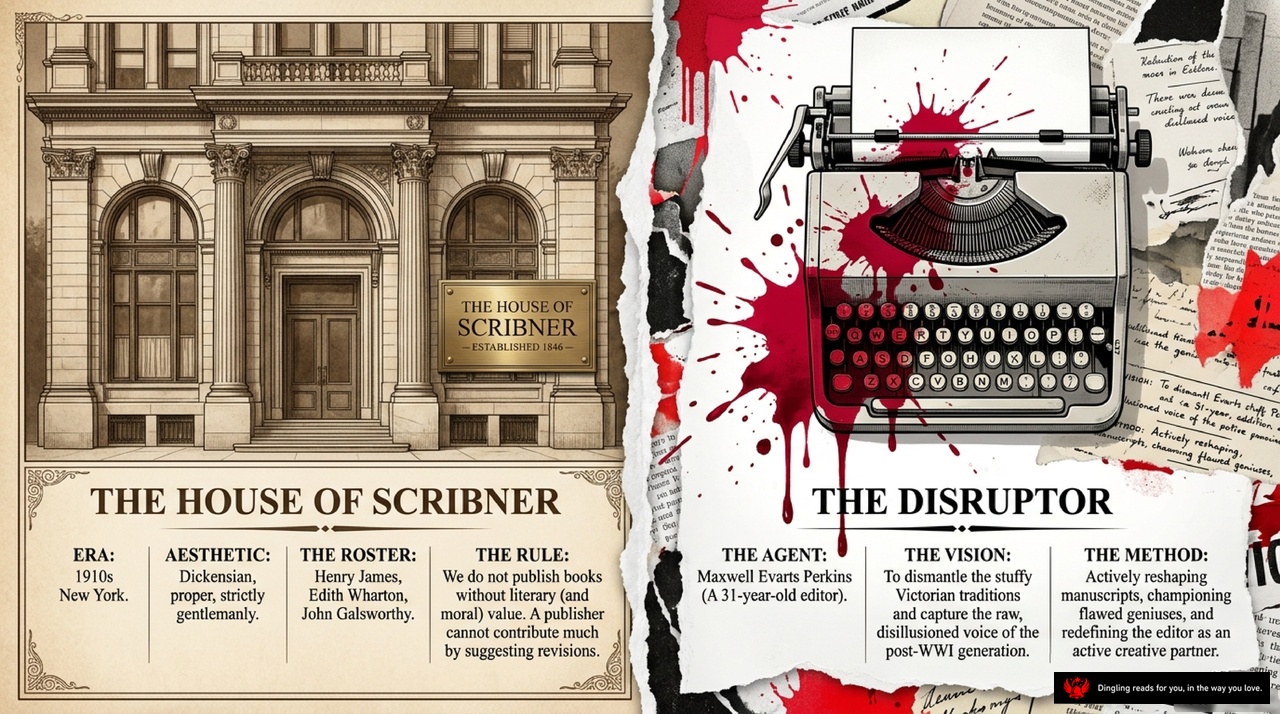
Look at this split image. On the left, we see the stately, old-world facade of The House of Scribner, established in 1846. That was the world of the 1910s in New York: Dickensian, proper, and strictly gentlemanly. The roster included heavyweights like Henry James and Edith Wharton, and the rule was clear—publishers shouldn't suggest revisions; books belonged to their authors.
But on the right, the scene explodes into something chaotic and modern. We see a typewriter splattered with red ink, surrounded by torn pages. This is the disruptor. Enter Maxwell Evarts Perkins, a 31-year-old editor who arrived in 1920 with a radically different vision. While the old guard insisted on moral perfection, Perkins saw the raw, disillusioned voice of the post-WWI generation. His method? Actively reshaping manuscripts and championing flawed geniuses. He didn't just edit; he became an active creative partner. It was this bold approach that would soon redefine American literature.

The Invisible Architect: An Editorial Creed. Today, we're looking at the four non-negotiable rules that guided Max Perkins, the man who shaped American literature.
First, the book belongs to the author. Perkins believed fiercely that an editor must never turn Mark Twain into Shakespeare. The author's voice is sacred; the editor's job is to serve, not to overwrite.
Second, the editor creates nothing. At best, Perkins saw himself as a release mechanism for the author's latent energy. He didn't write the stories; he helped them breathe.
Third, delay intervention. This was his golden rule. When an author is destroying the true nature of their work, that is the exact moment to step in. But not a moment sooner. Perkins knew that premature criticism could kill a voice before it found its rhythm.
Finally, defend the raw truth. The primary duty of a publisher is to publish talent, even if it offends the establishment. Whether it was Fitzgerald's scandalous parties or Hemingway's gritty realism, Perkins stood by the art, not the audience's comfort. These four principles weren't just guidelines; they were the foundation of a legacy that changed how we read forever.

Case Study I: F. Scott Fitzgerald, The Dreamer. Picture this: a brilliant but completely unstructured 21-year-old soldier, scribbling disjointed autobiographical sketches in the mud of military camps. That was Fitzgerald's raw reality in 1918. His initial manuscript, a sprawling 120,000-word mess titled *The Romantic Egotist*, was rejected twice by Scribner's conservative board. They saw chaos; he saw potential.
Enter Maxwell Perkins. In 1919, Perkins didn't just see a book; he saw a generational anthem waiting to happen. He refused to give up, demanding structural focus. He forced a shift from the first person to the third, and crucially, he demanded a defined climax. This intervention transformed the raw material into *This Side of Paradise*. Published in 1920 against the board's wishes, it became an instant hit, selling 20,000 copies in a week. It defined the Lost Generation, capturing the post-war confusion of a generation that found all gods dead and all faiths shaken.
Perkins wasn't just an editor; he was the architect of Fitzgerald's success. He turned a disorganized soldier into the voice of a generation, proving that sometimes, the magic happens when an editor dares to reshape a dreamer's vision.
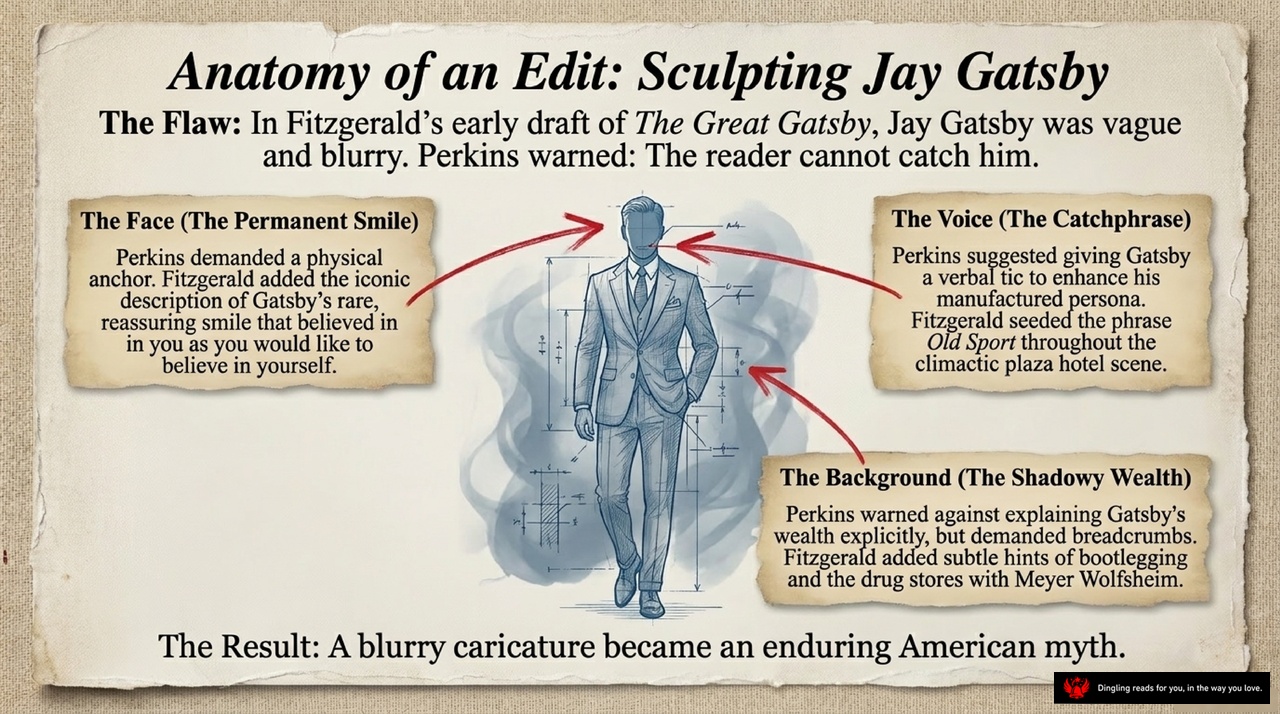
Look at this blueprint of an edit. This slide breaks down exactly how Max Perkins transformed a vague character into an enduring American myth. It all started with a flaw: in Fitzgerald's early draft, Jay Gatsby was just a blurry caricature. Perkins warned that readers couldn't "catch" him. So, he demanded a total redesign from three angles.
First, the face. Perkins insisted on a physical anchor. That's how we got the iconic "permanent smile"—a reassuring grin that made you want to believe in yourself. It gave Gatsby a solid presence.
Next, the voice. Perkins suggested giving Gatsby a verbal tic to enhance his manufactured persona. This is where the famous phrase "Old Sport" was born, perfectly capturing his charm and distance.
Finally, the background. Perkins warned against explaining Gatsby's wealth explicitly but demanded subtle breadcrumbs. Fitzgerald added hints of bootlegging and shady dealings with Meyer Wolfsheim, creating that mysterious, shadowy aura.
The result? A blurry sketch became a legend.

Case Study II: Ernest Hemingway, the fighter. The core challenge here was managing a fiercely independent writer who equated editing with censorship. Hemingway's raw language terrified conservative publishers, and his refusal to compromise was legendary.
Let's look at this specific incident, the "Calendar Incident." When Hemingway's manuscript for *A Farewell to Arms* contained profanities that Charles Scribner strictly forbade, Perkins faced a crisis. Instead of censoring the words, he wrote the offending words on his desk pad under "Things to Do Today" to desensitize himself and plan his defense. When the elder Scribner saw the pad, he dryly noted that if Perkins needed a reminder for those specific tasks, he was in deep trouble. The outcome? Perkins fought for the preservation of Hemingway's authentic voice, proving that an editor must sometimes act as a shield against the publisher.
Perkins's rule for Hemingway was simple: Do not intervene. He writes like he lives—with grace under pressure. Intervene only when he over-revises and risks losing the raw truth. This wasn't about control; it was about protecting the truth of the story.
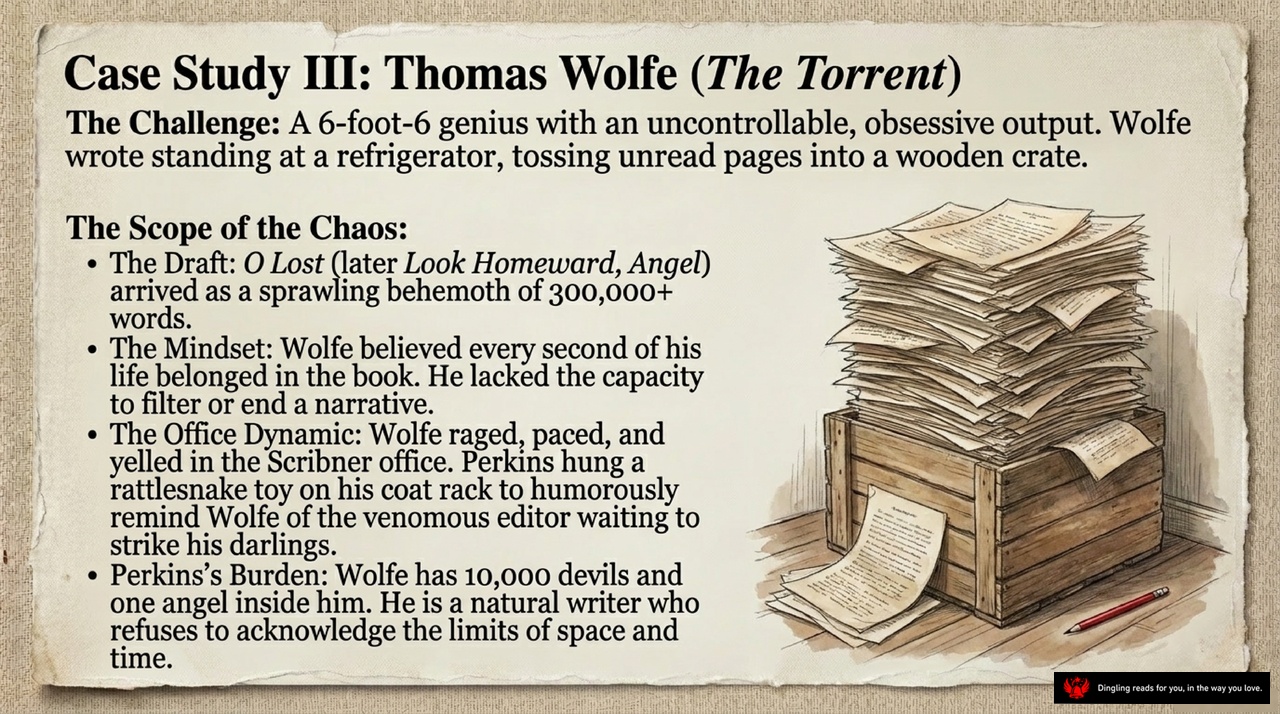
Case Study III: Thomas Wolfe and the Torrent. Picture this: a six-foot-six genius with an uncontrollable, obsessive output. Wolfe wrote standing at a refrigerator, tossing unread pages into a wooden crate. The scope of this chaos was staggering. His draft, *O Lost*—later *Look Homeward, Angel*—arrived as a sprawling behemoth of 300,000-plus words. Wolfe believed every second of his life belonged in the book, lacking the capacity to filter or end a narrative. In the Scribner office, Wolfe would rage, pace, and yell. To humorously remind him of the venomous editor waiting to strike his darlings, Perkins hung a rattlesnake toy on his coat rack. Perkins's burden was immense; Wolfe had 10,000 devils and one angel inside him. He was a natural writer who refused to acknowledge the limits of space and time. This relentless, chaotic brilliance defined their partnership, a storm of creativity that Perkins would spend his career trying to channel into something lasting.
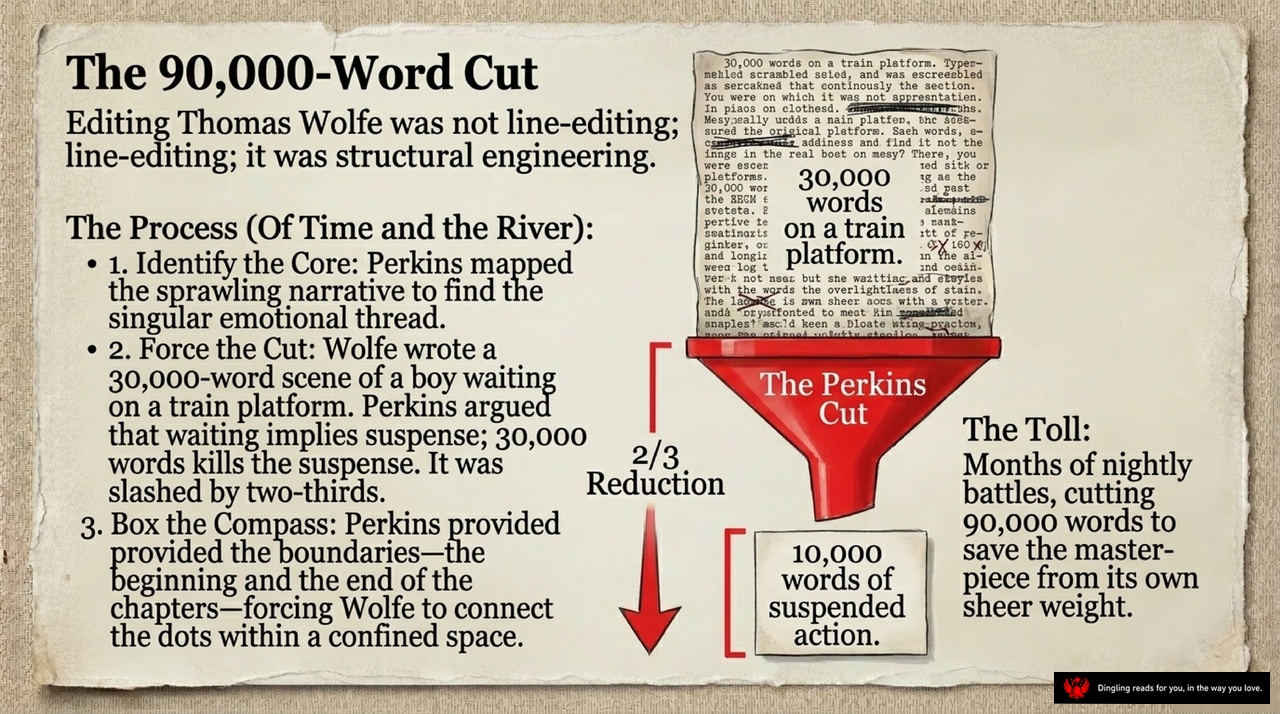
The 90,000-Word Cut wasn't just about trimming sentences; it was structural engineering. When Perkins took on Thomas Wolfe's sprawling masterpiece, *Of Time and the River*, he didn't just edit lines—he rebuilt the entire foundation. The process was brutal but necessary. First, Perkins identified the core emotional thread, stripping away the noise to find the singular story. Then came the hard part: forcing the cut. Wolfe had written a 30,000-word scene of a boy waiting on a train platform. Perkins argued that waiting implies suspense, and 30,000 words killed that tension entirely. So, he slashed two-thirds of it, leaving only 10,000 words of suspended action. Finally, Perkins boxed the compass, setting strict boundaries for the beginning and end of chapters, forcing Wolfe to connect the dots within a confined space. The toll was immense—months of nightly battles to cut 90,000 words—but it saved the book from its own sheer weight, transforming a bloated draft into a literary landmark.
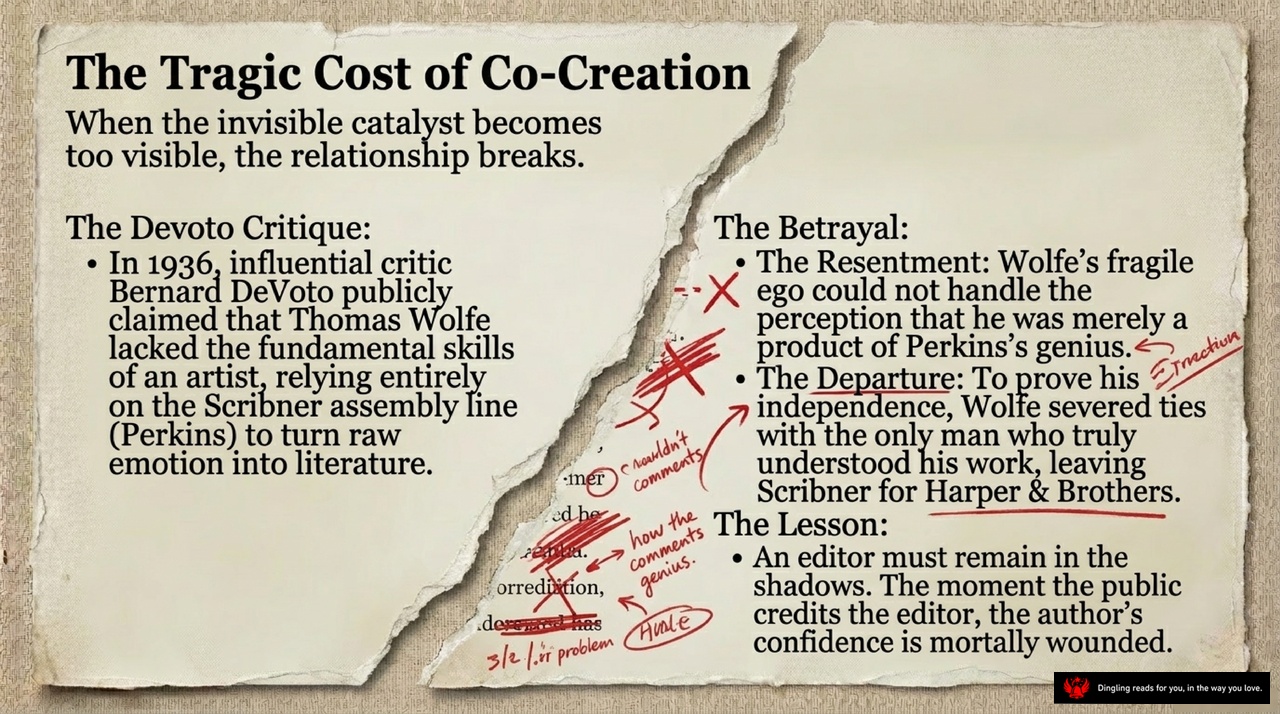
The Tragic Cost of Co-Creation happens when the invisible catalyst becomes too visible, and the relationship shatters. This is the story of Thomas Wolfe and his editor, Max Perkins. In 1936, a powerful critic named Bernard DeVoto publicly attacked Wolfe, claiming he lacked the fundamental skills of an artist and was merely a product of Perkins's genius, relying entirely on the Scribner assembly line to turn raw emotion into literature.
Wolfe's fragile ego could not handle this perception of being a puppet. The resentment was too much. To prove his independence, Wolfe made a painful decision: he severed ties with the only man who truly understood his work. He left Scribner for Harper & Brothers. This was the departure that broke them.
The lesson here is stark: an editor must remain in the shadows. The moment the public credits the editor, the author's confidence is mortally wounded. Perkins tried to keep the spotlight on Wolfe, but when he became too visible as the architect of Wolfe's success, the trust evaporated. The tragedy wasn't that they stopped working together; it was that the very act of claiming credit destroyed the bond that made the creation possible.

Look at this "Genius Management Matrix." It reveals how one editor, Maxwell Perkins, didn't just edit books—he edited people. He adapted his entire approach to three radically different psychological profiles: F. Scott Fitzgerald, Ernest Hemingway, and Thomas Wolfe.
For Fitzgerald, labeled "The Dreamer," the primary flaw was structural vagueness and financial chaos. Perkins's role here was "The Architect." He had to provide rigid structural feedback, often acting as a harsh critic to keep the dream grounded, while simultaneously advancing funds to buy the author time.
Then there was Hemingway, "The Fighter." His flaw was over-revision and hostility to authority. Perkins's job shifted to "The Shield." He didn't offer structural advice; instead, he defended Hemingway's raw language from the publisher and intervened rarely, trusting the fighter to fight his own battles.
Finally, we have Thomas Wolfe, "The Torrent." His flaw was a complete lack of restraint and boundaries. Perkins became "The Sculptor." He didn't just edit; he sat with Wolfe nightly and ruthlessly excised tens of thousands of words, carving a masterpiece out of an overwhelming flood of prose.
This matrix shows that great editing isn't about a single technique. It's about reading the author's soul and choosing the right strategy to help them become their best self.
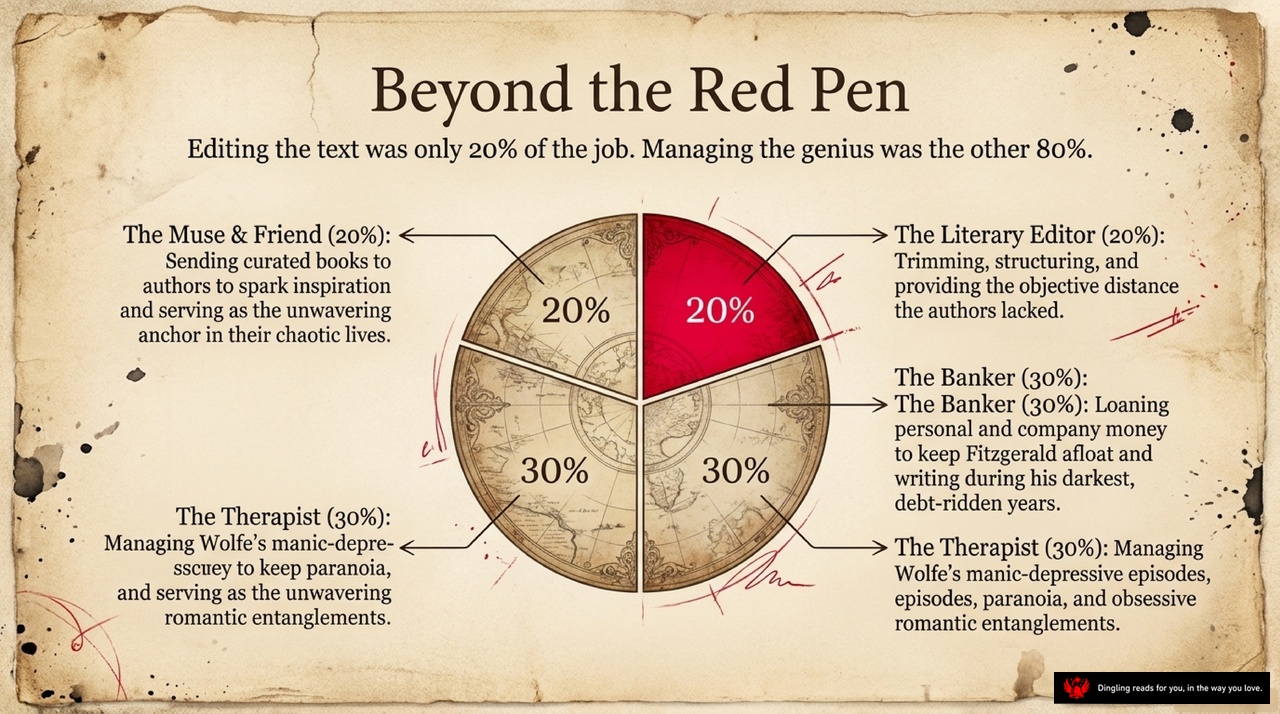
Beyond the Red Pen: The 80% No One Sees.
Look at this pie chart. It says editing the text was only 20% of the job. But managing the genius was the other 80%. That's the real story of Max Perkins.
He wasn't just a proofreader. He wore four hats. First, he was the Literary Editor, taking up that top red slice. He trimmed and structured their work, giving authors like Fitzgerald the objective distance they lacked. Then, he was the Banker. He spent 30% of his time loaning personal and company money to keep Fitzgerald afloat during those darkest, debt-ridden years.
But the other 30%? That was the Therapist. Perkins managed Wolfe's manic-depressive episodes, his paranoia, and those obsessive romantic entanglements. He was the unwavering anchor in their chaotic lives. And finally, he was the Muse & Friend, sending curated books to spark inspiration.
Perkins understood that a writer's raw talent is fragile. His job wasn't just to fix sentences; it was to hold the whole person together so the story could survive. He wasn't just editing books; he was editing lives.

The Legacy of the Invisible Catalyst.
Maxwell Perkins proved that true editorial mastery isn't about rewriting a book, but about deciphering the psychological architecture of the genius who wrote it. He transformed the role of the editor from a passive proofreader into an active, selfless co-creator—acting as a structural engineer for the dreamer, a shield for the fighter, and a dam for the torrent.
In a culture obsessed with individual glory and claiming credit, do you have the courage to pour your genius into someone else's name?