
Maybe You Should Talk to Someone: Complete Chapter-by-Chapter Summary
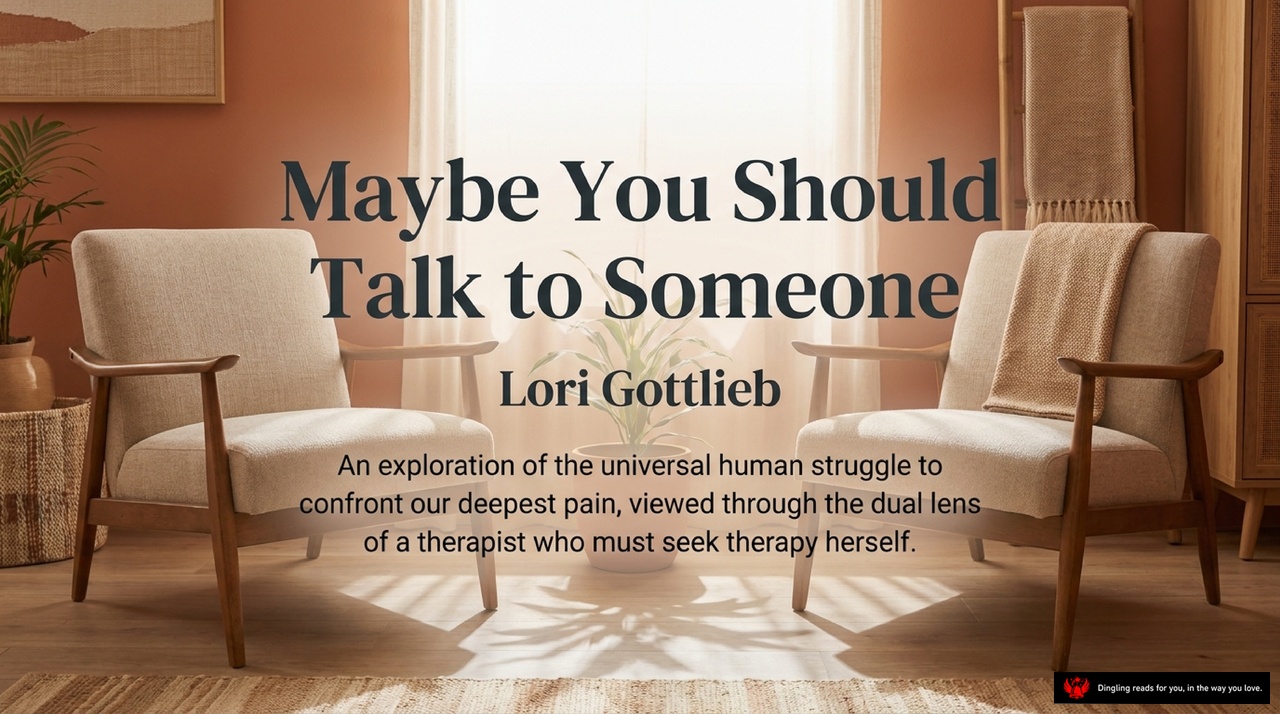
Welcome to today's session. We're diving into Lori Gottlieb's *Maybe You Should Talk to Someone*, a book that flips the script on therapy by placing us right in the therapist's chair—and then, in the patient's seat.
This opening image sets the tone perfectly: two chairs facing each other, a quiet, safe space. It represents the core premise of Gottlieb's exploration: the universal human struggle to confront our deepest pain. What makes this book unique is its dual lens. We see the story through the eyes of a therapist who must also seek therapy herself, revealing that healing isn't a one-way street. It's a shared journey where the patient's pain often reflects the therapist's own unprocessed emotions.
Gottlieb invites us to look at the "universal human struggle" not as something distant, but as a mirror. As she notes, "pain is never random; it's usually tied to loss and change." Whether it's a breakup, a career crisis, or a health scare, we all use armor—like anger or denial—to protect ourselves from the vulnerability underneath. This book doesn't offer quick fixes or magic formulas. Instead, it guides us through the messy, real work of facing our fears, understanding that sometimes, the bravest thing we can do is simply admit, "Maybe I need help."
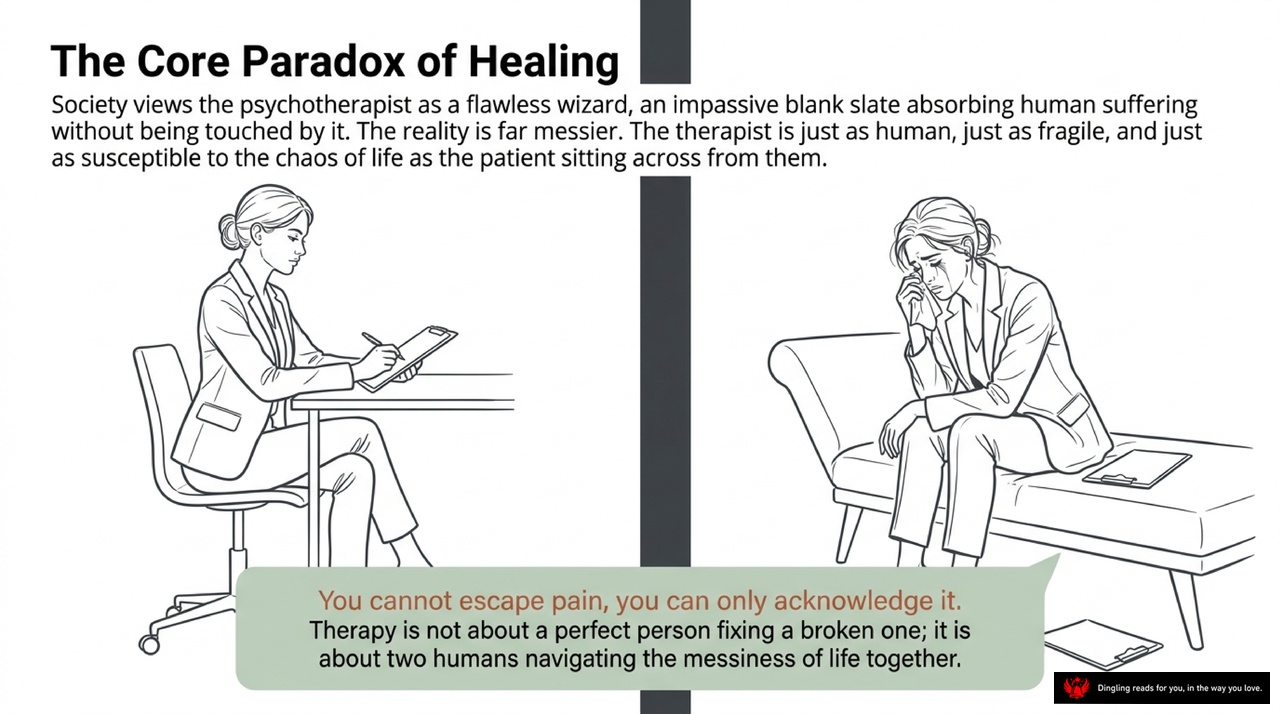
Welcome back. Today, we're diving into a concept that might feel counterintuitive at first, but is absolutely central to how healing actually works: The Core Paradox of Healing.
Look at this split image. On the left, we see the therapist as the calm, professional observer—the "flawless wizard" society often expects us to be. We imagine ourselves as an impassive blank slate, absorbing a patient's suffering without ever being touched by it ourselves. We think we're fixing a broken person from a distance.
But the reality, as the slide reminds us, is far messier. The image on the right shows the truth: the therapist is just as human, just as fragile, and just as susceptible to the chaos of life as the patient sitting across from them.
The text below the images hits home with a powerful truth: "You cannot escape pain; you can only acknowledge it." This flips the entire script on therapy. It's not about a perfect person fixing a broken one. It's about two humans navigating the messiness of life together.
Think about your own life. When we face a crisis, do we really believe we can handle it alone? Or do we secretly hope someone else will just magically fix it? This slide challenges that illusion. It tells us that vulnerability isn't a weakness; it's the bridge to connection. When we admit we're struggling, we aren't failing; we're inviting someone else in to walk the path with us.
So, remember this: Healing isn't a solo mission where you climb out of a pit alone. It's a shared journey. Whether you are the one seeking help or the one offering it, we are all just two people trying to make sense of a messy world, side by side.

Welcome to the hidden world of therapy, where the visible problem is just the tip of the iceberg. We often walk into sessions seeking a quick fix for an immediate crisis—maybe a breakup, a difficult boss, or chronic insomnia. But the real work happens beneath the surface.
Look at this diagram. Above the water, we see the "Presenting Problem." These are the obvious struggles we try to solve first: my boyfriend left abruptly, my boss is a jerk, or I can't sleep. But below the water lies "The Real Truth"—the massive, submerged part that drives those surface issues.
Think about it. When someone says, "My boyfriend left me," what they are really saying underneath is, "I am terrified that my life is half over." When they complain about a bad boss, the deeper fear is, "I am drowning in unspoken grief." And at the very bottom, often buried deepest, lies the primal terror: "I am paralyzingly afraid of death."
Therapy isn't just about patching up the surface cracks. It's about descending beneath the waterline to uncover these hidden terrors. Because until we face the deep, dark truths driving our immediate crises, we can't truly heal. The iceberg teaches us that the visible pain is just a shadow of what's really hurting us.

Welcome to the Diagnostic Matrix: Archetypes of Avoidance. This isn't just a chart; it's a mirror reflecting the hidden truths behind four distinct patient profiles.
First, we have John. On the surface, his presenting complaint is that he's surrounded by idiots and suffering from insomnia. His defense mechanism? Arrogance and abrasive anger, pushing everyone away. But the hidden truth is devastating: he's grappling with unprocessed grief over the death of his son. He builds a fortress of contempt to keep the pain at bay.
Next is Julie, a 35-year-old diagnosed with terminal cancer. Her frantic achievement, trying to compress a lifetime into months, masks a deep jealousy of the living and an existential terror of leaving her husband behind. She's running on adrenaline to avoid facing the silence.
Then there's Rita, turning 70, depressed, and setting a one-year deadline for suicide. Her defense is pushing away love and self-imposed isolation. Yet, the crushing guilt over her past failures as a mother hides a desperate, unmet craving for connection. She's punishing herself because she feels she doesn't deserve love.
Finally, Charlotte. She claims to suffer from karmic bad luck and terrible boyfriends. Her defense mechanism is creating chaotic crises, drinking, and feigning helplessness. But the real story is the paralyzing fear of adulthood, freedom, and taking responsibility for her own life. She creates chaos because the stillness of responsibility feels too terrifying.
Each of these patients is using a specific defense mechanism to avoid a painful reality. They are not defined by their complaints, but by the hidden truths they are desperately trying to escape.
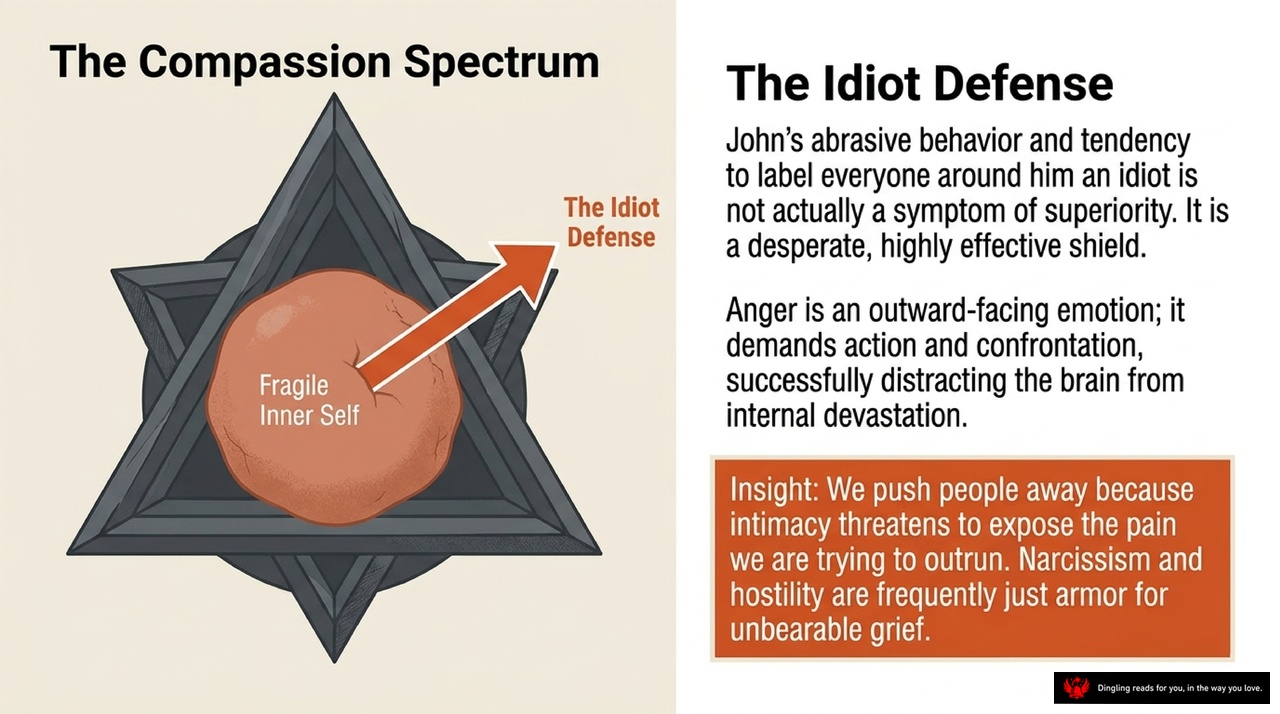
Let's talk about the "Compassion Spectrum" and a concept called "The Idiot Defense."
Look at this diagram. It shows a fragile inner self protected by a thick, dark armor. This armor is the "Idiot Defense." The text explains that John's abrasive behavior—his tendency to label everyone around him as an idiot—isn't actually a sign of superiority. It is a desperate, highly effective shield.
Why does he do this? Because anger is an outward-facing emotion. It demands action and confrontation, which successfully distracts the brain from internal devastation. By pushing people away and calling them idiots, John creates a safe distance. As the insight box states, we push people away because intimacy threatens to expose the pain we are trying to outrun.
Narcissism and hostility are frequently just armor for unbearable grief. When John calls everyone an idiot, he isn't looking down on them; he is trying to protect his own fragile inner self from the terrifying reality of his own vulnerability. He builds this wall so he doesn't have to feel the pain underneath.
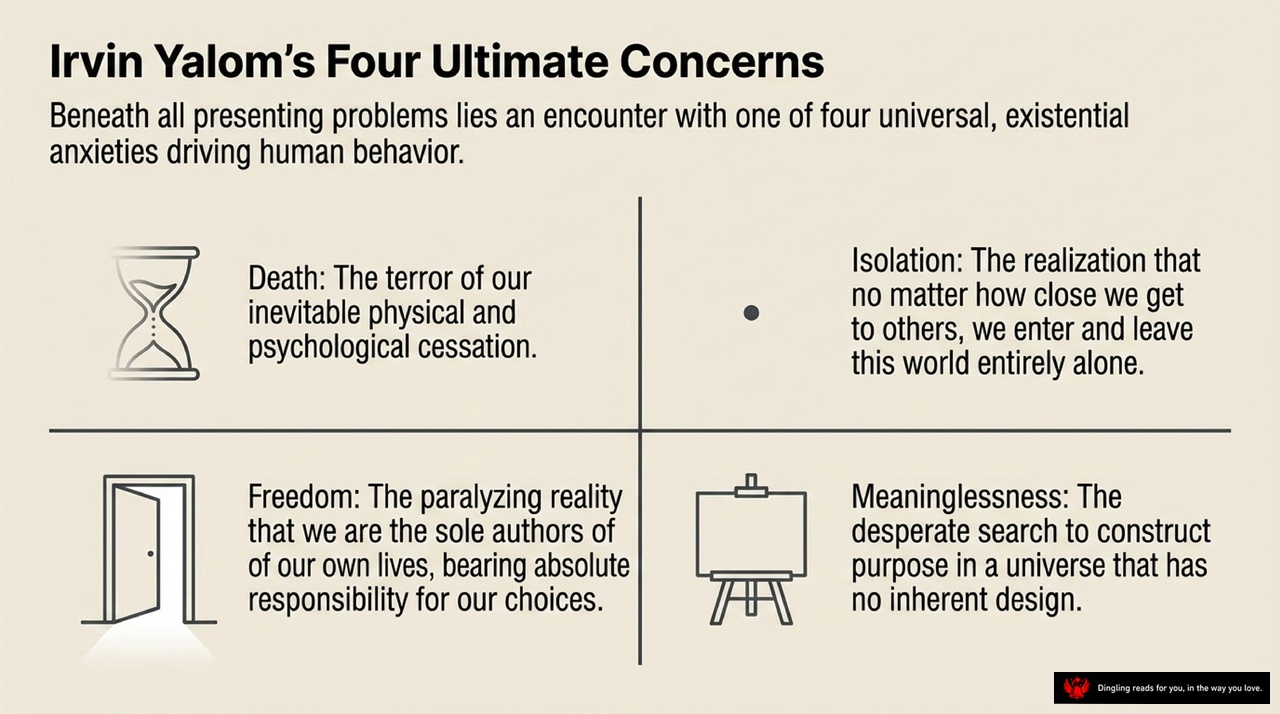
Today's slide introduces Irvin Yalom's Four Ultimate Concerns: Death, Isolation, Freedom, and Meaninglessness. These aren't just abstract concepts; they are the invisible engines driving every human behavior we see. Let's break them down.
First, Death. It's the terror of inevitable physical and psychological cessation. We all fear the end, but Yalom reminds us that recognizing this mortality is actually what makes life feel urgent and vibrant.
Next, Isolation. This is the realization that no matter how close we get to others, we ultimately enter and leave this world entirely alone. It's the fundamental solitude of the human experience.
Then, Freedom. This is the paralyzing reality that we are the sole authors of our own lives, bearing absolute responsibility for our choices. There is no one to blame but ourselves.
Finally, Meaninglessness. This is the desperate search to construct purpose in a universe that has no inherent design. We are the ones who have to create our own significance.
In the text, we see these concerns play out vividly. Julie, facing cancer, confronts death directly, finding that acknowledging it allows her to savor every moment. Charlotte struggles with freedom, trapped by her parents' chaotic lives, until she realizes she can choose her own path. And Rita, terrified of meaninglessness and isolation, eventually builds a new life by connecting with neighbors, proving that we can create meaning even in a seemingly indifferent world.
Understanding these four concerns isn't about avoiding them; it's about facing them so we can live more authentically. When we stop running from these existential anxieties, we stop creating unnecessary suffering. We realize that while we can't control the universe's design, we have the power to design our own lives with courage and purpose.
When we face our deepest fears, we often feel trapped by invisible walls, convinced that our circumstances have locked us in place. But the truth is far more liberating: there are no bars on either side of the cage. As Viktor Frankel taught us, even when everything else is stripped away, we retain the freedom to choose our attitude. This realization changes everything.
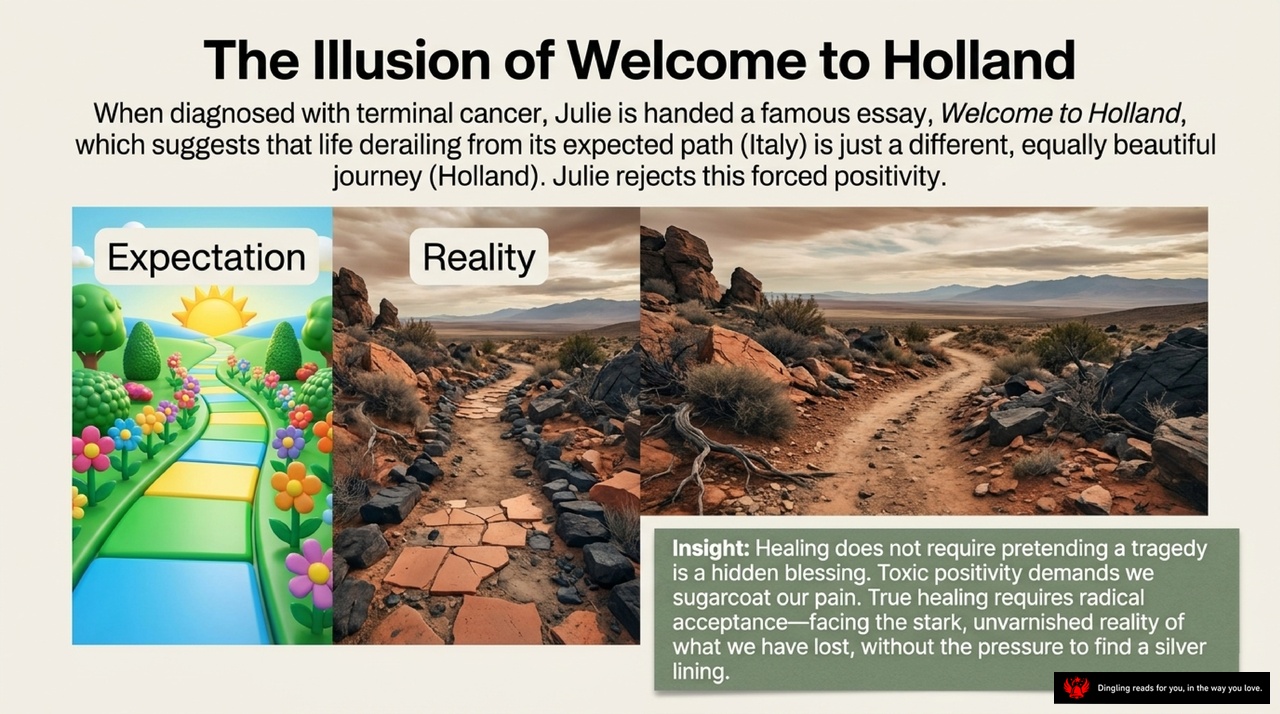
Take Julie, for instance. Facing a terminal diagnosis, she initially rejected the idea that her life could still hold meaning. She felt that cancer was just a cruel detour from her dream of Italy, a forced positivity that denied her pain. But she eventually learned to embrace the unexpected journey of Holland, finding beauty in the very moments she thought were losses. She realized that living fully meant savoring the smell of strawberries, the scent of grass, and the simple act of breathing, rather than obsessing over what she would lose.
Similarly, our characters throughout this story confront their own cages. Charlotte battles addiction, believing her life is a series of punishments she deserves. Yet, by choosing to change, she breaks free from the cycle of self-sabotage. Rita, on the verge of despair, learns that happiness isn't a reward for being perfect, but a choice she can make every day, even after making mistakes she can never undo.
The illusion of the cage is powerful, but it is also fragile. When we stop fighting against the uncertainty of life and instead choose to respond with courage, we discover that the barriers we thought were solid are nothing more than our own fears. We are not prisoners of our past or our circumstances; we are the architects of our own freedom, capable of turning any situation into an opportunity for growth and meaning.
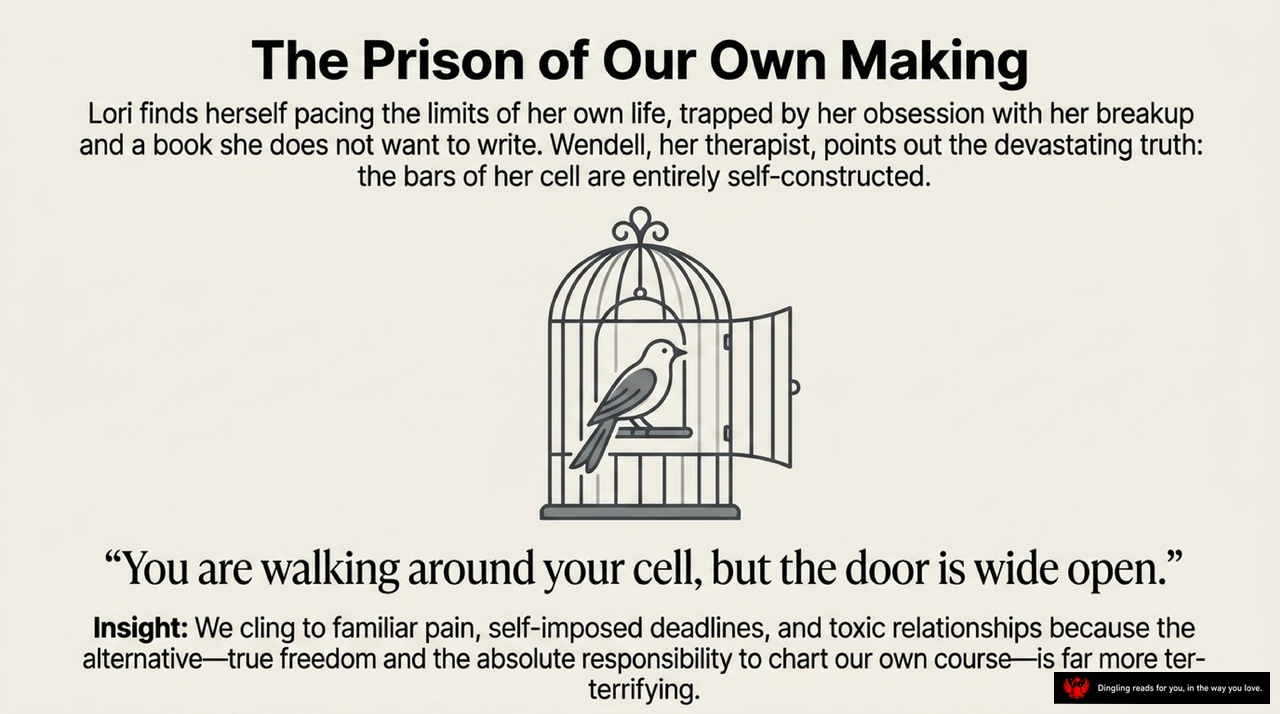
Today's slide captures a profound truth from our journey: "The Prison of Our Own Making." Look at that birdcage with the door wide open. It's a perfect metaphor for Lori's realization. She had been pacing the limits of her own life, trapped by her obsession with a painful breakup and a book she felt forced to write. But her therapist, Wendell, pointed out the devastating reality: the bars of her cell were entirely self-constructed.
As the slide reminds us, "You are walking around your cell, but the door is wide open." Why do we stay there? Because true freedom feels terrifying. We cling to familiar pain, self-imposed deadlines, and even toxic relationships because the alternative—taking absolute responsibility for charting our own course—is far more frightening than the pain we already know.
But here's the insight that changes everything: we are the architects of our own confinement, and we also hold the key. When Lori finally stopped building new bars and walked through the open door, she discovered that the freedom she feared was actually the only thing that could save her. It's a reminder that while we can't control every storm in life, we always have the power to choose whether to stay inside or step out.
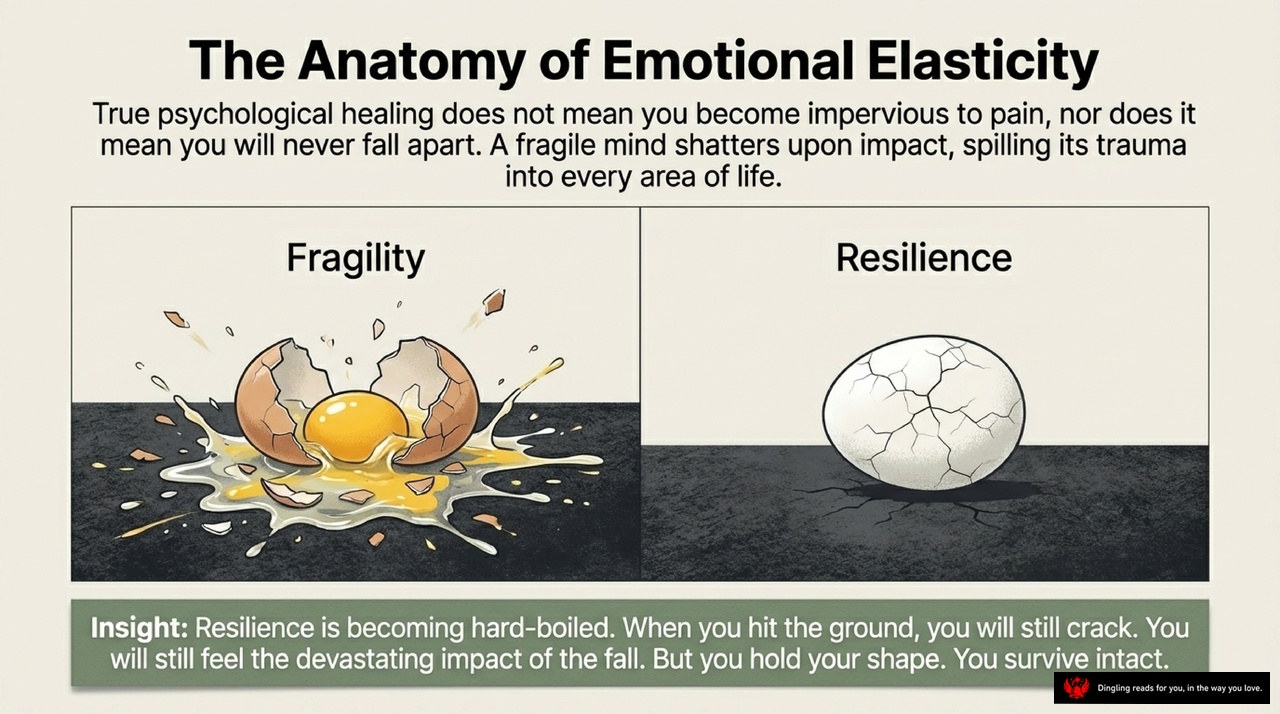
True psychological healing isn't about becoming invincible. It doesn't mean you'll never fall apart or become impervious to pain. In fact, a truly fragile mind shatters upon impact, spilling its trauma into every area of life.
Look at the image on the screen. On the left, we see "Fragility." It's like that raw egg hitting the ground—the shell cracks instantly, everything spills out, and the structure is destroyed. But on the right, we see "Resilience." Notice that egg? It's hard-boiled. When it hits the ground, it still cracks. You can see the fractures. But here is the key difference: the hard-boiled egg holds its shape. It survives intact.
This is the anatomy of emotional elasticity. Resilience isn't about avoiding the pain or pretending the fall never happened. When you hit the ground, you will still crack. You will still feel the devastating impact of the fall. But with resilience, you hold your shape. You survive the trauma without losing who you are. True healing means you can feel the pain, acknowledge the crack, and still stand up whole.
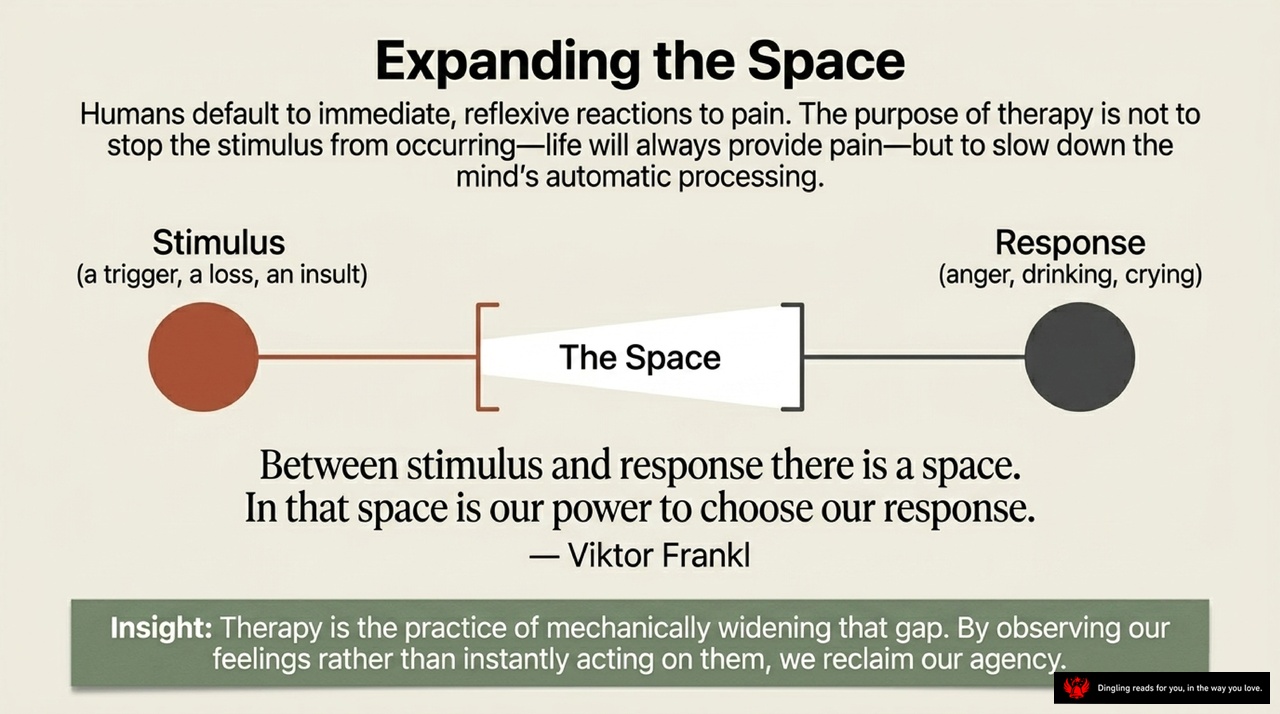
Welcome back to our journey of expanding the space. Today, we are diving into the profound wisdom of Viktor Frankl, a concept that serves as the cornerstone for our entire therapy practice.
As you see on the slide, we often default to immediate, reflexive reactions to pain. Life will always provide us with triggers—whether it's a loss, an insult, or a sudden disappointment. The natural human instinct is to react instantly with anger, withdrawal, or despair. But the true purpose of therapy is not to stop the stimulus from occurring; life will always have its challenges. Instead, our goal is to slow down the mind's automatic processing.
Look at the diagram: there is a distinct gap between the Stimulus and the Response. This is "The Space." It is in this very space that we hold our power. As Frankl famously said, "Between stimulus and response there is a space. In that space is our power to choose our response." Therapy is essentially the practice of mechanically widening that gap. By observing our feelings rather than instantly acting on them, we reclaim our agency and stop being slaves to our impulses.
We all want to feel in control, but true freedom isn't about avoiding pain; it's about having the freedom to choose how we face it. Can you find that space in your own life today?

Let's talk about the "Consolation Prize." It's a harsh but necessary truth in therapy: insights alone are just a trophy, not the cure. You can have all the "aha" moments, perfectly mapping your trauma and defenses, but if that understanding doesn't translate into changing your behavior in the real world, the therapy is completely useless.
The slide reminds us that true healing only happens in genuine connection with others. Inside the therapy room, you might achieve profound psychological breakthroughs, but that isn't enough. As the image suggests, the ultimate revelation of this journey is that the therapist and the patient are mirrors of each other. We can only heal when we connect authentically, not just when we understand ourselves intellectually.
So, don't settle for the consolation prize of knowing your story. Use that insight to rewrite your life.
We spend our lives building elaborate armor to avoid facing grief, isolation, and the terrifying freedom of our own choices. Therapy isn't a magic eraser; it's a mirror that forces us to look at the open door of the prisons we built ourselves. We only heal when we stop running, sit in the discomfort, and finally choose to walk out.
So, I want to leave you with this question: What is the pain you are currently running from? And what would happen if you finally stopped to face it?