
Midnight in Chernobyl: Complete Chapter-by-Chapter Summary
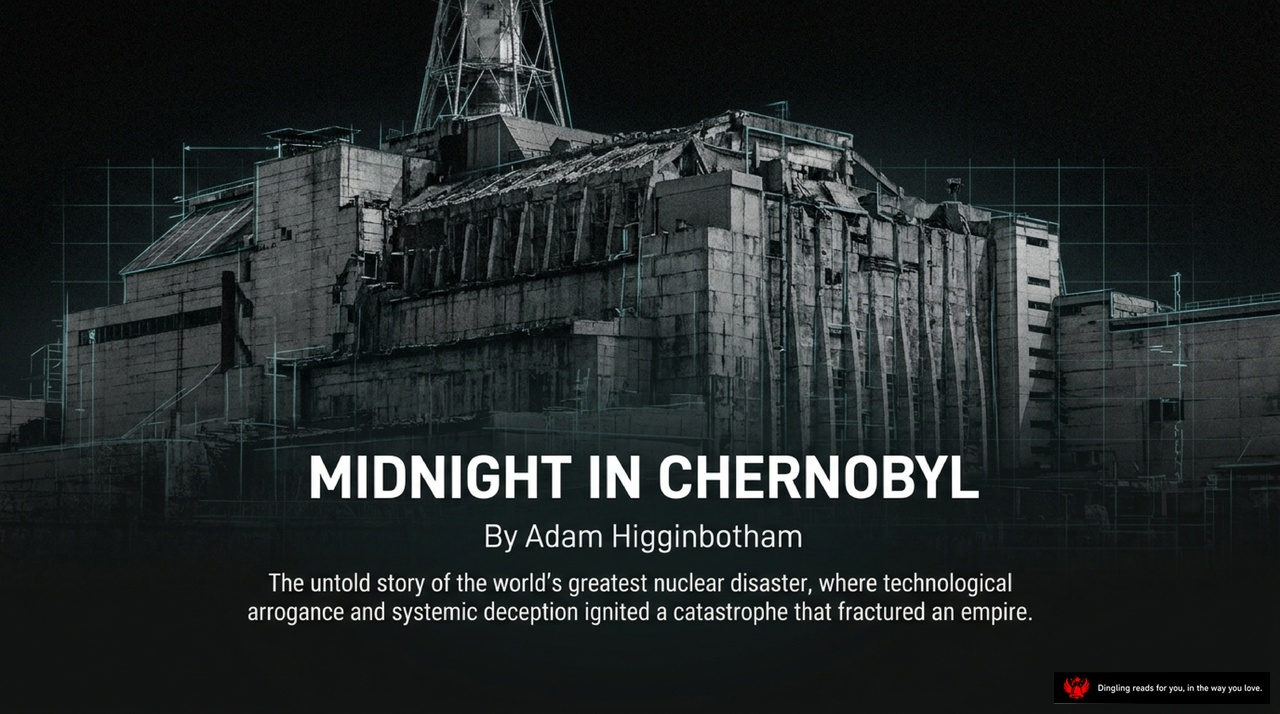
Welcome to *Midnight in Chernobyl* by Adam Higginbotham. Tonight, we step into the untold story of the world's greatest nuclear disaster—a tragedy born not from a sudden explosion, but from a slow-burning fire of technological arrogance and systemic deception.
The image you see here captures the haunting reality of that night: a massive industrial complex standing in silence, a monument to a mistake that fractured an empire. The book reveals how a Soviet ambition to outpace the West led to the construction of the world's largest nuclear power plant, the Chernobyl Atomic Energy Station. It was a project designed to showcase industrial might, built on the RBMK reactor, a design that looked efficient on paper but carried hidden, lethal flaws.
Under the leadership of Viktor Bryukhanov, a manager with little actual nuclear expertise, the station was rushed into existence. The promise was a utopia for the working class: a city called Pripyat, filled with schools, hospitals, and even flower beds, where thousands lived in blissful ignorance of the danger. But beneath the surface, safety protocols were ignored, cheap materials were used, and the reactor's design was fundamentally unstable.
This story is about the human cost of that failure. It explores how a series of poor decisions, a culture of secrecy, and a disregard for basic safety turned a routine test into a catastrophe that would send radiation across the globe. From the arrogance of the leadership to the bravery of the firefighters who ran into the unknown, *Midnight in Chernobyl* is a gripping account of how one night changed the world forever.

Look at this split image. On the left, we see Pripyat, the "Atomgrad." It looks like a perfect, sunny utopia with a giant Ferris wheel and wide streets. The text tells us this was an elite city for young nuclear pioneers, where the average age was just 26, and supermarkets were stocked with Austrian tableware and French perfume. It was an oasis of abundance in a nation defined by shortages.
But look at the right side. That unfinished concrete skeleton represents the command economy's impossible mandate. Behind that utopian facade lay a system of unrealistic quotas and defective materials. The text explains that Plant Director Viktor Brukhanov faced a pressure cooker of demands: he had to fulfill the state plan even if it meant quietly bypassing safety protocols.
This page captures the tragic irony of the Soviet Prometheus. They built a paradise for their workers while ignoring the fundamental laws of physics and engineering. The promise of a bright, secure future was built on a foundation of lies and shortcuts, setting the stage for the disaster that would follow.

Look at this blueprint of the RBMK reactor. This isn't just a machine; it's a ticking time bomb waiting to explode. The slide calls it "The Flawed Behemoth," and for good reason. The diagram highlights two specific design choices that turned a safety system into a death trap.
First, notice the "Positive Void Coefficient." Unlike Western reactors, this Soviet design used graphite as a moderator and water as a coolant. Here's the terrifying part: when the cooling water boils away and turns to steam—creating what engineers call "voids"—the nuclear reaction doesn't slow down. Instead, it speeds up. It's a runaway feedback loop. Less water means more power, which creates more heat, which boils off more water. It's a self-destructing cycle built right into the physics.
Second, look at those control rods. In a normal reactor, dropping them in stops the reaction instantly. But in this RBMK, the tips of those rods were made of graphite. When the emergency button was pressed, the graphite tips actually *added* fuel to the reaction before the boron could stop it. It acted like a detonator instead of a brake. Pressing the kill switch didn't stop the explosion; it made it worse.
These weren't minor glitches; they were fundamental flaws that made the reactor unstable at low power and nearly impossible to control in an emergency. It was a massive industrial experiment that ignored the most basic rule of engineering: safety first.
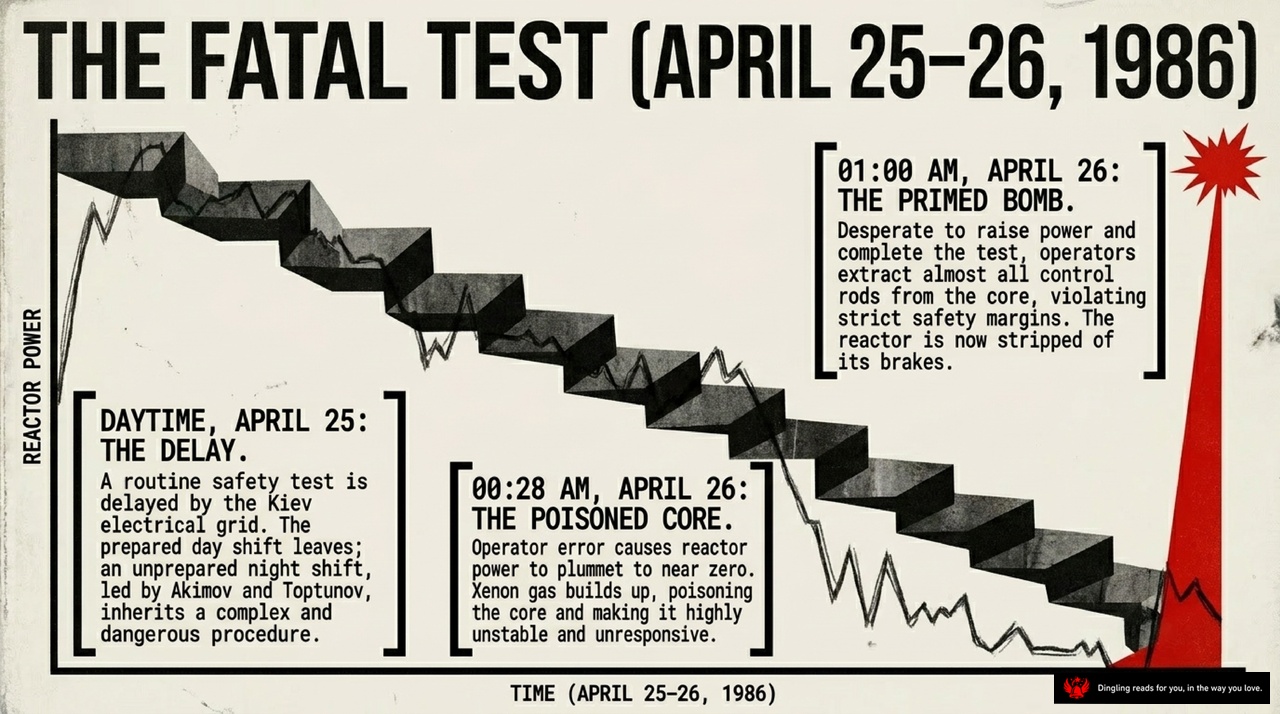
At 1:28 AM on April 26, 1986, a critical error in the control room sent the reactor's power plummeting toward zero. This wasn't just a drop; it was a poison trap. As the power died, Xenon gas began to build up rapidly, effectively poisoning the core and making it highly unstable and unresponsive to any control attempts. By 1:00 AM, in a desperate bid to raise power and complete the scheduled test, operators extracted almost all control rods from the core, completely stripping the reactor of its safety brakes. With no way to stop the reaction and the core already compromised by the Xenon poisoning, the system had reached a point of no return. The reactor was now a primed bomb, ticking toward a catastrophic explosion that would soon shatter the night over Pripyat.
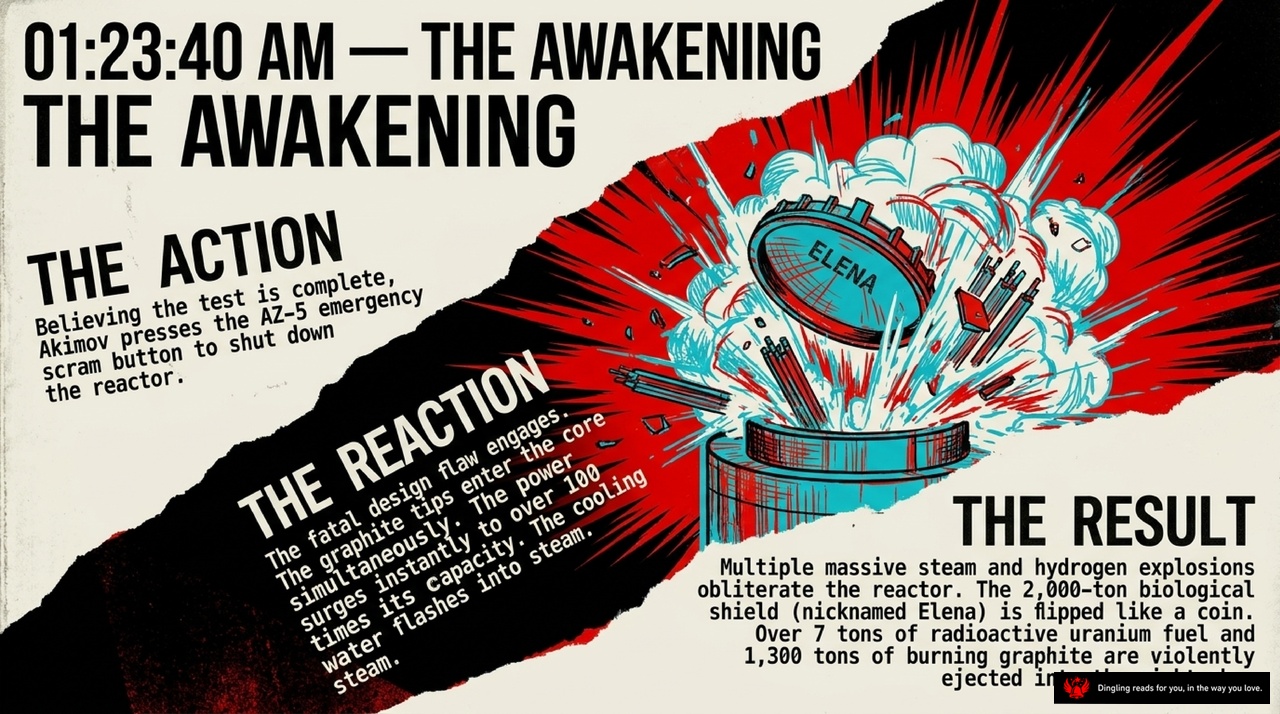
At 1:23:40 AM, the silence of the night was shattered not by a gentle alarm, but by a catastrophic awakening. Believing the test was finally complete, the exhausted operator Akimov made a desperate move: he slammed the AZ-5 emergency scram button, hoping to shut down the reactor before it was too late. But instead of stopping, the reactor violently reacted. A fatal design flaw triggered instantly. The graphite tips of the control rods, which were supposed to absorb neutrons, actually injected them into the core as they were inserted, causing power to surge over 100 times its capacity in seconds. The cooling water flashed into steam, and the core went completely out of control.
The result was immediate and devastating. Multiple massive steam and hydrogen explosions obliterated the reactor building. The 2,000-ton biological shield, nicknamed "Elena," was flipped like a coin, exposing the core to the sky. Over 7 tons of highly radioactive uranium fuel and 1,300 tons of burning graphite were violently ejected into the night air. This wasn't just an accident; it was the moment the world's most powerful nuclear disaster began, turning a dark Tuesday morning into a global emergency that would change history forever.
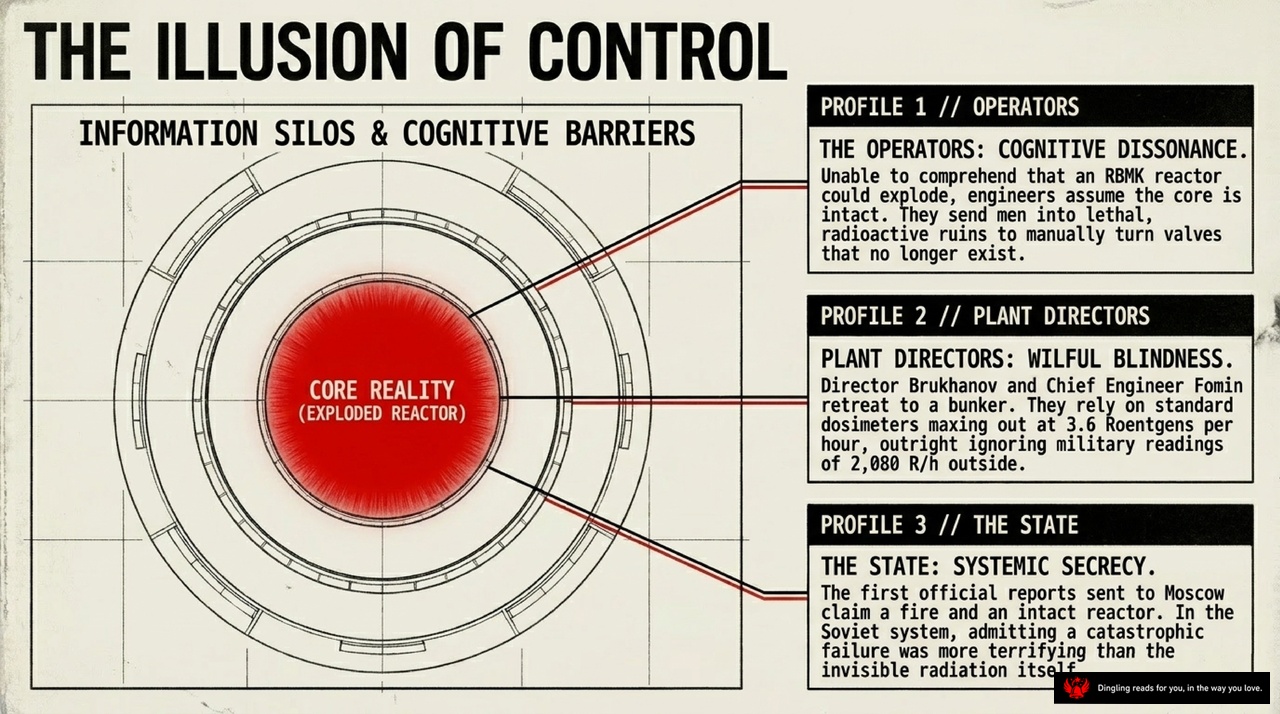
Look at this diagram. It illustrates the terrifying concept of "The Illusion of Control"—the gap between what leaders believed was happening and the deadly reality unfolding beneath them. At the very center is the "Core Reality": an exploded reactor. But surrounding that truth are three concentric rings of deception, each representing a different group that refused to see the catastrophe.
First, we have the Operators. They suffered from cognitive dissonance. They simply could not comprehend that an RBMK reactor could explode. So, they assumed the core was intact, sending men into lethal, radioactive ruins to manually turn valves that no longer existed. They were blind to the explosion because they refused to believe it was possible.
Moving outward, we see the Plant Directors. Their profile is defined by willful blindness. Directors Brukhanov and Chief Engineer Fomin retreated to a bunker, relying on dosimeters that were already maxing out at 3.6 Roentgens per hour. They outright ignored military readings showing 2,080 R/h outside. They chose to ignore the data because it was too terrifying to face.
Finally, the outermost ring represents the State, operating under systemic secrecy. The first official reports sent to Moscow claimed a mere fire and an intact reactor. In the Soviet system, admitting a catastrophic failure was considered more terrifying than the invisible radiation itself. The state lied to protect its image, creating a wall between the public and the truth.
This slide captures the tragic psychology of Chernobyl. It wasn't just a mechanical failure; it was a failure of perception. Every layer of leadership—from the engineers to the government—constructed a barrier against the truth, believing they were in control, while the reactor was already destroyed.

The image highlights a tragic irony: brave firefighters rushing into a blaze they thought was just an electrical fire, only to step onto a roof littered with intensely radioactive graphite. They were unknowing vanguards, wearing standard canvas suits that offered zero protection against gamma or neutron radiation, and breathing toxic smoke directly into their lungs without respirators. The danger was invisible at first; without functioning dosimeters, the only warning signs were a strange metallic taste, sudden sunburns, and violent vomiting. Despite the lethal doses they absorbed in minutes, these heroes fought on, buying time for the world to react, even as their own bodies began to fail under the invisible assault.
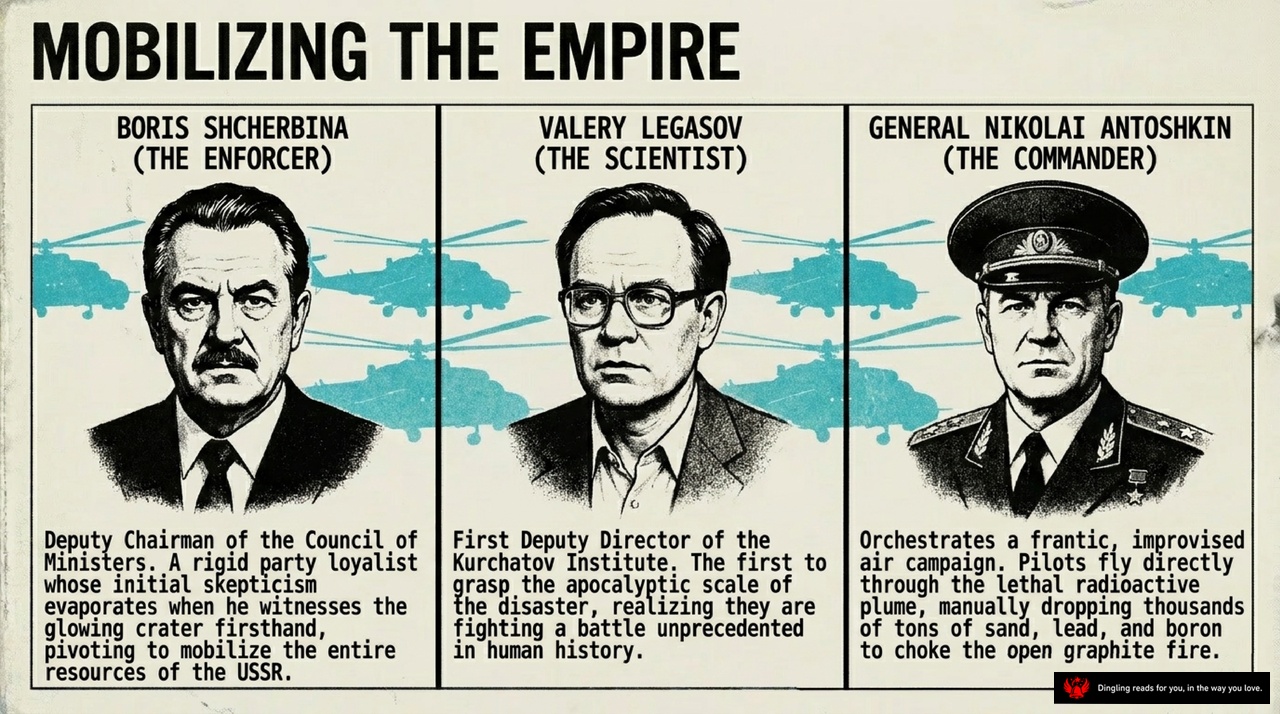
Mobilizing the Empire. This slide introduces the three critical figures who took charge immediately after the explosion: Boris Shcherbina, the Enforcer; Valery Legasov, the Scientist; and General Nikolai Antoshkin, the Commander.
Shcherbina was a rigid party loyalist, the Deputy Chairman of the Council of Ministers. Initially skeptical, his perspective shifted dramatically when he witnessed the glowing crater firsthand. That moment of realization triggered a complete pivot; he mobilized the entire resources of the USSR to fight this unprecedented battle.
Standing alongside him was Valery Legasov, the First Deputy Director of the Kurchatov Institute. He was the first to truly grasp the apocalyptic scale of the disaster. Legasov realized they were not just fighting a fire; they were fighting a battle unlike anything in human history.
Then there is General Antoshkin, the Commander. His role was to orchestrate a frantic, improvised air campaign. He directed pilots to fly directly through the lethal radioactive plume, manually dropping thousands of tons of sand, lead, and boron from the helicopters seen in the background. Their mission was clear and desperate: choke the open graphite fire to prevent a second, catastrophic explosion.
These three men, representing the state, science, and military, formed the core of the response, racing against time to contain the worst nuclear disaster in history.
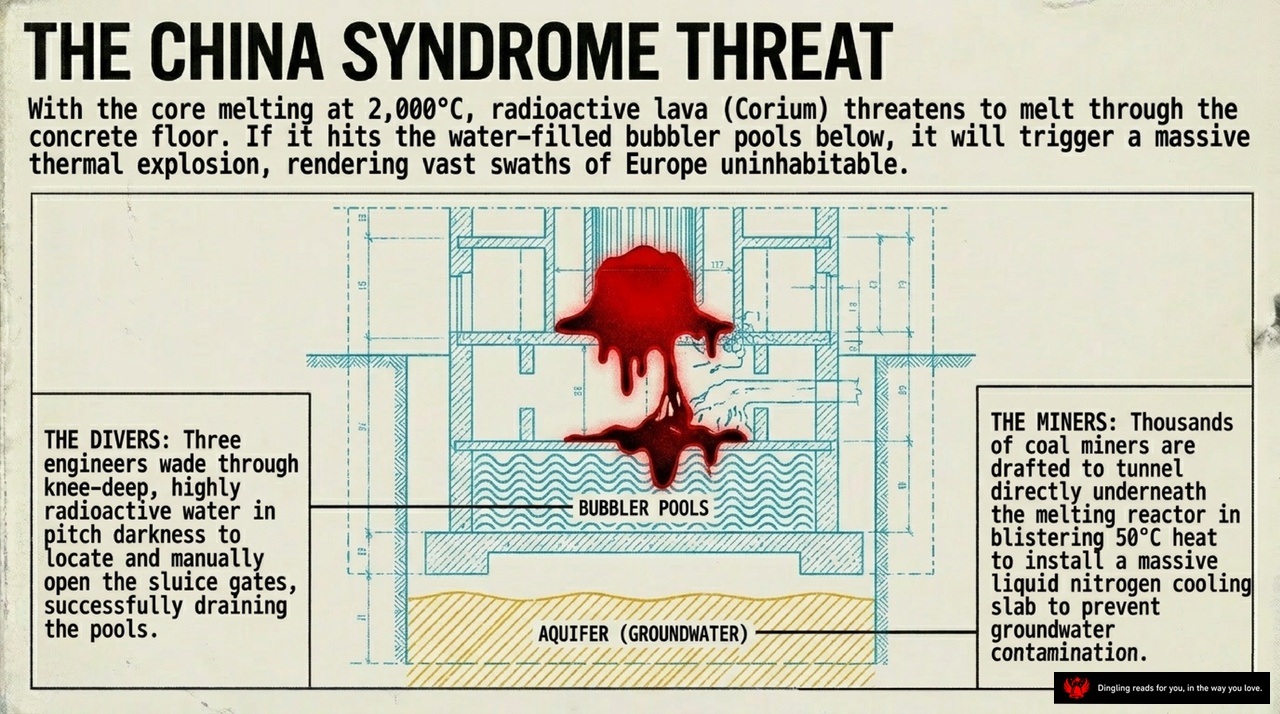
Imagine a nightmare scenario where the reactor core melts down, reaching a blistering 2,000 degrees Celsius. The resulting radioactive lava, known as corium, threatens to punch right through the concrete floor below. If this molten mass hits the water-filled bubbler pools underneath, it triggers a catastrophic thermal explosion. The result? Vast swathes of Europe rendered uninhabitable. This terrifying reality is what the world fears as "The China Syndrome."
But here is where the story gets even darker. To prevent this very disaster from happening, thousands of coal miners were drafted to tunnel directly underneath the melting reactor. They worked in blistering 50-degree heat, digging blindly into the unknown to install a massive liquid nitrogen cooling slab. Their goal? To stop groundwater contamination before the molten fuel could reach the aquifer.
While these miners fought the heat below, a different team of heroes faced a different hell above. Three engineers, dubbed "The Divers," waded through knee-deep, highly radioactive water in pitch darkness. They had to manually locate and open sluice gates to drain the pools, all while exposed to lethal radiation levels.
The diagram shows the sheer scale of this desperate battle: the bubbling pools, the aquifer below, and the relentless flow of radioactive lava. It was a race against time where every second counted, and the cost was measured in human lives. These miners and divers didn't know if they would survive, but they stood as the first line of defense against a potential apocalypse.

Look at this map. That dark, sweeping cloud stretching from Ukraine into Scandinavia isn't just ink on paper; it was the radioactive plume from Chernobyl, an invisible cloud that crossed borders in days while the world watched in shock.
This slide captures the critical first 36 hours of the disaster, defined by a terrifying disconnect between reality and official lies. On April 27, just 36 hours after the explosion, the silent evacuation of Pripyat's 47,000 residents finally began. By then, they had already been exposed to massive radiation, but they were told nothing.
The next day, April 28, the truth started leaking, not from Moscow, but from Sweden. When Swedish authorities detected the plume, they forced Moscow's hand. The Soviet government released a terse, 23-word statement, admitting an accident occurred but aggressively minimizing its severity. It was a desperate attempt to control the narrative before the radiation had even reached their borders.
Yet, even as the invisible cloud drifted over Europe, the illusion of normalcy was maintained right under the residents' noses. By May 1, under orders from Moscow to project stability, Kiev held its annual May Day parade. Children marched outdoors directly under the radioactive fallout, completely unaware of the invisible danger above them. This slide illustrates the tragic cost of secrecy: a city evacuated too late, a world lied to, and a population sacrificed for the sake of a government's fragile image.
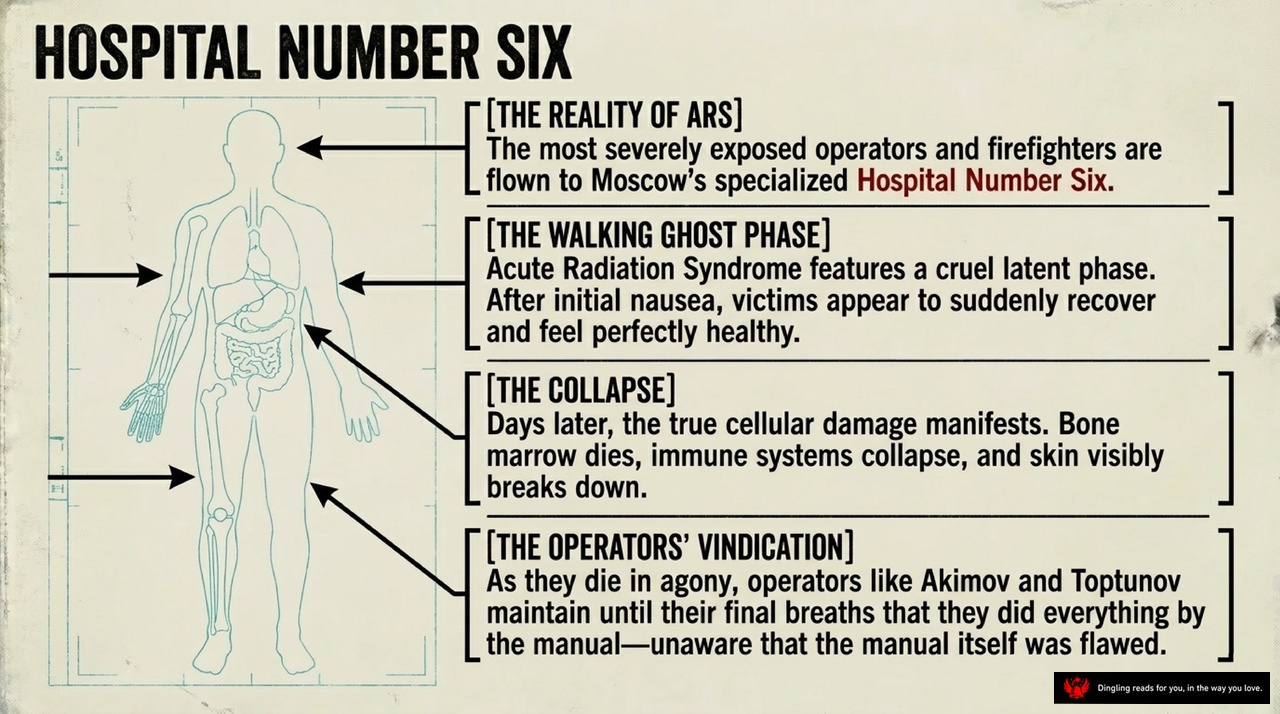
Look at this diagram. It maps the terrifying timeline of radiation sickness, starting from the moment the most exposed operators and firefighters were flown to Moscow's specialized Hospital Number Six. But the horror wasn't immediate. This slide highlights the "Walking Ghost Phase," where victims, after initial nausea, suddenly appear to recover and feel perfectly healthy. It's a cruel trick of Acute Radiation Syndrome.
Then, days later, the true cellular damage manifests in "The Collapse." Bone marrow dies, immune systems fail, and skin visibly breaks down. As these men die in agony, operators like Akimov and Toptunov maintain until their final breaths that they did everything by the manual, unaware that the manual itself was flawed. This slide isn't just about biology; it's the ultimate tragedy of a system that failed its people, leaving them to suffer while believing they had done their job correctly.

The image breaks down the human cost of the Chernobyl disaster into three harrowing realities: the Draft, the Biobots, and the Tomb. It tells the story of over 600,000 Liquidators—soldiers, miners, and civilians from across the Soviet empire—who were conscripted to decontaminate the land. These men and women faced a terrifying deadline. When remote-controlled rovers failed due to radiation destroying their circuitry, human soldiers were sent onto the reactor roof. Wearing crude lead aprons, they had exactly 90 seconds to shovel highly radioactive graphite over the edge before absorbing a lifetime limit of radiation.
This graphic captures the desperate race against time. While engineers worked in lethal conditions, they constructed a 14-story steel and concrete Sarcophagus over the ruins in just seven months, sealing the beast inside. This was a race to contain the meltdown, but it came at an unimaginable price. The image illustrates the sheer scale of sacrifice: thousands of men, often unaware of the full extent of the danger, stepped into a death zone to buy time for the world. Their story is one of courage born from necessity, a stark reminder of the human toll behind the headlines of the world's worst nuclear catastrophe.
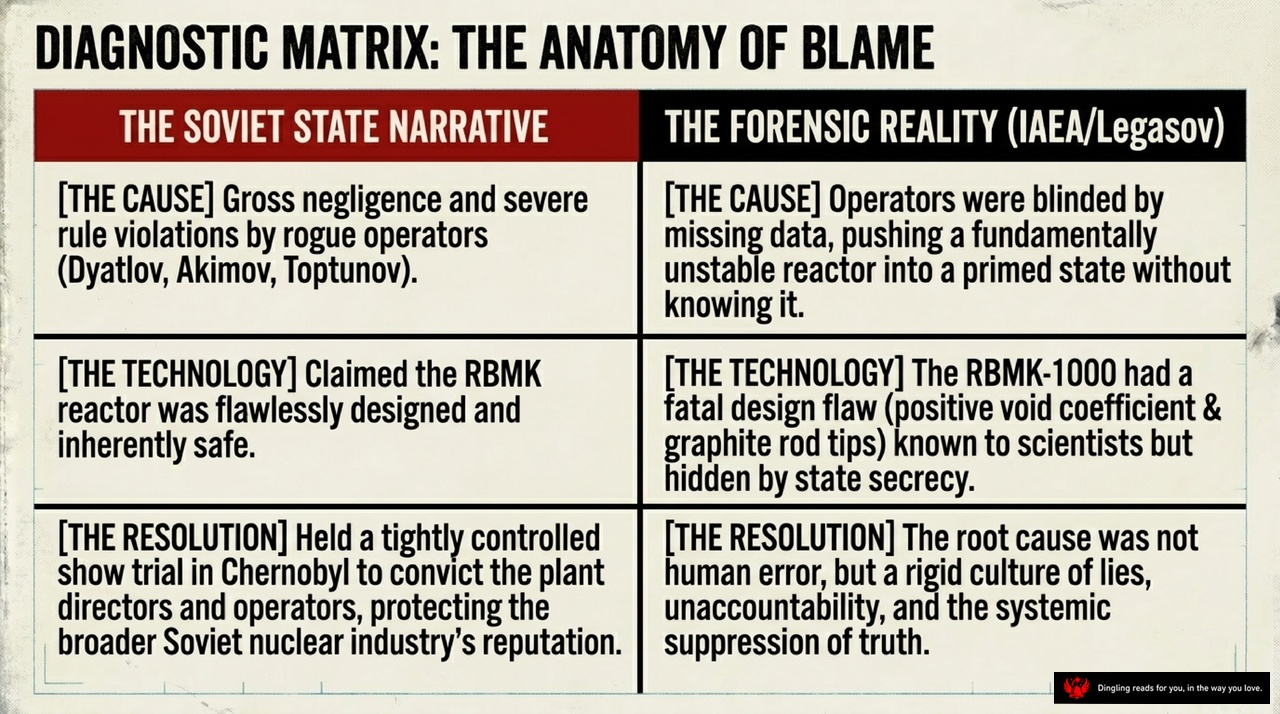
Look at this "Diagnostic Matrix: The Anatomy of Blame." It perfectly captures the tragic irony of Chernobyl: the clash between the official story and the forensic reality.
On the left, we see the Soviet State Narrative. They wanted to tell the world that the disaster was caused by gross negligence, rogue operators, and a flawless reactor design that simply failed due to human error. The resolution? A tightly controlled show trial in Chernobyl to convict the plant directors, protecting the broader Soviet nuclear industry's reputation. It was a narrative designed to shield the system.
But on the right, under the Forensic Reality revealed by the IAEA and Legasov, the truth is far more complex and damning. The cause wasn't just operator error; it was operators blinded by missing data, pushing a fundamentally unstable reactor into a primed state without even knowing it. The technology wasn't safe; the RBMK-1000 had a fatal design flaw—specifically that positive void coefficient and graphite rod tips—that scientists knew about but hid behind state secrecy.
And the resolution? The root cause wasn't human error at all. It was a rigid culture of lies, unaccountability, and the systemic suppression of truth. This slide reminds us that while we often blame individuals for disasters, sometimes the real culprit is an entire system built on hiding the facts.
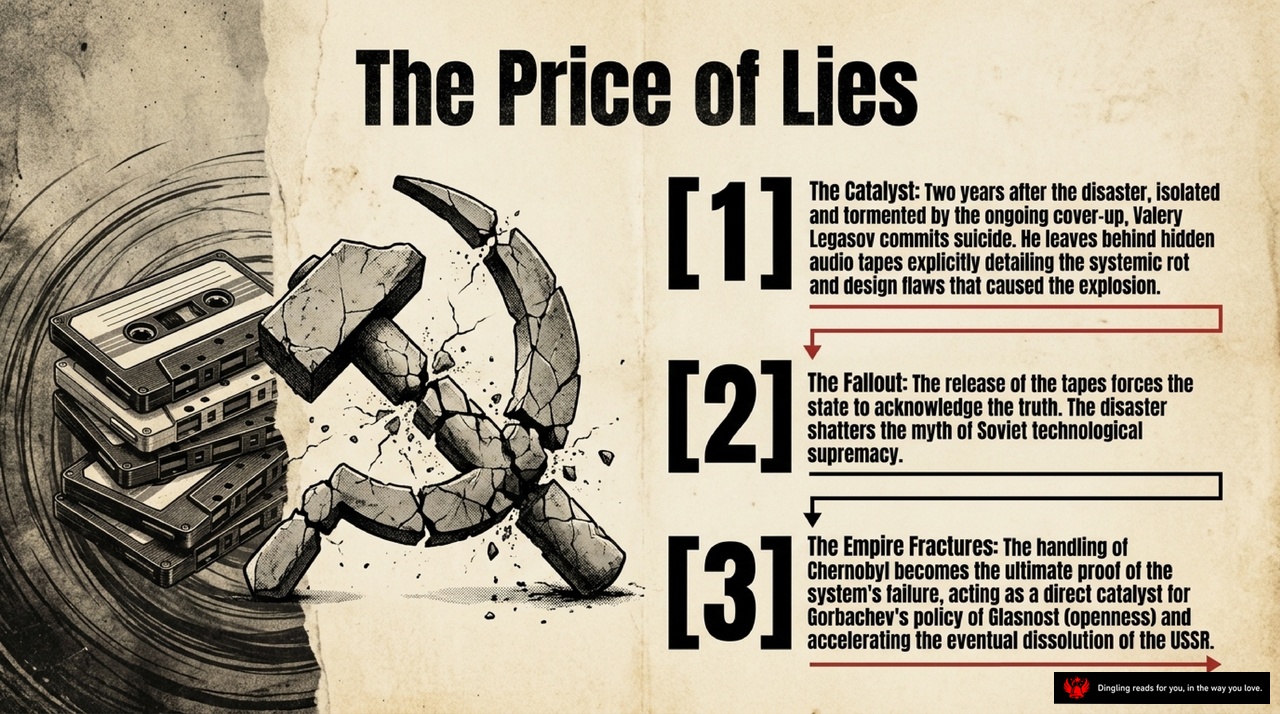
The Price of Lies isn't just a headline; it's the brutal reality of the Soviet collapse. Look at this slide: on the left, a stack of cassette tapes, and on the right, the hammer and sickle shattering into pieces. This visual perfectly captures the three-stage domino effect that destroyed the USSR.
First, we have the Catalyst. Two years after the disaster, Valery Legasov, isolated and tormented by the government's cover-up, took his own life. But he didn't die in vain; he left behind those hidden audio tapes, explicitly detailing the systemic rot and design flaws that caused the explosion.
Then came the Fallout. The release of those tapes forced the state to finally acknowledge the truth. It shattered the myth of Soviet technological supremacy, proving that their "superpower" status was built on a foundation of lies and danger.
Finally, the Empire Fractures. The handling of Chernobyl became the ultimate proof of the system's failure. It acted as a direct catalyst for Gorbachev's policy of Glasnost, or openness, accelerating the eventual dissolution of the USSR. The price of lies, as we see here, was the very existence of the empire itself.
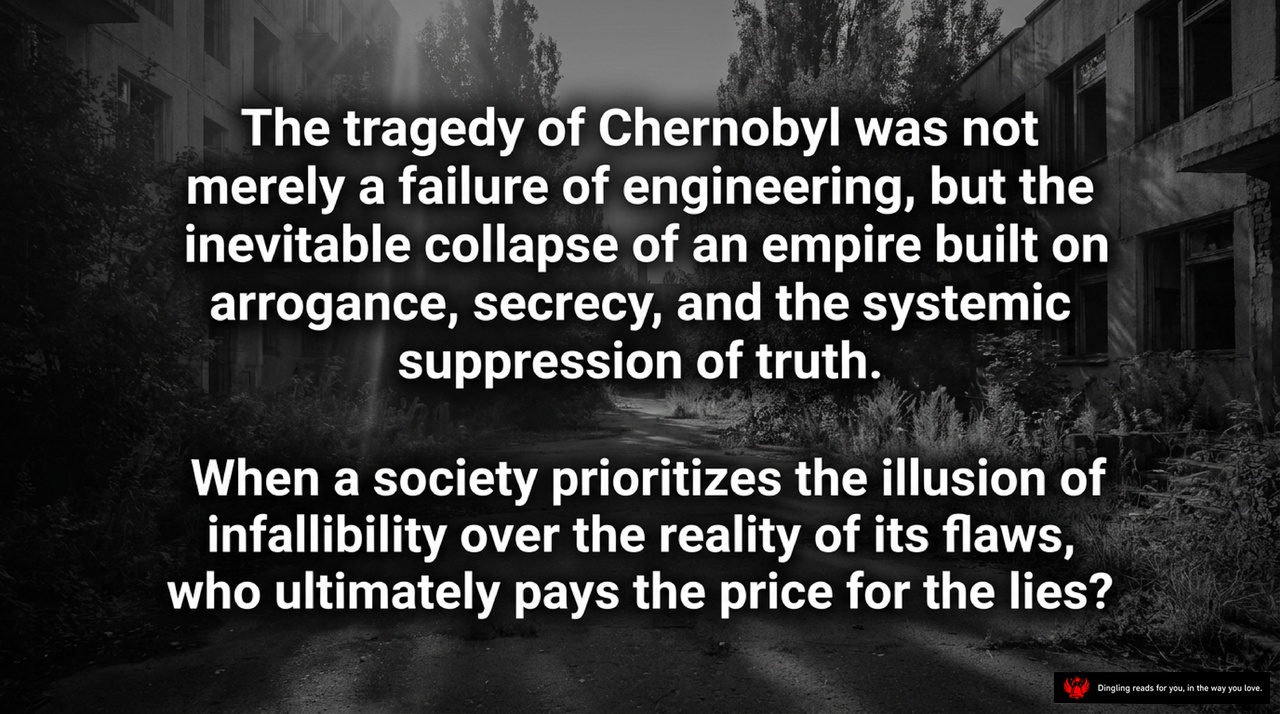
The tragedy of Chernobyl was never just about a broken machine; it was the inevitable collapse of an empire built on arrogance, secrecy, and the systemic suppression of truth. As the slide reminds us, when a society prioritizes the illusion of infallibility over the reality of its flaws, who ultimately pays the price for the lies?
In the years leading up to the disaster, the Soviet leadership chose speed and scale over safety. They rushed to build the RBMK reactor, skipping critical testing phases and ignoring known design defects. When warnings surfaced about the reactor's instability, they were silenced. Instead of fixing the problem, officials buried the evidence, fostering a culture where fear of punishment kept dangerous truths hidden.
This refusal to acknowledge reality created a false sense of security. Workers believed the plant was safe, even as alarms went unheeded and protocols were ignored. The leadership's demand for absolute control meant that no one felt empowered to speak up. When the disaster finally struck, the initial response was paralyzed by the same secrecy that caused it. Lies were told to protect the state's image, but in doing so, they cost thousands of lives and contaminated an entire continent.
Chernobyl stands as a grim monument to the dangers of hiding the truth. It teaches us that no system is foolproof if it refuses to listen to its own warnings. The cost of that arrogance was paid not just by the engineers who lost their lives, but by generations who lived in the shadow of the lies.