
Midnight's Children: Complete Chapter-by-Chapter Summary

Welcome to *Midnight's Children*, by Salman Rushdie. Imagine a single night in 1947, where the birth of a nation and the birth of a child happen at the exact same moment. This is the story of Salim, a boy born under the midnight clock of independence, whose life becomes inextricably linked with the chaotic, magical, and often brutal history of India.
From the very beginning, Salim's world is a tapestry of the impossible. He is born with blue eyes like the Kashmir sky, and he can hear the thoughts of everyone around him—a superpower that quickly turns into a burden. But his story is not just about magic; it is about the fragility of identity. Born into a wealthy family in Bombay, he is secretly swapped at birth with a boy from the slums, a twist that will haunt him for decades.
As he grows, Salim navigates a landscape of shifting borders and rising tensions. He moves from the opulent Meenakshi Apartments to the political turmoil of Pakistan, and eventually to the refugee camps of Bangladesh. Along the way, he meets other "Midnight Children"—children born on that same historic night, each carrying their own unique gifts and tragic destinies. Together, they form a secret society bound by fate, trying to make sense of a country that is constantly tearing itself apart and putting itself back together.
This is a story of love, betrayal, war, and the relentless search for truth in a world where nothing is as it seems. It is a visual synthesis decoding the magical realism, historical parallels, and fragmented truths of a nation's birth. Get ready to enter a world where the past is never dead, and every shadow holds a secret.

On August 15, 1947, at the exact stroke of midnight, India gained its independence. But for one baby, that precise second meant something far more personal: Saleem Sinai was born. This image captures that pivotal moment—a newborn crying into a new era, a clock striking the historic hour, and the map of India celebrating with fireworks. It's the birth of a "Midnight's Child," a destiny inextricably linked to the nation's fate.
The book opens with a powerful metaphor: "I had been mysteriously handcuffed to history, my destinies indissolubly chained to those of my country." From the very first breath, Saleem's life was not his own to shape; it was a script written by the rise and fall of a nation. The novel's central conceit is simple yet profound: the destiny of the child and the destiny of the nation are forever locked together. Just as the clock hands move forward, so does the story of a country, and Saleem is right there in the middle of it, watching history unfold in real-time.

The macrocosm and the microcosm. That's the heartbeat of this novel. It operates on a dual scale: everything that happens to the body politic of the newly independent nation happens literally and physically to the body of Saleem Sinai. The nation's rise and fall are etched directly into his skin.
Look at the face. Kashmir. His blue eyes and immense nose represent his Kashmiri heritage and the towering geography of the north. It's not just a metaphor; it's his physical reality. Then, look at the heart, the political center. His physical health fluctuates directly with the optimism and despair of the new government in Delhi. When the country thrives, he feels strong; when it fractures, he feels weak.
And finally, the cracks. This represents the nation's divide. As the nation physically fractures through partition, linguistic riots, and war, Saleem's physical body literally begins to crack and crumble. The chains binding him are the chains of history, and the map behind him is the map of a country that is bleeding and breaking apart. Saleem isn't just a man living in India; he is India itself, alive, suffering, and dying in real time.

Look at this page, titled "Glossary of Key Motifs." Here, we decode the three most powerful symbols that drive the entire story: The Perforated Sheet, The Silver Spittoon, and The Knees & The Nose.
First, we have The Perforated Sheet. Literally, it represents fragmented perception. Thematically, it symbolizes the inability to see the whole truth at once. It forces the characters to love and understand the world only in disjointed fragments. We see this vividly when Adam Aziz first meets Nasim; she hides behind this sheet with a hole in the middle, showing him only her body parts—a stomach, an ankle, a toe—while her face remains hidden. This barrier defines their early romance, keeping her mysterious and incomplete until she finally reveals her full face years later.
Next is The Silver Spittoon. Its literal meaning is amnesia and debris. Thematically, it serves as a vessel for discarded things, representing the loss of historical memory and the ultimate disposability of the past. This object appears as a haunting symbol of what has been forgotten or cast aside, a physical reminder of the erasure of history that permeates the narrative.
Finally, we have The Knees & The Nose, representing the Ultimate Duality. The Nose represents Saleem, symbolizing synthesis, telepathy, and creation. It is the mark of his unique connection to the world and his family's legacy. In contrast, the Knees represent Shiva, the antagonist, embodying war, brute force, and destruction. This duality perfectly mirrors the conflict between the two boys born at midnight, one destined to witness the nation's history through empathy, and the other to destroy it through violence. These three motifs are not just illustrations; they are the DNA of the story, weaving together the personal tragedies of the characters with the grand, chaotic history of a nation.

Welcome back to our deep dive into *Midnight's Children*. Today, we are stepping back to understand the unique mechanism that drives the entire narrative of Saleem's life. Look at this diagram titled "The Human Radio Receiver." This isn't just a metaphor; it is the biological and psychological architecture of the protagonist.
Saleem acts as a telepathic radio receiver. This allows Rushdie to blend intimate personal secrets with vast national movements, placing the entire continent inside one child's head.
Let's break down the three frequencies illustrated here. First, we have Frequency 1: All India Radio. This represents the literal radio waves of political broadcasts and national news. For Saleem, the radio is the primary lens through which he perceives history. The events of the nation—Independence, Partition, the Emergency—are not distant; they are broadcast directly into his consciousness.
Next is Frequency 2: The Mother's Mind. This is about tuning into the secret, guilty thoughts of the adults around him. Saleem doesn't just hear what his parents say; he hears what they are thinking. He absorbs the hidden anxieties of his father, the repressed desires of his mother, and the silent fears of the era. This frequency makes him a vessel for the family's unspoken trauma.
Finally, we have Frequency 3: The MCC. This stands for the Midnight Children Conference. It represents the babble of 581 distinct voices of the other magic children entering his brain. When Saleem was born, he didn't just enter a world; he entered a network. He is connected to every other child born at the stroke of midnight on August 15, 1947. Their joys, their sorrows, and their deaths resonate through him.
So, when you read the book, remember that Saleem is constantly receiving signals on all three channels. He is the antenna for India's history, the decoder of his family's secrets, and the collective voice of a magical generation. This triad of frequencies is what makes his story so powerful—it proves that in this world, no one is truly alone.

Imagine a spectrum where magic doesn't stay constant, but fades like the light just after midnight. On this scale, we see the tragic arc of the Midnight's Children Conference. At the very start, at 12:00 AM, lies "The Miraculous." These children, born closest to the stroke of midnight, possess god-like powers—time travel, alchemy, and even telepathy. They are the divine, the extraordinary.
But as the clock ticks forward to 12:30 AM, the spectrum shifts into "The Mutated." Here, the powers degrade. They don't vanish completely; they twist into mere physical oddities or circus-freak mutations. The magic becomes grotesque, a distorted reflection of the original wonder. By 1:00 AM, the spectrum ends in tragedy.
This isn't just about magic; it's a metaphor for the nation itself. These children represent the pluralism and hope of the new India, but ultimately, they represent its failure. They spend their lives arguing over capitalism versus communism, individualism versus collectivism. In their endless debates, they fracture their own magical union, proving that even the most powerful bond cannot survive the weight of political chaos. It is the ultimate irony: the children born to save a nation end up destroying the very community they were meant to unite.

Indissolubly Chained: The Dual Timeline. Look at this graphic; it perfectly captures the brutal reality of Saleem's life. It's not just a personal story; it's a map of a nation's scars, where every political earthquake in India and Pakistan directly shakes the foundation of one man's existence.
On the top line, you see India's Political Milestones. It starts in 1947 with Independence and Partition. This is the moment Saleem is born, swapped at birth by Mary Pereira, unknowingly becoming the child of the poor instead of the wealthy, binding his very DNA to the new nation. Then, in 1958, the Military Coup in Pakistan. This isn't just a headline; it's the moment Saleem's finger is mutilated and he is exiled to Pakistan, physically torn from his roots. Fast forward to 1965, the Indo-Pak War. The bombs falling here are the ones that kill Saleem's family and erase his memory, leaving him as a ghost of his own life. Finally, in 1975, Indira Gandhi declares The Emergency. This is the climax where Saleem is captured and surgically sterilized, his future literally cut off by the state.
Now, look at the bottom line: Saleem's Physical and Personal Milestones. These aren't random tragedies; they are the direct echoes of the history above. When the country splits, his parents swap him. When the army takes over, his body is punished. When the war erupts, his home is destroyed. When the state becomes totalitarian, his body is violated. The heavy chains connecting these two timelines show that Saleem was never an observer of history. He was its victim, its witness, and ultimately, its prisoner. His life proves that in times of chaos, no individual is safe, and no private moment is truly private.

Welcome to the core conflict of the story. Imagine two babies, born on the exact same night in 1947, destined to become the mirror of a new nation. But a desperate nurse, driven by a twisted sense of social justice, swaps them at the hospital.
On one side, you have Saleem Sinai, or "The Nose." He is raised in immense wealth, surrounded by servants and sprawling estates. His magic is telepathy—the ability to connect, listen, and synthesize voices. He represents creation, pluralism, and the heavy burden of history.
On the other side is Shiva of the Knees, or "The Knees." He is raised in abject poverty, singing on the streets. His power is combat—unmatched physical prowess and the ability to destroy. He stands for destruction, individualism, and the harsh reality of survival.
These two lives are inextricably linked. Saleem lives Shiva's life of privilege, while Shiva inherits Saleem's life of poverty. Their conflict isn't just personal; it is the conflict of post-colonial India itself. One builds, the other breaks. One listens to the world, the other fights it. This duality defines their journey from birth until the very end.

The Cracking: The Decline of Magic. Look at that shattered mirror. It represents the moment the illusion of a magical nation finally breaks apart. We are moving from the hopeful optimism of independence into a brutal authoritarian reality.
First, there was The State of Emergency between 1975 and 1977. That was the point where the dream of freedom dissolved completely into authoritarian rule. The government stopped trusting its own people.
Then came The Widow's Hand. This is a terrifying metaphor for how the state actively hunted down the Midnight Children. The government feared their pluralistic power, their ability to question authority, and saw them as a rival threat. So, they didn't just ban them; they hunted them.
And finally, The Sperectomy. This is the most brutal act of all. It was a literal and metaphorical castration. The children were surgically sterilized, permanently draining the magic and hope from the nation's future. It wasn't just about punishment; it was about ensuring the "miracle" of India could never be reproduced again. The magic was cut out, just like a tumor, leaving behind a sterile, controlled, and dead future.

Welcome to the concept of "The Pickling of History." Imagine history not as a static record of facts, but as a jar of pickles, where raw ingredients transform over time into something entirely new. In this slide, we see that formula clearly: take Raw Facts, which are just the bare bones of historical events, and add Spices—representing human emotion, bias, and the inevitable fallibility of memory. Then, let Time act as the fermentation process. Just as vegetables sit in brine and change flavor, memories sit in the crucible of years, altering and exaggerating until they become something different from the original truth.
This is the core metaphor Saleem uses: he operates a pickle factory, not to preserve history perfectly, but to create "Pickled History." Rushdie asserts here that absolute historical truth is impossible because memory itself is selective. We don't just remember what happened; we select, alter, and exaggerate the details to fit our own narratives. The result? A history that might be factually flawed, yet feels emotionally and structurally true. It becomes a personal truth, a reality that resonates with us even if the dates and events are distorted. So, when we look at the past, we aren't seeing the original object; we are seeing the pickled version, seasoned by our own lives and the passage of time.
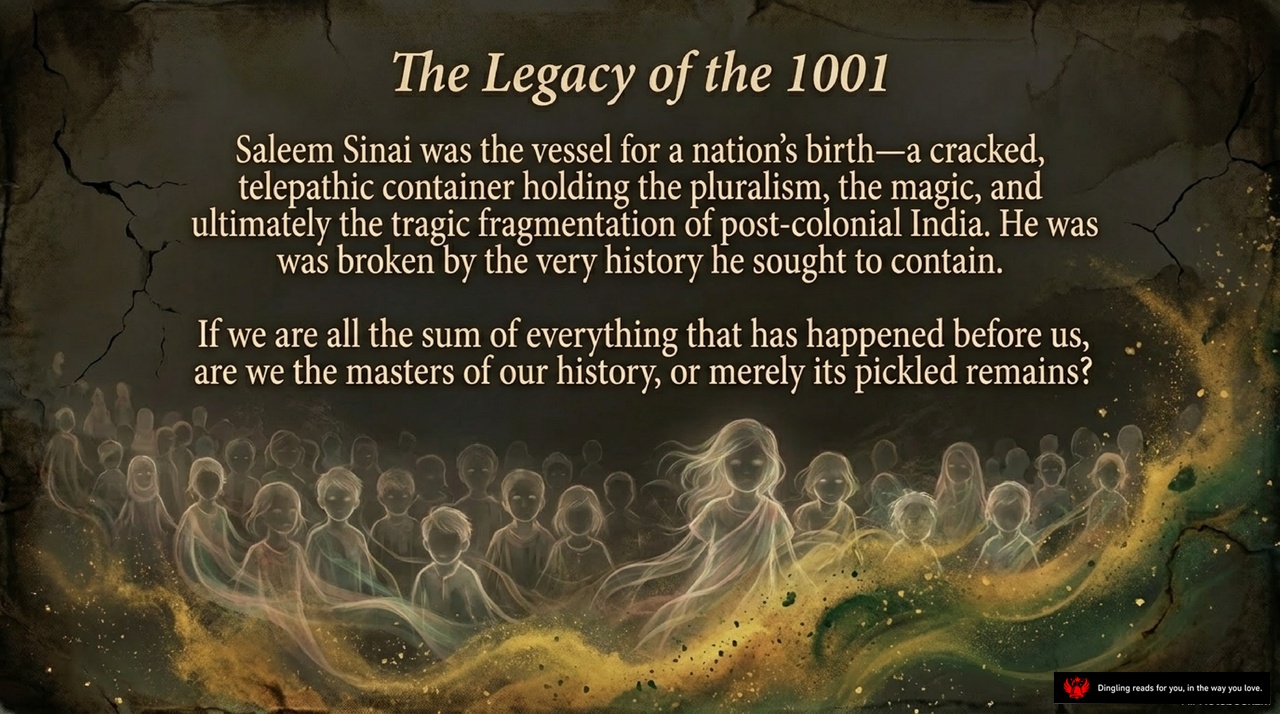
The legacy of the 101 isn't just about numbers; it's about the heavy, invisible weight of history passing through us. As the slide reveals, Saleem Sinai was never just a man; he was a cracked, telepathic container holding the pluralism, the magic, and ultimately the tragic fragmentation of post-colonial India. He was broken by the very history he sought to contain.
This image captures the haunting truth of that burden. Look at the swirling, ghostly figures at the bottom—these are the echoes of the past, the countless lives that shaped him. The text asks a question that cuts deep into our own existence: If we are all the sum of everything that has happened before us, are we the masters of our history, or merely its pickled remains?
In Saleem's life, the answer is often a painful mix of both. He tries to steer his destiny, to be the master, but he is constantly pulled by the forces of partition, war, and the secrets hidden in his family's laundry boxes. We are all, in a way, pickled remains, preserved by the choices of our ancestors and the chaos of our times. But even as we are shaped by them, we leave our own marks, however faint, on the river of time that flows endlessly forward.