
Misbehaving: Complete Chapter-by-Chapter Summary

Welcome to *Misbehaving*, by Richard H. Thaler. This isn't just another book about economics; it's a field guide to the predictable, systematic irrationality of Homo Sapiens.
For decades, the standard model assumed we were all perfectly rational agents, making optimal choices to maximize our utility. But the truth? We don't. We are prone to biases, overconfidence, and emotional reactions that throw logic out the window.
Think about it: you might hold onto a stock that's tanking just because you bought it, ignoring the reality that you'd never buy it today at that price. Or you might stick with a failing project simply because you've already spent so much on it. These aren't random mistakes; they are patterns.
Thaler introduces us to the concept of "mental accounting," where we treat money differently depending on where it came from or what we plan to do with it. We feel the pain of a loss twice as hard as the joy of an equivalent gain, a phenomenon known as loss aversion. This simple insight explains everything from why we hate paying taxes to why we love buying things on sale.
This book dives deep into how psychology and economics collide, challenging the old ways of thinking and showing us that understanding our irrational side is the key to making better decisions—in our wallets, our careers, and our lives.
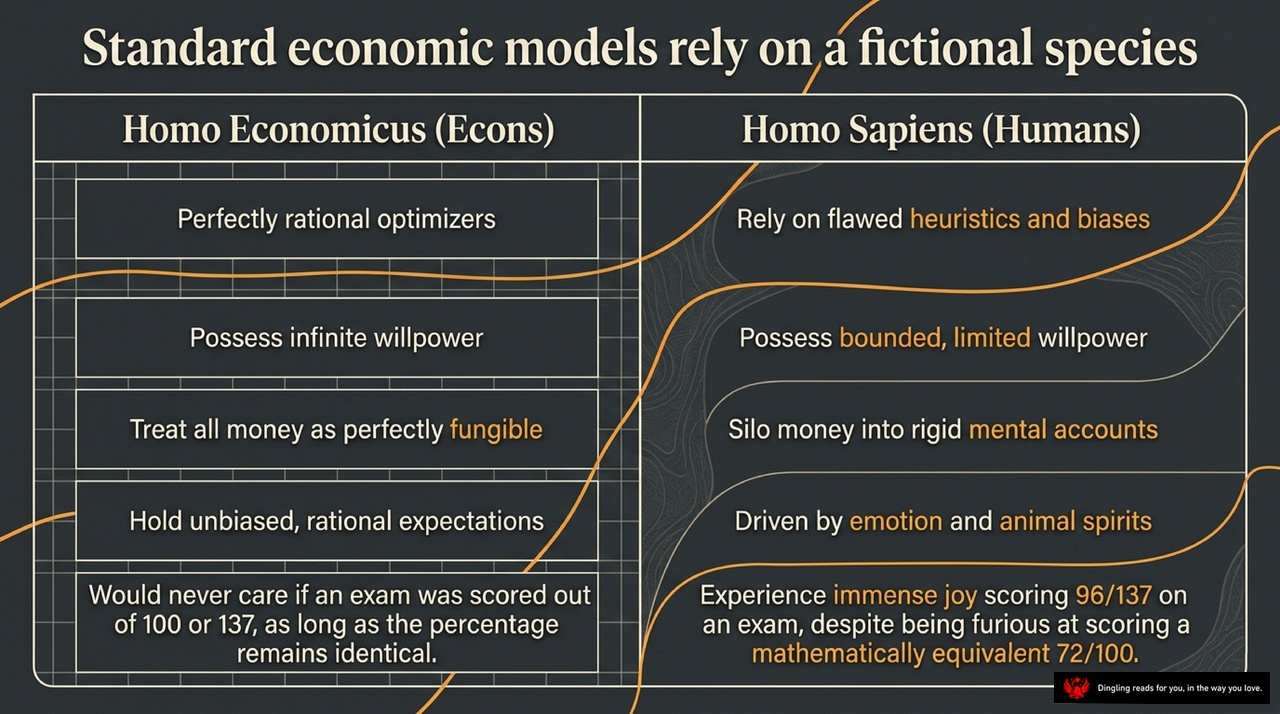
Standard economic models rely on a fictional species called Homo Economicus—perfectly rational optimizers with infinite willpower who treat all money as perfectly fungible. But real humans, or Homo Sapiens, operate very differently. We rely on flawed heuristics and biases, possess bounded willpower, and instinctively silo money into rigid mental accounts. Instead of holding unbiased expectations, we are driven by emotion and animal spirits.
Consider the exam scenario on the right: a rational econ would care only about the percentage, indifferent between scoring 96 out of 137 or 72 out of 100. But humans experience immense joy at the 96, despite it being mathematically equivalent to the 72. We feel pain from losses twice as strongly as we feel pleasure from gains, and we cling to what we already own. These aren't just quirks; they are the fundamental reality that standard models ignore, proving that our decisions are often shaped by how we frame them rather than pure logic.

Humans don't just look at how rich we are; we react to how our wealth changes. This slide captures a profound truth about human psychology: we process changes in wealth rather than absolute levels.
Notice that S-shaped curve in the center. It represents our "Psychological Impact" relative to a "Reference Point," which is essentially our current status quo. The graph reveals two critical insights. First, look at the right side: "Gains yield diminishing joy." As we accumulate more wealth, each additional dollar brings us less happiness than the last. We adapt to our new environment quickly.
But look at the left side. The text warns that "Losses inflict agonizing pain," and crucially, "Pain of loss is roughly 2x the joy of equivalent gain." This is the concept of loss aversion. Losing $100 hurts us twice as much as gaining $100 feels good. This asymmetry explains why we are so risk-averse and why we cling so tightly to what we already own.
The bottom right box summarizes it all: instead of experiencing life through absolute states of wealth, we adapt to our current environment and react almost exclusively to variations. We are inherently wired to despise losses. This isn't just a quirk; it's the fundamental engine driving how we make financial decisions, from holding onto losing stocks to refusing to sell winning ones.

Have you ever noticed how the moment you own something, your perception of its value instantly changes? It's a psychological quirk called the Endowment Effect. Look at the coffee mug on the left. If you weren't holding it, you'd probably only pay about $2.75 to buy it. But the second you own that same mug, suddenly you demand around $5.25 just to give it up. The value didn't actually change; your ownership did. You've shifted your baseline.
Now, let's look at the bottle of wine on the right. Professor Rosett bought this bottle for just $10. Years later, its market value skyrocketed to $100. A local merchant offered to buy it for that full $100. Here is the fascinating part: Professor Rosett refuses to sell his existing bottle, yet he also refuses to buy a brand new bottle for the same $100. Why? Because to him, the $100 represents a painful loss of something he already owns, whereas buying a new one is just an expense.
This brings us to a crucial conclusion. To a human being, out-of-pocket expenses feel vastly more painful than the opportunity costs of simply not selling. We suffer twice as much from losing what we have as we enjoy gaining what we don't. This isn't just about mugs or wine; it's a fundamental rule of how we value our lives. We hold onto things, not because they are objectively more valuable, but because letting go feels like a personal loss.

Imagine you're at a casino, and you've just lost a few dollars. The rational move, according to traditional economics, is to walk away and keep your remaining chips. But what do you actually do? You double down. You bet bigger, hoping to win back exactly what you lost. This isn't just gambling; it's a trap that "dead costs" set for us every single day.
The slide you see right now highlights a critical flaw in how we make decisions: we let the past dictate our future. Look at the scale. On one side, we have "Irrecoverable Past Investment"—money already spent that we can't get back. On the other, we have "Actual Future Utility," which is the real value of our next move. The problem? We weigh the past so heavily that it crushes the future.
Take Vince, for example. He pays $1,000 for a tennis club membership. Two months later, he develops severe tennis elbow. Painful, right? A rational economist would say, "Stop playing. The $1,000 is gone regardless of whether you play or not." But Vince, a human, plays in agony for three more months. Why? Because he can't accept the loss. He keeps playing just to "not waste the sunk cost."
Or consider a fan who buys an expensive ticket for a basketball game. A severe blizzard hits, making the drive dangerous. If the ticket were free, he'd stay home. But because he paid for it, he risks his life driving through the snow. He endures negative utility—pain and danger—simply to avoid declaring a past investment a definitive loss.
This is the power of sunk costs. They linger in our mental ledgers, poisoning our live decisions. We aren't making choices based on what's best for tomorrow; we're making them to justify yesterday's mistakes. We endure pain and risk not because it makes sense, but because walking away feels like admitting we were wrong. That is the active poison of dead costs.

Anomaly III: The illusion of perfectly fungible money. Here's the twist: money is the same, but our brains treat it differently depending on where it comes from or where it's spent.
Traditional economics assumes money is purely about value—what an item is worth minus what you gave up to get it. But humans care about something else: transaction utility. This is the psychological feeling of the deal. Does it feel like a steal, or like a great bargain?
Consider the "Beer Experiment." Imagine you're craving a beer at the beach. If you buy it from a run-down grocery store, you might only pay $4.10. But if you buy the exact same beer from a luxury resort, you're willing to pay $7.25. The consumption experience is identical, yet the context changes everything. That extra $3.15 isn't for the beer; it's for the feeling of getting a premium deal at a premium location.
This explains why companies use "suggested retail prices" or "sale" tags. They aren't just showing numbers; they're manipulating your reference point to make you feel like you're winning. When you feel like you've won a deal, you're happy, even if the actual product hasn't changed. It's the power of the illusion that money is always fungible, when in reality, our psychology makes it feel like different currencies entirely.

Behavioral economics isn't just about theory; it's about proving that even when the stakes are life-changing, human psychology still drives the decisions. In 2005, we tested this in the high-pressure environment of Dutch TV game shows like "Deal or No Deal," where contestants faced millions of euros. Standard economic models predicted extreme risk aversion at these levels, yet our data showed the opposite. Players often took massive risks, displaying a "hot hand" fallacy similar to gamblers.
We also uncovered a powerful phenomenon called "path dependence." One contestant, Frank, had lost heavily in earlier rounds. Even when offered a guaranteed 6,000 euros—far better than his expected future value—he foolishly chose to gamble again, ultimately winning only 10 euros. Conversely, a winner named Susanna, facing the same expected value, confidently chose to gamble and walked away with 150,000 euros. This proves that past wins or losses distort our perception of the present moment.
Interestingly, we found that public scrutiny makes people more conservative, but the path dependence remains regardless of the audience. Even in high-stakes scenarios like the "Golden Balls" game, where players could split or steal up to $175,000, cooperation rates didn't plummet as theory predicted. We proposed the "Big Peanut" hypothesis: when the prize feels relatively small compared to the situation, people are more willing to be fair. One clever player even used a bluff to force his opponent into a cooperative choice, splitting the pot. These real-world experiments confirm that even with huge money on the line, we aren't rational calculators; we are creatures of habit and emotion, constantly influenced by our history and the immediate context.

Markets aren't always efficient, and they don't always reward fairness. In fact, they often punish it. This slide highlights a fascinating anomaly: when people perceive a transaction as unfair, they are willing to sacrifice their own financial gain just to punish the other party.
Look at the "Ultimatum & Dictator Games" on the right. In a standard economic model, if you offer someone $1 out of $20, they should accept it because $1 is better than nothing. But real humans are different. We regularly reject insulting offers, even if it means walking away with nothing, just to inflict financial punishment on the bad actor. We will gladly pay a cost to enforce fairness.
Now, compare that to the "Snow Shovel" scenario on the left. When a blizzard hits and a hardware store raises prices from $15 to $20, pure market efficiency says this is perfect—supply meets demand. But 82% of survey respondents view this price hike as completely unfair, seeing it as gouging.
This illustrates the shift from Pure Market Efficiency to Human Fairness. While traditional models assume we act purely on rational self-interest, the reality is that our sense of fairness drives powerful economic behaviors, sometimes causing us to lose money just to say, "No, that's not fair."

The macro view reveals a hard truth: high stakes do not eliminate behavioral bias. As we see here, the "Law of One Price"—the idea that identical assets must have the same price—is frequently violated by human psychology. Take the case of 3Com and Palm. When 3Com spun off Palm in an IPO, retaining 95% of the company, the market irrationally valued Palm so highly that 3Com's implied business value dropped below zero. In an efficient market, this is mathematically impossible. Yet, humans proved that prices can be wildly and demonstrably wrong.
This happens because of the "Value Stock Reversal." We often overreact to recent bad news, driving value stocks too low, and extrapolate recent good news, inflating growth stocks too high. The market eventually corrects these psychological overreactions, but not instantly. This disconnect between how we perceive value and how assets are actually priced is the core lesson of the macro view. Even when the financial consequences are massive, our behavioral biases still dictate the outcome, proving that traditional models of perfect rationality simply don't hold up in the real world.
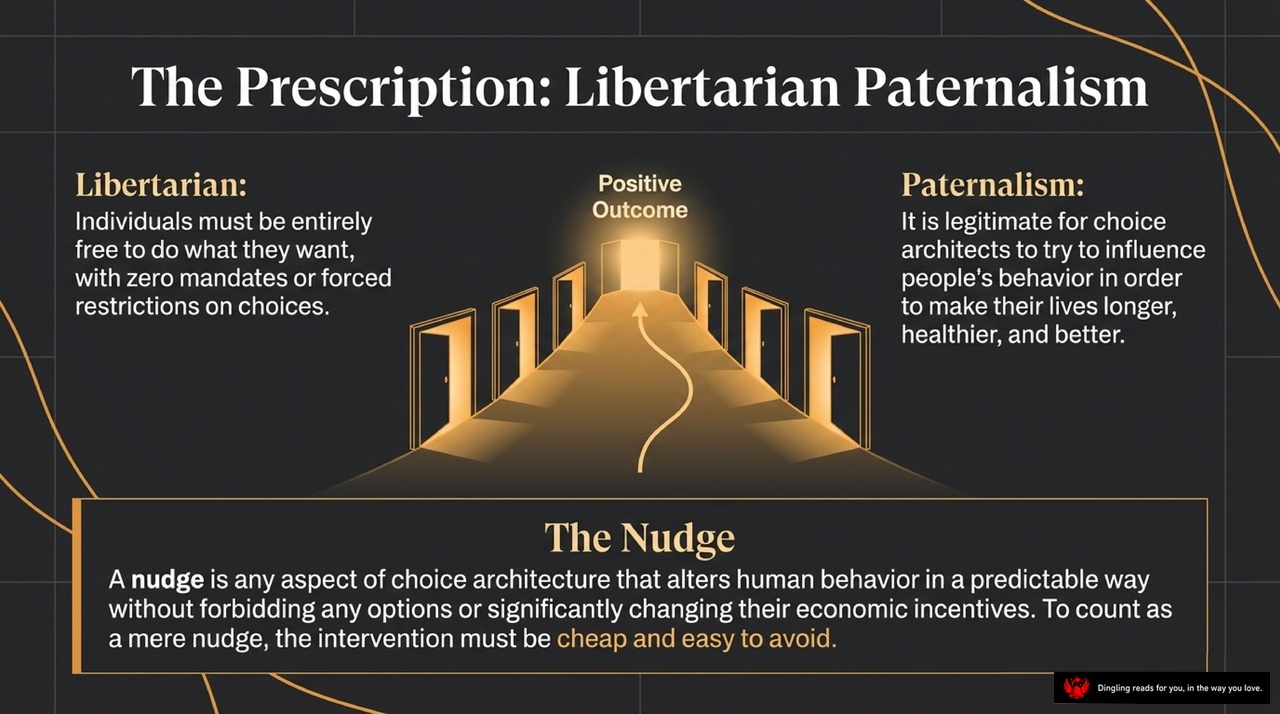
The image presents a powerful synthesis of two seemingly opposing philosophies: Libertarianism and Paternalism, blending them into a concept called "Libertarian Paternalism." On one side, Libertarianism champions absolute freedom, insisting individuals must be entirely free to do what they want with zero mandates or forced restrictions. On the other, Paternalism argues that it is legitimate for choice architects to influence behavior to make lives longer, healthier, and better. The visual metaphor of a hallway with a central path leading to a glowing "Positive Outcome" perfectly illustrates how these forces converge.
This convergence is the essence of "The Nudge." As the slide defines, a nudge is any aspect of choice architecture that alters human behavior in a predictable way without forbidding any options or significantly changing economic incentives. Crucially, for an intervention to count as a mere nudge, it must be cheap and easy to avoid. This is the sweet spot where we respect individual liberty while guiding them toward better decisions. Instead of forcing people down a specific path, we simply make the better choice the path of least resistance. Whether it's saving for retirement or making healthy food choices, the goal isn't to control, but to gently steer. By understanding the human mind's predictable quirks, we can design environments where freedom and positive outcomes walk hand in hand.

Choice architecture isn't just a buzzword; it's about designing for how humans actually behave, not how we wish they would. Look at the two powerful strategies on this slide: Environmental Design and Overcoming Present Bias.
First, consider Environmental Design. Schiphol Airport didn't rely on signs begging people to be clean. Instead, they etched a fly image into the urinals. By giving humans a specific target to aim at, they turned a messy habit into a precise one. The result? Spillage dropped by 80%. This proves that a microscopic design element can drive a profound behavioral shift.
Next, look at how we overcome Present Bias. Humans hate losing current take-home pay and often lack the willpower to save for the future. That's why programs like "Save More Tomorrow" work so well. Instead of asking people to cut their current paycheck, employees commit now to allocating a portion of *future* salary increases toward retirement. They never see their paychecks shrink. In this system, the Planner wins before the Doer can even spend the money. These examples show that by aligning our environment with our psychology, we can guide people toward better outcomes without forcing their hand.

We often build our world based on a dangerous fantasy: that humans are calculating, emotionless, and flawlessly rational. But reality tells a different story. As the text reminds us, we are profoundly, beautifully flawed. Our irrationality isn't random chaos; it is perfectly predictable.
So here is the burning question we must face: If human irrationality is so predictable, why are we still designing systems, laws, and markets for a species that does not exist?
The answer lies in accepting our cognitive limits. When we stop pretending to be robots and start designing for the messy, emotional, and biased humans we actually are, we can finally build systems that work for real people. It's time to stop designing for fiction and start building for reality.