
Models of My Life: Complete Chapter-by-Chapter Summary
Welcome to our reading session on *Models of My Life* by Herbert A. Simon. This cover sets the stage for a fascinating journey into the mind of a true polymath. As the title suggests, Simon didn't just live a life; he built models to understand it. The text on the screen describes him as a pioneer who navigated the complex maze of human cognition to pioneer artificial intelligence and redefine how we think about economic rationality.
In this book, Simon takes us from his childhood in Milwaukee to his groundbreaking work at the intersection of psychology, economics, and computer science. He challenges the idea that humans are perfectly rational calculators, proposing instead that we are "satisficers"—people who seek solutions that are good enough, rather than perfect. Through his personal story, we see how a man who loved puzzles, from chess to city planning, eventually helped create the machines that now think alongside us. This is not just a biography; it is a masterclass in how to think in a complex world. Let's dive into the chapters ahead.

This infographic highlights Herbert A. Simon as the ultimate "20th-Century Renaissance Scientist," a title that perfectly captures his unique ability to bridge the gap between the physical and social worlds. At the center of this network are his two most prestigious crowning achievements: the Turing Award in 1975 for his foundational contributions to Artificial Intelligence, and the Nobel Prize in Economics in 1978 for his pioneering research into decision-making within economic organizations.
But what makes Simon truly special is how these seemingly distinct fields are actually connected by one core thread: human decision-making. As the graphic illustrates, his influence radiates outward into five major disciplines. In **Computer Science**, he didn't just build machines; he taught them to think by simulating human problem-solving. In **Cognitive Psychology**, he broke the "black box" of the mind, showing us that we don't always calculate the perfect answer, but rather settle for a "good enough" one. This concept of "satisficing" revolutionized how we understand human behavior.
This insight then reshaped **Economics** and **Management**, proving that traditional models of perfect rationality were flawed because they ignored real human limits. Even **Political Science** and **Industrial Administration** were transformed by his work, moving away from abstract theories to empirical, data-driven analysis of how organizations and societies actually function. Simon didn't just contribute to these fields; he fundamentally rewrote the rulebook for each, proving that understanding how humans make choices is the key to unlocking progress across all of science.

Imagine you are trapped in a dark, stone labyrinth with no windows, where every turn feels like a gamble between survival and despair. This is "The Mythic Maze"—a metaphor for the old way of thinking where we obsess over finding the single, perfect escape route, driven by fear and the desperate need for an optimal solution. But what if the maze wasn't meant to be escaped, but explored? What if there was no monster at the end, only a branching path of choices waiting for us?
This is "Simon's Labyrinth." Unlike the terrifying stone walls of the mythic version, Simon's maze is built of light and branching circuits, representing curiosity, heuristic search, and the continuous branching choices that define human life. In this version, every fork isn't a trap; it's a human choice in navigating complexity. We stop trying to calculate the perfect path and instead settle for a "good enough" solution that allows us to move forward. This shift from fear-driven survival to curiosity-driven exploration is the heart of bounded rationality, transforming our experience from a nightmare of uncertainty into a vibrant journey of discovery.

Look at this matrix comparing two very different ways we make decisions. On the left, you have the Classical Economics model, often called "Homo Economicus." It assumes we have infinite time and computing power, know everything about every possible option, and relentlessly hunt for that single, perfect "optimal" choice. It's a beautiful, logical fantasy, but it doesn't match reality.
Now, look at the right side: Simon's Model of Bounded Rationality. This is how we actually operate. We have limited cognitive resources and time. We can't see the whole maze of possibilities. Instead of trying to find the absolute best path, we engage in a sequential, heuristic search through a limited space. We stop as soon as we find something that is "good enough" to meet our criteria. We seek a "satisficing" choice, not an optimal one.
This shift from "optimizing" to "satisficing" is the core of human behavior. It explains why we don't compare every job offer forever, why companies aim for a target profit rather than infinite growth, and why we rely on mental shortcuts. The image perfectly captures this contrast: the rigid, all-knowing machine on the left versus the flexible, adaptive human on the right. Our rationality is bounded by our limits, and that's exactly why our decisions are so effective.
The dawn of artificial intelligence wasn't a sudden explosion, but a quiet convergence of ideas from psychology, logic, and engineering. Before the 1950s, most psychologists treated the human mind as a black box, ignoring the internal mechanics of how we think. But pioneers like Piaget and Gestalt psychologists were already mapping the territory of cognitive processes, laying the groundwork for what was to come.
In the mid-1950s, the stage was set. The rise of cybernetics, the physical reality of digital computers, and the mathematical rigor of logic all aligned. It was time to stop asking *what* we think, and start building machines that could *do* what we think.
This is where my work with Allen Newell and Cliff Shaw changed everything. We realized that human problem-solving followed a specific, logical pattern: comparing the current state to the goal state, and taking steps to close the gap. This "means-end analysis" became the core of our General Problem Solver.
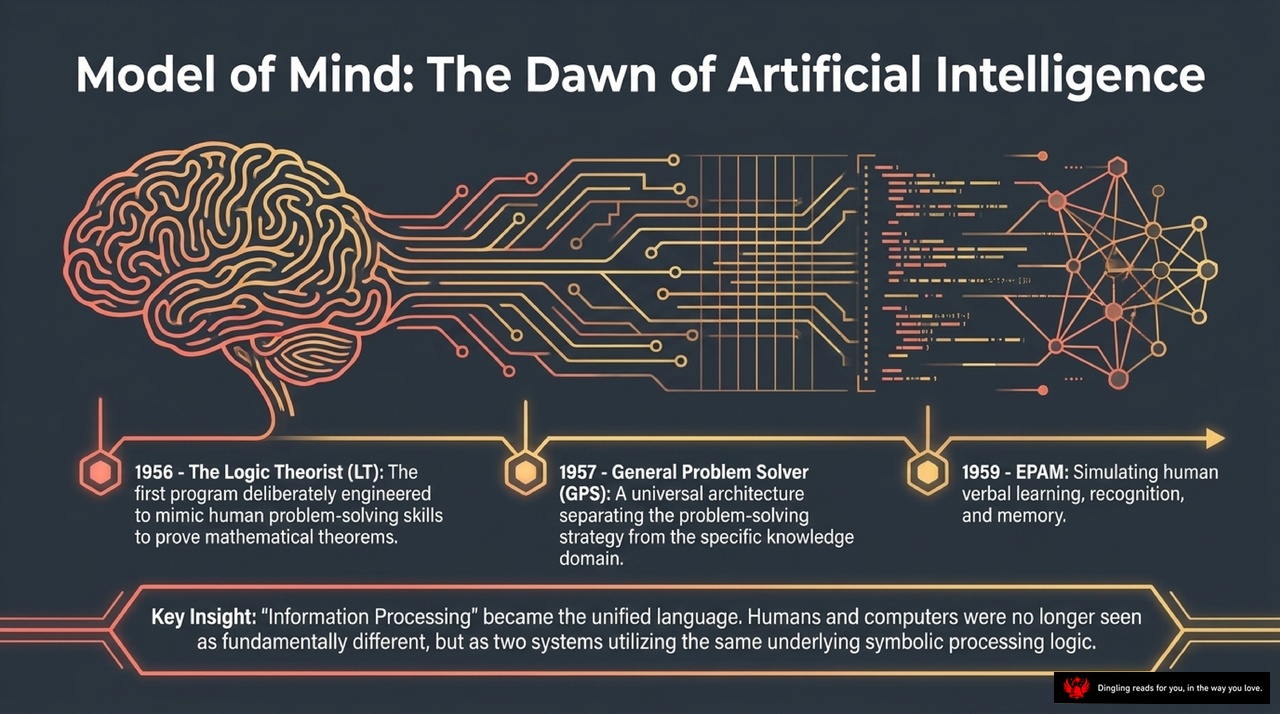
Our breakthrough moment came in 1956 with the Logic Theorist. We programmed a computer to prove mathematical theorems from Russell and Whitehead's *Principia Mathematica*. Not only did it succeed, but it even found a proof that was more elegant than the one in the original book. This proved a radical point: machines could mimic human reasoning.
We also invented a new way to store information, using lists and pointers to mimic human memory structures. This approach became the ancestor of the LISP programming language and shaped the future of computer science.
By 1957, we had built the General Problem Solver, a universal architecture that could solve any problem by separating the strategy from the specific knowledge. We also developed EPAM, a model that simulated how humans learn and recognize verbal patterns.
These milestones—Logic Theorist, GPS, and EPAM—marked a turning point. "Information processing" became the unified language connecting humans and machines. We no longer saw ourselves as fundamentally different from computers; we were now two systems operating on the same symbolic logic. The age of artificial intelligence had officially begun.
So, let's dive into the very moment Herbert Simon realized that the old rules of "perfect rationality" were actually broken. Think about it: we've all been there. You're trying to solve a complex problem, maybe choosing a career or making a big investment, and you realize you simply don't have enough time or information to calculate the absolute best answer. You can't see every possible path in that maze.
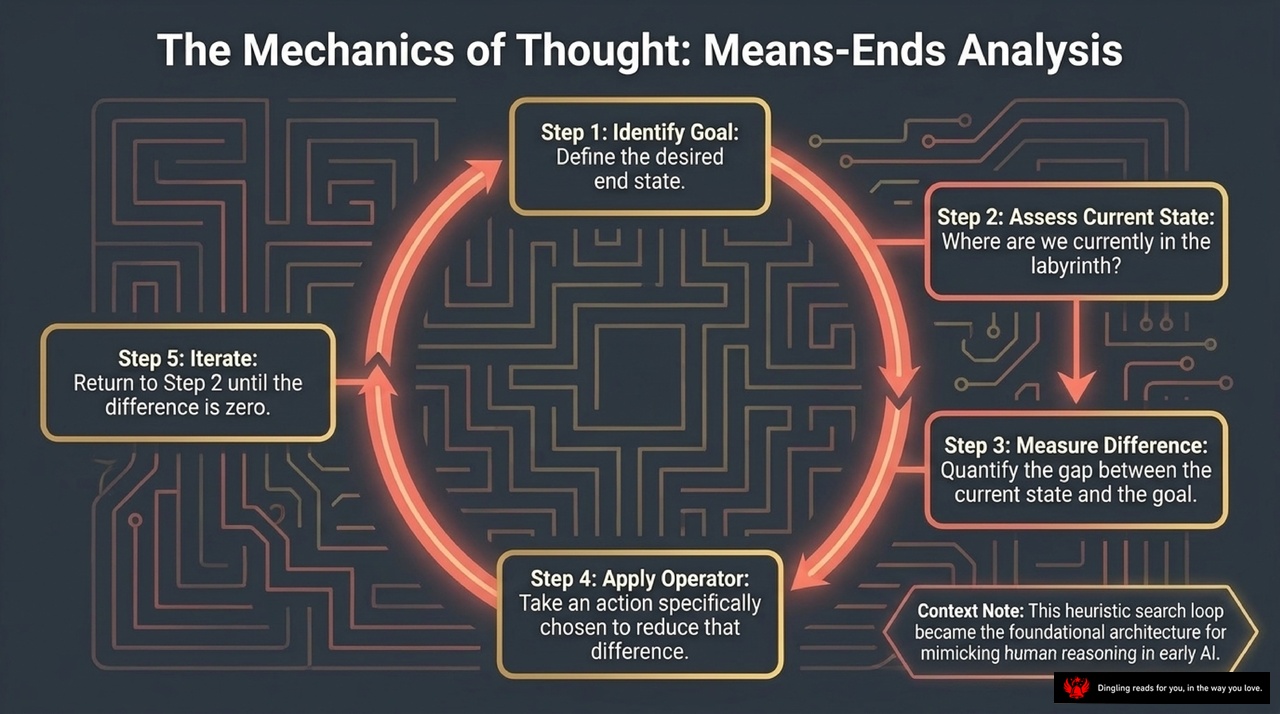
This is exactly where Herbert's famous "Means-Ends Analysis" comes in. As you can see on this slide, it's not about finding the perfect solution; it's about reducing the gap between where you are and where you want to be. Step one is identifying your goal. Step two is honestly assessing your current state. Then, in step three, you measure the difference. The magic happens in step four: you apply an operator—an action specifically chosen to close that gap. You don't need the perfect move; you just need *a* move that gets you closer.
If that move doesn't get you there yet, you loop back to step two. That's step five: iterate. You keep doing this until the difference is zero. This isn't just a management trick; it's how our brains actually work. It's a heuristic search loop. In fact, this exact architecture became the foundational blueprint for early AI, allowing machines to mimic human reasoning by searching for "satisficing" solutions rather than impossible optimal ones. It's a powerful reminder that in a complex world, the smartest thing you can do is just take the next best step.

Let's rethink what it actually means to be a scientist. For decades, the popular myth has been that discovery is a flash of inexplicable genius—a sudden, magical epiphany reserved only for extraordinary minds like Einstein. But the reality, as Herbert Simon showed us, is far more grounded and replicable.
Discovery isn't magic; it is structured problem-solving. Scientists navigate a vast "problem space," systematically looking for patterns and connections. Simon proved this wasn't just theory by building AI programs like BACON and KEKADA. These algorithms independently rediscovered Kepler's Third Law of Planetary Motion and modeled the discovery of the Krebs cycle, proving that scientific breakthroughs are essentially algorithmic, replicable searches.
This shift in perspective changes everything. It means that creativity isn't a mystical gift, but a skill anyone can learn by mastering the art of heuristic search. We don't need to be geniuses to make discoveries; we just need the right tools and the patience to explore the maze of possibilities until we find a solution that satisfies our needs.

Welcome to the final chapter of our journey through Herbert Simon's life and work. Today, we are looking at the synthesis of his entire intellectual legacy: the "Liberal-Vocational Synthesis."
As you see on this slide, Simon believed that true education—and by extension, true freedom—lies at the intersection of two distinct paths. On the left, we have Liberal Arts. This isn't just about memorizing history or culture; it's about understanding the deep human values that shape our world. It provides the context, the "why" behind our actions. On the right, we have Vocational Skills. These are the actionable tools: programming, applied mathematics, and the ability to solve real-world problems. It provides the "how."
Simon fiercely opposed the academic division between 'pure' thought and practical skill. He argued that without actionable skills, liberal arts fail to translate into reality; conversely, without the broad perspective of liberal arts, vocational skills lack direction. True liberal education, he insisted, must be vocational to empower students to navigate the labyrinth of the real world.
This philosophy was the foundation of his life's work. Whether he was designing computer programs to simulate human thought or analyzing economic systems, he never separated the mind from the machine, or the theory from the practice. He wanted to create the "True Free Citizen"—someone who is both deeply thoughtful and highly capable. This is the legacy we carry forward today: the belief that the best solutions come not from choosing between art and science, but from weaving them together.

Imagine the world not as a map of distant places you check off, but as a maze you must learn to navigate from the inside out. This slide introduces what I call the "Travel Theorem": Depth Over Breadth. It challenges the common belief that the farther you travel, the more you learn. Instead, it argues that true global understanding comes from deep immersion in local life, not just collecting passport stamps.
The diagram contrasts two extremes. On one side, we have high physical distance but low depth—what I call "shallow tourism." This is the experience of luxurious globe-trotting where you visit many countries but remain an outsider, observing surface-level differences without grasping the underlying cultural structures. It's like sprinting around the globe without ever stopping to read the map.
On the other side, we have low physical distance but high depth. This means staying close to home or traveling short distances, but engaging in deep immersion with local variations. Think of working alongside a local farmer, clerk, or manager. In my own experience, whether it was clearing land in a Wisconsin swamp or studying organizations in Japan, the most profound insights came from these close, grounded interactions. As I noted in my synthesis, observing deep structural variations in local life prepares the mind better for global understanding than merely racing across borders.
The maze of human society is understood through deep local analysis, not shallow global sprinting. When you truly understand the logic of one community, you begin to see the patterns that connect them all. So, when you plan your next journey, ask yourself: Am I traveling to see more places, or am I traveling to understand people? The answer will determine whether you are just a tourist or a true learner.

Today's slide highlights the remarkable journey of Sima He, a true civilian diplomat who bridged the gap between the US and China through science and intellect. The timeline on the screen captures three pivotal moments in his life. It begins in 1972, when he joined the very first pioneering delegation of American scientists to visit China, a historic move that followed the thawing of "Ping-Pong Diplomacy." This wasn't just a diplomatic visit; it was an invitation to rebuild trust and open minds.
By 1983, Sima He was already making a deep impact back in Beijing. He delivered a seminal, semester-long lecture series on cognitive psychology at Peking University. This was crucial because he helped revive a discipline that had been stifled during the Cultural Revolution, planting the seeds for a new generation of Chinese scholars. Finally, in 1994, his contributions were officially recognized when he was elected as a Foreign Member of the Chinese Academy of Sciences.
As the slide beautifully summarizes, by embracing his Chinese name, 'Sima He,' he spent nearly a cumulative year in China over the course of a decade. He didn't just visit; he championed open intellectual exchange and the 'open door' of the mind. His story reminds us that the most powerful diplomacy isn't always about treaties, but about the willingness to share knowledge and understand one another across borders.
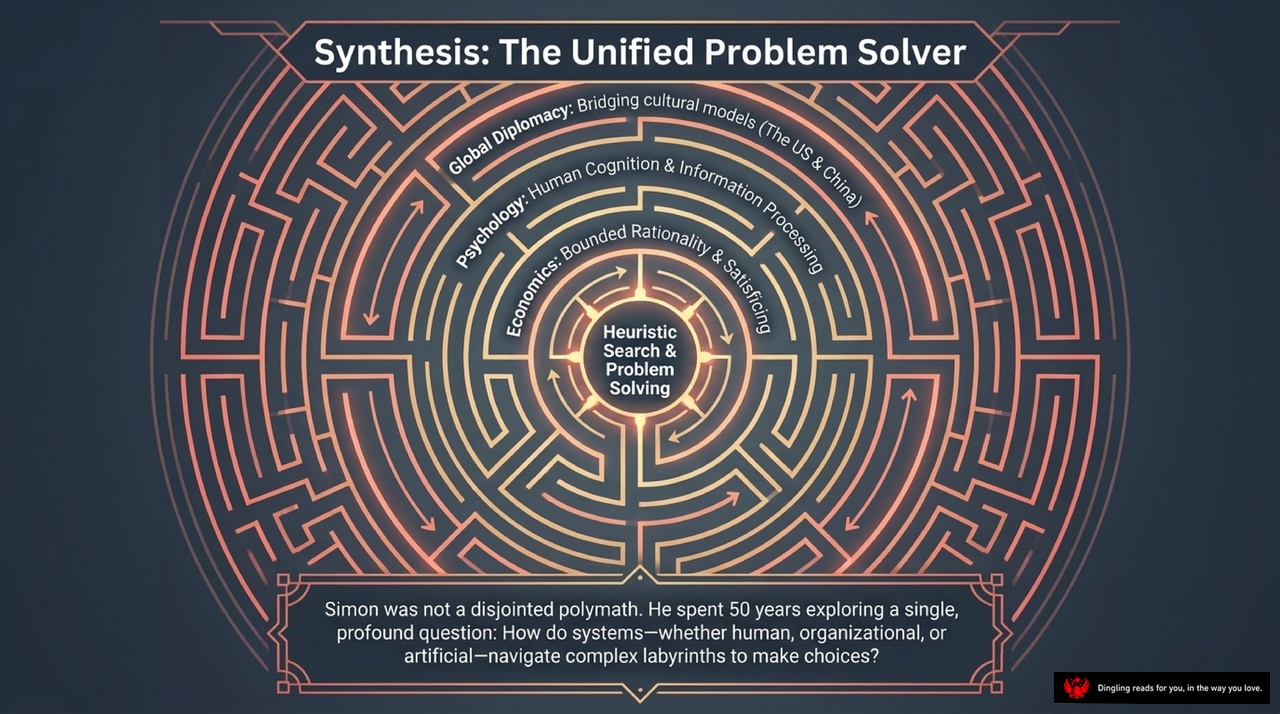
Synthesis: The Unified Problem Solver. Herbert Simon wasn't a disjointed polymath; he spent fifty years exploring a single, profound question: How do systems—whether human, organizational, or artificial—navigate complex labyrinths to make choices? Look at this diagram. At the very center lies his core insight: Heuristic Search and Problem Solving. This is the engine that drives everything else.
Expanding outward, we see how this single principle unifies diverse fields. First, in Economics, it manifests as Bounded Rationality and Satisficing. Simon realized humans don't calculate the perfect optimal solution; we stop searching once we find something "good enough." This shifts the focus from the ideal result to the actual decision process. Moving further out to Psychology, we see Human Cognition and Information Processing. Simon treated the mind like a computer, a system that takes in data, processes it through heuristics, and outputs a decision.
Finally, at the outermost ring, we see Global Diplomacy. Here, Simon's framework bridges cultural models, specifically the dynamic between the US and China. He understood that even in complex international negotiations, actors are navigating a maze of conflicting goals and limited information, relying on satisficing rather than perfect optimization. Whether it's a manager allocating resources, a scientist discovering a law, or nations navigating global tensions, the path is the same: navigating the maze to find a satisfactory solution. This unified view is the true power of Simon's legacy.
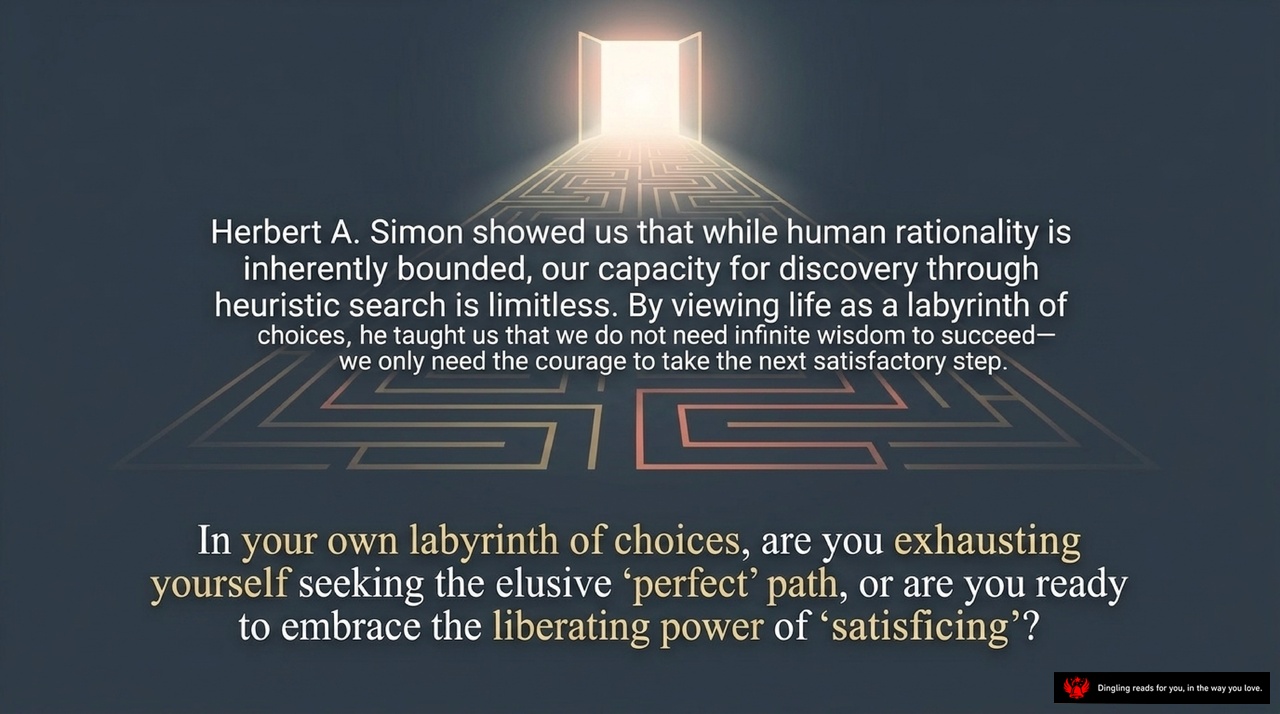
Imagine life not as a race to find the single perfect answer, but as a maze where the goal is simply to find your way out. Herbert A. Simon taught us that while our human rationality is inherently bounded, our capacity for discovery through heuristic search is limitless. By viewing life as a labyrinth of choices, he taught us that we do not need infinite wisdom to succeed—we only need the courage to take the next satisfactory step.
So, in your own labyrinth of choices, are you exhausting yourself seeking the elusive 'perfect' path, or are you ready to embrace the liberating power of 'satisficing'?