
Modern Chinese History: Complete Chapter-by-Chapter Summary

Welcome to our book club session on *Modern Chinese History: 1840–1937* by Jiang Tingfu. Today, we're diving into the dramatic opening chapter of this epic saga—a story about a medieval empire's painful, iterative struggle to survive and modernize in a rapidly industrializing global landscape.
Imagine a China that saw itself as the "Celestial Empire," a superior civilization looking down on the West. But the 19th century brought a harsh reality check. As the industrial revolution churned in Europe, China remained locked in its traditional ways, while the world outside was racing ahead. This book doesn't just list dates and battles; it dissects the soul of a nation caught between two worlds.
We'll explore how a once-dominant power faced the shock of Western gunboats, the devastation of the Opium Wars, and the internal collapse that led to the rise of new forces. From the tragic failure of the Self-Strengthening Movement to the fiery revolutions that eventually toppled the Qing dynasty, this narrative reveals the complex path toward modernity.
Whether you're a history buff or just curious about how nations rise and fall, this journey through China's turbulent past offers profound lessons for our own time. Let's turn the page and begin this essential story of resilience, loss, and transformation.

Imagine China not just as a nation, but as a massive, intricate machine designed in the 19th century. The question we face today is whether this machine can ever truly modernize. Jiang Tingfu's core thesis argues that the entire century of humiliation and conflict boils down to one existential test. It's about whether China can upgrade its operating system.
First, can China utilize science and mechanization? Look at the gears in our image. For centuries, China relied on tradition, but the world was racing toward industrial power. When the West arrived with steam and steel, the gap was already widening.
Second, can the people abandon clan-based mindsets to form a modern nation-state? The diagram shows a shift from fragmented parts to a unified whole. Traditional China was built on local loyalties and family ties, but modernization requires a single, cohesive national identity that transcends local boundaries.
Finally, can a deeply traditional society synchronize with a changing world before it is consumed by it? This is the most critical gear of all. If the internal culture resists the external changes, the whole system risks breaking under the pressure. The history of the 19th century shows us the consequences of failing this test. The challenge isn't just about building factories or buying ships; it's about fundamentally transforming the soul of the nation to match the demands of the modern era.

The East and the West in 1840 weren't just different neighbors; they were operating in entirely different universes. Look at the slide: on the left, the East was rooted in a medieval, traditional world. Its knowledge base wasn't built on science or engineering, but on eight-legged essays, Yin-Yang philosophy, and classical moral literature. Economically, it was an agrarian society focused on self-sufficiency, relying on Tang and Song-era military structures that simply couldn't match modern threats. Politically, identity was defined by deep loyalty to family, clan, and hometown, viewing the world through a lens of an "older brother" overseeing tributary states.
Contrast that with the West, shown on the right. They were modern and industrializing. Their foundation was hard science, empirical research, and mechanical engineering. While the East farmed, the West was building mechanized production lines and relying on global markets, powered by steam-driven naval fleets. Their political identity was forged in intense state competition, creating a fervent nationalism that strictly adhered to international law and treaties.
This slide captures the essence of the "1840 Collision." It wasn't just a war; it was a clash between an ancient agricultural civilization and a rising industrial power. The East's traditional structures, from its philosophical knowledge to its agrarian economy, simply had no defense against the West's mechanized might and modern diplomatic rules. The gap wasn't just in weapons; it was in the very way they understood the world, making the eventual confrontation inevitable.

The Closed Door and the Catalyst. This slide captures the pivotal moment when China's rigid isolation met the relentless force of the British Empire, sparking the Opium Wars. On the left, you see the Canton System—a fortress wall built on restricted trade, the ban on learning Chinese, and the treatment of foreigners as unequal subjects. For centuries, this "closed door" kept China insulated from the modern world. But on the right, the gears of the British Empire were turning, driven by the East India Company and a desperate demand for new markets to fuel their industrial revolution. The friction was inevitable. When Britain tried to push free trade through, they turned to opium. Over 20,000 chests flooded the market, draining China's silver and destroying its social fabric. The spark came in 1839 when Commissioner Lin Zexu, acting with traditional Chinese decisiveness, confiscated and destroyed these chests at Humen. He treated an international crisis like an internal police matter, refusing to recognize the British as equal partners. Britain, however, responded with steamships and modern artillery, shattering the closed door forever. The result was a catastrophic clash between an ancient agricultural civilization and a rising industrial power, a defeat that would force China into a painful century of humiliation and eventual, hard-won transformation.

The slide before us is titled "The Tragedy of the Lost 20 Years," and it highlights a critical period in China's history: the two decades between 1842 and 1860. This timeline isn't just a gap on a chart; it represents a fatal window of opportunity that China missed while Japan sprinted toward modernization.
On the left, we see the Treaty of Nanjing in 1842, marking the end of the First Opium War. The text below describes this as "The Fatal Wound of Intellectual Stagnation." After this crushing defeat, China didn't learn or reform. Instead, the ruling class squandered two decades in arrogance and denial. While Japan was already industrializing, China remained asleep, clinging to outdated beliefs and refusing to confront the reality of its backwardness.
On the right, the timeline jumps to 1860 with the Second Opium War. The gap in the middle is labeled "The 20-Year Gap," magnified by a lens. This period was defined by "The Conspiracy of Silence." Even though Commissioner Lin Zxu privately recognized the truth in 1842—admitting that British artillery was vastly superior—he chose to stay silent. Why? Because he was terrified of the conservative literati, the powerful scholars who controlled public opinion. Lin prioritized his personal reputation over the national survival of the empire. This silence allowed the entire nation to remain asleep, leaving the door wide open for further invasion.
This twenty-year stagnation is the tragedy. It was the time when China could have adapted, learned from its failure, and begun to catch up. But instead, it lost the crucial window to modernize. By the time the Second Opium War finally forced the Qing government to wake up and start reforms, Japan had already taken the lead. The cost of that silence was the loss of China's future.

Today's slide, "Internal Collapse and the Old Cycle," distills a painful truth about 19th-century China: the Taiping Rebellion wasn't just a random uprising; it was the symptom of a society that had stopped evolving. The image shows us a trap we call "The Dynastic Loop." On the left, we see the failed disruptor, Hong Xiuquan. He tried to break the cycle by building a new dynasty based on a radical religious state, abandoning traditional Chinese culture. But he failed because he prioritized creating a new dynasty over actually creating a new, modern society.
On the right, we see the traditional savior, Zeng Guofan. Recognizing the rot in the regular military, he built the Xiang Army. This wasn't just an army; it was built on traditional Confucian loyalty, localized hometown ties, and superior pay. He saved the old order, but here is the twist: in doing so, he inadvertently planted the seeds for modern warlordism by creating private, regional armies.
The central lesson here is that a decaying, stagnant society often creates a self-perpetuating cycle. When the old system fails to adapt, the response is either to try and smash it with a flawed new ideology, or to patch it up with stronger private forces. Both paths, as we see in the history of Hong and Zeng, ultimately reinforced the very structures that were causing the collapse, trapping the nation in an endless loop of internal struggle without ever achieving true modernization.
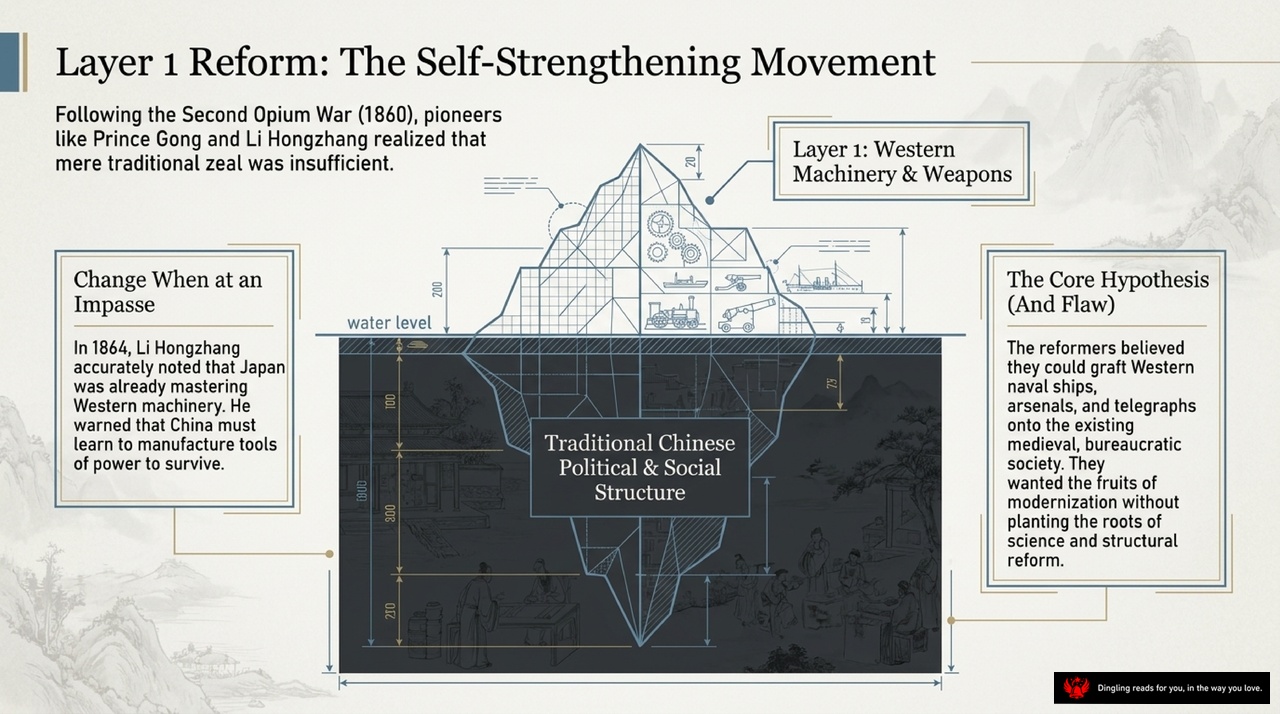
Look at this iceberg diagram. It perfectly captures the tragic reality of China's "Self-Strengthening Movement." The tip above the water represents what the reformers saw: Western machinery, weapons, and modern factories. They believed that by grafting these new technologies onto our traditional political structure, we could survive. That was their core hypothesis.
But the vast part beneath the water? That's the real problem. It's our medieval bureaucratic society and the rigid political system that never changed. The reformers wanted the fruits of modernization without planting the roots of scientific and structural reform. They tried to fix the ship's hull while ignoring the rotting keel.
This is why the movement failed so spectacularly. When Japan modernized its entire system, they surged ahead. But we only bought guns and ships, leaving our institutions exactly as they were. As Li Hongzhang painfully realized, you can't manufacture tools of power without first learning how to use them wisely. We tried to patch a broken system with new tools, and in the end, the old structure crushed the new innovations. The iceberg sank not because the tip was weak, but because the foundation was gone.

Look at this graphic titled "The Wall of Conservatism." It vividly illustrates why the first layer of modernization failed. Imagine three powerful arrows representing Railroads, Tongwen Guan science classes, and Western diplomacy, all driving straight into a massive brick wall. This wall isn't just made of bricks; it's the entrenched power of the scholar-official class. For these pioneers, modernization wasn't just a technical upgrade; it was an existential threat to their livelihood. The civil service exam system was the foundation of their power, wealth, and social status. When they proposed railroads or science, they were asking the literati to lose their monopoly on knowledge and authority.
The image shows the arrows shattering against this wall. It highlights the tragic fate of these pioneers. On the left, under "Science Rejected," we see Woren, a powerful conservative, arguing that a nation relies on propriety and righteousness, not power and plots. His rhetoric convinced the scholar class to boycott the very science classes meant to save the country. On the right, under "Diplomacy Punished," we see Guo Songtao, China's first minister to Britain. He urged political and economic learning, not just military strength. But for challenging the traditional order, he was ostracized as a traitor and died in isolation.
This visual perfectly captures the paradox of that era: the very people who needed to learn from the West were the ones most determined to block it. The pioneers faced crushing opposition not because their ideas were wrong, but because their success threatened the entire social structure of the time. The wall of conservatism stood firm, and for a long time, no arrow could break through.

The slide you're seeing right now captures a pivotal moment in Chinese history: the "Melon-Slicing Era" of 1894 to 1898. Look at that map with arrows pointing inward from Britain, Russia, Germany, and France. This wasn't just a military defeat; it was a geopolitical shattering. The ultimate proof that China's earlier "Self-Strengthening Movement" had failed was the devastating loss against Japan in 1894. Japan, a smaller nation, had embraced total modernization, while China had merely bought machinery without changing its core.
This defeat invited the "Melon-Slicing Era." Foreign powers immediately carved China into spheres of influence, demanding long-term leases on ports and exclusive railway rights. As the text highlights, the threat shifted dramatically from unequal trade to total national extinction. The era was defined by a desperate struggle where sovereignty was sliced up like a melon, leaving China vulnerable to complete partition. This period marked the end of any illusion that China could remain isolated or unchanged in the face of a rapidly modernizing world.

The image we see here is titled "Layer 2 Reform: Changing the Institutions." It captures a pivotal moment in history: the realization that you simply cannot run a modern machine with a medieval bureaucracy. This shock, triggered by the failure of the 1894 war, forced China to look inward and fundamentally alter its operating system.
The diagram highlights Kang Youwei's "Hundred Days' Reform" of 1898 as the centerpiece of this attempt. Kang understood that the biggest barrier wasn't just technology, but ideology. He recognized that to break through the entrenched traditional mindset, he had to use tradition itself as a Trojan Horse. That's why he published *Study of Confucius as a Reformer*, cleverly using ancient wisdom to justify radical change.
With the Emperor Guangxu's backing, Kang launched a frantic, top-down overhaul. The plan was ambitious and aggressive: abolish useless ministries that clogged the system, establish modern economic and agricultural bureaus to drive growth, and replace the poetry-focused imperial exams with practical, science-based tests. The goal was to eliminate sinecures and modernize the very foundation of the state.
However, as the graphic illustrates, pushing too fast against the entrenched elite triggered a total reactionary backlash. The Emperor, lacking real power, was quickly overthrown, and the reformers were purged. This failure proved that changing institutions requires more than just a good plan; it requires the political will to protect those changes from the very people who benefit from the old system.

Look at this blueprint of the "Modern Nation-State." We see three pillars holding up the roof: Nationalism, Democracy, and Livelihood. This visual perfectly captures Sun Yat-sen's Layer 3 Reform, a vision that was far more ambitious than the earlier reformers who only tinkered with the surface. Unlike them, Sun was educated in Western science from a young age, which gave him a clear-eyed view of reality. He realized that no amount of new weapons or top-down bureaucratic tweaks could save a fundamentally broken system.
Sun's genius lay in designing a total systemic overhaul. He understood that a population living under autocracy for millennia couldn't jump straight into democracy overnight. That's why he created the "Tutelage Phase." As the diagram shows, the path was deliberate: starting with Military Rule, moving to Political Tutelage to actively train the populace in civic duty, and finally arriving at Constitutional Democracy. This mechanism was essential to dismantle deep-seated regional and clan loyalties, replacing them with a unified national identity. Sun didn't just want to change the government; he wanted to engineer a complete societal transformation, ensuring that the pillars of Nationalism, Democracy, and Livelihood were strong enough to hold up the modern nation-state.

The Diagnostic Matrix of Modernization on this slide maps out the five critical stages of China's struggle to modernize, from Lin Zexu's initial reforms to Sun Yat-sen's revolutionary blueprint.
Starting with Lin Zexu in the 1840s, his focus on moral policing and traditional methods ultimately blinded him to Western technological supremacy, leaving his insights secret and leading to military defeat. Moving to Zeng Guofan in the 1860s, while he saved the dynasty through localized military loyalty, he inadvertently birthed regional warlordism by prioritizing local ties over national unity.
In the 1870s, Li Hongzhang attempted to adopt Western machinery and weapons, but the fatal blind spot was believing tools could exist separately from the science and institutions that created them. This led to the destruction of the fleet by modernized Japan in 1894.
Then, Kang Youwei's 1898 reform focused on institutional bureaucracy, but trying to force radical top-down change without a military or popular base resulted in a swift 100-day collapse against conservative elites. Finally, Sun Yat-sen in the 1910s proposed a total systemic overhaul. Although he lacked the unified military force needed for a tutelage phase, his vision provided the essential ideological blueprint for the modern Chinese state.

The Geopolitical Vise. China's journey into modernity wasn't a smooth ride; it was a painful struggle fought under the crushing weight of global imperialism. As this slide illustrates, China was squeezed from every direction. On one side, we see Western Economic Imperialism. For decades, Western powers systematically eroded China's tariff autonomy, deliberately stunting local industrial growth just to keep China as a consumer of their manufactured goods. On the other side, specifically from the north and northeast, came Territorial Imperialism. Neighboring powers like Russia and a rapidly modernizing Japan moved far beyond simple trade. They shifted to direct annexation, stripping away China's historical buffer states and threatening its very core sovereignty. While China was desperately undergoing this painful transition, arrows of pressure from all sides converged, turning the nation into a tight vise. This wasn't just about trade disputes; it was a fundamental battle for survival where China's independence was being carved up by a combination of economic strangulation and military aggression.

Today's slide, "The Anatomy of Modernization," distills Jiang Tingfu's powerful conclusion from the turbulent 1840–1937 era: modernization cannot be achieved piecemeal. Survival in a volatile global landscape demands the simultaneous synchronization of three critical elements. Think of them as interlocking gears; if one stops, the entire machine grinds to a halt.
First, we have Scientific Application. This isn't just about buying machines or importing technology. It's about embedding the scientific method deeply into our education and industry, moving beyond mere possession to true understanding and integration.
Second, National Cohesion. In the chaos of that era, fractured regionalism and clan mentalities were fatal weaknesses. To survive, we needed to eradicate these divisions and forge a unified, unbreakable national identity. A nation divided by local loyalties cannot compete globally.
Finally, Pragmatic Leadership. This means abandoning superficial bureaucratic harmony and the fear of conservative backlash. Leaders must have the courage to take bold, reality-based action, even when it's unpopular, rather than hiding behind empty rituals or appeasing traditionalists.
As history proved, when these three gears align, a nation can transform. When they are out of sync, as China experienced for decades, the result is stagnation and crisis.

From 1840 to 1937, China's survival hinged on one painful truth: clinging to past glories was a death sentence. The nation had to dismantle its medieval mindset and embrace science, industry, and national unity to stay alive. History shows that our greatest failures often stem from arrogance and a refusal to adapt to a changing world. But here is the hard question we must face today: are we truly certain that we have eradicated that dangerous inertia? Or are we simply repeating the same mistakes, waiting for the next crisis to force our hand?