
Modernity and the Holocaust: Complete Chapter-by-Chapter Summary

Good morning, everyone. Welcome to today's session on Zygmunt Bauman's profound inquiry into the nature of modernity.
The slide before us presents a striking title: "Modernity and the Holocaust." Bauman's central argument challenges a comforting but dangerous assumption: that the Holocaust was a regression into primitive barbarism or a unique failure of the Jewish people. Instead, he insists it was a direct, logical product of modern civilization itself.
As the text on your screen states, the Holocaust was not a relapse into pre-modern barbarism, but a direct, logical product of modern civilization, rational bureaucracy, and the quest for a perfect society.
Bauman argues that the Holocaust wasn't an accident or a "cancer" on a healthy body. It was the inevitable outcome of the very tools we pride ourselves on: industrial efficiency, scientific rationality, and bureaucratic management. The same systems that built our cities and cured diseases were repurposed to organize the systematic extermination of millions. It was the triumph of modernity's promise of order and control, twisted into its darkest form.
Thank you.
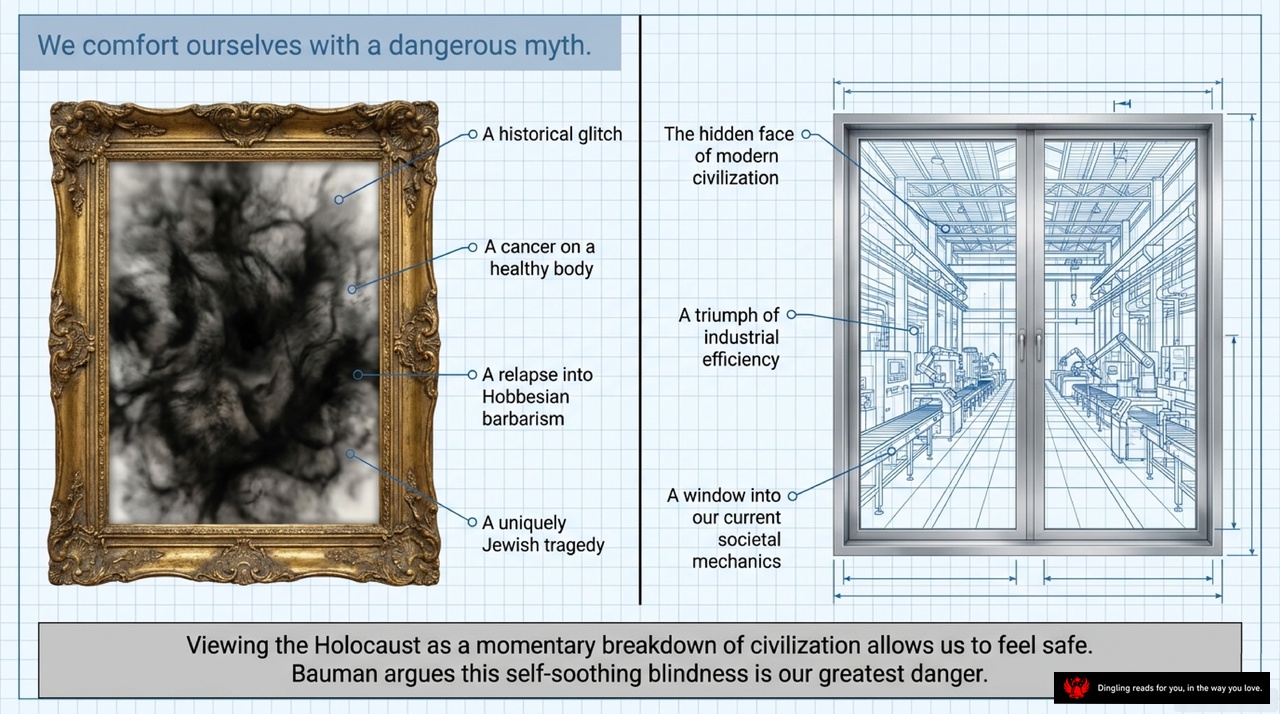
We often comfort ourselves with a dangerous myth: that the Holocaust was a rare glitch in an otherwise healthy civilization, a cancer on a modern body, or a uniquely Jewish tragedy. But the reality is far more unsettling. As the slide illustrates, viewing the Holocaust as a momentary breakdown allows us to feel safe, yet Zygmunt Bauman argues this self-soothing blindness is our greatest danger.
The truth is, the Holocaust wasn't an accident; it was the hidden face of modern civilization itself. Look at the industrial efficiency depicted on the right. The Nazis didn't rely on wild mobs; they built a machine. They used modern chemistry, advanced railways, and bureaucratic precision to turn human beings into raw materials and death into a product. It was a triumph of industrial logic applied to the ultimate horror.
This reveals a terrifying duality. On one side, we see the "historical glitch"—the barbarism we fear. On the other, we see the "societal mechanics" we admire: our love for order, efficiency, and rational management. The Holocaust wasn't a departure from modernity; it was its darkest extension. It proved that the very tools we use to build a better world—bureaucracy, science, and division of labor—can be twisted to create the most efficient system of destruction. We cannot separate the light from the dark; they are two sides of the same coin.
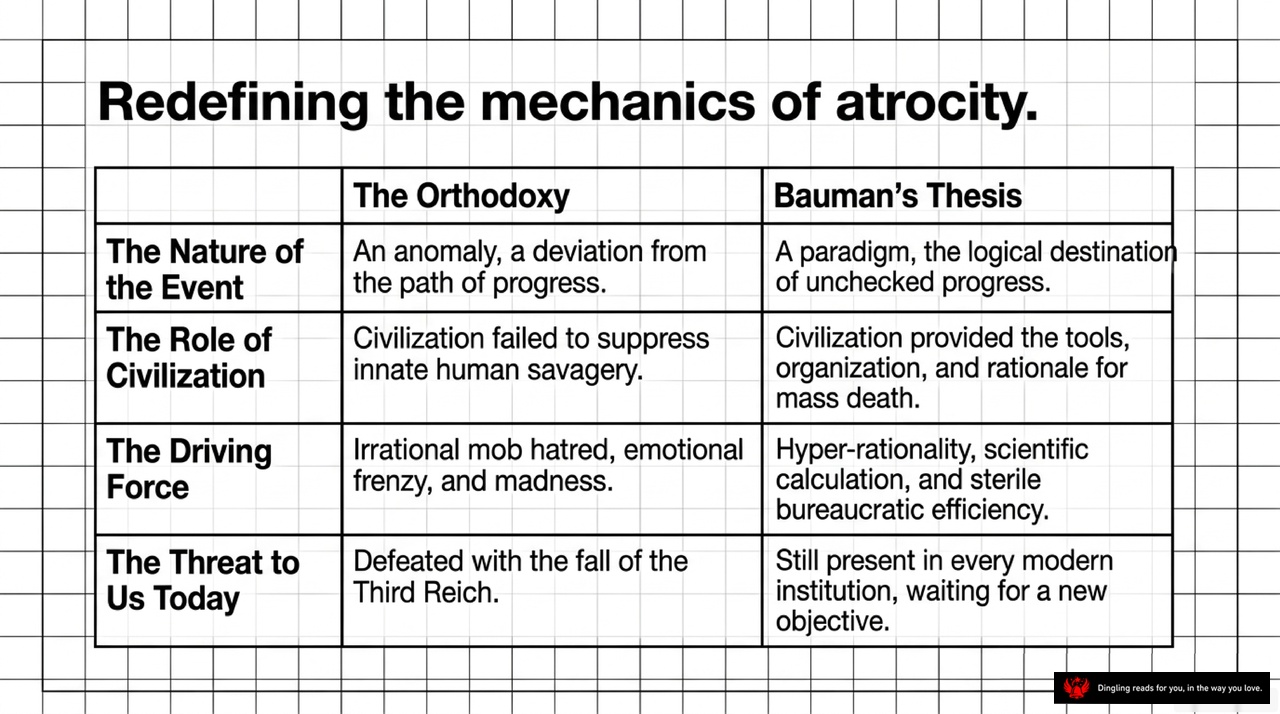
Redefining the mechanics of atrocity. We often think of mass murder as a breakdown of civilization, a moment where society fails to suppress our innate savagery. But Hannah Arendt and Zygmunt Bauman taught us a far more terrifying truth: civilization didn't break; it provided the very tools, organization, and rationale for mass death.
Look at the table on your screen. The traditional view sees the Holocaust as an anomaly, driven by irrational mob hatred and emotional frenzy. It assumes that if we just defeat the Third Reich, the threat is gone. But Bauman's thesis flips this entirely. He argues that unchecked progress is the logical destination of our modern world. The driving force wasn't madness, but hyper-rationality and sterile bureaucratic efficiency.
Think about it: the Holocaust wasn't a chaotic riot. It was a perfectly managed industrial process. Trains, chemistry, accounting, and bureaucracy worked in lockstep to turn human beings into statistics. The threat isn't behind us; it's still present in every modern institution, waiting for a new objective. When we prioritize efficiency over humanity, we aren't just building a better machine; we might be building a more efficient engine for destruction.
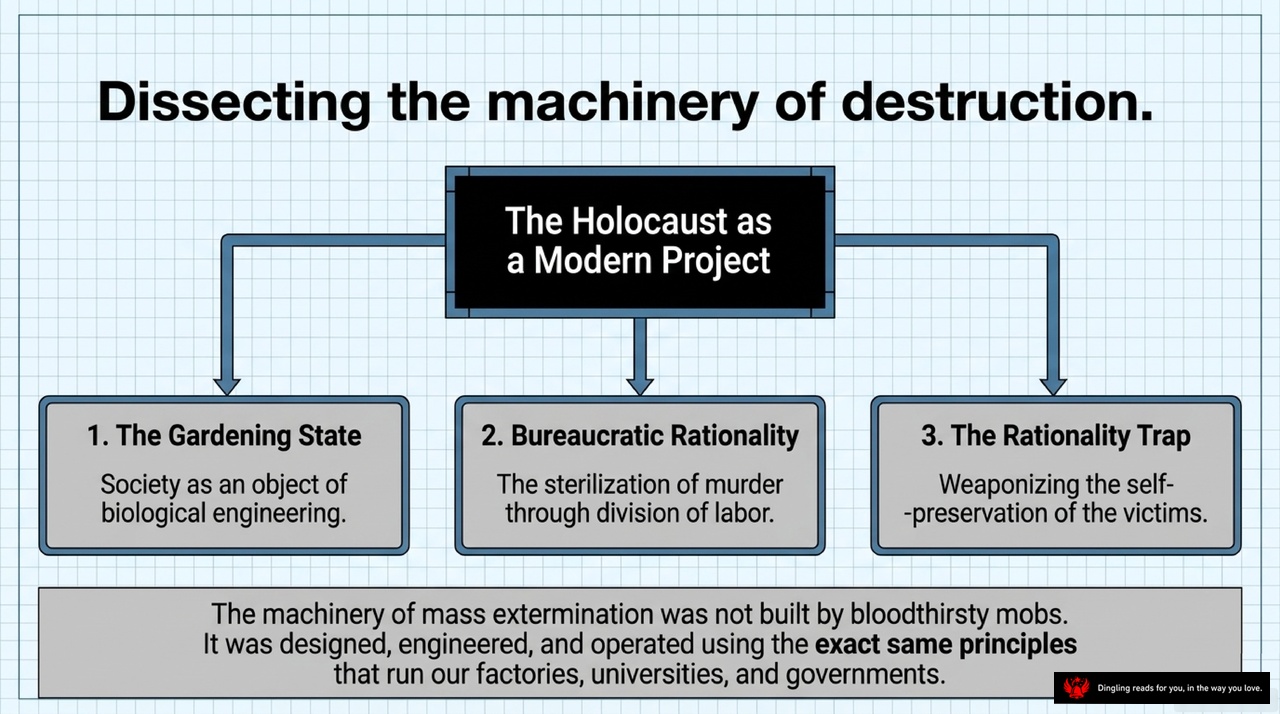
Dissecting the machinery of destruction. Today, we look at the Holocaust not as a random outbreak of barbarism, but as a terrifyingly efficient "modern project." The slide outlines three critical pillars that made this possible. First, the Gardening State, where society is treated like a garden to be engineered, with people as objects of biological management. Second, Bureaucratic Rationality, which sterilized murder through the division of labor, turning genocide into a series of mundane administrative tasks. And third, the Rationality Trap, where the very drive for self-preservation weaponized the victims against themselves.
The text at the bottom reminds us of the most chilling truth: this machinery of mass extermination wasn't built by bloodthirsty mobs. It was designed, engineered, and operated using the exact same principles that run our factories, universities, and governments. The horror lies not in the absence of logic, but in the presence of it.

The modern state views society as a garden to be engineered. In this powerful metaphor, the state acts as the Gardener, holding an architectural vision of a perfect, harmonious society. Just as a gardener uses tools to shape a landscape, the modern state believes it can design human society from the ground up. This is the Garden itself—the favored citizens who are cultivated, protected, and nurtured to thrive.
However, every garden requires maintenance, and sometimes, it requires ruthless pruning. The diagram shows a sharp arrow labeled "Medicalized Extermination" pointing downward, representing the removal of what the Gardener deems undesirable. These are the Weeds—elements that do not fit the design, obstacles to the perfect order, and targets to be cut out.
This shift defines the dark side of modernity. History moved leadership from gamekeepers, who let nature take its course, to gardeners who violently prune and design. In this worldview, genocide is re-categorized not as destruction, but as an act of political hygiene. It is a necessary procedure to remove the infected and create a healthy, pure society. This logic reveals a terrifying truth: the very mechanisms we celebrate as the pinnacle of civilization—our rational planning, our scientific efficiency, and our drive for perfection—are the same tools that make mass extermination possible. The capacity to create a utopia is inextricably linked to the capacity to erase anyone who stands in its way.

The modernization of hate transformed prejudice into a science. This slide contrasts two distinct eras of hatred: Pre-Modern Heterophobia and Modern Scientific Racism.
On the left, we see how hatred used to work. It was spontaneous, emotional, and mob-driven. Think of riots, pogroms, and religious persecution. The goal was simply to convert, assimilate, or kick people out geographically. The problem? It was fundamentally inefficient. Once the emotions faded, the violence stopped. It burned itself out.
But look at the right side. Modern Scientific Racism is a completely different beast. It is calculated, state-driven, and medicalized. It's no longer about anger; it's about management. The goal shifted from exclusion to permanently eradicating what the Nazis called an "incurable biological contagion." They didn't just want to push Jews away; they wanted to engineer their extinction.
How did they do it? Through legislation, taxonomy, chemical engineering, and industrial logistics. They treated people like chemicals in a lab or cargo on a train. And here is the terrifying limit: this new form of hate is boundless. Its only constraints are technology and budget. While old hatred was limited by human emotion, modern scientific racism can go as far as a machine allows. This isn't just prejudice anymore; it's a factory for death, powered by the very tools of our civilization.

Look at this diagram. It captures the terrifying logic of the Holocaust not as a chaotic act of madness, but as a perfectly engineered system. The slide illustrates how the division of labor effectively sterilizes the act of murder. At the top, we see the overarching goal: to eradicate the anomaly. But notice how this horrific macro-goal is broken down into hundreds of mundane micro-tasks. We have logistics and railway timetables, chemical engineering for Zyklon B, budgeting, resource allocation, and even campsite architecture.
This bureaucratic machine ensures that almost no single participant feels the moral weight of the outcome. As the text explains, they are simply drafting memos, fixing engines, or balancing budgets. The system is so efficient that it separates the worker from the victim. A train scheduler never sees the people in the carriages; a chemist never smells the gas he designed. By compartmentalizing these roles, the bureaucracy transforms mass murder into a series of routine, technical tasks. It's a dark reminder that when rationality is divorced from morality, the most civilized tools can become the most destructive weapons imaginable.

Inefficiency was the enemy, and the Nazis solved it with an assembly line. This slide contrasts two terrifying phases of the Holocaust. Phase one was the Einsatzgruppen—face-to-face killings that were highly inefficient and emotionally devastating. The sheer brutality of killing a neighbor triggered animal pity in the perpetrators, interrupting the work. It was barbarism in its raw, messy form. But then came Phase two: the modern factory. By moving the killing to gas chambers, the Nazis achieved maximum efficiency. The perpetrator was reduced to a sanitation officer pouring chemicals through a roof hatch, physically separated from the victim. As the text at the bottom explains, these chambers weren't born of sadism, but of bureaucratic problem-solving. They were engineered to silence innate human empathy by creating distance. This shift proves that barbarism didn't vanish with modernity; it just became more efficient, more managed, and far more deadly.
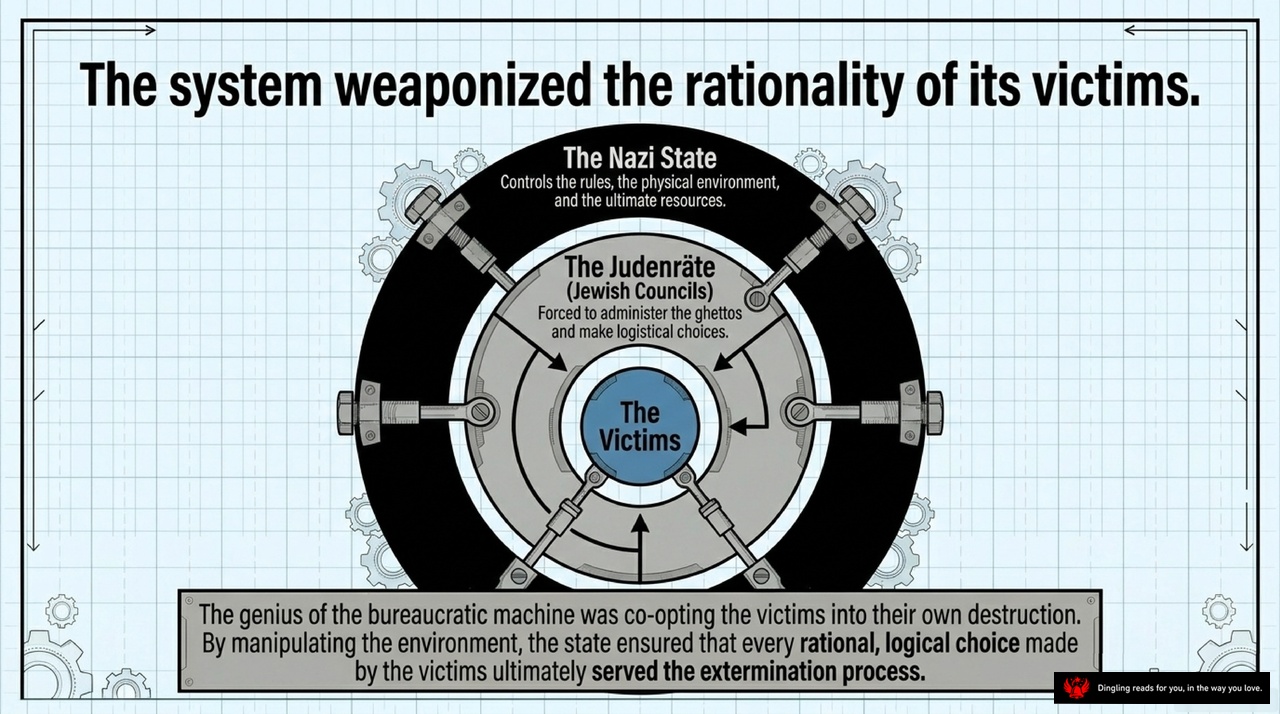
Look closely at this diagram. It illustrates a terrifying mechanism: the system weaponized the rationality of its victims. At the center are "The Victims," surrounded by "The Judenräte," or Jewish Councils, who were forced to administer the ghettos and make logistical choices. All of this is controlled by "The Nazi State," which held the rules, the physical environment, and the ultimate resources.
The genius of this bureaucratic machine was co-opting the victims into their own destruction. By manipulating the environment, the state ensured that every rational, logical choice made by the victims ultimately served the extermination process. It wasn't about chaos or madness; it was about cold, calculated efficiency. The victims were trapped in a system where their only "smart" move—trying to save themselves through organization and cooperation—became the very tool used to destroy them. This is the dark side of modern rationality, where logic is twisted into a weapon of mass destruction.
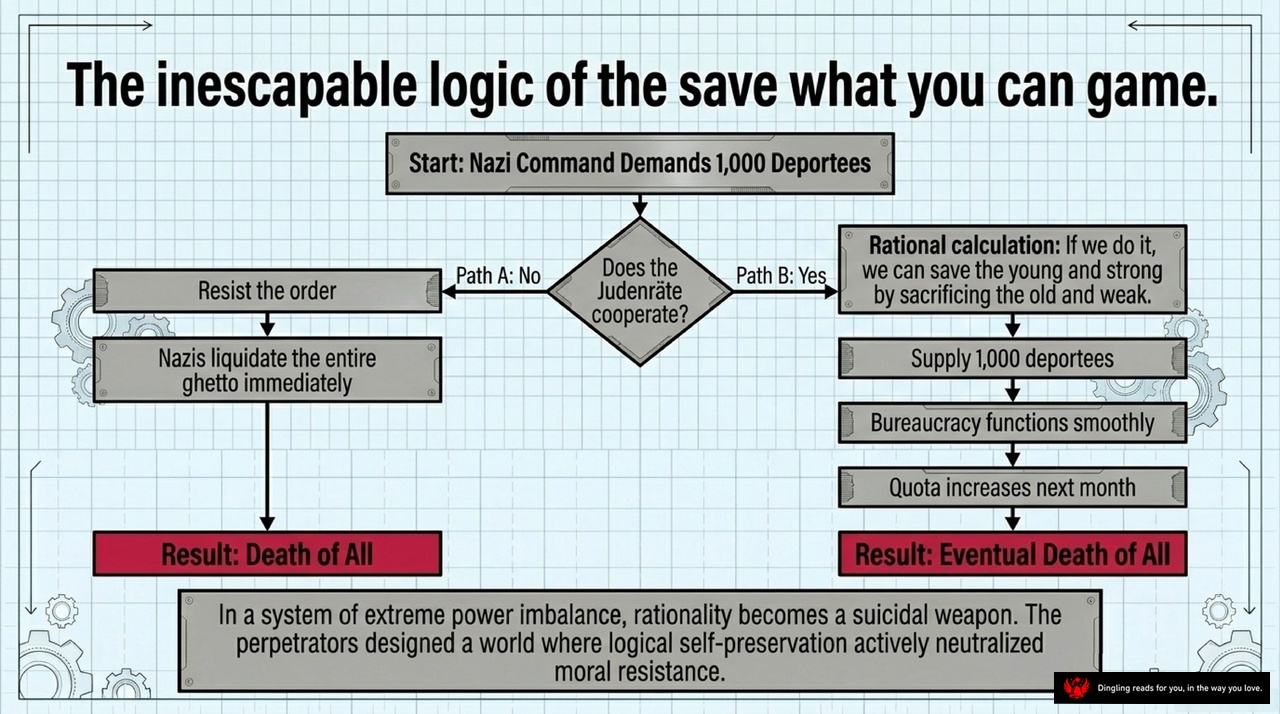
Look at this flowchart. It captures a terrifying truth about the Holocaust: the inescapable logic of "save what you can."
Imagine you are in the ghetto, and the command comes down: 1,000 deportees. You face a choice. Path A is to resist the order. But if you resist, the Nazis liquidate the entire ghetto immediately. The result? The death of all.
So, what do you do? You take Path B. You cooperate. Your rational calculation is simple: if we do it, we can save the young and the strong by sacrificing the old and the weak. You supply the 1,000 deportees, the bureaucracy functions smoothly, and the quota might even increase next month. It looks like a logical trade-off. But the final result? Eventual death of all.
This diagram reveals a brutal paradox. In a system of extreme power imbalance, rationality becomes a suicidal weapon. The perpetrators designed a world where logical self-preservation actively neutralized moral resistance. By trying to be smart and save themselves, the victims actually accelerated their own destruction. It's a chilling reminder that in a totalitarian machine, the most "rational" choice is often the path to total annihilation.
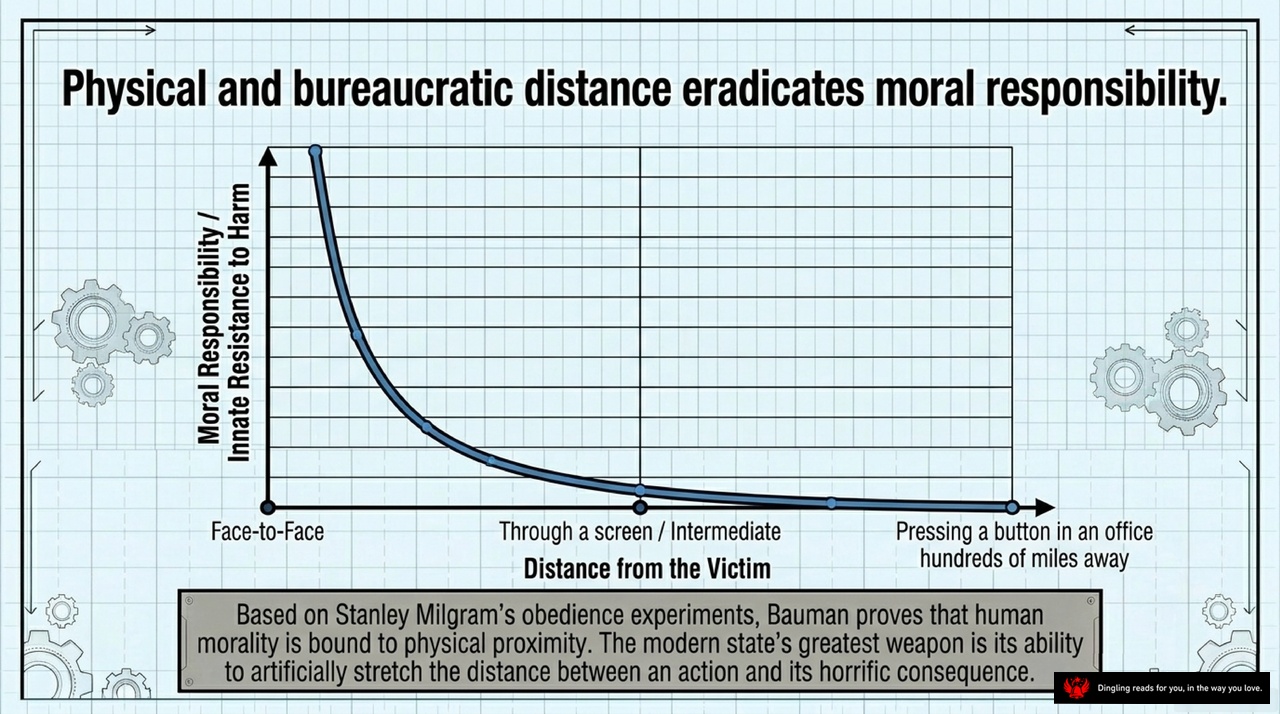
Physical and bureaucratic distance eradicates moral responsibility. As this graph illustrates, the closer you are to the victim, the heavier the moral weight you feel. But as soon as you step behind a screen, or simply press a button in an office hundreds of miles away, that responsibility evaporates.
This isn't just about geography; it's about the architecture of modern bureaucracy. Hannah Arendt and Stanley Milgram's obedience experiments proved a terrifying truth: human morality is bound to physical proximity. When we remove the human face from the equation, when we turn victims into abstract numbers or cargo to be shipped, our innate resistance to harm collapses. The modern state's greatest weapon is its ability to artificially stretch the distance between an action and its horrific consequence. By compartmentizing tasks and hiding the final result behind layers of administration, we allow ordinary people to participate in extraordinary evil without ever feeling the moral weight of their actions. The result? A system where efficiency replaces empathy, and where doing one's job becomes a shield against guilt.
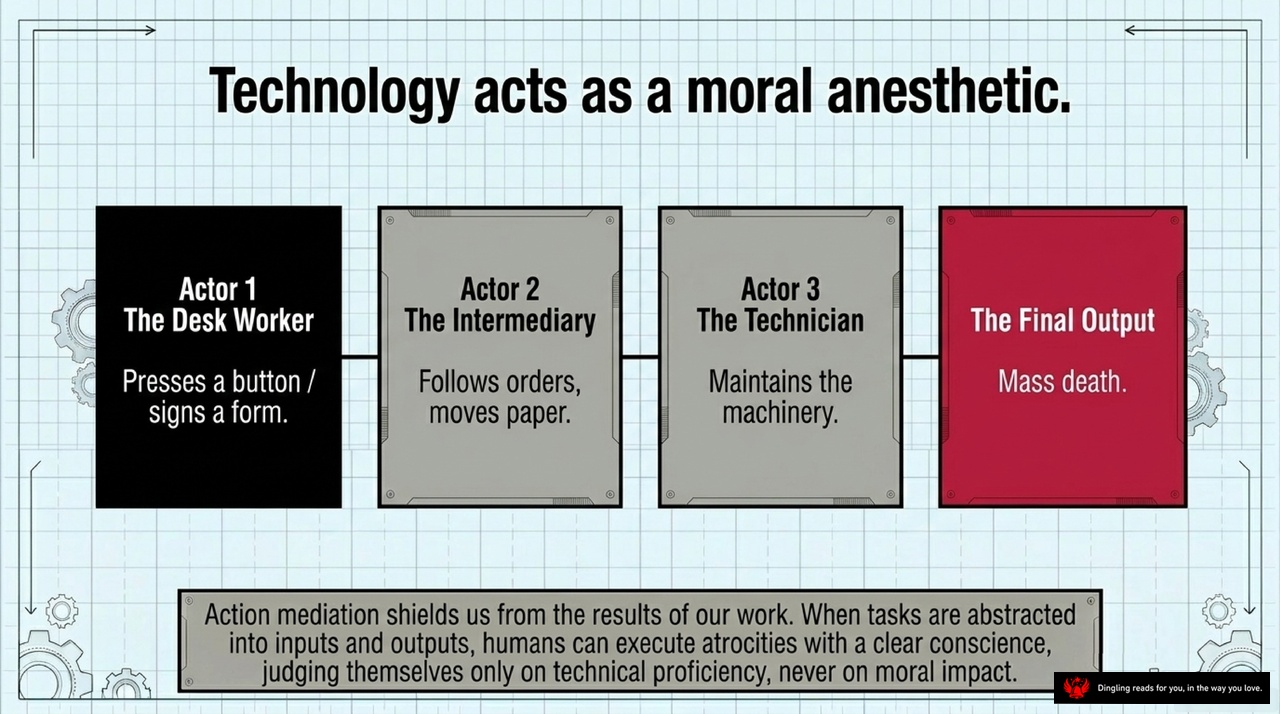
Imagine a system where pressing a button or moving a piece of paper has nothing to do with the final result. This slide illustrates a terrifying concept: technology acts as a moral anesthetic. Look at the four actors in this chain. Actor 1 is just a desk worker pressing a button. Actor 2 is an intermediary moving paper. Actor 3 is a technician maintaining machinery. None of them are looking at the final output: mass death.
The text at the bottom explains why this happens. Action mediation shields us from the results of our work. When tasks are abstracted into simple inputs and outputs, humans can execute atrocities with a clear conscience. We judge ourselves only on technical proficiency—did I move the paper correctly? Did I maintain the machine well?—never on moral impact.
This is how modern bureaucracy allows ordinary people to participate in evil without feeling it. By separating the act from the consequence, the system numbs our conscience, making the unthinkable possible through the routine of the everyday.

The catastrophic silence of the civilized elites. Look at these crumbling pillars. They represent the three pillars of our modern world—Science, The Church, and Culture—and today, we see how all three failed to stop the Holocaust.
Under the banner of Science, we valued value-free research and technical perfection over moral outcomes. We actively supplied the lethal chemistry and logistics for mass murder, believing that efficiency was the highest virtue. The Church retreated into institutional self-preservation, protecting its own domain while ignoring the slaughter happening just outside its walls. And Culture? It proved that refined manners, high art, and university education are perfectly compatible with mass murder.
The bottom line is clear: the checks and balances of modern society failed completely. The pursuit of pure rationality and institutional survival overrode any primitive, animal pity for the victims. We thought we had built a civilization immune to barbarism, but the Holocaust revealed a terrifying truth: our obsession with order and efficiency didn't stop evil; it actually made it more efficient, more organized, and far more deadly.
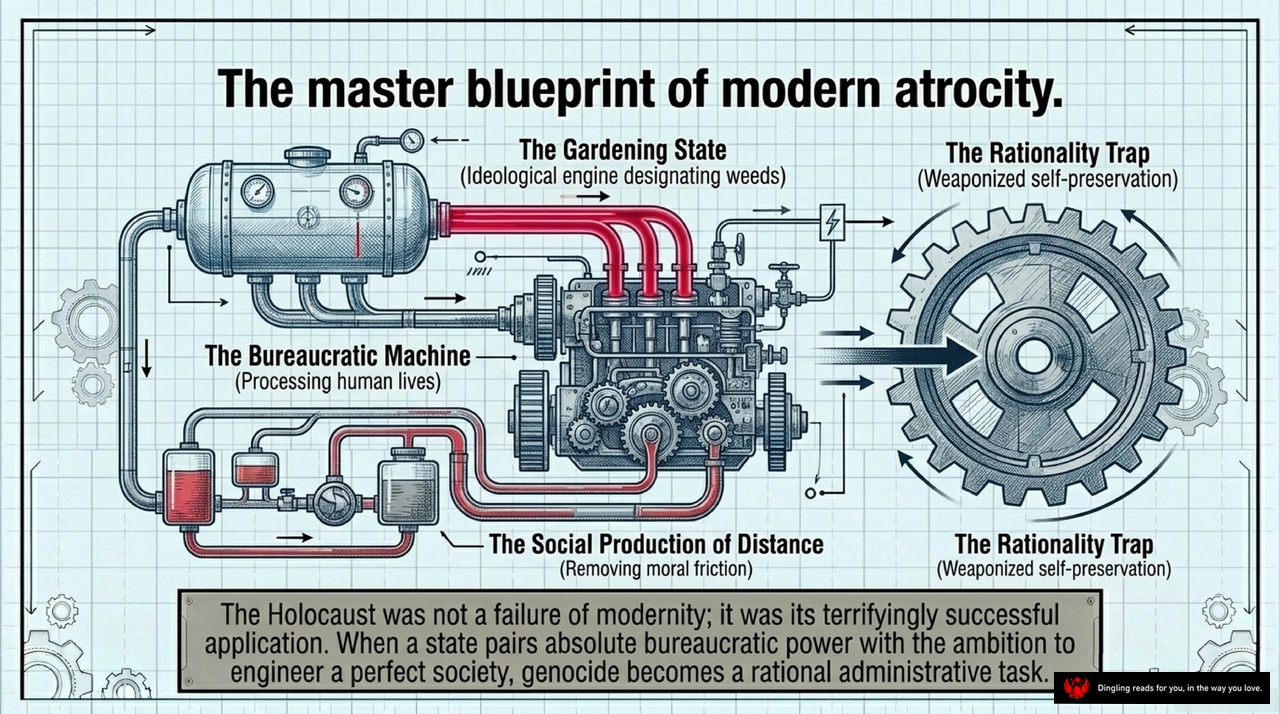
The Holocaust wasn't a glitch in modern civilization; it was its terrifyingly successful application. As this blueprint illustrates, when a state pairs absolute bureaucratic power with the ambition to engineer a perfect society, genocide becomes a rational administrative task.
Look at the flow: it starts with **The Gardening State**, an ideological engine that designates specific groups as "weeds" to be removed. These targets are then fed into **The Bureaucratic Machine**, which processes human lives with industrial efficiency. To make this possible, the system relies on **The Social Production of Distance**, stripping away moral friction so that ordinary people don't feel the weight of their actions. Finally, it all spins within **The Rationality Trap**, where self-preservation is weaponized to justify the machinery of destruction.
The chilling takeaway is clear: the Holocaust was not a failure of modernity, but its darkest feature. When you combine a rational bureaucracy with the goal of creating a "perfect" society, the result is that creating and destroying become inseparable parts of the same system.

Look at this slide. It delivers a chilling but crucial message: "The machinery is still completely intact."
The image highlights four specific components that, while marked with red X's, remain undamaged in our modern world. We see sovereign states claiming absolute power, hyper-efficient bureaucracies that are morally blind, technologies that distance us from the consequences of our actions, and an enduring desire to engineer perfect societies.
The text at the bottom drives the point home: while we may have defeated the specific ideological hatred of the Nazis, the industrial, bureaucratic, and technological tools they used have not vanished. Instead, they have grown more sophisticated and deeply embedded in our daily lives.
This isn't just about history; it's a warning. The industrial and bureaucratic systems that once executed genocide are the same ones we celebrate today for their efficiency and order. We often think of these systems as the solution to chaos, but as this slide reminds us, that same machinery, stripped of its original intent but kept intact, holds the potential for destruction if left unchecked. The tools for mass destruction haven't disappeared; they've just been repurposed for our modern world.

Look at this flow: a human being gets reduced to a string of binary code, fed into an algorithm, and out comes a pie chart labeled "Output / Collateral Damage." The slide's core message is stark: "Abstraction is the ultimate moral distance."
Today, we routinely strip human lives down to inputs, variables, and percentages. When technology allows us to abstract human suffering into spreadsheets and algorithms, we replicate the exact moral blindness that made the Holocaust possible.
Think about it. In a modern bureaucracy, a person isn't a neighbor or a friend; they are just a row in a database, a number on a production line. When you remove the face and the story, the moral weight of your actions evaporates. You stop seeing a victim and start seeing a statistic. This abstraction creates a buffer, a safe distance that lets ordinary people commit extraordinary evil without feeling the pain. It turns genocide into a logistical problem, a series of technical tasks to be completed efficiently.
This is the dark side of modern rationality. We thought we were building a civilized society where reason conquers barbarism, but the Holocaust proved that abstraction can be the most efficient tool for destruction. When we treat people as abstract data points, we give ourselves permission to ignore their humanity, and in doing so, we pave the way for the unthinkable.

Civilization doesn't naturally protect us from barbarism; it simply provides barbarism with better tools. As we've explored, the Holocaust proved that rational calculation, bureaucratic efficiency, and technological progress can easily be separated from moral responsibility. When we look at the machinery that engineered the Holocaust, we see a system built on the very principles we admire today: precision, logistics, and cold logic. If that exact bureaucratic machinery is what runs our modern world, how confident are you that the only thing keeping us safe is the current instruction programmed into the machine? The danger isn't that we've lost our humanity; it's that our modern systems have become so efficient at achieving goals that they can silence our moral conscience in the process. We must remain vigilant, because the tools of destruction are now the tools of our daily life.