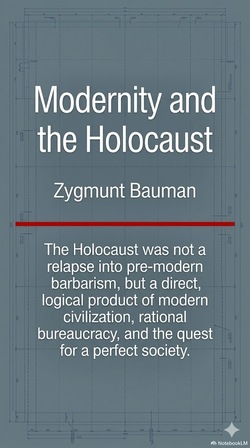
Bauman argues that modernity did not prevent the Holocaust but actually enabled it through bureaucratic efficiency and rational planning. The book challenges the comforting myth that we lived in a civilized era immune to such barbarism, revealing instead how the very systems designed to create order and progress were repurposed to systematically organize mass murder. This includes the use of industrial technology, precise logistics, and the division of labor that allowed ordinary people to participate in genocide without confronting the moral weight of their actions, treating human lives as mere data points or production metrics to be optimized. The interpretation highlights how anti-Semitism provided the motive, but modernity provided the means, turning chaotic hatred into a cold, calculated industrial process that stripped individuals of responsibility by embedding them as invisible cogs in a massive machine, forcing us to confront the terrifying reality that the tools of our daily civilization can be twisted to commit unspeakable evil when paired with the right ideology. This perspective is essential because it prevents us from viewing the Holocaust as a unique historical anomaly or a regression to primitive savagery, instead warning us that the same bureaucratic rationality, scientific classification, and hierarchical structures that drive our modern economies and governments still carry the potential for similar dehumanization and harm if we lose sight of our moral responsibilities and allow efficiency to override empathy.